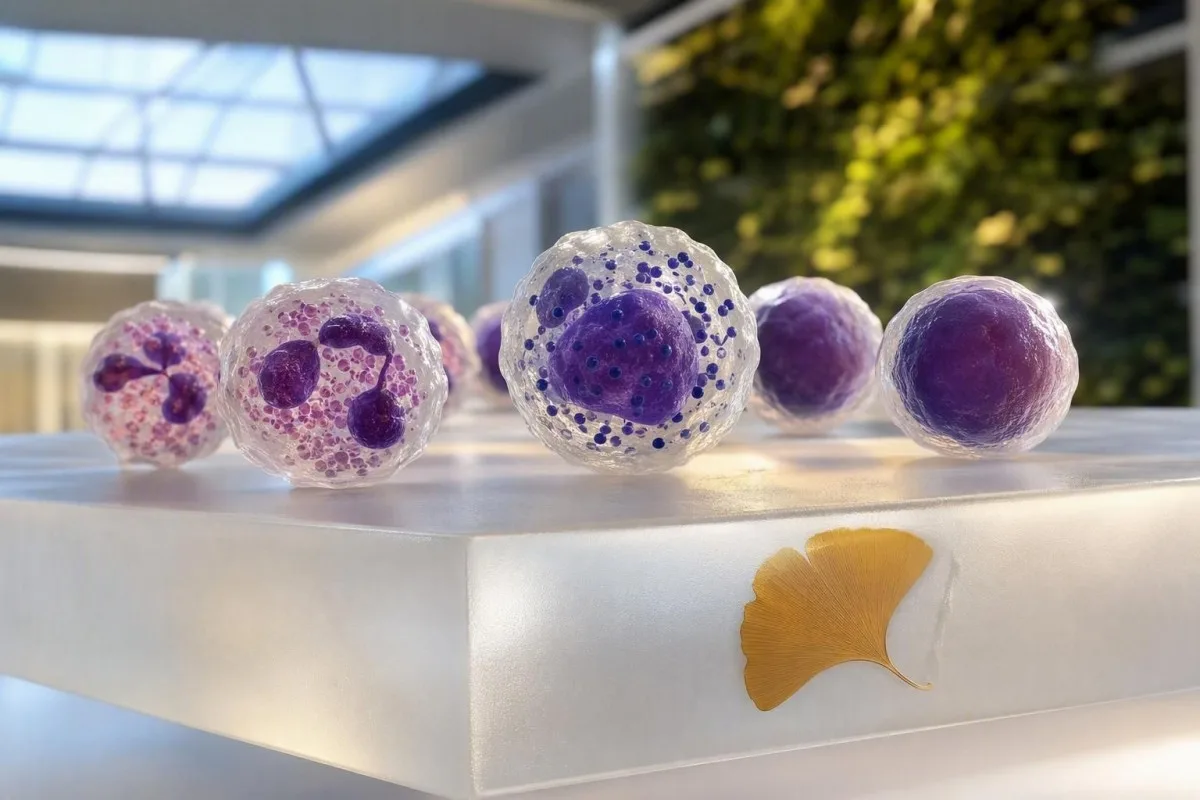
Die meisten Erwachsenen haben absolute Basophile von 0,00–0,10 × 10⁹/L (0–100/µL), während der Prozentsatz normalerweise 0–1% beträgt. Ein leicht ungewöhnlicher Prozentsatz spiegelt oft Verschiebungen bei anderen weißen Blutkörperchen wider; die absolute Basophile-Zahl ist das Ergebnis, das normalerweise weitere Untersuchungen leitet.


- Absolute Basophile sind normalerweise bei Erwachsenen 0,00–0,10 × 10⁹/L (0–100/µL) und sind klinisch nützlicher als ein alleiniger Prozentsatz.
- Basophilen-Prozentsatz beträgt üblicherweise 0–1% der weißen Blutkörperchen, kann aber steigen, wenn Neutrophile oder Lymphozyten fallen, auch wenn die absolute Zahl normal ist.
- Kinder verwenden nach dem Säuglingsalter häufig die gleiche praktische Obergrenze von 0,10 × 10⁹/L, aber das altersabhängige Intervall des Labors hat Vorrang.
- Eine wiederholte CBC innerhalb von 2–8 Wochen ist bei isolierter, leichter Basophilie nach einer Allergie, Infektion oder Medikamentenänderung angemessen.
- Anhaltende Basophilie über 0,20 × 10⁹/L verdient eine ärztliche Überprüfung, insbesondere bei hohen weißen Blutkörperchen, Anämie, Splenomegalie oder konstitutionellen Symptomen.
- Dringende Überprüfung ist gerechtfertigt bei ausgeprägter Leukozytose, unerklärlichem Gewichtsverlust, nächtlichen Schweißausbrüchen, Fieber oder frühem Völlegefühl unter den linken Rippen.
- Null Basophile bei einer automatisierten Differenzierung ist häufig und hat normalerweise keine klinische Bedeutung.
- Kantesti AI liest Basophile zusammen mit der Gesamtzahl der weißen Blutkörperchen, Eosinophilen, Thrombozytenzahl, Hämoglobin und früheren Ergebnissen, anstatt ein einzelnes Signal als Diagnose zu behandeln.
Absolute Basophile im Vergleich zum Basophile-Prozentsatz
Absolute Basophile von 0,00–0,10 × 10⁹/L sind bei Erwachsenen im Allgemeinen normal, während ein Basophilenprozentsatz von 0–1% nur ein Teil der gesamten weißen Blutkörperchen ist. Wenn die beiden nicht übereinstimmen, gewichten Kliniker normalerweise das absolute Ergebnis stärker.
Ein Prozentsatz kann hoch erscheinen, nur weil ein anderer Typ weißer Blutkörperchen niedrig ist. Zum Beispiel ergibt 1,5% Basophile bei einer Leukozytenzahl von 3,0 × 10⁹/L eine absolute Zählung von nur 0,045 × 10⁹/L – weit innerhalb vieler Erwachsenenintervalle. Deshalb erzählt ein einzelnes prozentuales Signal selten die ganze Geschichte.
Die Berechnung ist einfach: Gesamtzahl der weißen Blutkörperchen × Basophilenprozentsatz ÷ 100. Eine Leukozytenzahl von 12,0 × 10⁹/L und Basophile von 2% ergibt 0,24 × 10⁹/L, was eine echte Erhöhung ist. Für den breiteren Kontext siehe unseren Leitfaden zu was ein CBC umfasst.
Kantesti ist ein KI-Bluttestanalysator , der Prozentsätze in klinisch vergleichbare absolute Werte umrechnet, wenn der Ursprungsbericht eine Differentialzählung liefert. Meiner Erfahrung nach verhindert diese eine Umrechnung eine beträchtliche Menge unnötiger Beunruhigung nach einer routinemäßigen Gesundheitsuntersuchung.
Warum die absolute Zahl stabiler ist
Automatisierte Analysegeräte zählen Tausende von Zellereignissen, aber Basophile sind normalerweise selten – oft weniger als 1 von 100 weißen Blutkörperchen. Kleine analytische und biologische Verschiebungen können daher den Prozentsatz stärker bewegen als die absolute Zählung.
Praktische Referenzintervalle für Basophile nach Alter
Die meisten Laboratorien verwenden ein absolutes Basophilen-Referenzintervall von 0,00–0,10 × 10⁹/L von der Kindheit bis ins Erwachsenenalter, aber Neugeborenenbereiche können breiter sein. Verwenden Sie das Intervall, das neben Ihrem eigenen Ergebnis gedruckt ist, da die Grenzwerte vom Analysatorverfahren und der lokalen gesunden Bevölkerung des Labors abhängen.
Bei Säuglingen in den ersten Lebenswochen akzeptieren einige pädiatrische Labore absolute Basophile bis zu etwa 0,20–0,40 × 10⁹/L. Das neonatale Immunsystem passt sich schnell an, daher sollten Erwachsenengrenzwerte nicht ohne pädiatrische Beratung auf ein Neugeborenen-Ergebnis angewendet werden.
Ab etwa 1 Jahr wenden viele Dienste eine praktische Obergrenze von etwa 0,10 × 10⁹/L oder 100/µL an. Ein Ergebnis von 0,11 × 10⁹/L bei einem gesunden Kind mit einer normalen Gesamtzahl weißer Blutkörperchen ist normalerweise eine Frage der Wiederholung und des Kontexts, kein Notfall.
CLSI EP28-A3c erklärt, warum Laboratorien ihre eigenen Referenzintervalle festlegen oder überprüfen, anstatt einen universellen Bereich zu leihen (CLSI, 2010). Unser Leitfaden zu Neutrophilen-Altersbereichen zeigt das gleiche Prinzip für eine andere Differentialzählung.
Basophile-Einheiten in britischen, US-amerikanischen und internationalen Berichten verstehen
Ein Basophilenwert von 0,10 × 10⁹/L entspricht 100/µL, daher können Berichte mit unterschiedlichen Einheiten dasselbe Ergebnis beschreiben. Britische Blutbilder berichten häufig in ×10⁹/L, während US-amerikanische Laboratorien häufig Zellen/µL oder K/µL verwenden.
Um ×10⁹/L in Zellen/µL umzurechnen, multiplizieren Sie mit 1.000. Somit entspricht 0,05 × 10⁹/L 50/µL; 0,25 × 10⁹/L entspricht 250/µL. Ein Bericht, der 0,0 angibt, kann auf eine Dezimalstelle gerundet sein, anstatt zu beweisen, dass buchstäblich keine Basophilen vorhanden sind.
Ein Wert von 0,2 K/µL entspricht 0,20 × 10⁹/L. Dieser Unterschied ist wichtig, da 0,21 und 0,2 K/µL völlig unterschiedliche Messungen sind. Patienten verwechseln sie regelmäßig, wenn sie Berichte aus zwei Ländern vergleichen.
Wenn Ihr Bericht FBC statt CBC lautet, sind die Komponenten weitgehend gleich; unser Leitfaden zum britischen Blutbild übersetzt die gängige Terminologie.
Warum Basophile-Zahlen steigen oder fallen
Eine leichte Basophilie begleitet am häufigsten Allergien, chronische Entzündungen, die Erholung von einer Infektion oder eine medikamentenbedingte Immunverschiebung. Eine niedrige Anzahl oder null Basophile ist normalerweise nicht aussagekräftig, da diese Zellen in sehr geringen Mengen zirkulieren.
Basophile tragen Rezeptoren für IgE und können nach Allergenexposition Histamin und andere Mediatoren freisetzen. Saisonale allergische Rhinitis, chronische Urtikaria, Asthma und einige Hauterkrankungen können mit einem leichten Anstieg einhergehen, obwohl ein normaler Wert keine davon ausschließt oder bestätigt.
Hypothyreose, entzündliche Darmerkrankungen, rheumatische Erkrankungen und einige chronische Infektionen können ebenfalls mit einer Basophilie verbunden sein. Die nützliche Frage ist nicht “Welche Krankheit verursacht dies?”, sondern “Welche anderen Signale sind vorhanden?” — CRP, Eosinophile, Symptome, Medikamentenanamnese und der Verlauf sind alle wichtig.
Ein erhöhter IgE- und Eosinophilenwert kann ein allergisches Muster unterstützen, während isolierter Juckreiz möglicherweise eine breitere Untersuchung erfordert; unser Artikel über Blutuntersuchungen bei juckender Haut erklärt die praktischen Grenzen der CBC-Tests.
Wann sollte eine CBC für Basophile wiederholt werden?
Wiederholen Sie eine CBC in 2–8 Wochen bei einer leichten, isolierten Basophilensteigerung nach einem vorübergehenden Auslöser, vorausgesetzt, Sie fühlen sich wohl und der Rest des Blutbilds ist beruhigend. Wiederholen Sie früher, normalerweise innerhalb von Tagen bis 2 Wochen, wenn die Gesamtzahl der weißen Blutkörperchen steigt oder mehrere abnormale Zelllinien vorhanden sind.
Bei einem absoluten Basophilenwert von 0,11–0,20 × 10⁹/L nach einer Erkältung, einem Heuschnupfen-Schub, einer Impfung oder einer kurzen Steroidbehandlung bevorzuge ich oft eine ruhige Wiederholung gegenüber einer Kaskade von Tests. Versuchen Sie, dasselbe Labor zu verwenden, und notieren Sie kürzliche Erkrankungen, neue Medikamente, Änderungen beim Rauchen und Steroidexposition.
Versuchen Sie nicht, die Anzahl vor einer erneuten Untersuchung zu “verbessern”. Hydration ist sinnvoll, aber Nahrungsergänzungsmittel, Antihistaminika, Kortikosteroide und intensives Ausdauertraining können die breitere Differenzialdiagnose verändern. Unser Leitfaden zur Zeitplanung von Bluttests beschreibt gängige Timing-Effekte.
Kantesti ist ein AI-Bluttest-Auswertungsplattform der die aktuelle Differenzialblutbild mit früheren CBCs vergleicht und einen konsistenten Anstieg anders als eine einmalige Meldung kennzeichnet. Ein Trend über 3–6 Monate ist oft aussagekräftiger als ein einzelner Dezimalpunkt.
Wie man sich auf einen zuverlässigen Basophile-Wiedertest vorbereitet
Basophilen-Tests erfordern normalerweise kein Fasten, aber ein wiederholtes CBC ist am aussagekräftigsten, wenn Sie nicht akut krank sind und die Entnahmebedingungen ähnlich sind. Streben Sie normale Flüssigkeitszufuhr, gewöhnliche Mahlzeiten und einen routinemäßigen Tag an, anstatt extreme Veränderungen vorzunehmen.
Vermeiden Sie die Planung einer nicht dringenden Nachuntersuchung während Fieber, einer starken allergischen Reaktion oder am Tag nach einer ungewöhnlich intensiven Ausdauerbelastung, wenn das Ziel die Festlegung einer Basislinie ist. Akute Stresshormone und Flüssigkeitsverschiebungen können mehrere Untergruppen der weißen Blutkörperchen für Stunden bis Tage verändern.
Informieren Sie den Arzt oder Phlebotomisten über systemische Kortikosteroide, Lithium, epinephrinhaltige Behandlungen, kürzlich durchgeführte Biologikatherapie und jegliche neuen Nahrungsergänzungsmittel. Steroide senken typischerweise die zirkulierenden Basophilen und Eosinophilen, sodass ein “normales” Ergebnis während der Einnahme möglicherweise nicht Ihre unbehandelte Basislinie darstellt.
Die Probenqualität ist immer noch wichtig. Geronnene EDTA-Proben und verzögerte Analyse können automatisierte Differenzialblutbilder weniger zuverlässig machen; wenn mehrere CBC-Werte zusammen seltsam aussehen, überprüfen Sie wann ein erneuter Abstrich erforderlich ist.
CBC-Muster, die erhöhte Basophile bedeutsamer machen
Eine Basophilie ist besorgniserregender, wenn absolute Basophile 0,20 × 10⁹/l überschreiten und mit anhaltend hohen weißen Blutkörperchen über 11,0 × 10⁹/l, Anämie, Veränderungen der Blutplättchen oder unreifer Zellen auftreten. Die Kombination – nicht nur die Basophilen – bestimmt, wie schnell die Ärzte untersuchen.
Eine 44-jährige Patientin, die ich untersuchte, hatte 0,28 × 10⁹/l Basophile, 16,4 × 10⁹/l weiße Blutkörperchen, 610 × 10⁹/l Blutplättchen und frühe Sättigung. Dieses Muster erforderte eine hämatologische Abklärung noch in derselben Woche; das isolierte Basophilen-Ergebnis diagnostizierte die Erkrankung nicht, war aber ein wichtiger Hinweis.
Eine Basophilie zusammen mit hohen Neutrophilen und Milzsymptomen kann bei myeloproliferativen Neoplasien, einschließlich chronischer myeloischer Leukämie, auftreten. European LeukemiaNet empfiehlt molekulare Tests und fachärztliche Beurteilung, wenn das klinische Bild und das Blutbildmuster dies nahelegen (Hochhaus et al., 2020).
Ein peripherer Blutausstrich kann echte Differenzialveränderungen von Analyseunsicherheiten unterscheiden und kann eine Linksverschiebung oder atypische Zellen zeigen. Lesen Sie mehr über Blutkrebs-CBC-Pfade ohne anzunehmen, dass eine abnormale Anzahl Krebs bedeutet.
Symptome und Ergebnisse, die sofortige ärztliche Aufmerksamkeit erfordern
Suchen Sie dringend ärztliche Hilfe bei Basophilie mit Fieber, Nachtschweiß, unerklärlichem Gewichtsverlust, neuen Blutergüssen, Atemnot, starker Müdigkeit oder Völlegefühl im linken Oberbauch. Diese Symptome werden nicht durch ein geringfügig erhöhter Basophilen-Ergebnis selbst verursacht; sie signalisieren, dass das breitere klinische Bild beurteilt werden muss.
Eine Gesamtzahl weißer Blutkörperchen über 30 × 10⁹/l, schnell steigende Werte oder sichtbare unreife Granulozyten auf einem Bericht sollten dringend mit dem behandelnden Arzt besprochen werden. Starke Kopfschmerzen, Sehstörungen, Brustschmerzen oder neurologische Symptome erfordern unabhängig von der Basophilen-Zahl eine Notfallbewertung.
Die meisten Menschen mit 0,11–0,20 × 10⁹/l Basophilen und ohne Symptome benötigen keine Notfallversorgung. Dennoch ist dies einer der Bereiche, in denen der Kontext wichtiger ist als die Zahl, insbesondere wenn frühere Ergebnisse 0,02 × 10⁹/l waren und die neue Zählung steigt.
Wenn Sie auch Kurzatmigkeit oder Blässe haben, können die begleitenden Hämoglobin- und Thrombozytenwerte unmittelbar wichtiger sein; siehe unsere Kurzatmigkeit-Bluttest-Anleitung.
Was niedrige Basophile oder ein Ergebnis von Null bedeuten
Ein Basophilen-Ergebnis von 0,00 × 10⁹/l ist normalerweise normal und muss selten allein wiederholt werden. Basophile können unterhalb der Meldeschwelle des Analysators liegen, da sie in der Zirkulation naturgemäß spärlich sind.
Akuter Stress, Infektionen, Schwangerschaft, Hyperthyreose und Kortikosteroidbehandlung können zirkulierende Basophile vorübergehend reduzieren. Doch gibt es kein anerkanntes Symptom-Syndrom, das durch isolierte niedrige Basophile verursacht wird, im Gegensatz zur klinisch signifikanten Neutropenie.
Das analytische Problem ist leicht zu übersehen: Wenn nur wenige Basophile gezählt werden, kann die routinemäßige Stichprobenvariabilität bei einer nachfolgenden Entnahme 0,01 × 10⁹/L in 0,00 × 10⁹/L umwandeln. Dies ist nicht unbedingt eine biologische Veränderung.
Dr. Thomas Kleins praktischer Rat ist, eine niedrige Basophilen-Anzeige zu ignorieren, wenn der Rest des CBC unauffällig ist und keine relevanten Symptome vorliegen. Unser spezieller Leitfaden erklärt Basophile bei Null.
Basophile in der Schwangerschaft und im späteren Leben
Schwangerschaft und Altern haben keinen einzelnen besonderen Basophilen-Grenzwert; das Intervall des meldenden Labors und das gesamte Muster der weißen Blutkörperchen bleiben die beste Referenz. Eine Schwangerschaft erhöht häufig die Gesamtzahl der weißen Blutkörperchen durch Neutrophile, was dazu führen kann, dass der prozentuale Anteil der Basophilen ohne eine tatsächliche Reduzierung der Basophilen niedriger erscheint.
Während der Schwangerschaft kann eine Gesamtzahl weißer Blutkörperchen von 12–15 × 10⁹/L physiologisch sein, insbesondere im späteren Stadium der Schwangerschaft, so dass die prozentuale Interpretation noch unzuverlässiger wird. Ein absolutes Basophilen-Zählverfahren bleibt vorzuziehen, aber besorgniserregende Symptome überschreiben immer noch einen Referenzbereich.
Bei älteren Erwachsenen verdient eine neu anhaltende Basophilen-Zahl über 0,20 × 10⁹/L Aufmerksamkeit, da Medikamentenbelastung und Knochenmarkserkrankungen mit zunehmendem Alter häufiger vorkommen. Das macht es nicht diagnostisch; es senkt lediglich die Schwelle für die Betrachtung des CBC-Trends und des Ausstrichs.
Weitere interpretationsspezifische Fallstricke während der Schwangerschaft finden Sie unter Schwangerschafts-Bluttest-Red-Flags.
Medikamente, Allergien und Basophile-Schwankungen
Allergiesymptome können mit leicht erhöhten Basophilen zusammenfallen, während systemische Kortikosteroide sie oft innerhalb weniger Tage senken. Kein Muster bestätigt eine Allergiediagnose oder beweist, dass ein Medikament verantwortlich ist.
Antihistaminika blockieren primär Histaminrezeptoren; sie normalisieren einen Basophilen-Wert nicht zuverlässig. Orale Prednisolonpräparate und andere systemische Glukokortikoide können weiße Blutkörperchen umverteilen, oft Eosinophile und Basophile senken, während sie zirkulierende Neutrophile erhöhen.
Lithium ist ein seltenerer, aber nützlicher Medikamentenhinweis, da es die Produktion weißer Blutkörperchen erhöhen kann. Biologika, Chemotherapie und immunmodulierende Behandlungen sollten niemals wegen eines einzelnen CBC-Ergebnisses abgesetzt werden – fragen Sie das verschreibende Team, wie das Ergebnis in ihren Überwachungsplan passt.
Ein erhöhter Basophilen-Wert zusammen mit Giemen, Nesselsucht, Gesichtsschwellung oder Ohnmacht sollte als Symptomproblem und nicht als Laborrätsel behandelt werden. Unser Leitfaden für hohes IgE erklärt, wo Allergie-Marker helfen und wo sie irreführen.
Was Kliniker nach anhaltender Basophilie überprüfen
Anhaltende absolute Basophilie veranlasst normalerweise eine Wiederholung des CBC, eine manuelle Ausstrichuntersuchung, eine Überprüfung von Medikamenten und Symptomen sowie gezielte Tests, wenn die Gesamtzahl der weißen Blutkörperchen oder andere Zelllinien abnormal sind. Breitere Krebs-Panels sind nicht der übliche erste Schritt bei einer leichten isolierten Erhöhung.
Der erste Verzweigungspunkt ist, ob das Ergebnis isoliert ist. Ein stabiles Hämoglobin, normale Thrombozyten, eine normale Leukozytenzahl und ein normaler Ausstrich unterstützen stark einen konservativen Plan; Anämie, Thrombozytose, Leukämie oder Splenomegalie lenken die Beurteilung in eine andere Richtung.
Wenn eine myeloproliferative Erkrankung plausibel ist, können Kliniker eine BCR::ABL1-Testung, eine JAK2-Testung, Laktatdehydrogenase, Harnsäure und eine Facharztbegutachtung anfordern. Valent et al. beschreiben eine anhaltende Basophilie als bedeutsamen Befund bei der Klassifizierung von basophilen und myeloischen Neoplasien (Valent et al., 2022).
Das neuronale Netz von Kantesti identifiziert Kombinationen, die eine Überprüfung erfordern, diagnostiziert aber keine Leukämie anhand eines CBC. Unser Ansatz zur medizinischen Validierung erklärt, warum die Laborinterpretation die klinische Aufsicht beibehalten muss.
Wie man Basophile verfolgt, ohne überzureagieren
Ein aussagekräftiger Basophilen-Trend ist eine anhaltende gerichtete Veränderung über vergleichbare CBCs hinweg, nicht eine einzelne Bewegung von 0,04 auf 0,08 × 10⁹/L. Bei einem Referenzwert für Erwachsene von 0,10 × 10⁹/L liegen beide Werte trotz numerischer Unterschiede im Bereich.
Speichern Sie die absolute Zahl, den Prozentsatz, die gesamten weißen Blutkörperchen, Neutrophile, Eosinophile, Hämoglobin, Thrombozyten, Datum, kürzliche Krankheit und Medikamente nach jeder Entnahme. Diese kleine Aufzeichnung gibt Ihrem Arzt mehr nutzbare Informationen als Screenshots isolierter Warnsignale.
Kantesti ist ein KI-gestütztes Analyse-Tool für Bluttests wird in 127+ Ländern verwendet, um CBC-Ergebnisse longitudinal zu vergleichen und gleichzeitig den angegebenen Intervall des Quelllabors beizubehalten. Dr. Thomas Klein empfiehlt, mindestens zwei vergleichbare Ergebnisse zu überprüfen, bevor einer grenzwertigen differentiellen Veränderung eine Bedeutung beigemessen wird.
Eine nützliche Regel: Wenn die absolute Zahl unter 0,10 × 10⁹/L bleibt, die Gesamtzahl der weißen Blutkörperchen stabil ist und Sie sich wohl fühlen, ist eine routinemäßige Nachuntersuchung bei Ihrer nächsten geplanten Blutuntersuchung normalerweise ausreichend. Nutzen Sie unsere Leitlinie zur Differenz bei Bluttests , um zu beurteilen, ob eine Veränderung wahrscheinlich real ist.
Fragen, die bei einem Nachuntersuchungstermin gestellt werden sollten
Die beste Nachfrage ist: “Wie hoch ist meine absolute Basophilenzahl und was hat sich sonst noch im CBC verändert?” Diese Formulierung lenkt das Gespräch auf die Variablen, die das klinische Risiko tatsächlich verändern.
Fragen Sie, ob die Zahl neu, anhaltend, steigend oder wahrscheinlich reaktiv ist; ob eine Ausstrichuntersuchung erforderlich ist; und wann die nächste CBC entnommen werden soll. Bringen Sie eine Liste von kürzlichen Infektionen, Allergiesymptomen, Medikamenten, Nahrungsergänzungsmitteln, Reisen und familiärer Vorgeschichte von Bluterkrankungen mit.
Wenn Sie eine absolute Zahl über 0,20 × 10⁹/L zusammen mit erhöhten weißen Blutkörperchen haben, fragen Sie, ob eine hämatologische Beratung angebracht ist. Wenn die Zahl nur leicht über dem Bereich liegt und isoliert ist, fragen Sie, welche Veränderung eine frühere Untersuchung auslösen würde, anstatt das Schlimmste anzunehmen.
Die von Ärzten geprüften Bildungsstandards von Kantesti werden über unsere Medizinischer Beirat. überwacht. Mit Stand vom 30. August 2026 bleibt der sicherste Ansatz einfach: Interpretieren Sie die absolute Zahl, bestätigen Sie die Persistenz und handeln Sie nur dann schneller, wenn das breitere Muster dies rechtfertigt.
Häufig gestellte Fragen
Was ist die normale Basophilen-Anzahl bei Erwachsenen?
Der übliche Referenzbereich für absolute Basophile bei Erwachsenen liegt bei 0,00–0,10 × 10⁹/L, was 0–100 Zellen/µL entspricht. Die meisten Labore geben einen Basophilenanteil von 0–11 % an, obwohl der Prozentsatz irreführend sein kann, wenn sich die Gesamtzahl der weißen Blutkörperchen ändert. Der im Labor Ihres eigenen Labors angegebene Referenzbereich hat Vorrang, da sich Methoden und lokale Referenzpopulationen unterscheiden. Ein isoliertes Ergebnis von 0,11 × 10⁹/L erfordert in der Regel eine Kontextualisierung oder eine geplante Wiederholung, anstatt eine Notfallversorgung.
Sind 2% Basophile erhöht?
Ein Basophilenanteil von 2% liegt über vielen prozentualen Intervallen im Labor, aber er reicht nicht aus, um das Risiko ohne die Gesamtzahl der weißen Blutkörperchen zu beurteilen. Bei weißen Blutkörperchen von 4,0 × 10⁹/L entspricht 2% einer absoluten Basophilenanzahl von 0,08 × 10⁹/L, was oft normal ist. Bei weißen Blutkörperchen von 15,0 × 10⁹/L entspricht dasselbe 2% 0,30 × 10⁹/L und erfordert eine klinische Überprüfung. Ermitteln Sie immer die absolute Basophilenanzahl, bevor Sie den Prozentsatz interpretieren.
Wann sollte ich ein CBC bei erhöhten Basophilen wiederholen?
Ein wiederholtes CBC in 2–8 Wochen ist bei leichter isolierter Basophilie von etwa 0,11–0,20 × 10⁹/L nach einer Krankheit, einem allergischen Schub oder einer Medikamentenänderung im Allgemeinen vertretbar. Wiederholen Sie die Untersuchung früher, wenn die Gesamtzahl der Leukozyten steigt, die Basophilenzahl über 0,20 × 10⁹/L liegt oder Hämoglobin und Thrombozyten ebenfalls abnormal sind. Verwenden Sie möglichst dasselbe Labor, da die Analysemethoden und Referenzbereiche variieren. Fieber, Gewichtsverlust, Nachtschweiß, Blutergüsse oder ein Völlegefühl im linken Oberbauch erfordern eine umgehende ärztliche Untersuchung und nicht das Warten auf eine routinemäßige Nachuntersuchung.
Sind Basophile null gefährlich?
Ein Basophilenwert von 0,00 × 10⁹/L ist normalerweise nicht gefährlich und erfordert im Allgemeinen keine weitere Überwachung, wenn der Rest des CBC normal ist. Basophile sind seltene Zellen, sodass eine routinemäßige automatisierte Differenzialzählung null ergeben kann, weil die festgestellte Anzahl unterhalb der Rundungs- oder Meldegenauigkeit liegt. Kortikosteroide, akuter Stress, Schwangerschaft und Infektionen können die zirkulierenden Basophilen vorübergehend senken. Ärzte diagnostizieren keine Immunschwäche anhand isoliert niedriger Basophilenwerte.
Können Allergien hohe Basophilenwerte verursachen?
Allergische Zustände können mit leicht erhöhten Basophilen einhergehen, da Basophile an IgE-vermittelten Immunreaktionen teilnehmen und Mediatoren wie Histamin freisetzen. Eine hohe Basophilen-Zahl beweist nicht, dass eine Allergie die Ursache ist, und viele Menschen mit signifikanten allergischen Symptomen haben normale Basophilen-Zahlen. Werte über 0,20 × 10⁹/L, die nach Abklingen der allergischen Symptome bestehen bleiben, sollten im Zusammenhang mit dem gesamten CBC beurteilt werden. Eosinophile, Gesamt-IgE, Hautsymptome und Medikamentenexposition können nützlichere Informationen liefern.
Welche Basophilenanzahl deutet auf Leukämie hin?
Kein einzelner basophiler Wert diagnostiziert eine Leukämie, aber eine anhaltende absolute Basophilie über 0,20 × 10⁹/L mit Leukozytose, Anämie, Thrombozytenanomalien, unreife Granulozyten oder Splenomegalie sollte eine ärztliche Abklärung veranlassen. Basophilie kann bei chronischer myeloischer Leukämie und anderen myeloproliferativen Neoplasien auftreten, aber reaktive Ursachen sind bei leichten isolierten Erhöhungen weiterhin häufiger. Kliniker können einen Ausstrich und gezielte molekulare Tests wie BCR::ABL1 anordnen, nur wenn das breitere Muster dies unterstützt. Eine normale Gesamtzahl der weißen Blutkörperchen und ein stabiler CBC verändern den Besorgnisgrad erheblich.
Hol dir heute eine KI-gestützte Bluttest-Analyse
Schließe dich über 2 Millionen Nutzern weltweit an, die Kantesti für sofortige, genaue Laboranalysen vertrauen. Lade deine Blutwerte Ergebnisse hoch und erhalte in Sekunden eine umfassende Interpretation von 15,000+-Biomarkern.
📚 Referenzierte Forschungsveröffentlichungen
Klein, T., Mitchell, S., & Weber, H. (2026). Leitfaden zu Blutgruppe B negativ, LDH-Bluttest & Retikulozytenzahl. Kantesti KI-Medizinische Forschung.
Klein, T., Mitchell, S., & Weber, H. (2026). Durchfall nach dem Fasten, schwarze Flecken im Stuhl & Magen-Darm-Ratgeber 2026. Kantesti KI-Medizinische Forschung.
📖 Externe medizinische Referenzen
Clinical and Laboratory Standards Institute (2010). Definition, Festlegung und Überprüfung von Referenzintervallen im klinischen Labor. CLSI EP28-A3c.
⚕️ Medizinischer Haftungsausschluss
Dieser Artikel dient nur zu Bildungszwecken und stellt keine medizinische Beratung dar. Wende dich für Diagnose- und Behandlungsentscheidungen immer an eine qualifizierte medizinische Fachkraft.
E-E-A-T Vertrauenssignale
Erfahrung
Ärztlich geleitete klinische Überprüfung von Labor-Interpretations-Workflows.
Sachverstand
Fokus der Labormedizin darauf, wie Biomarker sich im klinischen Kontext verhalten.
Autorität
Verfasst von Dr. Thomas Klein, überprüft von Dr. Sarah Mitchell und Prof. Dr. Hans Weber.
Vertrauenswürdigkeit
Evidenzbasierte Interpretation mit klaren nächsten Schritten zur Reduzierung von Alarm.