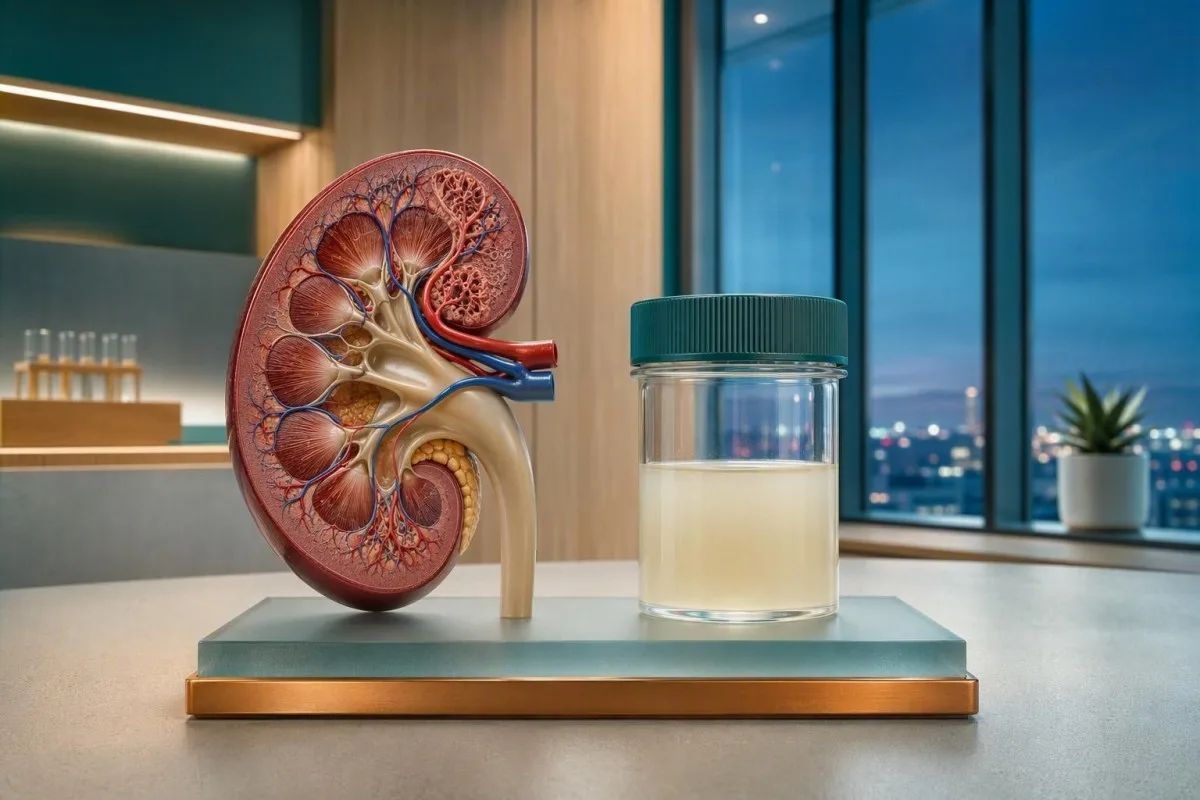
Cloudiness is usually caused by concentrated urine, harmless phosphate sediment, vaginal contamination, crystals, or urinary inflammation. The pattern around it—especially pain, fever, blood, pregnancy, or a new change—determines whether a urine test is needed today.


- Cloudy urine without pain, fever, blood, or urinary urgency often clears after normal hydration and a properly collected repeat sample.
- Urgent review is needed the same day for cloudy urine with fever of 38.0°C or higher, flank pain, vomiting, visible blood, pregnancy, or inability to pass urine.
- Leukocyte esterase detects white-cell enzyme activity; a positive result supports urinary inflammation but does not prove a bacterial infection.
- Nitrites are specific but not sensitive for common bacterial urinary infection: a negative nitrite strip does not rule out a UTI.
- Pyuria usually means more than 5 white cells per high-power microscopic field, although vaginal contamination can create the same result.
- Urine culture identifies the organism and antibiotic susceptibility; in symptomatic women, counts as low as 10² to 10³ CFU/mL can be clinically meaningful.
- Calcium oxalate crystals can occur in healthy urine, but recurring crystals with colicky flank pain or blood need stone-risk assessment.
- Protein or red cells alongside cloudiness are not explained by dehydration alone and often require repeat microscopy, urine ACR, and kidney-function blood tests.
When cloudy urine needs testing today
Cloudy urine needs same-day assessment when it occurs with fever of 38.0°C or higher, one-sided back or flank pain, vomiting, visible blood, pregnancy, confusion, or trouble passing urine. Without those features, a single cloudy void is commonly concentration or harmless sediment, but persistence beyond 24 to 48 hours deserves a clean-catch urinalysis.
The appearance alone cannot diagnose a UTI, kidney stone, or kidney disease. In my 15 years of clinical practice, I have seen a pale cloudy sample after a hard workout turn out to be phosphate sediment, while a nearly clear sample with burning and urgency proved to be infection; the symptoms carry more diagnostic weight than the opacity.
Cloudiness plus fever, shaking chills, or flank pain raises concern for an upper urinary tract infection, particularly when symptoms have developed over 24 to 72 hours. If you also have diabetes, kidney disease, immune suppression, a urinary catheter, or a transplanted kidney, do not wait for home remedies; assessment may include vital signs, urine testing, and blood tests.
Dr Thomas Klein's practical rule is simple: take a photo only if it helps you describe a change, but do not rely on a photo to decide whether you are safe. Kantesti is an AI blood test analyzer that can place creatinine, eGFR, glucose, and inflammatory markers in context after a clinician has chosen appropriate testing, but it does not replace a urine culture for suspected infection. Our guide to dark urine warning signs explains why colour and cloudiness are separate clues.
Common harmless reasons urine looks cloudy
Concentrated urine, phosphate precipitation, mucus, semen, and vaginal discharge are common non-dangerous cloudy urine causes. These explanations are most likely when cloudiness is brief and there is no burning, urgency, fever, blood, or new pelvic or flank pain.
A concentrated morning specimen can look hazy because salts and normal cellular debris are packed into less water. Urine specific gravity of 1.020 to 1.030 indicates relatively concentrated urine, while a result near 1.005 is dilute; neither number alone diagnoses dehydration or kidney disease. Compare this with our explanation of urine specific gravity results.
Phosphate crystals may make alkaline urine look milky or cloudy after the sample cools, especially if it sits on the counter. This is why laboratories prefer analysis within 2 hours of collection, or refrigeration followed by prompt processing; delayed testing can create crystals that were not clinically relevant in the bladder.
Genital secretions are another frequent explanation, especially around ovulation, after intercourse, or during menstruation. A repeat midstream sample collected after separating the labia or retracting the foreskin is more informative than treating a visually cloudy sample as infection.
Cloudiness with burning, urgency or frequency
Cloudy urine with burning during urination, urgency, frequency, or lower abdominal discomfort is compatible with cystitis and usually warrants urinalysis; culture is more useful when symptoms are complicated, recurrent, or atypical. A person can have a bacterial UTI with clear urine, and cloudy urine without urinary symptoms does not automatically need antibiotics.
Dysuria plus new frequency has a high likelihood of acute uncomplicated cystitis in non-pregnant women when vaginal discharge is absent, but testing policies differ by country and clinical setting. The 2019 Infectious Diseases Society of America guideline advises against screening or treating asymptomatic bacteriuria in most non-pregnant adults because antibiotics offer no benefit and can cause harm (Nicolle et al., 2019).
Dipsticks test leukocyte esterase and nitrite within minutes. Nitrite may remain negative when urine has been in the bladder for fewer than about 4 hours, when the organism does not reduce nitrate, or when dietary nitrate intake is low—so a negative strip is not a clean bill of health. See our focused guide to nitrite results in urine.
I am particularly cautious when “UTI symptoms” include vaginal itch, discharge, sores, or pelvic pain after a new sexual contact. Those features can point away from simple cystitis, and blindly taking leftover antibiotics can make the eventual culture harder to interpret.
How to collect a sample that gives a useful answer
A midstream clean-catch sample reduces contamination and makes a urine test for infection more reliable. The best sample is fresh, collected before antibiotics when possible, and delivered to the laboratory within 2 hours or refrigerated according to local instructions.
Start urinating into the toilet, then collect the midstream flow without allowing the container to touch skin. This small detail matters: abundant squamous epithelial cells on microscopy usually suggest external contamination, and mixed bacterial growth on culture often means the lab cannot identify one credible urinary pathogen.
More than 10 squamous epithelial cells per low-power field often prompts clinicians to question specimen quality, although laboratories use different reporting thresholds. If the result says “mixed flora,” “mixed growth,” or “contaminated,” repeat collection is usually more useful than guessing which organism to treat. Our urine culture results guide explains that lab wording.
Do not force fluids immediately before the test in an attempt to produce a sample. Excess water can dilute white cells, nitrite, protein, and bacteria below detection thresholds; drink normally, and tell the clinician if you had already started antibiotics, phenazopyridine, vitamin C, or diuretics.
What urinalysis, microscopy and urine sediment find
Urinalysis combines dipstick chemistry with microscopy to look for white cells, red cells, protein, glucose, crystals, casts, and bacteria. Microscopy is especially useful when cloudy urine may reflect sediment rather than infection.
More than 5 white blood cells per high-power field is commonly called pyuria, but pyuria can result from bacterial infection, kidney stones, sexually transmitted infection, interstitial nephritis, or contamination. In the 2004 systematic review by Devillé and colleagues, dipstick combinations improved UTI probability estimates but did not replace clinical judgement or culture in uncertain cases (Devillé et al., 2004).
Microscopic hematuria is generally defined as 3 or more red blood cells per high-power field on one properly collected specimen. Menstrual blood, strenuous exercise, stones, infection, and urinary tract cancer can all produce this finding, which is why a repeat sample after a transient cause resolves is often sensible. Read more on testing blood in urine.
Urine sediment is not static. White cells can break down in a warm sample, casts can dissolve in dilute alkaline urine, and crystals can form after cooling. When the laboratory result and your story do not agree, I often repeat a fresh sample rather than build an elaborate diagnosis around one imperfect tube.
Urine crystals and sediment: when they matter
Urine crystals are often incidental, but recurrent crystals with colicky pain, blood, or prior stones should trigger a stone-focused review. Crystal type, urine pH, medications, diet, and family history matter far more than a single “crystals present” report.
Calcium oxalate crystals are the most frequent urinary crystals and may appear as envelope-shaped or dumbbell forms. They can occur after ordinary dietary oxalate intake and do not prove a stone, but recurrence alongside flank pain or red cells calls for more attention. Our calcium oxalate crystal guide covers practical next steps.
Uric acid crystals are more likely in acidic urine, whereas struvite crystals occur in alkaline urine and can accompany certain bacterial infections. A urine pH below 5.5 is acidic and above 8.0 is strongly alkaline, yet pH changes after a meal and while a sample stands, so one reading is never the whole story.
Cloudiness caused by crystals often settles or changes after warming, unlike sustained turbidity from cells or microbes. That observation is interesting but not diagnostic; a laboratory microscope, not a kitchen experiment, should decide what is actually in the sediment.
When cloudy urine could signal a stone or blockage
Cloudy urine with sudden waves of severe flank pain, nausea, blood, fever, or reduced urine output needs urgent clinical assessment because a stone can obstruct urine flow. Fever plus suspected obstruction is an emergency because infection behind a blockage can deteriorate quickly.
Kidney stone pain classically rises and falls in waves and may travel from the flank toward the groin, but real presentations vary. A stone smaller than 5 mm often passes without a procedure, whereas size, location, anatomy, and infection determine management, not a home estimate of pain severity. Urine cloudiness alone cannot tell you the stone size.
Urgent imaging is considered when there is fever, a solitary kidney, acute kidney injury, uncontrolled pain, persistent vomiting, or reduced urine output. A non-contrast CT is highly sensitive for stones in many adults, while ultrasound is often preferred first in pregnancy and may identify hydronephrosis without radiation.
Do not take high-dose vitamin C, calcium, or “stone-cleansing” supplements simply because crystals were seen once. If stones recur, a clinician may request a 24-hour collection for calcium, oxalate, citrate, sodium, uric acid, volume, and creatinine; our 24-hour urine collection guide helps avoid common collection errors.
Why pregnancy, childhood and male symptoms change the plan
Pregnancy, childhood, male urinary symptoms, and immune suppression lower the threshold for a clinician-reviewed urine test and culture. In these groups, missing infection or structural disease carries more risk, while unnecessary antibiotics still have consequences.
Pregnant patients with urinary symptoms should contact their maternity or primary-care team promptly, and many systems screen for asymptomatic bacteriuria early in pregnancy. Untreated bacteriuria in pregnancy is associated with pyelonephritis and adverse pregnancy outcomes, so the usual “wait and see” approach to a cloudy sample is not appropriate. Related pregnancy-specific kidney context is available in our pregnancy GFR guide.
In children, a bag-collected specimen is prone to contamination and cannot reliably confirm a UTI culture. Fever without an obvious source in an infant or young child may require a catheterized or clean-catch sample based on age and local practice; the collection method is part of the diagnostic result.
New urinary symptoms in men merit assessment because prostate involvement, urinary retention, stones, and anatomical obstruction are more common than in uncomplicated cystitis. Kantesti AI is an AI blood test interpretation platform that can contextualize kidney markers after testing, but urine microscopy and culture remain the decisive tools for identifying a urinary organism.
Cloudiness with blood, protein or swelling
Cloudy urine accompanied by blood, persistent protein, ankle swelling, high blood pressure, or reduced eGFR may point to kidney disease rather than a simple lower UTI. These combinations deserve repeat urine microscopy and quantitative protein testing rather than reassurance based on a negative nitrite strip.
A urine albumin-to-creatinine ratio below 3 mg/mmol, or below 30 mg/g, is generally considered normal to mildly increased in adults. Persistent values at or above 3 mg/mmol should be interpreted with eGFR, diabetes status, blood pressure, and a repeat early-morning sample. Our ACR preparation guide explains the collection details.
The American Urological Association defines microscopic hematuria as at least 3 red cells per high-power field and recommends risk-based evaluation after transient explanations are addressed (Barocas et al., 2020). The reason we worry about red cells plus protein is that together they can arise from the kidney filters, whereas red cells alone may originate anywhere from the kidney to the urethra.
Foam that disappears quickly is often just forceful urination; persistent fine foam in several samples is a reason to check protein quantitatively. Granular or red-cell casts are not a home-test finding and should be interpreted promptly by a clinician, particularly if creatinine is rising or blood pressure is elevated; see our guide to granular casts in urine.
Medicines, foods and sample timing that can mislead
Several medicines and supplements alter urine appearance or dipstick results, while sample delay can create cloudiness that was absent in the body. A complete medication list—including over-the-counter products and powders—is often more useful than a second dipstick.
Phenazopyridine can turn urine orange and interfere with visual reading of dipsticks, while high-dose vitamin C can produce falsely negative glucose, blood, nitrite, or leukocyte esterase results on some strips. Vitamin C doses of 1,000 mg or more per day are enough to affect certain urine assays, though the effect depends on the manufacturer and timing.
Cloudiness after ejaculation can reflect semen in the urethra and usually settles without treatment. Foods rarely make urine genuinely cloudy, but dehydration after exercise, diarrhoea, fasting, or heat exposure concentrates solutes; compare the related physiology in our urine osmolality guide.
Medication-related interstitial nephritis is uncommon but clinically serious when new rash, fever, eosinophilia, rising creatinine, and sterile pyuria occur together. Proton-pump inhibitors, NSAIDs, and certain antibiotics are recognized triggers, so tell the prescriber exactly when each medicine started rather than stopping essential treatment on your own.
Which blood tests may follow an abnormal urine result
Blood tests are not routine for every cloudy sample, but clinicians usually add creatinine, eGFR, electrolytes, glucose, and a full blood count when infection appears systemic, kidney function may be affected, or urine shows protein or blood. The test choice should answer a clinical question rather than create a broad fishing expedition.
An eGFR below 60 mL/min/1.73 m² for at least 3 months supports chronic kidney disease, while a sudden creatinine rise may indicate acute kidney injury. A single elevated creatinine after dehydration, intense exercise, or a large cooked-meat meal needs context and often a repeat. Review the pattern in our basic metabolic panel guide.
Random plasma glucose of 200 mg/dL, or 11.1 mmol/L, with classic hyperglycaemic symptoms can meet diagnostic criteria for diabetes, and glucose in urine may be an early clue or a medication effect. Frequent urination and thirst with cloudy urine should not automatically be labelled a UTI; our review of glucose in urine explains the distinction.
Kantesti AI interprets blood results by examining relationships among creatinine, eGFR, sodium, potassium, glucose, and prior values rather than treating one flag as a diagnosis. Kantesti is an AI-powered blood test analysis tool used across 127+ countries, and its report should support—not delay—urgent care when fever, vomiting, confusion, or very low urine output are present.
When culture, imaging or specialist review is the next step
Urine culture is most useful before antibiotics in pregnancy, suspected kidney infection, recurrent UTI, male urinary symptoms, catheter-associated symptoms, treatment failure, and atypical presentations. Imaging becomes more likely when clinicians suspect a stone, obstruction, abscess, structural problem, or persistent blood in urine.
The traditional threshold of 10⁵ colony-forming units per mL was designed partly to separate contamination from infection, but symptomatic patients can have clinically relevant lower counts. This is why culture interpretation needs symptoms, collection method, organism type, and the number of organisms—not merely a positive or negative label. Our comparison of urinalysis and culture sets out their distinct roles.
A culture report may include susceptibility results, showing whether the isolated organism is likely to respond to specific antibiotics. Do not self-select an antibiotic based on an old result: resistance patterns change, and bacteria causing a current infection may not be the same as the organism from 6 months ago.
Referral to urology or nephrology is usually based on a pattern, not cloudiness alone: recurrent febrile infections, persistent hematuria, recurrent stones, declining eGFR, substantial albuminuria, or abnormal imaging are common reasons. The chronic kidney disease stages guide may help you prepare specific questions for that visit.
Why antibiotics should not be based on appearance alone
Cloudy urine alone is not a reason to start antibiotics because asymptomatic bacteriuria and contaminated samples are common, while unnecessary treatment increases adverse effects and resistance. The exceptions are specific high-risk situations, especially pregnancy and certain urological procedures.
Asymptomatic bacteriuria means bacteria are present in urine without urinary symptoms, and it is frequently found in older adults, catheter users, and people in long-term care. The IDSA guideline recommends treatment mainly in pregnancy or before invasive urological procedures that breach the urinary mucosa, not simply for cloudy or odorous urine (Nicolle et al., 2019).
The difficult clinical scenario is an older person who has cloudy urine and new confusion. Confusion needs urgent assessment, but the urine appearance should not distract from dehydration, medication effects, constipation, hypoxia, stroke, pain, and other causes; a positive culture in this population can be incidental.
Dr Thomas Klein advises recording the onset, temperature, pain location, fluid intake, medicines, pregnancy status, and any prior culture result before an appointment. That 60-second history often prevents a low-quality sample from becoming an unnecessary course of antibiotics.
A practical 48-hour plan for new cloudy urine
For isolated cloudiness without red flags, drink normally, collect a correctly handled midstream sample if the change persists, and arrange clinical review within 24 to 48 hours if symptoms develop or continue. Do not delay same-day care for fever, flank pain, vomiting, visible blood, pregnancy, or inability to urinate.
Today, note whether the cloudiness occurs every time or only in the first morning void, and check for burning, frequency, pelvic discomfort, fever, or back pain. A temperature of 38.0°C or above, pulse persistently above 100 beats per minute, or repeated vomiting changes the decision from observation to urgent assessment, particularly with urinary symptoms.
If a test is arranged, bring a current medication and supplement list, including the dose of vitamin C, creatine, protein powders, and antibiotics taken in the last 14 days. If you already have kidney-related blood results, our lab result tracker checklist can help you preserve dates and circumstances for comparison.
Kantesti AI can help you organize renal blood results and questions before a clinician visit, particularly when values have changed across several tests. Its methodology and limits are described in our AI blood-test technology guide; a urine sample still needs laboratory testing through appropriate healthcare services.
Emergency warning signs that outweigh the urine result
Seek emergency care now for cloudy urine with confusion, fainting, severe weakness, fever and flank pain, inability to pass urine, uncontrolled vomiting, or visibly bloody urine with clots. These symptoms can reflect severe infection, obstruction, significant bleeding, or acute kidney injury and should not wait for an online interpretation.
Urine output below roughly 0.5 mL/kg/hour for 6 hours can be a warning sign of reduced kidney perfusion or obstruction in an acutely unwell adult, although measuring output at home is often imprecise. The practical signal is a marked reduction from your normal pattern combined with illness, swelling, or breathlessness.
People with a single kidney, known urinary blockage, kidney transplant, advanced chronic kidney disease, or recent urinary tract procedure should seek advice earlier. A negative home dipstick does not safely exclude a serious problem in these settings because early infection, dilution, and non-bacterial causes can all yield misleading strips.
Our doctors on the Medical Advisory Board emphasize that AI-supported laboratory interpretation is a follow-up tool, not an emergency triage substitute. If symptoms are severe, call emergency services or attend an emergency department rather than uploading results and waiting.
How Kantesti handles kidney-related blood results after urine testing
Kantesti does not diagnose cloudy urine from appearance or replace urinalysis, microscopy, culture, imaging, or a clinician examination. It helps users interpret relevant blood-test context—such as creatinine, eGFR, glucose, electrolytes, and inflammatory markers—once those results have been obtained through clinical care.
Kantesti is an AI biomarker interpretation platform that reviews measured blood values against laboratory ranges, reported symptoms, and longitudinal changes rather than claiming to identify a urinary pathogen. A stable eGFR with a contaminated urine culture means something very different from a rising creatinine with fever and heavy proteinuria.
As of August 18, 2026, our clinical workflow keeps the distinction clear: urine testing answers questions about sediment and organisms; blood tests assess kidney function and systemic effects. Technical oversight, validation scope, and human-review boundaries are available on our medical validation page.
Klein T. (2026). Clinical Validation Framework v2.0 (Medical Validation Page). Zenodo. https://doi.org/10.5281/zenodo.17993721. Kantesti LTD. (2026). AI Blood Test Analyzer: 2.5M Tests Analyzed | Global Health Report 2026. Zenodo. https://doi.org/10.5281/zenodo.18175532. These publications describe validation and reporting methods; they do not change the need for clinician-led urine testing when symptoms suggest infection or obstruction.
Frequently Asked Questions
Is cloudy urine always a UTI?
Cloudy urine is not always a urinary tract infection. Concentrated urine, harmless phosphate sediment, vaginal discharge, semen, crystals, and delayed sample processing can all cause cloudiness without bacteria. A UTI becomes more likely when cloudiness occurs with burning, urgency, frequency, lower abdominal pain, fever of 38.0°C or higher, or flank pain. A properly collected urinalysis and, when indicated, culture are the tests that clarify the cause.
When should I get a urine test for cloudy urine?
Get a urine test promptly if cloudy urine lasts longer than 24 to 48 hours, recurs, or occurs with pain, burning, urgency, blood, fever, pregnancy, or a history of kidney stones. Same-day testing is appropriate for fever of 38.0°C or higher, one-sided flank pain, vomiting, or reduced urine output. A midstream clean-catch sample should reach the laboratory within 2 hours or be refrigerated under local laboratory instructions. Testing before the first antibiotic dose gives the best chance of a useful culture.
What does cloudy urine with white sediment mean?
White sediment in cloudy urine may be phosphate crystals, white blood cells, mucus, vaginal contamination, or less commonly a large amount of protein or fat. Microscopy distinguishes these possibilities by identifying white cells, crystals, epithelial cells, and casts. More than 5 white blood cells per high-power field is commonly called pyuria, but pyuria can occur without a bacterial UTI. Fever, burning, flank pain, or visible blood makes clinical assessment more urgent.
Can dehydration make urine cloudy?
Dehydration can make urine look cloudy by concentrating salts, mucus, and normal cellular debris in a smaller volume of water. A urine specific gravity of 1.020 to 1.030 suggests relative concentration, but it cannot diagnose dehydration by itself. Normal hydration should improve concentration-related cloudiness over several voids. Cloudiness that persists despite usual fluid intake, or that occurs with pain or fever, deserves a urine test.
Do crystals in urine mean I have kidney stones?
Crystals in urine do not automatically mean a person has kidney stones. Calcium oxalate crystals, the most common type, can appear in healthy people and may form after a sample cools outside the body. Recurrent crystals matter more when they occur with colicky flank pain, microscopic or visible blood, nausea, or a history of stones. A clinician may use imaging and a 24-hour urine collection to assess stone risk when that pattern is present.
What urine test confirms an infection?
Urine culture is the test that identifies a bacterial organism and reports antibiotic susceptibility, while urinalysis provides rapid clues such as leukocyte esterase, nitrite, white cells, and red cells. The traditional culture threshold is 10⁵ colony-forming units per mL, but symptomatic patients can have meaningful infection at lower counts of 10² to 10³ CFU/mL. A culture collected before antibiotics is most informative. Mixed growth often indicates contamination and may require a repeat clean-catch sample.
Get AI-Powered Blood Test Analysis Today
Join over 2 million users worldwide who trust Kantesti for instant, accurate lab test analysis. Upload your blood test results and receive comprehensive interpretation of 15,000+ biomarkers in seconds.
📚 Referenced Research Publications
Klein, T., Mitchell, S., & Weber, H. (2026). Klein, T. (2026). Clinical Validation Framework v2.0 (Medical Validation Page). Zenodo.. Kantesti AI Medical Research.
Klein, T., Mitchell, S., & Weber, H. (2026). Kantesti LTD. (2026). AI Blood Test Analyzer: 2.5M Tests Analyzed | Global Health Report 2026. Zenodo.. Kantesti AI Medical Research.
📖 External Medical References
⚕️ Medical Disclaimer
This article is for educational purposes only and does not constitute medical advice. Always consult a qualified healthcare provider for diagnosis and treatment decisions.
E-E-A-T Trust Signals
Experience
Physician-led clinical review of lab interpretation workflows.
Expertise
Laboratory medicine focus on how biomarkers behave in clinical context.
Authoritativeness
Written by Dr. Thomas Klein with review by Dr. Sarah Mitchell and Prof. Dr. Hans Weber.
Trustworthiness
Evidence-based interpretation with clear follow-up pathways to reduce alarm.