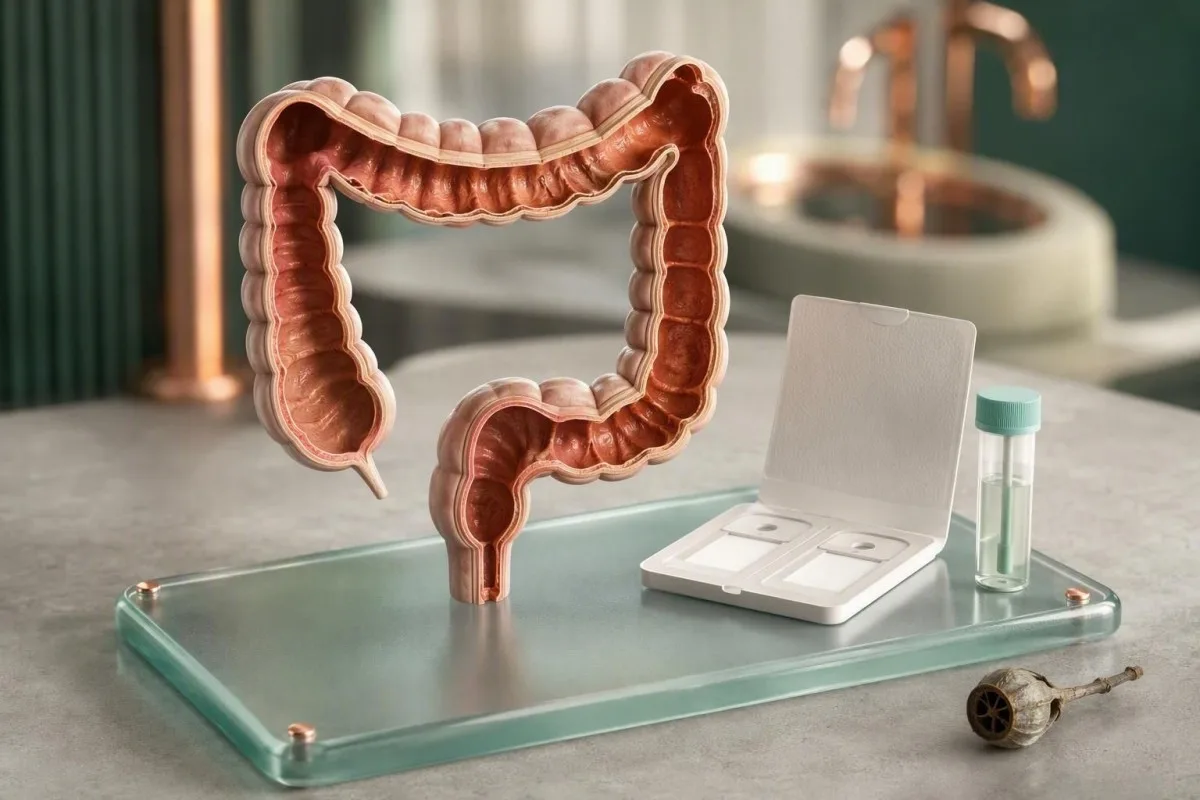
A guaiac fecal occult blood test can detect tiny amounts of blood-related pigment that are not visible in stool. Its result is useful, but the collection method, recent diet, medicines, symptoms, and whether the test was FIT all change what happens next.


- Positive FOBT means the guaiac card detected heme-related peroxidase activity; it does not diagnose colorectal cancer.
- Negative FOBT lowers the chance of ongoing detectable bleeding but cannot rule out polyps, colorectal cancer, ulcers, or intermittent bleeding.
- Diet restriction for many guaiac kits includes avoiding red meat and certain raw vegetables for 3 days before collection; follow that kit's instructions exactly.
- Vitamin C doses above 250 mg daily may suppress the guaiac reaction and create a false-negative result with some older gFOBT methods.
- NSAIDs and anticoagulants can cause genuine microscopic gastrointestinal bleeding rather than a laboratory false positive; do not stop prescribed medicines without clinician advice.
- Positive screening stool tests should usually be followed by diagnostic colonoscopy, not repeated stool testing.
- FIT differs from FOBT because FIT detects human haemoglobin and normally requires no diet restriction; its follow-up after a positive result is still colonoscopy.
- Urgent symptoms such as black tarry stool, fainting, severe weakness, or ongoing rectal bleeding need prompt clinical assessment even after a negative test.
What a guaiac stool card actually detects
FOBT results are qualitative: positive means the card reacted to heme-related peroxidase activity, while negative means no reaction crossed that kit's detection threshold. A guaiac fecal occult blood test does not identify where the signal came from, how much blood may be present, or whether the cause is benign or serious.
Guaiac resin changes colour after developer is applied when a peroxidase-like reaction occurs. Human haemoglobin can trigger that chemistry, but so can animal heme and plant peroxidases; that biochemical limitation explains why preparation rules exist. A single positive window on a correctly collected multi-card test is generally treated as a positive screen.
The older high-sensitivity gFOBT format commonly uses two samples from each of three separate bowel movements, giving six test windows. Bleeding from a small polyp can be intermittent, so one sample is a poor referendum on the entire colon; this is also why a negative result does not overrule symptoms. The Bristol stool chart can help describe stool appearance accurately at a clinical visit.
Kantesti is an AI blood test analyzer that places a reported stool-screen result alongside relevant blood findings such as haemoglobin, MCV, ferritin, and transferrin saturation; it does not replace colonoscopy or a clinician's diagnostic judgement. In my practice, the combination of a positive card and evolving iron-deficiency indices matters far more than the shade or intensity of a card reaction.
Why the result has no “normal range”
A guaiac fecal occult blood test is reported as detected or not detected, not as mg/dL or a concentration range. Laboratories may use different cards, developer timing, and collection instructions, so the result must be read with that laboratory's method and the date of collection.
What a positive FOBT means clinically
A positive FOBT means detectable heme-related activity was found in at least one collected stool sample, and the usual next diagnostic step is colonoscopy. It is a signal to investigate, not a cancer diagnosis and not a reason to repeat the card at home for reassurance.
Potential sources include colorectal polyps, colorectal cancer, haemorrhoids, diverticular disease, inflammatory bowel disease, peptic ulcer disease, and upper gastrointestinal bleeding. Roughly 70% to 80% of positive stool screening tests do not reveal cancer, but that reassuring statistic should never delay appropriate follow-up because advanced precancerous polyps are common actionable findings.
The 2021 US Preventive Services Task Force recommendation treats a positive stool-based screening test as incomplete screening until colonoscopy is performed (US Preventive Services Task Force, 2021). Colonoscopy can identify the source and remove many polyps during the same procedure, which is something a repeat guaiac card cannot do.
A 58-year-old patient I reviewed had a positive gFOBT after assuming it was caused by ibuprofen. Colonoscopy found a 14 mm adenoma rather than cancer, and removal was preventive care at its best. If the report arrives before an appointment, use a doctor-visit result checklist to record medicines, collection dates, bowel changes, and family history.
Do haemorrhoids explain a positive result?
Haemorrhoids can contribute microscopic blood, but clinicians should not assume they are the explanation for a positive FOBT in a screening-eligible adult. A visible benign source can coexist with polyps or a separate bowel condition, particularly after age 45.
What a negative FOBT result can and cannot rule out
A negative FOBT means the sampled stool did not produce a detectable guaiac reaction; it does not prove that there is no gastrointestinal bleeding or colorectal disease. Intermittent bleeding, inadequate collection, vitamin C interference, and lesions that do not bleed on collection days can all produce a negative result.
High-sensitivity guaiac tests are designed for repeated annual screening, not as a one-time all-clear test. For average-risk adults aged 45 to 75 years, the USPSTF lists annual high-sensitivity gFOBT and annual FIT as screening options; screening after age 76 is individualized by health, prior screening, and life expectancy (US Preventive Services Task Force, 2021).
A negative test should not be used to explain away new rectal bleeding, persistent change in bowel habit, unintentional weight loss, abdominal mass, or iron-deficiency anaemia. In men and postmenopausal women with iron-deficiency anaemia, the American Gastroenterological Association generally recommends bidirectional endoscopy rather than relying on a stool test (Ko et al., 2020).
The nuance is particularly important when a CBC is drifting: a haemoglobin fall from 14.2 to 11.8 g/dL over 9 months can be clinically meaningful even if it remains near a laboratory reference interval. Our low transferrin saturation guide explains why ferritin and saturation often clarify this pattern earlier than a single FOBT.
When a negative result is reassuring
A properly collected negative annual screening test is reassuring for an average-risk person with no alarm symptoms, but its value depends on repeating screening at the recommended interval. It is not intended to diagnose the cause of active digestive symptoms.
Foods that can cause a false-positive guaiac test
Red meat and some raw vegetables can make a guaiac FOBT positive without human gastrointestinal bleeding because the test reacts to heme or plant peroxidase activity. The preparation window is usually 3 days before and during collection, but the laboratory kit leaflet is the controlling instruction.
Beef, lamb, and liver contain animal heme, which can activate guaiac chemistry. Raw broccoli, cauliflower, turnip, radish, horseradish, cantaloupe, and some uncooked fruits or vegetables contain enough peroxidase activity to interfere with certain cards; cooking reduces enzyme activity, but a kit may still ask for broad avoidance.
Food-related false positives are a reason to follow collection instructions, not a reason to dismiss an already positive result. I have seen patients postpone colonoscopy after a steak dinner, then lose months to uncertainty; clinicians may consider collection quality, but a positive screening result still merits proper diagnostic follow-up.
Dietary changes should be limited to the test's brief preparation period rather than becoming a restrictive long-term eating plan. If fibre changes your stool pattern dramatically, the practical context is covered in our article on gut-health foods and stool tests.
Why FIT has fewer food restrictions
FIT uses antibodies directed at human globin rather than guaiac oxidation chemistry, so red meat and peroxidase-rich vegetables do not usually affect it. This methodological distinction is one reason FIT has replaced guaiac testing in many screening programs.
Medicines, supplements and collection contamination
Aspirin, ibuprofen, naproxen, anticoagulants, and antiplatelet medicines may increase microscopic gastrointestinal blood loss, while vitamin C can cause false-negative guaiac results. These effects are not interchangeable: one may reveal real bleeding, while the other may suppress the test reaction.
Aspirin at 81 mg daily and non-steroidal anti-inflammatory drugs can irritate the upper gastrointestinal tract and increase real occult loss in some people. Warfarin, direct oral anticoagulants, and clopidogrel can make a small pre-existing lesion more likely to bleed, but stopping them for screening without prescriber guidance can create a dangerous clotting risk.
Vitamin C doses above 250 mg per day may inhibit the guaiac oxidation reaction with some tests, producing a false-negative FOBT. Multivitamins, citrus supplements, and powdered vitamin drinks are easy to miss; check the total dose for the 3 days specified by the kit, and ask the ordering clinician before pausing any prescribed supplement.
Kantesti AI helps organise medicine lists with related laboratory patterns, but it cannot determine whether an anticoagulant should be stopped or changed. For the clinical logic behind unexpected results and pre-test variables, see our blood test timing guide.
Contamination that changes the interpretation
Menstrual blood, bleeding from the urinary tract, and collection from a toilet bowl with cleaning products can contaminate a specimen. If contamination was obvious, contact the test provider promptly; do not quietly substitute a new card after a positive result without advice.
Why follow-up differs between guaiac FOBT and FIT
Both a positive high-sensitivity guaiac FOBT and a positive FIT generally require colonoscopy, but FIT is more specific for human lower-gastrointestinal bleeding and does not need diet restriction. The key difference is the molecule each assay detects, not a different standard for follow-up.
Guaiac FOBT detects the peroxidase activity of heme, which survives transit from the upper or lower digestive tract and can also come from food. FIT detects the globin portion of human haemoglobin; globin is degraded during upper gastrointestinal transit, so FIT is more focused on bleeding from the colon and rectum.
The US Multi-Society Task Force ranks FIT as the preferred stool-based screening option where it is available because of its performance and adherence advantages (Rex et al., 2017). Many programs use a positivity threshold between 10 and 20 micrograms of haemoglobin per gram of stool, although the threshold is a program decision that balances test sensitivity, available colonoscopy capacity, and local cancer prevalence.
Do not confuse gFOBT with a stool DNA test or assume a repeat FIT cancels a positive gFOBT. Our side-by-side FIT versus FOBT comparison and FIT versus colonoscopy article explain the strengths and limits of each pathway.
Why FIT may miss upper gastrointestinal bleeding
Because globin degrades as it moves through the digestive tract, a negative FIT does not reliably exclude a stomach or small-bowel source of bleeding. Black sticky stool, vomiting material that resembles coffee grounds, or symptomatic anaemia needs clinical assessment regardless of FIT status.
The practical pathway after a positive stool screen
After a positive FOBT, contact the ordering service promptly and arrange diagnostic colonoscopy; repeating the stool test is not the usual next step. The timeline should be measured in weeks, not ignored until the next annual screen.
A clinician will review collection quality, family history, bowel symptoms, prior colonoscopy, and medicines before arranging colonoscopy. If colonoscopy is incomplete or unsuitable, alternatives such as CT colonography may be discussed, but they do not permit polyp removal and an abnormal result can still lead back to colonoscopy.
Kantesti is an AI blood test interpretation platform that can flag a reported positive FOBT beside anaemia or iron-study abnormalities as a follow-up trigger rather than an isolated laboratory event. We built this context-first approach because a result is not clinically meaningful until it is connected to symptoms, trend data, and the test method.
Ask three direct questions: was my test guaiac or FIT, did I collect it according to the kit, and what is the planned diagnostic investigation? It is also useful to bring a concise family cancer history record because a first-degree relative with colorectal cancer can alter screening strategy.
How quickly should colonoscopy happen?
There is no single universal deadline, but systems should avoid prolonged delays after a positive stool test. Scheduling depends on local capacity and individual risk, while alarm symptoms or worsening anaemia may justify more urgent assessment.
When FOBT results matter alongside blood tests
A positive FOBT paired with low haemoglobin, low MCV, ferritin below 45 ng/mL, or transferrin saturation below 20% raises concern for chronic gastrointestinal blood loss. The combination is more informative than either a card result or a CBC value alone.
The AGA guideline uses ferritin below 45 ng/mL to support iron deficiency in anaemic adults, rather than the older 15 ng/mL threshold that misses many cases (Ko et al., 2020). Inflammation can raise ferritin despite depleted available iron, so a ferritin of 70 ng/mL with C-reactive protein elevation and saturation of 12% is not automatically reassuring.
In my 15 years of clinical practice, the pattern that earns attention is a slow fall in haemoglobin with rising RDW before frank microcytosis appears. A low MCV alone is not proof of gastrointestinal loss—thalassaemia traits and chronic inflammation are alternative explanations—but a positive FOBT changes the probability and the urgency of the work-up.
Kantesti's neural network can compare CBC and iron-study trends across reports, helping patients prepare targeted questions for a clinician. For a detailed explanation of early red-cell changes, read our RDW and MCV guide and our article on low ferritin without heavy periods.
What blood tests may be checked next
Clinicians commonly request a full blood count, ferritin, serum iron, transferrin or TIBC, transferrin saturation, renal function, and sometimes C-reactive protein. A normal haemoglobin does not exclude early iron depletion or an intermittently bleeding polyp.
Symptoms that override a negative FOBT
Black tarry stool, visible rectal blood, dizziness with weakness, severe abdominal pain, unexplained weight loss, or a persistent bowel-habit change need clinical evaluation even when FOBT results are negative. FOBT is a screening tool, not an emergency triage test.
Black, sticky, unusually foul-smelling stool can indicate digested blood from higher in the digestive tract, although iron tablets and bismuth can also darken stool. A person with black stool plus light-headedness, shortness of breath, chest discomfort, or fainting should seek urgent care rather than waiting for a repeat kit.
Rectal bleeding that is new after age 45, occurs with weight loss, or is accompanied by anaemia deserves examination even if haemorrhoids seem likely. The reason is simple: guaiac sampling can miss intermittent blood, whereas a clinician can assess risk based on the full symptom trajectory and examination.
Dr. Thomas Klein, Kantesti's Chief Medical Officer, advises treating symptom duration as data: write down whether a bowel change persisted for more than 3 weeks, whether you woke at night to pass stool, and whether your weight changed by more than 5% in 6 to 12 months. Our guide to mucus in stool and red flags adds useful distinctions before a consultation.
When to seek emergency care
Seek emergency assessment for fainting, confusion, rapid heartbeat at rest, vomit that resembles coffee grounds, or ongoing heavy rectal bleeding. These symptoms may reflect significant blood loss or another acute condition that a stool screening card cannot evaluate.
Collection mistakes that make FOBT results less reliable
FOBT accuracy depends on sampling separate bowel movements without urine, menstrual blood, toilet water, or cleaning-product contamination. Applying too little sample, collecting after the developer window, or returning cards late can reduce reliability even when the laboratory technically reports a result.
For a multi-card gFOBT, collect from different areas of each stool and follow the number of bowel movements stated in the kit—often three. Keep cards away from heat and return them within the stated interval because humidity and delayed development can alter the reaction; instructions vary enough that generic online rules are not a substitute.
Do not collect during active menstruation or while bleeding visibly from urine unless the ordering clinician says otherwise. If constipation, diarrhoea, or travel makes collection impractical, ask for a new kit rather than improvising; sample quality is part of the test, much like correct fasting and handling affect a metabolic panel.
Kantesti is an AI-powered blood test analysis tool designed to explain laboratory reports in context, but a photograph cannot repair an inadequately collected stool specimen. For a broader view of quality checks before reviewing a report, see our lab report accuracy checklist.
A useful note to send with the sample
Record the collection dates, recent high-dose vitamin C, medicines that affect bleeding, and any obvious contamination. That small amount of context can prevent a clinician from mistakenly treating a questionable collection as a clean screening result.
Screening intervals, age and family-risk exceptions
Average-risk colorectal cancer screening commonly begins at age 45, with high-sensitivity FOBT or FIT repeated every year when used as the chosen method. Personal or family history of colorectal cancer, advanced polyps, inflammatory bowel disease, or hereditary syndromes can require earlier colonoscopy-based surveillance.
The USPSTF recommends screening adults aged 45 to 75 years and selective screening from 76 to 85 years after considering prior testing and overall health (US Preventive Services Task Force, 2021). A negative gFOBT does not extend the interval to 2 or 3 years; its benefit depends on annual completion and timely colonoscopy after any positive result.
A parent, sibling, or child diagnosed with colorectal cancer or an advanced adenoma can change the starting age and modality. People with ulcerative colitis or Crohn's colitis follow surveillance plans based on disease duration and colonoscopy findings, not routine home-card schedules.
The preventive testing guide for a family cancer history can help patients assemble the details clinicians need: relative, cancer type, age at diagnosis, and whether polyps were advanced. “My grandfather had cancer” is less actionable than a specific family timeline.
Why annual testing is not overtesting
Annual stool testing is scheduled because bleeding can begin between previous negative screens and because individual polyps may bleed inconsistently. Regular participation matters more to screening benefit than trying to interpret a single negative card as permanent reassurance.
How to prepare correctly for a guaiac FOBT
Preparation for guaiac FOBT usually means following a 3-day diet and supplement plan supplied with the kit, while continuing prescribed medicines unless the prescriber says otherwise. FIT preparation is different and usually does not require avoiding red meat, vegetables, or vitamin C.
Read the test leaflet before the first collection day, not after a card becomes positive. Some high-sensitivity guaiac cards have fewer restrictions than older kits, while others specifically ask patients to avoid red meat, raw peroxidase-rich produce, and vitamin C above 250 mg daily for 72 hours; the package instruction outranks any general checklist.
Do not stop aspirin prescribed after a heart attack, anticoagulation prescribed for atrial fibrillation or venous clot prevention, or anti-inflammatory medicines without personalised advice. The clinician may decide that continuing the medicine gives the most realistic screening result, or may choose FIT instead—there is no safe one-size-fits-all answer.
If a patient is unsure what a pill contains, the medication label, pharmacy record, and a clinician or pharmacist are more reliable than guessing from tablet colour. This same preparation discipline applies to many tests, as explained in our article on supplements that alter laboratory results.
Should you avoid iron tablets?
Oral iron can darken stool but does not contain heme and is not usually a direct guaiac false-positive cause. Do not stop prescribed iron solely for FOBT collection unless the kit or clinician explicitly instructs it; the more relevant issue is whether iron deficiency itself needs investigation.
If colonoscopy is normal after a positive FOBT
A normal, high-quality colonoscopy after a positive FOBT is reassuring for colorectal cancer and significant colon polyps, but clinicians may still investigate anaemia, recurrent positive tests, or upper-gastrointestinal symptoms. The next step depends on bowel preparation quality, cecal intubation, findings, and the original reason for testing.
If bowel preparation was inadequate or the examination did not reach the cecum, the protective value of a “normal” result is lower and repeat colonoscopy may be needed sooner. A colonoscopy report should state preparation quality and completion; patients are entitled to ask for that detail because it informs the follow-up interval.
Persistent iron-deficiency anaemia after a normal colonoscopy may lead to upper endoscopy, coeliac testing, Helicobacter pylori evaluation, medication review, or small-bowel assessment depending on the case. In premenopausal adults, menstrual loss and diet can contribute, but significant or persistent anaemia still deserves careful reasoning rather than assumptions.
Kantesti AI can help organise reports over time, including haemoglobin and ferritin trends after a negative investigation, while our clinicians maintain human medical oversight through the Medical Advisory Board. A normal result is good news; it is not a reason to abandon follow-up if symptoms or iron deficiency persist.
Will you need another stool test next year?
The clinician who performed colonoscopy should set the next screening interval based on the examination quality and any polyps found. After a high-quality normal colonoscopy in an average-risk person, routine annual stool testing is usually not the preferred parallel strategy.
Using digital results tools without delaying care
Digital interpretation can help you understand FOBT results and related blood tests, but it must never delay colonoscopy after a positive screen or urgent assessment for alarm symptoms. A safe tool distinguishes explanation from diagnosis and names the exact follow-up question to take to a clinician.
Kantesti, an AI lab test interpretation service, can translate related CBC and iron-study language across reports in about 60 seconds and help users spot changes worth discussing. It should not be used to decide that a positive guaiac card was “only food-related,” because that conclusion requires collection details and clinical judgement.
As of August 18, 2026, the practical standard remains straightforward: positive stool screening needs diagnostic follow-up, while a negative screen cannot override concerning symptoms. Dr. Thomas Klein recommends saving the original laboratory report, kit name, collection dates, medication list, and any previous colonoscopy report before your visit; this reduces the common problem of a result being discussed without its method.
Our approach is built around privacy-conscious, clinically reviewed explanation rather than unsupported certainty. Readers who want to understand how our methods are evaluated can review our clinical validation standards and our AI interpretation technology guide.
The one sentence to tell your clinician
Say: “My guaiac FOBT was positive or negative on this date, I used this kit, these medicines and supplements were taken, and these symptoms or blood-test changes are present.” That concise statement gives the clinical team the information needed to choose safe next steps.
Frequently Asked Questions
What does a positive FOBT result mean?
A positive FOBT result means a guaiac stool card detected heme-related peroxidase activity in at least one sample. It does not diagnose colorectal cancer, because food, medicines, polyps, haemorrhoids, ulcers, and other sources can contribute. A positive screening test is generally followed by colonoscopy rather than another home stool test. In adults aged 45 to 75 using stool screening, diagnostic follow-up is needed even when there are no symptoms.
Can red meat cause a positive FOBT?
Red meat can cause a false-positive guaiac FOBT because animal heme can activate the card's chemical reaction. Many guaiac kits ask patients to avoid beef, lamb, liver, and similar foods for 3 days before and during sample collection, although instructions differ by product. FIT does not have this restriction because it uses antibodies to human haemoglobin rather than guaiac chemistry. A positive result should still be discussed with the ordering clinician rather than assumed to be diet-related.
Can vitamin C cause a false-negative FOBT?
Vitamin C can cause a false-negative guaiac FOBT by inhibiting the oxidation reaction used by the card. Some collection instructions advise avoiding vitamin C doses above 250 mg daily for 72 hours before and during testing. This includes supplements, powders, and some multivitamins, not only citrus fruit. FIT is not subject to the same guaiac-specific vitamin C interference.
Should I repeat a positive FOBT to see if it was wrong?
A positive FOBT should usually not be repeated to decide whether follow-up is necessary, because bleeding from polyps and cancers can be intermittent. A subsequent negative card cannot reliably cancel the first positive result. Diagnostic colonoscopy is the usual next investigation because it can locate a source and remove many polyps. If obvious contamination or kit misuse occurred, contact the ordering clinician before doing anything else.
Can haemorrhoids cause a positive fecal occult blood test?
Haemorrhoids can contribute blood that makes an FOBT positive, but they should not automatically be accepted as the cause in a screening-eligible adult. A person can have haemorrhoids and a separate colon polyp or cancer at the same time. Colonoscopy is commonly recommended after a positive screening stool test, particularly from age 45 onward. Visible bleeding, anaemia, weight loss, or bowel changes increase the need for clinical assessment.
What is the difference between FOBT and FIT?
Guaiac FOBT detects heme-related peroxidase activity and can be affected by red meat, raw peroxidase-rich vegetables, and high-dose vitamin C. FIT detects human haemoglobin using antibodies, generally needs no dietary restriction, and is more specific for lower-gastrointestinal bleeding because globin degrades during upper-digestive transit. Both tests are commonly repeated annually when used for screening. A positive result from either test generally needs colonoscopy.
Get AI-Powered Blood Test Analysis Today
Join over 2 million users worldwide who trust Kantesti for instant, accurate lab test analysis. Upload your blood test results and receive comprehensive interpretation of 15,000+ biomarkers in seconds.
📚 Referenced Research Publications
Klein, T., Mitchell, S., & Weber, H. (2026). RDW Blood Test: Complete Guide to RDW-CV, MCV & MCHC. Kantesti AI Medical Research.
Klein, T., Mitchell, S., & Weber, H. (2026). BUN/Creatinine Ratio Explained: Kidney Function Test Guide. Kantesti AI Medical Research.
📖 External Medical References
⚕️ Medical Disclaimer
This article is for educational purposes only and does not constitute medical advice. Always consult a qualified healthcare provider for diagnosis and treatment decisions.
E-E-A-T Trust Signals
Experience
Physician-led clinical review of lab interpretation workflows.
Expertise
Laboratory medicine focus on how biomarkers behave in clinical context.
Authoritativeness
Written by Dr. Thomas Klein with review by Dr. Sarah Mitchell and Prof. Dr. Hans Weber.
Trustworthiness
Evidence-based interpretation with clear follow-up pathways to reduce alarm.