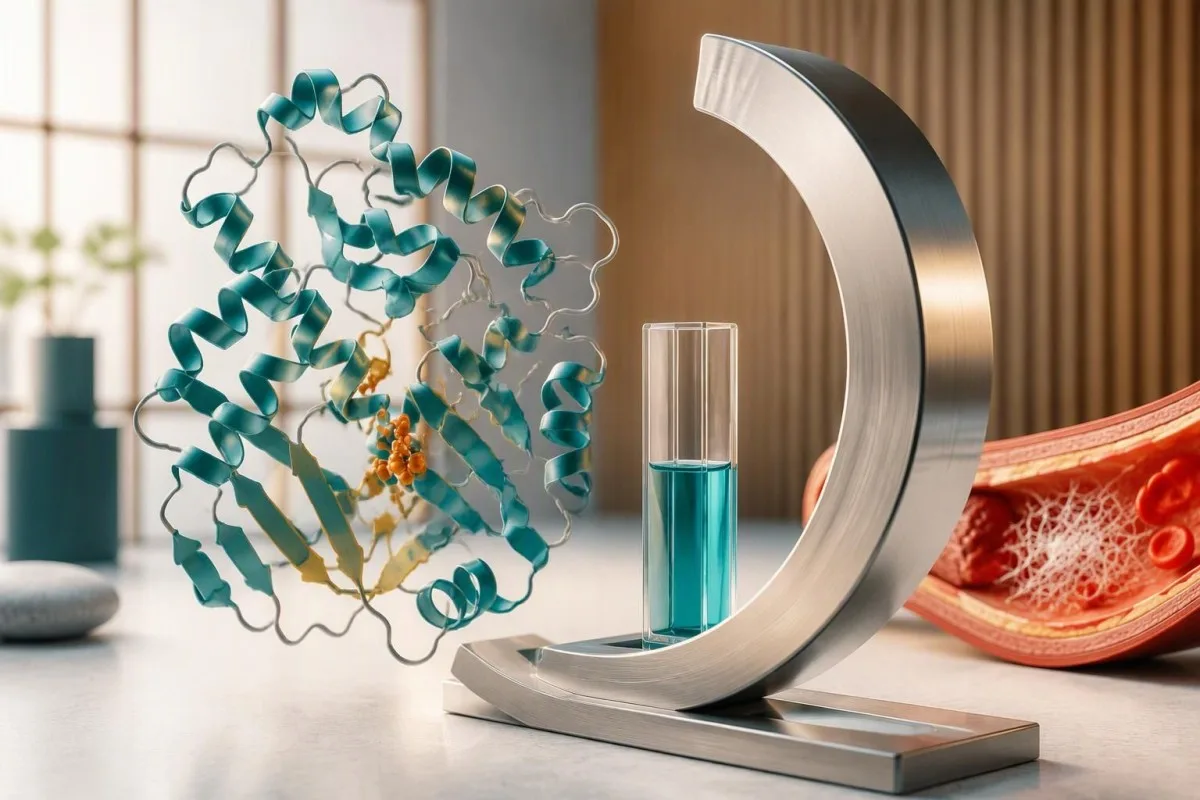
Nízka aktivita antitrombínu automaticky neznamená dedičný deficit: akútna trombóza, heparín, závažné ochorenie alebo strata bielkovín ju môžu dočasne znížiť. Lekári potvrdzujú pretrvávajúce odchýlky vhodne načasovaným vyšetrením aktivity, niekedy aj vyšetrením antigénu a laboratórnym plánom zohľadňujúcim lieky — často po prvých 3 mesiacoch liečby trombózy.

Kľúčové poznatky
- Referenčný rozsah: Aktivita antitrombínu u dospelých sa bežne pohybuje v rozmedzí 80–120%; použite referenčný interval uvedený vo vlastnom výsledku.
- Jeden nízky výsledok: Aktivita 65% pri novej trombóze alebo počas liečby heparínom nemôže potvrdiť dedičný deficit antitrombínu.
- Načasovanie opakovania: Britská hematologická spoločnosť odporúča vyšetrenie deficitov prirodzených antikoagulancií až po 3 mesiacoch antikoagulačnej liečby akútnej trombózy.
- Aktivita verzus antigén: Deficit typu I zvyčajne znižuje obe hodnoty; pri deficite typu II je znížená funkcia, zatiaľ čo hladina antigénu môže zostať normálna.
- Interferencia liekov: Apixabán, rivaroxabán a edoxabán môžu falošne zvýšiť aktivitu pri testoch založených na faktore Xa; dabigatrán môže spôsobiť to isté pri testoch založených na trombíne.
- Strata bielkovín: Proteinúria u dospelých v nefrotickom rozmedzí predstavuje zvyčajne aspoň 3,5 g za 24 hodín a môže prispievať k získanému poklesu antitrombínu.
- Vyšetrenie rodiny: Potvrdený heterozygotný dedičný deficit zvyčajne znamená, že každé dieťa má 50% pravdepodobnosť zdedenia príslušného variantu — nie 50% istotu, že sa uňho vytvorí krvná zrazenina.
- Bezpečnosť liekov: Nikdy neprerušujte antikoagulačnú liečbu s cieľom získať presnejší laboratórny výsledok bez individuálneho plánu od predpisujúceho lekára.
Čo v skutočnosti znamená nízka aktivita antitrombínu?
Nízka aktivita antitrombínu znamená, že laboratórny test zistil nižšiu antikoagulačnú funkciu, než sa očakávalo; sama osebe však neurčuje príčinu. Výsledok pod dolnou hranicou referenčného rozmedzia laboratória pre dospelých — často približne 80% — môže odrážať dedičný deficit, dočasnú spotrebu, zníženú tvorbu, stratu bielkovín alebo problém pri testovaní.

Antitrombín obmedzuje zrážanie krvi inhibíciou enzýmov vrátane trombínu, nazývaného aj faktor IIa, a faktora Xa. Výsledok aktivity 60% opisuje funkčnosť v porovnaní s kalibračným štandardom testu; neznamená to, že váš krvný obeh je chránený na 60% ani že pravdepodobnosť vzniku krvnej zrazeniny je 40%.
Normálny rutinný koagulačný panel nevylučuje deficit antitrombínu, pretože PT a aPTT nie sú skríningovými testami na každú dedičnú predispozíciu k zrážaniu krvi. Naše vysvetlenie obmedzení normálneho koagulačného panelu pomáha rozlíšiť tieto otázky: či sú časy zrážania predĺžené a či určitý prirodzený antikoagulant funguje normálne, sú 2 rôzne vyšetrenia.
Kantesti je analyzátor krvných testov s umelou inteligenciou, ktorý pomáha posúdiť percentuálnu aktivitu spolu s anamnézou liečby a súvisiacimi laboratórnymi výsledkami, namiesto toho, aby sa 1 abnormálny príznak považoval za diagnózu. Naša história a účel spoločnosti vysvetľuje túto úlohu; dedičný deficit si stále vyžaduje potvrdenie pod vedením lekára a naliehavé príznaky sa musia posúdiť nezávisle od akejkoľvek interpretácie umelej inteligencie.
Aké rozpätie aktivity antitrombínu sa považuje za nízke?
Aktivita antitrombínu u dospelých má zvyčajne referenčné rozmedzie približne 80–120%, hoci niektoré laboratóriá používajú rozmedzie 80–130% alebo iné validované rozmedzie. Aktivita 75% je preto často hranične nízka, ale ani 75%, ani žiadna iná jediná hraničná hodnota nepotvrdzuje dedičný deficit ani neurčuje urgentnú liečbu.

Mnoho ľudí s heterozygotným dedičným deficitom antitrombínu má aktivitu približne 40–70%, no rovnaké hodnoty môžu spôsobovať aj získané stavy. Naopak, niektoré dedičné varianty vedú k miernejšiemu poklesu alebo unikajú detekcii pri určitých testoch; lekári interpretujú mieru poklesu spolu s opakovanými výsledkami, nie ako samostatný genetický odtlačok.
Vek výrazne mení interpretáciu: zdravé donosené novorodence môžu mať aktivitu antitrombínu približne 40–60% hodnôt dospelých, pričom hladiny sa počas dojčenského obdobia zvyšujú. Predčasné narodenie prináša ďalšiu variabilitu a výsledky môže ovplyvniť aj neskoré tehotenstvo alebo skoré popôrodné obdobie; nekritické uplatnenie dolnej hranice 80% pre dospelých môže viesť k zavádzajúcemu označeniu.
Uveďme jasne hypotetický príklad: inak zdravý dospelý s aktivitou 78% a bez predchádzajúcich krvných zrazenín potrebuje iné vyšetrenie než dospelý s hodnotou 42% počas ťažkej sepsy. V oboch správach môže byť uvedený rovnaký príznak nízkej hodnoty, ale náš sprievodca výsledky laboratórnych výsledkov mimo rozsahu vysvetľuje, prečo referenčné limity nemožno zamieňať za diagnostické alebo liečebné prahové hodnoty.
| Úroveň | Rozmedzie | Čo to znamená |
|---|---|---|
| Bežné rozmedzie u dospelých | Približne 80–120% | Zvyčajne v rozmedzí, ale prednosť má vlastné rozmedzie laboratória a citlivosť testu. |
| Hraničný pokles | 70–79% | Often warrants context review and appropriately timed confirmation; not a diagnosis. |
| Clear reduction | 50–69% | Compatible with inherited or acquired deficiency; activity alone cannot distinguish them. |
| Výrazné zníženie | Below 50% | Requires clinical review, especially during illness or thrombosis; the percentage alone does not establish an emergency. |
Antigén antitrombínu verzus jeho aktivita: aký je rozdiel?
Jeden antithrombin activity test measures how effectively the protein inhibits a coagulation enzyme, while antithrombin antigen measures how much protein is present. Type I inherited deficiency generally lowers both; type II generally lowers activity despite a relatively normal antigen concentration, making these 2 tests complementary rather than interchangeable.

Most routine activity methods are chromogenic assays: the laboratory adds an enzyme and measures how much remains after antithrombin has inhibited it. The ISTH laboratory recommendations favor activity testing first, followed by antigen measurement when activity is low, with exclusion of acquired causes and assay interference before classification (Van Cott et al., 2020).
Consider 2 hypothetical repeat profiles obtained under suitable conditions: activity 52% with antigen 49% supports a quantitative pattern, whereas activity 52% with antigen 101% supports a qualitative pattern. These examples are not diagnostic formulas, because acquired illness can lower both measurements and antigen assays do not explain whether a functional result was distorted by medication.
Type II deficiency includes reactive-site, heparin-binding-site and other functional abnormalities; the choice of assay can change how readily a variant is detected. Kantesti’s explanations therefore distinguish quantity from performance, a distinction also illustrated by protein level versus function in C1 esterase inhibitor testing—but those are different proteins with different clinical consequences.
Môže akútna trombóza dočasne znížiť antitrombín?
Acute thrombosis can temporarily reduce antithrombin activity through consumption, particularly when accompanied by illness, procedures or treatment effects. A value such as 58% during a newly diagnosed deep vein thrombosis therefore cannot reliably distinguish an inherited baseline deficiency from a reduction caused by the current event.

The British Society for Haematology recommends testing deficiencies of natural anticoagulants only after 3 months of anticoagulation for acute thrombosis, because early results are unreliable and rarely change immediate management (Arachchillage et al., 2022). This is a recommendation about diagnostic timing, not an instruction to delay treating a suspected clot or to stop anticoagulants at month 3.
A hypothetical patient has activity of 61% during a pulmonary embolism and 96% after recovery using an appropriate assay. That change supports a temporary reduction, but comparing 2 percentages remains incomplete unless the clinician knows whether heparin, a direct oral anticoagulant, replacement products or different laboratory methods affected either measurement.
D-dimer answers a different question: it reflects fibrin formation and breakdown, not antithrombin quantity or inherited status. Our clotting tests and D-dimer guide explains why an elevated D-dimer and low activity can occur together during 1 acute event without proving that the low antithrombin caused the clot.
Prečo môže liečba heparínom znížiť aktivitu antitrombínu?
Heparin can lower circulating antithrombin during treatment, so a low result obtained while receiving unfractionated or low-molecular-weight heparin may reflect an acquired reduction. Heparin also depends on antithrombin for much of its anticoagulant effect; activity of 50% during treatment can therefore raise both diagnostic and medication-monitoring questions.

Reduced antithrombin can contribute to apparent heparin resistance, but an unexpectedly high dose requirement does not prove inherited deficiency. During 1 episode of severe illness, increased factor VIII or fibrinogen may shorten aPTT-based impressions of anticoagulation even when heparin exposure is adequate, so clinicians may reassess the monitoring method rather than simply escalate treatment.
Some heparin anti-Xa assays add exogenous antithrombin and others do not; this difference can affect what the result says about heparin concentration versus its activity in the patient. Ask the laboratory about 2 separate methods—the antithrombin activity assay and the heparin monitoring assay—because their handling of antithrombin and heparin is not necessarily identical.
A platelet fall of more than 50% during heparin exposure raises a separate possibility, heparin-induced thrombocytopenia, which is not diagnosed by low antithrombin. Our explanation of PF4 testing and HIT assessment describes that distinction; decisions about changing heparin, using replacement antithrombin or scheduling a repeat require the treating team, not a self-directed medication pause.
Ako závažné ochorenie a DIC znižujú antitrombín?
Sepsis, disseminated intravascular coagulation and major physiological stress can reduce antithrombin through consumption, impaired production and altered distribution. A markedly low result—for example, 35%—during critical illness is often an acquired finding; it cannot be used alone to label someone with lifelong hereditary antithrombin deficiency.

DIC is assessed from a pattern, not 1 abnormal protein: falling platelets, prolonged PT, increased fibrin-related markers and sometimes reduced fibrinogen provide the relevant context. Fibrinogen may initially remain normal or elevated because it is an acute-phase protein, so a preserved fibrinogen concentration does not automatically rule out evolving consumption.
For a hypothetical example, activity of 38%, platelets of 72 × 10^9/L and worsening PT during a major systemic illness point toward an acquired coagulation disturbance rather than an isolated inherited finding. Our DIC laboratory pattern explanation shows why trends across several measurements are more informative than repeatedly checking antithrombin while the illness remains active.
Recent antithrombin concentrate or plasma treatment can raise measured activity and obscure the underlying baseline, adding a second source of uncertainty during the same hospital stay. A result of 105% after replacement does not exclude inherited deficiency, just as 35% before recovery does not prove it; document the product and timing before interpreting either percentage.
Môže strata bielkovín obličkami spôsobiť nízku aktivitu antitrombínu?
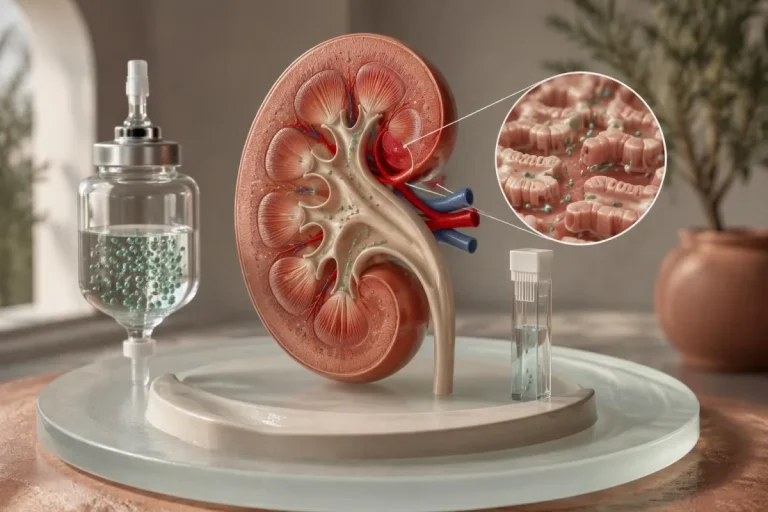
Heavy urinary protein loss can contribute to acquired antithrombin reduction, particularly in nephrotic syndrome. Adult nephrotic-range proteinuria is conventionally at least 3.5 g per 24 hours; clinicians interpret antithrombin alongside urine protein, serum albumin and the underlying kidney disorder, rather than relying on creatinine or eGFR alone.
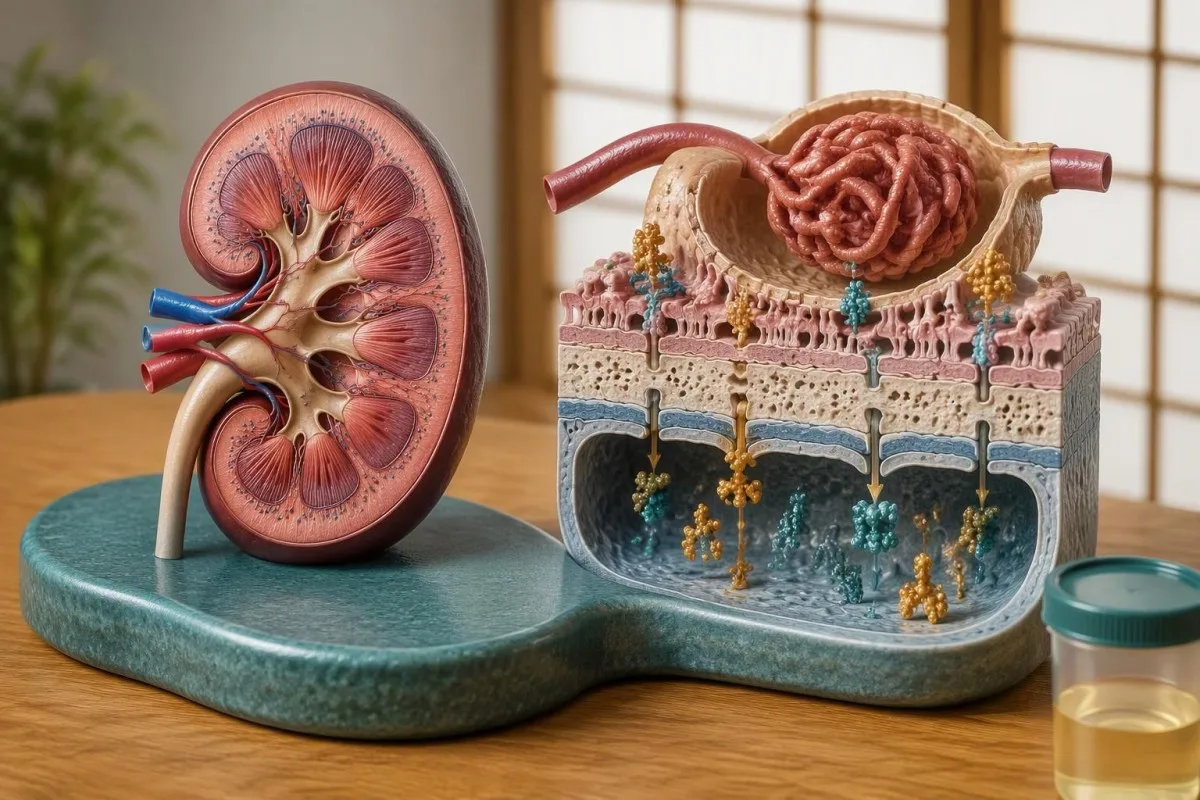
A normal eGFR does not exclude substantial protein leakage through the glomerular filtration barrier. For example, an adult with eGFR 95 mL/min/1.73 m², albumin 22 g/L and urine protein 6 g per day may have a strong acquired explanation for low activity despite apparently reassuring filtration results; persistent penivom moči a testovaní bielkovín deserve assessment in that context.
The relationship between nephrotic syndrome, antithrombin levels and clot risk is not uniform: not every person with nephrotic syndrome has low antithrombin, and the thrombotic tendency involves more than urinary loss of 1 protein. Underlying diagnosis matters, including membranous nephropathy, where PLA2R results and kidney monitoring help explain the kidney process rather than prove an inherited clotting disorder.
Kantesti is an AI blood test interpretation platform that can organize an antithrombin percentage alongside albumin and kidney markers, but it cannot infer the amount of urinary protein from eGFR alone. If activity remains 62% while heavy protein loss continues, repeat testing may still describe the acquired condition; the cleaner inherited assessment usually follows clinical stabilization and improvement of that competing explanation.
Môže ochorenie pečene alebo iná liečba znížiť antitrombín?
Reduced liver synthesis can lower antithrombin, especially in advanced liver disease, while certain treatments such as L-asparaginase can also cause acquired reductions. An activity of 55% alongside other abnormalities requires review of protein production, protein loss and treatment history before clinicians consider a genetic explanation.
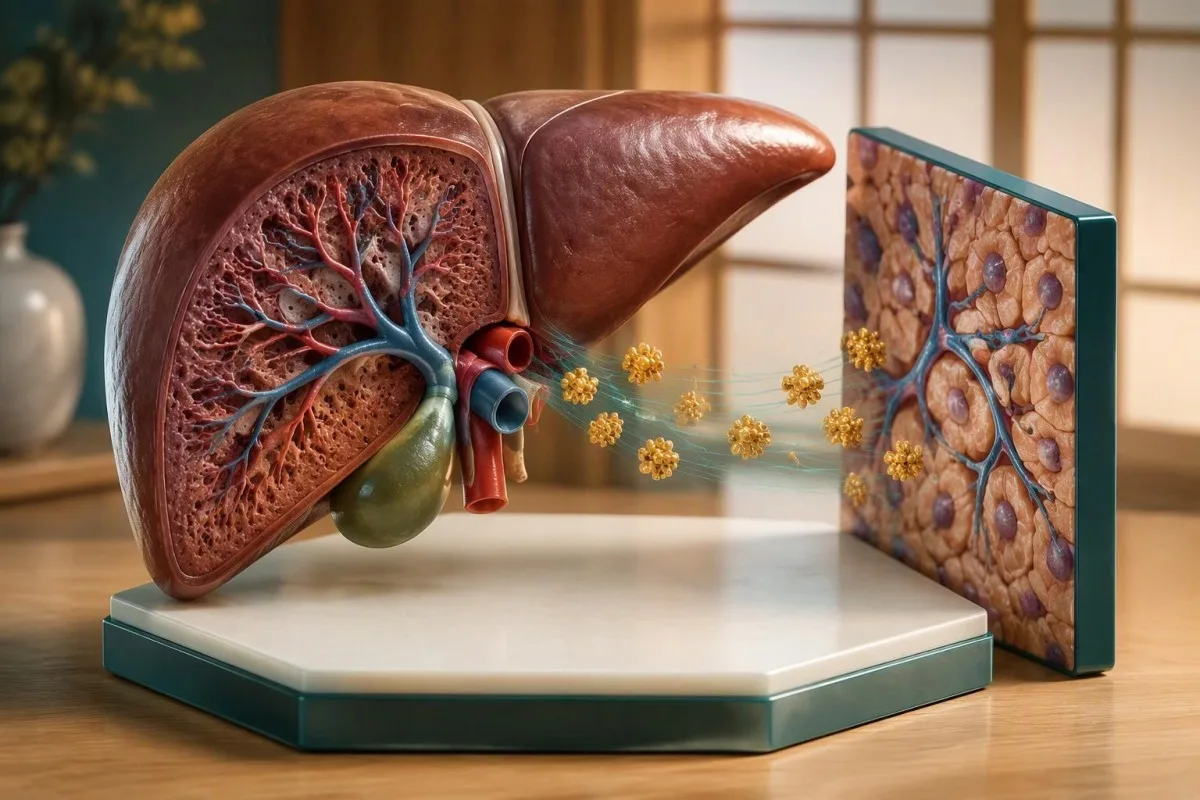
ALT and AST reflect injury more than protein-making capacity, so normal or mildly elevated enzymes do not guarantee normal antithrombin production. If activity is 57%, albumin is 25 g/L and INR is 1.6, impaired synthesis becomes a possibility—but warfarin, nutrition and protein loss can confound that pattern, as our sprievodca interpretáciou pečeňových testov .
Albumin cannot serve as a substitute antithrombin test because the 2 proteins have different turnover and can respond differently to illness or therapy. Our albumin and serum protein guide helps interpret the surrounding panel; a normal albumin does not exclude inherited antithrombin deficiency, and a low albumin does not prove that the liver caused it.
L-asparaginase can reduce anticoagulant proteins during cancer treatment, creating an acquired thrombosis risk that may need active management rather than merely a future repeat test. Major procedures, extracorporeal support and recent replacement products can also complicate 1 measurement; eating more protein or taking a vitamin supplement does not correct a SERPINC1-related defect or replace treatment of the underlying acquired cause.
Ktoré antikoagulanciá interferujú s vyšetrením antitrombínu?
Direct oral anticoagulants can falsely increase antithrombin activity, potentially masking deficiency rather than causing a low flag. Apixaban, rivaroxaban and edoxaban interfere with factor Xa-based activity assays, while dabigatran can interfere with thrombin-based assays; the same patient’s 2 results may therefore differ because of assay design.
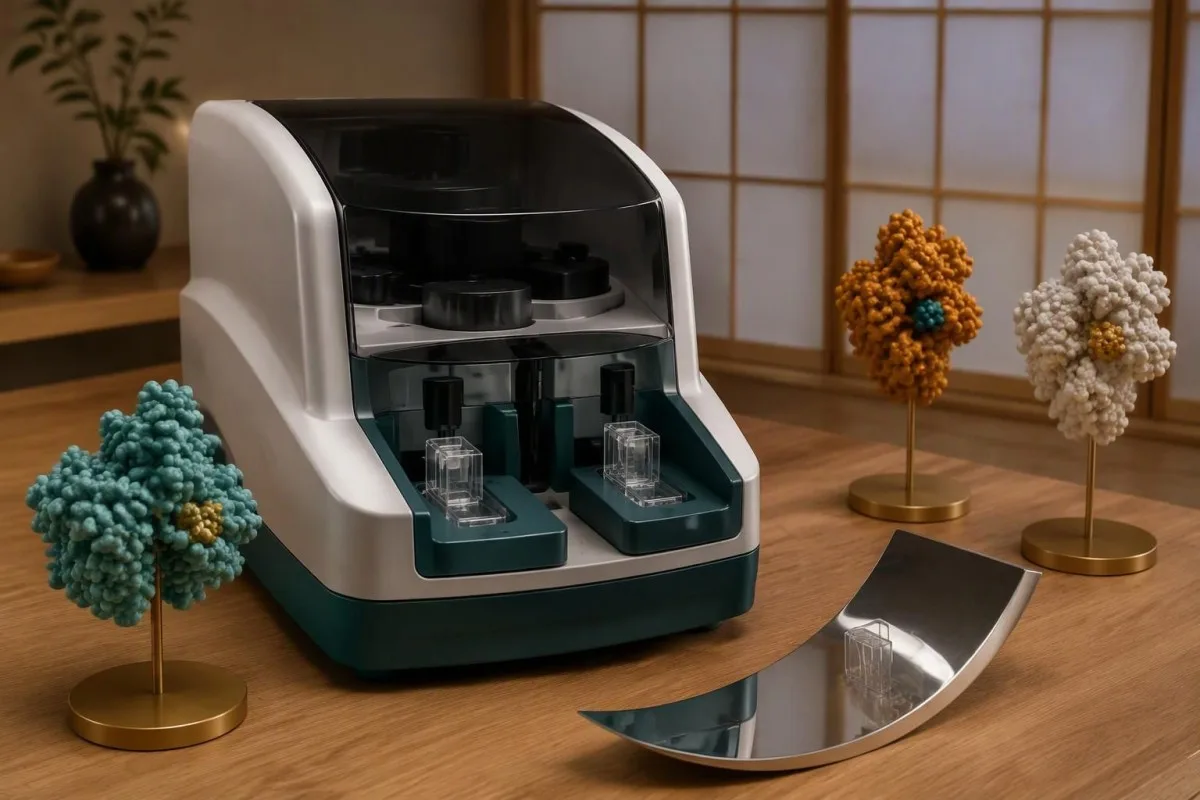
The mechanism is straightforward: the medication inhibits the assay’s added enzyme, and the instrument can misread that inhibition as stronger antithrombin function. The ISTH communication explicitly identifies these drug–assay combinations, including effects from direct thrombin inhibitors such as argatroban and bivalirudin (Van Cott et al., 2020); antigen testing usually avoids this particular functional interference, but does not replace an activity assessment.
A hypothetical activity of 108% on a factor Xa-based assay while taking rivaroxaban may conceal an underlying reduction; activity of 66% on that same drug still cannot be mathematically corrected into a true baseline. Anticoagulants also affect lupus anticoagulant test interpretation, but the direction and mechanism of interference are test-specific, not a universal rule for all thrombophilia assays.
Kantesti AI should support medication-aware interpretation rather than claim that 1 uploaded report identifies the laboratory’s reagent or removes a drug effect. Depending on the situation, the laboratory may use a less-affected assay, measure drug exposure or apply a validated removal procedure; our technické overenie a dohľad describes the broader standards behind interpretation, not a guarantee that AI can resolve missing assay information.
Mohlo neočakávaný nízky výsledok zapríčiniť nesprávne zaobchádzanie so vzorkou?
Sample quality and assay differences can make antithrombin results unreliable, especially when the laboratory flags collection or processing problems. Coagulation samples typically require a 9:1 ratio of sample to citrate anticoagulant; underfilling, inappropriate handling or an unsuitable specimen should be considered before interpreting an isolated abnormal percentage.

A hematocrit above approximately 55% may require citrate adjustment for coagulation testing because the amount of plasma relative to citrate is reduced. This is a laboratory preparation issue, not evidence of hereditary deficiency; if activity is 73% in a flagged specimen, ask whether the laboratory accepted the sample as valid and whether recollection is preferable to repeating the same material.
Hemolysis, lipemia and marked discoloration can interfere with optical methods, although the effect depends on the instrument and reagent rather than having 1 predictable direction. Our guides to hemolysis-related result distortion a lipemic specimens and redraws explain why a specimen-quality warning needs a method-specific answer instead of an automatic diagnosis.
Changing laboratories can create a second problem: an activity of 76% by one method and 84% by another may reflect analytical differences rather than biological recovery. Using the same laboratory helps trend comparison, but persistent clinical suspicion may justify a specialist laboratory using an alternative assay that is more sensitive to certain inherited variants; consistency and diagnostic sensitivity are 2 different goals.
Kedy treba nízku aktivitu antitrombínu zopakovať?
Repeat antithrombin testing should occur after temporary causes have settled and medication effects have been addressed. Following an acute clot, the BSH recommendation is to wait until after 3 months of anticoagulation before testing natural anticoagulant deficiencies; the safest collection date then depends on the drug, assay and clinical situation.

An incidental borderline result in a well adult without a recent clot does not automatically require the same 3-month wait, because that interval addresses acute thrombosis. The clinician may instead arrange a separate repeat once collection issues and acquired causes are reviewed, adding antigen testing if activity remains low; there is no universally validated waiting interval that fits every outpatient finding.
Heparin-related reductions may recover after treatment ends, but laboratory policies and ongoing illness affect when a repeat becomes meaningful. For a DOAC, a fixed 48-hour pause is not universally adequate or safe: kidney function, dose timing, drug accumulation and assay sensitivity matter, and choosing a compatible method may avoid interrupting treatment entirely.
Kantesti’s trend tools can help organize 2 measurements with their dates, but a timeline should also record clot onset, heparin exposure, the last relevant medication dose and any replacement products. Our explanation of výsledkom po prepustení z nemocnice supports that workflow; warfarin does not usually lower antithrombin as it lowers vitamin K-dependent proteins, so protein C or S stopping rules should not be copied automatically.
Ktoré nálezy svedčia o dedičnom deficite antitrombínu?
Inherited antithrombin deficiency becomes more likely when activity remains low on separate, interpretable samples, acquired causes are excluded and the personal or family history fits. Two concordant results provide stronger evidence than 1 result during illness, but activity, antigen and sometimes SERPINC1 testing must still be considered together.

A clearly hypothetical profile of activity 54% and 56% on 2 suitable occasions, antigen 51%, no major protein loss and a first-degree relative with confirmed deficiency would support a quantitative inherited pattern. Early or recurrent venous thrombosis increases suspicion, but age alone is not diagnostic, and absence of a family history does not exclude a new variant or previously unrecognized disease.
SERPINC1 testing can help establish a molecular explanation when the laboratory phenotype is convincing and the result could affect management or family counseling. A variant of uncertain significance is not equivalent to a diagnosis, while a negative genetic test does not necessarily exclude every relevant change; the ISTH recommendations also note that molecular testing may identify defects missed by activity assays (Van Cott et al., 2020).
Antithrombin and protein S deficiency require different interpretive rules, even when they appear on the same thrombophilia panel. Our guide to low protein S activity explains several contrasting confounders; a type II antithrombin heparin-binding-site variant can also have a different risk profile from type I deficiency, so 1 generic risk estimate should not be applied to all confirmed variants.
Kedy je vhodné vyšetrenie rodiny?
Family evaluation is usually considered after the original patient’s inherited deficiency is convincingly confirmed, especially when the result could change prevention, hormone choices or pregnancy planning. Most inherited antithrombin deficiency is autosomal dominant, giving each child of a heterozygous carrier a 50% chance of inheriting the relevant variant—not a certainty of thrombosis.
The BSH guideline discourages routine thrombophilia testing of all first-degree relatives but supports selective evaluation for relatives of people with antithrombin, protein C or protein S deficiency when results could influence management (Arachchillage et al., 2022). Our sprievodca rodinným testovaním založeným na riziku explains why testing 1 relevant inherited condition can be more useful than ordering a broad panel without a clinical question.
ASH’s 2023 thrombophilia guideline similarly supports selective testing in certain families with known high-risk deficiencies, including decisions about estrogen exposure and prophylaxis during particular risk situations (Middeldorp et al., 2023). Many recommendations are conditional and based on very low-certainty evidence; antithrombin deficiency should not be treated as interchangeable with factor V Leiden results, which often carry a different risk profile.
Kantesti’s Family Health Risk feature can help organize information shared with consent, but it cannot determine whether a relative inherited a SERPINC1 variant from 1 family member’s activity percentage. Testing children requires age-aware laboratory interpretation and an assessment of whether the result would change care now; predictive testing also deserves counseling about privacy, uncertainty and the difference between inherited susceptibility and an actual clot.
Čo má zahŕňať váš plán následnej kontroly a overovania zdrojov?
Bring the original percentage, reference interval, medication list and sampling date to follow-up, along with details of the clot, illness or protein loss that could explain the result. Two decisions come first: whether the current finding needs clinical action and whether repeat testing would genuinely change treatment or family counseling.

A low activity percentage alone does not automatically require lifelong anticoagulation or antithrombin concentrate; treatment depends on previous thrombosis, the provoking circumstances, bleeding risk and the confirmed diagnosis. New one-sided leg swelling needs prompt assessment, while sudden shortness of breath, chest pain or fainting requires emergency care even if the last activity was 100%—do not wait for a repeat thrombophilia panel.
Kantesti is an AI lab test interpretation service that can help organize the 2-stage workflow of context review followed by clinician-directed confirmation, not replace hematology advice or authorize medication interruption. Our zásady zodpovedného používania AI describe that boundary; use AI explanations to prepare precise questions, including which enzyme the assay uses and whether activity and antigen should be collected together.
The clinical recommendations here draw on 3 directly relevant external sources: the ISTH laboratory communication, the BSH testing guideline and the ASH thrombophilia guideline. The 2 Zenodo publications below provide background on serum proteins and immune-related laboratory context—not clinical trials validating antithrombin diagnosis; our štandardy medicínskeho obsahu a sprievodca testovaním komplementu a autoimunitných ochorení help readers distinguish supporting education from condition-specific evidence.
Často kladené otázky
Znamená nízka aktivita antitrombínu vždy dedičný deficit?
0 Nízka aktivita antitrombínu nemusí vždy znamenať dedičný deficit. Aktivita 60% sa môže vyskytnúť pri akútnej trombóze, liečbe heparínom, závažnom ochorení, pokročilom ochorení pečene alebo výrazných stratách bielkovín močom. Lekári po zvážení týchto získaných príčin hľadajú pretrvávajúce zníženie v samostatných vzorkách odobratých vo vhodnom čase. Stanovenie antigénu a niekedy aj vyšetrenie SERPINC1 pomáhajú klasifikovať potvrdenú abnormalitu.
Kedy treba po vzniku krvnej zrazeniny zopakovať test aktivity antitrombínu?
Po akútnej trombóze odporúča Britská hematologická spoločnosť testovať nedostatky prirodzených antikoagulancií až po 3 mesiacoch antikoagulačnej liečby. Pri skutočnom plánovaní odberu treba zohľadniť aj zotavenie, používané antikoagulancium a laboratórny test. Toto odporúčanie neznamená, že každý má po 3 mesiacoch vysadiť lieky. Antikoagulačnú liečbu nikdy neprerušujte kvôli testovaniu bez pokynov lekára, ktorý ju predpísal.
Aký je rozdiel medzi antigénom antitrombínu a jeho aktivitou?
Aktivita antitrombínu meria jeho funkciu, zatiaľ čo antigén antitrombínu meria množstvo proteínu. Pri deficite typu I sú zvyčajne znížené oba výsledky; pri deficite typu II je zvyčajne znížená aktivita, hoci antigén je relatívne normálny. Napríklad opakovaná aktivita 52% pri antigéne 101% poukazuje na kvalitatívny vzorec, ale nepotvrdzuje dedičnú príčinu bez preverenia získaných stavov a účinkov liekov. Vyšetrenie antigénu nemôže nahradiť platné funkčné vyšetrenie.
Môžu apixabán alebo rivaroxabán ovplyvniť výsledky antitrombínu?
Apixabán a rivaroxabán môžu vo vyšetreniach založených na faktore Xa falošne zvyšovať aktivitu antitrombínu, čím môžu maskovať jeho deficit. Dabigatrán môže podobne zvyšovať zdanlivú aktivitu vo vyšetreniach založených na trombíne. Výsledok 100% počas užívania lieku, ktorý spôsobuje interferenciu, preto môže byť menej upokojujúci, než sa zdá. Laboratórium môže zvoliť menej ovplyvnenú metódu alebo inú validovanú stratégiu; svojvoľne vysadiť liek nie je bezpečné.
Je aktivita antitrombínu 70% nebezpečná?
Aktivita antitrombínu 70% je nižšia než mnohé referenčné intervaly pre dospelých používané v laboratóriách, samotné percento však nepotvrdzuje naliehavý stav ani neurčuje mieru osobného rizika vzniku krvnej zrazeniny. Jeho význam závisí od použitého testu, liekov, prekonaných krvných zrazenín, rodinnej anamnézy a aktuálneho ochorenia. Izolovaný výsledok si zvyčajne vyžaduje klinické posúdenie a plán vhodného potvrdenia. Náhla dýchavičnosť, bolesť na hrudníku, mdloby alebo nový jednostranný opuch nohy si vyžadujú vyšetrenie bez ohľadu na toto percento.
Mala by sa moja rodina nechať vyšetriť, ak mám deficit antitrombínu?
Selektívne testovanie rodiny môže byť vhodné po presvedčivom potvrdení dedičného deficitu antitrombínu, najmä keď by výsledky zmenili prevenciu, výber hormonálnej liečby alebo plánovanie tehotenstva. Heterozygotný nosič má všeobecne 50% pravdepodobnosť, že odovzdá príslušný variant každému dieťaťu, nejde však o 50% istotu, že sa u dieťaťa rozvinie trombóza. Odporúčania BSH a ASH podporujú vyšetrenie zamerané na konkrétne rozhodnutia namiesto plošného testovania každého príbuzného. U detí treba výsledky interpretovať primerane veku a prediskutovať, či testovanie v súčasnosti mení postup.
Získajte vysvetlenie výsledkov krvných testov
Nahrajte svoj laboratórny nález a AI nástroja Kantesti vám v priebehu niekoľkých sekúnd vysvetlí každý biomarker jednoduchým jazykom. Používa ho viac než 2 milióny ľudí na celom svete.
Referencie
- Klein, T., Mitchell, S., & Weber, H. (2026). Sprievodca sérovými bielkovinami: globulíny, albumín a pomer A/G pri krvnom teste. Kantesti AI lekársky výskum. DOI
- Klein, T., Mitchell, S., & Weber, H. (2026). Sprievodca vyšetrením C3 a C4 komplementu v krvi a titrom ANA. Kantesti AI lekársky výskum. DOI
- Van Cott EM et al. (2020). Recommendations for clinical laboratory testing for antithrombin deficiency; Communication from the SSC of the ISTH. Journal of Thrombosis and Haemostasis. DOI
- Arachchillage DJ a kol. (2022). Testovanie trombofílie: odporúčanie British Society for Haematology. British Journal of Haematology. DOI
- Middeldorp S a kol. (2023). Odporúčania American Society of Hematology z roku 2023 na liečbu venózneho tromboembolizmu: testovanie trombofílie. Blood Advances. DOI
- 2 milióny+Analyzované testy
- 127+Krajiny
- 100+Jazyky
O zdravotníckom tíme


Signály dôvery E-E-A-T Trust Signals
Skúsenosti
Klinické hodnotenie vedené lekárom pracovných postupov interpretácie laboratórnych výsledkov.
Odbornosť
Laboratórna medicína so zameraním na to, ako sa biomarkery správajú v klinickom kontexte.
Autoritatívnosť
Lekársky recenzoval Dr. Thomas Klein, s príspevkami Dr. Sarah Mitchell a prof. Dr. Hansa Webera.
Dôveryhodnosť
Interpretácia založená na dôkazoch s jasnými následnými krokmi na zníženie poplachu.




Zdravotnícke upozornenie
Tento článok je určený len na vzdelávacie účely a nepredstavuje lekárske poradenstvo. Pri rozhodnutiach o diagnostike a liečbe sa vždy poraďte s kvalifikovaným poskytovateľom zdravotnej starostlivosti.
Publikované · Kontaktujte redakčný tím
Vydáva Kantesti Ltd, registrovaná v Anglicku a Walese, číslo spoločnosti. 17090423, Londýn, Spojené kráľovstvo.
