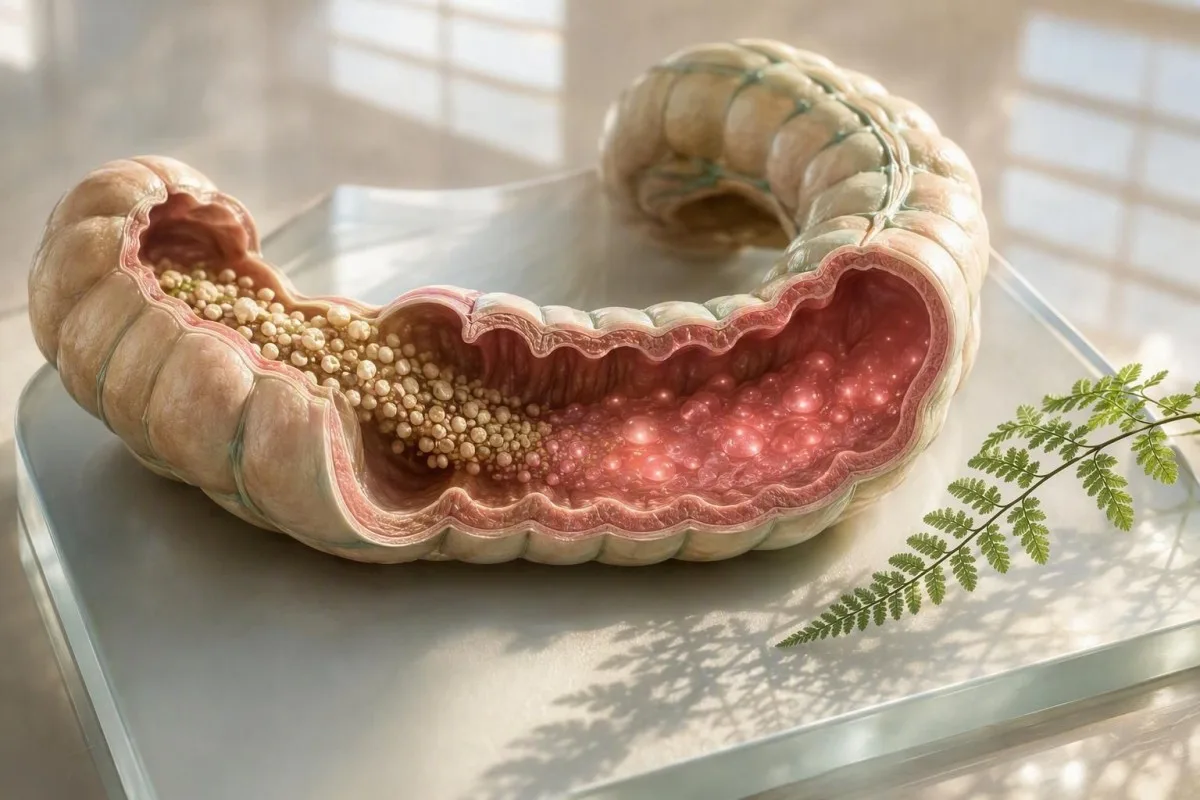
Een zure stoelgang kan wijzen op fermentatie van onverteerde suikers, maar het is een aanwijzing – geen diagnose van lactose-intolerantie of een andere voedselintolerantie.


- Lage stoelgang-pH betekent meestal een pH lager dan 5.5, wat wijst op coloniche fermentatie van onverteerde koolhydraten in een vers diarree-monster.
- Reducerende stoffen kunnen koolhydraatmalabsorptie ondersteunen, maar de test detecteert verschillende suikers en identificeert de dieet-trigger niet.
- Diarree bij peuters komt vaak voor tussen 6 maanden en 5 jaar bij kinderen die normaal groeien en grote hoeveelheden sap, sorbitol of fructose consumeren.
- Lactose-intolerantie wordt niet alleen gediagnosticeerd op basis van de zuurgraad van de ontlasting; een dieetgeschiedenis, groei-evaluatie en soms waterstofademtesten zijn informatiever.
- Verse verwerking is belangrijk omdat bacteriën na de inzameling zuur blijven produceren, wat een vertraagde monster zuurder kan laten lijken.
- Rode vlaggen omvatten bloed in de ontlasting, gewichtsverlies, aanhoudend braken, koorts, uitdroging, nachtelijke diarree of slechte lineaire groei.
- Tijdelijk lactase-tekort kan volgen op virale gastro-enteritis en verbetert vaak binnen dagen tot weken naarmate het darmslijmvlies herstelt.
- Bloedonderzoek kunnen uitdroging, anemie, ontsteking, coeliakie of nutritionele effecten beoordelen wanneer de symptomen aanhouden of de groei wordt beïnvloed.
Wat een zure stoelgangresultaat werkelijk betekent
Lage pH van de ontlasting, wat betekent: een verse ontlasting-pH van ruwweg 5.5 kan erop wijzen dat onverteerde suikers de dikke darm hebben bereikt en zijn gefermenteerd tot organische zuren. Het is een fysiologische aanwijzing, geen bewijs dat een kind lactose-intolerantie, een koemelkallergie of een permanente spijsverteringsstoornis heeft.
Praktisch gezien komen koolhydraten die normaal in de dunne darm worden geabsorbeerd in de dikke darm terecht, waar aanwezige bacteriën ze omzetten in vetzuren met een korte keten, waterstof, koolstofdioxide en soms methaan. Het resulterende zuur verlaagt de pH en kan water in de darm trekken; die combinatie verklaart waterige, borrelende, soms scherp zure ontlasting. Een ontlasting-pH van 6,0 tot 7,5 wordt vaak als globaal verwacht beschouwd, hoewel leeftijd, moedermelk, dieet en laboratoriummethode een enkele universele reeks onrealistisch maken.
De meest nuttige vraag is niet “Hoe laag is het getal?”, maar “Wat gebeurde er toen het werd verzameld?”. Een kind van 20 maanden met dunne ontlasting na een ziekte die op norovirus lijkt en een pH van 5.0 heeft een heel ander waarschijnlijkheidsprofiel dan een bloeiend kind van 3 jaar met één zure monster na een dag appelsap. De Bristol stoelpatroon en een driedaags voedings- en symptoomverslag voegen vaak meer diagnostische waarde toe dan het herhaaldelijk meten van de pH alleen.
Als Thomas Klein, MD, leg ik dit resultaat uit als een verkeerslicht in plaats van een etiket: het vertelt ons om zorgvuldig te kijken naar koolhydraatblootstelling, duur van de ontlasting, hydratatie en groei. Kantesti is een AI-bloedtestanalysator die gerelateerde bloedmarkers - zoals bicarbonaat, glucose, albumine, ijzerindices en coeliakie-screening - in klinische context plaatst in plaats van een stoelresultaat als een vonnis te behandelen.
Waarom de ontlasting zuur wordt
Fermentatie produceert melkzuur en vetzuren met een korte keten nadat suikers de dikke darm bereiken. Zure ontlasting kan ook de perianale huid irriteren, zodat een zuigeling of peuter roodheid kan ontwikkelen na frequente zure diarree, zelfs als er geen allergie of infectie is.
Hoe de stoelgang-pH-test wordt uitgevoerd – en waarom de timing deze verandert
A ontlasting-pH-test meet de waterstofionenconcentratie in een ontlastingsmonster, meestal met pH-papier of een elektrode. Een waarde lager 5.5 wordt traditioneel beschouwd als compatibel met koolhydraatmalabsorptie, maar laboratoria gebruiken geen volledig gestandaardiseerd protocol voor het verzamelen of rapporteren.
Het monster moet vers zijn en onmiddellijk worden afgeleverd, vooral als het waterig is. Bacteriën blijven koolhydraten metaboliseren na passage, dus een monster dat urenlang warm blijft, kan zuurder worden dan het in de darm was. Luiermateriaal, urinebesmetting en onvoldoende vloeibare ontlasting kunnen de test ook minder betrouwbaar maken.
Ik heb ouders begrijpelijkerwijs gealarmeerd gezien door een pH van 4.8 op een monster dat de avond ervoor is verzameld. Voordat ik voedsel uitsluit, zou ik vragen of het monster is gekoeld, hoe lang het transport duurde, of antibiotica de darmflora recentelijk hadden veranderd, en of de diarree nog steeds actief was. Testkwaliteit kan het verschil zijn tussen een nuttige aanwijzing en een valse spoor.
Een laboratorium-pH-resultaat onderscheidt lactose niet van fructose-, sucrose-, glucose-galactose-transportstoornissen, of snelle transit na infectie. Hetzelfde principe geldt voor testen: pre-analytische details kunnen de interpretatie veranderen, zoals onze gids voor laboratoriumveranderingen tijdens ziekte illustreert voor bloedresultaten.
Wat een pH-strip niet kan vertellen
Een pH-strip kan niet meten hoeveel koolhydraten werden gemalabsorbeerd, de betrokken koolhydraat naam geven, of vaststellen of symptomen voortkomen uit een enzymtekort, infectie, dieetpatroon of functionele diarree. Het kan ook geen voedselallergie diagnosticeren, die wordt veroorzaakt door immuunmechanismen in plaats van door ontlastingszuurgraad.
Hoe reducerende stoffen passen bij een zure stoelgang
Positieve reducerende stoffen in de ontlasting plus een pH onder 5,5 kan koolhydraatmalabsorptie ondersteunen, met name bij een kind met waterige diarree. De combinatie blijft niet-specifiek omdat de assays voor reducerende stoffen chemische suikereigenschappen detecteren, niet een benoemde intolerantie.
De klassieke koper-reductie-assay reageert met reducerende suikers zoals glucose, galactose, lactose en fructose. Sucrose is geen reducerende suiker, tenzij het eerst door hydrolyse wordt gesplitst, dus een negatieve test sluit sucrose-gerelateerde symptomen of sucrase-isomaltase-deficiëntie niet uit. Resultaten worden vaak gerapporteerd van negatief tot spoor, 1+, 2+, 3+, En 4+, maar die gradaties zijn niet uitwisselbaar tussen laboratoria.
Een zure pH met positieve reducerende stoffen is het meest overtuigend wanneer deze verschijnt tijdens actieve, volumineuze diarree en verbetert naarmate de symptomen afnemen. Onze gedetailleerde beoordeling van positieve reducerende stoffen in de ontlasting verklaart waarom een spoorresultaat in een gevormde ontlasting veel minder gewicht heeft dan een sterk positief resultaat in verse vloeibare ontlasting.
Kantesti is een AI-laboratoriumtest-interpretatieservice die gezinnen kan helpen bij het organiseren van gerelateerde bloedresultaten, maar noch onze analyse noch een resultaat van reducerende stoffen kan de pediatrische beoordeling van groei, hydratatie en het daadwerkelijke dieet van het kind vervangen. Als testen wordt gebruikt om een belangrijke beperking te rechtvaardigen, moet de klinische diagnose eerst solide zijn.
Een veelvoorkomende misvatting over melk
Een positieve test op reducerende stoffen bewijst niet dat melk de boosdoener is. Lactose kan aanwezig zijn in de ontlasting na tijdelijke post-infectieuze lactase-reductie, maar fructose-rijke dranken, medicijnen die sorbitol bevatten, en snelle transit kunnen een vergelijkbaar biochemisch patroon creëren.
Waarom koolhydraatmalabsorptie diarree veroorzaakt
Koolhydraatmalabsorptie veroorzaakt diarree via osmoses en fermentatie: Ongeabsorbeerde suikers trekken water naar het darmlumen, waarna coliforme bacteriën het omzetten in zuren en gas. De ontlasting kan daarom dun, zuur en gepaard gaan met een opgeblazen gevoel of luieruitslag.
De dunne darm gebruikt normaal gesproken enzymen en transporteurs om koolhydraten af te breken en op te nemen. Lactase bevindt zich aan de borstelrand en splitst lactose in glucose en galactose; wanneer mucosale schade lactase tijdelijk vermindert, blijft lactose in het lumen achter. 12 tot 18 gram lactose – de hoeveelheid in ongeveer een kopje melk – kan symptomen veroorzaken bij een vatbaar ouder kind, hoewel de individuele tolerantie aanzienlijk varieert.
Osmostische diarree verbetert vaak wanneer het slecht geabsorbeerde koolhydraat wordt verwijderd en kan verergeren na een voeding met veel suiker. Toch kan een kind met virale diarree een lage pH hebben omdat beschadigde mucosa en snelle transit gelijktijdig optreden; dit “intolerantie” noemen kan een levenslange aandoening impliceren wanneer de biologie meestal tijdelijk is. Beoordeling interpretatie van ontlastingskweek wanneer koorts, reizen, uitbraken of langdurige symptomen de mogelijkheid van een infectieuze oorzaak doen toenemen.
Het punt is dat fermentatie normale biologie is in de dikke darm. De abnormaliteit is niet de aanwezigheid van bacteriële zuurproductie, maar de combinatie van overmatig substraat, symptomen en klinische gevolgen zoals uitdroging, achterblijvende groei of voedingstekorten.
Gas is niet gelijk aan malabsorptie
Waterstof en kooldioxide kunnen krampen en uitzetting veroorzaken, maar gas alleen komt vaak voor bij gezonde kinderen. Symptomen die betrouwbaar volgen op een dosis van een specifiek koolhydraat zijn informatiever dan de geur van de ontlasting, bubbels of één laboratoriumwaarde.
Waarom een lage stoelgang-pH geen lactose-intolerantie of melkallergie diagnosticeert
Een lage pH van de ontlasting kan niet diagnosticeren lactose-intolerantie, en het heeft geen vermogen om te diagnosticeren koemelkproteïneallergie. Lactose-intolerantie weerspiegelt beperkte koolhydraatvertering; melkallergie is een immuunreactie en kan braken, netelroos, eczeem, bloed of slijm in de ontlasting, of slechte groei veroorzaken.
Primaire lactase-niet-persistentie is zeldzaam als symptomatisch probleem bij zuigelingen en varieert sterk per afkomst en leeftijd. Secundaire lactase-deficiëntie is waarschijnlijker na acute gastro-enteritis, onbehandelde coeliakie of intestinale ontsteking. The American Academy of Pediatrics merkt op dat lactose-intolerantie moet worden beoordeeld aan de hand van de anamnese en passende tests in plaats van te worden aangenomen op basis van niet-specifieke gastro-intestinale symptomen (Heyman et al., 2006).
Een korte, begeleide lactose-reductie kan redelijk zijn na diarree als het de symptomen duidelijk verbetert, maar brede melkvermijding heeft nadelen. Veel kinderen hebben praktische vervangende bronnen van calcium, vitamine D, eiwitten en energie nodig; langdurige beperking zonder dieetondersteuning kan contraproductief zijn. Voor context over pediatrische voedingsmarkers, zie calciumgehaltes bij kinderen.
Thomas Klein, MD, heeft de tegenovergestelde fouten in de kliniek gezien: families die lactose blijven gebruiken ondanks duidelijke post-infectieuze symptomen, en families die alle zuivelproducten maandenlang elimineren na één enkele zure ontlasting. Een tijdgebonden proef met geplande herintroductie is vaak veiliger dan een onbeperkt eliminatiedieet, tenzij een arts allergie of een andere ziekte vermoedt.
Wanneer allergie dringende beoordeling vereist
Onmiddellijke netelroos, piepende ademhaling, zwelling van het gezicht, herhaaldelijk braken, lethargie of circulatiesymptomen na het drinken van melk vereisen dringende medische beoordeling. Bloed in de ontlasting, aanhoudend eczeem met voedingsproblemen, of achterblijvende groei verdienen pediatrische beoordeling in plaats van thuis testen.
Diarree bij peuters: de gebruikelijke dieetcontext
Diarree bij peuters, ook wel chronische niet-specifieke diarree genoemd, treft meestal kinderen van 6 maanden tot 5 jaar oud die frequente dunne dagelijkse ontlasting hebben, maar normale energie, een normaal lichamelijk onderzoek en een normale groei. Overmatig sap, fructose, sorbitol, grote vloeistofvolumes en weinig voedingsvet kunnen allemaal bijdragen aan zure ontlasting.
Appel, peer, en sommige gemengde vruchtendranken kunnen aanzienlijke vrije fructose en sorbitol bevatten, die variabel worden geabsorbeerd. Een kind dat 500 tot 700 ml sap of gezoete dranken per dag drinkt, kan ondanks een verder goed uitziend kind, dunne ontlasting hebben; het verminderen van sap tot leeftijdsadequate hoeveelheden kan nuttiger zijn dan het testen van elk voedingsmiddel. Het Rome IV-kader uit 2016 classificeert dit patroon onder functionele gastro-intestinale aandoeningen wanneer er geen alarmsignalen zijn (Rhoads et al., 2016).
Het ontlastingspatroon is veelzeggend: meerdere dunne ontlastingen gedurende de dag, zichtbare voedseldeeltjes, weinig of geen ontlasting 's nachts, en aanhoudende gewichtstoename wijzen op peuterdiarree. Daarentegen zijn nachtelijke ontlasting, een kind dat wakker wordt uit slaap met pijn, of een naar beneden door de gewichtspercintielen zakken niet typisch en veranderen de werk-up. Onze Gids voor spijsverteringsklachten bespreekt het praktische belang van timing.
Kantesti is een AI-aangedreven bloedtestanalysehulpmiddel dat wordt gebruikt om nutritionele en metabole bloedmarkers te interpreteren wanneer een arts deze heeft aangevraagd voor aanhoudende spijsverteringssymptomen. Bij een welvarende peuter met klassieke dieettriggers kunnen bloedtesten echter weinig toevoegen; een gerichte dieetgeschiedenis is meestal de eerste stap met een hogere opbrengst.
Een nuttig voedingsdagboekformaat
Noteer dranken in milliliters, niet alleen “glazen”, naast de timing van de ontlasting voor 72 uur. Neem suikervrije snoepjes, kauwtabletten met vitaminen, hoestbereidingen en elektrolytenproducten op, omdat sorbitol en fructose kunnen schuilen in producten waarvan families niet denken dat het voedsel is.
Andere redenen waarom een kind zure stoelgang kan hebben
Een zure ontlasting betekenis is breder dan koolhydraatintolerantie: acute virale gastro-enteritis, snelle intestinale transit, overmatige dieetsuikers, door antibiotica veroorzaakte microbiomeverandering en zeldzame aangeboren aandoeningen kunnen de pH van de ontlasting verlagen. De leeftijd en het traject van het kind bepalen welke oorzaken testen verdienen.
Na gastro-enteritis kan de borstelrand van de dunne darm enige tijd nodig hebben om 1 tot 3 weken de volledige lactaseactiviteit te herstellen, vooral bij zuigelingen en peuters. Gedurende die periode kan een kind zure diarree hebben na blootstelling aan lactose zonder permanente lactose-intolerantie te hebben. Daarom beoordelen veel artsen de tolerantie opnieuw na herstel in plaats van het dieet permanent te veranderen.
Coeliakie kan secundaire koolhydraatmalabsorptie veroorzaken, maar een lage pH van de ontlasting is er geen screeningsonderzoek voor. Aanhoudende diarree met abdominale distensie, ijzertekort, vertraagde groei of een familiegeschiedenis kan weefseltransglutaminase IgA plus totaal IgA rechtvaardigen, omdat IgA-deficiëntie een vals geruststellend coeliakie-screen kan creëren; zie IgA en coeliakie testvalkuilen.
Zeldzame aandoeningen verdienen vermelding zonder onnodige angst te veroorzaken. Aangeboren sucrase-isomaltase-deficiëntie verschijnt vaak wanneer zetmeel en sucrose in de voeding komen, terwijl glucose-galactosemalabsorptie meestal ernstige neonatale waterige diarree en uitdroging veroorzaakt. Deze diagnoses worden gedreven door dramatische klinische patronen en specialistische tests - niet alleen door pH.
Wanneer ontsteking waarschijnlijker is
Aanhoudende bloed, koorts, gewichtsverlies, anemie, of verhoogde ontstekingsmarkers plaatsen inflammatoire darmziekte en infectie hoger op de lijst. In die setting kan een fecale calprotectine resultaat klinisch informatiever zijn dan het herhalen van de pH van de ontlasting.
Welke tests de oorzaak verduidelijken wanneer de symptomen aanhouden
Aanhoudende diarree vereist gerichte testen, niet een groter, willekeurig ontlastingspanel. Artsen selecteren tests op basis van leeftijd, duur, hydratatie, groei, blootstellingsgeschiedenis en of het patroon wijst op suikermalabsorptie, ontsteking, alvleesklierziekte, infectie of coeliakie.
Een waterstofademtest kan lactose- of fructosemalabsorptie evalueren wanneer de voorgeschiedenis onduidelijk is, hoewel voorbereiding en interpretatie belangrijk zijn. Een stijging in ademwaterstof van 20 parts per million boven de uitgangswaarde wordt vaak gebruikt in protocollen, maar er treden fout-positieven op door snelle transit en fout-negatieven bij personen met lage waterstofproductie. Symptomen tijdens de test zijn net zo belangrijk als de gascurve.
Voor diarree die langer dan 14 dagen, duurt, kunnen clinici stoelpathogentesten, coeliakieserologie, volledig bloedbeeld, elektrolyten, albumine en ontstekingsmarkers overwegen, afhankelijk van de presentatie. ESPGHAN en ESPID raden routinematige onnodige interventies af bij acute pediatrische gastro-enteritis, en richten zich in plaats daarvan op de klinische beoordeling van uitdroging en adequate rehydratatie (Guarino et al., 2014).
Als stoelen volumineus, olieachtig, moeilijk door te spoelen zijn of gepaard gaan met slechte gewichtstoename, verschuift de vraag van koolhydraatvertering naar vetvertering. Fecale vettest en pancreasevaluatie beantwoorden een andere klinische vraag dan een pH-strip, dus de één kan de ander niet vervangen.
Tests moeten een gedefinieerde vraag beantwoorden
Een test is het meest nuttig wanneer een positief en een negatief resultaat tot verschillende volgende stappen zouden leiden. Het herhalen van de stoel pH bij een gezond kind wiens symptomen verdwijnen na het verminderen van sap verandert zelden de zorg; een gestructureerde ademtest kan helpen wanneer het dieetverhaal tegenstrijdig blijft.
Groei en hydratatie zijn belangrijker dan het zuurgetal
Een kind met zure ontlasting die drinkt, plast, alert is en zijn gebruikelijke groeicurve volgt, loopt meestal minder risico dan een kind met een normale pH en uitdroging of gewichtsverlies. Klinische status weegt zwaarder dan stoel pH bij het beslissen of een dringende evaluatie nodig is.
Tekenen van uitdroging omvatten merkbaar verminderde urineproductie, droge mond, afwezige tranen, ongebruikelijke slaperigheid, koele extremiteiten en aanhoudend braken. Bij zuigelingen, minder dan 3 natte luiers in 24 uur of een duidelijk ingezonken fontanel verdient onmiddellijk klinisch advies; drempels hebben context nodig, maar ouders merken de verandering vaak op voordat een test dat doet.
Wanneer diarree langdurig of ernstig is, kunnen bloedonderzoeken lage bicarbonaatgehalten door stoel bicarbonaatverlies, veranderde natrium- of kaliumgehalten, verhoogd ureum door uitdroging, of ijzertekort door een onderliggende enteropathie aantonen. Onze elektrolytenpanel-richtlijn verklaart waarom symptomen en verschillende waarden samen veiliger te interpreteren zijn dan één getal buiten het bereik.
Kantesti AI kan longitudinale bloedwaarden organiseren en veranderingen markeren voor discussie, maar het stelt de oorzaak van pediatrische diarree niet vast. Een monster genomen na slechte inname kan albumine en hemoglobine tijdelijk concentreren, wat voedingszorgen kan verbergen, tenzij de hydratiestatus wordt overwogen.
Groeigegevens om mee te nemen naar het bezoek
Neem gewichts- en lengterecords mee van het vorige 6 tot 12 maanden, niet alleen het getal van vandaag. Een stabiel percentiel is geruststellend; een aanhoudende daling over twee belangrijke percentielkanalen is een reden om zorgvuldiger te onderzoeken.
Rode vlaggen die medische beoordeling vereisen in plaats van dieetexperimenten
Zoek onmiddellijk medische beoordeling voor diarree met bloed, zwarte ontlasting, galbraken, hevige buikpijn, koorts bij een jonge zuigeling, uitdroging, gewichtsverlies of verminderde alertheid. Een lage pH van de ontlasting is nooit een reden om de zorg uit te stellen wanneer deze tekenen aanwezig zijn.
Bloed of slijm kan voorkomen bij infecties, colitis gerelateerd aan allergieën, fissuren en inflammatoire darmziekten; de aanwezigheid ervan wordt niet verklaard door eenvoudige lactose-malabsorptie. Een kind met bloed in de ontlasting en koorts kan onderzoek naar ziekteverwekkers in de ontlasting en een lichamelijk onderzoek nodig hebben, terwijl een kind met terugkerend bloed en slechte groei een breder traject nodig heeft. Lees onze praktische gids over waarschuwingssignalen voor slijm en bloed voor wat clinici eerst vragen.
Diarree die langer dan 2 weken, aanhoudt, terugkerende episodes gedurende meerdere maanden, of symptomen die de slaap verstoren, rechtvaardigen een juiste evaluatie, zelfs wanneer het kind er tussentijds goed uitziet. Andere waarschuwingssignalen zijn onder meer aanhoudende buikzwelling, mondzweren, gewrichtssymptomen, een familiegeschiedenis van coeliakie of inflammatoire darmziekten, en een onverklaarbaar laag hemoglobinegehalte.
Naar mijn ervaring voelen ouders zich soms gerustgesteld door een “eenvoudig koolhydraatprobleem” en stellen ze de controle uit wanneer het kind gewicht verliest. Dat is de verkeerde richting: de reden dat we ons zorgen maken over diarree plus falende groei is dat deze samen duiden op een verminderde inname, malabsorptie of darmaandoening, terwijl losse ontlasting alleen vaak goedaardig is.
Wat vandaag te doen
Ga door met gebruikelijke vloeistoffen en gebruik orale rehydratievloeistof wanneer aanbevolen; vermijd het forceren van alleen puur water bij een jong kind met aanzienlijke verliezen. Houd een schriftelijk verslag bij van de frequentie van de ontlasting, de urineproductie, de temperatuur, de dranken en het gewicht, indien beschikbaar.
Hoe dieetveranderingen te proberen zonder een kind te veel te beperken
Een veilig dieetexperiment is kort, specifiek en omkeerbaar: verander één waarschijnlijke koolhydraatbron voor 7 tot 14 dagen, volg de frequentie en het comfort van de ontlasting, en introduceer deze vervolgens opnieuw als de symptomen verbeteren. Het elimineren van zuivel, fruit, gluten en meerdere voedselgroepen tegelijk maakt het resultaat onmogelijk te interpreteren.
Bij vermoedelijke peuterdiarree, begin met dranken: stop sap en gezoete dranken, verminder overmatig drinken tussen maaltijden door, en bied evenwichtige maaltijden aan met voldoende voedingsvet voor de leeftijd. Het doel is geen koolhydraatarm dieet. Kinderen hebben koolhydraten nodig voor energie, en het vervangen ervan door restrictieve “darm” producten kan de calorie-inname verminderen zonder het onderliggende patroon op te lossen.
Bij mogelijke post-infectieuze lactose-malabsorptie verdragen veel kinderen yoghurt of harde kaas beter dan melk omdat bacteriële culturen en verwerking lactose verminderen. Een diëtist kan helpen bij het zorgen voor calciumopname; zuivelalternatieven variëren sterk en alleen verrijkte producten bieden een zinvolle vervanging. Zie ons evidence-based overzicht van voedingsmiddelen die stoelgangtesten beïnvloeden voordat u ingrijpende veranderingen aanbrengt.
Kantesti ondersteunt voedingsgesprekken door bestelde bloedmarkers in de loop van de tijd weer te geven, niet door een eliminatiedieet te voorschrijven op basis van een stoelgangresultaat. Kantesti is een AI-platform voor interpretatie van biomerkers dat patronen in door clinici bestelde laboratoriumgegevens identificeert, terwijl voedseluitdagingen en pediatrische beslissingen individueel klinisch werk blijven.
Vermijd een veelvoorkomende testvalkuil
Introduceer niet op dezelfde dag een nieuwe probiotica, vezelpoeder, lactosevrije formule en sapbeperking. Als alle vier tegelijkertijd beginnen, kan verbetering op dag 10 niet aan een enkele interventie worden toegeschreven.
Wat het darmmicrobioom en probiotica wel – en niet – kunnen verklaren
Darmbacteriën genereren zuren uit koolhydraten, dus het microbioom beïnvloedt de pH van de ontlasting; een lage pH identificeert echter geen schadelijke bacteriële onbalans en bewijst niet dat een probioticum nodig is. De zuurgraad van de ontlasting is een ruw eindsignaal van dieet, transit, microbiële stofwisseling en verzamelomstandigheden.
Korteketenvetzuren zijn over het algemeen normale producten van colontfermentatie en kunnen het energiemetabolisme van de coloncellen ondersteunen. Het klinische probleem ontstaat wanneer er voldoende slecht geabsorbeerd koolhydraat overblijft om water in het darmlumen en symptomen te verhogen. Dit onderscheid is belangrijk omdat pogingen om stoelgang te “alkaliseren” geen standaardbehandeling zijn en kunnen afleiden van hydratatie of dieettrigers.
Het bewijs voor probiotica bij acute diarree is stam-specifiek en product-specifiek; effecten kunnen niet worden afgeleid uit een stoelgang pH-waarde. Voor anders gezonde kinderen raad ik aan de stam, dosering, duur en immuunstatus met een arts te bespreken in plaats van een product te kiezen op basis van marketingclaims. Onze probioticaveiligheidsgids behandelt die praktische grenzen.
Antibiotica kunnen fermentatiepatronen veranderen, maar nieuwe diarree tijdens of na antibiotica roept ook bezorgdheid op over medicijneffecten en, in passende klinische settings, pathogentesten. Een lagere pH na antibiotica vertelt ons niet of de antibioticum hielp, schaadde of simpelweg samenviel met een intercurrente virale ziekte.
Geur is geen laboratoriumtest
Zure of ongewoon penetrante stoelgeur kan gepaard gaan met koolhydraatfermentatie, maar de geur heeft een slechte diagnostische precisie. De observatie van ouders is nuttig wanneer deze wordt gecombineerd met timing, blootstelling aan voedsel, huiduitslag, koorts en hydratatie - niet als vervanging voor testen.
Hoe u zich voorbereidt op een nuttig kinderartsconsult
De beste pediatrische consultatie begint met een beknopte tijdlijn: stoelfrequentie, consistentie, nachtelijke symptomen, dranken in mL, maaltijden, recente ziekte, medicijnen, reizen, familiegeschiedenis en groei-records. Deze informatie vernauwt vaak de differentiële diagnose voordat een andere test wordt aangevraagd.
Breng de exacte laboratoriumterminologie mee, inclusief pH-waarde, de graad van reducerende stoffen, datum van het specimen, en of het monster gekoeld was. Een pH van 5.2 uit een vloeibaar monster dat binnen een uur werd geanalyseerd, betekent meer dan “abnormale stoelgangtest” die in een portaal werd gekopieerd. Het is ook nuttig om te vermelden wat het kind de afgelopen 24 uur heeft gegeten en of diarree na een virale ziekte volgde.
Stel vier directe vragen: Welke diagnose is het meest waarschijnlijk? Welke bevinding zou u zorgen baren over een andere oorzaak? Is een korte dieetproef redelijk? Wanneer moeten we de groei opnieuw beoordelen? Deze vragen voorkomen de gebruikelijke afdwaling naar herhaalde tests zonder een duidelijk beslissingspunt. De bloedtest samenvatting checklist kan gezinnen helpen bij het efficiënt verzamelen van gerelateerde resultaten.
Als een arts bloedonderzoek aanvraagt, gebruik dan een veilig dossier in plaats van te vertrouwen op geheugen of screenshots verspreid over apparaten. Onze privacygerichte technologiegids legt uit hoe onze meertalige Health AI geüploade laboratoriumrapporten verwerkt en tegelijkertijd interpretatie scheidt van diagnose.
Wat niet mee te nemen
Voel u niet verplicht om elke stoelgang van een week met symptomen mee te nemen, tenzij het klinische team dit vraagt. Een duidelijke logboek en een correct verzameld vers monster dat voor een specifieke test wordt aangevraagd, zijn meestal nuttiger dan meerdere ongeplande specimens.
Waar AI en laboratoriuminterpretatie duidelijke beperkingen hebben
AI kan laboratoriuminformatie organiseren en vragen voor een arts identificeren, maar geen enkel AI-systeem kan koolhydraatinquietude diagnosticeren op basis van alleen stoelgang pH. De diagnose hangt af van symptoomtiming, dieet, onderzoek, groei en soms formele adem-, genetische, endoscopische of infectietesten.
Kantesti AI interpreteert geüploade bloeduitslagen in ongeveer 60 seconden en kan combinaties aan het licht brengen zoals laag ferritine plus laag albumine of elektrolytveranderingen na langdurige diarree. Die functie is nuttig voor voorbereiding en trendbewustzijn, maar vervangt de kinderarts niet die een kind kan onderzoeken, groei kan plotten en kan beslissen of een stoelresultaat actie vereist.
Onze medische inhoud wordt getoetst aan klinische normen, omdat nauwkeurigheid ook inhoudt dat men weet wanneer men niet te veel moet afleiden. U kunt over onze methodologie en klinisch toezicht lezen in het medisch validatiedossier, en de artsen ontmoeten die dit werk begeleiden via onze Medische Adviesraad.
Vanaf 26 augustus 2026, mijn conclusie is eenvoudig: een lage pH van de ontlasting kan passen bij malabsorptie van koolhydraten, vooral naast positieve reducerende substanties en waterige diarree, maar kan het type, de duur of de oorzaak van een intolerantie niet vaststellen. Als er rode vlaggen zijn, zoek dan onmiddellijk medische hulp; als het kind gedijt, werk dan met een arts aan een gemeten dieet- en opvolgingsplan in plaats van bang te zijn voor één zuur resultaat.
Een verstandige volgende stap
Bewaar het originele verslag, noteer de omstandigheden van de afname en deel het volledige verhaal met de arts van het kind. Als er bloedonderzoek is aangevraagd, Kantesti’s biomarker-gids kan u helpen de termen te begrijpen vóór de afspraak, zonder ze om te zetten in zelfdiagnose.
Veelgestelde vragen
Wat betekent een lage pH in de ontlasting bij een kind?
Een stoel-pH van minder dan ongeveer 5.5 kan betekenen dat onverteerde koolhydraten de dikke darm hebben bereikt en door bacteriën zijn gefermenteerd tot zuren. Dit patroon kan optreden bij tijdelijke lactasedeficiëntie na gastro-enteritis, een hoge inname van fructose of sorbitol, of andere oorzaken van snelle transit. Het stelt op zichzelf geen lactose-intolerantie vast, omdat vertraging bij de afname, dieet en infectie ook de pH kunnen beïnvloeden. Een kinderarts moet het resultaat interpreteren in samenhang met het stoelpatroon, de groei, de hydratatie en de symptomen.
Betekent zure ontlasting lactose-intolerantie?
Nee, zure ontlasting betekent op zichzelf geen lactose-intolerantie. Lactosemalabsorptie is een mogelijke oorzaak van een stoel-pH onder 5.5, maar fructose, sorbitol, snelle transit na infectie en andere onverteerde suikers kunnen hetzelfde bevinden veroorzaken. Lactose-intolerantie is geloofwaardiger wanneer symptomen herhaaldelijk optreden na blootstelling aan lactose en verbeteren tijdens een korte, begeleide vermindering met latere herintroductie. Melkallergie is een andere immuunaandoening en kan niet worden vastgesteld aan de hand van de stoel-pH.
Wat zijn reducerende stoffen bij stoelgangonderzoek?
Reducerende substanties zijn suikers die reageren in een chemische stoelassay, waaronder glucose, galactose, lactose en fructose. Een positief resultaat samen met waterige, zure ontlasting kan malabsorptie van koolhydraten ondersteunen, maar kan de verantwoordelijke suiker of de ernst van het probleem niet identificeren. Sucrose kan worden gemist omdat het geen reducerende suiker is, tenzij het laboratorium het eerst hydrolyseert. Resultaten gerapporteerd als spoor, 1+, of hoger moeten altijd worden gelezen met behulp van de methode van dat laboratorium en de klinische geschiedenis van het kind.
Kan diarree bij peuters een lage pH van de ontlasting veroorzaken?
Ja, diarree bij peuters kan een lage stoel-pH veroorzaken wanneer overtollig sap, vrije fructose, sorbitol of grote hoeveelheden zoete dranken de dikke darm bereiken. Dit veelvoorkomende functionele patroon treedt meestal op tussen 6 maanden en 5 jaar en gaat vaak gepaard met normale groei, normale activiteit en diarree overdag zonder bloed. Een dagboek van 72 uur waarin de dranken in milliliters en de timing van de stoelgang worden bijgehouden, is vaak nuttiger dan herhaaldelijk de pH testen. Nachtelijke diarree, gewichtsverlies, koorts of bloed zijn niet typisch en vereisen medische beoordeling.
Hoe lang kan ontlasting zuur blijven na een buikgriep?
Ontlasting kan zuur blijven gedurende ongeveer 1 tot 3 weken na virale gastro-enteritis omdat de dunne-darmborstelrand tijdelijk minder lactase kan produceren en de transit snel kan blijven. Veel kinderen herstellen zonder langdurige dieetbeperking, vooral naarmate de eetlust en de consistentie van de ontlasting normaliseren. Een korte lactosevermindering kan soms onder klinische begeleiding worden gebruikt, gevolgd door geplande herintroductie. Aanhoudende symptomen na 2 weken, slechte inname, uitdroging of slechte groei moeten opnieuw worden beoordeeld.
Wanneer is een lage pH van de ontlasting bij een kind urgent?
Lage stoel-pH op zichzelf is geen noodsituatie, maar dringende beoordeling is nodig als diarree optreedt met uitdroging, bloed of zwarte ontlasting, galbraken, hevige buikpijn, ongebruikelijke slaperigheid of verminderde urineproductie. Bij een jong kind is minder dan 3 natte luiers in 24 uur een zorgwekkende hydratatieverandering en verdient onmiddellijk klinisch advies. Diarree die langer dan 14 dagen duurt of gepaard gaat met gewichtsverlies, vereist ook een kinderartsenbeoordeling. Het uiterlijk, de hydratatie en de groei van het kind zijn urgenter indicatoren dan het pH-getal.
Ontvang vandaag nog AI-aangedreven bloedtestanalyse
Sluit je aan bij meer dan 2 miljoen gebruikers wereldwijd die Kantesti vertrouwen voor directe, nauwkeurige analyse van labtests. Upload je bloedwaarden resultaten en ontvang binnen enkele seconden een uitgebreide interpretatie van 15,000+-biomarkers.
📚 Geraadpleegde wetenschappelijke publicaties
Klein, T., Mitchell, S., & Weber, H. (2026). Kantesti LTD. (2026). C3 C4 Complement Bloedtest & ANA Titer Gids. Zenodo. https://doi.org/10.5281/zenodo.18353989. Kantesti AI medisch onderzoek.
Klein, T., Mitchell, S., & Weber, H. (2026). Kantesti LTD. (2026). Nipahvirus Bloedtest: Gids voor Vroege Detectie & Diagnose 2026. Zenodo. https://doi.org/10.5281/zenodo.18487418. Kantesti AI medisch onderzoek.
📖 Externe medische referenties
Guarino A et al. (2014). Europese richtlijnen van de European Society for Pediatric Gastroenterology, Hepatology, and Nutrition/European Society for Pediatric Infectious Diseases voor de behandeling van acute gastro-enteritis bij kinderen in Europa: update 2014. Journal of Pediatric Gastroenterology and Nutrition.
⚕️ Medische disclaimer
Dit artikel is uitsluitend bedoeld voor educatieve doeleinden en vormt geen medisch advies. Raadpleeg altijd een gekwalificeerde zorgverlener voor beslissingen over diagnose en behandeling.
E-E-A-T Vertrouwenssignalen
Ervaring
Klinische beoordeling door artsen van lab-interpretatieworkflows.
Expertise
Laboratoriumgeneeskunde met focus op hoe biomarkers zich gedragen in een klinische context.
Gezag
Geschreven door Dr. Thomas Klein, met review door Dr. Sarah Mitchell en Prof. Dr. Hans Weber.
Betrouwbaarheid
Evidence-based interpretatie met duidelijke vervolgstappen om onrust te verminderen.