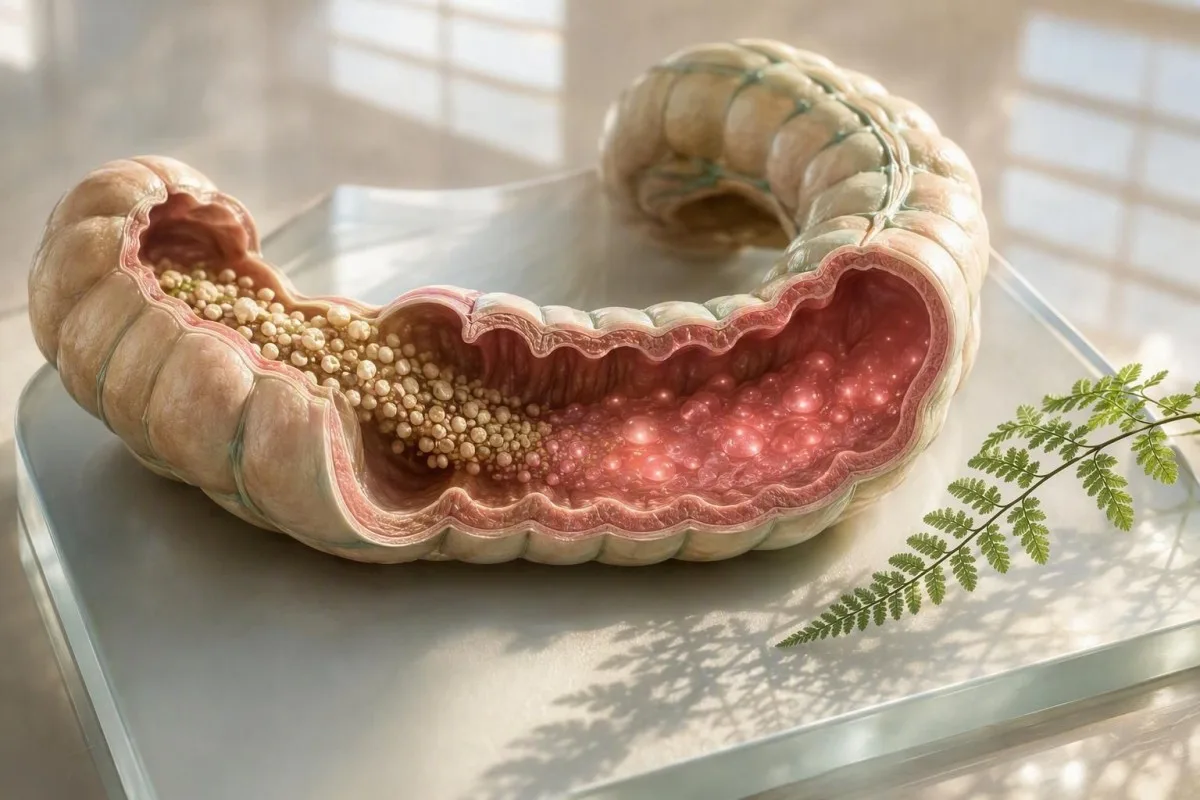
Une selle acide peut refléter la fermentation de sucres non absorbés, mais c'est un indice — pas un diagnostic d'intolérance au lactose ou d'une autre intolérance alimentaire.


- Faible pH des selles signifie généralement un pH inférieur à 5.5, suggérant une fermentation colique de glucides non absorbés dans un échantillon de diarrhée fraîche.
- Substances réductrices peuvent soutenir la malabsorption des glucides, mais le test détecte plusieurs sucres et n'identifie pas le déclencheur alimentaire.
- Diarrhée du jeune enfant survient souvent entre 6 mois et 5 ans chez des enfants en bonne croissance qui consomment de grandes quantités de jus, de sorbitol ou de fructose.
- Intolérance au lactose ne se diagnostique pas par la seule acidité des selles ; un historique alimentaire, un examen de la croissance et parfois un test respiratoire à l'hydrogène sont plus informatifs.
- La manipulation fraîche est importante car les bactéries continuent de produire de l'acide après le prélèvement, ce qui peut rendre un échantillon retardé plus acide.
- Signes d’alerte incluent du sang dans les selles, une perte de poids, des vomissements persistants, de la fièvre, une déshydratation, une diarrhée nocturne ou un retard de croissance staturo-pondérale.
- Déficit temporaire en lactase peut survenir après une gastro-entérite virale et s'améliore souvent en quelques jours ou semaines à mesure que la muqueuse intestinale se rétablit.
- analyses sanguines peuvent évaluer la déshydratation, l'anémie, l'inflammation, la maladie cœliaque ou les effets nutritionnels lorsque les symptômes sont persistants ou que la croissance est affectée.
Ce que signifie réellement un résultat de selles acides
Signification d'un pH fécal bas : un pH fécal frais inférieur à environ 5.5 peut indiquer que des sucres non absorbés ont atteint le côlon et ont été fermentés en acides organiques. C'est un indice physiologique, pas une preuve qu'un enfant souffre d'intolérance au lactose, d'allergie au lait ou d'un trouble digestif permanent.
En pratique, les glucides normalement absorbés dans l'intestin grêle s'échappent dans le côlon, où les bactéries résidentes les transforment en acides gras à chaîne courte, en hydrogène, en dioxyde de carbone et parfois en méthane. L'acide résultant abaisse le pH et peut attirer l'eau dans l'intestin ; cette combinaison explique les selles aqueuses, gazeuses, parfois à odeur âcre. Un pH fécal de 6,0 à 7,5 est souvent décrit comme globalement attendu, bien que l'âge, le lait maternel, le régime alimentaire et la méthode de laboratoire rendent une plage universelle unique irréaliste.
La question la plus utile n'est pas “ Quel est le chiffre le plus bas ? ” mais “ Que se passait-il au moment du prélèvement ? ” Un enfant de 20 mois avec des selles molles après une maladie ressemblant à une norovirose et un pH de 5.0 a un profil de probabilité très différent de celui d'un enfant de 3 ans en bonne santé avec un seul échantillon acide après une journée de jus de pomme. Le aspect des selles selon Bristol et un journal alimentaire et symptomatique de trois jours ajoutent souvent plus de valeur diagnostique que la répétition du pH seul.
En tant que Thomas Klein, MD, j'explique ce résultat comme un feu de circulation plutôt qu'une étiquette : il nous indique d'examiner attentivement l'exposition aux glucides, la durée des selles, l'hydratation et la croissance. Kantesti est un analyseur sanguin IA qui place les marqueurs sanguins apparentés, tels que le bicarbonate, le glucose, l'albumine, les indices du fer et le dépistage cœliaque, dans un contexte clinique plutôt que de traiter un résultat fécal comme un verdict.
Pourquoi les selles deviennent acides
La fermentation produit de l'acide lactique et des acides gras à chaîne courte après que les sucres atteignent le côlon. Les selles acides peuvent également irriter la peau périnéale, de sorte qu'un nourrisson ou un jeune enfant peut développer des rougeurs après une diarrhée acide fréquente, même en l'absence d'allergie ou d'infection.
Comment le test de pH des selles est effectué — et pourquoi le moment influe sur celui-ci
A test de pH fécal mesure la concentration d'ions hydrogène dans un échantillon de selles, généralement avec du papier pH ou une électrode. Une valeur inférieure à 5.5 est traditionnellement considéré comme compatible avec la malabsorption des glucides, mais les laboratoires n'utilisent pas un protocole de prélèvement ou de compte-rendu entièrement standardisé.
L'échantillon doit être frais et livré rapidement, surtout s'il est aqueux. Les bactéries continuent à métaboliser les glucides après l'évacuation, de sorte qu'un spécimen laissé à température ambiante pendant plusieurs heures peut devenir plus acide qu'il ne l'était dans l'intestin. Le matériel de couche, la contamination urinaire et une selle liquide insuffisante peuvent également rendre les tests moins fiables.
J'ai vu des parents s'alarmer, à juste titre, d'un pH de 4.8 sur un échantillon prélevé la veille au soir. Avant d'exclure des aliments, je demanderais si l'échantillon a été réfrigéré, combien de temps a pris le transport, si des antibiotiques ont récemment modifié la flore intestinale et si la diarrhée était encore active. La qualité du test peut faire la différence entre un indice utile et une fausse piste.
Un résultat de pH en laboratoire ne distingue pas les troubles du transport du lactose, du fructose, du saccharose, du glucose-galactose, ni le transit rapide après une infection. Le même principe s'applique à l'ensemble des tests : les détails préanalytiques peuvent altérer l'interprétation, comme notre guide des changements de laboratoire pendant la maladie l'illustre pour les résultats sanguins.
Ce qu'une bandelette de pH ne peut pas vous dire
Une bandelette de pH ne peut pas mesurer la quantité de glucides malabsorbés, nommer le glucide impliqué, ni établir si les symptômes proviennent d'une carence enzymatique, d'une infection, d'un régime alimentaire, ou d'une diarrhée fonctionnelle. Elle ne peut pas non plus diagnostiquer une allergie alimentaire, qui est déclenchée par des mécanismes immunitaires plutôt que par l'acidité des selles.
Comment les substances réductrices s'inscrivent dans le cadre de selles acides
Substances réductrices dans les selles positives plus un pH inférieur à 5,5 peuvent soutenir la malabsorption des glucides, en particulier chez un enfant souffrant de diarrhée aqueuse. L'association reste non spécifique car les dosages des substances réductrices détectent les propriétés chimiques des sucres, et non une intolérance nommée.
Le dosage classique par réduction du cuivre réagit avec les sucres réducteurs tels que le glucose, le galactose, le lactose et le fructose. Le saccharose n'est pas un sucre réducteur à moins d'avoir été d'abord séparé par hydrolyse, donc un test négatif n'exclut pas les symptômes liés au saccharose ou une déficience en sucrase-isomaltase. Les résultats sont souvent rapportés de négatif à traces, 1+, 2+, 3+, et 4+, mais ces grades ne sont pas interchangeables entre laboratoires.
Un pH acide avec des substances réductrices positives est plus convaincant lorsqu'il apparaît pendant une diarrhée active et abondante et s'améliore à mesure que les symptômes disparaissent. Notre examen détaillé des substances réductrices dans les selles positives explique pourquoi un résultat de traces dans une selle formée a beaucoup moins de poids qu'un résultat fortement positif dans une selle liquide fraîche.
Kantesti est un service d'interprétation de tests de laboratoire basé sur l'IA qui peut aider les familles à organiser les résultats sanguins connexes, mais ni notre analyse ni un résultat de substances réductrices ne peuvent remplacer l'évaluation pédiatrique de la croissance, de l'hydratation et du régime alimentaire réel de l'enfant. Si les tests sont utilisés pour justifier une restriction majeure, le diagnostic clinique doit être solide au préalable.
Une idée fausse fréquente concernant le lait
Un test positif aux substances réductrices ne prouve pas que le lait est en cause. Le lactose peut être présent dans les selles après une réduction temporaire de la lactase post-infectieuse, mais les boissons riches en fructose, les médicaments contenant du sorbitol et un transit rapide peuvent créer un schéma biochimique similaire.
Pourquoi la malabsorption des glucides provoque la diarrhée
La malabsorption des glucides provoque la diarrhée par osmose et fermentation : Le sucre non absorbé attire l'eau dans la lumière intestinale, puis les bactéries coliques le transforment en acides et en gaz. Les selles peuvent donc être liquides, acides et associées à des ballonnements ou à une irritation de la couche.
L'intestin grêle utilise normalement des enzymes et des transporteurs pour décomposer et absorber les glucides. La lactase se trouve à la bordure en brosse et scinde le lactose en glucose et en galactose ; lorsque les lésions de la muqueuse réduisent temporairement la lactase, le lactose reste dans la lumière. Juste 12 à 18 grammes de lactose – la quantité contenue dans environ une tasse de lait – peuvent provoquer des symptômes chez un enfant plus âgé susceptible, bien que la tolérance individuelle varie considérablement.
La diarrhée osmotique s'améliore souvent lorsque le glucide mal absorbé est éliminé et peut s'aggraver après un repas riche en sucre. Pourtant, un enfant atteint de diarrhée virale peut avoir un pH bas car la muqueuse lésée et le transit rapide coexistent ; qualifier cela d“” intolérance » peut impliquer une condition permanente alors que la biologie est généralement temporaire. Revue interprétation de la culture des selles en cas de fièvre, de voyage, d'épidémies ou de symptômes prolongés soulevant la possibilité d'une cause infectieuse.
Le fait est que la fermentation est une biologie normale dans le côlon. L'anomalie n'est pas la présence de production d'acide bactérien, mais la combinaison d'un excès de substrat, de symptômes et de conséquences cliniques telles que la déshydratation, un ralentissement de la croissance ou une carence nutritionnelle.
Le gaz n'équivaut pas à une malabsorption
L'hydrogène et le dioxyde de carbone peuvent provoquer des crampes et une distension, mais les gaz seuls sont fréquents chez les enfants en bonne santé. Les symptômes qui suivent de manière fiable une dose d'un glucide spécifique sont plus informatifs que l'odeur des selles, les bulles ou une seule valeur de laboratoire.
Pourquoi un faible pH des selles ne diagnostique pas l'intolérance au lactose ou l'allergie au lait
Un faible pH des selles ne peut pas diagnostiquer intolérance au lactose, et il n'a aucune capacité à diagnostiquer une allergie aux protéines de lait de vache. L'intolérance au lactose reflète une digestion limitée des glucides ; l'allergie au lait est une réponse immunitaire et peut provoquer des vomissements, de l'urticaire, de l'eczéma, du sang ou du mucus dans les selles, ou une mauvaise croissance.
La non-persistance primaire de la lactase est rare en tant que problème symptomatique chez le nourrisson et varie fortement selon l'ascendance et l'âge. La déficience secondaire en lactase est plus plausible après une gastro-entérite aiguë, une maladie cœliaque non traitée ou une inflammation intestinale. L'American Academy of Pediatrics note que l'intolérance au lactose doit être évaluée par l'histoire et des tests appropriés plutôt que supposée à partir de symptômes gastro-intestinaux non spécifiques (Heyman et al., 2006).
Une réduction du lactose courte et supervisée peut être raisonnable après la diarrhée si elle améliore clairement les symptômes, mais une éviction large du lait présente des inconvénients. De nombreux enfants ont besoin de sources de remplacement pratiques de calcium, de vitamine D, de protéines et d'énergie ; une restriction prolongée sans soutien diététique peut être contre-productive. Pour le contexte des marqueurs nutritionnels pédiatriques, voir taux de calcium chez les enfants.
Thomas Klein, MD, a observé les erreurs opposées en clinique : des familles qui continuent le lactose malgré des symptômes post-infectieux évidents, et des familles qui éliminent tous les produits laitiers pendant des mois après une seule selle acide. Un essai limité dans le temps avec réintroduction planifiée est souvent plus sûr qu'un régime d'élimination indéfini, à moins qu'un clinicien ne suspecte une allergie ou une autre maladie.
Quand l'allergie nécessite un examen rapide
L'apparition immédiate d'urticaire, de respiration sifflante, d'un gonflement du visage, de vomissements répétés, de léthargie ou de symptômes circulatoires après la consommation de lait nécessite une évaluation médicale urgente. Le sang dans les selles, l'eczéma persistant avec des difficultés d'alimentation ou un ralentissement de la croissance méritent un examen pédiatrique plutôt que des tests à domicile.
Diarrhée du jeune enfant : le contexte alimentaire courant
Diarrhée du jeune enfant, également appelée diarrhée chronique non spécifique, affecte généralement les enfants âgés de 6 mois à 5 ans qui ont des selles liquides fréquentes pendant la journée mais une énergie, un examen et une croissance normaux. Un excès de jus, de fructose, de sorbitol, de grands volumes de liquide et un faible taux de matières grasses alimentaires peuvent tous contribuer à des selles acides.
Les jus de fruits de pomme, de poire et certains jus de fruits mélangés peuvent contenir des quantités importantes de fructose libre et de sorbitol, qui sont absorbés de manière variable. Un enfant qui boit 500 à 700 mL de jus ou de boissons sucrées chaque jour peut avoir des selles molles tout en semblant bien par ailleurs ; réduire la consommation de jus à des quantités appropriées à l'âge peut être plus utile que de tester chaque aliment. Le cadre Rome IV 2016 classe ce schéma parmi les troubles gastro-intestinaux fonctionnels en l'absence de signes d'alerte (Rhoads et al., 2016).
Le schéma des selles est révélateur : plusieurs selles molles pendant la journée, des particules alimentaires visibles, peu ou pas de selles pendant la nuit et une prise de poids continue favorisent la diarrhée du tout-petit. En revanche, les selles nocturnes, un enfant qui se réveille de son sommeil avec douleur, ou qui descend dans les courbes de poids n'est pas typique et modifie le bilan. Notre guide des symptômes digestifs discute de l'importance pratique du calendrier.
Kantesti est un outil d'analyse sanguine basé sur l'IA utilisé pour interpréter les marqueurs sanguins nutritionnels et métaboliques lorsqu'un clinicien les a prescrits pour des symptômes digestifs persistants. Chez un tout-petit en bonne santé présentant des déclencheurs alimentaires classiques, cependant, les analyses sanguines peuvent apporter peu ; une histoire alimentaire ciblée est généralement la première étape la plus rentable.
Un format utile de journal alimentaire
Enregistrez les boissons en millilitres, pas seulement en “ tasses ”, ainsi que le moment des selles pour 72 heures. Inclure les bonbons sans sucre, les vitamines à croquer, les sirops contre la toux et les produits électrolytiques car le sorbitol et le fructose peuvent se cacher dans des produits que les familles ne considèrent pas comme des aliments.
Autres raisons pour lesquelles un enfant peut avoir des selles acides
Un signification des selles acides est plus large que l'intolérance aux glucides : une gastro-entérite virale aiguë, un transit intestinal rapide, un excès de sucres alimentaires, un changement du microbiome associé aux antibiotiques et de rares troubles congénitaux peuvent tous abaisser le pH des selles. L'âge de l'enfant et sa trajectoire déterminent quelles causes méritent d'être testées.
Après une gastro-entérite, la bordure en brosse de l'intestin grêle peut avoir besoin de 1 à 3 semaines pour rétablir une activité lactase complète, en particulier chez les nourrissons et les tout-petits. Pendant cet intervalle, un enfant peut avoir une diarrhée acide après exposition au lactose sans avoir d'intolérance au lactose permanente. C'est pourquoi de nombreux cliniciens réévaluent la tolérance après la guérison au lieu de modifier le régime alimentaire de façon permanente.
La maladie cœliaque peut causer une malabsorption secondaire des glucides, mais un faible pH des selles n'est pas un test de dépistage pour cela. La diarrhée persistante avec distension abdominale, carence en fer, ralentissement de la croissance ou antécédents familiaux peut justifier une recherche d'anticorps IgA anti-transglutaminase tissulaire et d'IgA totale, car un déficit en IgA peut donner un résultat faussement rassurant pour le dépistage de la maladie cœliaque ; voir Pièges des tests IgA et cœliaques.
Les maladies rares méritent d'être mentionnées sans causer de peur inutile. Le déficit congénital en sucrase-isomaltase apparaît souvent lorsque les amidons et le saccharose entrent dans l'alimentation, tandis que la malabsorption du glucose-galactose provoque généralement une diarrhée aqueuse néonatale sévère et une déshydratation. Ces diagnostics sont guidés par des tableaux cliniques spectaculaires et des tests spécialisés, et non par le pH seul.
Lorsque l'inflammation est plus probable
La présence de sang, de fièvre, de perte de poids, d'anémie ou de marqueurs inflammatoires élevés fait figurer la maladie inflammatoire de l'intestin et l'infection plus haut sur la liste. Dans ce contexte, un résultat de calprotectine fécale peut être plus informatif sur le plan clinique que de répéter le pH des selles.
Quels tests clarifient la cause lorsque les symptômes persistent
La diarrhée persistante nécessite des tests ciblés, et non un panel de selles plus large et non sélectif. Les médecins choisissent les tests en fonction de l'âge, de la durée, de l'hydratation, de la croissance, des antécédents d'exposition et si le schéma clinique suggère une malabsorption des sucres, une inflammation, une maladie pancréatique, une infection ou une maladie cœliaque.
Un test respiratoire à l'hydrogène peut évaluer la malabsorption du lactose ou du fructose lorsque l'histoire est incertaine, bien que la préparation et l'interprétation soient importantes. Une augmentation de l'hydrogène expiré de 20 parties par million au-dessus de la valeur de base est couramment utilisée dans les protocoles, mais des faux positifs dus à un transit rapide et des faux négatifs chez les faibles producteurs d'hydrogène surviennent. Les symptômes pendant le test sont aussi importants que la courbe de gaz.
Pour la diarrhée qui dure plus de 14 jours, les cliniciens peuvent envisager des tests de recherche de pathogènes dans les selles, une sérologie cœliaque, une numération formule sanguine, des électrolytes, de l'albumine et des marqueurs inflammatoires en fonction de la présentation. L'ESPGHAN et l'ESPID déconseillent les interventions inutiles de routine dans la gastro-entérite pédiatrique aiguë, en se concentrant plutôt sur l'évaluation clinique de la déshydratation et la réhydratation appropriée (Guarino et al., 2014).
Si les selles sont volumineuses, huileuses, difficiles à évacuer, ou accompagnées d'une mauvaise prise de poids, la question passe de la gestion des glucides à la digestion des graisses. Test de graisse fécale et l'évaluation pancréatique répondent à une question clinique différente de celle d'une bandelette de pH, donc l'un ne peut pas remplacer l'autre.
Les tests doivent répondre à une question définie
Un test est plus utile lorsqu'un résultat positif et un résultat négatif conduisent à des étapes différentes. Répéter le pH des selles chez un enfant en bonne santé dont les symptômes disparaissent après avoir réduit le jus change rarement la prise en charge ; un test respiratoire structuré peut aider lorsque l'histoire alimentaire reste contradictoire.
La croissance et l'hydratation sont plus importantes que le chiffre d'acidité
Un enfant avec des selles acides qui boit, urine, est alerte et suit sa courbe de croissance habituelle est généralement à plus faible risque qu'un enfant avec un pH normal et une déshydratation ou une perte de poids. L'état clinique l'emporte sur le pH des selles lors de la décision de savoir si une évaluation urgente est nécessaire.
Les signes de déshydratation comprennent une diminution marquée de la miction, une bouche sèche, l'absence de larmes, une somnolence inhabituelle, des extrémités froides et des vomissements persistants. Chez les nourrissons, moins de 3 couches mouillées en 24 heures ou une fontanelle clairement enfoncée méritent un avis médical rapide ; les seuils nécessitent un contexte, mais les parents remarquent souvent le changement avant tout test.
Lorsque la diarrhée est prolongée ou sévère, les analyses de sang peuvent montrer une faible bicarbonatémie due à une perte de bicarbonate dans les selles, des anomalies du sodium ou du potassium, une augmentation de l'urée due à la déshydratation, ou une carence en fer due à une entéropathie sous-jacente. Notre guide du bilan électrolytique explique pourquoi les symptômes et plusieurs valeurs ensemble sont plus sûrs à interpréter qu'un seul chiffre hors norme.
L'IA peut organiser les valeurs sanguines longitudinales et signaler les changements pour discussion, mais elle ne diagnostique pas la cause de la diarrhée pédiatrique. Un échantillon prélevé après une faible prise peut concentrer transitoirement l'albumine et l'hémoglobine, ce qui peut masquer des problèmes nutritionnels à moins que le statut d'hydratation ne soit pris en compte.
Données de croissance à apporter à la visite
Apportez les enregistrements de poids et de taille des visites précédentes 6 à 12 mois, pas seulement le chiffre du jour. Un percentile stable est rassurant ; une chute soutenue sur deux canaux de percentile majeurs est une raison d'enquêter plus attentivement.
Signaux d'alerte nécessitant un avis médical plutôt que des expériences alimentaires
Demandez un avis médical rapide pour une diarrhée avec du sang, selles noires, vomissements bilieux, douleur abdominale sévère, fièvre chez un nourrisson, déshydratation, perte de poids ou diminution de la vigilance. Un pH fécal bas ne doit jamais retarder la prise en charge lorsque ces signes sont présents.
Du sang ou du mucus peuvent survenir en cas d'infections, de colite liée à une allergie, de fissures et de maladies inflammatoires de l'intestin ; leur présence n'est pas expliquée par une simple malabsorption du lactose. Un enfant présentant du sang dans les selles et de la fièvre peut nécessiter un examen et des tests de pathogènes fécaux, tandis qu'un enfant présentant des saignements récurrents et une mauvaise croissance nécessite une approche plus globale. Lisez notre guide pratique sur les signes d'alerte de mucus et de sang pour savoir ce que les cliniciens demandent d'abord.
Diarrhée persistant au-delà de 2 semaines, épisodes récurrents sur plusieurs mois, ou symptômes qui perturbent le sommeil justifient un examen approprié même lorsque l'enfant semble bien par intermittence. D'autres signes d'alerte incluent une distension abdominale persistante, des ulcères buccaux, des symptômes articulaires, des antécédents familiaux de maladie cœliaque ou de maladie inflammatoire de l'intestin, et une anémie inexpliquée.
D'après mon expérience, les parents sont parfois rassurés par un “ simple problème de glucides ” et reportent l'examen lorsque l'enfant perd du poids. C'est la mauvaise direction : la raison pour laquelle nous nous inquiétons de la diarrhée associée à une croissance ralentie est qu'ils suggèrent ensemble une apport insuffisant, une malabsorption ou une maladie intestinale, alors que des selles molles seules sont souvent bénignes.
Que faire aujourd'hui
Continuez les liquides habituels et utilisez une solution de réhydratation orale lorsque cela est recommandé ; évitez de forcer uniquement de l'eau pure chez un jeune enfant ayant des pertes substantielles. Tenez un journal écrit sans photos de la fréquence des selles, du débit urinaire, de la température, des boissons et du poids si disponible.
Comment essayer des changements alimentaires sans restreindre excessivement un enfant
Un essai alimentaire sûr est court, spécifique et réversible: changez une source probable de glucides pour 7 à 14 jours, suivez la fréquence des selles et le confort, puis réintroduisez-la si les symptômes s'améliorent. L'élimination du lait, des fruits, du gluten et de plusieurs groupes d'aliments à la fois rend le résultat impossible à interpréter.
Pour la diarrhée du nourrisson suspectée, commencez par les boissons : arrêtez les jus et les boissons sucrées, réduisez le grignotage excessif de liquides et proposez des repas équilibrés avec suffisamment de graisses alimentaires pour l'âge. Le but n'est pas un régime pauvre en glucides. Les enfants ont besoin de glucides pour l'énergie, et leur remplacement par des produits “ intestinaux ” restrictifs peut réduire les calories sans résoudre le schéma sous-jacent.
Pour une possible malabsorption du lactose post-infectieuse, de nombreux enfants tolèrent mieux le yaourt ou le fromage à pâte dure que le lait car les cultures bactériennes et le traitement réduisent le lactose. Un diététicien peut aider à assurer l'apport en calcium ; les alternatives laitières varient considérablement, et seuls les produits fortifiés fournissent un remplacement significatif. Voir notre aperçu basé sur les preuves de aliments qui affectent les tests de selles avant de faire des changements radicaux.
Kantesti soutient les conversations sur la nutrition en montrant les marqueurs sanguins ordonnancés au fil du temps, et non en prescrivant un régime d'élimination à partir d'un résultat de selles. Kantesti est une plateforme d'interprétation de biomarqueurs par IA qui identifie des schémas dans les données de laboratoire ordonnancées par le clinicien, tandis que les défis alimentaires et les décisions pédiatriques restent un travail clinique individuel.
Évitez un piège de test courant
N'introduisez pas un nouveau probiotique, une poudre de fibres, une formule sans lactose et une restriction de jus le même jour. Si les quatre commencent ensemble, l'amélioration au jour 10 ne peut être attribuée à aucune intervention.
Ce que le microbiome intestinal et les probiotiques peuvent — et ne peuvent pas — expliquer
Les bactéries intestinales génèrent des acides à partir des glucides, donc le microbiome influence le pH des selles ; cependant, un pH bas n'identifie pas un déséquilibre bactérien nocif ni ne prouve qu'un probiotique est nécessaire. L'acidité des selles est un signal final brut de l'alimentation, du transit, du métabolisme microbien et des conditions de collecte.
Les acides gras à chaîne courte sont des produits généralement normaux de la fermentation colique et peuvent soutenir le métabolisme énergétique des cellules du côlon. Le problème clinique survient lorsqu'une quantité suffisante de glucides mal absorbés reste pour augmenter l'eau luminale et les symptômes. Cette distinction est importante car les tentatives d“”alcalinisation" des selles ne sont pas un traitement standard et peuvent détourner l'attention de la réhydratation ou des déclencheurs alimentaires.
Les preuves concernant les probiotiques dans la diarrhée aiguë sont spécifiques à la souche et au produit ; les effets ne peuvent pas être déduits d'une valeur de pH des selles. Pour les enfants par ailleurs en bonne santé, je recommande de discuter de la souche, de la dose, de la durée et du statut immunitaire avec un clinicien plutôt que de choisir un produit basé sur des allégations marketing. Notre guide de sécurité des probiotiques couvre ces limites pratiques.
Les antibiotiques peuvent modifier les schémas de fermentation, mais une nouvelle diarrhée pendant ou après les antibiotiques soulève également des préoccupations concernant les effets des médicaments et, dans des contextes cliniques appropriés, des tests pathogènes. Un pH plus bas après les antibiotiques ne nous dit pas si l'antibiotique a aidé, nui ou simplement coïncidé avec une maladie virale intercurrente.
L'odeur n'est pas un test de laboratoire
Une odeur de selles aigre ou inhabituellement piquante peut accompagner la fermentation des glucides, mais l'odorat a une faible précision diagnostique. L'observation des parents est utile lorsqu'elle est associée au moment, à l'exposition alimentaire, à l'éruption cutanée, à la fièvre et à l'hydratation, et non en remplacement des tests.
Comment se préparer à un rendez-vous pédiatrique utile
La meilleure consultation pédiatrique commence par une chronologie concise : fréquence des selles, consistance, symptômes nocturnes, boissons en mL, repas, maladie récente, médicaments, voyages, antécédents familiaux et dossiers de croissance. Ces informations permettent souvent de réduire le diagnostic différentiel avant qu'un autre test ne soit demandé.
Apportez la formulation exacte du laboratoire, y compris la valeur du pH, le degré des substances réductrices, la date du spécimen et si l'échantillon a été réfrigéré. Un pH de 5.2 à partir d'un échantillon liquide analysé dans l'heure signifie plus qu'un “ test de selles anormal ” copié dans un portail. Il est également utile d'indiquer ce que l'enfant a mangé au cours des 24 heures précédentes et si la diarrhée a suivi une maladie virale.
Posez quatre questions directes : Quel diagnostic est le plus probable ? Quelle constatation vous ferait craindre une autre cause ? Un court essai diététique est-il raisonnable ? Quand devrions-nous réévaluer la croissance ? Ces questions empêchent la dérive courante vers des tests répétés sans point de décision clair. Le résumé des analyses sanguines par liste de contrôle peut aider les familles à rassembler efficacement les résultats connexes.
Si un clinicien demande des analyses sanguines, utilisez un dossier sécurisé plutôt que de vous fier à votre mémoire ou à des captures d'écran éparpillées sur différents appareils. Notre guide sur les technologies Kantesti axé sur la confidentialité explique comment notre IA de santé multilingue traite les rapports de laboratoire téléchargés tout en maintenant l'interprétation séparée du diagnostic. explique comment notre IA de santé multilingue traite les rapports de laboratoire téléchargés tout en séparant l'interprétation du diagnostic.
Ce qu'il ne faut pas apporter
Ne vous sentez pas obligé d'apporter toutes les selles d'une semaine de symptômes, sauf si l'équipe clinique le demande. Un journal clair et un échantillon frais correctement collecté demandé pour un dosage spécifique sont généralement plus utiles que plusieurs spécimens non planifiés.
Où l'IA et l'interprétation en laboratoire ont des limites claires
L'IA peut organiser les informations de laboratoire et identifier les questions pour un clinicien, mais aucun système d'IA ne peut diagnostiquer une intolérance aux glucides à partir du seul pH des selles. Le diagnostic dépend du moment des symptômes, de l'alimentation, de l'examen, de la croissance et parfois de tests formels respiratoires, génétiques, endoscopiques ou d'infection.
Kantesti AI interprète les analyses de sang téléchargées en environ 60 secondes et peut mettre en évidence des combinaisons telles qu'une faible ferritine plus une faible albumine ou des changements électrolytiques après une diarrhée prolongée. Cette fonction est utile pour la préparation et la conscience des tendances, mais elle ne remplace pas le pédiatre qui peut examiner un enfant, tracer la croissance et décider si un résultat de selles est exploitable.
Notre contenu médical est examiné selon les normes cliniques car l'exactitude inclut de savoir quand ne pas tirer de conclusions excessives. Vous pouvez lire notre méthodologie et notre supervision clinique dans les dossier de validation médicale, et rencontrer les médecins qui guident ce travail à travers nos Conseil consultatif médical.
À partir de 26 août 2026, ma conclusion est simple : un pH fécal bas peut correspondre à une malabsorption des glucides, surtout en présence de substances réductrices positives et de diarrhées aqueuses, mais il ne permet pas d'établir le type, la durée ou la cause d'une intolérance. S'il y a des signaux d'alarme, consultez rapidement ; si l'enfant se porte bien, travaillez avec un clinicien sur un plan alimentaire et de suivi mesuré plutôt que de craindre un résultat acide.
Une prochaine étape logique
Conservez le rapport original, notez les circonstances de la collecte et partagez l'histoire complète avec le clinicien de l'enfant. Si des analyses de sang ont été demandées, le guide des biomarqueurs de Kantesti peut vous aider à comprendre les termes avant le rendez-vous sans en faire un autodiagnostic.
Questions fréquemment posées
Que signifie un pH fécal bas chez un enfant ?
Un pH fécal inférieur à environ 5.5 peut signifier que des glucides non absorbés ont atteint le côlon et ont été fermentés par des bactéries en acides. Ce schéma peut survenir en cas de déficit temporaire en lactase après une gastro-entérite, une forte consommation de fructose ou de sorbitol, ou d'autres causes de transit rapide. Il ne diagnostique pas l'intolérance au lactose en soi car le retard de collecte, le régime alimentaire et l'infection peuvent également affecter le pH. Un clinicien pédiatrique doit interpréter le résultat parallèlement au schéma des selles, à la croissance, à l'hydratation et aux symptômes.
Une selle acide signifie-t-elle une intolérance au lactose ?
Non, des selles acides ne signifient pas en soi une intolérance au lactose. La malabsorption du lactose est une cause possible d'un pH fécal inférieur à 5.5, mais le fructose, le sorbitol, le transit rapide post-infectieux et d'autres sucres non absorbés peuvent produire le même résultat. L'intolérance au lactose est plus crédible lorsque les symptômes font suite à une exposition au lactose de manière répétée et s'améliorent lors d'une réduction brève et supervisée avec une réintroduction ultérieure. L'allergie au lait est une maladie immunitaire différente et ne peut pas être diagnostiquée par le pH fécal.
Que sont les substances réductrices dans l'analyse des selles ?
Les substances réductrices sont des sucres qui réagissent dans un dosage chimique des selles, y compris le glucose, le galactose, le lactose et le fructose. Un résultat positif, associé à des selles aqueuses acides, peut indiquer une malabsorption des glucides, mais ne peut pas identifier le sucre responsable ni la gravité du problème. Le sucrose peut être manqué car ce n'est pas un sucre réducteur à moins que le laboratoire ne l'hydrolyse d'abord. Les résultats indiqués comme trace, 1+, ou plus élevés doivent toujours être lus en utilisant la méthode de ce laboratoire et l'histoire clinique de l'enfant.
La diarrhée du tout-petit peut-elle causer un faible pH des selles ?
Oui, la diarrhée du tout-petit peut produire un pH fécal bas lorsque l'excès de jus, de fructose libre, de sorbitol ou de grands volumes de boissons sucrées atteignent le côlon. Ce schéma fonctionnel courant survient généralement entre 6 mois et 5 ans et s'accompagne souvent d'une croissance normale, d'une activité normale et de selles molles diurnes sans sang. Un journal de 72 heures qui enregistre les boissons en millilitres et le moment des selles est souvent plus utile que des tests de pH répétés. La diarrhée nocturne, la perte de poids, la fièvre ou la présence de sang ne sont pas typiques et nécessitent un avis médical.
Combien de temps les selles peuvent-elles rester acides après une gastro-entérite ?
Les selles peuvent rester acides pendant environ 1 à 3 semaines après une gastro-entérite virale car la bordure en brosse de l'intestin grêle peut produire temporairement moins de lactase et le transit peut rester rapide. De nombreux enfants se rétablissent sans restriction alimentaire à long terme, surtout lorsque l'appétit et la consistance des selles se normalisent. Une réduction courte du lactose peut parfois être utilisée sous la direction d'un clinicien, suivie d'une réintroduction planifiée. Les symptômes persistants au-delà de 2 semaines, un apport insuffisant, une déshydratation ou une faible croissance doivent inciter à une réévaluation.
Quand le pH bas des selles chez un enfant est-il une urgence ?
Un faible pH fécal en soi n'est pas une urgence, mais une évaluation urgente est nécessaire si la diarrhée s'accompagne de déshydratation, de selles sanglantes ou noires, de vomissements bilieux, de douleurs abdominales intenses, d'une somnolence inhabituelle ou d'une diminution de la miction. Chez un nourrisson, moins de 3 couches mouillées en 24 heures est un changement d'hydratation préoccupant et mérite un avis clinique rapide. Une diarrhée durant plus de 14 jours ou associée à une perte de poids nécessite également un examen pédiatrique. L'apparence, l'hydratation et la croissance de l'enfant sont des indicateurs plus urgents que le chiffre du pH.
Obtenez dès aujourd’hui une analyse de sang par IA
Rejoignez plus de 2 millions d’utilisateurs dans le monde qui font confiance à Kantesti pour une analyse instantanée et précise des analyses de laboratoire. Téléversez vos résultats prise de sang et recevez une interprétation complète des biomarqueurs de 15,000+ en quelques secondes.
📚 Publications de recherche citées
Klein, T., Mitchell, S., & Weber, H. (2026). Kantesti LTD. (2026). Guide du test sanguin C3 C4 du complément et du titre d'ANA. Zenodo. https://doi.org/10.5281/zenodo.18353989. Recherche médicale par IA Kantesti.
Klein, T., Mitchell, S., & Weber, H. (2026). Kantesti LTD. (2026). Guide de test sanguin contre le virus Nipah : détection précoce et diagnostic 2026. Zenodo. https://doi.org/10.5281/zenodo.18487418. Recherche médicale par IA Kantesti.
📖 Références médicales externes
Guarino A et al. (2014). Lignes directrices fondées sur des preuves de la European Society for Pediatric Gastroenterology, Hepatology, and Nutrition/European Society for Pediatric Infectious Diseases pour la prise en charge de la gastro-entérite aiguë chez les enfants en Europe : mise à jour 2014. Journal de gastroentérologie pédiatrique et de nutrition.
⚕️ Avertissement médical
Cet article est fourni à des fins éducatives uniquement et ne constitue pas un avis médical. Consultez toujours un professionnel de santé qualifié pour les décisions de diagnostic et de traitement.
Signaux de confiance E-E-A-T
Expérience
Revue clinique guidée par un médecin des flux d’interprétation des analyses.
Compétence
Orientation en médecine de laboratoire sur la façon dont les biomarqueurs se comportent dans un contexte clinique.
autorité
Rédigé par le Dr Thomas Klein, avec relecture par le Dr Sarah Mitchell et le Prof. Dr Hans Weber.
Fiabilité
Interprétation fondée sur des preuves, avec des parcours de suivi clairs pour réduire l’alarme.