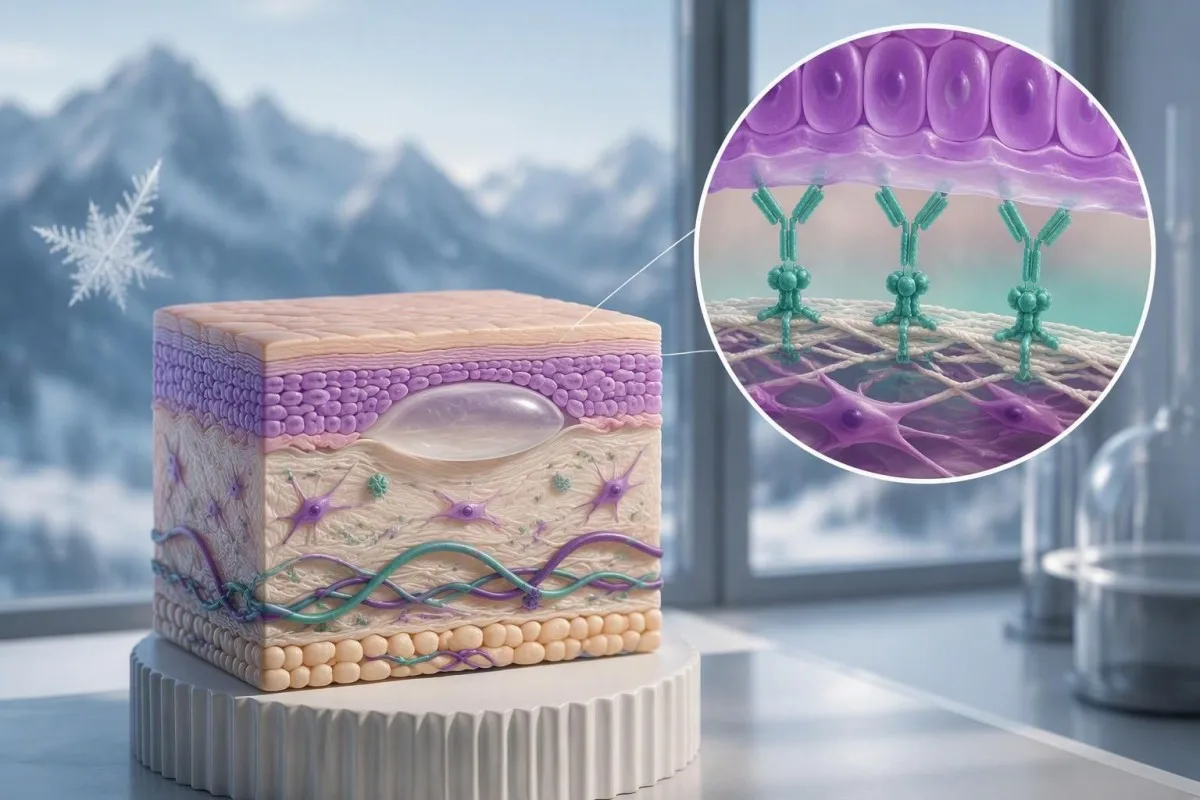
BP180 emaitza positiboak larruazaleko nahasmendu autoimmune bat babesten du, baina zenbakiak ezin du diagnostikoa bere kabuz ezarri. Sintomek, erabilitako saiakuntzak eta behar bezala bildutako larruazaleko laginek zehazten dute zer egin hurrena.

Ondorio nagusiak
- BP180 antigorputzen emaitza positiboa saiakuntzak BP180 helburuaren aurkako antigorputzak detektatu dituela esan nahi du; ez du bere kabuz penfigoide anpulosoa baieztatzen.
- Laborategiko atalaseak desberdinak dira: BP180 saiakuntza batzuek gutxi gorabehera 9 U/mL erabiltzen dituzte, eta beste batzuek, gutxi gorabehera, 20 U/mL. Irakurri zure laborategiko erreferentzia-tartea.
- Emaitza positibo apalak azkurarik, erupziorik edo babarik ez badago, antigorputzen detekzio ustekabekoa edo saiakuntzaren emaitza positibo faltsua izan daiteke, ez larruazaleko gaixotasun baieztatua.
- Penfigoide ez-anpulosoak azkura iraunkorra eragin dezake babarik gabe; diagnostiko espezializatuari buruzko azterlan bateko penfigoide-kasuen artean, 343tik 74 ez-anpulosoak ziren.
- BP230 antigorputzek ebidentzia osagarria ematen dute, baina BP230 antigorputzen emaitza negatiboek ez dute penfigoide anpulosoa baztertzen.
- Immunofluoreszentzia zuzenak larruazaleko antigorputz-gordailuak aztertzen ditu; soto-mintzean zehar IgG lineala eta/edo C3 egoteak pemfigoide-nahasmendu bat adierazten du.
- Bi larruazal-lagin hartu ohi dira: kaltetutako eremuko lagin bat mikroskopia arrunterako, eta inguruko lagin egoki hautatu bat immunofluoreszentzia zuzenerako.
- Sintoma larrigarriak begietako mina, ikusmen-aldaketak, irensteko zailtasuna, larruazal-aldaketa zabalekin batera agertzen den sukarra edo babak azkar hedatzea; ez itxaron beste antigorputz-emaitza baten zain.
BP180 emaitza positibo batek penfigoide anpulosoa baieztatzen al du?
Ez — BP180 antigorputzaren emaitza positibo batek ez du berez penfigoide bulotsua baieztatzen. Diagnostikoa babesten du sintomak eta larruazaleko aurkikuntzak bat datozenean, baina babarik gabeko emaitza positibo ahul bat ustekabekoa izan daiteke; dermatologoek sarritan larruazal-biopsia behar dute immunofluoreszentzia zuzenarekin, eta batzuetan antigorputzen azterketa osagarriak ere bai, kausa zehazteko.
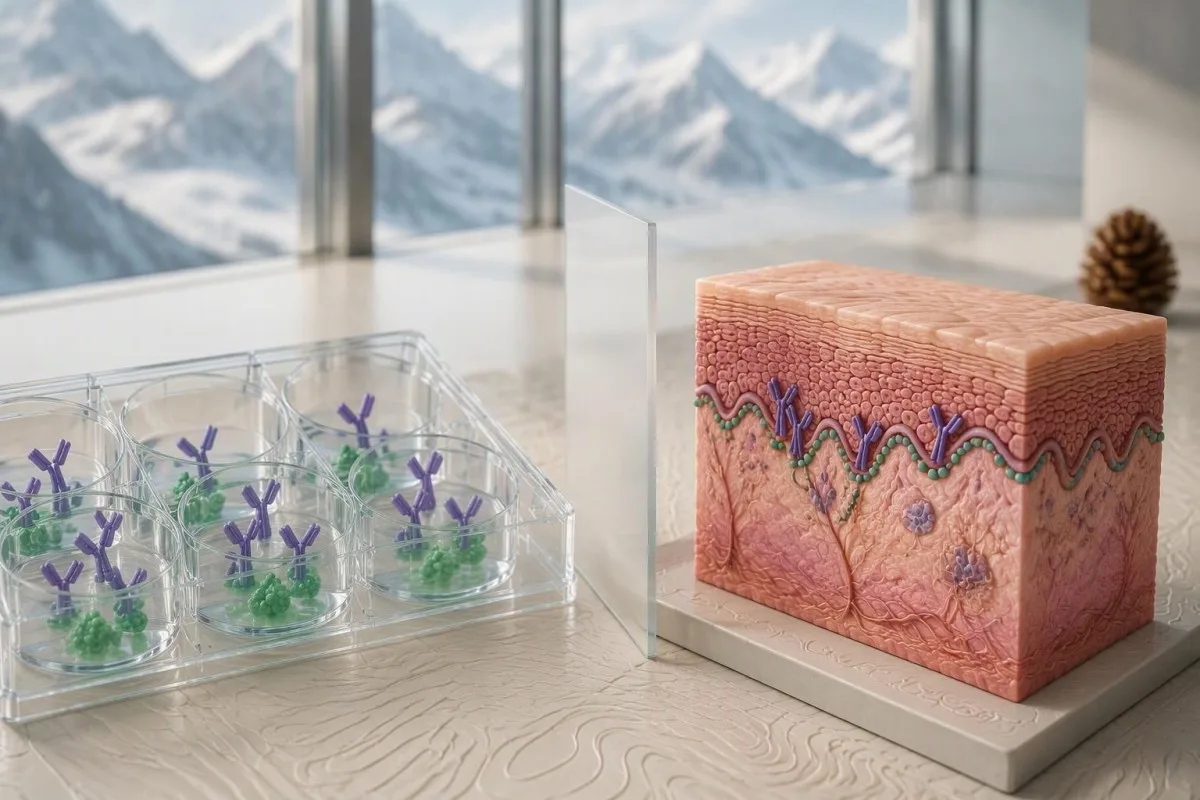
Penfigoide bulotsuaren diagnostikorako bat etorri behar dute aurkikuntza klinikoek eta immunopatologikoek, ez da nahikoa laborategiko emaitza bakar bat anormaltzat agertzea. 2022ko EADV gidalerroak dio diagnostikoa egiteko aztertu behar direla koadro klinikoa eta ehuneko zein odoleko antigorputzen azterketa egokiak (Borradori et al., 2022); galdera praktikoa da ea detektatutako antigorputzek pertsonaren larruazaleko egoera azaltzen duten.
Antigorputzen proba positiboa eta gaixotasun autoimmune aktiboa aurkikuntza desberdinak dira. Esaterako, emaitza hipotetiko bat 12 U/mL positiboa izan daiteke laborategi batean; hala ere, emaitza hori duen sintomarik gabeko pertsona baten diagnostiko-probabilitatea desberdina da kontzentrazio bera duen baina azkura eragiten duten baba tenkatu ugari dituen pertsona batenarekin alderatuta.
Kantesti odol-analisien emaitzak aztertzen dituen IA da, BP180 emaitzak laborategiko ebaki-puntuarekin eta zuk ematen duzun informazioarekin batera azaltzen laguntzen duena. Gure azalpenak ezin du zure larruazala aztertu edo immunofluoreszentzia zuzena egin; gure enpresaren atzeko plana atalak hezkuntza-laguntza honen atzean dagoen erakundea identifikatzen du.
Hartu emaitza galdera zehatzago bat egiteko arrazoitzat, ez gaixotasunaren behin betiko etiketatzat. Gure gidak, antigorputz positiboen emaitzak , azaltzen du zergatik diren hiru kontzeptu bereizi antigorputzen detekzioa, gaixotasunaren jarduera eta diagnostikoaren berrespena.
Zer neurtzen du zehazki BP180 antigorputzen probak?
BP180 antigorputzen probak normalean BP180ren zati baten aurkako serumeko IgG neurtzen du; BP180 horri XVII motako kolageno ere esaten zaio. BP180 gutxi gorabehera 180 kDa-ko proteina da, epidermisa azpiko ehunari ainguratzen laguntzen duena; ohiko azterketa askok haren NC16A eskualdea aztertzen dute, proteina osoa beharrean.
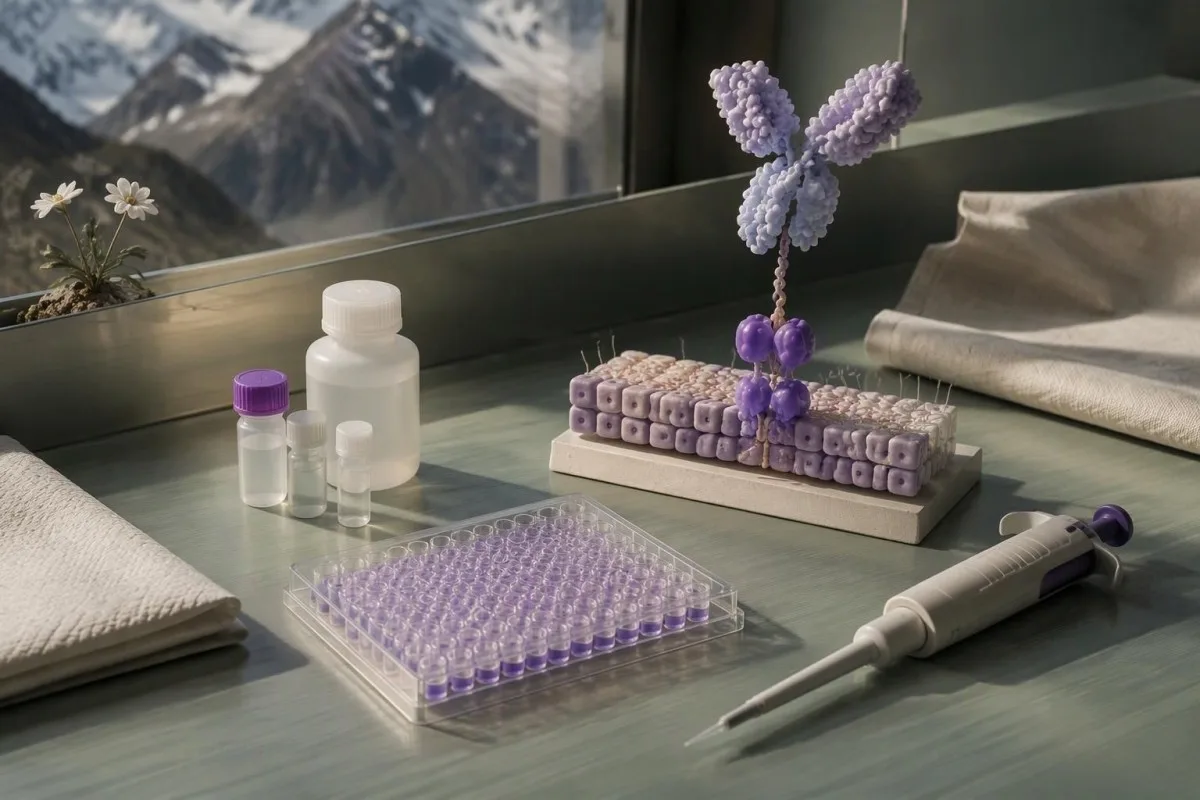
BP180 larruazaleko proteina estruktural bat da, eta ez da odoleko kontzentrazioa neurtzen zaion substantzia bat. Txostenak proteina horren aurkako antigorputzak deskribatzen ditu; entzimei lotutako immunoadsortzio-azterketa erabiltzen da sarritan (ELISA, ingelesezko siglengatik); beraz, emaitza hau 30 U/mL ez da esan nahi 30 azal-proteina-unitate odolean dabiltzanik.
The NC16A domeinua zelula-mintzetik gertu dago, BP180 proteinaren kanpoko zatian, eta antigorputzen ohiko xedea da penfigoide anpuloso klasikoan. Eskualde hori aztertzeak saiakuntza praktiko bat egitea ahalbidetzen du, baina puntu itsu bat sortzen du: nagusiki beste eskualde batzuen aurka zuzendutako antigorputzak detektatu gabe gera daitezke.
Antigorputzen kontzentrazio numeriko bat ez da immunofluoreszentziako titulu baten baliokidea. Emaitza honela adierazten denean: 1:40 diluzio bateko erreaktibotasuna deskribatzen du; aldiz, 40 U/mL saiakuntzaren arabera kalibratutako kontzentrazioa deskribatzen du; gure azalpenak, hauen ingurukoa: proba kuantitatiboak eta kualitatiboak emaitzak adierazteko formatu horiek bereizten laguntzen du.
Egiaztatu txostenak hau dioen: BP180 NC16A IgG, beste BP180 saiakuntza bat edo penfigoide-panel zabalago bat. Ez dira berez baliokideak, eta IgG ELISA negatibo batek ez ditu beste antigorputz-klase batzuei edo soto-mintzaren beste itu batzuei buruzko galdera guztiak erantzuten.
Zer hartzen da BP180 antigorputzen emaitza positibo baxutzat?
BP180ren emaitza positibo ahula erabilitako saiakuntzaren ebaketa-balioaren gainetik dagoen balioa da. Ez dago positibotasun ahulerako tarte unibertsalik: laborategi batzuek gutxi gorabehera atalase hau erabiltzen dute: 9 U/mL, ; beste batzuek, berriz, honen ingurukoa: 20 U/mL, kalibrazio eta emaitza-kategoria desberdinekin.
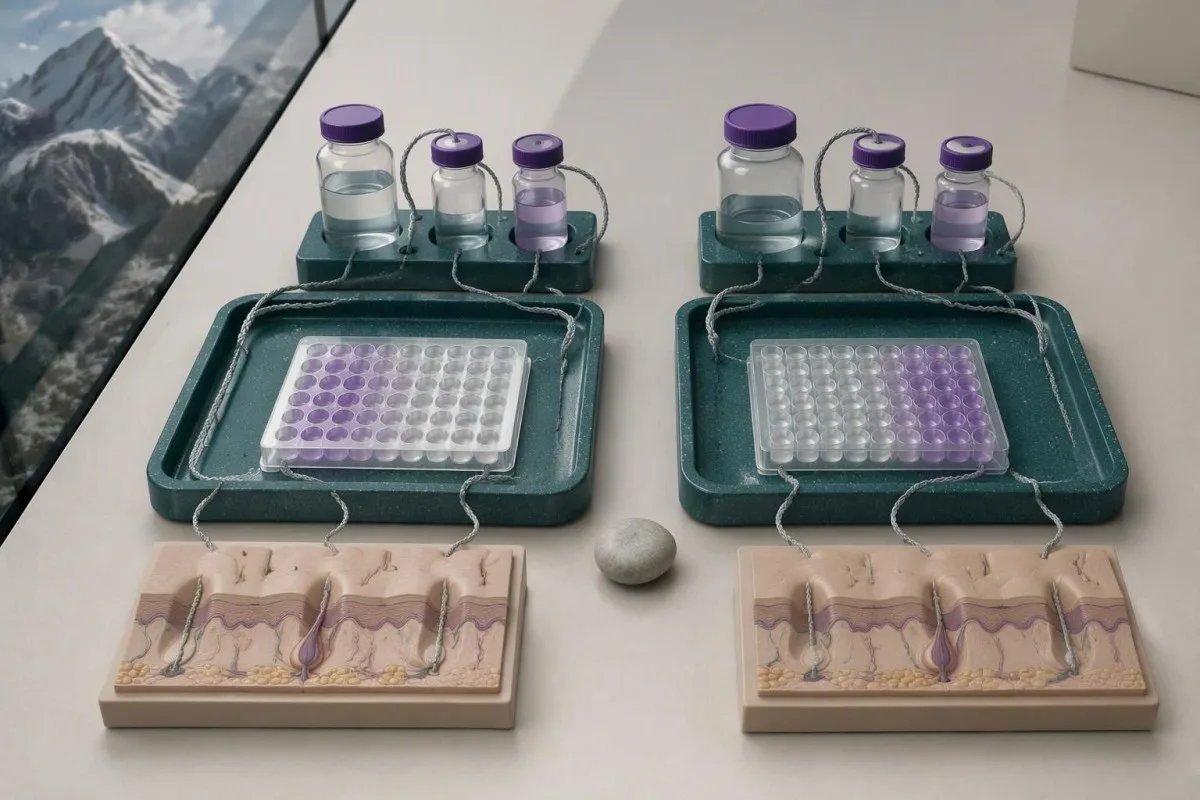
BP180 saiakuntzen unitateak ez daude laborategi guztietan modu unibertsalean estandarizatuta. Emaitza bat 15 U/mL positiboa izan liteke 9 U/mL-ko irizpidearen arabera, eta negatiboa 20 U/mL-koaren arabera; baina horrek ez du frogatzen bigarren saiakuntzak gaixotasuna detektatu ez duenik, metodoak eta kalibratzaileak desberdinak izan baitaitezke.
Ebaketa-balioek sentikortasunaren eta espezifikotasunaren arteko oreka bilatzen dute, saiakuntza ebaluatzeko erabilitako populazioetan. Atalasea beheratzeak gaixotasuna duten pertsona gehiago detektatzea ahalbidetzen du, baina gaixotasunik ez duten pertsona gehiago identifikatzea ere bai; ebaketa-balioa laborategiak ezarritako erabaki-muga da, ez larruazala bat-batean anpuluak sortzen hasten den puntu biologikoa.
Kantesti AI lagungarria izan daiteke emandako BP180 balioa hari dagokion erreferentzia-tartearen ondoan kokatzeko, baina hau bakarrik erakusten duen irudi moztu batek: 18 U/mL funtsezko informazioa kanpoan uzten du. Sartu probaren izena, unitateak, interpretazio-kategoriak eta laborategiaren oharrak; ohiko barrutitik kanpoko bandera batek ezin ditu xehetasun horiek ordezkatu.
Beheko adibideek bi jakinarazpen-politika posible erakusten dituzte, larritasun-eskala unibertsal bat baino. BP180 antigorputzen kontzentrazioak bakarrik ez du larrialdi mediko bat definitzen; larrialdi-maila zehazten dute larruazaleko inplikazio zabalak, deshidratazioak, gaixotasun sistemikoak eta begietako edo arnasbideetako sintomek.
| Maila | Tartea | Zer esan nahi duen |
|---|---|---|
| A analisiaren adibidea: ebaketa-balioaren azpitik | <9 U/mL | Negatiboa politika ilustratibo honen arabera; gaixotasuna ez da baztertzen susmo klinikoak handia izaten jarraitzen badu. |
| A analisiaren adibidea: ebaketa-balioan edo hortik gora | ≥9 U/mL | Positiboa politika honen arabera; ebaketa-balioarekiko hurbiltasunak eta aurkikuntza klinikoek eragina dute interpretazioan. |
| B analisiaren adibidea: ebaketa-balioaren azpitik | <20 U/mL | Negatiboa beste politika ilustratibo baten arabera; ez bihurtu zuzenean analisi-sistemen arteko emaitzak. |
| B analisiaren adibidea: ebaketa-balioan edo hortik gora | ≥20 U/mL | Positiboa politika honen arabera; zenbakiak ez du berez diagnostikoa edo larritasuna ezartzen. |
Zergatik izan daiteke engainagarria BP180 emaitza positibo bat?
BP180 emaitza positiboa ez da hain sinesgarria, baldin eta pertsonak probak egin aurretik penfigoidea izateko probabilitate kliniko txikia bazuen. Nahiko zehatza den analisi batek ere emaitza faltsu positiboak ematen ditu; beraz, emaitzaren esanahia aldatu egiten da sintomarik gabeko baheketa-populazio baten eta babak bereizgarriak ebaluatzen dituen klinika espezializatu baten artean.
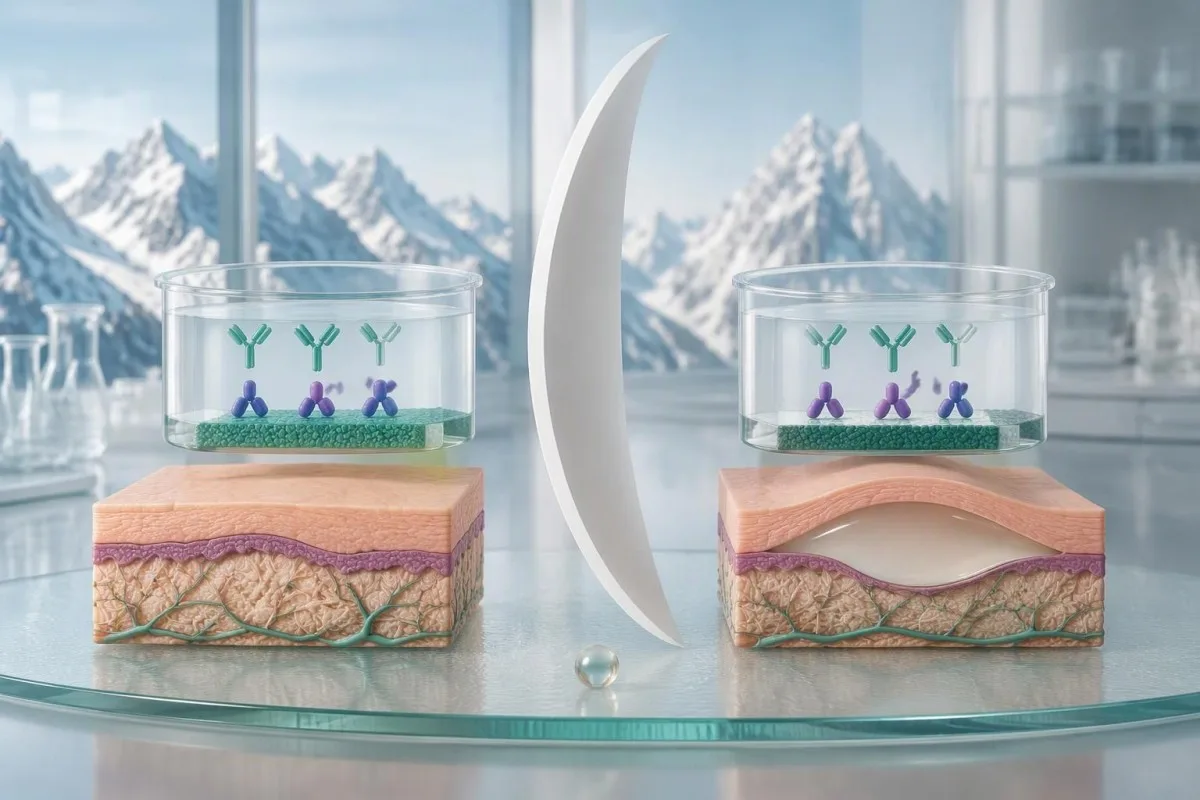
Sentikortasuna eta espezifikotasuna ez dira emaitza positibo baten ondoren zuk pertsonalki gaixotasuna izateko duzun probabilitatearen baliokide. Probabilitate hori aztertutako taldean gaixotasuna zenbateraino den ohikoa denaren araberakoa ere bada; bereizketa hori bereziki garrantzitsua da antigorputz-panel bat modu zabalean eskatu bada, larruazaleko eredu espezifiko bat ikertzeko eskatu beharrean.
Demagun argi eta garbi hipotetikoa den analisi bat, honako hauekin: 90%eko sentikortasuna eta 95%eko espezifikotasuna, gaixotasuna izateko probabilitatea 1% den 1.000 pertsonari egina. Gutxi gorabehera honako hauek identifikatuko lituzke: 9 benetako positibo eta 50 positibo faltsu, eta horrenbestez balio prediktibo positiboa gutxi gorabehera 15% izango litzateke; horiek irakaskuntzarako hipotesiak dira, ez zure BP180 analisiaren errendimenduari buruzko baieztapenak.
Erabili analisi hipotetiko bera, gaixotasuna izateko probabilitatea hau denean: 20%, and approximately 180 true positives and 40 false positives would occur per 1,000 tests. The positive predictive value becomes about 82%—a large change caused by clinical context, not by a different laboratory method.
These examples explain why a dermatologist may request tissue testing despite a positive result, or take characteristic symptoms seriously despite a negative one. Our discussion of MOG antigorputzen interpretazioa illustrates the same probability principle in another autoimmune condition, although its diagnostic criteria cannot be transferred to pemphigoid.
Zer gertatzen da BP180 positiboa bada baina babarik ez baduzu?
A low-positive BP180 result without blisters does not establish bullous pemphigoid or reliably predict future blistering. The next distinction is whether you have no skin symptoms at all, or persistent itching and an unexplained rash that could represent a nonbullous pemphigoid presentation.

Incidental BP180 antibody detection can occur without clinically established pemphigoid. Possible explanations include low-level autoreactivity and assay-related false positivity; there is no validated conversion rule that turns an isolated result of 11 U/mL into a percentage risk of developing blisters later.
A hypothetical person with 11 U/mL, no itching, no rash, and no mucosal symptoms usually needs a contextual review rather than automatic immunosuppressive treatment. The clinician should check why the assay was ordered, whether the result was unexpected, and whether a skin examination reveals findings the person had not recognized.
Persistent dryness and itching still deserve assessment because common explanations remain common. Eczema, medication effects, thyroid disease, and other causes may be more likely than pemphigoid; our dry skin testing guide explains why additional blood tests should follow symptoms rather than a blanket panel.
Ez dago no universal repeat-testing interval for an asymptomatic low-positive BP180 result. A clinician may choose observation, a repeat using the same method, or specialist review depending on the history; new persistent itching, urticarial plaques, or blisters should change that plan rather than waiting for a scheduled repeat.
Penfigoide anpulosoa azkura hutsarekin has al daiteke?
Pemphigoid can present with persistent itching, eczema-like patches, urticarial plaques, or scratch-related changes without visible blisters. In a specialist diagnostic study, 74 of 343 pemphigoid cases—21.6%—were nonbullous, showing that the absence of blisters cannot independently exclude the disorder (Meijer et al., 2019).

Nonbullous pemphigoid is not simply every itchy rash with a positive BP180 result. Diagnosis still needs compatible symptoms and appropriate immunopathological evidence; the 21.6% study figure came from a referred population and should not be interpreted as the probability that any person with itching has pemphigoid.
The symptom pattern often matters more than whether one small blister has appeared. Persistent, widespread itching in an older adult, especially with recurrent raised plaques or poor response to ordinary eczema care, warrants a dermatological assessment; our itchy skin laboratory guide separates skin-directed testing from tests for systemic causes.
Eosinophilia can accompany bullous pemphigoid, but it is neither required nor diagnostic. An absolute eosinophil count above approximately 0,5 × 10^9/L is often flagged in adults, yet allergy, medications, and parasites can produce the same finding; our guide to eosinofilo kopuru altuak explains those alternatives.
A dermatologist does not always need to wait for a blister before collecting a useful sample for direct immunofluorescence. In nonbullous disease, sample selection is tailored to the available rash and laboratory protocol; document the distribution and duration of itching, because a disappearing rash can make later assessment harder.
Nola osatzen dute BP230 antigorputzek BP180 proba?
BP230 antibodies provide complementary evidence for pemphigoid but cannot confirm or exclude bullous pemphigoid alone. BP230 is an approximately 230-kDa intracellular anchoring protein, whereas BP180 crosses the cell membrane; their different locations and antibody targets help explain why the two results can disagree.
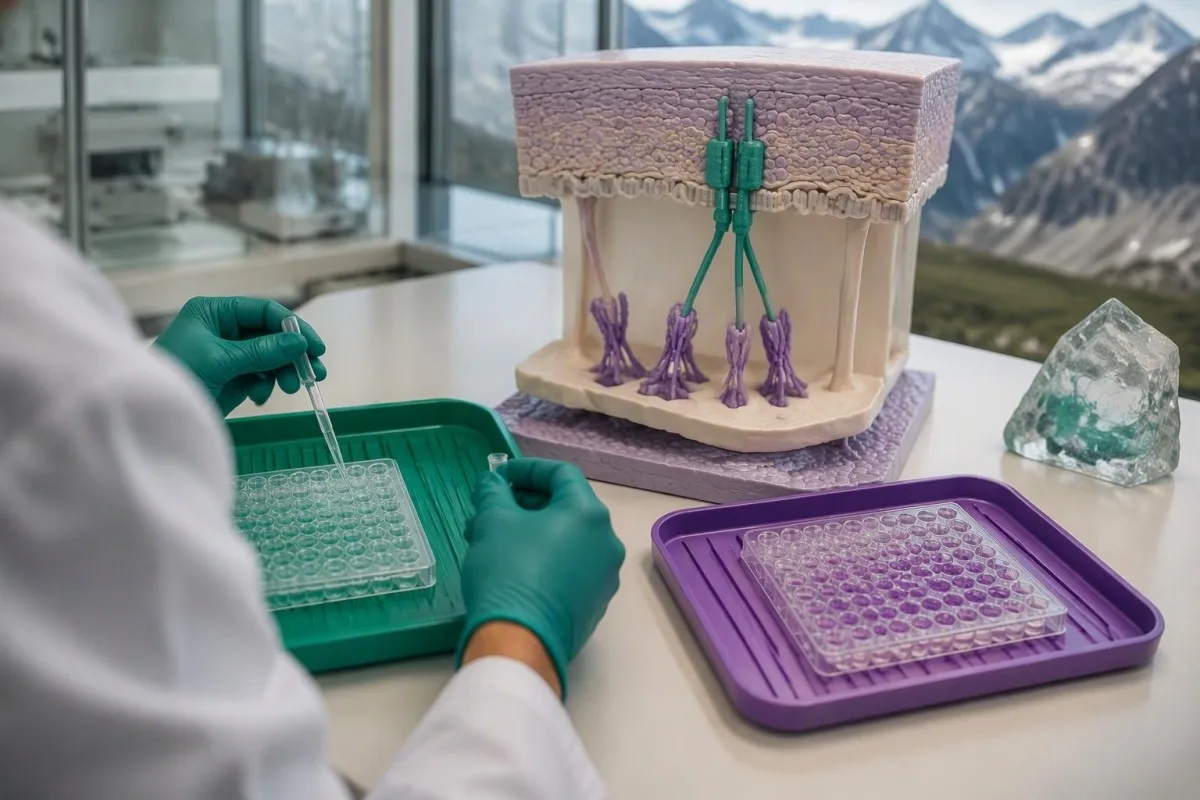
A negative BP230 antibody result does not cancel a positive BP180 result. Some people with confirmed pemphigoid have antibodies detectable against only one tested antigen, and each assay has its own sensitivity; interpreting the pair as a two-test pass-or-fail rule creates avoidable diagnostic errors.
Balizko BP180 result of 45 U/mL with negative BP230 antibodies still warrants assessment if tense blisters and severe itching are present. Conversely, isolated low-positive BP230 antibodies without compatible findings are not enough to diagnose pemphigoid; a second positive marker strengthens a pattern only when the overall evidence fits.
Kantesti is an AI biomarker interpretation platform that can explain BP180 and BP230 antibodies as complementary findings rather than interchangeable scores. This is similar to the reasoning used for antibody panels in connective disease, but skin-specific tissue findings remain central to pemphigoid assessment.
Do not add BP180 and BP230 concentrations together, even if both are expressed in U/mL. They represent different antigen-specific measurements with different calibration systems; BP180 levels generally have a better-established relationship with disease activity than BP230 levels, but neither replaces examination.
Zergatik behar izan dezakezu larruazaleko biopsia immunofluoreszentzia zuzenarekin?
Skin biopsy with direct immunofluorescence can show whether antibodies or complement are deposited at the skin's basement membrane. Dermatologists often collect two separate specimens because routine microscopy and direct immunofluorescence answer different questions and require different sample handling.
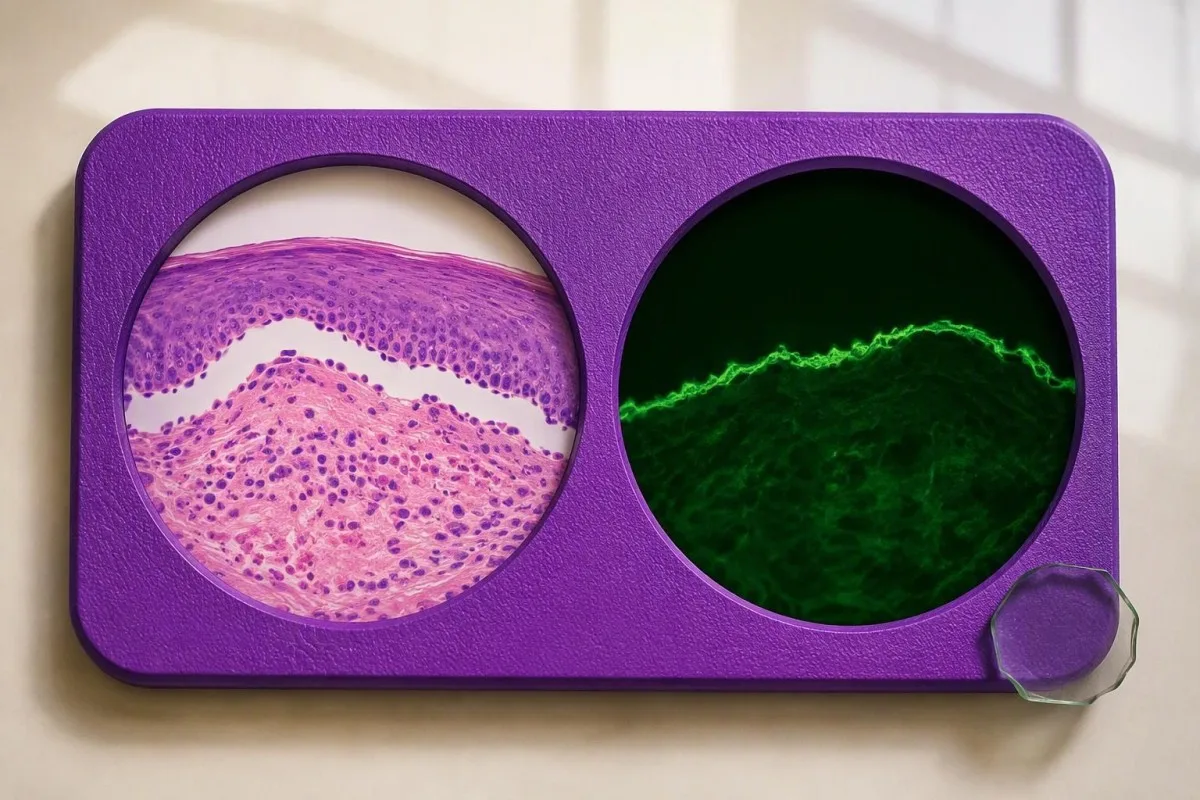
Routine histology examines tissue structure and inflammatory cells. A sample from a fresh blister or suitable affected area may show separation beneath the epidermis and eosinophils, but these features are not unique to bullous pemphigoid; the second sample looks for the immune-deposit pattern that helps classify the disorder.
For classic blistering presentations, the direct-immunofluorescence sample is commonly taken from appropriately selected skin near a fresh blister rather than its eroded center. A small 3–4-mm punch is often used, although technique and location depend on the case; sampling heavily damaged tissue can remove the structures the laboratory needs to examine.
The specimen for direct immunofluorescence must not be routinely placed in formalin. Laboratories generally require a dedicated transport medium or another explicitly agreed handling method, while the routine histology specimen commonly goes into formalin; ask whether the two containers have been prepared for their separate purposes.
In Meijer et al.'s 2019 diagnostic cohort, direct immunofluorescence had a sensitivity of 88.3%, so even this valuable test was not infallible. Kantesti's baliozkotze klinikoari buruzko informazioa concerns our interpretation methodology—not a claim that AI can reproduce skin immunofluorescence or establish its findings.
Zer esan nahi dute immunofluoreszentzia positiboak eta gatz bidezko bereizketa-probek?
Linear IgG and/or C3 along the basement membrane on direct immunofluorescence supports a pemphigoid-spectrum disorder, but the pattern is not unique to bullous pemphigoid. Indirect immunofluorescence on salt-split skin can add evidence by showing where circulating antibodies bind relative to an experimentally created tissue separation.
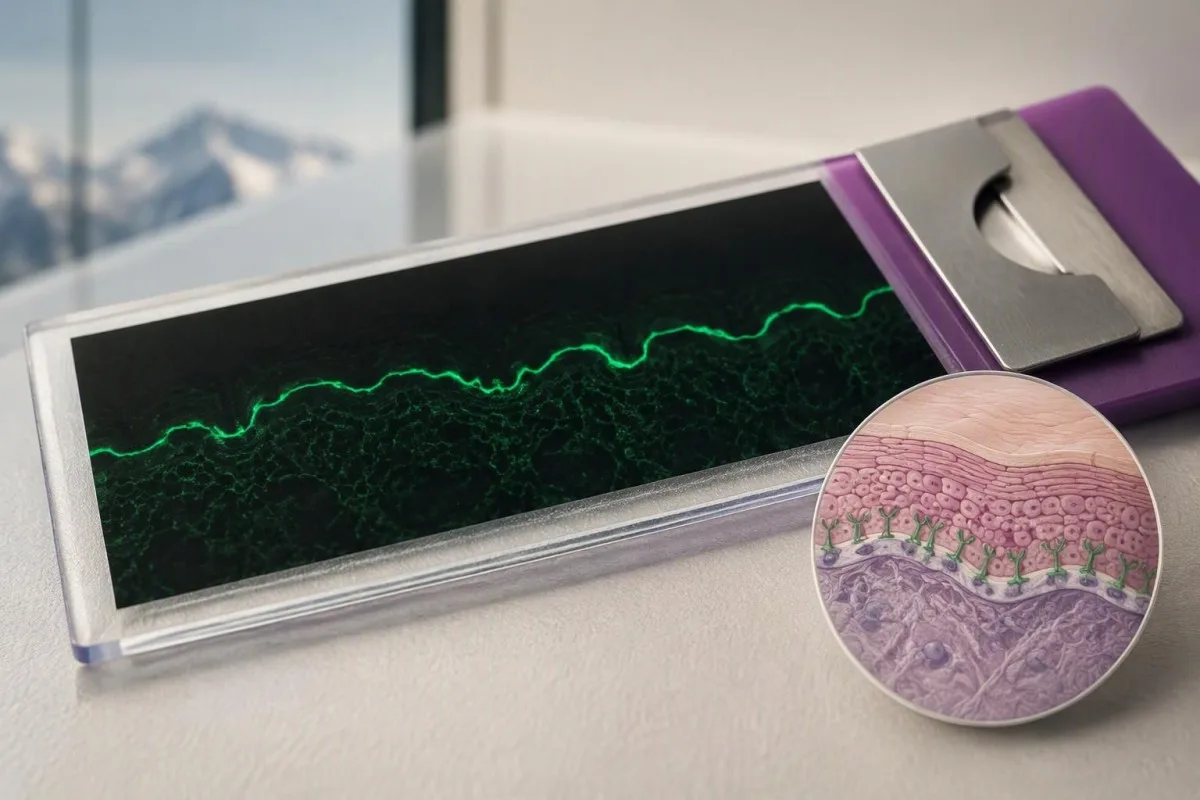
Direct and indirect immunofluorescence use different materials. Direct testing examines deposits already present in the person's skin, while indirect testing applies the person's serum to a laboratory substrate; a positive result in one test and a negative result in the other is therefore possible without a reporting error.
On salt-split skin, bullous pemphigoid antibodies commonly bind the epidermal side, often called the roof. Antibodies binding the dermal side, or floor, raise consideration of other disorders such as epidermolysis bullosa acquisita or anti-p200 pemphigoid, but binding location alone does not fully classify every case.
Meijer et al. reported 99.9% specificity for indirect immunofluorescence on salt-split skin in their 2019 diagnostic cohort. That high figure applies to that study and testing pathway; a negative result still cannot exclude pemphigoid because specificity describes false positives, not how many cases the test misses.
C3 detected in skin is not the same measurement as a serum C3 concentration. A normal circulating complement result does not negate local deposits at the basement membrane; our complement testing explanation helps prevent this common cross-test misunderstanding.
Zer gertatzen da BP180 emaitzak, larruazaleko biopsiak eta sintomek bat egiten ez badute?
Discordant BP180 and skin-test results require a review of the clinical picture, assay target, sampling site, and specimen handling. A positive ELISA with negative direct immunofluorescence can reflect incidental antibodies or an uninformative skin sample; a negative NC16A ELISA can miss disease directed against other targets.
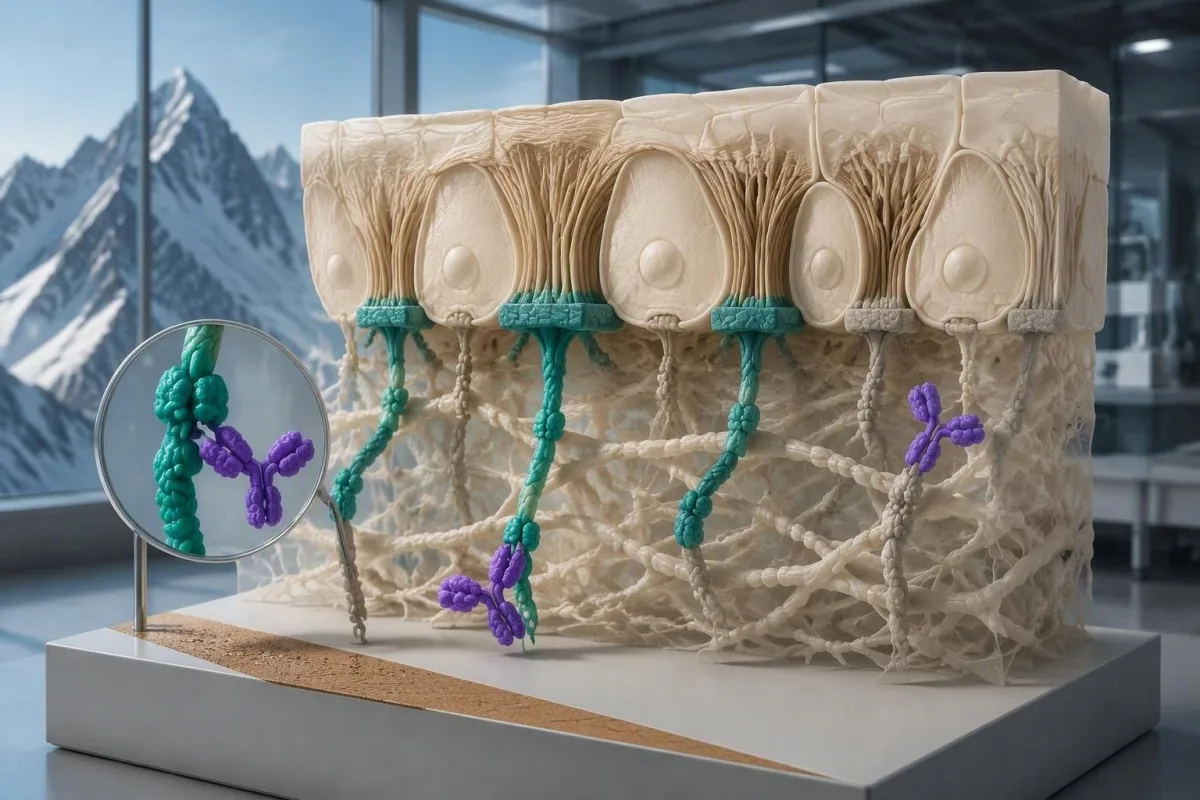
A negative direct-immunofluorescence result is less reassuring if the sample was poorly selected or incorrectly transported. Treatment before sampling may also influence findings, so clinicians need to know which creams or systemic medicines were used and where; never stop prescribed treatment solely to make a test more likely to turn positive.
A hypothetical person with characteristic new blisters, BP180 of 80 U/mL, and a negative direct-immunofluorescence specimen from an old eroded site may need repeat sampling. The same antibody result with no compatible skin findings demands a different investigation; the discrepancy does not have one automatic explanation.
A negative BP180 NC16A result does not exclude every form of pemphigoid. Further testing may include BP230 antibodies, indirect immunofluorescence, or specialized assays for other antigens; our guide to negative myasthenia antibody tests illustrates why a limited antigen panel cannot exclude an entire autoimmune disease category.
Repeat testing should address a specific uncertainty rather than create an endless sequence of panels. Ask whether the next investigation is checking the same antigen by another method, examining an additional antigen, or correcting a tissue-sampling problem; each strategy answers a different diagnostic question.
Zer beste gaixotasunek izan dezakete BP180 positiboko penfigoidearen antzeko itxura?
BP180 antibodies can occur in other pemphigoid-spectrum conditions, including mucous membrane pemphigoid and pemphigoid gestationis. Eczema, scabies, and drug-related eruptions can resemble early bullous pemphigoid clinically, while pemphigus involves different adhesion proteins and usually a different level of skin separation.
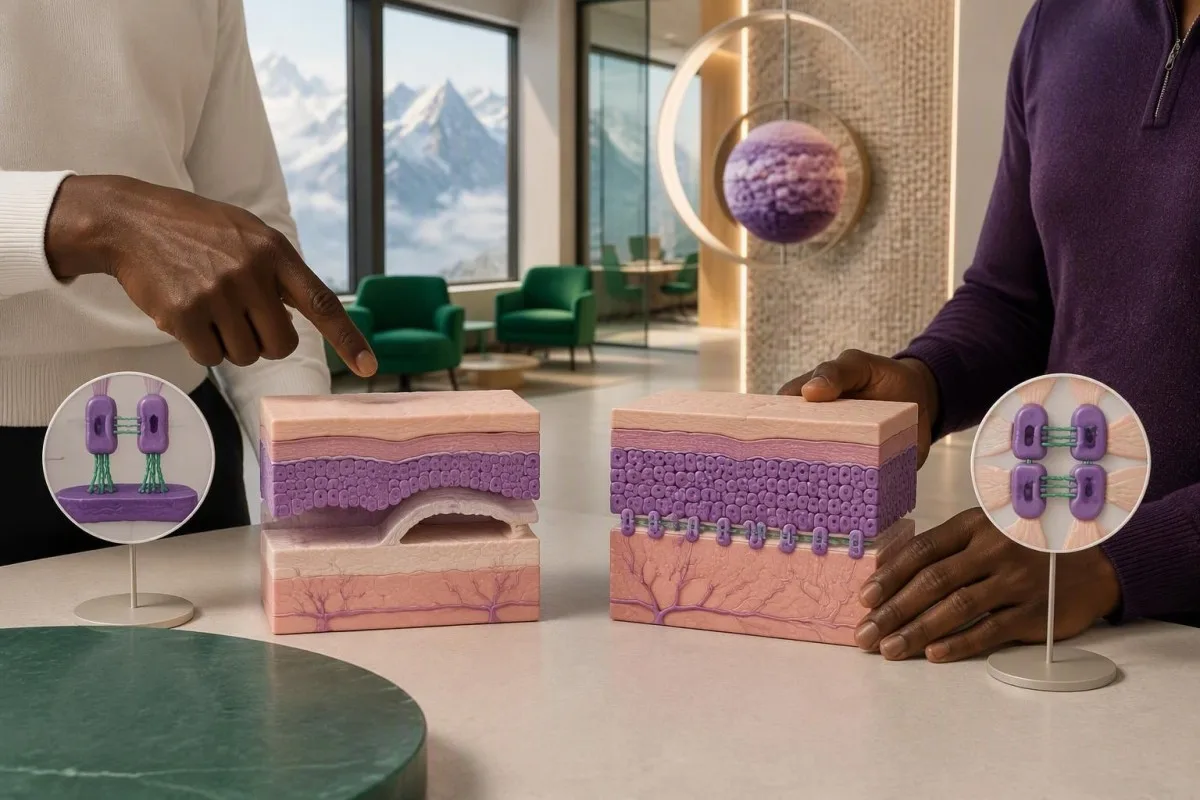
Bullous pemphigoid typically causes tense blisters because separation occurs beneath the epidermis. Pemphigus often produces more fragile blisters or erosions through loss of adhesion within the epidermis; our desmoglein antibody guide explains why BP180 testing cannot substitute for a pemphigus evaluation.
Predominantly mouth, eye, genital, or other mucosal involvement raises concern for mucous membrane pemphigoid, especially when scarring occurs. Eye pain, light sensitivity, or vision changes require urgent assessment because waiting for a repeat antibody concentration can delay treatment of a sight-threatening process.
Pemphigoid gestationis is associated with pregnancy and can produce BP180 antibodies. Pregnancy or recent childbirth therefore changes the interpretation of the same laboratory result; the distinction requires obstetric and dermatological coordination rather than assuming that every BP180-positive blistering disorder is classic older-adult bullous pemphigoid.
Scabies can cause intense itching and may coexist with an unrelated positive antibody result. Household itching, characteristic distribution, and burrows alter the differential; our scabies symptom guide is useful for that comparison, but neither household exposure nor BP180 positivity independently settles the diagnosis.
Sendagaiek BP180ren interpretazioa edo tratamendu-erabakiak aldatzen al dituzte?
Medication history can change the likelihood and presentation of bullous pemphigoid, but a positive BP180 result alone is not a reason to stop a medicine. DPP-4 inhibitors used for diabetes and immune checkpoint inhibitors are recognized associations; treatment decisions depend on confirmed disease, severity, and the person's other health risks.

DPP-4 inhibitor-associated pemphigoid can have a less typical inflammatory presentation and may show limited NC16A reactivity. This is not universal, and exposure does not prove causation; bring a complete medicine list, including start dates, to a review using our senior medication effects guide as a preparation aid.
The 2022 EADV guideline recommends potent topical corticosteroids as a mainstay when feasible and discusses oral prednisone at approximately 0.5 mg/kg/day as an alternative in suitable circumstances (Borradori et al., 2022). These are clinician-directed treatment options for disease, not instructions to treat an isolated antibody result or begin steroids without assessment.
Systemic corticosteroids can create additional risks that are unrelated to the BP180 concentration. People with relevant residence or travel exposure may need assessment for Strongyloides before significant immunosuppression; our Strongyloides antibody explanation describes why an apparently unrelated parasite history can become a treatment-safety issue.
Kidney function, glucose, infection risk, and the ability to apply topical treatment may influence the choice of therapy more than whether BP180 is 40 or 80 U/mLGure giltzurrun-funtzioaren interpretazio gidak covers supportive laboratory assessment, but renal markers do not confirm pemphigoid.
BP180 mailak erabil al daitezke gaixotasunaren jarduera eta susperraldia monitorizatzeko?
BP180 antibody levels can support monitoring in confirmed bullous pemphigoid, but they do not replace examination or determine treatment alone. Concentrations often track disease activity at a group level; individual patients can remain antibody-positive while their skin is controlled or experience symptoms without a proportionate rise.
A falling BP180 concentration is most useful when it agrees with fewer new blisters and less itching. A hypothetical decline from 120 to 35 U/mL on the same assay supports an improving pattern, but it does not independently establish remission or justify stopping treatment.
An increase from 12 to 14 U/mL near a cutoff may reflect analytical or biological variation rather than a meaningful change in disease. There is no universal percentage increase that proves relapse across all BP180 assays; the method, timing, symptoms, and previous response need to be considered together.
Kantesti is an AI blood test interpretation platform that can organize serial BP180 results without treating a laboratory trend as a diagnosis. Gure AI teknologiaren azalpena describes the interpretation workflow; preserving each report's assay name and reference interval matters when comparing two or more measurements.
Changing laboratories can create an apparent rise or fall that is partly methodological. Our botiken segurtasunaren joeraren gida explains why dates, doses, and laboratory context belong beside the numbers; photograph new skin findings and record new-blister counts when your dermatologist requests them.
Zer eraman behar duzu jarraipen-kontsultara, eta zein ebidentzia da aplikagarria?
Bring the full BP180 report, any BP230 result, symptom photographs, and your complete medication list to follow-up. These four information groups help a clinician decide whether you need observation, additional serum testing, properly handled skin samples, or urgent assessment rather than another isolated antibody measurement.

A useful report includes the exact assay name, numerical value, units, cutoff, and collection date. If a hypothetical BP180 result reads 16 U/mL, the missing cutoff may reverse whether it is considered positive; also request the actual histology and direct-immunofluorescence reports rather than relying on the phrase 'skin biopsy normal.'
New eye symptoms, swallowing difficulty, extensive rapidly spreading blisters, fever, or inability to maintain fluids need prompt clinical attention. Do not wait for a scheduled second test when those symptoms appear; supportive urinalysis can answer separate medical questions, as explained in our gernu-analisirako interpretazio-gidak, but it cannot establish a pemphigoid diagnosis.
Kantesti helps explain the distinctions between a flagged antibody result, a probable diagnosis, and confirmed disease. Gure IA arduratsurako printzipioek describe the boundaries of educational interpretation; only a clinician with access to your examination and appropriate investigations can decide whether a BP180 antigorputzen emaitza positiboa result represents active pemphigoid.
The directly relevant evidence here comes from the 2022 EADV guideline and the 2019 JAMA Dermatology diagnostic study. The two Zenodo publications listed below concern kidney-function and urinalysis interpretation and are included as background educational publications, not evidence that BP180 confirms bullous pemphigoid or that our AI has validated diagnostic accuracy for this condition.
Ohiko galderak
BP180 antigorputz-probaren emaitza positiboak esan nahi al du ziur aski penfigoide boladuna dudala?
BP180 antigorputz-proba positibo batek ez du behin betiko esan nahi penfigoide boltsosoa duzunik. Laborategi batzuek 9 U/mL inguruko ebaki-balioa erabiltzen dute, eta beste batzuek 20 U/mL ingurukoa; beraz, azterketa zehatza eta erreferentzia-tartea garrantzitsuak dira. Azkura edo babak bateragarriak izateak emaitza esanguratsuagoa egiten du; aldiz, positibo baxu isolatua ustekabekoa edo positibo faltsua izan daiteke. Diagnostikoa ezartzeko, larruazaleko biopsia zuzeneko immunofluoreszentziarekin eta antigorputzen azterketa osagarriak behar izan daitezke.
Zer esan nahi du BP180aren emaitza positibo baxu batek babarik ez badut?
Anpulu gabeko BP180 emaitza positibo baxu batek ausazko antigorputz-detekzioa, saiakuntzari lotutako positibo faltsua edo anpulu gabe agertzen den penfigoidea adieraz dezake. Adibidez, 12 U/mL positiboa da 9-U/mL-ko mugaren arabera, baina ezin du aurresan sintomarik ez duen pertsona batek gaixotasuna garatuko duen. Azkura iraunkorrak edo azaleko erupzio argitu gabe batek dermatologia-ebaluazioa behar du, anpuluak egon ez arren. Ez dago errepikatu beharreko proben tarte unibertsalik, ezta emaitza positibo baxu isolatu batean soilik oinarritutako tratamendu-gomendiorik ere.
BP180 antigorputz negatiboak izanik, penfigoide besikularra izan dezaket?
0 Bullous pemfigoidea ager daiteke BP180 antigorputzen emaitza negatiboa izan arren, ohiko NC16A saiakuntzan. Saiakuntzak 180 kDa inguruko proteinaren eskualde jakin bat aztertzen du, eta baliteke batez ere beste eskualde batzuen aurka zuzendutako antigorputzak ez hautematea. BP230 proben emaitzek, immunofluoreszentzia zuzenak eta zeharkako immunofluoreszentziak ebidentzia gehigarria eman dezakete. Odol-analisi negatibo batek ez luke ebaluazioa amaitu behar larruazaleko aurkikuntzek pemfigoidea biziki iradokitzen dutenean.
BP230 antigorputz negatiboek penfigoide bolatzailea baztertzen al dute?
BP230 antigorputz negatiboek ez dute penfigoide boladuna baztertzen. BP230 gutxi gorabehera 230 kDa-ko ainguratze-proteina zelula barnekoa da, eta gaixotasuna baieztatuta duten pertsona batzuek ez dute haren aurkako antigorputz detektagarririk. BP180 emaitza positiboa eta BP230 antigorputz negatiboak diagnostikoarekin bat etor daitezke, aurkikuntza klinikoak eta ehunetakoak bat datozenean. Bi antigorputzen kontzentrazioak ez dira batu behar, ezta bi probako berrespen-arau gisa hartu ere.
Zergatik behar izaten dira batzuetan bi azal-biopsia penfigoidea diagnostikatzeko?
Biopsia dermiko bi behar izaten dira askotan, histologia arruntak eta immunofluoreszentzia zuzenak galdera diagnostiko desberdinei erantzuten dietelako. Normalean 3–4 mm-ko puntzoi-biopsia erabiltzen da, baina dermatologoak aukeratzen ditu teknika eta laginketa-gunea, kasuaren ezaugarrien arabera. Lagin batek ehunaren egitura aztertzen du; besteak, berriz, mintz basalaren inguruko immunogordailuak. Immunofluoreszentzia zuzeneko laginak aldez aurretik adostutako garraio-metodo propioa behar du, eta ez da formolean jarri behar ohiko prozedura gisa.
BP180 maila altua izateak esan nahi al du nire penfigoidea larria dela?
A high BP180 level does not independently determine how severe pemphigoid is or whether it is an emergency. A result of 100 U/mL must be interpreted using that assay's cutoff and alongside the extent of skin involvement, itching, new blisters, and general health. Antibody levels often relate to disease activity, but individual results and symptoms can disagree. Eye pain, vision changes, difficulty swallowing, or rapidly spreading extensive blistering require prompt assessment regardless of the antibody concentration.
Tratamendua eten aurretik BP180ren aurkako antigorputzak negatibo bihurtu behar al dira?
0 BP180 antigorputzek ez dute beti negatibo bihurtu behar mediku batek penfigoaren tratamendua murriztea edo etetea azter dezan. 120 U/mL-tik 35 U/mL-ra gertatutako balizko jaitsiera hobekuntzaren aldekoa izan daiteke, baina erabakia sintomek, babak berriro agertzeak, azterketa klinikoak eta berrerortze-aurrekariek gidatzen dute. Antigorputzak detektagarri gera daitezke larruazaleko gaixotasuna kontrolatuta dagoenean, eta ez dago saiakuntza guztietarako balio duen etete-atalase unibertsalik. Ez aldatu agindutako tratamendua antigorputzen joeran soilik oinarrituta.
Jaso odol-analisien emaitzak nola irakurri
Kargatu zure laborategiko txostena, eta Kantesti-ren AIak biomarkatzaile bakoitza hizkera arruntean azalduko du segundo gutxitan. Mundu osoan 2 milioi pertsona baino gehiagok erabiltzen dute.
Erreferentziak
- Klein, T., Mitchell, S., & Weber, H. (2026). BUN/Kreatinina Ratio Azalduta: Galtzak Funtzioaren Proba Gida. Kantesti AI Ikerketa Medikoa. DOI
- Klein, T., Mitchell, S., & Weber, H. (2026). Urinako Urobilinogena: Urinaren Analisi Osoa Gida 2026. Kantesti AI Ikerketa Medikoa. DOI
- Borradori L et al. (2022). Updated S2 K guidelines for the management of bullous pemphigoid initiated by the European Academy of Dermatology and Venereology (EADV). Journal of the European Academy of Dermatology and Venereology. DOI
- Meijer JM et al. (2019). Assessment of Diagnostic Strategy for Early Recognition of Bullous and Nonbullous Variants of Pemphigoid. JAMA Dermatology. DOI
- 2M+Aztertutako probak
- 127+Herrialdeak
- 100+Hizkuntzak
Medikuntza-taldeari buruz


E-E-A-T Konfiantza-seinaleak
Esperientzia
Medikuek gidatutako berrikuspen klinikoa laborategiko interpretazioaren lan-fluxuei buruz.
Espezializazioa
Laborategiko medikuntzaren ikuspegia biomarkatzaileek testuinguru klinikoan nola jokatzen duten aztertzean.
Autoritatea
Thomas Klein doktoreak medikoki berrikusia, Sarah Mitchell doktorearen eta Hans Weber irakasle doktorearen ekarpenekin.
Fidagarritasuna
Ebidentzian oinarritutako interpretazioa, alarma murrizteko jarraipen-bide argiekin.


Ohar medikoa
Artikulu hau hezkuntza-helburuetarako da soilik eta ez du mediku-aholkurik ematen. Diagnostiko- eta tratamendu-erabakietarako, beti kontsultatu osasun-profesional kualifikatu bati.
Argitaratua · Jarri harremanetan erredakzio-taldearekin
Kantesti Ltd-k argitaratua, Ingalaterran eta Galesen erregistratua, enpresa zk. 17090423, Londres, Erresuma Batua.
