Verlässliches Vitamin B12 stammt aus tierischen Lebensmitteln oder speziell angereicherten Produkten; eine nährstoffreiche Ernährung kann nicht jedes Absorptionsproblem beheben. Hier erfahren Sie, wie ich Patienten helfe, die Auswahl von Lebensmitteln, Symptome, Medikamente und Laborergebnisse abzugleichen.


- Tägliche B12-Zufuhr beträgt 2,4 µg für die meisten Erwachsenen, 2,6 µg in der Schwangerschaft und 2,8 µg während der Stillzeit.
- Beste Nahrungsquellen umfassen Muscheln, Leber, Fisch, Fleisch, Milchprodukte, Eier und mit B12 angereicherte Lebensmittel; nicht angereicherte pflanzliche Lebensmittel sind keine zuverlässigen Quellen.
- Rinderleber liefert etwa 70 µg B12 pro 85 g gekochter Portion, während 250 ml Milch etwa 1,3 µg liefern.
- Absorptionsgrenze bedeutet, dass der intrinsische Faktor normalerweise nur etwa 1,5–2 µg aus einer Mahlzeit aufnimmt; etwa 1 % einer großen oralen Dosis kann immer noch passiv aufgenommen werden.
- Serum-B12 unter 200 pg/mL (148 pmol/L) stützt häufig einen Mangel, während 200–300 pg/mL oft Methylmalonsäure oder den aktiven B12-Kontext erfordern.
- Metformin und säureunterdrückende Medikamente kann B12 im Laufe der Zeit senken, insbesondere wenn die Anwendung mehrere Jahre andauert.
- Neurologische Symptome wie Taubheitsgefühl, Gangunsicherheit, Gedächtnisprobleme oder Verlust des Vibrationsempfindens erfordern eine ärztliche Untersuchung, auch wenn keine Anämie vorliegt.
- Nahrung allein kann einen Mangel nicht beheben verursacht durch perniziöse Anämie, Magenoperation, schwere Malabsorption oder signifikante neurologische Symptome.
Welche Lebensmittel liefern das zuverlässigste Vitamin B12?
Lebensmittel mit hohem B12-Gehalt sind fast ausschließlich tierische Lebensmittel und Lebensmittel, die absichtlich mit Cobalamin angereichert sind. Muscheln, Leber, Fisch, Fleisch, Milch, Joghurt, Käse, Eier, angereicherte Frühstückszerealien und angereicherte Pflanzendrinks sind zuverlässige Optionen, wenn das Etikett den B12-Gehalt bestätigt.
Gekochte Muscheln können ungefähr 84 mcg pro 85 g, und gekochte Rinderleber etwa 70 mcg pro 85 g; liefern; beide übersteigen den Erwachsenenbedarf um ein Vielfaches. Ich empfehle dennoch Abwechslung, anstatt sich häufig auf Leber zu verlassen, da Leber auch außergewöhnlich reich an präformiertem Vitamin A ist und in der Schwangerschaft keine alltägliche Nahrung ist.
Fisch ist ein praktischer Mittelweg: gekochte Forelle liefert etwa 5,4 mcg pro 85 g, Lachs etwa 2,6 mcg, und Thunfisch aus der Dose etwa 2,5 mcg. Ein Patient, der keine Schalentiere mag, kann seinen Nahrungsbedarf normalerweise mit zwei Portionen Fisch pro Woche plus Milchprodukten, Eiern oder angereicherten Lebensmitteln decken; unser Leitfaden „B12 vs. Folat“ behandelt erklärt, warum Folsäure Cobalamin nicht ersetzen kann.
Kantesti ist ein KI-Bluttestanalysator der ein B12-Ergebnis neben dem mittleren korpuskulären Volumen, dem Hämoglobin, dem Folsäuregehalt, der Nierenfunktion und dem Medikamentenkontext stellt. Das ist wichtig, denn eine Person, die zweimal pro Woche Fisch isst, kann dennoch einen Mangel erleiden, wenn das Problem der intrinsische Faktor und nicht die Aufnahme ist.
Wie viel B12 ist in alltäglichen Lebensmitteln enthalten?
Eine einzelne Portion Fisch, Fleisch oder Milchprodukte kann einen Teil oder den gesamten Zielwert von 2,4 mcg für Erwachsene liefern, aber die Mengen variieren stark je nach Lebensmittel und Portion. Etiketten und Tabellen zur Lebensmittelzusammensetzung sind Schätzungen, keine Garantie dafür, was in den Blutkreislauf gelangt.
Eine Tasse Kuhmilch (250 ml) liefert etwa 1,3 mcg, 170 g Naturjoghurt etwa 1,0 mcg, ein großes Ei etwa 0,5 mcg, und 85 g gekochtes mageres Rindfleisch etwa 2,4 µg. Milchprodukte können daher die Zufuhr sinnvoll unterstützen, auch wenn zwei Eier zum Frühstück normalerweise nicht den Tagesbedarf decken.
Ich sehe oft ein irreführendes Muster bei Menschen, die sich selbst als 'meist vegetarisch' bezeichnen: Gelegentliche Eier und Käse können eine schwere Mangelerscheinung verhindern, aber ihre Zufuhr liegt trotzdem monatelang unter dem Zielwert. Dies ist ein Grund, warum Müdigkeit einer breiteren Betrachtung bedarf, die eisenreiche Lebensmittel und nicht nur ein Multivitaminpräparat einschließt.
Thomas Klein, MD, rät Patienten, die tatsächlichen Portionen 7 Tage lang zu protokollieren, bevor sie entscheiden, dass die Ernährung ausreichend ist. Ein Ernährungstagebuch, das nur 0,5-1,0 mcg täglich anzeigt, ist klinisch nützlicher als die vage Aussage 'Ich esse gesund'.'
Reichen mit B12 angereicherte Lebensmittel für Veganer aus?
Mit B12 angereicherte Lebensmittel können den Bedarf von Veganern decken, wenn sie konsequent in abgemessenen Mengen verzehrt werden, aber nicht angereicherte pflanzliche Lebensmittel können dies nicht zuverlässig tun. Seetang, Pilze, fermentierte Lebensmittel und Nährhefe ohne zugesetztes B12-Etikett sind keine zuverlässigen Ersatzstoffe.
Viele angereicherte Pflanzendrinks liefern 0,4–1,0 mcg pro 250 ml, während eine angereicherte Müsliportion 1,0–6,0 mcg. liefern kann. Lesen Sie jedes Mal das lokale Etikett: Produkte variieren je nach Land, Rezeptur und Portionsgröße, und 'enthält Vitamine' bedeutet nicht automatisch, dass es B12 enthält.
Cyanocobalamin ist das häufigste Anreicherungsmittel, da es während der Lagerung und beim Kochen stabil bleibt. Die Übersichtsarbeit von O'Leary und Samman in Nutrients aus dem Jahr 2010 beschreibt, warum Analoga, die in einigen Algen vorkommen, chemisch B12 ähneln können, aber den menschlichen B12-Status nicht zuverlässig unterstützen (O'Leary & Samman, 2010).
Kantesti ist ein AI-Bluttest-Auswertungsplattform verwendet, um Lesern zu helfen, Ernährungsmuster, B12 und verwandte Marker in einer Ansicht zusammenzufassen. Menschen, die sich pflanzlich ernähren, sollten auch einen geplanten Nährstofflücken-Bluttest in Betracht ziehen, anstatt auf Kribbeln oder Erschöpfung zu warten.
Wie hoch ist der tägliche B12-Bedarf nach Alter und Lebensphase?
Die meisten Erwachsenen benötigen täglich 2,4 mcg Vitamin B12, während Schwangerschaft 2,6 mcg und Stillen 2,8 mcg erfordert. Diese Ziele verhindern einen Mangel bei Menschen mit normaler Absorption; sie sind keine Dosen zur Behandlung eines bestehenden Mangels.
Die Recommended Dietary Allowance der Vereinigten Staaten beträgt 0,4 mcg von der Geburt bis 6 Monate, 0,9 mcg im Alter von 1–3 Jahren, 1,2 mcg im Alter von 4–8 Jahren, 1,8 mcg im Alter von 9–13 Jahren, Und 2,4 mcg ab 14 Jahren. Die britische Referenz-Nährstoffzufuhr für Erwachsene liegt mit 1,5 mcg täglich, niedriger, sodass internationale Ernährungs-Apps unterschiedliche Ziele anzeigen können, ohne dass eines davon ein Fehler ist.
Ältere Erwachsene benötigen oft die gleiche Nahrungsmenge, haben aber eine höhere Wahrscheinlichkeit für nahrungsgebundene B12-Malabsorption aufgrund reduzierter Magensäure, Gastritis oder Medikamenten. Ein normaler Appetit schließt dies nicht aus; unser Leitfaden zu B12-Werten bei Kindern zeigt auch, warum altersabhängiger Kontext wichtig ist.
B12 wird in der Leber gespeichert, üblicherweise in Mengen von 2-5 mg, weshalb es 2-5 Jahre dauern kann, bis ein Mangel bei unzureichender Zufuhr offensichtlich wird. Diese Verzögerung ist klinisch ungünstig: Symptome können lange nach Beginn einer restriktiven Diät auftreten.
Wie funktioniert die B12-Aufnahme, nachdem Sie es gegessen haben?
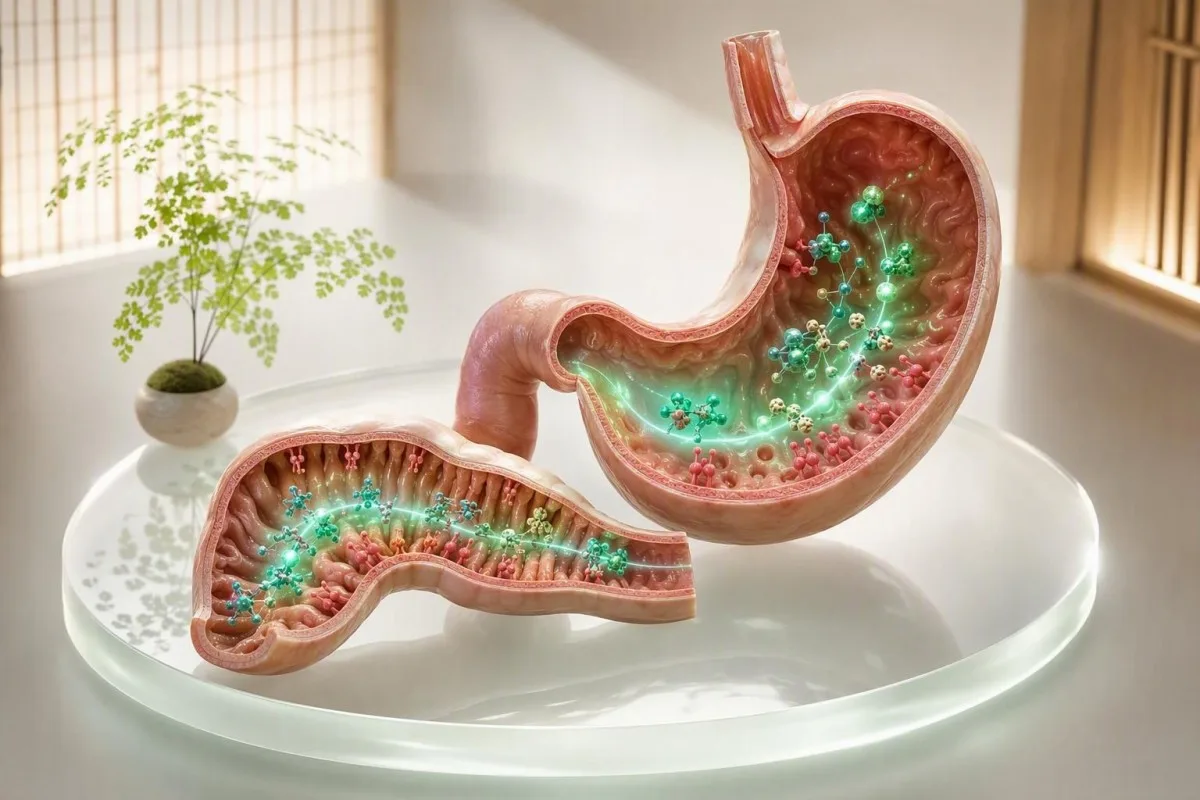
Die B12-Absorption erfordert Magensäure, Pankreasenzyme und intrinsischen Faktor aus Magenzellen, bevor es im terminalen Ileum aufgenommen wird. Ein Problem in einem dieser Schritte kann eine B12-reiche Diät unzureichend machen.
Nahrungsgebundenes B12 wird im Magen von Protein freigesetzt, bindet zunächst an Haptocorrin und wird dann im Dünndarm an den intrinsischen Faktor gebunden. Der Komplex aus intrinsischem Faktor und B12 wird im terminalen Ileum über einen rezeptorvermittelten Prozess aufgenommen; deshalb haben Erkrankungen oder die Entfernung dieses Darmabschnitts Folgen.
Die Absorption von intrinsischem Faktor sättigt bei etwa 1,5-2 mcg pro Mahlzeit, während etwa 1% einer großen oralen Dosis durch passive Diffusion aufgenommen werden können. Dieser kleine passive Weg erklärt, warum Ärzte manchmal orale Behandlungsdosen von 1.000-2.000 mcg verwenden, nicht weil jemand das 1.000-fache des Ernährungsbedarfs benötigt.
Bei Personen mit chronischem Durchfall, unerklärlichem Gewichtsverlust oder Verdacht auf Zöliakie reicht eine Berechnung der Zufuhr nicht aus. Die Besprechung des richtigen Zeitpunkts für eine Glutenbelastung vor der Testung kann eine fälschlicherweise beruhigende Untersuchung verhindern.
Was blockiert die B12-Aufnahme auch bei einer guten Ernährung?
Perniziöse Anämie, Magen- oder Darmoperationen, Zöliakie, Morbus Crohn, Langzeitbehandlung mit Metformin und Säuresuppression können die B12-Absorption verringern. In diesen Fällen kann die Erhöhung von Fisch oder angereichertem Müsli den Rückgang verlangsamen, aber einen Mangel möglicherweise nicht beheben.
Autoimmun-Gastritis kann die intrinsischen-Faktor-produzierenden Magenzellen zerstören und zu perniziöse Anämie, einer Absorptionsstörung und nicht einem Ernährungsversagen, führen. Die NICE-Richtlinie NG239 aus dem Jahr 2024 empfiehlt die Berücksichtigung von Antikörpertests gegen den intrinsischen Faktor bei Verdacht auf Autoimmun-Gastritis, obwohl ein negatives Ergebnis diese nicht vollständig ausschließt.
Metformin-assoziierter niedriger B12-Spiegel ist real, aber variabel. In der Diabetes Prevention Program Outcomes Study war ein niedriger oder grenzwertig niedriger B12-Spiegel nach 5 Jahren unter Metformin häufiger als unter Placebo, und das Risiko stieg mit längerer Exposition (Aroda et al., 2016); deshalb Blutuntersuchungen nach Metformin sollte sich nicht nur auf die Glukose konzentrieren.
Eine 63-jährige Patientin, die ich untersuchte, aß wöchentlich Lachs und trank täglich Milch, hatte aber nach jahrelanger Einnahme von Metformin und Omeprazol einen B12-Spiegel von 156 pg/mL mit tauben Zehen. Die Nahrung war nicht der fehlende Schritt – die Absorption war es.
Welche Blutuntersuchungen klären einen möglichen B12-Mangel auf?
Ein Serum-B12-Spiegel unter 200 pg/mL oder 148 pmol/L deutet häufig auf einen Mangel hin, während 200-300 pg/mL eine unbestimmte Zone darstellen, die von bestätigenden Kontexten profitiert. Methylmalonsäure, Homocystein, aktives B12, ein Blutbild und Folsäure können Unsicherheiten beseitigen.
Methylmalonsäure steigt normalerweise an, wenn zelluläres B12 unzureichend ist; ein MMA über 0,40 Mikromol/L gilt oft als erhöht, obwohl die Laborgrenzwerte variieren. Eine Nierenfunktionsstörung kann MMA unabhängig erhöhen, sodass eine eGFR von 35 mL/min/1,73 m² die Bedeutung desselben Ergebnisses verändert.
Makrozytose ist ein Hinweis, keine Voraussetzung. Ein MCV über , ansteigendem MCV über kann bei B12-Mangel auftreten, aber ein früher Mangel kann einen normalen MCV aufweisen, und Eisenmangel kann die Zellvergrößerung teilweise maskieren; vergleichen Sie das Ergebnis mit unserem Leitfaden zur Nachverfolgung von hohem MCV.
Kantesti ist ein KI-gestütztes Analyse-Tool für Bluttests , der B12 mit MMA, MCV, RDW, Kreatinin und Längsveränderungen liest, anstatt einen einzelnen Grenzwert anzuwenden. Der diagnostische Rahmen in Devalia et al. (2014) unterstützt ebenfalls die Verwendung klinischer Merkmale und Tests zweiter Linie, wenn Serum-B12 die Frage nicht klärt.
Kann ein B12-Mangel Symptome ohne Anämie verursachen?
Ja, B12-Mangel kann Nerven- und kognitive Symptome verursachen, bevor das Hämoglobin sinkt oder der MCV steigt. Kribbeln, brennende Füße, verminderte Balance, Verlust des Vibrationsempfindens, gedrückte Stimmung und Gehirnnebel verdienen eine Untersuchung, wenn sie anhalten.
Ein Hämoglobin von 13,2 g/dL und ein MCV von 92 fL schließen einen funktionellen B12-Mangel bei einer Person mit fortschreitender Parästhesie nicht aus. Die neurologische Erholung ist weniger vorhersagbar, wenn die Symptome seit vielen Monaten bestehen, weshalb ich nicht rate, auf eine offensichtliche Anämie zu warten.
Folsäure kann das Blutbild normalisieren, während B12-bedingte Nervenschäden fortschreiten. Dies ist das klinische Problem hinter der Warnung vor hochdosierter Folsäure; siehe unsere Erklärung von hohes Folsäure-Maskieren von B12 für die praktischen Details.
Eine dringende Untersuchung am selben Tag ist sinnvoll bei sich schnell verschlechternder Gehschwierigkeit, neuer Verwirrtheit, ausgeprägter Schwäche oder Veränderungen des Stuhlgangs und der Blasenfunktion. Diese Symptome haben mehrere Ursachen, aber B12 sollte Teil einer schnellen Differentialdiagnose sein und kein Experiment mit Nahrungsergänzungsmitteln.
Wann kann die Nahrung einen niedrigen B12-Spiegel korrigieren und wann ist eine Behandlung erforderlich?
Nahrung kann eine grenzwertige geringe Aufnahme bei Personen mit intakter Absorption beheben, aber ein nachgewiesener Mangel aufgrund von Malabsorption erfordert oft eine hochdosierte orale Behandlung oder Injektionen. Die Wahl hängt von der Ursache, der Schwere, der Compliance und den neurologischen Befunden ab – nicht nur von der Serumkonzentration.
Bei ernährungsbedingtem Mangel ohne schwere Symptome können Ärzte oral Cyanocobalamin oder Methylcobalamin in Dosen wie 50-150 mcg täglich zur Erhaltung verwenden, mit höheren Dosen bei der Korrektur eines Mangels. Genaue Regimes variieren je nach Land und sollten dem Protokoll des behandelnden Arztes folgen.
Perniziöse Anämie, totale Gastrektomie, schwere Ileuserkrankungen oder erhebliche neurologische Symptome verändern in der Regel die Diskussion. Unser detaillierter Vergleich von B12-Injektionen und Tabletten erklärt, warum hochdosierte Tabletten immer noch durch passive Absorption wirken können, während Injektionen bevorzugt werden können, wenn Sicherheit oder Geschwindigkeit wichtig sind.
Nach meiner Erfahrung ist ein "food-first"-Ansatz eine ausgezeichnete Prävention, aber eine schlechte Notfalltherapie bei symptomatischer Malabsorption. Der Zeitpunkt der Nachuntersuchung sollte Symptome und funktionelle Marker umfassen, nicht nur ein B12-Ergebnis, das nach einer Injektion schnell ansteigt.
Ist methyliertes B12 besser als Cyanocobalamin?
Methylcobalamin und Cyanocobalamin können beide einen B12-Mangel korrigieren, wenn Dosis und Absorption angemessen sind; die Beweise zeigen nicht, dass methyliertes B12 universell überlegen ist. Cyanocobalamin ist stabil, gut untersucht und wird häufig in angereicherten Lebensmitteln verwendet.
Der Körper wandelt Cobalamin in aktive Coenzym-Formen um, die von Methionin-Synthase und Methylmalonyl-CoA-Mutase verwendet werden. Marketing-Sprache rund um 'methylierte' Produkte übertrifft oft die vergleichende klinische Evidenz; Absorption, Dosis, Kosten und Konsistenz sind in der Regel entscheidender.
Hydroxocobalamin wird in mehreren Gesundheitssystemen häufig per Injektion verwendet, da es länger im Körper verbleibt als Cyanocobalamin. Personen mit chronischer Nierenerkrankung oder ungewöhnlichen Stoffwechselstörungen benötigen individuelle Ratschläge, da MMA und die Wahl der Behandlung komplizierter werden können.
Für einen praktischen Vergleich von Produktchemie, Dosislogik und Labor-Nachuntersuchungen lesen Sie methyliertes B12 im Vergleich zu Cyanocobalamin. Setzen Sie verschriebene Injektionen nicht ab, nur weil ein Nahrungsergänzungsmittel-Etikett eine 'natürlichere' Form verspricht.
Wie sieht ein praktischer Tag mit B12-reicher Ernährung aus?
Eine gemischte Ernährung kann bei normalen Mahlzeiten 2,4 mcg B12 erreichen, während ein veganes Muster eine bewusste Planung angereicherter Lebensmittel oder ein Nahrungsergänzungsmittel erfordert. Der zuverlässigste Plan ist einer, den Sie während Reisen, geschäftigen Wochen und Appetitänderungen wiederholen können.
Ein Beispiel für Allesfresser ist Joghurt zum Frühstück (1,0 mcg), ein Ei zum Mittagessen (0,5 mcg) und 85 g Lachs zum Abendessen (2,6 mcg). Dies liefert ungefähr 4,1 mcg vor Berücksichtigung von Schwankungen bei der Nahrungsaufnahme, wobei die Verteilung der Aufnahme auf mehrere Mahlzeiten für die meisten Menschen angenehm ist.
Ein angereichertes veganes Beispiel könnte ein pflanzliches Getränk verwenden, das 1,0 mcg, Müsli, das 1,5 mcg, liefert, und angereicherte Nährhefe, die 1,0 mcg. liefert. Der Haken ist die Konsistenz: Ein Markenwechsel kann das Nährstoffelement abrupt entfernen, bewahren Sie daher ein Foto des Etiketts in Ihren Gesundheitsnotizen auf.
B12 gehört in das breitere Muster der wasserlöslichen Nährstoffe, Protein, Eisen und Energieaufnahme. Unser unser Leitfaden zu wasserlöslichen Vitaminen hilft, den häufigen Fehler zu vermeiden, eine einzelne Vitamin als alleinige Erklärung für Müdigkeit zu betrachten.
Wer sollte besonders auf einen niedrigen B12-Spiegel achten?
Veganer, ältere Erwachsene, Personen, die Metformin oder langfristig Säurehemmer einnehmen, Patienten nach Magen- oder Ileostoma-Operationen und Personen mit entzündlichen Darmerkrankungen haben ein höheres Risiko für einen B12-Mangel. Das Risiko steigt, wenn mehr als ein Faktor vorhanden ist.
Die langfristige Einnahme von Protonenpumpenhemmern kann die Freisetzung von B12 aus Nahrungsproteinen verringern, indem sie die Magensäure senkt. Der Zusammenhang ist kein Grund, ein verschriebenes Medikament abrupt abzusetzen, aber er ist ein Grund, zu fragen, ob eine Überwachung nach 2 Jahren oder länger der kontinuierlichen Anwendung.
Personen über 60 Jahren Jahren können auch bei abwechslungsreicher Ernährung eine Malabsorption von Nahrungs-Cobalamin entwickeln, manchmal zusammen mit einer atrophischen Gastritis. Ein niedrigerer B12-Spiegel in dieser Gruppe ist nicht automatisch 'nur Alter'; es kann ein Signal sein, Symptome, Medikamente und autoimmune Vorgeschichte zu untersuchen.
Unser Leitfaden zur Langzeitüberwachung von PPIs beschreibt zugehörige Laboruntersuchungen, einschließlich Magnesium und Eisen. Die Kombination von niedrigem B12 mit unerklärlichem Eisenmangel kann Klinikern eher eine Ursache im Magen als zwei nicht zusammenhängende Ernährungslücken aufzeigen.
Wann sollten die B12-Spiegel nach Änderung der Ernährung oder Behandlung erneut getestet werden?
Die erneute Testung erfolgt oft 8-12 Wochen nach einer Ernährungs- oder oralen Behandlungsänderung, während die Schwere der Symptome und die Behandlungsmethode eine frühere klinische Überprüfung rechtfertigen können. Ein Serum-B12-Ergebnis kann nach einer Nahrungsergänzung schnell ansteigen und beweist allein noch keine Geweberegeneration.
Ein komplettes Blutbild kann innerhalb von etwa 1 Woche nach wirksamer Behandlung einer megaloblastären Anämie eine Retikulozytenantwort zeigen, während sich der Hämoglobinspiegel normalerweise über mehrere Wochen verbessert. Nervensymptome erholen sich häufig langsamer und manchmal unvollständig, insbesondere nach langem Mangel.
Ein Unterbrechen und Wiederaufnehmen der Nahrungsergänzung kann den Serum-B12-Spiegel am Testtag normal erscheinen lassen, während MMA, Symptome oder Makrozytose besorgniserregend bleiben. Dies ist ein Grund, dem Arzt genau zu sagen, was Sie eingenommen haben, die Dosis und das Datum der letzten Einnahme, bevor Ergebnisse interpretiert werden.
Kantesti AI kann B12, MCV, Hämoglobin, RDW, Folsäure und Kreatinin über mehrere Berichte hinweg vergleichen, um festzustellen, ob eine Änderung klinisch bedeutsam ist. Für Leser, die diese Fähigkeit erlernen, erklärt unser Leitfaden zur Trendanalyse von Bluttests , warum ein einzelnes Ergebnis selten die ganze Geschichte ist.
Welche B12-Fehlvorstellungen können eine angemessene Versorgung verzögern?
Die größte Verwechslung bezüglich B12 ist, dass der Verzehr von mehr tierischen Lebensmitteln jedes niedrige Ergebnis beheben wird. Die Ernährung hilft bei der Aufnahme, kann aber keinen intrinsischen Faktor wiederherstellen, keine Darmerkrankungen umkehren oder eine Bewertung neurologischer Symptome sicher ersetzen.
Ein weiterer Mythos ist, dass ein hoher Serum-B12-Spiegel immer einen ausgezeichneten Status bedeutet. Ein Ergebnis über 900 pg/mL spiegelt häufig Nahrungsergänzungsmittel oder Injektionen wider, aber eine anhaltende unerklärliche Erhöhung kann auch bei Lebererkrankungen, Nierenerkrankungen oder einigen hämatologischen Erkrankungen auftreten; der Kontext ist wichtiger als Panik.
Ab dem 1. September 2026 warne ich auch davor, eine Verbesserung der Energie nach einer Tablette als diagnostischen Beweis zu verwenden. Placeboeffekte, Schlaf, Eisenstatus, Schilddrüsenerkrankungen, Depressionen und Glukoseveränderungen können die Energie über 1-4 Wochen verändern, ohne einen B12-Mangel zu bestätigen.
Die klinischen Inhalte von Kantesti werden mit Unterstützung von unserem Medizinischer Beirat, überprüft, aber eine KI-Interpretation ersetzt niemals eine Untersuchung auf fortschreitende neurologische Symptome. Leser können unsere Ansatz zur klinischen Validierung überprüfen, um zu verstehen, wie wir Folgeaufforderungen formulieren, anstatt eine Diagnose zu stellen.
Was sind die sichersten nächsten Schritte, wenn Sie einen niedrigen B12-Spiegel vermuten?
Wenn Sie anhaltende Taubheit, Gleichgewichtsprobleme, kognitive Veränderungen, unerklärliche Makrozytose oder ein B12-Ergebnis unter 200 pg/ml haben, veranlassen Sie eine ärztliche Untersuchung, anstatt sich nur auf die Ernährung zu verlassen. Eine frühzeitige Behandlung ist besonders relevant, wenn Nerven beteiligt sein könnten.
Bringen Sie eine Liste der Medikamente, Nahrungsergänzungsmittel, Ernährungsmuster, Verdauungsdiagnosen, Operationen, Alkoholkonsum und frühere Laborberichte mit. Ein Arzt kann dann entscheiden, ob B12 wiederholt werden soll, ob MMA oder Homocystein bestellt werden soll, ob Folsäure und ein großes Blutbild überprüft werden sollen oder ob eine perniziöse Anämie und Malabsorption untersucht werden sollen.
Thomas Klein, MD, empfiehlt, hochdosierte Folsäure als Selbstbehandlung bei unerklärlicher Makrozytose zu vermeiden, bis B12 angemessen beurteilt wurde. Wenn Sie keine Warnzeichen haben und die Nahrungsaufnahme eindeutig niedrig ist, ist ein abgestimmter Ernährungs- oder Ergänzungsplan mit einem Wiederholungsergebnis in 8-12 Wochen oft sinnvoll.
Kantesti verbindet Labortrendberichte mit verständlichen Fragen für Ihren Termin, während die endgültige diagnostische Entscheidung bei Ihrem Arzt liegt. Erkunden Sie unsere Biomarker-Referenzhandbuch für die Laborbegriffe, die wahrscheinlich zusammen mit einem B12-Ergebnis erscheinen.
Häufig gestellte Fragen
Welches Lebensmittel ist am reichsten an Vitamin B12?
Muscheln und Rinderleber gehören zu den Lebensmitteln mit dem höchsten Vitamin-B12-Gehalt. Eine gekochte 85-g-Portion Muscheln kann etwa 84 mcg B12 liefern, während die gleiche Portion Rinderleber etwa 70 mcg liefert; beides übersteigt bei weitem die tägliche Zielmenge von 2,4 mcg für Erwachsene. Leber sollte aufgrund ihres sehr hohen Gehalts an vorgeformtem Vitamin A in der Schwangerschaft nicht als alltägliches Lebensmittel betrachtet werden. Für regelmäßige Mahlzeiten sind Fisch, Fleisch, Milchprodukte, Eier und entsprechend gekennzeichnete angereicherte Lebensmittel praktischere Quellen.
Können Veganer genug B12 allein über die Nahrung aufnehmen?
Veganer können ihren Bedarf an Vitamin B12 nur aus Lebensmitteln decken, wenn sie regelmäßig Produkte verwenden, die mit B12 in abgemessenen Mengen angereichert sind. Unangereicherte Gemüse, Pilze, Algen, Tempeh und Nährhefe sind keine zuverlässigen B12-Quellen, da ihr Cobalamingehalt fehlt, inkonsistent ist oder inaktive Analoga enthalten kann. Viele angereicherte pflanzliche Getränke liefern 0,4-1,0 mcg pro 250 ml, aber die Formulierungen variieren je nach Land und Marke. Ein B12-Präparat ist oft eine einfachere und zuverlässigere Absicherung für vegane Ernährungsweisen.
Wie viel B12 sollte ein Erwachsener täglich zu sich nehmen?
Die meisten Erwachsenen benötigen laut der United States Recommended Dietary Allowance täglich 2,4 mcg Vitamin B12. Eine Schwangerschaft erhöht den Bedarf auf 2,6 mcg täglich und Stillen auf 2,8 mcg täglich. Die britische Referenznährstoffzufuhr für Erwachsene beträgt 1,5 mcg täglich, daher können länderspezifische Nährwertangaben abweichen. Diese Werte sind Präventionsziele für normale Absorption und liegen deutlich unter den Behandlungsmengen, die bei diagnostiziertem Mangel angewendet werden.
Kann ich einen B12-Mangel durch den Verzehr von mehr Fleisch und Eiern beheben?
Eine Erhöhung von Fleisch, Fisch, Milchprodukten, Eiern oder angereicherten Lebensmitteln kann einen B12-Mangel, der nur durch geringe Aufnahme über die Nahrung verursacht wird, beheben, ist aber bei beeinträchtigter Absorption möglicherweise nicht wirksam. Perniziöse Anämie, Zöliakie, Morbus Crohn, Magenoperationen, Dünndarmoperationen, Metformin und eine lang andauernde säureunterdrückende Behandlung können die Absorption trotz einer B12-reichen Ernährung verringern. Ein Serum-B12-Wert unter 200 pg/mL oder 148 pmol/L rechtfertigt im Allgemeinen eine klinische Beurteilung der Ursache. Neurologische Symptome wie Taubheit, schlechte Balance oder kognitive Veränderungen sollten nicht allein mit Nahrungsmitteln behandelt werden.
Was hilft bei der B12-Aufnahme?
Die Vitamin-B12-Aufnahme hängt von einer ausreichenden Magenverarbeitung, Pankreasenzymen, intrinsic factor und einem funktionierenden terminalen Ileum ab. Intrinsic factor nimmt nur etwa 1,5–2 µg B12 aus einer Mahlzeit aktiv auf, während etwa 1% einer großen oralen Dosis durch passive Diffusion aufgenommen werden können. Die Einnahme von B12 mit Nahrung ist sinnvoll, aber keine spezifische Lebensmittelkombination kann einen fehlenden intrinsic factor oder eine schwere Ileumerkrankung ausgleichen. Bei beeinträchtigter Resorption können hochdosiertes orales B12 oder Injektionen erforderlich sein.
Welcher B12-Spiegel gilt als niedrig?
Ein Serum-Vitamin-B12-Ergebnis unter 200 pg/mL, was etwa 148 pmol/L entspricht, unterstützt üblicherweise einen B12-Mangel, obwohl Labore unterschiedliche Testbereiche verwenden. Ergebnisse von 200-300 pg/mL werden oft als grenzwertig oder unbestimmt angesehen und erfordern möglicherweise Methylmalonsäure, Homocystein, aktives B12, ein vollständiges Blutbild, Folsäure, Nierenfunktion und den Symptomkontext. Methylmalonsäure über etwa 0,40 Mikromol/L unterstützt zellulären B12-Mangel, kann aber auch bei eingeschränkter Nierenfunktion ansteigen. Ein normales Hämoglobin oder MCV schließt frühe B12-bedingte Nervensymptome nicht zuverlässig aus.
Hol dir heute eine KI-gestützte Bluttest-Analyse
Schließe dich über 2 Millionen Nutzern weltweit an, die Kantesti für sofortige, genaue Laboranalysen vertrauen. Lade deine Blutwerte Ergebnisse hoch und erhalte in Sekunden eine umfassende Interpretation von 15,000+-Biomarkern.
📚 Referenzierte Forschungsveröffentlichungen
Klein, T., Mitchell, S., & Weber, H. (2026). Urobilinogen im Urin-Test: Vollständige Anleitung zur Urinanalyse 2026. Kantesti KI-Medizinische Forschung.
Klein, T., Mitchell, S., & Weber, H. (2026). Leitfaden zu Eisenstudien: TIBC, Eisensättigung und Bindungskapazität. Kantesti KI-Medizinische Forschung.
📖 Externe medizinische Referenzen
⚕️ Medizinischer Haftungsausschluss
Dieser Artikel dient nur zu Bildungszwecken und stellt keine medizinische Beratung dar. Wende dich für Diagnose- und Behandlungsentscheidungen immer an eine qualifizierte medizinische Fachkraft.
E-E-A-T Vertrauenssignale
Erfahrung
Ärztlich geleitete klinische Überprüfung von Labor-Interpretations-Workflows.
Sachverstand
Fokus der Labormedizin darauf, wie Biomarker sich im klinischen Kontext verhalten.
Autorität
Verfasst von Dr. Thomas Klein, überprüft von Dr. Sarah Mitchell und Prof. Dr. Hans Weber.
Vertrauenswürdigkeit
Evidenzbasierte Interpretation mit klaren nächsten Schritten zur Reduzierung von Alarm.