
Patogenní varianta BRCA1 nebo BRCA2 zvyšuje dědičné riziko rakoviny; nejedná se o diagnózu rakoviny. Varianta nejasného významu by neměla být důvodem k preventivní operaci. Negativní výsledek je skutečně negativní pouze tehdy, pokud vylučuje známou familiární variantu — jinak nemusí dědičné riziko objasnit.

Klíčová sdělení
- Positive result znamená, že byla zjištěna patogenní nebo pravděpodobně patogenní varianta; dědičná predispozice není diagnózou rakoviny.
- Pět klasifikací popisuje genetické varianty: patogenní, pravděpodobně patogenní, nejasného významu, pravděpodobně benigní a benigní.
- Riziko BRCA1 v prospektivní studii JAMA dosáhlo u žen s patogenními variantami do 80 let přibližně 72% u rakoviny prsu a 44 % u rakoviny vaječníků.
- Riziko BRCA2 ve stejné studii dosáhlo do 80 let přibližně 69 % u rakoviny prsu a 17 % u rakoviny vaječníků; jde o skupinové odhady, nikoli osobní předpovědi.
- Postup při variantě nejasného významu by se měl řídit osobní a rodinnou anamnézou, nikoli nejistou variantou; samotná varianta nejasného klinického významu (VUS) neodůvodňuje preventivní operaci.
- Skutečně negativní výsledek znamená, že laboratoř nenašla konkrétní patogenní variantu, která již byla ve vaší rodině potvrzena.
- Neinformativní negativní výsledek znamená, že testování nezjistilo příčinu předpokládaného dědičného rizika; silná rodinná anamnéza může i nadále odůvodňovat další vyšetření.
- Dědičnost v rodině obvykle znamená, že každé dítě nositele zárodečné patogenní varianty BRCA1 nebo BRCA2 má 50% pravděpodobnost, že tuto variantu zdědí.
- Genetické poradenství pomáhá propojit přesnou variantu, rozsah testování, obě strany rodiny a možnosti screeningu či prevence závislé na věku.
Co výsledky genetického testu BRCA vlastně znamenají?
Výsledky genetického testu BRCA se obvykle dělí do 3 praktických skupin: pozitivní, nejisté nebo negativní. Pozitivní dědičný výsledek určuje náchylnost k nádorovým onemocněním, variant s neurčitým významem zůstává nevyřešený a negativní výsledek je třeba posoudit v kontextu rodiny, než jej lze označit za uklidňující.

A Zárodečný test BRCA analyzuje DNA, obvykle ze vzorku krve nebo slin vyšetřeného v laboratoři, namísto měření koncentrace bílkoviny. Jeho výsledek nelze interpretovat jako hodnotu v ng/mL: klinicky užitečné informace tvoří gen, přesná varianta, klasifikace a rozsah testování.
Většina lidí má 2 kopie genu BRCA1 a 2 kopie genu BRCA2, přičemž jednu kopii každého genu dědíme od každého biologického rodiče. Škodlivá změna v jedné kopii může zvýšit náchylnost k nádorovým onemocněním, k jejich vzniku však obecně přispívají další buněčné změny — dědičnost není odpočítáváním do propuknutí nemoci.
U hypotetického 38letého člověka bez nádorového onemocnění může patogenní výsledek BRCA2 ovlivnit budoucí diskuse o screeningu a prevenci, aniž by potvrzoval aktuální diagnózu rakoviny. U někoho, kdo se již léčí s nádorovým onemocněním, může stejný dědičný nález ovlivnit také způsobilost k léčbě a posouzení budoucích nádorových onemocnění.
Kantesti je Analyzátor krevních testů AI pro rutinní laboratorní interpretaci, nikoli jako náhrada klinické genetické laboratoře. Informace o naší organizace pomáhají odlišit naši vzdělávací roli od odborné práce potřebné k interpretaci dědičného výsledku týkajícího se nádorového onemocnění.
Na kterých údajích v laboratorní zprávě BRCA záleží?
Nejužitečnější údaje ve zprávě o BRCA jsou gen, přesná varianta, klasifikace, typ vzorku a metoda testování. Klinické laboratoře běžně používají 5 klasifikačních kategorií variant a samotné slovo “varianta” neříká, zda je nález škodlivý.

Rámec ACMG/AMP rozlišuje patogenní, pravděpodobně patogenní, nejasného klinického významu, pravděpodobně benigní a benigní nálezy (Richards et al., 2015). Patogenní a pravděpodobně patogenní varianty obecně vedou ke stejné klinické strategii; rozdíl vyjadřuje míru jistoty důkazů, nikoli dvě různé hodnoty rizika nádorového onemocnění.
Popis varianty může zahrnovat změnu na úrovni DNA začínající na c. and a protein-level consequence beginning with p. These are coordinates, not severity scores; two reports may describe the same change differently because they use different transcripts or historical naming conventions.
Look for both sequence analysis a deletion/duplication analysis when evaluating a comprehensive BRCA1/BRCA2 test. Reading individual DNA changes and detecting missing or extra gene segments require complementary methods, so a report stating “sequencing negative” may not answer every relevant question.
A hypothetical report can contain 2 findings: a pathogenic BRCA1 variant and an unrelated BRCA2 VUS. Management follows the established pathogenic finding, not an average of the two classifications; our guide to categorical versus numerical results explains why laboratory result types require different reading strategies.
Význam pozitivního výsledku BRCA1: predispozice, nikoli jistota
BRCA1 positive meaning depends on the classification: a germline pathogenic or likely pathogenic BRCA1 variant indicates inherited cancer susceptibility. In a prospective study, women carrying pathogenic BRCA1 variants had an estimated 72% breast cancer risk and 44% ovarian cancer risk by age 80.
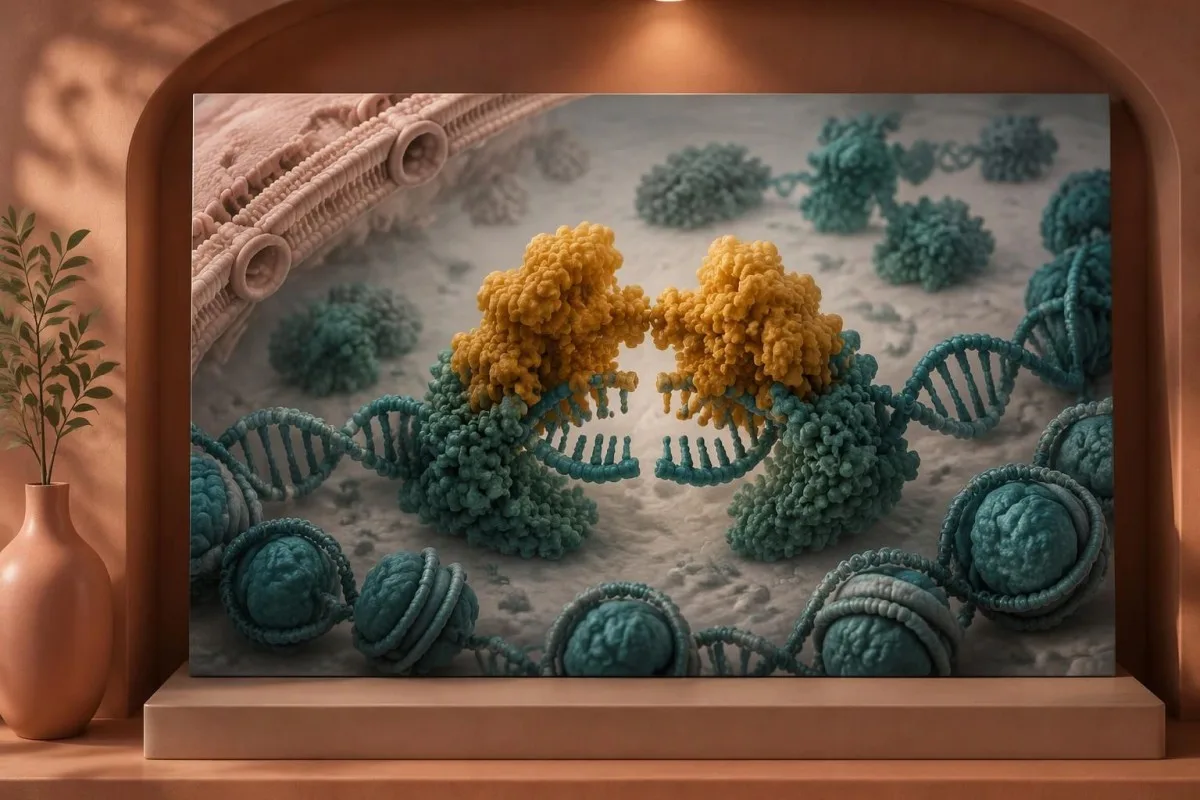
Kuchenbaecker et al. reported those age-80 estimates in JAMA, with 95% confidence intervals of 65–79% for breast cancer a 36–53% for ovarian cancer (2017). The intervals describe uncertainty around population estimates; they do not mean an individual’s risk can be read directly from the laboratory report.
A hypothetical 30-year-old BRCA1 carrier should not interpret a 72% age-80 estimate as a 72% risk this year. Personal counseling separates near-term risk from longer-term risk and considers age, prior cancer, relatives’ diagnoses and any preventive procedures already completed.
BRCA1-associated breast cancers are more often triple-negative than breast cancers in the general population, but receptor status cannot be predicted from an inherited result alone. An existing cancer still requires its own pathological and receptor assessment; a genetic finding does not replace those separate tests.
One family can also have more than one inherited explanation for cancer, particularly when diagnoses cluster on both parental branches. For example, several colorectal and endometrial cancers may justify a separate assessment of Lynch syndrome results rather than assuming a BRCA1 finding explains every diagnosis.
Jak se liší riziko rakoviny související s mutací BRCA2?
BRCA2 mutation cancer risk includes breast and ovarian cancer susceptibility, with particular relevance to male breast, prostate and pancreatic cancer assessment. In the same prospective JAMA study, women carrying pathogenic BRCA2 variants had estimated risks of 69% for breast cancer and 17% for ovarian cancer by age 80.
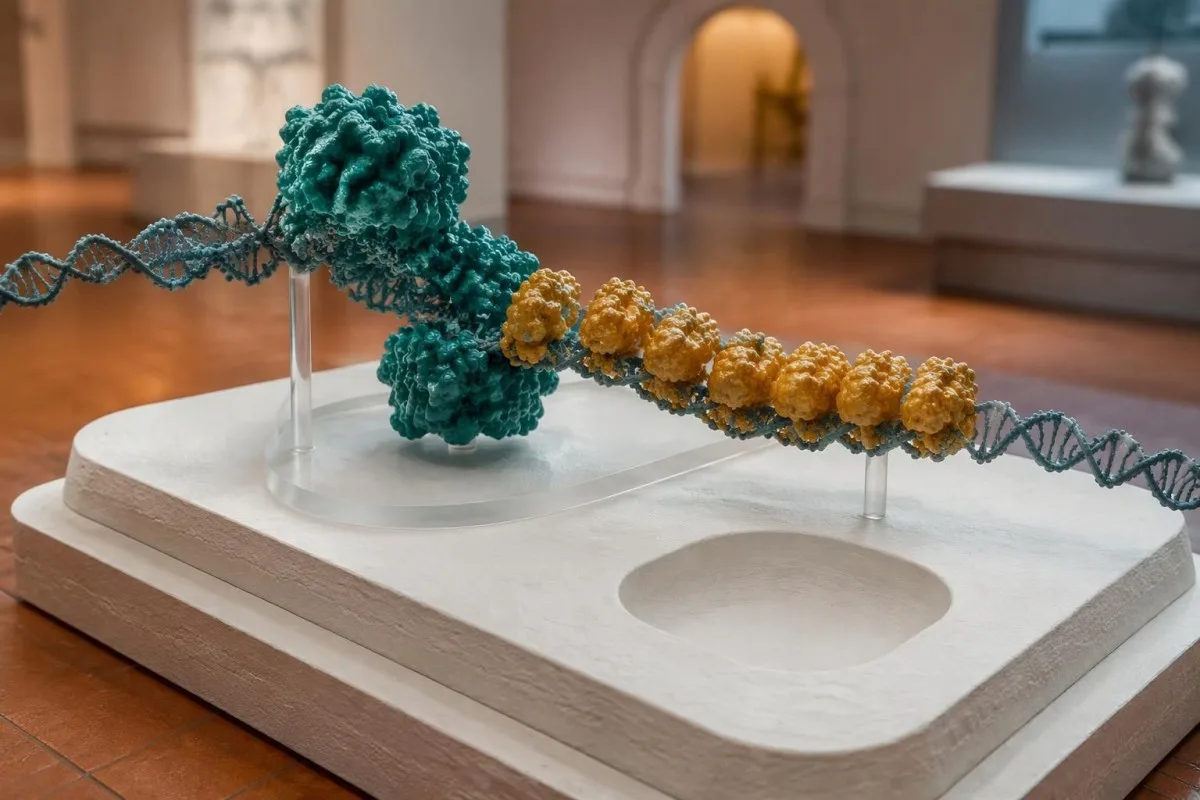
The BRCA2 estimates had 95% confidence intervals of 61–77% for breast cancer a 11–25% for ovarian cancer (Kuchenbaecker et al., 2017). BRCA2’s lower average ovarian cancer risk compared with BRCA1 helps explain why preventive ovary-and-tube removal is commonly discussed later for BRCA2 carriers.
A previous breast cancer creates a different risk question: the chance of another cancer in the opposite breast. Kuchenbaecker et al. estimated 20-year contralateral breast cancer risks of 26% for BRCA2 and 40% for BRCA1; those figures are not the same as first-cancer risk and should not be substituted for it.
Prostate screening discussions may begin around age 40 in men with pathogenic BRCA2 variants, depending on the applicable clinical pathway. PSA is a screening measurement rather than a symptom generator; our explanation of what elevated PSA means separates the laboratory number from a diagnosis.
Pancreatic surveillance is another area where eligibility criteria differ, including the importance assigned to family history. A hypothetical 52-year-old BRCA2 carrier with an affected first-degree relative needs a specialist discussion about MRI-based imaging or endoscopic ultrasound—not routine CA 19-9 testing as a substitute.
Co znamená varianta BRCA nejasného významu?
A BRCA variant of uncertain significance, or VUS, means available evidence cannot establish whether a DNA change increases cancer risk. A VUS is not a positive result, and it should not independently determine preventive mastectomy or removal of the ovaries and fallopian tubes.

The ACMG/AMP standards state that a VUS by se neměl používat při klinickém rozhodování (Richards et al., 2015). Among the 5 classification categories, uncertainty is an evidence status—not a diagnosis, not a halfway-positive result and not a 50% probability that the variant causes cancer.
For example, a hypothetical 42-year-old with a BRCA1 VUS and no significant family history should not be offered risk-reducing surgery because of that VUS alone. Another 42-year-old with the same VUS and a substantial family history may qualify for intensified surveillance because of the history, not because the uncertain variant became actionable.
Ancestry can affect how often laboratories encounter uncertainty because population databases do not represent every group equally. Two people with the same cancer history can therefore receive different levels of interpretive certainty; this reflects evidence gaps and does not establish a biological difference in the seriousness of their results.
At Kantesti, we separate finding a genetic change from proving that the change warrants action. The same distinction helps readers understand common MTHFR variant findings, although MTHFR results and BRCA-associated cancer susceptibility have very different clinical implications.
Může se klasifikace varianty BRCA nejasného významu později změnit?
A BRCA VUS can be reclassified when new evidence clarifies its clinical significance. Many reclassified VUS move toward benign categories, but neither the direction nor the timing can be promised for an individual finding; reinterpretation usually reviews existing DNA data rather than requiring another sample.

Useful new evidence can come from 3 broad sources: population frequency, carefully validated functional work and observations of the variant in families. A computer prediction alone is usually insufficient; expert curation weighs whether the evidence actually addresses the disease mechanism and meets classification standards.
Laboratories can disagree because their evidence differs or their interpretations were issued at different times. Record 2 separate dates when available—the original report date and the most recent classification date—and ask whether a specialist expert-panel assessment exists, rather than counting database entries as votes.
Routine testing of unaffected relatives for a VUS usually does not guide care, although a genetics team may arrange selected family studies to help classification. A hypothetical family with 3 affected relatives should not independently order VUS testing for everyone and interpret who carries it as proof of causation.
Ask which laboratory manages reinterpretation, how amended reports reach you and whether your contact details remain current; there is no universal recontact interval. Our discussion of inherited TTR variant interpretation illustrates the broader need to connect exact genetic findings with disease-specific evidence.
Kdy je negativní výsledek BRCA skutečně negativní?
A true negative BRCA result means testing did not find the specific pathogenic or likely pathogenic variant already identified in a biological relative. It removes the inherited risk attributable to that familial variant, but it does not eliminate ordinary cancer risk or unrelated risks from the other family branch.

Suppose a hypothetical mother has a confirmed pathogenic BRCA1 variant and her adult daughter’s targeted test excludes that exact variant. Before testing, the daughter generally had a 50%; afterward, she is not considered a carrier of that maternal finding and cannot pass that uncarried variant to her children.
A negative result becomes less definitive if nobody knows the affected relative’s exact finding. Bring a copy of the original family report rather than a verbal account of “BRCA positive”; a gene name alone cannot distinguish a pathogenic variant from a VUS or identify which change the laboratory should test.
An independently concerning paternal history can remain relevant despite a maternal true negative. For example, 2 close paternal relatives with early breast cancer may warrant separate risk assessment, because excluding one maternal variant does not explain another branch of the pedigree.
The logic of matching a relative’s exact finding also appears in family-based Alport genetic testing, although the genes and inheritance patterns differ. Ask for a written statement identifying which familial variant was excluded and what remaining screening recommendation follows from your own history.
Proč může být negativní výsledek BRCA neprůkazný?
An neprůkazně negativní výsledek means no actionable BRCA finding was detected, but testing has not explained a suspicious personal or family cancer history. The result may reflect another gene, a technical limitation or a familial risk pattern that cannot currently be assigned to one detectable variant.
Testing an affected relative first usually provides more information than testing an unaffected relative. A hypothetical unaffected 35-year-old’s negative panel does not prove that her mother’s ovarian cancer lacked an inherited cause; testing the mother, when possible, can establish whether there is a familial finding to exclude.
A broader panel may consider genes such as PALB2, ATM, CHEK2, RAD51C, RAD51D and BRIP1, depending on the cancer pattern. These genes do not share identical cancer risks or prevention recommendations, so “panel positive” still requires gene-specific interpretation rather than applying the BRCA pathway to every result.
Older tests or limited consumer tests may assess only selected variants, whereas comprehensive clinical testing can include sequencing and deletion/duplication analysis. Our explanation of hidden carrier-screening limitations illustrates why a reassuring-looking result can still depend on methodology, although SMA uses a different genetic model.
Kantesti AI does not establish the completeness of a genetic assay or certify that a family’s inherited risk has been excluded. If a hypothetical family has 3 related cancers despite negative testing, clinical genetics can decide whether updated testing, another affected relative or a formal family-history risk model would answer the unresolved question.
Znamená nález BRCA v nádoru, že je dědičný?
A BRCA variant found in tumor tissue is not automatically inherited. Tumor testing can detect acquired changes confined to cancer cells; germline testing examines a suitable non-tumor specimen to determine whether the finding is constitutional and relevant to relatives.
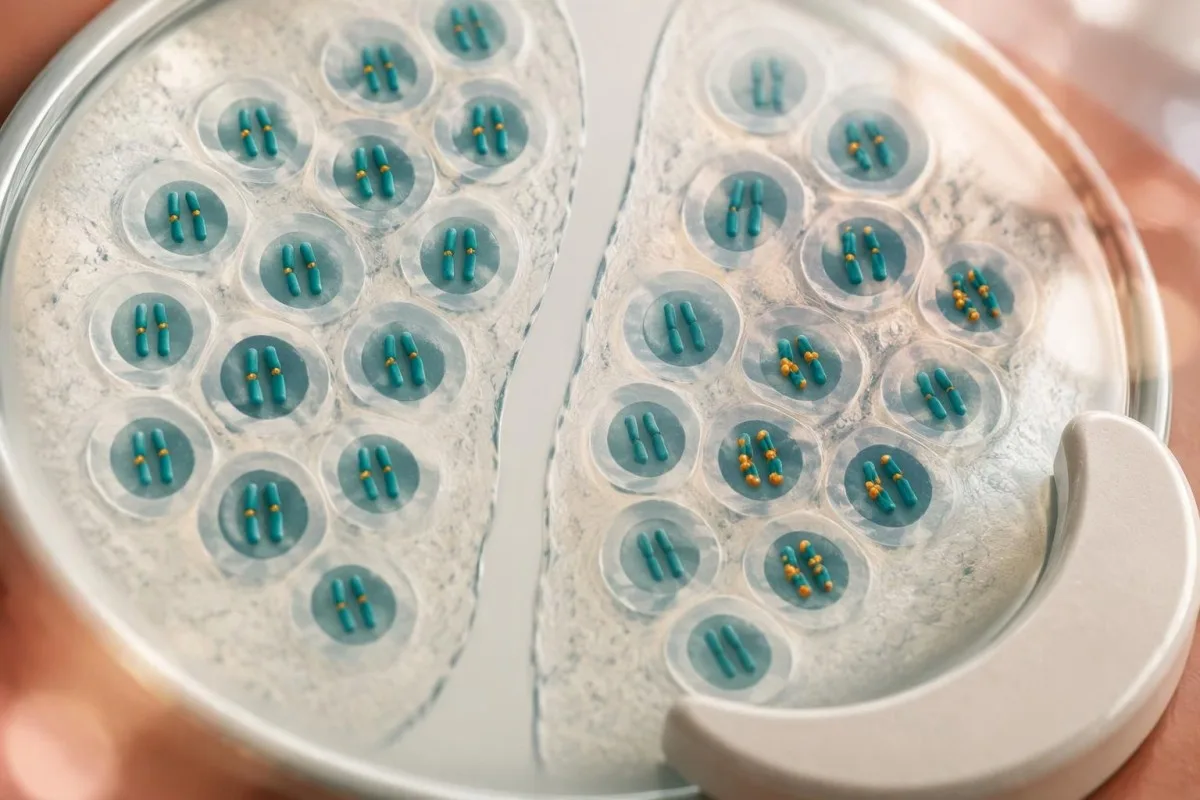
A tumor report may show a variant allele fraction near 50%, but that number does not prove germline origin. Tumor purity, copy-number changes and loss of the other gene copy can all shift the fraction; a percentage on a tumor report cannot replace a properly selected germline test.
Some oncology reports describe homologous recombination deficiency, or HRD, rather than a specific inherited variant. HRD can arise through more than one mechanism, and an HRD-positive result does not establish that a person or their children carry a pathogenic BRCA1 or BRCA2 variant.
After an allogeneic stem-cell transplant, a blood-derived DNA sample may reflect the donor, and saliva can also contain donor-derived cells. A hypothetical transplant recipient therefore needs the genetics laboratory to select an appropriate specimen—sometimes cultured skin fibroblasts—rather than assuming that 2 easily obtained samples answer the inheritance question.
The distinction between acquired and inherited DNA changes also matters in UBA1-related VEXAS testing, although VEXAS is a different condition. For a tumor BRCA finding, ask whether germline confirmation has been completed, is pending or was never requested.
Kdy je genetické poradenství nejpřínosnější?
Genetic counseling helps before testing and whenever a result could change screening, treatment or family testing. It is especially useful for pathogenic findings, unresolved VUS, limited negative tests and family patterns involving young diagnoses, ovarian cancer, male breast cancer or multiple related cancers.

A practical pedigree usually covers 3 generace and records cancer type, age at diagnosis, biological relationships and both maternal and paternal branches. “Abdominal cancer” is less useful than a confirmed primary site; ovarian, pancreatic and metastatic cancers can otherwise be misremembered as the same diagnosis.
Small families, early deaths and few female relatives can hide hereditary breast-and-ovarian cancer patterns. A hypothetical father with 2 sons and no sisters can carry and transmit a BRCA variant even when the family has no obvious breast cancer cluster; paternal inheritance deserves the same attention as maternal inheritance.
Kantesti je platforma pro rozbor krevních výsledků AI, not a genetic counseling service. Our guidance on age-appropriate family testing separates routine laboratory needs from predictive BRCA testing, which is generally deferred in children under 18 because management usually begins in adulthood.
Before an appointment, gather the actual family report, pathology details if available and your previous test methods. Use separate consent for each relative’s records; our discussion of family health consent explains why a shared family history does not give one person automatic permission to access everyone’s medical information.
Jaké následné kroky následují po patogenním výsledku BRCA?
A germline pathogenic BRCA result warrants a personalized prevention plan, not automatic surgery. Options include enhanced breast screening, discussion of risk-reducing procedures and assessment of other gene-associated cancers; age, reproductive plans, previous cancer and local guidance determine the timing.

Many high-risk pathways use annual breast MRI beginning around ages 25–30, with mammography commonly added around age 30, but national recommendations differ. The reason for combining methods is that each detects some findings the other can miss; more imaging is not simply a substitute for understanding age-specific benefit and false-positive risk.
NICE guideline NG241 lists risk-reducing removal of ovaries and fallopian tubes no earlier than age 35 for BRCA1 and 40 for BRCA2, with individualized assessment (NICE, 2024). Common clinical discussions use windows of approximately 35–40 and 40–45 years, respectively, after childbearing; these are planning ranges, not instructions for every carrier.
Removing only the fallopian tubes while delaying ovary removal has not been established as equivalent protection and remains a trial-based strategy in NICE guidance. Surgical menopause can affect symptoms, cardiovascular health and bones; our průvodce pro ženské hormonální zdraví explains why prevention planning includes consequences beyond cancer risk.
Hormone treatment after premenopausal risk-reducing surgery may be considered until the usual menopause age, approximately 51, but previous breast cancer and other contraindications change that discussion. Bone-density assessment and evaluation of secondary bone-loss causes are distinct tasks; our guide to bone health laboratory assessment explains what routine tests can and cannot answer.
Co výsledek BRCA znamená pro příbuzné a děti?
Each child of a germline BRCA pathogenic-variant carrier usually has a 50% chance of inheriting the variant, regardless of sex. Adult relatives can consider targeted testing for the established family finding; inheriting susceptibility does not mean inheriting an existing cancer.
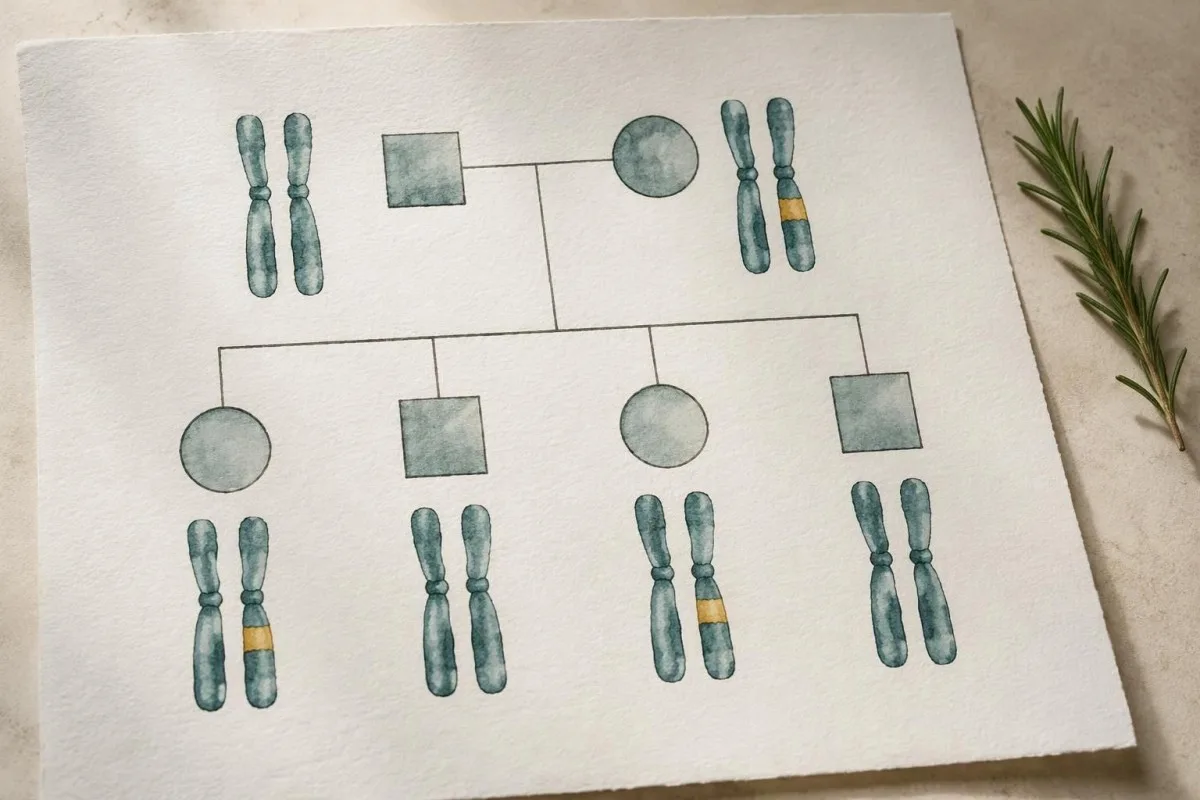
Four children do not imply that exactly 2 will inherit a parent’s BRCA variant. Each pregnancy is an independent event, so all, none or any number in between can inherit it; the 50% figure describes probability rather than a guaranteed family distribution.
A carrier’s siblings often have a 50% šance of sharing the variant when a parent carries it, but that estimate should not be applied without checking the pedigree. Identifying which parent carries the finding helps determine which cousins, aunts and uncles should receive an invitation to discuss testing.
Reproductive options can include natural conception, prenatal diagnosis or IVF with preimplantation genetic testing for a known familial variant. These are preference-sensitive choices, not obligations; our explanation of reproductive genetic result counseling shows why gene-specific inheritance matters, although FMR1 repeat expansion behaves differently from BRCA inheritance.
A rare additional question arises when both partners carry pathogenic variants in mutací BRCA2: each pregnancy has a 25% chance of inheriting pathogenic variants in both copies, which can cause a Fanconi anemia phenotype. Partner testing is not automatically required for every BRCA carrier, but ancestry, relatedness and reproductive planning can justify specialist assessment.
Mohou příznaky nebo nádorové markery potvrdit rakovinu související s BRCA?
Neither a BRCA result nor a tumor-marker concentration confirms that cancer is present. New symptoms need their own assessment, and a negative genetic result does not make them harmless; examination, imaging and sometimes tissue assessment answer a different question from inherited susceptibility testing.

CA-125 can rise in benign conditions and can remain normal in ovarian cancer, particularly earlier disease. Routine CA-125 and ultrasound screening have not demonstrated a mortality benefit sufficient to replace established risk-reduction discussions; our guide to CA-125 limits and symptoms explains why the usual 35 U/mL cutoff is not a cancer yes-or-no boundary.
CA 15-3 and CA 27-29 are not appropriate tests for deciding whether an unaffected BRCA carrier has developed breast cancer. A hypothetical carrier with a normal marker still needs assessment of a new breast lump; our explanation of CA 15-3 interpretation separates selected monitoring uses from screening.
Kantesti does not infer BRCA carrier status from routine laboratory markers. For example, a CA 19-9 result of 80 U/mL can have non-cancer explanations and cannot establish pancreatic cancer or inherited BRCA2 risk; our guide to CA 19-9 limitations explains the need for clinical and imaging context.
Persistent bloating, early satiety, unexplained weight loss, a new breast change or unexplained jaundice deserve timely medical review regardless of genetic classification. A hypothetical person with 3 weeks of new persistent symptoms should not wait for VUS reclassification or a routine genetics appointment before seeking a separate assessment.
Využívejte vysvětlení pomocí AI, aniž by nahrazovala genetické poradenství
AI explanations can support understanding, but they cannot independently classify a BRCA variant or authorize preventive surgery. A safe workflow preserves 3 essentials: the original laboratory report, specialist interpretation and a written follow-up plan that distinguishes inherited risk from evaluation of any current symptoms.

Kantesti je platforma pro interpretaci biomarkerů pomocí AI that explains routine laboratory findings, with interpretation generally available in about 60 seconds. That turnaround is not a timetable for genetic counseling, and our informace o klinické metodice should not be read as validation of independent BRCA classification or hereditary cancer risk calculation.
Genetic reports can reveal information relevant to more than 1 osoby, including biological relatives who have not chosen testing. Read our zásady ochrany soukromí a nakládání s údaji before sharing sensitive documents, and avoid uploading another relative’s identifiable report without their permission.
The 2 research publications listed below concern our global routine-test report and RDW educational material; they are not BRCA cancer-risk studies, clinical prevention guidelines or evidence supporting surgery. The medical recommendations in this article instead draw on the ACMG/AMP classification standards, the prospective JAMA risk study and NICE familial ovarian cancer guidance.
Before acting, ask your genetics team to document whether the result is germline, which exact variant is actionable and whether a negative is true or uninformative. Our zásady odpovědného používání AI support keeping those clinical decisions with qualified professionals rather than treating an automated explanation as another laboratory classification.
Často kladené dotazy
Znamená pozitivní test na BRCA1 nebo BRCA2, že mám rakovinu?
Pozitivní test zárodečné linie BRCA1 nebo BRCA2 identifikuje patogenní nebo pravděpodobně patogenní dědičnou variantu; nediagnostikuje rakovinu. V prospektivní studii Kuchenbaeckera et al. publikované v časopise JAMA bylo odhadované riziko rakoviny prsu do 80 let věku u žen nesoucích patogenní varianty 72% u BRCA1 a 69 % u BRCA2. Jde o populační odhady, nikoli o pravděpodobnost, že je rakovina přítomna právě nyní. Diagnóza aktuálního nádorového onemocnění vyžaduje samostatné klinické vyšetření.
Měl(a) bych podstoupit preventivní operaci kvůli variantě genu BRCA nejasného významu?
Varianta BRCA s nejasným klinickým významem by neměla být sama o sobě důvodem k preventivní operaci. Rámec ACMG/AMP řadí varianty s nejasným klinickým významem mezi 5 klasifikací založených na důkazech a uvádí, že nejisté varianty by se neměly používat při klinickém rozhodování. Osobní nebo rodinná anamnéza může být samostatným důvodem pro péči odpovídající vyššímu riziku, ale toto rozhodnutí nesmí vycházet z předpokladu, že je daná varianta patogenní. Genetik může vysvětlit, jaké důkazy skutečně podporují navrhovaný zákrok.
Jaký je rozdíl mezi skutečně negativním a neinformativním negativním výsledkem testu BRCA?
Pravý negativní výsledek vylučuje konkrétní patogenní nebo pravděpodobně patogenní variantu genu BRCA, která již byla zjištěna u biologického příbuzného. U dítěte nositele může tento výsledek objasnit původní 50% pravděpodobnost zdědění dané varianty v rodině. Neinformativní negativní výsledek neodhalí žádnou klinicky využitelnou variantu, aniž by objasnil, proč se v rodině vyskytla nádorová onemocnění. Po kterémkoli z těchto výsledků mohou být nadále důležité další větve rodiny, další geny i omezení testování.
Může se z BRCA VUS později stát pozitivní nález?
Varianta BRCA nejasného významu může být později překlasifikována na patogenní nebo pravděpodobně patogenní, ale může být také překlasifikována na pravděpodobně benigní nebo benigní. Při překlasifikaci se hodnotí důkazy v rámci stejného pětikategoriálního systému; neznamená to, že se DNA dané osoby změnila. Pro jednotlivé varianty neexistuje univerzální lhůta ani zaručený směr překlasifikace. Zeptejte se původní laboratoře nebo genetické služby, jakým způsobem se nakládá s aktualizovanými zprávami a opětovným kontaktováním.
Mohu zdědit variantu BRCA po otci?
Patogenní varianta genu BRCA1 nebo BRCA2 může být zděděna od kteréhokoli biologického rodiče. Každé dítě nositele zárodečné varianty má obvykle 50% pravděpodobnost, že tuto variantu zdědí, bez ohledu na to, zda je nositelem matka, nebo otec. V rodině z otcovy strany s malým počtem ženských příbuzných může být patrný jen malý výskyt karcinomu prsu nebo vaječníků, přestože rodina danou variantu nese. Genetické poradenství by proto mělo zohledňovat obě větve rodiny.
Znamená mutace BRCA nalezená v mém nádoru, že jsou moje děti ohroženy?
Mutace BRCA zjištěná v nádorové tkáni nedokazuje, že je dědičná. Ani podíl variantní alely v nádoru blížící se 50 % nemůže spolehlivě prokázat její zárodečný původ, protože toto procento ovlivňuje čistota nádoru a změny počtu kopií. K potvrzení dědičného původu je nutné provést testování zárodečné linie z vhodného vzorku. Obvyklá 50% pravděpodobnost přenosu platí pouze tehdy, pokud rodič nese zárodečnou variantu.
Musím každý rok opakovat negativní test BRCA?
Každoroční opakované testování DNA genu BRCA obvykle není nutné, protože se dědičná varianta neobjeví jen vlivem stárnutí. Negativní výsledek může být vhodné přezkoumat, pokud byla původní analýza omezená, je zjištěna nová rodinná varianta nebo se u dalšího příbuzného rozvine příslušný typ rakoviny. Například testování pouze na 3 vybrané varianty není totéž jako komplexní sekvenování genů BRCA1/BRCA2 spolu s analýzou delecí a duplikací. Zeptejte se genetické služby, zda by reinterpretace výsledku, cílené testování v rodině nebo jiný panel přinesly další informace.
Nechte si vysvětlit výsledky krevních testů
Nahrajte svou laboratorní zprávu a AI Kantesti během několika sekund vysvětlí jednotlivé biomarkery srozumitelným jazykem. Používá ji více než 2 miliony lidí na celém světě.
Reference
- Klein, T., Mitchell, S. & Weber, H. (2026). AI analyzátor krevních testů: analyzováno 2,5 mil. testů | Zpráva o globálním zdraví 2026. Lékařský výzkum AI Kantesti. DOI
- Klein, T., Mitchell, S. & Weber, H. (2026). Krevní test RDW: Kompletní průvodce RDW-CV, MCV a MCHC. Lékařský výzkum AI Kantesti. DOI
- Richards S et al. (2015). Standardy a pokyny pro interpretaci variant sekvencí: společné konsenzuální doporučení American College of Medical Genetics and Genomics a Association for Molecular Pathology. Genetika v medicíně. DOI PubMed
- Kuchenbaecker KB et al. (2017). Risks of Breast, Ovarian, and Contralateral Breast Cancer for BRCA1 and BRCA2 Mutation Carriers. JAMA. DOI PubMed
- National Institute for Health and Care Excellence (2024). Ovarian cancer: identifying and managing familial and genetic risk. NICE guideline NG241.
- 2 miliony+Analyzovaná vyšetření
- 127+země
- 100+Jazyky
O lékařském týmu


Signály důvěry E-E-A-T
Zažít
Lékařem vedená klinická revize pracovních postupů pro interpretaci laboratorních výsledků.
Odbornost
Zaměření laboratorní medicíny na to, jak se biomarkery chovají v klinickém kontextu.
Autoritativnost
Lékařskou kontrolu provedl Dr. Thomas Klein, s přispěním Dr. Sarah Mitchell a prof. Dr. Hanse Webera.
Důvěryhodnost
Interpretace založená na důkazech s jasnými následnými kroky pro snížení poplachu.






Lékařské upozornění
Tento článek je pouze pro vzdělávací účely a nepředstavuje lékařské poradenství. Pro rozhodnutí o diagnóze a léčbě se vždy poraďte s kvalifikovaným poskytovatelem zdravotních služeb.
Publikováno · Kontaktujte redakční tým
Vydává Kantesti Ltd, registrovaná v Anglii a Walesu, číslo společnosti. 17090423, Londýn, Spojené království.
