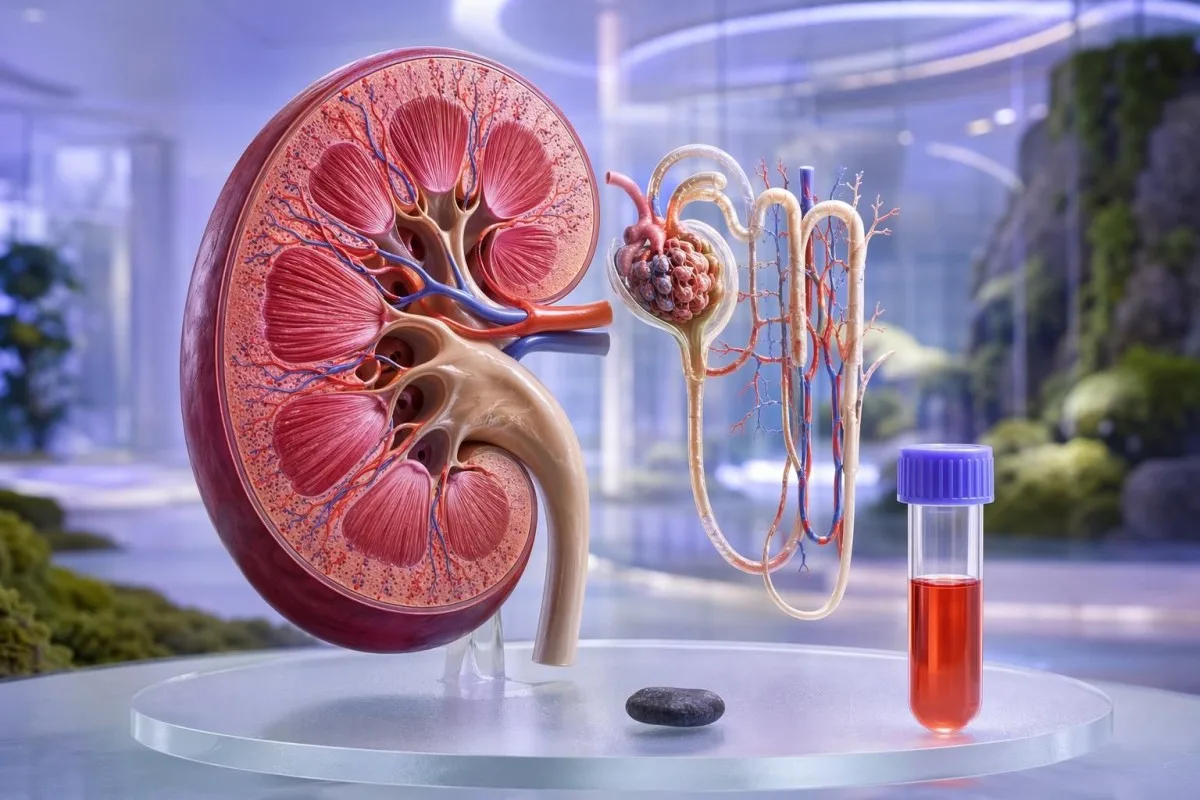
A mildly high creatinine result is often temporary, but the pattern around it matters. The safest reading compares eGFR, BUN, urine ACR, medications, muscle mass, and your previous baseline.


- Borderline creatinine usually means a result about 0.1–0.3 mg/dL above your lab’s upper limit, not automatic kidney disease.
- Dehydration clue is often a high BUN/creatinine ratio above 20:1 with concentrated urine and normal repeat creatinine after fluids.
- Kidney-risk clue is creatinine rising over weeks to months, eGFR below 60 mL/min/1.73 m², or urine ACR above 30 mg/g.
- Exercise effect can raise creatinine for 24–72 hours after heavy lifting, marathon running, or rhabdomyolysis-prone workouts.
- Creatine supplements at 3–5 g/day may mildly raise serum creatinine without proving kidney damage, especially in muscular people.
- Medication triggers include NSAIDs, ACE inhibitors, ARBs, diuretics, trimethoprim, cimetidine, and some antivirals or chemotherapy drugs.
- Repeat testing is usually done within 1–2 weeks after correcting dehydration or avoiding heavy exercise; CKD requires persistence for at least 3 months.
- Urine ACR below 30 mg/g is usually normal; 30–300 mg/g suggests moderately increased albumin leakage and deserves follow-up.
- When to worry includes a rapid creatinine rise, falling urine output, swelling, breathlessness, confusion, high potassium, or eGFR below 30 mL/min/1.73 m².
What a borderline creatinine result usually means
A borderline creatinine result is often a temporary signal, not a diagnosis: dehydration, a hard workout, high meat intake, creatine, or medication can raise it mildly. The worry rises when creatinine stays high on repeat testing, eGFR falls, or urine shows albumin. That is the practical borderline creatinine meaning I use in clinic.
Kantesti is an AI blood test analyzer that reads creatinine beside eGFR, BUN, electrolytes, urine markers, age, sex, and trend history, because creatinine alone can be surprisingly misleading. We describe the company and our clinical approach on the Kantesti medical team page for readers who want to know who is behind the interpretation.
A 38-year-old weightlifter once sent me a creatinine of 1.42 mg/dL, flagged high, after a leg session and 5 g/day creatine monohydrate. His cystatin C, urine ACR, potassium, and repeat creatinine 6 days later were normal; the original result looked alarming only because it was viewed in isolation.
A mildly high creatinine is different from a steadily rising creatinine. If your number has climbed from 0.85 to 1.05 to 1.28 mg/dL over 18 months, that pattern deserves more attention than one isolated 1.25 mg/dL after a dehydrating weekend; for deeper context, our high creatinine guide covers the wider differential.
Creatinine ranges and what counts as mildly high
Slightly elevated creatinine usually means the value is just above your lab’s reference interval, often by 0.1–0.3 mg/dL or 9–27 µmol/L. Adult reference ranges commonly sit around 0.59–1.04 mg/dL for women and 0.74–1.35 mg/dL for men, but ranges vary by laboratory method.
Creatinine is reported in mg/dL in many countries and µmol/L in the UK, Europe, Canada, and much of the world. To convert mg/dL to µmol/L, multiply by 88.4; a creatinine of 1.3 mg/dL is about 115 µmol/L.
I’m Thomas Klein, MD, and when I review borderline kidney results I first ask, “Is this high for the person, or only high for the reference range?” A petite 72-year-old woman with creatinine 1.15 mg/dL may have a much lower eGFR than a muscular 28-year-old man with the same number, which is why generic flags can mislead; our normal range guide explains that problem across many markers.
A creatinine of 1.4 mg/dL in a person whose usual result is 1.3 mg/dL may be noise, while 1.1 mg/dL in someone whose long-term baseline is 0.65 mg/dL can represent a meaningful fall in filtration. Baseline beats the asterisk.
Why eGFR can change the story
eGFR estimates kidney filtration from creatinine, age, sex, and sometimes cystatin C, so it often matters more than the creatinine flag itself. An eGFR above 90 mL/min/1.73 m² is usually normal if urine tests are clean; eGFR below 60 for 3 months meets a CKD criterion.
The 2021 CKD-EPI creatinine equation removed race from eGFR estimation, and Inker et al. published the creatinine and cystatin C equations in the New England Journal of Medicine (Inker et al., 2021). As of June 10, 2026, many labs still differ in which equation they report, so comparing old and new eGFR values can create apparent jumps.
An eGFR of 60–89 mL/min/1.73 m² is not automatically kidney disease in an older adult unless there is albuminuria, structural kidney disease, or another marker of damage. Our eGFR age guide gives age-aware context because a “normal” eGFR at 25 is not the same clinical signal at 82.
The tricky zone is eGFR 45–59 with no albumin in urine and no previous results. In that setting I often want a repeat creatinine, cystatin C, urine ACR, blood pressure review, and medication list before anyone labels the person with chronic kidney disease.
Dehydration and fasting false highs
Dehydration can mildly raise creatinine by reducing kidney blood flow and concentrating the blood sample, especially after vomiting, diarrhea, heat exposure, long fasting, or poor fluid intake. A BUN/creatinine ratio above 20:1, high urine specific gravity, and a normal repeat result support a temporary fluid-related rise.
I see this pattern often after Ramadan-style fasting, colonoscopy prep, long-haul flights, and summer endurance events. The creatinine bump is usually modest, often 0.1–0.4 mg/dL, and it should improve after 24–72 hours of normal fluids if dehydration was the main driver.
Kantesti AI interprets a mildly high creatinine by checking whether albumin, sodium, BUN, hemoglobin, and urine concentration also look hemoconcentrated. If several markers point the same way, our report frames the result as a hydration-pattern finding rather than jumping straight to kidney failure; our article on dehydration false highs covers the same phenomenon across multiple labs.
Do not overcorrect with huge water intake before a repeat test. For most adults, returning to usual fluid intake and avoiding alcohol, sauna sessions, and heavy exercise for 48 hours is enough; people with heart failure or advanced kidney disease should follow their clinician’s fluid plan.
Exercise, muscle injury and high-protein days
Hard exercise can raise creatinine for 24–72 hours because creatinine comes from muscle creatine metabolism and muscle breakdown products. The clue is a recent marathon, heavy lifting, CrossFit-style session, or high CK result; kidney injury becomes more concerning when CK is very high, urine darkens, or potassium rises.
A steak-heavy dinner can also push creatinine up a little because cooked meat contains creatinine-like compounds absorbed from the gut. In small studies, cooked meat meals have raised serum creatinine enough to change eGFR classification for several hours, which is why I prefer repeat testing after a usual diet.
If creatinine is borderline and CK is 300–800 IU/L after training, I usually interpret that very differently from creatinine plus CK 10,000 IU/L. The second pattern can reflect rhabdomyolysis risk and needs urgent assessment, especially with muscle pain, weakness, or cola-colored urine; our exercise lab guide explains these post-workout shifts.
For a clean retest, avoid unusually intense exercise for 48–72 hours and skip large meat-heavy meals the evening before. That advice sounds simple, but it prevents many false alarms in athletes and people restarting gym routines.
Creatine supplements and bodybuilding context
Creatine monohydrate at 3–5 g/day can slightly increase serum creatinine because the supplement increases the creatine pool that converts to creatinine. That does not prove kidney damage, but it does make eGFR based only on creatinine less reliable in muscular people or those taking creatine.
The evidence on creatine safety is generally reassuring in healthy adults at standard doses, but I am more cautious in people with known CKD, uncontrolled hypertension, diabetes with albuminuria, or repeated eGFR below 60. “Natural supplement” does not mean “irrelevant to labs.”
A bodybuilder with creatinine 1.45 mg/dL and eGFR 65 may have normal kidney filtration if cystatin C is normal and urine ACR is below 30 mg/g. Our creatine lab guide explains why cystatin C can be a useful second look when muscle mass distorts creatinine.
If your clinician asks for a repeat, do not secretly stop everything and then restart the day after the test. Tell them exactly what you take, including dose, brand form, loading phases such as 20 g/day for 5–7 days, protein powder, pre-workouts, and NSAID use after training.
Medicines that can bump creatinine
Medications can raise creatinine either by reducing kidney filtration or by blocking creatinine secretion in the kidney tubules. Common culprits include NSAIDs, ACE inhibitors, ARBs, diuretics, trimethoprim, cimetidine, some antivirals, calcineurin inhibitors, and certain cancer therapies.
ACE inhibitors and ARBs can cause a creatinine rise of up to about 30% after starting or dose increase; clinicians often accept that if potassium is safe and the patient benefits from kidney or heart protection. A rise beyond 30%, severe dizziness, or potassium above about 5.5 mmol/L needs prompt review.
Trimethoprim is a classic trap because it can raise serum creatinine by reducing tubular secretion without a true fall in GFR. Kantesti’s neural network flags this context when medication names appear in uploaded reports or patient notes, and our medication monitoring guide outlines timing by drug class.
NSAIDs are the ones I most often find hidden in the story: ibuprofen after a sports injury, naproxen for back pain, or diclofenac gel plus tablets. The risk rises when NSAIDs combine with a diuretic and ACE inhibitor or ARB, the so-called “triple whammy,” particularly during dehydration.
BUN, electrolytes and urine clues
BUN, potassium, bicarbonate, and urine findings help separate dehydration from kidney function decline. A high BUN/creatinine ratio above 20:1 often points toward dehydration or reduced kidney blood flow, while high potassium, low bicarbonate, or abnormal urine protein raises concern for true renal impairment.
BUN is more diet- and hydration-sensitive than creatinine, so a high-protein diet or gastrointestinal bleeding can raise BUN disproportionately. A low BUN with borderline creatinine may point away from dehydration and toward muscle mass, assay variation, or a medication effect.
The BUN/creatinine ratio is not diagnostic by itself, but it is a useful pattern clue; our patient article on BUN ratio patterns explains high and low ratios in plain language. For a deeper technical reference, the BUN creatinine guide reviews the calculation and common interpretation traps.
Potassium is the safety marker I never ignore. A borderline creatinine with potassium 4.6 mmol/L and normal bicarbonate feels very different from creatinine rising with potassium 6.0 mmol/L, bicarbonate 17 mmol/L, and new weakness.
Urine ACR: the early kidney damage test
Urine albumin-to-creatinine ratio, or ACR, can detect kidney damage before serum creatinine rises. ACR below 30 mg/g is usually normal, 30–300 mg/g is moderately increased albuminuria, and above 300 mg/g is severely increased albuminuria that needs timely medical follow-up.
Kantesti is an AI lab test interpretation service that treats urine ACR as a core companion marker to creatinine, not an optional extra. This matters because diabetes, hypertension, and glomerular conditions may leak albumin while creatinine still looks normal.
In the UK, ACR is often reported as mg/mmol; roughly, below 3 mg/mmol is normal, 3–30 mg/mmol is moderately increased, and above 30 mg/mmol is severely increased. Our urine ACR guide walks through those units because patients often compare mg/g and mg/mmol incorrectly.
ACR should be repeated if it is mildly abnormal, especially after fever, strenuous exercise, urinary tract symptoms, menstruation, or uncontrolled blood pressure. A first-morning urine sample reduces noise and often prevents overdiagnosis.
When to worry about creatinine
Worry about creatinine when it rises quickly, doubles from baseline, comes with eGFR below 60 for 3 months, or appears with high potassium, swelling, shortness of breath, reduced urine output, confusion, or urine ACR above 30 mg/g. One borderline value without these features is usually a repeat-test problem.
The KDIGO 2024 CKD guideline defines chronic kidney disease by abnormalities of kidney structure or function present for at least 3 months, including eGFR below 60 mL/min/1.73 m² or markers such as albuminuria (KDIGO, 2024). That 3-month rule protects patients from being labeled with CKD after one dehydrated sample.
Same-day care is sensible if creatinine rises with potassium above 6.0 mmol/L, severe vomiting, confusion, chest pain, breathlessness, or very low urine output. For people with one kidney, kidney transplant, pregnancy, advanced heart failure, or known CKD stage 3–5, I use a lower threshold for urgent review.
If creatinine and eGFR disagree with the clinical picture, cystatin C can help because it is less affected by muscle mass and meat intake. Our cystatin C guide explains when a second filtration estimate changes decision-making.
How and when to repeat the test
Repeat creatinine within 1–2 weeks if the result is mildly high and you had a plausible temporary trigger such as dehydration, heavy exercise, high meat intake, or a new medicine. Repeat sooner, sometimes same day, if symptoms, high potassium, or a large rise from baseline are present.
A clean repeat test means normal fluids, no unusually intense training for 48–72 hours, no large cooked-meat meal the night before, and a clear medication list. Fasting is not usually required for creatinine, but some panels bundle glucose or lipids, so follow the lab’s instructions.
Levey et al. developed the CKD-EPI equation to estimate GFR more accurately than older approaches in many patients (Levey et al., 2009). Still, eGFR is an estimate; a repeat result under similar conditions often gives more clinical value than debating a single decimal point.
If the repeat normalizes, I usually advise storing both results rather than deleting the abnormal one from the story. Our repeat testing guide gives practical retest windows for common borderline results.
Trend analysis beats one flagged result
Creatinine trends are more informative than one flagged value because kidney function usually changes over time, not in a perfectly straight line. A stable creatinine of 1.25 mg/dL for 5 years may be less concerning than a rise from 0.75 to 1.05 mg/dL within 6 months.
Kantesti is an AI biomarker interpretation platform that compares current creatinine against prior uploaded panels, not just the lab’s printed reference interval. In our analysis of 2M+ user-uploaded reports, the most useful kidney-risk signal is often the slope across visits, especially when eGFR and ACR move together.
Our engineering team describes how pattern-based interpretation works in the AI technology guide, including why outlier detection needs units, dates, and reference intervals. A creatinine jump from 88 to 104 µmol/L may look small, but in a small older woman it can materially change eGFR.
Patients often remember the flagged result and forget the trend. A side-by-side graph with dates, medications, exercise events, illness, and hydration context turns the question from “Is this bad?” into “Is this changing?”; our trend analysis guide shows that workflow.
What to change before a retest
Before a creatinine retest, return to your normal routine rather than trying to create a perfect result. Hydrate normally, avoid unusually intense exercise for 48–72 hours, avoid a large cooked-meat meal the night before, and ask your clinician before stopping prescribed medication.
If you normally eat high protein, do not crash into a low-protein diet for 2 days just to improve the number. That may produce a prettier creatinine but a less truthful baseline, and it does not answer whether your kidneys are safe on your real diet.
For people with repeated eGFR below 60 or confirmed albuminuria, diet changes become more individualized: sodium reduction, blood pressure control, diabetes management, and appropriate protein intake matter more than gimmicks. Our kidney diet guide explains practical food choices without pretending diet can reverse every kidney condition.
Bring your supplement list. I have seen “borderline creatinine” cases clarified by creatine, collagen protein, high-dose vitamin C, NSAIDs, and pre-workout blends that the patient did not consider medical information.
How Kantesti reviews creatinine safely
Kantesti AI reviews creatinine safely by treating it as one marker in a kidney pattern: creatinine, eGFR, BUN, electrolytes, urine ACR, age, sex, medications, exercise history, and prior results. The output is interpretation and triage guidance, not a replacement for urgent care or your clinician’s diagnosis.
As Thomas Klein, MD, I want patients to leave a creatinine review with a clear next action: repeat routinely, repeat soon, add urine testing, discuss medicines, or seek urgent care. Vague reassurance is not enough, and vague alarm is worse.
Our physicians and advisors review the clinical rules behind kidney interpretation through the medical advisory board and our published clinical validation work. That oversight matters because creatinine is one of those markers where overcalling and undercalling both harm patients.
Kantesti also maintains research publications across adjacent lab domains because real reports rarely arrive as single-marker puzzles. Our Zenodo publications listed below include coagulation and serum protein interpretation work; they are not creatinine papers, but they show the same structured approach to units, ranges, and pattern-based review.
Frequently Asked Questions
What does borderline creatinine mean on a blood test?
Borderline creatinine usually means your serum creatinine is slightly above the lab’s reference range, often by about 0.1–0.3 mg/dL. It can happen from dehydration, heavy exercise, a high meat meal, creatine supplements, or certain medications. It becomes more concerning if it stays high on repeat testing, eGFR is below 60 mL/min/1.73 m² for 3 months, or urine ACR is above 30 mg/g.
Can dehydration cause mildly high creatinine?
Yes, dehydration can cause mildly high creatinine by reducing kidney blood flow and concentrating the blood sample. A BUN/creatinine ratio above 20:1, high urine specific gravity, recent vomiting, diarrhea, heat exposure, or poor fluid intake supports a dehydration pattern. If dehydration is the main cause, creatinine often improves within 24–72 hours after normal fluids.
When should I worry about creatinine?
Worry about creatinine when it rises quickly, doubles from your usual baseline, or comes with symptoms such as reduced urine output, swelling, shortness of breath, confusion, or severe weakness. A creatinine rise with potassium above 6.0 mmol/L or eGFR below 30 mL/min/1.73 m² generally needs urgent medical assessment. A single borderline value without symptoms is usually handled with repeat testing and urine ACR.
How soon should creatinine be repeated if it is mildly high?
A mildly high creatinine is often repeated within 1–2 weeks if there is a likely temporary trigger such as dehydration, exercise, a high meat meal, or a new medication. For the repeat, keep normal hydration, avoid unusually intense exercise for 48–72 hours, and tell your clinician about supplements and medications. Repeat sooner if potassium is high, symptoms are present, or the result has risen sharply from baseline.
Can creatine supplements make creatinine look high?
Creatine supplements can make creatinine look mildly high because creatine converts to creatinine in the body. Standard creatine monohydrate doses of 3–5 g/day may raise serum creatinine without proving kidney damage, especially in muscular adults. Cystatin C and urine ACR can help clarify kidney function when creatinine is distorted by muscle mass or creatine use.
Is eGFR more important than creatinine?
eGFR is often more useful than creatinine because it translates creatinine into an estimate of kidney filtration using age and sex. An eGFR above 90 mL/min/1.73 m² is usually normal if urine markers are normal, while eGFR below 60 for at least 3 months can meet a chronic kidney disease criterion. Creatinine still matters, but the safest interpretation uses eGFR, urine ACR, and trends together.
What urine test should I ask for with borderline creatinine?
The most useful urine test with borderline creatinine is the urine albumin-to-creatinine ratio, or ACR. ACR below 30 mg/g is usually normal, 30–300 mg/g suggests moderately increased albumin leakage, and above 300 mg/g is severely increased albuminuria. A first-morning urine sample is often preferred because exercise, fever, and hydration changes can affect random samples.
Can a urinary tract infection raise creatinine?
A simple bladder infection usually does not raise creatinine. However, fever, vomiting, dehydration, a kidney infection, or urinary blockage can affect kidney function; seek prompt care for flank pain, fever, vomiting, or trouble passing urine.
Can a normal creatinine miss kidney problems in someone with low muscle mass?
Yes. Because creatinine comes from muscle, an older adult, someone who is underweight, or a person with muscle loss may have a normal creatinine despite reduced filtration. eGFR, urine ACR, and sometimes cystatin C give a safer assessment when muscle mass is low.
Get AI-Powered Blood Test Analysis Today
Join over 2 million users worldwide who trust Kantesti for instant, accurate lab test analysis. Upload your blood test results and receive comprehensive interpretation of 15,000+ biomarkers in seconds.
📚 Referenced Research Publications
Klein, T., Mitchell, S., & Weber, H. (2026). aPTT Normal Range: D-Dimer, Protein C Blood Clotting Guide. Kantesti AI Medical Research.
Klein, T., Mitchell, S., & Weber, H. (2026). Serum Proteins Guide: Globulins, Albumin & A/G Ratio Blood Test. Kantesti AI Medical Research.
📖 External Medical References
Kidney Disease: Improving Global Outcomes CKD Work Group (2024). KDIGO 2024 Clinical Practice Guideline for the Evaluation and Management of Chronic Kidney Disease. Kidney International.
⚕️ Medical Disclaimer
This article is for educational purposes only and does not constitute medical advice. Always consult a qualified healthcare provider for diagnosis and treatment decisions.
E-E-A-T Trust Signals
Experience
Physician-led clinical review of lab interpretation workflows.
Expertise
Laboratory medicine focus on how biomarkers behave in clinical context.
Authoritativeness
Written by Dr. Thomas Klein with review by Dr. Sarah Mitchell and Prof. Dr. Hans Weber.
Trustworthiness
Evidence-based interpretation with clear follow-up pathways to reduce alarm.