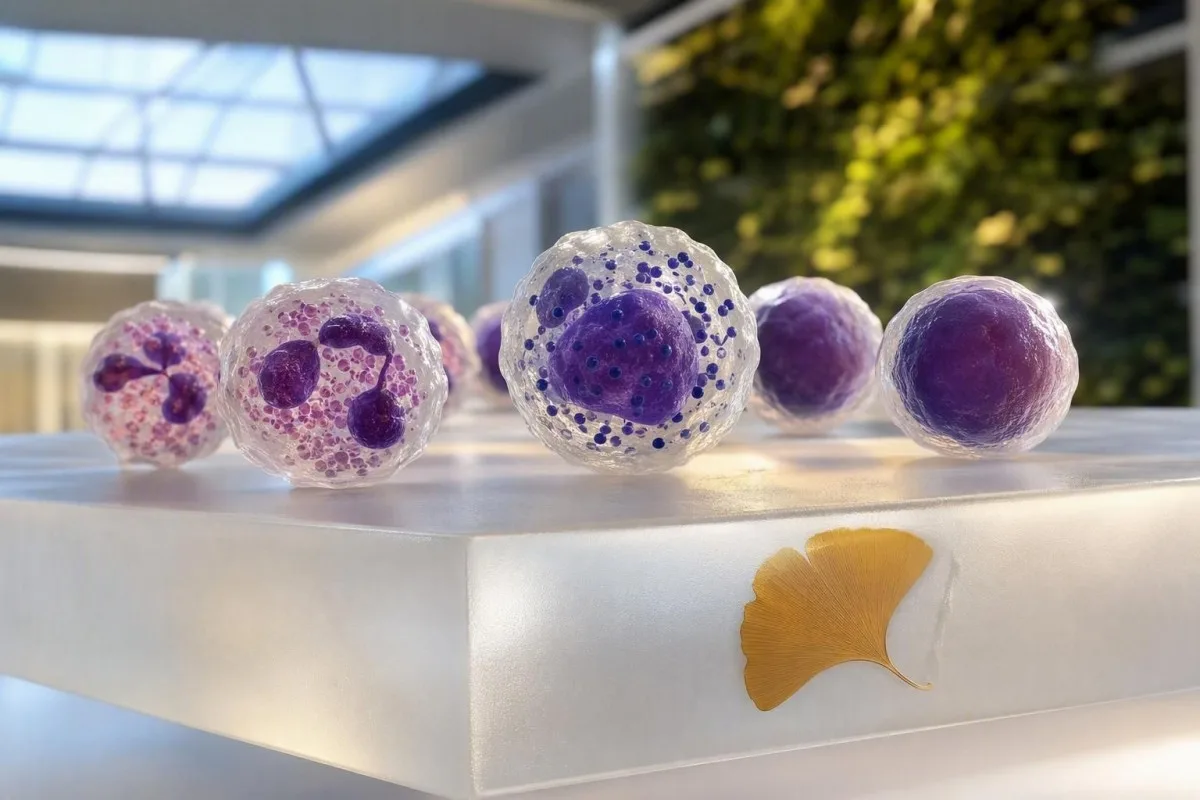
大多数成年人的绝对嗜碱性粒细胞计数为 0.00–0.10 × 10⁹/L(0–100/µL),而百分比通常为 0–1%。轻微异常的百分比通常反映其他白细胞的变化;绝对嗜碱性粒细胞计数是通常指导后续检查的结果。.

本指南在以下人员的领导下撰写: 托马斯·克莱因医学博士 与……合作 Kantesti AI 医疗顾问委员会, 其中包括 Hans Weber 教授博士的贡献以及 Sarah Mitchell 医学博士、哲学博士的医学审查。.
托马斯·克莱因,医学博士
Kantesti AI首席医疗官
Thomas Klein 博士是经董事会认证的临床血液科医师兼内科医师,拥有超过 15 年的实验室医学与 AI 辅助临床分析经验。作为 Kantesti AI 的首席医疗官,他负责对专有神经网络的医疗准确性进行临床监督。Klein 博士已发表关于生物标志物解读与实验室诊断的研究。.
Sarah Mitchell,医学博士,哲学博士
首席医学顾问 - 临床病理学和内科
Sarah Mitchell博士是获得董事会认证的临床病理科医生,拥有超过18年的实验室医学与诊断分析经验。她在临床化学方面拥有专业认证,并在临床实践中就生物标志物面板与实验室分析发表了大量研究成果。.
汉斯·韦伯教授,博士
实验室医学与临床生物化学教授
Hans Weber教授博士在临床生物化学、实验室医学和生物标志物研究方面拥有30年以上的专业经验。曾任德国临床化学学会主席,他专注于诊断面板分析、生物标志物标准化以及AI辅助的实验室医学。.
- 嗜碱性粒细胞的绝对计数 成年人通常为 0.00–0.10 × 10⁹/L(0–100/µL),比单独的百分比更有临床意义。.
- 嗜碱性粒细胞百分比 通常占白细胞的 0–1%,但当嗜中性粒细胞或淋巴细胞下降时,即使绝对计数正常,它也可能升高。.
- 儿童 婴儿期后通常使用相同的实用上限 0.10 × 10⁹/L,但实验室的特定年龄区间优先。.
- 重复的 CBC 在过敏、感染或药物改变后,孤立性轻度嗜碱性粒细胞增多症在 2–8 周内复查是合理的。.
- 持续性嗜碱性粒细胞增多症 超过 0.20 × 10⁹/L 值得临床医生评估,特别是伴有高白细胞、贫血、脾肿大或全身症状时。.
- 需要紧急复查 对于明显的白细胞增多、不明原因的体重减轻、盗汗、发烧或左肋下早期饱胀感,需要进行检查。.
- 零嗜碱性粒细胞 在自动化鉴别诊断中很常见,通常没有临床意义。.
- 坎泰斯蒂人工智能 读取嗜碱性粒细胞以及白细胞总数、嗜酸性粒细胞、血小板计数、血红蛋白和先前结果,而不是将一个标志视为诊断。.
绝对嗜碱性粒细胞计数与嗜碱性粒细胞百分比
成人嗜碱性粒细胞绝对值 0.00–0.10 × 10⁹/L 通常是正常的, ,而 嗜碱性粒细胞百分比为 0–1% 仅占白细胞总数的一部分。当两者不一致时,临床医生通常更看重绝对值结果。.
百分比可能看起来很高,仅仅因为另一种白细胞类型较低。例如,1.5% 的嗜碱性粒细胞,白细胞计数为 3.0 × 10⁹/L,其绝对计数仅为 0.045 × 10⁹/L——远在许多成人范围内。这就是为什么单独的百分比标志很少能说明全部情况。.
计算很简单:白细胞总数 × 嗜碱性粒细胞百分比 ÷ 100。白细胞计数为 12.0 × 10⁹/L,嗜碱性粒细胞为 2%,则为 0.24 × 10⁹/L,这是真正的升高。有关更广泛的背景,请参阅我们的指南 CBC 包含哪些内容.
Kantesti 是一个 人工智能血液检测分析仪 ,该指南在来源报告提供鉴别诊断时,将百分比转换为临床上可比的绝对计数。根据我的经验,这一个转换可以避免在例行健康检查后产生相当多的不必要恐慌。.
为什么绝对值更稳定
自动分析仪计数数千个细胞事件,但嗜碱性粒细胞通常很稀少——通常不到 100 个白细胞中有 1 个。因此,微小的分析和生物学变化会比绝对计数更明显地改变百分比。.
按年龄划分的实用嗜碱性粒细胞参考区间
大多数实验室使用 0.00–0.10 × 10⁹/L 的绝对嗜碱性粒细胞参考区间,从儿童期到成年期, ,但新生儿范围可能更广。请使用您自己结果旁边的区间,因为参考限值取决于分析仪方法和实验室的当地健康人群。.
对于生命最初几周的婴儿,一些儿科实验室接受绝对嗜碱性粒细胞高达约 0.20–0.40 × 10⁹/L。新生儿免疫系统正在快速适应,因此不应在没有儿科意见的情况下将成人临界值强加于新生儿结果。.
从大约 1 岁开始,许多服务机构将实际上限应用于接近 0.10 × 10⁹/L 或 100/µL。在健康成长且白细胞总数正常的儿童中,0.11 × 10⁹/L 的结果通常是一个需要重复检查和考虑背景的问题,而不是紧急情况。.
CLSI EP28-A3c 解释了为什么实验室建立或验证自己的参考区间,而不是借用通用范围(CLSI,2010)。我们的 中性粒细胞年龄范围指南 对另一种鉴别计数显示了相同的原理。.
理解英国、美国和国际报告中的嗜碱性粒细胞单位
A basophil count of 0.10 × 10⁹/L equals 100/µL, so reports using different units can describe the same result. UK full blood counts often report ×10⁹/L, while US laboratories commonly use cells/µL or K/µL.
To convert ×10⁹/L to cells/µL, multiply by 1,000. Thus 0.05 × 10⁹/L equals 50/µL; 0.25 × 10⁹/L equals 250/µL. A report showing 0.0 may be rounded to one decimal place rather than proving there are literally no basophils.
A value listed as 0.2 K/µL equals 0.20 × 10⁹/L. That distinction matters because 0.2% and 0.2 K/µL are completely different measurements. Patients regularly mix them up when comparing reports from two countries.
If your report says FBC rather than CBC, the components are largely the same; our UK full blood count explainer translates the common terminology.
嗜碱性粒细胞计数升高的原因
Mild basophilia most often accompanies allergy, chronic inflammation, recovery from an infection, or a medication-related immune shift. A low count or zero basophils is usually not meaningful because these cells circulate in very small numbers.
Basophils carry receptors for IgE and can release histamine and other mediators after allergen exposure. Seasonal allergic rhinitis, chronic urticaria, asthma, and some skin disorders can coincide with a small rise, although a normal count does not rule any of them in or out.
Hypothyroidism, inflammatory bowel disease, rheumatoid disorders, and some chronic infections may also be associated with basophilia. The useful question is not “what disease causes this?” but “what other signals are present?”—CRP, eosinophils, symptoms, medication history, and the trajectory all matter.
A raised IgE and eosinophil count can support an allergic pattern, while isolated itch may need a broader review; our article on blood tests for itchy skin explains the practical limits of CBC testing.
何时应重复进行 CBC 以检查嗜碱性粒细胞?
Repeat a CBC in 2–8 weeks for a mild, isolated basophil elevation after a temporary trigger, provided you feel well and the rest of the count is reassuring. Repeat sooner, usually within days to 2 weeks, when total white cells are rising or there are multiple abnormal cell lines.
For an absolute basophil count of 0.11–0.20 × 10⁹/L after a cold, flare of hay fever, vaccination, or short steroid course, I often prefer one calm repeat over a cascade of testing. Try to use the same laboratory, and record recent illness, new medicines, smoking changes, and steroid exposure.
Do not attempt to “improve” the count before a retest. Hydration is sensible, but supplements, antihistamines, corticosteroids, and intense endurance exercise can change the wider differential. Our 血检时间线指南 details common timing effects.
Kantesti 是一个 AI 血液检查解读平台 that compares the current differential with previous CBCs and flags a consistent rise differently from a one-off flag. A trend over 3–6 months is often more informative than a single decimal point.
如何准备可靠的嗜碱性粒细胞复查
Basophil testing does not usually require fasting, but a repeat CBC is most interpretable when you are not acutely unwell and the collection conditions are similar. Aim for normal fluids, ordinary meals, and a routine day rather than extreme changes.
Avoid scheduling a non-urgent retest during a fever, significant allergic flare, or the day after an unusually hard endurance event if the goal is to establish baseline. Acute stress hormones and fluid shifts can move several white-cell subsets for hours to days.
Tell the clinician or phlebotomist about systemic corticosteroids, lithium, epinephrine-containing treatments, recent biologic therapy, and any new supplement. Steroids more commonly lower circulating basophils and eosinophils, so a “normal” result while taking them may not represent your untreated baseline.
Sample quality still matters. Clotted EDTA samples and delayed analysis can make automated differentials less dependable; if several CBC values look odd together, review when a redraw is needed.
使嗜碱性粒细胞升高更显著的 CBC 模式
Basophilia is more concerning when absolute basophils exceed 0.20 × 10⁹/L and occur with persistent white blood cells above 11.0 × 10⁹/L, anaemia, platelet changes, or immature cells. The combination—not basophils alone—determines how quickly clinicians investigate.
A 44-year-old I reviewed had basophils of 0.28 × 10⁹/L, white cells of 16.4 × 10⁹/L, platelets of 610 × 10⁹/L, and early satiety. That pattern warranted a same-week haematology pathway; the individual basophil result did not make the diagnosis, but it was an important clue.
Basophilia alongside high neutrophils and splenic symptoms can occur in myeloproliferative neoplasms, including chronic myeloid leukaemia. European LeukemiaNet advises molecular testing and specialist assessment when the clinical and blood-count pattern raises that possibility (Hochhaus et al., 2020).
A peripheral smear can distinguish true differential changes from analyser uncertainty and may show left shift or atypical cells. Read more about blood cancer CBC pathways without assuming that an abnormal count means cancer.
需要立即就医的症状和结果
Seek urgent medical assessment for basophilia with fever, drenching night sweats, unexplained weight loss, new bruising, breathlessness, severe fatigue, or left-upper abdominal fullness. These symptoms are not caused by a mildly raised basophil result itself; they signal that the broader clinical picture needs assessment.
A total white count above 30 × 10⁹/L, rapidly increasing values, or visible immature granulocytes on a report should be discussed urgently with the ordering clinician. Severe headache, visual change, chest pain, or neurological symptoms need emergency evaluation irrespective of the basophil count.
Most people with 0.11–0.20 × 10⁹/L basophils and no symptoms do not need emergency care. Still, this is one of those areas where context matters more than the number, especially if previous results were 0.02 × 10⁹/L and the new count is climbing.
If you also have shortness of breath or pallor, the accompanying haemoglobin and platelet values may matter more immediately; see our 呼吸困难血液检测指南.
嗜碱性粒细胞计数低或为零意味着什么
A basophil result of 0.00 × 10⁹/L is usually normal and rarely needs repeating by itself. Basophils may be below the analyser’s reporting threshold because they are naturally sparse in circulation.
Acute stress, infection, pregnancy, hyperthyroidism, and corticosteroid treatment can all reduce circulating basophils temporarily. Yet there is no recognised symptom syndrome caused by isolated low basophils, unlike clinically significant neutropenia.
The analytical issue is easy to miss: if only a few basophils are counted, routine sampling variability can turn 0.01 × 10⁹/L into 0.00 × 10⁹/L on a subsequent draw. That is not necessarily a biological change.
Dr. Thomas Klein’s practical advice is to ignore a low-basophil flag when the rest of the CBC is sound and there are no relevant symptoms. Our dedicated guide explains basophils at zero.
妊娠期和晚年期的嗜碱性粒细胞
Pregnancy and ageing do not have a single special basophil cutoff; the reporting laboratory’s interval and the full white-cell pattern remain the best reference. Pregnancy commonly raises total white cells through neutrophils, which can make the basophil percentage appear lower without a true basophil reduction.
During pregnancy, a total white count of 12–15 × 10⁹/L can be physiological, particularly later in gestation, so percentage-based interpretation becomes even less reliable. An absolute basophil count remains preferable, but concerning symptoms still override a reference interval.
In older adults, a newly persistent basophil count above 0.20 × 10⁹/L deserves attention because medication burden and marrow disorders become more common with age. That does not make it diagnostic; it simply lowers the threshold for looking at the CBC trend and smear.
For other pregnancy-specific interpretation pitfalls, review 妊娠验血“警示信号”.
药物、过敏和嗜碱性粒细胞波动
Allergy symptoms can coincide with mildly elevated basophils, while systemic corticosteroids often lower them within days. Neither pattern confirms an allergy diagnosis or proves that a medicine is responsible.
Antihistamines primarily block histamine receptors; they do not reliably normalise a basophil count. Oral prednisolone and other systemic glucocorticoids can redistribute white cells, often decreasing eosinophils and basophils while increasing circulating neutrophils.
Lithium is a less common but useful medication clue because it can increase white-cell production. Biologic medicines, chemotherapy, and immune-modulating treatments should never be stopped because of one CBC result—ask the prescribing team how the result fits their monitoring plan.
A raised basophil count alongside wheeze, hives, facial swelling, or faintness should be managed as a symptom problem, not a laboratory puzzle. Our high IgE guide explains where allergy markers help and where they mislead.
持续性嗜碱性粒细胞增多症的临床医生检查内容
Persistent absolute basophilia usually prompts a repeat CBC, manual smear review, medication and symptom review, then targeted testing if the total white count or other cell lines are abnormal. Broad cancer panels are not the usual first step for a slight isolated increase.
The first branch point is whether the result is isolated. A stable haemoglobin, platelets, white-cell count, and normal smear strongly support a conservative plan; anaemia, thrombocytosis, leukocytosis, or splenomegaly push the assessment in a different direction.
When a myeloproliferative disorder is plausible, clinicians may request BCR::ABL1 testing, JAK2 testing, lactate dehydrogenase, urate, and specialist review. Valent et al. describe persistent basophilia as a meaningful finding in the classification of basophilic and myeloid neoplasms (Valent et al., 2022).
Kantesti’s neural network identifies combinations that merit review but does not diagnose leukaemia from a CBC. Our 医学验证方法 explains why laboratory interpretation must retain clinical oversight.
如何在不过度反应的情况下追踪嗜碱性粒细胞
A meaningful basophil trend is a persistent directional change across comparable CBCs, not a single movement from 0.04 to 0.08 × 10⁹/L. With an adult reference limit of 0.10 × 10⁹/L, both values remain within range despite being numerically different.
Save the absolute count, percentage, total white cells, neutrophils, eosinophils, haemoglobin, platelets, date, recent illness, and medicines after each draw. This small record gives your clinician more usable information than screenshots of isolated red flags.
Kantesti 是一个 基于 AI 的血液检测分析工具 used across 127+ countries to compare CBC results longitudinally while preserving the source laboratory’s stated interval. Dr. Thomas Klein recommends reviewing at least two comparable results before assigning meaning to a borderline differential change.
A useful rule: if the absolute count remains below 0.10 × 10⁹/L, the total white count is stable, and you feel well, routine follow-up at your next planned blood test is usually enough. Use our 血液化验差异指南 to judge whether a shift is likely real.
在复诊预约时应提出的问题
The best follow-up question is “What is my absolute basophil count, and what else changed on the CBC?” That wording directs the conversation toward the variables that actually alter clinical risk.
Ask whether the count is new, persistent, rising, or likely reactive; whether a smear review is needed; and when the next CBC should be taken. Bring a list of recent infections, allergy symptoms, medicines, supplements, travel, and family history of blood disorders.
If you have an absolute count above 0.20 × 10⁹/L plus elevated total white cells, ask whether haematology input is appropriate. If the count is only slightly above range and isolated, ask what change would trigger earlier testing rather than assuming the worst.
Kantesti’s physician-reviewed educational standards are overseen through our 医疗顾问委员会. As of August 30, 2026, the safest approach remains simple: interpret the absolute count, confirm persistence, and act faster only when the wider pattern warrants it.
常见问题
成年人的正常嗜碱性粒细胞计数是多少?
成人绝对嗜碱性粒细胞的常用参考区间为 0.00–0.10 × 10⁹/L,相当于 0–100 细胞/µL。大多数实验室报告的嗜碱性粒细胞百分比为 0–1%,但当总白细胞计数改变时,百分比可能会产生误导。您自己实验室的参考区间具有优先权,因为方法和当地参考人群有所不同。0.11 × 10⁹/L 的孤立结果通常需要结合具体情况或计划复查,而不是紧急处理。.
2% 嗜碱性粒细胞高吗?
2% 的嗜碱性粒细胞百分比高于许多实验室的百分比区间,但如果没有总白细胞计数,则不足以判断风险。当白细胞计数为 4.0 × 10⁹/L 时,2% 等于 0.08 × 10⁹/L 的绝对嗜碱性粒细胞计数,这通常是正常的。当白细胞计数为 15.0 × 10⁹/L 时,相同的 2% 等于 0.30 × 10⁹/L,需要进行临床审查。在解释百分比之前,务必找到绝对嗜碱性粒细胞计数。.
高嗜碱性粒细胞计数时,我应何时重复进行 CBC 检查?
对于疾病、过敏发作或药物改变后出现的轻度孤立性嗜碱粒细胞增多(约 0.11–0.20 × 10⁹/L),在 2–8 周后复查 CBC 是合理的。当白细胞总数增加、嗜碱粒细胞计数高于 0.20 × 10⁹/L、或血红蛋白和血小板也异常时,应尽早复查。如果可能,请在同一家实验室进行检查,因为分析仪方法和参考区间会有所不同。发烧、体重减轻、盗汗、瘀伤或左上腹饱胀感应立即就医,而不是等待常规复查。.
嗜碱性粒细胞为零是否危险?
0.00 × 10⁹/L 的嗜碱性粒细胞计数通常是无害的,如果 CBC 的其余部分正常,通常不需要随访。嗜碱性粒细胞是稀有的细胞,因此常规的自动分类可能报告为零,因为检测到的数量低于舍入或报告精度。皮质类固醇、急性应激、怀孕和感染可能暂时降低循环嗜碱性粒细胞。临床医生不根据孤立的嗜碱性粒细胞减少来诊断免疫缺陷。.
过敏会引起嗜碱性粒细胞升高吗?
过敏性疾病可伴有嗜碱性粒细胞轻度升高,因为嗜碱性粒细胞参与IgE相关的免疫反应并释放组胺等介质。嗜碱性粒细胞计数升高并不能证明过敏是病因,许多有过敏症状的人嗜碱性粒细胞计数正常。过敏症状消退后,计数持续高于0.20 × 10⁹/L的应结合全血细胞计数(CBC)进行评估。嗜酸性粒细胞、总IgE、皮肤症状和药物暴露可能提供更有用的背景信息。.
什么是嗜碱性粒细胞计数提示白血病?
没有单一的嗜碱性粒细胞计数可诊断白血病,但持续的绝对嗜碱性粒细胞增多(> 0.20 × 10⁹/L)伴白细胞增多、贫血、血小板异常、未成熟粒细胞或脾脏症状,应促使进行医学评估。嗜碱性粒细胞增多可见于慢性髓系白血病和其他骨髓增生性肿瘤,但反应性原因在轻度孤立性升高时更为常见。仅当更广泛的模式支持时,临床医生才可能要求进行涂片和靶向分子检测,如 BCR::ABL1。正常的总白细胞计数和稳定的 CBC 会显著降低担忧程度。.
立即获取AI驱动的血液检测分析
加入全球超过2,000,000名用户,他们信任Kantesti进行即时、准确的检验分析。上传你的血液检查结果,并在几秒内获得对15,000+生物标志物的全面解读。.
📚 参考研究论文
Klein, T., Mitchell, S., & Weber, H. (2026). B 型阴性血型、LDH 血液检查与网织红细胞计数指南. Kantesti AI医学研究。.
Klein, T., Mitchell, S., & Weber, H. (2026). 空腹腹泻、大便带黑点及胃肠道指南 2026. Kantesti AI医学研究。.
📖 外部医学参考资料
临床与实验室标准协会(Clinical and Laboratory Standards Institute,2010)。. Defining, Establishing, and Verifying Reference Intervals in the Clinical Laboratory. CLSI EP28-A3c.
📖 继续阅读
从 坎特什蒂 医疗团队探索更多经过专家审核的医学指南:

EDTA血小板聚集:计数为何看起来偏低
血液学检验解读 2026 年更新 患者友好型 血小板计数偏低有时可能是试管相关测量误差所致…….
阅读文章 →
脱水后 GFR 检测:eGFR 暂时降低?
肾脏健康检验解读 2026 年更新 患者友好型 呕吐、高温暴露、腹泻或体液摄入不足后 eGFR 偏低…….
阅读文章 →
输血后血红蛋白 A1c:结果误导时
糖尿病检测实验室解读 2026 年更新 对患者友好的供者红细胞可以暂时替代葡萄糖的既往史,因为...
阅读文章 →
避孕药会升高C-反应蛋白结果吗?
女性健康实验室解读 2026 更新 患者友好型 含有雌激素的避孕药会升高 CRP,而无需感染或自身免疫性疾病....
阅读文章 →
临界粪便钙卫蛋白:重复检测及后续步骤
肠道健康实验室解读 2026 更新 面向患者 粪便钙卫蛋白轻度升高通常在感染、抗炎...后消退.
阅读文章 →
白细胞酯酶阳性,亚硝酸盐阴性解释
尿液分析实验室解释 2026 更新 患者友好型 这种不一致的试纸条模式通常反映尿液中的白细胞,但它确实...
阅读文章 →发现我们所有的健康指南以及 基于AI的血液检查分析工具 在 kantesti.net
⚕️ 医疗免责声明
本文仅用于教育目的,不构成医疗建议。诊断和治疗决策请始终咨询合格的医疗专业人员。.
E-E-A-T信任信号
经验
由医生主导的临床审阅:实验室解读工作流程。.
专业知识
实验室医学重点:生物标志物在临床情境中的表现。.
权威
由 Thomas Klein 博士撰写,并由 Sarah Mitchell 博士与 Hans Weber 教授审阅。.
可信度
基于循证的解读,并提供清晰的后续路径以减少警报。.