Ishonchli vitamin B12 hayvonot mahsulotlaridan yoki maxsus boyitilgan mahsulotlardan olinadi; to'yimli ovqatlanish har qanday so'rilish muammosini bartaraf eta olmaydi. Mana, bemorlarga oziq-ovqat tanlovlari, alomatlar, dorilar va laboratoriya natijalarini moslashtirishga qanday yordam beraman.


- Kundalik B12 ehtiyoji ko'pchilik kattalar uchun 2,4 mcg, homiladorlikda 2,6 mcg va emizikli davrda 2,8 mcg ni tashkil qiladi.
- Eng yaxshi oziq-ovqat manbalari mollyuskalar, jigar, baliq, go'sht, sut mahsulotlari, tuxum va B12 bilan boyitilgan oziq-ovqatlarni o'z ichiga oladi; boyitilmagan o'simlik oziq-ovqatlari ishonchli manbalar emas.
- Mol go‘shti jigar har 85 g pishirilgan porsiyada taxminan 70 mcg B12 beradi, shu bilan birga 250 ml sut taxminan 1,3 mcg beradi.
- So'rilish shifti shuni anglatadiki, ichki omil odatda ovqatdan faqat taxminan 1,5-2 mcg ni so'radi; katta og'iz dozalarining taxminan 1% hali ham passiv ravishda kirib kelishi mumkin.
- Zardobdagi B12 200 pg/mL dan past bo‘lsa (148 pmol/L) ko'pincha etishmovchilikni qo'llab-quvvatlaydi, shu bilan birga 200-300 pg/mL ko'pincha metilmalonik kislota yoki faol B12 kontekstini talab qiladi.
- Metformin va kislotani bostiruvchi dorilar vaqt o'tishi bilan, ayniqsa bir necha yil davomida qo'llanilganda B12 darajasini pasaytirishi mumkin.
- Nevrologik simptomlar , masalan, uyqusizlik, yurish o'zgarishi, xotira muammolari yoki tebranish hissini yo'qotish kabi holatlar, hatto kamqonlik bo'lmasa ham, tibbiy ko'rikni talab qiladi.
- Faqat oziq-ovqat bilan etishmovchilikni to'g'irlash mumkin emas kamqonlik, oshqozon jarrohligi, jiddiy so'rilishning buzilishi yoki sezilarli nevrologik belgilar sababli yuzaga keladi.
Qaysi oziq-ovqatlar eng ishonchli vitamin B12 ni ta'minlaydi?
B12 ga boy oziq-ovqatlar deyarli faqat hayvonot mahsulotlari va maxsus kobalamin bilan boyitilgan oziq-ovqatlardir. Qisqichbaqalar, jigar, baliq, go'sht, sut, yogurt, pishloq, tuxum, boyitilgan nonushta doni va boyitilgan o'simlik ichimliklari, agar yorliqlarda B12 miqdori tasdiqlangan bo'lsa, ishonchli tanlovlardir.
Pishirilgan qisqichbaqalar ta'minlashi mumkin har 85 gramm uchun taxminan 84 mcg, va pishirilgan mol go'shti jigari taxminan har 85 gramm uchun 70 mcg; ikkalasi ham kattalar ehtiyojini bir necha bor oshiradi. Men hali ham jigarni tez-tez iste'mol qilishga tayanishdan ko'ra xilma-xillikni rag'batlantiraman, chunki jigar vitamin A ning oldindan shakllangan shakliga ham juda boy va homiladorlik paytida tasodifiy kundalik ovqat emas.
Baliq amaliy o'rtacha yechimdir: pishirilgan qutur baliq taxminan har 85 gramm uchun 5,4 mcg, losos taxminan 2,6 mcg, va konservalangan tonna taxminan 2,5 mcg. Qisqichbaqadan voz kechgan bemor odatda haftasiga ikki porsiya baliq, sut, tuxum yoki boyitilgan oziq-ovqatlar bilan oziq-ovqat ehtiyojlarini qondira oladi; bizning B12 va folat bo‘yicha qo‘llanmada yoritilgan nima uchun folat kobalamin o'rnini bosa olmasligini tushuntiradi.
Kantesti - bu AI qon testi analizatori bu B12 natijasini o'rtacha eritrotsit hajmi, gemoglobin, folat, buyrak faoliyati va dori-darmonlar konteksti bilan bir qatorda ko'rsatadi. Bu muhim, chunki haftasiga ikki marta baliq iste'mol qiladigan odam, agar muammo iste'mol emas, balki ichki omil bo'lsa, etishmovchilikka duch kelishi mumkin.
Kundalik taomlarda qancha B12 bor?
Bir porsiya baliq, go'sht yoki sut kattalar uchun mo'ljallangan 2,4 mcg miqdorining qismini yoki hammasini ta'minlashi mumkin, ammo miqdorlar oziq-ovqat va porsiyaga qarab keskin farq qiladi. Yorliqlar va oziq-ovqat tarkibi jadvallari baholashlardir, aylanmada nima borligini kafolatlamaydi.
Bir stakan (250 ml) sigir suti taxminan ta'minlaydi 1,3 mkg, taxminan 170 g oddiy yogurt 1,0 mkg, taxminan bitta katta tuxum 0,5 mkg, va taxminan 85 g pishirilgan yog'siz mol go'shti Bu juda ozdek tuyuladi, ammo kattalarning kunlik B12 talabi atigi taxminan. Shu sababli sut mahsulotlari iste'molni sezilarli darajada qo'llab-quvvatlashi mumkin, ammo nonushtaga ikkita tuxum odatda kunlik ehtiyojni qondirmaydi.
Men ko'pincha o'zlarini 'asosan vegetarian' deb ta'riflaydigan odamlarda chalg'ituvchi naqshni ko'raman: tuxum va pishloqning vaqti-vaqti bilan iste'mol qilinishi jiddiy kamchiliklarning oldini olishi mumkin, ammo ularning iste'moli oylab maqsadli darajadan past bo'lib qoladi. Charchoqni kengroq ko'rib chiqishni talab qiladigan sabablardan biri bu temirga boy ovqatlanish tanlovlari va nafaqat multivitaminlarni o'z ichiga oladi.
Thomas Klein, MD, bemorlarga dietaning etarli ekanligiga qaror qilishdan oldin 7 kun davomida haqiqiy porsiyalarni yozib qo'yishni maslahat beradi. Kuniga faqat 0,5-1,0 mkg ni ko'rsatadigan ovqat kundaligi 'Men sog'lom ovqatlanaman' degan mavhum bayonotdan ko'ra klinik jihatdan foydaliroqdir.'
B12 bilan boyitilgan oziq-ovqatlar veganlar uchun etarlimi?
B12 bilan boyitilgan oziq-ovqatlar veganlar uchun o'lchangan miqdorda, muntazam iste'mol qilinganda ehtiyojlarni qondirishi mumkin, ammo boyitilmagan o'simlik mahsulotlari bu ishni ishonchli bajara olmaydi. Dengiz o'tlari, qo'ziqorinlar, fermentlangan oziq-ovqatlar va qo'shimcha B12 yorlig'isiz ozuqaviy xamirturushlar ishonchli o'rinbosarlar emas.
Ko'pgina quvvatlangan o'simlik ichimliklari taqdim etadi 250 ml uchun 0,4-1,0 mcg, shu bilan birga quvvatlangan donli mahsulotlar porsiyasi ta'minlashi mumkin 1,0-6,0 mcg. Har safar mahalliy yorliqni o'qing: mahsulotlar mamlakat, retsept va porsiya hajmi bo'yicha farqlanadi va 'vitaminlar mavjud' degani avtomatik ravishda B12 mavjudligini anglatmaydi.
Siyanokobalamin eng keng tarqalgan quvvatlantiruvchi vosita hisoblanadi, chunki u saqlash va pishirish paytida barqaror qoladi. O'Leary va Samman tomonidan Nutrients jurnalida 2010 yilda chop etilgan sharhda ba'zi suvo'tlarida topilgan analoglar kimyoviy jihatdan B12 ga o'xshash bo'lishi mumkinligi, ammo insonning B12 holatini ishonchli qo'llab-quvvatlamasligi tushuntirilgan (O'Leary & Samman, 2010).
Kantesti - bu AI qon tahlili natijalari platformasi iste'molchilarga parhez, B12 va tegishli ko'rsatkichlarni bir joyga jamlashga yordam berish uchun ishlatiladi. O'simlikka asoslangan parhezga rioya qiladiganlar, shuningdek, rejalashtirilgan ozuqa moddalari tanqisligi qon testi dimlanish yoki charchashni kutishdan ko'ra.
Yosh va hayot bosqichiga qarab kundalik B12 talablari qancha?
Ko'pgina kattalar kuniga 2,4 mcg vitamin B12 ga muhtoj, homiladorlik uchun 2,6 mcg va emizish davrida 2,8 mcg talab qilinadi. Ushbu maqsadlar oddiy so'rilishga ega bo'lgan odamlarda etishmovchilikni oldini oladi; ular aniqlangan etishmovchilik uchun davolash dozalari emas.
Amerika Qo'shma Shtatlari Tavsiya etilgan parhez miqdori 0,4 mcg tug'ilishdan 6 oygacha, 0,9 mcg 1-3 yoshda, 1,2 mcg 4-8 yoshda, 1,8 mcg 9-13 yoshda, va 14 yoshdan boshlab 2,4 mcg. Buyuk Britaniyaning kattalar uchun mos yozuvlar ozuqa moddalari miqdori pastroq, kuniga 1,5 mcg, shuning uchun xalqaro ovqatlanish ilovalari hech birini xato qilmasdan turli maqsadlarni ko'rsatishi mumkin.
Keksa yoshdagi odamlar ko'pincha bir xil parhez miqdoriga muhtoj bo'lishadi, ammo oshqozon kislotasi kamayishi, gastrit yoki dori-darmonlar tufayli oziq-ovqat bilan bog'liq B12 malabsorbtsiyasining yuqori xavfiga ega. Normal ishtaha bunga to'sqinlik qilmaydi; bizning qo'llanmamiz bolalarda B12 darajasi ham yoshga bog'liq kontekst nima uchun muhimligini ko'rsatadi.
B12 jig'ronda saqlanadi, odatda 2-5 mg, miqdorida, shuning uchun kam iste'mol qilishning oqibatlari sezilishi uchun 2-5 yil ketishi mumkin. Ushbu kechikish klinik jihatdan noqulaydir: cheklovchi parhez boshlanganidan ko'p o'tmay belgilar paydo bo'lishi mumkin.
B12 uni iste'mol qilgandan keyin qanday so'riladi?
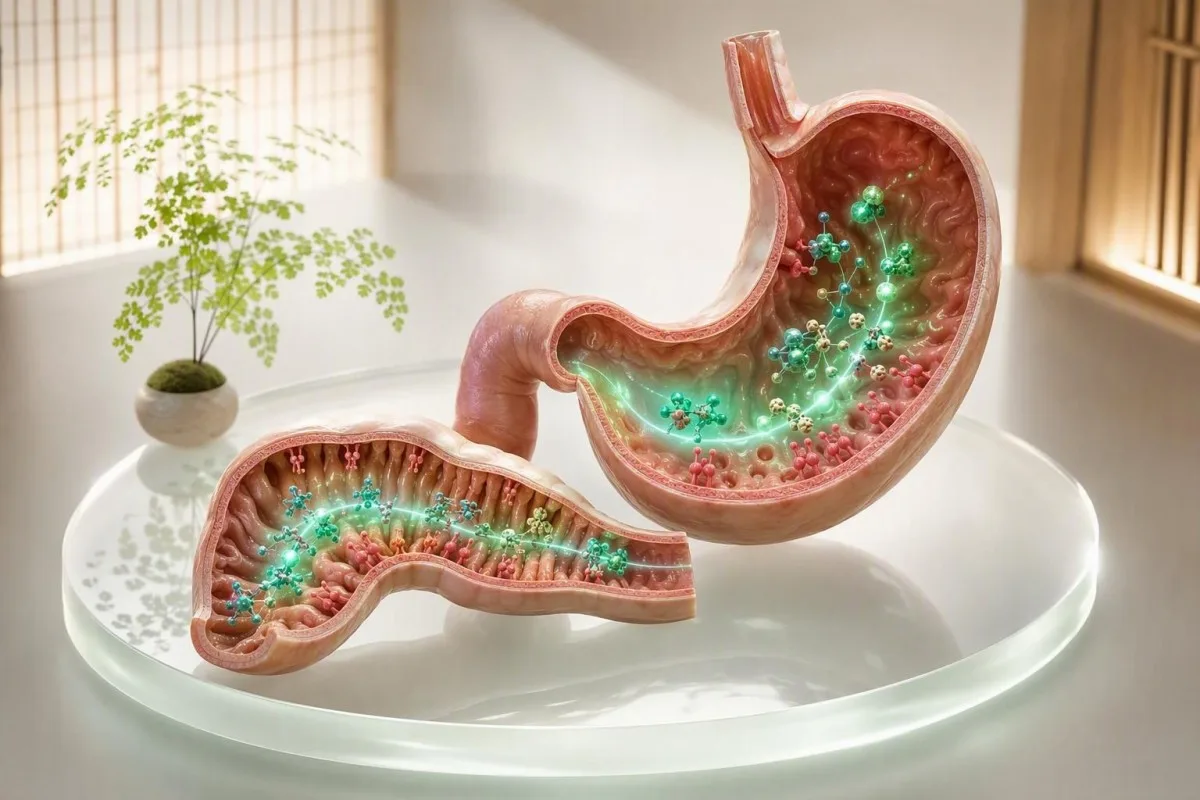
B12 so'rilishi uchun oshqozon kislotasi, oshqozon osti bezi fermentlari va oshqozon hujayralaridan olinadigan ichki faktor kerak bo'ladi, so'ngra ingichka ichakning oxirgi qismida so'riladi. Har qanday bosqichda muammo yuzaga kelsa, B12ga boy parhez yetarli bo'lmasligi mumkin.
Oziq-ovqat bilan bog'liq B12 oshqozonda oqsildan ajralib chiqadi, avval haptokorringa birikadi, keyin ingichka ichakda ichki faktorga o'tadi. Ichki faktor-B12 kompleksi terminal ileumda retseptorlar orqali vositachilik qiluvchi jarayon orqali so'riladi; buning uchun ushbu ichak segmentining kasalligi yoki olib tashlanishi oqibatlarga olib keladi.
Ichki faktorning so'rilishi taxminan quyidagicha to'yinadi ovqatlanishiga 1,5-2 mkg, shu bilan birga taxminan katta og'iz dozasi 1% passiv diffuziya orqali o'tishi mumkin. Ushbu kichik passiv yo'l shuni tushuntiradiki, nega klinisyennlar ba'zan 1000-2000 mkg og'iz orqali davolash dozalarini qo'llashadi, chunki hech kimga parhez talabidan 1000 barobar ko'p kerak bo'lgani uchun emas.
Surunkali diareya, sababsiz vazn yo'qotish yoki ko'yak kasalligi shubha qilingan odamlar uchun iste'molni hisoblash yetarli emas. Testdan oldin glyutenni sinashni to'g'ri vaqtini muhokama qilish yolg'on tasalli beruvchi ishni oldini olish mumkin.
Yaxshi ovqatlanish bilan ham B12 so'rilishini nima to'sib qo'yadi?
Pernitsioz anemiya, oshqozon yoki ichak operatsiyasi, ko'yak kasalligi, Kron kasalligi, uzoq muddatli metformin va kislotani bostirish B12 so'rilishini kamaytirishi mumkin. Bunday holatlarda, baliq yoki boyitilgan donli mahsulotlarni ko'paytirish sekinlashuvni sekinlashtirishi mumkin, ammo etishmovchilikni to'g'rilay olmasligi mumkin.
Autoimmun gastrit ichki faktor ishlab chiqaruvchi oshqozon hujayralarini yo'q qilishi va pernitsioz anemiya, sabab bo'lishi mumkin, bu parhezning buzilishi emas, balki so'rilish buzilishi. NICE NG239 ko'rsatmasi, 2024 yilda chop etilgan, autoimmun gastrit shubha qilinganda anti-ichki faktor antitelosini tekshirishni ko'rib chiqishni tavsiya qiladi, ammo salbiy natija uni to'liq istisno qilmaydi.
Metformin bilan bog'liq past B12 haqiqiy, lekin o'zgaruvchan. Diabetes Prevention Program Outcomes Study tadqiqotida, 5 yil o'tgach, metformin bilan platseboya nisbatan past yoki chegarada past B12 ko'proq tarqalgan va uzoqroq ta'sir qilish bilan xavf ortgan (Aroda et al., 2016); shuning uchun metformindan keyin o‘tkaziladigan qon tahlillari bo‘yicha yo‘riqnomamiz faqat glyukoza bilan cheklanmasligi kerak.
Men ko'rib chiqqan 63 yoshli bemor haftasiga losos iste'mol qilgan va har kuni sut ichgan, ammo metformin va omeprazolni yillar davomida qabul qilgandan keyin B12 darajasi 156 pg/mL va oyoq barmoqlarida uyquchanlik kuzatilgan. Oziq-ovqat yo'qolgan qadam emas edi - so'rilish edi.
Qaysi qon testlari mumkin bo'lgan B12 etishmovchiligini aniqlaydi?
200 pg/mL dan past, yoki 148 pmol/L dan past bo'lgan sarum B12 odatda etishmovchilikni qo'llab-quvvatlaydi, 200-300 pg/mL esa tasdiqlovchi kontekstdan foyda keltiradigan noaniq zonaldir. Metilmalonik kislota, homosistein, faol B12, to'liq qon miqdori va folat noaniqlikni bartaraf etishi mumkin.
Methylmalonic acid odatda hujayra B12 yetarli bo'lmaganda ko'tariladi; MMA yuqori 0.40 mikromol/l ko'pincha ko'tarilgan deb hisoblanadi, garchi laboratoriya chegaralari farq qilsa ham. Buyrak shikastlanishi MMA ni mustaqil ravishda ko'tarishi mumkin, shuning uchun 35 ml/min/1.73 m² bo'lgan eGFR bir xil natijaning ma'nosini o'zgartiradi.
Makrotsitoz belgidir, talab emas. MCV yuqoridagi MCV 100 fL dan B12 etishmovchiligi bilan yuzaga kelishi mumkin, ammo erta etishmovchilik normal MCV ga ega bo'lishi mumkin va temir etishmovchiligi hujayra kattalashishini qisman niqoblashi mumkin; natijani bizning yuqori MCV kuzatuv qo'llanmamiz.
Kantesti - bu AI asosidagi qon tahlili analiz vositasi bilan solishtiring, unda bir martalik chegaradan foydalanish o'rniga B12 ni MMA, MCV, RDW, kreatinin va uzunlamasına o'zgarishlar bilan o'qiladi. Devalia va boshqalar. (2014) dagi diagnostika tizimi ham shunga o'xshash ravishda B12 sarumi savolni hal qilmaganda klinik xususiyatlar va ikkinchi darajali testlardan foydalanishni qo'llab-quvvatlaydi.
B12 etishmovchiligi kamqonliksiz alomatlarni keltirib chiqarishi mumkinmi?
Ha, B12 etishmovchiligi gemoglobin tushishidan yoki MCV ko'tarilishidan oldin nerv va kognitiv alomatlarni keltirib chiqarishi mumkin. Barmoqlarda sanchish, oyoqlarda yonish, muvozanatni yo'qotish, tebranish hissini yo'qotish, kayfiyatning tushishi va miya loyqalik doimiy bo'lsa, baholashga loyiqdir.
Gemoglobin 13.2 g/dL bo‘lsa-da, temir yetishmovchiligi o‘tkazib yuborilishini ko‘raman. va MCV 92 fL progressiv paresteziya bilan og'rigan bemorda funktsional B12 etishmovchiligini istisno qilmaydi. Belgilar ko'p oylardan beri mavjud bo'lsa, nevrologik tiklanish kamroq bashorat qilinadi, shuning uchun men aniq kamqonlikni kutishni tavsiya etmayman.
Folat qon hujayralari ko'rinishini normallashtirishi mumkin, ammo B12 bilan bog'liq nerv shikastlanishi davom etadi. Bu yuqori dozali foliy kislotasi haqidagi ogohlantirish ortidagi klinik muammodir; yuqori folatning B12 ni niqoblashi haqidagi tushuntirishimizni ko'ring yuqori folat B12 ni niqoblaydi amaliy tafsilotlar uchun.
Yurish qiyinlashuvining tezlashishi, yangi chalkashlik, sezilarli kuchsizlik yoki ichak va siydik chiqarish o'zgarishlari uchun shoshilinch shu kunlik baholash maqsadga muvofiqdir. Bu alomatlarning bir nechta sabablari bor, ammo B12 qo'shimcha tajribasidan ko'ra tezkor differentsial diagnostikaning bir qismi bo'lishi kerak.
Qachon oziq-ovqat past B12 ni to'g'irlay oladi va qachon davolash kerak bo'ladi?
Ovqat hazm qilish tizimi yaxshi ishlaydigan odamda chegaraviy past iste'molni to'g'irlashi mumkin, ammo malabsorptsiyadan kelib chiqqan tasdiqlangan etishmovchilik ko'pincha yuqori dozali og'iz orqali davolashni yoki in'ektsiyalarni talab qiladi. Tanlov sabab, og'irligi, rioya qilish va nevrologik topqirlarga bog'liq - nafaqat sarum raqamiga.
Yuqori alomatlarsiz parhez etishmovchiligi uchun, klinisyentlar kuniga 50-150 mcg kabi dozalarda og'iz orqali cyanocobalamin yoki methylcobalamin dan foydalanishlari mumkin. kuniga 50-150 mcg parvarishlash uchun, etishmovchilikni tuzatishda kattaroq dozalar bilan. Aniqlangan tartib mamlakatlar bo'ylab farq qiladi va davolovchi shifokorning protokoliga amal qilishi kerak.
Pernitsioz anemiya, to'liq gastrektomiya, katta ileal kasallik yoki sezilarli nevrologik alomatlar odatda suhbatni o'zgartiradi. Bizning batafsil taqqosimiz B12 in'ektsiyalari va tabletkalari nega yuqori dozali planshetlar passiv assimilyatsiya orqali hali ham ishlay olishini tushuntiradi, in'ektsiyalar esa aniqlik yoki tezlik muhim bo'lganida afzal ko'riladi.
Mening tajribamda, oziq-ovqatga asoslangan reja mukammal profilaktika, ammo simptomatik malabsorptsiyani yaxshi qutqarish terapiyasi emas. Qayta tekshirish vaqti faqat B12 natijasini emas, balki in'ektsiyadan keyin tez ko'tariladigan alomatlar va funktsional markerlarni ham o'z ichiga olishi kerak.
Metillangan B12 siyanokobalamindan yaxshiroqmi?
Methylcobalamin va cyanocobalamin B12 etishmovchiligini dozalash va assimilyatsiya etarli bo'lganda to'g'rilashi mumkin; dalillar metillangan B12 universal ustun ekanligini ko'rsatmaydi. Cyanocobalamin barqaror, keng o'rganilgan va ko'pincha mustahkamlangan oziq-ovqatlarda ishlatiladi.
Gidroksokobalamin ko'pchilik sog'liqni saqlash tizimlarida in'ektsiya orqali keng tarqalgan, chunki u cyanocobalamindan ko'ra uzoqroq vaqt davomida tana ichida qoladi. Surunkali buyrak kasalligi yoki noodatiy metabolik kasalliklari bo'lgan odamlar individual maslahatga muhtoj, chunki MMA va davolash tanlovi yanada murakkablashishi mumkin.
Mahsulot kimyosi, dozalash mantig'i va laboratoriya kuzatuvini amaliy taqqoslash uchun o'qing.
metillangan B12 va cyanocobalamin . Zarur in'ektsiyalarni to'xtatmang, chunki qo'shimcha yorlig'i ko'proq 'tabiiy' shaklni va'da qiladi.. Oddiy taomlar bilan aralash parhez B12 ni 2,4 mcg ga yetishi mumkin, vegan parhezi esa majburiy mustahkamlangan oziq-ovqat jadvali yoki qo'shimchani talab qiladi.
B12 ga boy ovqatlanishning amaliy kuni qanday ko'rinishga ega?
Eng ishonchli reja - bu sayohat, band haftalar va ishtaha o'zgarishlari orqali takrorlashingiz mumkin bo'lgan reja. Oddiy taomlar kombinatsiyasi bir oziq-ovqatga bog'liq bo'lmasdan B12 ehtiyojlarini qondirishi mumkin.
), tushlikda tuxum (1,0 mkg) va kechki ovqatda 85 g losos (0,5 mkg). Bu taxminan ta'minlaydi.2,6 mcg). Bu taxminan ta'minlaydi 4,1 mkg oziq-ovqat ratsionini hisobga olmasdan, ovqatlanishni taqsimlash esa aksariyat odamlar uchun qulay.
Boyitilgan vegan misolida o'simlik ichimligi ishlatilishi mumkin, bu 1,0 mkg, donli mahsulotlar 1,5 mkg, va boyitilgan xamirturush bilan ta'minlaydi 1,0 mkg. Muammo barqarorlik: brendlarni o'zgartirish ozuqani to'satdan olib tashlashi mumkin, shuning uchun sog'liq haqidagi eslatmalaringizda yorliqning fotosuratini saqlang.
B12 suvda eriydigan oziq moddalar, oqsil, temir va energiya iste'molining kengroq qoidalariga kiradi. Bizning suvda eriydigan vitaminlar bo'yicha qo'llanmamiz charchoqning butun sababi sifatida bitta vitaminni ko'rib chiqishning keng tarqalgan xatosini oldini olishga yordam beradi.
Kim B12 ning kamligiga ayniqsa e'tiborli bo'lishi kerak?
Veganlar, keksa odamlar, metformin yoki uzoq muddatli kislota susaytirgichlarini qabul qilayotganlar, oshqozon yoki ileal jarrohlik amaliyotidan o'tgan bemorlar va yallig'lanishli ichak kasalliklari bo'lgan odamlar B12 etishmovchiligi xavfini yuqori darajada oshiradi. Bir nechta omil mavjud bo'lganda xavf ortadi.
Uzoq muddatli proton-pompa inhibitörlerinden foydalanish oshqozon kislotaliligini pasaytirish orqali oziq-ovqat oqsilidan B12 ajralishini kamaytirishi mumkin. Ushbu bog'liqlik buyurilgan dori vositasini to'satdan to'xtatish uchun sabab emas, lekin bu keyinroq monitoringni o'tkazish kerakmi degan savolga sababdir. 2 yil yoki undan ko'p uzluksiz qo‘llangandan keyin yanada muhimroq bo‘lib qoladi.
Yosh guruhidan kattaroq odamlar 60 yoshgacha bo‘lgan erektil disfunksiya faqat hayot sifati masalasi emas, balki tomirlar uchun ishora bo‘lishi mumkin; dalillar mukammal emas, lekin mening tajribamda bu lipid panelini kechiktirmaslik uchun yaxshi sabab. turli xil ratsionga ega bo'lsa ham, ba'zan atrofli gastrit bilan birga oziq-ovqat-kobalamin malabsorbtsiyasini rivojlantirishi mumkin. Ushbu guruhda B12 darajasining pastligi avtomatik ravishda 'faqat yosh' degani emas; bu simptomlarni, dori-darmonlarni va autoimmune tarixini tekshirish uchun signal bo'lishi mumkin.
Bizning uzoq muddatli PPI monitoringi bo'yicha qo'llanma magniy va temirni o'z ichiga olgan tegishli laboratoriya munozaralarini keltiradi. Aniqlanmagan temir etishmovchiligi bilan B12 ni birlashtirish shifokorlarni ikkita bog'liq bo'lmagan parhez kamchiliklaridan ko'ra oshqozon sababiga yo'naltirishi mumkin.
Oziq-ovqatni o'zgartirgandan yoki davolangandan keyin B12 darajasi qachon qayta tekshirilishi kerak?
Dietali yoki og'zaki davolash o'zgarishidan 8-12 hafta o'tgach, ko'pincha qayta tekshiruv o'tkaziladi, shu bilan birga simptomlarning og'irligi va davolash usuli yanada dastlabki klinik tekshiruvni kafolatlaydi. Serum B12 natijasi qo'shimcha qabul qilingandan keyin tez ko'tarilishi mumkin va to'qimalarning tiklanishini o'z boshiga isbotlamasligi mumkin.
To'liq qon hisobi megaloblastik anemiya uchun samarali davolashdan keyin taxminan ichida retikulotsit javobini ko'rsatishi mumkin, shu bilan birga gemoglobin odatda bir necha hafta davomida yaxshilanadi. Nerv simptomlari odatda sekinroq va ba'zan nomukammal tiklanadi, ayniqsa uzoq muddatli etishmovchilikdan keyin. 1 hafta samarali davolashdan keyin.
To'xtatish-boshlash qo'shimchasini qo'llash tekshiruv kunida serum B12ni normal ko'rsatishi mumkin, shu bilan birga MMA, simptomlar yoki makrotsitoz tashvish uyg'otadi. Bu natijalarni talqin qilishdan oldin siz nima olganingizni, dozasini va oxirgi doza sanasini shifokorga aniq aytishingizning bir sababidir.
Kantesti AI B12, MCV, gemoglobin, RDW, folat va kreatininni bir nechta hisobotlar bo'ylab solishtirishi mumkin, bu o'zgarish klinik jihatdan muhimligini aniqlash uchun. Ushbu ko'nikmani o'rganayotgan o'quvchilar uchun bizning qon tahlili trendini o‘rganish bo‘yicha yo‘riqnomamiz bitta izolyatsiya qilingan natija butun hikoyaning kamdan-kam bo'lishining sababini tushuntiradi.
Qaysi B12 noto'g'ri tushunchalari to'g'ri parvarishni kechiktirishi mumkin?
B12 haqidagi eng katta noto'g'ri tushuncha shundaki, ko'proq hayvonot mahsulotlarini iste'mol qilish har qanday past natijani to'g'irlaydi. Parhez iste'molga yordam beradi, lekin u ichki omilni tiklay olmaydi, ichak kasalliklarini teskari aylantira olmaydi yoki nevrologik belgilarning baholashini xavfsiz almashtira olmaydi.
Boshqa bir afsona shundaki, yuqori B12 sarum darajasi har doim ajoyib holatni anglatadi. Natija 900 pg/mL dan ko'pincha qo'shimchalar yoki in'ektsiyalar aks etadi, ammo doimiy tushunarsiz ko'tarilish jigar kasalligi, buyrak kasalligi yoki ba'zi gematologik sharoitlarda ham yuzaga kelishi mumkin; kontekst vahimadan ko'ra muhimroq.
1-sentabrdan boshlab, 2026-yil men bitta planshetdan keyin energiyani yaxshilashni diagnostik dalil sifatida ishlatishdan ham ehtiyot bo'lishni maslahat beraman. platsEbo effektlari, uyqu, temir holati, qalqonsimon bez kasalliklari, depressiya va glyukoza o'zgarishlari energiyani o'zgartirishi mumkin 1-4 hafta B12 tanqisligini tasdiqlamasdan.
Kantesti ning klinik mazmuni tomonidan ko'rib chiqiladi Tibbiy maslahat kengashi, yordamida, ammo AI talqini nevrologik belgilarning rivojlanishini tekshirishni hech qachon almashtirmaydi. O'quvchilar bizning klinik validatsiya yondashuvimiz ni ko'rib chiqishlari mumkin, biz qanday qilib tashxis qo'yish o'rniga keyingi so'rovlarni shakllantiramiz.
Agar siz B12 ning kamligidan shubhalansangiz, eng xavfsiz keyingi qadamlar qanday?
Agar sizda doimiy uyquchanlik, muvozanat muammolari, kognitiv o'zgarishlar, tushunarsiz makrotsitoz yoki 200 pg/ml dan past B12 natijasi bo'lsa, faqat oziq-ovqatga tayanish o'rniga tibbiy tekshiruvni tashkil qiling. Nervlar jalb qilingan bo'lishi mumkin bo'lgan hollarda erta davolash ayniqsa muhimdir.
Dori-darmonlar, qo'shimchalar, parhez rejimi, ovqat hazm qilish kasalliklari, operatsiyalar, alkogol iste'moli va oldingi laboratoriya hisobotlari ro'yxatini olib keling. Keyin shifokor B12ni takrorlash, MMA yoki gomosisteinni buyurish, folat va to'liq qon sonini tekshirish yoki pernisioz anemiya va malabsorbtsiyani tekshirishga qaror qilishi mumkin.
Tomas Klein, MD, B12 yetarli darajada baholanmaguncha, tushunarsiz makrotsitozni o'z-o'zini davolash uchun yuqori dozali foliy kislotasidan saqlanishni tavsiya etadi. Agar sizda qizil bayroqlar bo'lmasa va parhez iste'moli past bo'lsa, o'lchangan oziq-ovqat yoki qo'shimcha reja bilan takroriy natija 8-12 hafta ko'pincha oqilona.
Kantesti laboratoriya hisoboti tendentsiyalarini uchrashuv uchun tushunarli savollarga bog'laydi, oxirgi diagnostik qarorni esa sizning shifokoringizga qoldiradi. Bizning biomarker ma'lumotnomasi ni ko'rib chiqing, B12 natijasi bilan birga paydo bo'lishi mumkin bo'lgan laboratoriya atamalari.
Tez-tez so'raladigan savollar
Qaysi taom B12 vitamini eng ko'p saqlaydi?
Tovuq va mol jigari B12 vitamini eng ko'p bo'lgan taomlardandir. Chiqarilgan 85 g tovuqning porsiyasi taxminan 84 mcg B12 berishi mumkin, shu bilan birga mol jigarning shu miqdori taxminan 70 mcg beradi; ikkalasi ham kattalar uchun kunlik 2.4 mcg miqdoridan ancha oshadi. Jigarni homiladorlik paytida har kuni iste'mol qilish mumkin emas, chunki u juda ko'p oldindan shakllangan A vitaminiga ega. Muntazam ovqatlanish uchun baliq, go'sht, sut mahsulotlari, tuxum va maxsus belgilangan boyitilgan oziq-ovqatlar qulayroq manbalardir.
Veganlar faqat oziq-ovqatdan yetarli miqdorda B12 oladimi?
Veganlar vitamin B12 ga bo'lgan ehtiyojlarini faqat B12 bilan boyitilgan mahsulotlarni muntazam ravishda o'lchangan miqdorda iste'mol qilinganida qondira oladilar. Boyitilmagan sabzavotlar, qo'ziqorinlar, dengiz o'tlari, tempeh va xamirturush qo'ziqorini kabi mahsulotlar ishonchli B12 manbai emas, chunki ulardagi kobalamin miqdori yo'q, notekis yoki faol bo'lmagan analoglarni o'z ichiga olishi mumkin. Ko'pgina boyitilgan o'simlik ichimliklari 250 ml uchun 0,4-1,0 mkg beradi, ammo formulalar mamlakat va brend bo'yicha farq qiladi. B12 qo'shimchasi ko'pincha vegan parhezlari uchun sodda va ishonchliroq himoya vositasidir.
Kattalar har kuni qancha B12 olishlari kerak?
Qo'shma Shtatlar Tavsiya etilgan Parhez Ruxsatnomasi bo'yicha, ko'pchilik kattalar sutkasiga 2,4 mkg B12 vitaminiga muhtoj. Homiladorlik bu ko'rsatkichni sutkasiga 2,6 mkg gacha oshiradi, emizish esa sutkasiga 2,8 mkg gacha ko'taradi. Buyuk Britaniyada kattalar uchun tavsiya etilgan ozuqa moddasi ko'rsatkichi sutkasiga 1,5 mkg ni tashkil qiladi, shuning uchun mamlakatga xos ozuqaviy yorliqlar farq qilishi mumkin. Ushbu qiymatlar normal so'rilish uchun oldini olish maqsadlari hisoblanadi va aniqlangan etishmovchilik uchun ishlatiladigan davolash dozalaridan ancha pastdir.
Go'sht va tuxum ko'proq iste'mol qilib B12 yetishmovchiligini tuzatish mumkinmi?
Go'sht, baliq, sut mahsulotlari, tuxum yoki boyitilgan oziq-ovqatlarni iste'mol qilishning ko'payishi faqat parhez orqali kam bo'lgan B12 tanqisligini to'g'irlashi mumkin, ammo so'rilish buzilgan bo'lsa, u ishlamasligi mumkin. Pernitsioz anemiya, coeliac disease, Kron kasalligi, oshqozon jarrohligi, ileal jarrohlik, metformin va uzoq muddatli kislotani bostiruvchi davolash B12 ga boy parhezga qaramay so'rilishni kamaytirishi mumkin. 200 pg/mL yoki 148 pmol/L dan past bo'lgan serumi B12 odatda sababini klinik baholashni talab qiladi. Numbness, yomon muvozanat yoki kognitiv o'zgarish kabi nevrologik alomatlar faqat oziq-ovqat bilan davolanmasligi kerak.
B12 ni o'zlashtirishga nima yordam beradi?
B12 vitaminining so'rilishi me'daning yetarli darajada ishlov berishi, oshqozon osti bezi fermentlari, ichki omil va ishlaydigan terminal ileumga bog'liq. Ichki omil ovqatdan faol ravishda atigi 1,5-2 mkg B12 ni o'zlashtiradi, katta og'zaki dozasining taxminan 1% passiv diffuziya orqali kirishi mumkin. B12 ni ovqat bilan iste'mol qilish oqilona, ammo hech qanday maxsus oziq-ovqat kombinatsiyasi ichki omilning yo'qligi yoki ileumning jiddiy kasalliklarini bartaraf eta olmaydi. Agar so'rilish buzilgan bo'lsa, yuqori dozali og'zaki B12 yoki in'ektsiyalar kerak bo'lishi mumkin.
B12 darajasi qanday past hisoblanadi?
Siydikdagi B12 vitamini miqdorining 200 pg/mL dan past bo'lishi, taxminan 148 pmol/L ga teng, odatda B12 tanqisligini tasdiqlaydi, ammo laboratoriyalar turli xil tahlil diapazonlaridan foydalanadi. 200-300 pg/mL natijalari ko'pincha chegaradosh yoki aniqlanmagan deb hisoblanadi va metilmalonik kislota, homosistein, faol B12, to'liq qon soni, folat, buyrak faoliyati va simptom kontekstini talab qilishi mumkin. Taxminan 0.40 mikromol/L dan yuqori bo'lgan metilmalonik kislota hujayra B12 tanqisligini qo'llab-quvvatlaydi, ammo buyrak faoliyatining pasayishi bilan ham ko'tarilishi mumkin. Normal gemoglobin yoki MCV B12 bilan bog'liq dastlabki asab simptomlarini ishonchli ravishda istisno qilmaydi.
Bugun AI asosidagi qon tahlilini tahlil qilishni oling
Kantesti’ga tezkor va aniq laboratoriya tahlili uchun ishonadigan butun dunyo bo‘ylab 2 milliondan ortiq foydalanuvchiga qo‘shiling. Qon tahlili natijalaringizni yuklang va soniyalar ichida 15,000+ biomarkerlarining to‘liq talqinini oling.
📚 Havola qilingan ilmiy tadqiqot nashrlari
Klein, T., Mitchell, S., & Weber, H. (2026). Siydikdagi urobilinogen: Siydik tahlili bo‘yicha to‘liq qo‘llanma 2026. Kantesti AI tibbiy tadqiqoti.
Klein, T., Mitchell, S., & Weber, H. (2026). Temir tadqiqotlari bo'yicha qo'llanma: TIBC, temirning to'yinganligi va bog'lanish qobiliyati. Kantesti AI tibbiy tadqiqoti.
📖 Tashqi tibbiy manbalar
⚕️ Tibbiy ogohlantirish
Ushbu maqola faqat ta’lim maqsadlari uchun mo‘ljallangan va tibbiy maslahatni anglatmaydi. Tashxis va davolash bo‘yicha qarorlar uchun har doim malakali sog‘liqni saqlash mutaxassisiga murojaat qiling.
E-E-A-T ishonch signallari
Tajriba
Shifokor boshchiligidagi laboratoriya talqin qilish ish jarayonlarini klinik ko‘rib chiqish.
Tajriba
Laboratoriya tibbiyoti biomarkerlarning klinik kontekstda qanday o‘zini tutishini yoritadi.
Vakolatlilik
Dr. Tomas Klein tomonidan yozilgan, Dr. Sarah Mitchell va Prof. Dr. Hans Weber tomonidan ko‘rib chiqilgan.
Ishonchlilik
Xavotirni kamaytirish uchun aniq keyingi qadamlar yo‘nalishlari bilan dalillarga asoslangan talqin.