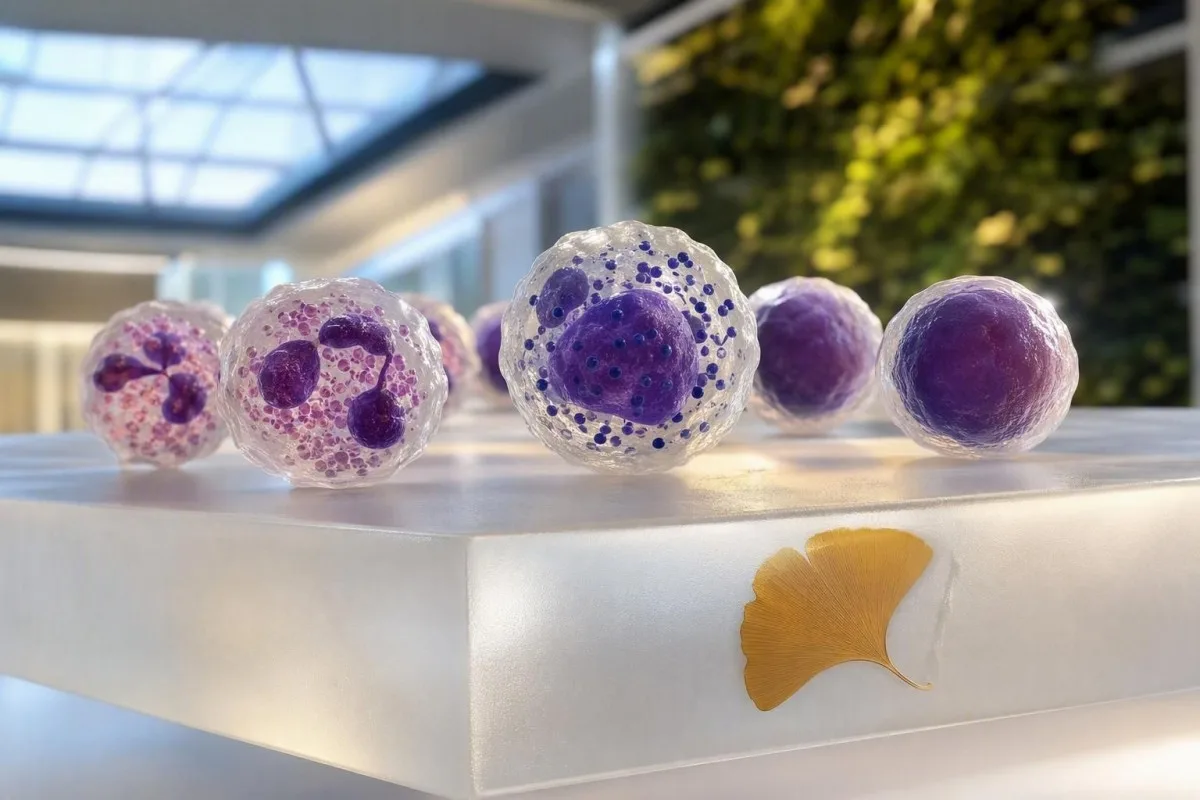
A maioria dos adultos tem basófilos absolutos de 0,00–0,10 × 10⁹/L (0–100/µL), enquanto a porcentagem é geralmente de 0–1%. Uma porcentagem ligeiramente incomum geralmente reflete mudanças em outras células brancas; a contagem absoluta de basófilos é o resultado que geralmente orienta o acompanhamento.


- Basófilos absolutos são geralmente 0,00–0,10 × 10⁹/L (0–100/µL) em adultos e são mais clinicamente úteis do que uma porcentagem isolada.
- Porcentagem de basófilos é comumente 0–1% das células brancas, mas pode aumentar quando neutrófilos ou linfócitos caem, mesmo que a contagem absoluta esteja normal.
- Crianças geralmente usam o mesmo limite superior prático de 0,10 × 10⁹/L após a infância, mas o intervalo específico de idade do laboratório tem prioridade.
- Um repeat CBC em 2–8 semanas é razoável para basofilia isolada e leve após uma alergia, infecção ou alteração medicamentosa.
- Basofilia persistente acima de 0,20 × 10⁹/L merece revisão clínica, especialmente com leucocitose, anemia, esplenomegalia ou sintomas constitucionais.
- revisão urgente é justificado para leucocitose acentuada, perda de peso inexplicada, suores noturnos intensos, febre ou plenitude precoce sob as costelas esquerdas.
- Zero basófilos em um diferencial automatizado é comum e geralmente não tem significado clínico.
- Kantesti AI lê basófilos juntamente com leucócitos totais, eosinófilos, contagem de plaquetas, hemoglobina e resultados anteriores, em vez de tratar um alerta como um diagnóstico.
Basófilos absolutos versus porcentagem de basófilos
Basófilos absolutos de 0,00–0,10 × 10⁹/L são geralmente normais em adultos, enquanto uma porcentagem de basófilos de 0–1% é apenas uma proporção da contagem total de leucócitos. Quando os dois discordam, os clínicos geralmente dão mais peso ao resultado absoluto.
Uma porcentagem pode parecer alta simplesmente porque outro tipo de leucócito está baixo. Por exemplo, 1,5% de basófilos com uma contagem de leucócitos de 3,0 × 10⁹/L produz uma contagem absoluta de apenas 0,045 × 10⁹/L — bem dentro de muitos intervalos para adultos. É por isso que um alerta de porcentagem sozinho raramente conta toda a história.
O cálculo é simples: leucócitos totais × porcentagem de basófilos ÷ 100. Uma contagem de leucócitos de 12,0 × 10⁹/L e basófilos de 2% resulta em 0,24 × 10⁹/L, que é uma elevação real. Para um contexto mais amplo, consulte nosso guia de o que um CBC inclui.
Kantesti é um Analisador de teste de sangue de IA que converte porcentagens em contagens absolutas clinicamente comparáveis quando o relatório de origem fornece um diferencial. Em minha experiência, essa conversão evita uma quantidade considerável de alarme desnecessário após um check-up de rotina.
Por que o número absoluto é mais estável
Analisadores automatizados contam milhares de eventos celulares, mas basófilos são normalmente raros — muitas vezes menos de 1 em cada 100 leucócitos. Pequenas variações analíticas e biológicas podem, portanto, mover a porcentagem de forma mais perceptível do que a contagem absoluta.
Intervalos de referência práticos de basófilos por idade
A maioria dos laboratórios usa um intervalo de referência absoluto para basófilos de 0,00–0,10 × 10⁹/L da infância à idade adulta, mas os intervalos neonatais podem ser mais amplos. Use o intervalo impresso ao lado do seu próprio resultado, pois os limites de referência dependem do método do analisador e da população saudável local do laboratório.
Para lactentes nas primeiras semanas de vida, alguns laboratórios pediátricos aceitam basófilos absolutos de até aproximadamente 0,20–0,40 × 10⁹/L. O sistema imunológico neonatal está se adaptando rapidamente, portanto, os limites de corte para adultos não devem ser impostos a um resultado neonatal sem acompanhamento pediátrico.
A partir de aproximadamente 1 ano de idade, muitos serviços aplicam um limite superior prático próximo a 0,10 × 10⁹/L, ou 100/µL. Um resultado de 0,11 × 10⁹/L em uma criança saudável com contagem total de leucócitos normal geralmente requer uma pergunta de repetição e contexto, não uma emergência.
O CLSI EP28-A3c explica por que os laboratórios estabelecem ou verificam seus próprios intervalos de referência em vez de adotar uma faixa universal (CLSI, 2010). Nosso guia de intervalos de idade para neutrófilos mostra o mesmo princípio para outra contagem diferencial.
Entendendo as unidades de basófilos em relatórios do Reino Unido, EUA e internacionais
Uma contagem de basófilos de 0,10 × 10⁹/L é igual a 100/µL, portanto, relatórios que usam unidades diferentes podem descrever o mesmo resultado. Contagens sanguíneas completas do Reino Unido frequentemente relatam ×10⁹/L, enquanto laboratórios dos EUA comumente usam células/µL ou K/µL.
Para converter ×10⁹/L para células/µL, multiplique por 1.000. Assim, 0,05 × 10⁹/L é igual a 50/µL; 0,25 × 10⁹/L é igual a 250/µL. Um relatório mostrando 0,0 pode ser arredondado para uma casa decimal em vez de provar que não há literalmente basófilos.
Um valor listado como 0,2 K/µL é igual a 0,20 × 10⁹/L. Essa distinção importa porque 0,21 e 0,2 K/µL são medidas completamente diferentes. Os pacientes frequentemente as misturam ao comparar relatórios de dois países.
Se o seu relatório disser FBC em vez de CBC, os componentes são em grande parte os mesmos; nosso explicador de contagem sanguínea completa do Reino Unido traduz a terminologia comum.
Por que as contagens de basófilos aumentam ou diminuem
Leve basofilia acompanha mais frequentemente alergia, inflamação crônica, recuperação de uma infecção ou uma mudança imune relacionada a medicamentos. Uma contagem baixa ou zero basófilos geralmente não é significativa porque essas células circulam em números muito pequenos.
Os basófilos carregam receptores para IgE e podem liberar histamina e outros mediadores após exposição a alérgenos. Rinite alérgica sazonal, urticária crônica, asma e alguns distúrbios de pele podem coincidir com um pequeno aumento, embora uma contagem normal não confirme nem descarte nenhum deles.
Hipotireoidismo, doença inflamatória intestinal, distúrbios reumáticos e algumas infecções crônicas também podem estar associados à basofilia. A pergunta útil não é “qual doença causa isso?”, mas “quais outros sinais estão presentes?”—CRP, eosinófilos, sintomas, histórico de medicamentos e a trajetória são importantes.
Um IgE e contagem de eosinófilos elevados podem apoiar um padrão alérgico, enquanto coceira isolada pode precisar de uma revisão mais ampla; nosso artigo sobre exames de sangue para pele com coceira explica os limites práticos do teste de CBC.
Quando repetir um CBC para basófilos?
Repita um CBC em 2–8 semanas para uma elevação leve e isolada de basófilos após um gatilho temporário, desde que você se sinta bem e o restante da contagem seja tranquilizador. Repita mais cedo, geralmente em dias a 2 semanas, quando os leucócitos totais estão aumentando ou há múltiplas linhagens celulares anormais.
Para uma contagem absoluta de basófilos de 0,11–0,20 × 10⁹/L após um resfriado, exacerbação de febre do feno, vacinação ou um curso curto de esteroides, frequentemente prefiro uma repetição calma em vez de uma cascata de testes. Tente usar o mesmo laboratório e registre doenças recentes, novos medicamentos, mudanças de tabagismo e exposição a esteroides.
Não tente “melhorar” a contagem antes de uma repetição do exame. A hidratação é sensata, mas suplementos, anti-histamínicos, corticosteroides e exercícios de endurance intensos podem alterar a diferencial mais ampla. Nosso guia de cronologia de exames de sangue detalha efeitos comuns de temporização.
Kantesti é um plataforma de interpretação de exame de sangue da AI que compara a diferencial atual com CBCs anteriores e sinaliza um aumento consistente de forma diferente de um sinal isolado. Uma tendência ao longo de 3-6 meses é muitas vezes mais informativa do que um único ponto decimal.
Como se preparar para um teste confiável de basófilos
O teste de basófilos geralmente não requer jejum, mas um CBC repetido é mais interpretável quando você não está gravemente doente e as condições de coleta são semelhantes. Procure por hidratação normal, refeições comuns e um dia rotineiro, em vez de mudanças extremas.
Evite agendar uma repetição não urgente durante febre, surto alérgico significativo, ou no dia seguinte a um evento de endurance incomumente difícil, se o objetivo for estabelecer a linha de base. Hormônios de estresse agudo e alterações de fluidos podem mover vários subconjuntos de leucócitos por horas a dias.
Informe o médico ou o flebotomista sobre corticosteroides sistêmicos, lítio, tratamentos contendo epinefrina, terapia biológica recente e qualquer novo suplemento. Esteroides mais comumente diminuem basófilos e eosinófilos circulantes, então um resultado “normal” enquanto os toma pode não representar sua linha de base sem tratamento.
A qualidade da amostra ainda importa. Amostras de EDTA coaguladas e análise atrasada podem tornar as diferenciais automatizadas menos confiáveis; se vários valores de CBC parecerem estranhos juntos, revise quando uma nova coleta é necessária.
Padrões de CBC que tornam os basófilos elevados mais significativos
Basofilia é mais preocupante quando os basófilos absolutos excedem 0,20 × 10⁹/L e ocorrem com leucócitos persistentes acima de 11,0 × 10⁹/L, anemia, alterações plaquetárias ou células imaturas. A combinação – não apenas os basófilos – determina a rapidez com que os médicos investigam.
Uma paciente de 44 anos que revisei tinha basófilos de 0,28 × 10⁹/L, leucócitos de 16,4 × 10⁹/L, plaquetas de 610 × 10⁹/L e saciedade precoce. Esse padrão justificou um encaminhamento hematológico na mesma semana; o resultado isolado do basófilo não fez o diagnóstico, mas foi uma pista importante.
Basofilia, juntamente com neutrófilos elevados e sintomas esplênicos, pode ocorrer em neoplasias mieloproliferativas, incluindo leucemia mieloide crônica. A European LeukemiaNet recomenda testes moleculares e avaliação especializada quando o padrão clínico e de contagem sanguínea levanta essa possibilidade (Hochhaus et al., 2020).
Um esfregaço periférico pode distinguir alterações diferenciais verdadeiras de incertezas do analisador e pode mostrar desvio à esquerda ou células atípicas. Leia mais sobre vias de CBC para câncer de sangue sem assumir que uma contagem anormal significa câncer.
Sintomas e resultados que precisam de atenção médica imediata
Procure avaliação médica urgente para basofilia com febre, suores noturnos profusos, perda de peso inexplicada, hematomas novos, falta de ar, fadiga severa ou plenitude no abdômen superior esquerdo. Esses sintomas não são causados por um resultado de basófilo ligeiramente elevado em si; eles sinalizam que o quadro clínico mais amplo precisa de avaliação.
Uma contagem total de leucócitos acima de 30 × 10⁹/L, valores em rápido aumento ou granulócitos imaturos visíveis em um laudo devem ser discutidos urgentemente com o médico solicitante. Dor de cabeça severa, alteração visual, dor no peito ou sintomas neurológicos necessitam de avaliação de emergência, independentemente da contagem de basófilos.
A maioria das pessoas com 0,11–0,20 × 10⁹/L de basófilos e sem sintomas não precisa de atendimento de emergência. Ainda assim, esta é uma daquelas áreas onde o contexto importa mais do que o número, especialmente se os resultados anteriores foram 0,02 × 10⁹/L e a nova contagem está subindo.
Se você também tiver falta de ar ou palidez, os valores de hemoglobina e plaquetas associados podem ser mais importantes imediatamente; veja nosso guia de exames de sangue para falta de ar.
O que significa baixo número de basófilos ou um resultado de zero
Um resultado de basófilo de 0,00 × 10⁹/L é geralmente normal e raramente precisa ser repetido isoladamente. Os basófilos podem estar abaixo do limite de relato do analisador porque são naturalmente escassos na circulação.
Estresse agudo, infecção, gravidez, hipertireoidismo e tratamento com corticosteroides podem reduzir temporariamente os basófilos circulantes. No entanto, não há uma síndrome sintomática reconhecida causada por basófilos baixos isolados, ao contrário da neutropenia clinicamente significativa.
A questão analítica é fácil de perder: se apenas alguns basófilos forem contados, a variabilidade da amostragem de rotina pode transformar 0,01 × 10⁹/L em 0,00 × 10⁹/L em uma coleta subsequente. Isso não é necessariamente uma mudança biológica.
O conselho prático do Dr. Thomas Klein é ignorar um sinal de basófilos baixos quando o restante do CBC está normal e não há sintomas relevantes. Nosso guia dedicado explica basófilos em zero.
Basófilos na gravidez e em idades mais avançadas
Gravidez e envelhecimento não têm um único ponto de corte especial para basófilos; o intervalo do laboratório de relato e o padrão completo de leucócitos permanecem a melhor referência. A gravidez comumente aumenta os leucócitos totais através dos neutrófilos, o que pode fazer com que a porcentagem de basófilos pareça menor sem uma redução real de basófilos.
Durante a gravidez, uma contagem total de leucócitos de 12–15 × 10⁹/L pode ser fisiológica, particularmente no final da gestação, tornando a interpretação baseada em porcentagem ainda menos confiável. Uma contagem absoluta de basófilos permanece preferível, mas sintomas preocupantes ainda se sobrepõem a um intervalo de referência.
Em idosos, uma contagem persistente de basófilos acima de 0,20 × 10⁹/L merece atenção, pois a carga de medicamentos e distúrbios da medula óssea se tornam mais comuns com a idade. Isso não o torna diagnóstico; simplesmente reduz o limite para observar a tendência do CBC e o esfregaço.
Para outras armadilhas de interpretação específicas da gravidez, revise sinais de alerta em exames de sangue na gravidez.
Medicamentos, alergias e flutuações de basófilos
Sintomas alérgicos podem coincidir com basófilos levemente elevados, enquanto corticosteroides sistêmicos geralmente os diminuem em poucos dias. Nenhum padrão confirma um diagnóstico de alergia ou prova que um medicamento é responsável.
Anti-histamínicos bloqueiam principalmente os receptores de histamina; eles não normalizam de forma confiável a contagem de basófilos. Prednisolona oral e outros glicocorticoides sistêmicos podem redistribuir os leucócitos, frequentemente diminuindo eosinófilos e basófilos enquanto aumentam os neutrófilos circulantes.
O lítio é uma pista medicamentosa menos comum, mas útil, porque pode aumentar a produção de leucócitos. Medicamentos biológicos, quimioterapia e tratamentos imunomoduladores nunca devem ser interrompidos por um resultado de CBC — pergunte à equipe prescritora como o resultado se encaixa em seu plano de monitoramento.
Uma contagem elevada de basófilos juntamente com chiado, urticária, inchaço facial ou desmaio deve ser gerenciada como um problema sintomático, não um quebra-cabeça laboratorial. Nosso guia de IgE alta explica onde os marcadores de alergia ajudam e onde eles enganam.
O que os médicos verificam após basofilia persistente
Basofilia absoluta persistente geralmente leva a um CBC repetido, revisão manual do esfregaço, revisão de medicamentos e sintomas, e então testes direcionados se a contagem total de leucócitos ou outras linhagens celulares estiverem anormais. Painéis amplos de câncer não são o primeiro passo usual para um leve aumento isolado.
O primeiro ponto de ramificação é se o resultado é isolado. Hemoglobina estável, plaquetas, contagem de leucócitos e esfregaço normal apoiam fortemente um plano conservador; anemia, trombocitose, leucocitose ou esplenomegalia direcionam a avaliação em uma direção diferente.
Quando um distúrbio mieloproliferativo é plausível, os clínicos podem solicitar testes BCR::ABL1, testes JAK2, lactato desidrogenase, urato e revisão especializada. Valent et al. descrevem a basofilia persistente como um achado significativo na classificação de neoplasias basofílicas e mieloides (Valent et al., 2022).
A rede neural do Kantesti identifica combinações que merecem revisão, mas não diagnostica leucemia a partir de um hemograma completo (CBC). A nossa abordagem de validação médica explica por que a interpretação laboratorial deve manter a supervisão clínica.
Como monitorar basófilos sem exagerar
Uma tendência significativa de basófilos é uma mudança direcional persistente em hemogramas completos (CBCs) comparáveis, não um único movimento de 0,04 para 0,08 × 10⁹/L. Com um limite de referência para adultos de 0,10 × 10⁹/L, ambos os valores permanecem dentro da faixa, apesar de serem numericamente diferentes.
Guarde a contagem absoluta, a percentagem, as células brancas totais, os neutrófilos, os eosinófilos, a hemoglobina, as plaquetas, a data, doenças recentes e medicamentos após cada coleta. Este pequeno registo fornece ao seu médico mais informações úteis do que capturas de ecrã de sinais de alerta isolados.
Kantesti é um Ferramenta de análise de exames de sangue com IA utilizado em 127+ países para comparar resultados de hemogramas completos (CBCs) longitudinalmente, preservando o intervalo declarado pelo laboratório de origem. O Dr. Thomas Klein recomenda a revisão de pelo menos dois resultados comparáveis antes de atribuir significado a uma alteração limítrofe na contagem diferencial.
Uma regra útil: se a contagem absoluta permanecer abaixo de 0,10 × 10⁹/L, a contagem total de leucócitos estiver estável e você se sentir bem, o acompanhamento de rotina no seu próximo exame de sangue planeado é geralmente suficiente. Use o nosso guia de diferença em exame de sangue para julgar se uma alteração é provavelmente real.
Perguntas a fazer em uma consulta de acompanhamento
A melhor pergunta de acompanhamento é “Qual é a minha contagem absoluta de basófilos e o que mais mudou no hemograma completo (CBC)?” Essa formulação direciona a conversa para as variáveis que realmente alteram o risco clínico.
Pergunte se a contagem é nova, persistente, ascendente ou provavelmente reativa; se é necessária a revisão do esfregaço; e quando o próximo hemograma completo (CBC) deve ser realizado. Traga uma lista de infeções recentes, sintomas de alergia, medicamentos, suplementos, viagens e histórico familiar de doenças sanguíneas.
Se tiver uma contagem absoluta acima de 0,20 × 10⁹/L, mais células brancas totais elevadas, pergunte se a avaliação hematológica é apropriada. Se a contagem estiver apenas ligeiramente acima da faixa e isolada, pergunte que alteração desencadearia testes mais cedo em vez de assumir o pior.
Os padrões educacionais do Kantesti, revistos por médicos, são supervisionados através do nosso Conselho Consultivo Médico. A partir de 30 de agosto de 2026, a abordagem mais segura continua a ser simples: interpretar a contagem absoluta, confirmar a persistência e agir mais rapidamente apenas quando o padrão mais amplo o justificar.
Perguntas frequentes
Qual é a contagem normal de basófilos em adultos?
O intervalo de referência comum para adultos para basófilos absolutos é de 0,00–0,10 × 10⁹/L, o que equivale a 0–100 células/µL. A maioria dos laboratórios relata uma porcentagem de basófilos de 0–1%, embora a porcentagem possa ser enganosa quando a contagem total de leucócitos muda. O intervalo de referência impresso pelo seu próprio laboratório tem precedência porque os métodos e as populações de referência locais diferem. Um resultado isolado de 0,11 × 10⁹/L geralmente requer contexto ou uma repetição planejada, em vez de atendimento de emergência.
Os basófilos 2% estão altos?
Uma porcentagem de basófilos de 2% está acima de muitos intervalos de porcentagem de laboratório, mas não é suficiente para julgar o risco sem a contagem total de leucócitos. Com leucócitos de 4,0 × 10⁹/L, 2% equivale a uma contagem absoluta de basófilos de 0,08 × 10⁹/L, que geralmente é normal. Com leucócitos de 15,0 × 10⁹/L, o mesmo 2% equivale a 0,30 × 10⁹/L e merece revisão clínica. Sempre localize a contagem absoluta de basófilos antes de interpretar a porcentagem.
Quando devo repetir um hemograma completo para basófilos elevados?
Um CBC repetido em 2–8 semanas é comumente razoável para basofilia isolada leve de cerca de 0,11–0,20 × 10⁹/L após uma doença, exacerbação de alergia ou alteração de medicação. Repita mais cedo quando a contagem total de leucócitos estiver aumentando, a contagem de basófilos estiver acima de 0,20 × 10⁹/L, ou hemoglobina e plaquetas também estiverem anormais. Use o mesmo laboratório, se possível, pois os métodos dos analisadores e os intervalos de referência variam. Febre, perda de peso, suores noturnos, hematomas ou plenitude no abdômen superior esquerdo justificam revisão médica imediata em vez de esperar por um reexame de rotina.
Basófilos zero são perigosos?
Uma contagem de basófilos de 0,00 × 10⁹/L geralmente não é perigosa e, em geral, não requer acompanhamento se o restante do CBC estiver normal. Os basófilos são células raras, portanto, um diferencial automatizado de rotina pode relatar zero porque o número detectado está abaixo da precisão de arredondamento ou de relatórios. Corticosteroides, estresse agudo, gravidez e infecções podem diminuir temporariamente os basófilos circulantes. Os médicos não diagnosticam imunodeficiência a partir de baixos níveis isolados de basófilos.
As alergias podem causar basofilia?
Condições alérgicas podem coincidir com basófilos ligeiramente elevados porque os basófilos participam de respostas imunes relacionadas a IgE e liberam mediadores como a histamina. Uma contagem elevada de basófilos não prova que a alergia seja a causa, e muitas pessoas com sintomas de alergia significativos têm contagens normais de basófilos. Contagens acima de 0,20 × 10⁹/L que persistem após a resolução dos sintomas alérgicos devem ser revisadas com o CBC completo. Eosinófilos, IgE total, sintomas cutâneos e exposição a medicamentos podem fornecer um contexto mais útil.
Qual contagem de basófilos sugere leucemia?
Nenhum número isolado de basófilos diagnostica leucemia, mas basofilia absoluta persistente acima de 0,20 × 10⁹/L com leucocitose, anemia, anormalidades plaquetárias, granulócitos imaturos ou sintomas esplênicos devem levar à avaliação médica. A basofilia pode ocorrer na leucemia mieloide crônica e em outras neoplasias mieloproliferativas, no entanto, causas reativas ainda são mais comuns para elevações isoladas leves. Os clínicos podem solicitar um esfregaço e testes moleculares direcionados, como BCR::ABL1, somente quando o padrão mais amplo o justificar. Uma contagem total de leucócitos normal e um CBC estável alteram substancialmente o nível de preocupação.
Faça hoje a análise de exame de sangue com IA
Junte-se a mais de 2 milhões de usuários no mundo todo que confiam na Kantesti para análise instantânea e precisa de exames laboratoriais. Envie seus resultados de exame de sangue e receba uma interpretação abrangente de biomarcadores 15,000+ em segundos.
📚 Publicações de pesquisa referenciadas
Klein, T., Mitchell, S., & Weber, H. (2026). Guia de tipo sanguíneo B negativo, teste de sangue de LDH e contagem de reticulócitos. Pesquisa Médica por IA da Kantesti.
Klein, T., Mitchell, S., & Weber, H. (2026). Diarreia após jejum, pontos pretos nas fezes e guia GI 2026. Pesquisa Médica por IA da Kantesti.
📖 Referências Médicas Externas
Instituto de Padrões Clínicos e Laboratoriais (2010). Definição, Estabelecimento e Verificação de Intervalos de Referência no Laboratório Clínico. CLSI EP28-A3c.
⚕️ Aviso Médico
Este artigo é apenas para fins educacionais e não constitui aconselhamento médico. Consulte sempre um profissional de saúde qualificado para decisões de diagnóstico e tratamento.
Sinais de confiança E-E-A-T
Experiência
Revisão clínica orientada por médicos dos fluxos de interpretação de exames laboratoriais.
Especialização
Foco em medicina laboratorial sobre como os biomarcadores se comportam no contexto clínico.
Autoridade
Escrito pelo Dr. Thomas Klein, com revisão da Dra. Sarah Mitchell e do Prof. Dr. Hans Weber.
Confiabilidade
Interpretação baseada em evidências, com caminhos de acompanhamento claros para reduzir alarmes.