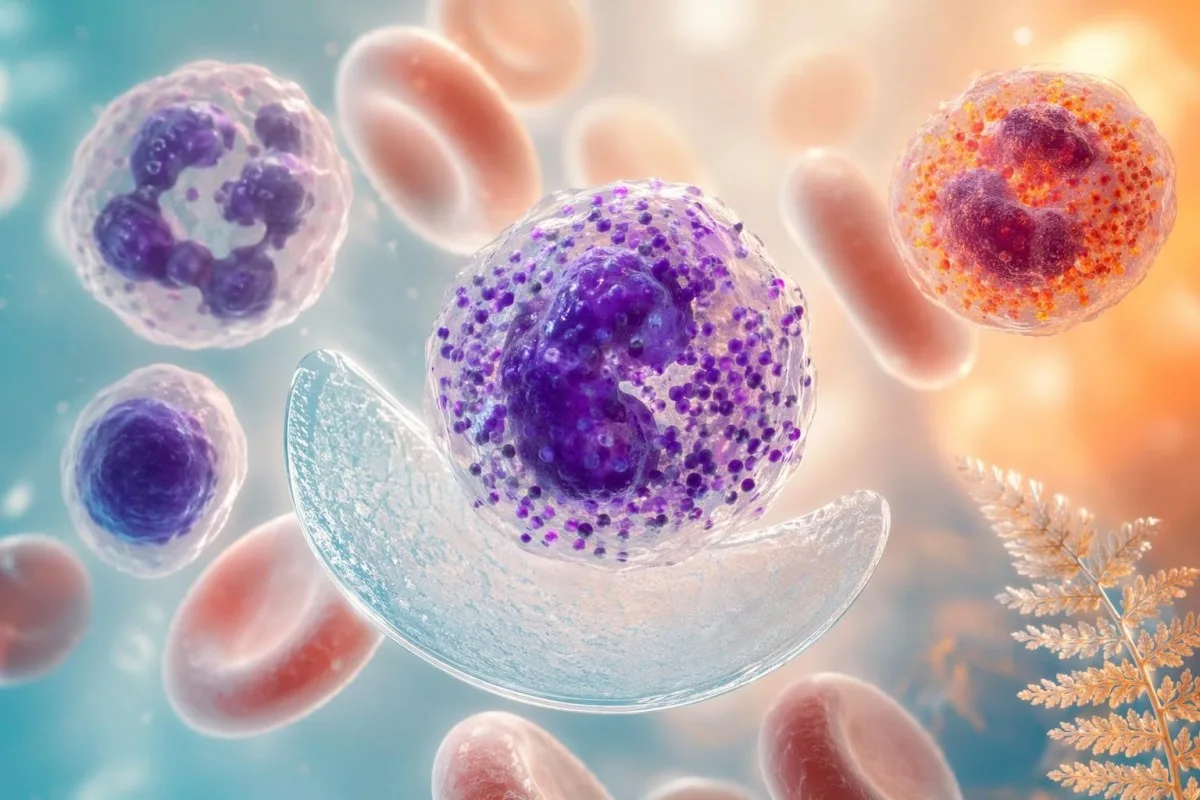
A zero basophil result often reflects rounding, stress chemistry, or a temporary shift in white-cell traffic — not a dangerous immune failure. The trick is reading the absolute count, the percentage, and the rest of the CBC together.


- Basophils at 0 on a CBC usually means the analyzer counted no basophils in that small sample window, not that your body has none.
- Absolute basophils are more useful than the percentage; many adult reference ranges are 0.00–0.20 x10^9/L or 0–200 cells/µL.
- Basophil percentage is often 0–1%; a 0% result can happen because basophils are the rarest circulating white cell.
- Low basophils on CBC are usually less concerning than persistent high basophils, especially if WBC, neutrophils, hemoglobin, and platelets are normal.
- Stress and cortisol can temporarily lower basophils and eosinophils within hours, often while neutrophils rise.
- Steroid medicines such as prednisone 20–40 mg daily can suppress basophils and eosinophils on the differential.
- Acute infection may show basophils at 0 because neutrophils or lymphocytes dominate the differential during the immune response.
- Thyroid context matters when basophils at 0 accompany low TSH, high free T4, palpitations, heat intolerance, or weight loss.
- Recheck timing is usually 2–8 weeks if the rest of the CBC is stable; same-day advice is for fever, severe symptoms, blasts, or major cytopenias.
What low basophils mean on a CBC
Low or zero basophils on a CBC usually means very little by itself. Basophils are normally so rare — often 0–1% of white cells — that a result of 0% or 0.00 x10^9/L commonly reflects rounding, timing, stress hormones, steroid medication, or an acute infection shift rather than a serious disease. When I review a low basophils on CBC result, I first check the absolute count, total WBC, neutrophils, eosinophils, hemoglobin, and platelets before worrying.
The practical answer to what does low basophils mean is: usually not much unless another CBC value is abnormal. Kantesti is an AI blood test analyzer that reads basophils beside the rest of the differential, which is why a lonely 0% rarely becomes a red flag in our reports.
I’m Thomas Klein, MD, and in clinical review I see this exact pattern several times a day: a healthy 34-year-old has WBC 6.2 x10^9/L, neutrophils 58%, eosinophils 1%, basophils 0%, and panics because one line is flagged. That CBC is usually normal; for background on what belongs in the panel, our CBC differential guide is a useful companion.
Basophils carry histamine, leukotrienes, and immune signaling molecules, but they are not the main defense against routine infections. A person can have 0 basophils reported on Tuesday and 0.03 x10^9/L on Friday without any meaningful biological change.
Basophils 0 meaning: absolute count versus percentage
A basophil percentage of 0% is less informative than an absolute basophil count. The absolute basophil count is calculated from the total WBC multiplied by the basophil percentage, so it shows the actual cell concentration more clearly than a rounded percentage.
If WBC is 5.0 x10^9/L and basophils are 0.4%, the absolute basophil count is 0.02 x10^9/L, or about 20 cells/µL. Some lab interfaces round 0.4% down to 0%, so the screen looks scarier than the biology.
Percentages also shift when another white-cell type expands. A viral illness can push lymphocytes to 55%, making basophils appear proportionally tiny even if the absolute basophil number has not really changed; our absolute counts guide explains this arithmetic with neutrophils and lymphocytes too.
The phrase absolute basophils low often appears when the value is 0.00 x10^3/µL or 0.00 K/µL. In many adult laboratories, that number is still inside the reference interval because the lower limit is literally zero.
Why low basophils worry doctors less than high basophils
Low basophils are usually less concerning than high basophils because zero can be normal, while persistent basophilia is uncommon and sometimes signals bone marrow overproduction. An absolute basophil count above 0.20 x10^9/L, especially with high WBC or platelets, deserves more attention than a count of 0.00 x10^9/L.
Basophils are the rarest granulocyte, so the lower end has very little diagnostic resolution. By contrast, persistent high basophils can appear with allergic disease, chronic inflammation, hypothyroidism, or myeloproliferative conditions; our high basophils guide covers those patterns in detail.
Siracusa et al. described basophils as immune amplifiers in allergic inflammation, not as a cell population where low counts reliably diagnose deficiency (Siracusa et al., 2013). Voehringer’s Nature Reviews Immunology paper also framed basophils as specialized responders, which helps explain why a single low value is rarely clinically decisive (Voehringer, 2013).
A real clinic example: a 62-year-old with WBC 18.4 x10^9/L, platelets 640 x10^9/L, and basophils 0.35 x10^9/L gets a different work-up from a 28-year-old with WBC 5.7 and basophils 0.00. Same cell line, completely different level of concern.
Normal basophil ranges and lab unit traps
Adult basophil reference ranges commonly run from 0.00 to 0.20 x10^9/L, or 0 to 200 cells/µL. Percentage ranges are often 0–1% or 0–2%, depending on the analyzer and the laboratory’s local population.
Unit conversion trips people up. A basophil count of 0.1 x10^9/L equals 100 cells/µL, and 0.01 x10^9/L equals 10 cells/µL; both may appear as tiny numbers even when they are expected for a rare cell type.
Some European labs report basophils in x10^9/L, while many North American portals use K/µL or cells/µL. Kantesti’s biomarker guide standardizes more than 15,000 markers across unit systems so a harmless unit difference does not look like a sudden health change.
The phrase “low” may be generated by a portal rule rather than a clinician’s judgment. If the lab’s lower limit is 0.02 x10^9/L, a value of 0.01 may be flagged, but a neighboring lab with a 0.00 lower limit would call the same result normal.
How analyzers and manual differentials create a zero
A CBC can show basophils at 0 because the analyzer’s counted sample did not include any basophils in that pass. Manual differentials are even more prone to zeros because a technologist may classify only 100 white cells, and zero basophils out of 100 does not mean zero basophils in the body.
Automated hematology instruments estimate five-part differentials using light scatter, impedance, fluorescence, or related methods. Basophils sit near the edge of detection because their true circulating concentration may be only 10–80 cells/µL in a well adult.
Manual review has a built-in sampling limit. If a smear review classifies 100 leukocytes, one basophil becomes 1% and no basophils becomes 0%; our manual differential guide explains why rare-cell percentages bounce around more than neutrophils.
This is why I do not chase a zero basophil count when the smear comment is otherwise quiet. I start caring if the same report mentions blasts, dysplasia, platelet clumping, nucleated red cells, or a WBC value far outside the expected 4.0–11.0 x10^9/L adult range.
Stress, cortisol, and temporary basophil suppression
Physical or emotional stress can temporarily lower basophils through cortisol and adrenaline signaling. The classic stress CBC pattern is higher neutrophils, lower lymphocytes or eosinophils, and basophils reported as 0.
Cortisol changes where immune cells travel. After a hard night shift, a panic episode, a severe workout, or an emergency department visit, basophils and eosinophils may drop while neutrophils rise above 7.5 x10^9/L.
I often see low basophils paired with low eosinophils in people whose morning cortisol biology is switched on. For more detail on that paired pattern, see our low eosinophils guide and our explanation of cortisol blood patterns.
The evidence here is mixed on exact cutoffs, because stress is hard to measure cleanly in routine labs. Still, when basophils are 0, eosinophils are 0.00–0.02 x10^9/L, and neutrophils are mildly high, the physiology often fits stress chemistry better than a primary blood disorder.
Steroids and medicines that can lower basophils
Glucocorticoid medicines can lower basophils and eosinophils, sometimes within 6–24 hours. Prednisone, methylprednisolone, dexamethasone, steroid inhalers at high doses, and steroid injections can all affect the CBC differential.
A typical example is prednisone 20–40 mg daily for asthma, rash, sinus swelling, or an autoimmune flare. The next CBC may show WBC 12–16 x10^9/L, neutrophils high, eosinophils 0, and basophils 0 — a pattern that can look alarming unless the medication is visible.
Steroids do not always lower the total WBC; they may raise it by demargination of neutrophils. That is why our steroid WBC guide focuses on the pattern rather than one isolated number.
Other medicines rarely matter for basophils alone. If a new drug coincides with low WBC below 3.0 x10^9/L, neutrophils below 1.5 x10^9/L, or platelets below 150 x10^9/L, the concern shifts from basophils to broader marrow or immune effects.
Acute infection can make basophils read as 0
Acute infection can make basophils read as 0 because the immune response is dominated by neutrophils, lymphocytes, or monocytes. In that setting, basophils are a background signal, not the main diagnostic clue.
Bacterial infections often raise neutrophils above 7.5 x10^9/L and may add immature granulocytes or bands. Viral infections more often raise lymphocyte percentage, sometimes above 45%, which can push basophil percentage to 0 even when the absolute count is merely tiny.
The useful question is not “Why are basophils zero?” but “Which white-cell line is driving the change?” Our infection blood test guide compares CBC patterns with CRP and procalcitonin when clinicians are deciding whether infection is likely.
A fever of 39°C, rigors, low blood pressure, confusion, or a lactate above 2 mmol/L changes the urgency completely. In those cases, basophils at 0 are background noise; the clinical picture and sepsis markers come first.
Thyroid context: when TSH and free T4 matter
Thyroid context matters when basophils at 0 appear with low TSH, high free T4, tremor, palpitations, heat intolerance, or unexplained weight loss. Hyperthyroid physiology can be associated with lower basophils, while hypothyroidism is more classically linked with higher basophils in some patients.
A low TSH below 0.4 mIU/L with free T4 above the lab range points the clinician toward hyperthyroidism, not toward basophil disease. The 2016 American Thyroid Association guideline by Ross et al. recommends interpreting TSH with free T4 and T3 when thyrotoxicosis is suspected (Ross et al., 2016).
The basophil signal is weak, honestly. If someone has basophils 0 but TSH 1.8 mIU/L and no thyroid symptoms, I do not use that basophil line to hunt thyroid disease; if they have TSH 0.02 mIU/L and resting heart rate 112, the story changes.
For thyroid-specific next steps, compare your result with our normal TSH ranges guide and our article on thyroid disease clues. Biotin supplements at 5–10 mg daily can also distort some thyroid immunoassays, so timing matters.
CBC combinations that change the interpretation
Low basophils matter more when other CBC values are abnormal. A basophil count of 0 with normal WBC, hemoglobin, MCV, platelets, neutrophils, and lymphocytes is usually benign; the same 0 with pancytopenia or blasts is a different conversation.
I look closely if WBC is below 3.0 x10^9/L, absolute neutrophils are below 1.0 x10^9/L, hemoglobin is below 100 g/L, or platelets are below 100 x10^9/L. Those thresholds do not diagnose one disease, but they move the result out of the “ignore it” category.
The opposite pattern also matters. WBC above 50 x10^9/L, platelets above 600 x10^9/L, and basophils above 0.20 x10^9/L raise marrow questions, while WBC 5.0 x10^9/L and basophils 0.00 usually does not.
If your portal flags several white-cell lines, read basophils beside the broader low WBC guide. In my experience, patients who bring the whole CBC rather than one screenshot get a safer answer in under 5 minutes.
When to recheck basophils or call a clinician
Most people with isolated basophils at 0 do not need urgent care. A reasonable recheck interval is 2–8 weeks if the rest of the CBC is normal and the result occurred during stress, illness, or steroid use.
Recheck sooner if there are repeated fevers above 38°C, drenching night sweats, unintentional weight loss over 5% in 6 months, swollen lymph nodes, unusual bruising, or breathlessness. Those symptoms are not caused by low basophils, but they can make a CBC abnormality more meaningful.
If the CBC was taken during influenza, COVID-19, a bacterial infection, a steroid burst, or heavy endurance exercise, repeating it after recovery is often more informative than ordering exotic tests. Our repeat abnormal labs guide gives practical timing for common CBC and chemistry abnormalities.
Same-day clinician advice is sensible if basophils 0 come with neutrophils below 0.5 x10^9/L, platelets below 50 x10^9/L, hemoglobin below 80 g/L, or a report mentioning blasts. Those are CBC safety issues, not basophil-specific issues.
Children, pregnancy, and older adults with basophils at 0
Basophils at 0 can be normal in children, pregnancy, and older adults, but the surrounding reference ranges change. Pediatric WBC and lymphocyte ranges vary sharply by age, and pregnancy often raises neutrophils even without infection.
In infants and young children, lymphocytes can be the dominant white-cell population, so basophil percentages often look tiny. A toddler with WBC 9.0 x10^9/L, lymphocytes 60%, and basophils 0% may be perfectly normal for age.
Pregnancy commonly raises WBC into the 11–15 x10^9/L range, especially in the third trimester and around labor. Basophils at 0 during pregnancy are usually less helpful than hemoglobin, platelets, urine protein, blood pressure, and liver enzymes.
Older adults need trend-based interpretation because baseline marrow reserve, medicines, and chronic inflammation differ. Our pediatric ranges guide shows why adult cutoffs should not be pasted onto children, and the same principle applies in reverse for frail older patients.
How Kantesti reads low basophils in context
Kantesti reads low basophils by checking whether the zero is isolated, repeated, medication-related, or part of a wider CBC pattern. A safe interpretation uses the absolute count, percentage, lab units, trend history, symptoms, and nearby white-cell lines together.
Kantesti is an AI blood test interpretation platform used by people in 127+ countries, so our system sees many unit formats and reference intervals for the same CBC differential. Our AI does not treat 0% basophils as a diagnosis; it asks what else moved.
Kantesti AI interprets basophils by mapping the value to WBC, neutrophils, eosinophils, lymphocytes, recent medications, and prior results when available. The logic behind this workflow is described in our AI technology guide and audited through our clinical validation work.
Trends are often the missing piece. If basophils are 0 for 4 years while WBC stays 4.8–6.5 x10^9/L, that is boring in the best possible way; if WBC, platelets, and inflammatory markers drift for 3 visits, our blood test trends article explains why the slope matters.
Research publications and medical review notes
Our research section lists two Kantesti DOI-backed publications relevant to pattern-based lab interpretation, even though low basophils are usually a low-risk CBC finding. The same clinical habit applies across lab medicine: interpret small numbers in context before turning them into diagnoses.
Kantesti is an AI-powered blood test analysis tool built with physician oversight, multilingual lab-unit normalization, and privacy-focused data handling. You can read more about about Kantesti and the physicians behind our medical advisory board if you want to understand who reviews our clinical standards.
Formal APA citation: Kantesti Medical Research Team. (2026). BUN/Creatinine Ratio Explained: Kidney Function Test Guide. Zenodo. DOI. Related internal article: BUN/creatinine guide.
Research profile link for the BUN/creatinine publication: ResearchGate. Academic archive link for the BUN/creatinine publication: Academia.edu.
Formal APA citation: Kantesti Medical Research Team. (2026). Urobilinogen in Urine Test: Complete Urinalysis Guide 2026. Zenodo. DOI. Related internal article: urinalysis guide.
Research profile link for the urinalysis publication: ResearchGate. Academic archive link for the urinalysis publication: Academia.edu. As of June 13, 2026, Thomas Klein, MD, reviews low-basophil content using the same clinical principle I use at the bedside: treat the patient and the pattern, not one lonely 0.
Frequently Asked Questions
What does low basophils mean on a CBC?
Low basophils on a CBC usually mean the basophil count is very small or rounded to zero, which is often normal. Adult absolute basophil ranges commonly include 0.00–0.20 x10^9/L, so 0.00 may still sit inside the lab’s reference interval. The result matters more if WBC, neutrophils, hemoglobin, platelets, or symptoms are also abnormal.
Are basophils at 0 dangerous?
Basophils at 0 are usually not dangerous when the rest of the CBC is normal. Basophils are often only 0–1% of circulating white cells, so a zero result can occur from rounding or small sample counts. Urgent concern comes from major CBC abnormalities such as neutrophils below 0.5 x10^9/L, platelets below 50 x10^9/L, hemoglobin below 80 g/L, or blasts on the report.
Is absolute basophils low different from basophil percentage 0?
Yes, absolute basophils low and basophil percentage 0 are different ways of reporting the same rare cell type. The absolute count is usually more useful because it reflects cells per volume, such as 0.00–0.20 x10^9/L or 0–200 cells/µL. A percentage of 0% can happen when the true value is below the reporting threshold or rounded down from a tiny fraction.
Can stress cause basophils to be 0?
Stress can contribute to basophils being reported as 0 because cortisol and adrenaline shift immune cells between blood, tissue, and vessel margins. A stress-type CBC often shows basophils 0, eosinophils near 0.00–0.02 x10^9/L, and neutrophils mildly elevated. This pattern can occur after acute illness, poor sleep, intense exercise, pain, panic, or emergency care.
Can prednisone or steroids lower basophils?
Prednisone and other glucocorticoids can lower basophils and eosinophils within about 6–24 hours. A common steroid pattern is WBC 12–16 x10^9/L with high neutrophils, eosinophils 0, and basophils 0 after doses such as prednisone 20–40 mg daily. The medication history is often the clue that prevents unnecessary worry.
Do low basophils mean my immune system is weak?
Low basophils alone do not usually mean the immune system is weak. Basophils are rare immune cells, and a reported 0% is common even in healthy people. Immune-risk assessment depends more on neutrophil count, lymphocyte count, recurrent infection history, immunoglobulins, medications, and clinical symptoms.
When should I repeat a CBC for low basophils?
If basophils are 0 but the rest of the CBC is normal, repeating the CBC in 2–8 weeks is usually enough if a recheck is needed at all. Recheck after recovery from infection, after finishing a short steroid course, or after a period of unusual stress. Seek faster medical advice if the report also shows severe anemia, very low platelets, neutrophils below 1.0 x10^9/L, blasts, persistent fever, night sweats, or unexplained weight loss.
Can antihistamines make my basophil count read as zero?
Common antihistamines, such as cetirizine or loratadine, block histamine effects and do not usually make basophils disappear from a CBC. Do not stop prescribed allergy medicine because of this result; ask your clinician to review corticosteroids and your complete medication list instead.
Get AI-Powered Blood Test Analysis Today
Join over 2 million users worldwide who trust Kantesti for instant, accurate lab test analysis. Upload your blood test results and receive comprehensive interpretation of 15,000+ biomarkers in seconds.
📚 Referenced Research Publications
Klein, T., Mitchell, S., & Weber, H. (2026). BUN/Creatinine Ratio Explained: Kidney Function Test Guide. Kantesti AI Medical Research.
Klein, T., Mitchell, S., & Weber, H. (2026). Urobilinogen in Urine Test: Complete Urinalysis Guide 2026. Kantesti AI Medical Research.
📖 External Medical References
Voehringer D (2013). Protective and pathological roles of mast cells and basophils. Nature Reviews Immunology.
⚕️ Medical Disclaimer
This article is for educational purposes only and does not constitute medical advice. Always consult a qualified healthcare provider for diagnosis and treatment decisions.
E-E-A-T Trust Signals
Experience
Physician-led clinical review of lab interpretation workflows.
Expertise
Laboratory medicine focus on how biomarkers behave in clinical context.
Authoritativeness
Written by Dr. Thomas Klein with review by Dr. Sarah Mitchell and Prof. Dr. Hans Weber.
Trustworthiness
Evidence-based interpretation with clear follow-up pathways to reduce alarm.