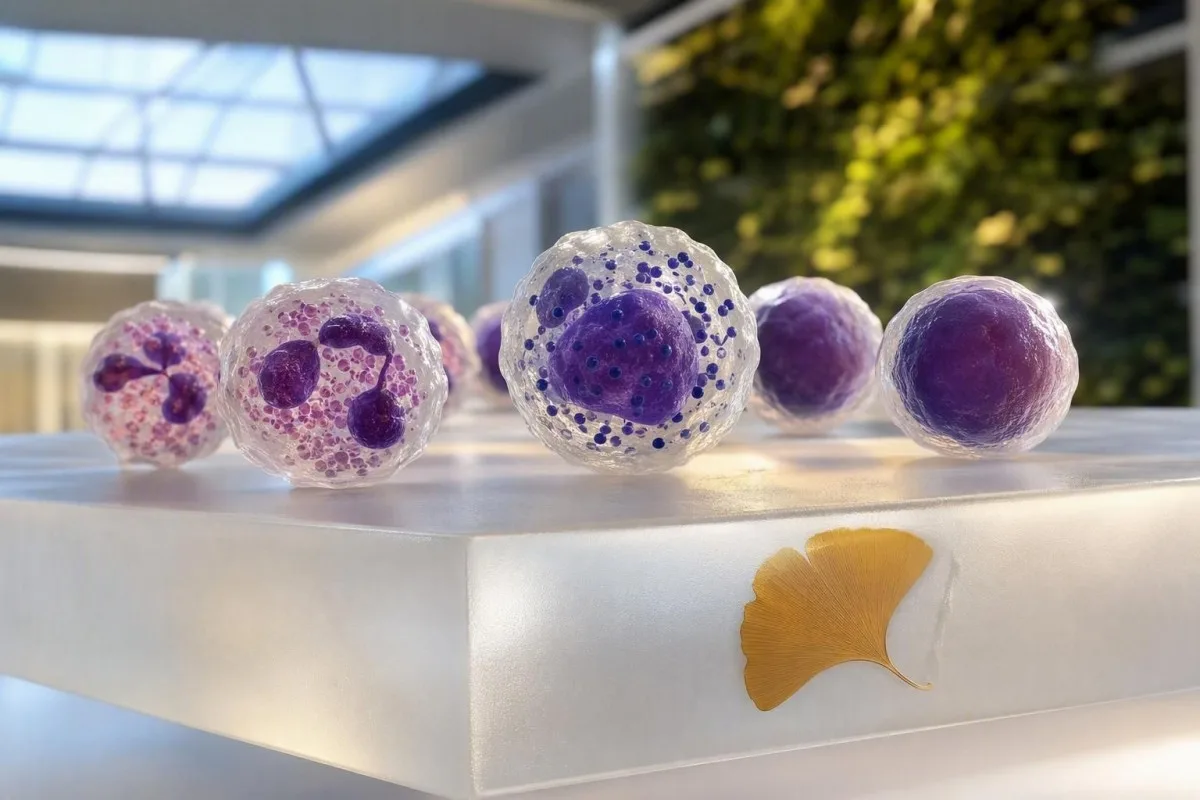
年齢別好塩基球正常範囲:再検査時期ガイド

カテゴリー
記事
血球計算(CBC)と白血球分画 検査の解釈 2026年の更新 患者さん向け

Most adults have absolute basophils of 0.00–0.10 × 10⁹/L (0–100/µL), while the percentage is usually 0–1%. A mildly unusual percentage often reflects shifts in other white cells; the absolute basophil count is the result that usually guides follow-up.

📖 約11分 📅
📝 公開: 🩺 医学的監修: ✅ エビデンスに基づく
⚡ 簡単な概要 v1.0 —
  1. 絶対好塩基球数 are usually 0.00–0.10 × 10⁹/L (0–100/µL) in adults and are more clinically useful than a percentage alone.
  2. 好塩基球の割合 is commonly 0–1% of white cells, but it can rise when neutrophils or lymphocytes fall even if the absolute count is normal.
  3. 子ども often use the same practical upper limit of 0.10 × 10⁹/L after infancy, but the laboratory’s age-specific interval takes priority.
  4. A repeat CBC in 2–8 weeks is reasonable for isolated, mild basophilia after an allergy, infection, or medication change.
  5. Persistent basophilia above 0.20 × 10⁹/L deserves clinician review, especially with high white cells, anaemia, splenomegaly, or constitutional symptoms.
  6. 緊急の見直し is warranted for marked leukocytosis, unexplained weight loss, drenching night sweats, fever, or early fullness under the left ribs.
  7. Zero basophils on an automated differential is common and usually has no clinical significance.
  8. カンテスティAI reads basophils alongside total white cells, eosinophils, platelet count, haemoglobin, and prior results rather than treating one flag as a diagnosis.

Absolute basophils versus basophil percentage

Absolute basophils of 0.00–0.10 × 10⁹/L are generally normal in adults, whereas a basophil percentage of 0–1% is only a proportion of the total white-cell count. When the two disagree, clinicians usually give more weight to the absolute result.

Basophils represented among white-cell types in a CBC differential laboratory illustration
図1: A differential count separates rare basophils from the wider white-cell population.

A percentage can look high simply because another white-cell type is low. For example, 1.5% basophils with a white blood cell count of 3.0 × 10⁹/L produces an absolute count of only 0.045 × 10⁹/L—well within many adult intervals. That is why a percentage flag alone rarely tells the whole story.

The calculation is straightforward: total white cells × basophil percentage ÷ 100. A white count of 12.0 × 10⁹/L and basophils of 2% gives 0.24 × 10⁹/L, which is a genuine elevation. For the broader context, see our guide to CBCに含まれるもの.

カンテスティは AI血液検査分析装置 that converts percentages into clinically comparable absolute counts when the source report provides a differential. In my experience, that one conversion prevents a fair amount of unnecessary alarm after a routine health check.

Why the absolute number is steadier

Automated analysers count thousands of cellular events, but basophils are normally rare—often fewer than 1 in 100 white cells. Small analytical and biological shifts can therefore move the percentage more noticeably than the absolute count.

Practical basophil reference intervals by age

Most laboratories use an absolute basophil reference interval of 0.00–0.10 × 10⁹/L from childhood through adulthood, but newborn ranges may be broader. Use the interval printed beside your own result, because reference limits depend on analyser method and the laboratory’s local healthy population.

Age-based CBC basophil reference concept shown with laboratory sample groups
図2: Age-specific reference intervals should come from the reporting laboratory.

For infants in the first weeks of life, some paediatric laboratories accept absolute basophils up to roughly 0.20–0.40 × 10⁹/L. The neonatal immune system is adapting rapidly, so adult cutoffs should not be imposed on a newborn result without paediatric input.

From roughly 1 year onward, many services apply a practical upper limit near 0.10 × 10⁹/L, or 100/µL. A result of 0.11 × 10⁹/L in a thriving child with a normal total white count is usually a repeat-and-context question, not an emergency.

CLSI EP28-A3c explains why laboratories establish or verify their own reference intervals rather than borrowing a universal range (CLSI, 2010). Our neutrophil age-range guide shows the same principle for another differential count.

Newborns, approximate 0.00–0.40 × 10⁹/L Broader early-life interval; use neonatal laboratory ranges.
Children over 1 year, common interval 0.00–0.10 × 10⁹/L Interpret with symptoms and total white count.
Adults, common interval 0.00–0.10 × 10⁹/L Equivalent to 0–100/µL.
持続的な上昇 >0.20 × 10⁹/L Merits clinical assessment, particularly with other CBC abnormalities.

Understanding basophil units on UK, US and international reports

A basophil count of 0.10 × 10⁹/L equals 100/µL, so reports using different units can describe the same result. UK full blood counts often report ×10⁹/L, while US laboratories commonly use cells/µL or K/µL.

CBC laboratory report conversion concept with basophil count sample containers
図3: Different reporting units can represent exactly the same basophil count.

To convert ×10⁹/L to cells/µL, multiply by 1,000. Thus 0.05 × 10⁹/L equals 50/µL; 0.25 × 10⁹/L equals 250/µL. A report showing 0.0 may be rounded to one decimal place rather than proving there are literally no basophils.

A value listed as 0.2 K/µL equals 0.20 × 10⁹/L. That distinction matters because 0.2% and 0.2 K/µL are completely different measurements. Patients regularly mix them up when comparing reports from two countries.

If your report says FBC rather than CBC, the components are largely the same; our UK full blood count explainer translates the common terminology.

Why basophil counts rise or fall

Mild basophilia most often accompanies allergy, chronic inflammation, recovery from an infection, or a medication-related immune shift. A low count or zero basophils is usually not meaningful because these cells circulate in very small numbers.

Basophil cellular response near allergy-related immune signals in a medical illustration
図4: Basophils release chemical mediators during selected immune responses.

Basophils carry receptors for IgE and can release histamine and other mediators after allergen exposure. Seasonal allergic rhinitis, chronic urticaria, asthma, and some skin disorders can coincide with a small rise, although a normal count does not rule any of them in or out.

Hypothyroidism, inflammatory bowel disease, rheumatoid disorders, and some chronic infections may also be associated with basophilia. The useful question is not “what disease causes this?” but “what other signals are present?”—CRP, eosinophils, symptoms, medication history, and the trajectory all matter.

A raised IgE and eosinophil count can support an allergic pattern, while isolated itch may need a broader review; our article on blood tests for itchy skin explains the practical limits of CBC testing.

When should you repeat a CBC for basophils?

Repeat a CBC in 2–8 weeks for a mild, isolated basophil elevation after a temporary trigger, provided you feel well and the rest of the count is reassuring. Repeat sooner, usually within days to 2 weeks, when total white cells are rising or there are multiple abnormal cell lines.

Sequential CBC laboratory samples arranged to show basophil retest timing
図5: Comparing two properly timed CBCs clarifies whether a finding persists.

For an absolute basophil count of 0.11–0.20 × 10⁹/L after a cold, flare of hay fever, vaccination, or short steroid course, I often prefer one calm repeat over a cascade of testing. Try to use the same laboratory, and record recent illness, new medicines, smoking changes, and steroid exposure.

Do not attempt to “improve” the count before a retest. Hydration is sensible, but supplements, antihistamines, corticosteroids, and intense endurance exercise can change the wider differential. Our 血液検査のタイムラインガイド details common timing effects.

カンテスティは AI血液検査の読み方プラットフォーム that compares the current differential with previous CBCs and flags a consistent rise differently from a one-off flag. A trend over 3–6 months is often more informative than a single decimal point.

How to prepare for a reliable basophil retest

Basophil testing does not usually require fasting, but a repeat CBC is most interpretable when you are not acutely unwell and the collection conditions are similar. Aim for normal fluids, ordinary meals, and a routine day rather than extreme changes.

Clinical sample preparation scene for a repeat CBC and basophil count
図6: Consistent collection conditions make CBC trends easier to interpret.

Avoid scheduling a non-urgent retest during a fever, significant allergic flare, or the day after an unusually hard endurance event if the goal is to establish baseline. Acute stress hormones and fluid shifts can move several white-cell subsets for hours to days.

Tell the clinician or phlebotomist about systemic corticosteroids, lithium, epinephrine-containing treatments, recent biologic therapy, and any new supplement. Steroids more commonly lower circulating basophils and eosinophils, so a “normal” result while taking them may not represent your untreated baseline.

Sample quality still matters. Clotted EDTA samples and delayed analysis can make automated differentials less dependable; if several CBC values look odd together, review when a redraw is needed.

CBC patterns that make elevated basophils more significant

Basophilia is more concerning when absolute basophils exceed 0.20 × 10⁹/L and occur with persistent white blood cells above 11.0 × 10⁹/L, anaemia, platelet changes, or immature cells. The combination—not basophils alone—determines how quickly clinicians investigate.

CBC differential pattern with basophils, platelets and white-cell categories
図7: Basophils gain significance when several CBC lines shift together.

A 44-year-old I reviewed had basophils of 0.28 × 10⁹/L, white cells of 16.4 × 10⁹/L, platelets of 610 × 10⁹/L, and early satiety. That pattern warranted a same-week haematology pathway; the individual basophil result did not make the diagnosis, but it was an important clue.

Basophilia alongside high neutrophils and splenic symptoms can occur in myeloproliferative neoplasms, including chronic myeloid leukaemia. European LeukemiaNet advises molecular testing and specialist assessment when the clinical and blood-count pattern raises that possibility (Hochhaus et al., 2020).

A peripheral smear can distinguish true differential changes from analyser uncertainty and may show left shift or atypical cells. Read more about blood cancer CBC pathways without assuming that an abnormal count means cancer.

Symptoms and results that need prompt medical attention

Seek urgent medical assessment for basophilia with fever, drenching night sweats, unexplained weight loss, new bruising, breathlessness, severe fatigue, or left-upper abdominal fullness. These symptoms are not caused by a mildly raised basophil result itself; they signal that the broader clinical picture needs assessment.

Clinical review of concerning CBC findings with patient symptom checklist materials
図8: Symptoms and full CBC context determine urgency more than a percentage alone.

A total white count above 30 × 10⁹/L, rapidly increasing values, or visible immature granulocytes on a report should be discussed urgently with the ordering clinician. Severe headache, visual change, chest pain, or neurological symptoms need emergency evaluation irrespective of the basophil count.

Most people with 0.11–0.20 × 10⁹/L basophils and no symptoms do not need emergency care. Still, this is one of those areas where context matters more than the number, especially if previous results were 0.02 × 10⁹/L and the new count is climbing.

If you also have shortness of breath or pallor, the accompanying haemoglobin and platelet values may matter more immediately; see our 息切れの血液検査ガイド.

What low basophils or a result of zero means

A basophil result of 0.00 × 10⁹/L is usually normal and rarely needs repeating by itself. Basophils may be below the analyser’s reporting threshold because they are naturally sparse in circulation.

Automated CBC analyser showing rare basophil cellular events in a differential process
図9: Very low basophil numbers are often below routine reporting precision.

Acute stress, infection, pregnancy, hyperthyroidism, and corticosteroid treatment can all reduce circulating basophils temporarily. Yet there is no recognised symptom syndrome caused by isolated low basophils, unlike clinically significant neutropenia.

The analytical issue is easy to miss: if only a few basophils are counted, routine sampling variability can turn 0.01 × 10⁹/L into 0.00 × 10⁹/L on a subsequent draw. That is not necessarily a biological change.

Dr. Thomas Klein’s practical advice is to ignore a low-basophil flag when the rest of the CBC is sound and there are no relevant symptoms. Our dedicated guide explains basophils at zero.

Basophils in pregnancy and later life

Pregnancy and ageing do not have a single special basophil cutoff; the reporting laboratory’s interval and the full white-cell pattern remain the best reference. Pregnancy commonly raises total white cells through neutrophils, which can make the basophil percentage appear lower without a true basophil reduction.

Pregnancy CBC review materials beside age-specific laboratory reference samples
図10: Physiological shifts can alter percentages without changing absolute basophils.

During pregnancy, a total white count of 12–15 × 10⁹/L can be physiological, particularly later in gestation, so percentage-based interpretation becomes even less reliable. An absolute basophil count remains preferable, but concerning symptoms still override a reference interval.

In older adults, a newly persistent basophil count above 0.20 × 10⁹/L deserves attention because medication burden and marrow disorders become more common with age. That does not make it diagnostic; it simply lowers the threshold for looking at the CBC trend and smear.

For other pregnancy-specific interpretation pitfalls, review 妊娠中の血液検査のレッドフラグ.

Medicines, allergies and basophil fluctuations

Allergy symptoms can coincide with mildly elevated basophils, while systemic corticosteroids often lower them within days. Neither pattern confirms an allergy diagnosis or proves that a medicine is responsible.

Allergy-related immune testing scene with CBC sample and antihistamine container
図11: Medication and allergy context can explain small differential-count changes.

Antihistamines primarily block histamine receptors; they do not reliably normalise a basophil count. Oral prednisolone and other systemic glucocorticoids can redistribute white cells, often decreasing eosinophils and basophils while increasing circulating neutrophils.

Lithium is a less common but useful medication clue because it can increase white-cell production. Biologic medicines, chemotherapy, and immune-modulating treatments should never be stopped because of one CBC result—ask the prescribing team how the result fits their monitoring plan.

A raised basophil count alongside wheeze, hives, facial swelling, or faintness should be managed as a symptom problem, not a laboratory puzzle. Our high IgE guide explains where allergy markers help and where they mislead.

What clinicians check after persistent basophilia

Persistent absolute basophilia usually prompts a repeat CBC, manual smear review, medication and symptom review, then targeted testing if the total white count or other cell lines are abnormal. Broad cancer panels are not the usual first step for a slight isolated increase.

Haematology laboratory workflow for a persistent basophil count review
図12: Persistent findings are assessed through staged CBC, smear and targeted testing.

The first branch point is whether the result is isolated. A stable haemoglobin, platelets, white-cell count, and normal smear strongly support a conservative plan; anaemia, thrombocytosis, leukocytosis, or splenomegaly push the assessment in a different direction.

When a myeloproliferative disorder is plausible, clinicians may request BCR::ABL1 testing, JAK2 testing, lactate dehydrogenase, urate, and specialist review. Valent et al. describe persistent basophilia as a meaningful finding in the classification of basophilic and myeloid neoplasms (Valent et al., 2022).

Kantesti’s neural network identifies combinations that merit review but does not diagnose leukaemia from a CBC. Our 医学的なバリデーションのアプローチ explains why laboratory interpretation must retain clinical oversight.

How to track basophils without overreacting

A meaningful basophil trend is a persistent directional change across comparable CBCs, not a single movement from 0.04 to 0.08 × 10⁹/L. With an adult reference limit of 0.10 × 10⁹/L, both values remain within range despite being numerically different.

Longitudinal CBC basophil trend review on a clinical tablet without visible text
図13: Longitudinal patterns help separate ordinary variation from persistent change.

Save the absolute count, percentage, total white cells, neutrophils, eosinophils, haemoglobin, platelets, date, recent illness, and medicines after each draw. This small record gives your clinician more usable information than screenshots of isolated red flags.

カンテスティは AI搭載の血液検査解析ツール used across 127+ countries to compare CBC results longitudinally while preserving the source laboratory’s stated interval. Dr. Thomas Klein recommends reviewing at least two comparable results before assigning meaning to a borderline differential change.

A useful rule: if the absolute count remains below 0.10 × 10⁹/L, the total white count is stable, and you feel well, routine follow-up at your next planned blood test is usually enough. Use our 血液検査の差(ガイド) to judge whether a shift is likely real.

Questions to ask at a follow-up appointment

The best follow-up question is “What is my absolute basophil count, and what else changed on the CBC?” That wording directs the conversation toward the variables that actually alter clinical risk.

Patient and clinician reviewing a CBC follow-up plan from an over-shoulder view
図14: A focused follow-up discussion turns an isolated flag into a practical plan.

Ask whether the count is new, persistent, rising, or likely reactive; whether a smear review is needed; and when the next CBC should be taken. Bring a list of recent infections, allergy symptoms, medicines, supplements, travel, and family history of blood disorders.

If you have an absolute count above 0.20 × 10⁹/L plus elevated total white cells, ask whether haematology input is appropriate. If the count is only slightly above range and isolated, ask what change would trigger earlier testing rather than assuming the worst.

Kantesti’s physician-reviewed educational standards are overseen through our 医療諮問委員会. As of August 30, 2026, the safest approach remains simple: interpret the absolute count, confirm persistence, and act faster only when the wider pattern warrants it.

よくある質問

成人における好塩基球の正常値はどのくらいですか?

絶対好塩基球の一般的な成人参照範囲は0.00–0.10 × 10⁹/Lで、これは0–100 cells/µLに相当します。ほとんどの検査室では好塩基球の割合を0–11%と報告していますが、総白血球数が変化すると割合は誤解を招く可能性があります。ご自身の検査室が印刷した参照範囲は、方法や地域の参照集団が異なるため優先されます。0.11 × 10⁹/Lの単独の結果は、通常、緊急治療ではなく、背景情報または計画的な再検査に値します。.

2% の好塩基球は高いですか?

白血球百分率が2%というのは、多くの検査室の百分率範囲を上回っていますが、総白血球数なしではリスクを判断するには不十分です。白血球数が4.0 × 10⁹/Lの場合、2%は絶対好塩基球数0.08 × 10⁹/Lに相当し、これはしばしば正常値です。白血球数が15.0 × 10⁹/Lの場合、同じ2%は0.30 × 10⁹/Lに相当し、臨床的評価に値します。百分率を解釈する前に、必ず絶対好塩基球数を確認してください。.

好酸球が多い場合、CBCをいつ再検査すべきですか?

病後、アレルギーの増悪、または薬剤変更後の軽度の孤発性好塩基球増加症(約 0.11–0.20 × 10⁹/L)に対しては、2〜8週間後のCBCの再検査が一般的に妥当である。総白血球数が増加している場合、好塩基球数が 0.20 × 10⁹/L を超えている場合、またはヘモグロビンと血小板も異常な場合は、より早く再検査する。可能な限り同じ検査室を使用すること。なぜなら、分析装置の方法と基準範囲は異なるためである。発熱、体重減少、寝汗、あざ、または左上腹部の膨満感がある場合は、定期的な再検査を待つのではなく、速やかな医学的診察が必要である。.

好中球がゼロになるのは危険ですか?

0.00 × 10⁹/L の好塩基球数は通常危険ではなく、CBC の残りが正常であれば、一般的にフォローアップは不要です。好塩基球はまれな細胞であるため、検出された数が丸め処理や報告精度を下回る場合、ルーチンの自動分画でゼロが報告されることがあります。ステロイド、急性ストレス、妊娠、感染症は、循環好塩基球を一時的に低下させることがあります。臨床医は、単独の好塩基球減少症から免疫不全を診断することはありません。.

アレルギーは好塩基球増加症の原因になりますか?

アレルギー性疾患は、好塩基球がIgE関連免疫応答に関与し、ヒスタミンなどのメディエーターを放出するため、軽度の上昇と一致することがあります。好塩基球数の増加は、アレルギーが原因であることを証明するものではなく、重度の季節性アレルギー症状を持つ人の多くは、好塩基球数が正常です。アレルギー症状が治まった後も0.20 × 10⁹/Lを超える好塩基球数が持続する場合は、全体のCBCとともに再評価が必要です。好酸球、総IgE、皮膚症状、および薬剤曝露が、より有用な情報を提供する可能性があります。.

白血病を示唆する好塩基球数は?

単独の好塩基球数で白血病と診断されることはありませんが、白血球増加、貧血、血小板異常、未熟顆粒球、または脾臓症状を伴う持続的な絶対好塩基球増多(0.20 × 10⁹/L超)は、医学的評価を促すべきです。好塩基球増多は慢性骨髄性白血病やその他の骨髄増殖性腫瘍で起こり得ますが、軽度の孤立性上昇では反応性の原因が依然としてより一般的です。より広範なパターンがそれを支持する場合にのみ、臨床医は塗抹標本検査やBCR::ABL1などの標的分子検査を依頼することがあります。総白血球数が正常でCBCが安定していることは、懸念の度合いを大幅に変化させます。.

今日、AIによる血液検査分析を

いますぐ利用しませんか。即時で正確な検査分析を提供するKantestiを信頼する、世界中の200万人以上のユーザーに参加してください。血液検査結果をアップロードすると、15,000+のバイオマーカーについて数秒で包括的な解釈が得られます。.

📚 Referenced Research Publications

1

Klein, T., Mitchell, S., & Weber, H. (2026). B型(Rh陰性)血液型、LDH血液検査、網赤血球数ガイド.。 Kantesti AI Medical Research.

2

Klein, T., Mitchell, S., & Weber, H. (2026). 断食後の下痢、便の黒い斑点、消化管ガイド2026.。 Kantesti AI Medical Research.

📖 外部の医学的参考文献

3

臨床および検査室標準協会(CLSI)(2010年)。. Defining, Establishing, and Verifying Reference Intervals in the Clinical Laboratory. CLSI EP28-A3c.

4

Hochhaus A et al. (2020). European LeukemiaNet 2020 recommendations for treating chronic myeloid leukemia.。 血液。.

5

Valent P et al. (2022). Proposed diagnostic criteria and classification of basophilic leukemias and related disorders.。 血液。.

200万以上分析されたテスト
127+
75+言語

⚕️ 医療免責事項

E-E-A-T 信頼性シグナル

経験

医師主導による、検査結果解釈ワークフローの臨床レビュー。.

📋

専門知識

臨床的な文脈においてバイオマーカーがどのように振る舞うかに焦点を当てた検査医学。.

👤

権威

トーマス・クライン博士が執筆し、サラ・ミッチェル博士およびハンス・ヴェーバー教授によるレビュー。.

🛡️

信頼性

アラームを減らすための明確なフォローアップ経路を備えた、エビデンスに基づく解釈。.

🏢 カンテスティ株式会社 イングランドおよびウェールズに登録 · 会社番号. 17090423 ロンドン、イギリス · kantesti.net
blank
Prof. Dr. Thomas Kleinによる

トーマス・クライン博士は、Kantesti AIにおける最高医療責任者(CMO)を務める、ボード認定の臨床血液専門医です。検査医学における15年以上の経験に加え、「血液検査結果」のAI支援による解釈に強い関心を持ち、新しい技術を日常の臨床実践につなげることに取り組んでいます。関心領域には、バイオマーカー解析、臨床意思決定支援の研究、集団特異的な基準範囲の最適化が含まれます。CMOとして、同プラットフォームの内部ベンチマークに対する臨床的インプットを提供し、Kantestiの教育レポートの医療品質に関する臨床的監督を行います。.

コメントを残す

メールアドレスが公開されることはありません。 が付いている欄は必須項目です
