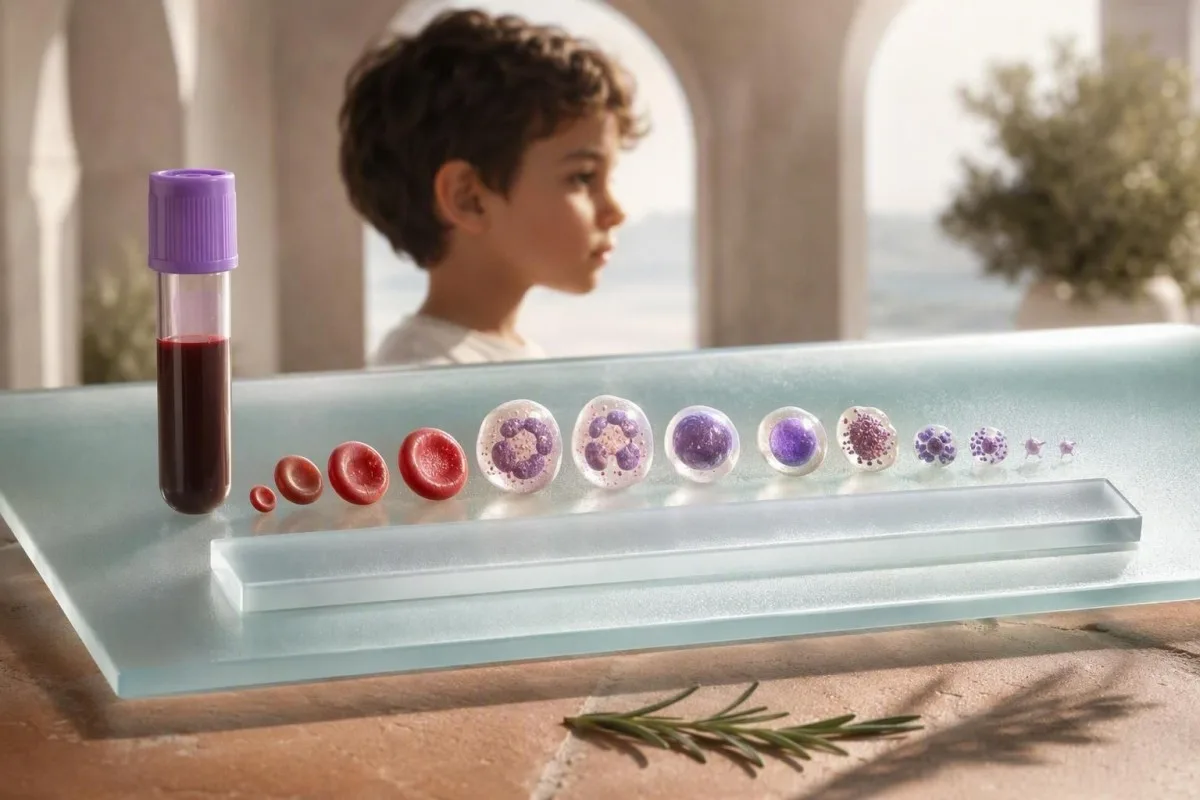
AI dapat mengorganisasi hasil laboratorium anak dan menjelaskan istilah yang tidak familiar, tetapi tidak dapat menggantikan klinisi pediatrik yang mengetahui usia anak, pola pertumbuhan, pemeriksaan, dan gejala.


- Jawaban langsung: AI dapat menginterpretasikan pola tes darah untuk anak sebagai suplemen edukatif, tetapi klinisi pediatrik harus membuat keputusan diagnostik dan penatalaksanaan.
- Rentang spesifik usia: Jumlah limfosit yang diharapkan pada usia 2 tahun dapat ditandai tinggi oleh interval rujukan orang dewasa.
- Pubertas itu penting: Fosfatase alkali dapat meningkat di atas 300 IU/L selama pertumbuhan tulang tanpa penyakit hati.
- Gejala yang mendesak: Kesulitan bernapas, kebingungan, kejang, bibir kebiruan, dehidrasi berat, atau anak yang tampak sangat sakit memerlukan penanganan klinis segera apa pun laporan AI.
- Kualitas sampel: Hemolisis, pemrosesan yang tertunda, dan penggumpalan trombosit EDTA dapat menghasilkan hasil kalium, LDH, atau trombosit yang menyesatkan.
- Nilai tren: Membandingkan hasil dari laboratorium yang sama selama minggu atau bulan sering kali lebih bermanfaat daripada bereaksi terhadap satu hasil yang berada di batas.
- Tidak untuk pengobatan sendiri: Orang tua tidak boleh memulai suplemen zat besi, vitamin D, pengobatan tiroid, atau suplemen elektrolit hanya berdasarkan interpretasi hasil lab dari internet.
- Privasi: Laporan anak hanya boleh diunggah dengan persetujuan orang tua atau wali hukum serta penghapusan yang cermat terhadap identitas yang tidak diperlukan.
Apa yang dapat dan tidak dapat dilakukan AI dengan tes darah anak
AI dapat menginterpretasikan hasil tes darah pada anak hanya sebagai penjelasan terstruktur, bukan sebagai diagnosis atau pengganti peninjauan dokter anak. AI dapat mengidentifikasi nilai yang diberi tanda, mengonversi satuan, menjelaskan penyebab umum, dan memunculkan pertanyaan untuk klinisi; AI tidak dapat menilai hidrasi, tahap perkembangan, temuan pemeriksaan, atau seberapa tampak anak tersebut sedang sakit. Per 6 September 2026, perbedaan itu tetap menjadi batas keselamatan yang paling sering saya bahas dengan orang tua.
Saya Dr. Thomas Klein, dan dalam peninjauan klinis saya telah melihat CBC balita yang normal menimbulkan alarm yang tidak perlu ketika rentang untuk orang dewasa diterapkan. Hasil di luar rentang yang tercetak tidak otomatis berarti tidak normal pada anak, karena banyak laporan secara default menggunakan penanda yang luas atau berasal dari orang dewasa. Laporan kesehatan berbasis AI yang masuk akal harus menyebutkan interval rujukan yang digunakannya dan mengarahkan keluarga kembali kepada klinisi yang memesan.
Kantesti adalah seorang Analisa tes darah AI dirancang untuk mengorganisasi data laboratorium dan menjelaskan pola dalam bahasa yang mudah dipahami; untuk laporan pediatrik, keluaran kami harus diperlakukan sebagai pemantik percakapan bagi dokter anak, bukan lampu hijau untuk bertindak secara mandiri. Bayi 18 bulan yang demam dengan laporan yang tampak meyakinkan tetap mungkin memerlukan penilaian pada hari yang sama jika ia lesu, bernapas dengan berat, atau minumnya buruk.
Interpretasi hasil lab secara online paling membantu ketika mengubah PDF yang kacau menjadi pertanyaan yang praktis: Apakah anak sedang puasa? Apakah ada penyakit virus baru-baru ini? Apakah tinggi atau berat badan melewati persentil? Orang tua juga dapat meninjau pemeriksaan keselamatan laporan medis AI sebelum mengandalkan penjelasan otomatis apa pun.
Mengapa anak memerlukan interval rujukan laboratorium yang spesifik usia
Anak memerlukan interval rujukan yang disesuaikan dengan usia, jenis kelamin, tahap pubertas, jenis pemeriksaan (assay), dan kadang usia kehamilan. Suatu angka dapat berubah secara substansial antara masa bayi, usia sekolah, dan remaja sementara anak tetap sehat.
Hemoglobin bayi baru lahir umumnya sekitar 14 hingga 22 g/dL, sedangkan kisaran khas anak usia 1 hingga 5 tahun kira-kira 11,0 hingga 13,5 g/dL; laboratorium menetapkan interval tervalidasi mereka sendiri. Penurunan fisiologis setelah lahir adalah hal yang diharapkan, tetapi hemoglobin yang sama 9 g/dL memerlukan penilaian urgensi yang berbeda pada bayi 2 bulan yang tampak berkembang baik dibandingkan pada anak 8 tahun yang pucat dan takikardik.
Hitung limfosit absolut juga bergantung pada usia. Hitungan sekitar 4,0 × 10⁹/L mungkin biasa pada anak prasekolah namun di atas banyak rentang dewasa, itulah sebabnya hitung jenis harus dibaca berdasarkan usia daripada persentase saja; kami panduan hitung limfosit berdasarkan usia menjelaskan perbedaannya.
Soldin dan rekan-rekannya menjelaskan bagaimana fisiologi perkembangan membuat interval pediatrik sangat berbeda dari nilai dewasa di berbagai analit (Soldin et al., 2005). Dalam praktiknya, saya menginginkan interval laboratorium itu sendiri terlebih dahulu, kemudian usia pasti anak saat pengambilan—bukan rentang web generik.
Bagaimana pertumbuhan dan pubertas mengubah hasil laboratorium
Pertumbuhan dan pubertas dapat mengubah alkaline phosphatase, hemoglobin, ferritin, lipid, dan hormon seks secukupnya untuk meniru penyakit pada laporan dewasa. Waktu lonjakan pertumbuhan anak seringkali menjelaskan lebih dari satu angka yang ditandai.
Selama pertumbuhan kerangka yang cepat, alkaline phosphatase (ALP) dapat melebihi 300 IU/L dan tetap normal untuk usia karena aktivitas osteoblas tinggi. Peningkatan ALP dengan bilirubin normal, GGT, kalsium, fosfat, gejala, dan riwayat pertumbuhan adalah pola yang sangat berbeda dari penyakit hati kolestatik; lihat penjelasan kami tentang ALP setelah pertumbuhan tulang.
Pubertas menambahkan lapisan lain. Hemoglobin sering meningkat pada anak laki-laki seiring peningkatan testosteron dalam produksi sel darah merah, sementara remaja yang menstruasi dapat mengalami defisiensi zat besi dengan ferritin di bawah 15 ng/mL bahkan sebelum hemoglobin turun. Pedoman kardiovaskular pediatrik NHLBI 2011 juga mengakui bahwa nilai lipid bervariasi sesuai dengan pematangan dan harus dinilai menggunakan titik potong pediatrik (Expert Panel, 2011).
Kantesti adalah seorang platform interpretasi tes darah AI yang dapat menunjukkan kendala perkembangan ini, tetapi tidak dapat secara andal menyimpulkan stadium Tanner dari PDF laboratorium. Seorang dokter dapat bertanya tentang menstruasi, kecepatan pertumbuhan, diet, latihan atletik, pengobatan, dan waktu pubertas keluarga sebelum menafsirkan panel hormon atau zat besi.
Mengapa hasil bayi baru lahir dan bayi prematur perlu ditinjau oleh spesialis
Hasil laboratorium bayi baru lahir dan bayi prematur tidak boleh diinterpretasikan hanya oleh output AI umum karena fisiologi normal berubah seiring jam dan hari setelah lahir. Bilirubin, glukosa, kalsium, hematokrit, dan skrining tiroid semuanya memerlukan konteks neonatal yang peka waktu.
Konsentrasi bilirubin total sebesar 12 mg/dL (205 µmol/L) dapat dipantau atau mungkin memerlukan pengobatan segera tergantung pada usia pascanatal dalam jam, usia kehamilan, pemberian makan, risiko hemolisis, dan laju kenaikan. Itulah sebabnya keputusan ikterus neonatus menggunakan nomogram spesifik jam dan penilaian klinis daripada satu ambang batas universal.
Kadar glukosa plasma di bawah 47 mg/dL (2.6 mmol/L) umum digunakan sebagai ambang batas operasional dalam protokol bayi berisiko, tetapi penanganannya tergantung pada gejala, pemberian makan, pengukuran ulang, dan panduan neonatal setempat. Hasil tusuk tumit juga dapat berbeda dari nilai plasma laboratorium yang diproses segera.
Orang tua harus memperlakukan pesan skrining neonatal yang abnormal sebagai jalur kontak cepat, bukan masalah riset daring. Tinjauan kami tentang bendera skrining bayi baru lahir menjelaskan mengapa beberapa hasil memerlukan kontak pada hari yang sama sementara yang lain memerlukan pengulangan yang terencana.
Cara membaca CBC anak tanpa bereaksi berlebihan
Hitung darah lengkap anak berguna bila dibaca sebagai pola: hemoglobin, MCV, retikulosit, diferensial sel darah putih, trombosit, gejala, dan lintasan saling terkait. Bendera tinggi atau rendah yang terisolasi jarang memberikan diagnosis.
Hemoglobin di bawah 11,0 g/dL pada anak kecil seringkali memicu penilaian untuk defisiensi zat besi, diet, risiko paparan timbal, peradangan kronis, hemoglobinopati, dan kehilangan darah; MCV dan feritin membantu mempersempit pertanyaan. Feritin dapat terlihat meyakinkan secara keliru selama infeksi karena meningkat sebagai reaktan fase akut.
Hitung neutrofil absolut di bawah 1,5 × 10⁹/L disebut neutropenia di banyak tempat, tetapi urgensinya berubah tajam dengan usia, leluhur, durasi, demam, dan kedalaman penurunan. Anak sehat dengan ANC 1,2 × 10⁹/L setelah virus bukanlah situasi klinis yang sama dengan anak dengan demam dan ANC di bawah 0,5 × 10⁹/L; baca panduan rentang neutrofil kami.
Saat saya meninjau hitung darah lengkap setelah gastroenteritis, saya memeriksa apakah hemokonsentrasi menjelaskan hitung hemoglobin atau trombosit yang sedikit tinggi sebelum mengasumsikan masalah sumsum. Pengulangan setelah pemulihan seringkali lebih aman daripada pengujian luas, kecuali memar, demam terus-menerus, nyeri tulang, penurunan berat badan, atau pucat yang signifikan mengubah risiko.
Mengapa penanganan sampel dapat menyesatkan AI dan klinisi
Pengumpulan yang buruk atau pemrosesan yang tertunda dapat membuat hasil darah anak salah sebelum ada manusia atau algoritme yang melihatnya. Hemolisis, pengumpulan yang sulit, waktu tourniquet yang lama, dan tabung yang salah dapat mengubah hasil yang cukup untuk memicu alarm palsu.
Hemolisis melepaskan kalium intraseluler dan LDH ke dalam sampel, sehingga hasil kalium yang tinggi dengan bendera hemolisis mungkin memerlukan pengulangan segera daripada pengobatan segera. Namun, anak dengan kelemahan, palpitasi, penyakit ginjal, atau kekhawatiran EKG masih memerlukan penilaian klinis yang cepat; peringatan sampel tidak membuktikan kalium tidak berbahaya.
Penggumpalan platelet terkait EDTA dapat menghasilkan hitungan platelet yang rendah secara artifisial, terkadang di bawah 100 × 10⁹/L, meskipun platelet anak normal. Tinjauan film darah laboratorium atau pengulangan dalam tabung sitrat dapat mengklarifikasi jebakan pra-analitik yang umum ini; artikel kami tentang Satu jebakan yang saya lihat setiap bulan adalah menunjukkan mengapa angka saja dapat menyesatkan.
Kantesti’s Alat analisis pemeriksaan darah berbasis AI dapat menandai ketidakkonsistenan internal dan komentar laboratorium yang terlihat, tetapi tidak dapat memeriksa tabung atau mengamati pengumpulan yang sulit. Orang tua harus memotret seluruh laporan, termasuk komentar kualitas spesimen, waktu pengumpulan, dan kisaran referensi—bukan hanya halaman yang ditandai.
Bagaimana demam, dehidrasi, dan virus mengubah tes sementara
Penyakit akut dapat secara sementara mengubah glukosa, natrium, kreatinin, hitungan sel darah putih, CRP, ferritin, dan enzim hati pada anak-anak. Hasil selama demam sering kali harus dibandingkan dengan pengulangan setelah pemulihan daripada diperlakukan sebagai garis dasar anak.
Muntah dan penurunan asupan dapat memekatkan hemoglobin dan urea, sementara diare parah dapat menurunkan bikarbonat dan mengganggu natrium atau kalium. Natrium di bawah 130 mmol/L, terutama dengan kebingungan, sakit kepala parah, kejang, atau muntah berulang, memerlukan penilaian medis segera daripada penjelasan online.
CRP naik dan turun lebih cepat daripada ESR, tetapi kedua tes tersebut tidak mengidentifikasi penyebab spesifik dengan sendirinya. CRP sebesar 40 mg/L dapat terjadi dengan penyakit virus atau bakteri, cedera jaringan, dan penyakit inflamasi; penampilan anak, durasi demam, pemeriksaan, dan terkadang kultur lebih penting daripada satu penanda.
Aturan praktis Dr. Thomas Klein sederhana: dokumentasikan hari penyakit, obat-obatan, asupan cairan, dan suhu di samping hasilnya. Catatan kecil itu membuat perubahan laboratorium antar kunjungan jauh lebih mudah diinterpretasikan oleh dokter anak.
Gejala yang mengesampingkan laporan AI apa pun yang menenangkan
Gejala mendesak mengesampingkan laporan AI yang tampak normal karena panel laboratorium tidak menyingkirkan banyak keadaan darurat pediatrik. Anak yang kesulitan bernapas, sulit dibangunkan, bibir membiru, kejang, atau menunjukkan tanda-tanda dehidrasi parah memerlukan penilaian darurat sekarang.
Cari perawatan segera untuk anak dengan ruam yang tidak memudar ditambah demam, leher kaku, sakit kepala parah yang terus-menerus, perubahan perilaku, atau perfusi yang buruk seperti tangan dingin berbintik-bintik dan urine yang sangat berkurang. CBC atau CRP tidak dapat dengan aman menyingkirkan sepsis dini, meningitis, radang usus buntu, ketoasidosis diabetik, atau keadaan darurat alergi.
Untuk risiko diabetes, muntah dengan pernapasan dalam atau cepat, sakit perut, mengantuk, atau keton sedang hingga besar memerlukan penilaian segera. Glukosa darah sebesar 200 mg/dL (11,1 mmol/L) dengan gejala klasik mendukung evaluasi diabetes, tetapi penilaian ketoasidosis memerlukan glukosa, keton, elektrolit, status asam-basa, dan dokter.
Hasil tidak dapat menilai upaya pernapasan atau pengisian kapiler. Orang tua yang khawatir tentang gejala dada dapat menggunakan panduan gejala tes darah mendesak kami panduan gejala tes darah darurat untuk konteks, tetapi mereka tidak boleh menunggu analisis otomatis ketika anak tampak sangat sakit.
Obat, vitamin, dan suplemen yang mengubah pemeriksaan laboratorium pediatrik
Obat-obatan dan suplemen umum dapat mengubah atau mengganggu tes laboratorium pediatrik, sehingga AI memerlukan daftar obat yang lengkap untuk menghindari penjelasan yang menyesatkan. Biotin, kortikosteroid, antikonvulsan, zat besi, vitamin D, dan cairan IV baru-baru ini adalah contoh yang sering terjadi.
Biotin dosis tinggi dapat mengganggu beberapa immunoassay dan menghasilkan hasil tiroid atau hormon yang menyesatkan; keluarga harus memberi tahu dokter tentang produk rambut, kuku, atau multivitamin. Dosis penting: asupan makanan biasa berbeda dari suplemen yang mengandung 5.000 hingga 10.000 mikrogram setiap hari.
Zat besi tidak boleh dimulai hanya karena anak terlihat lelah atau memiliki ferritin yang rendah normal. Terlalu banyak zat besi dapat berbahaya, dan pemeriksaan diagnostik berbeda untuk defisiensi zat besi, sifat talasemia, peradangan kronis, dan paparan timbal; panduan studi zat besi kami menunjukkan mengapa saturasi transferrin dan ferritin ditafsirkan bersama.
Pengobatan Vitamin D adalah area lain di mana konteks penting. Konsentrasi 25-hidroksivitamin D di bawah 20 ng/mL (50 nmol/L) sering dianggap defisien, tetapi dosis pediatrik tergantung pada usia, ukuran tubuh, diet, risiko malabsorpsi, kalsium, dan panduan lokal—bukan rencana nutrisi AI generik.
Mengapa tren biasanya lebih aman daripada satu hasil pediatrik
Hasil berulang dari laboratorium yang sama seringkali lebih informatif daripada satu nilai pediatrik yang borderline. Tren dapat mengungkapkan pemulihan, perubahan terkait pertumbuhan, efek pengobatan, atau pola persisten yang membutuhkan tinjauan spesialis.
Pergeseran ferritin dari 8 hingga 28 ng/mL setelah pengobatan yang dipandu dokter menceritakan kisah yang lebih jelas daripada satu hasil 18 ng/mL, terutama jika CRP turun pada waktu yang sama. Untuk tes tiroid, perubahan TSH hanya bermakna ketika waktu pengumpulan, uji, penyakit, dan kepatuhan pengobatan dipertimbangkan.
Kantesti adalah seorang layanan interpretasi tes lab AI yang dapat menempatkan laporan historis berdampingan dan menunjukkan perubahan besar, tetapi sistem tidak boleh mengklaim bahwa tren membuktikan diagnosis. Variasi analitik laboratorium dan fluktuasi biologis normal dapat menjelaskan perubahan kecil, terutama di dekat ambang batas keputusan.
Simpan PDF asli dan catat apakah anak mengalami demam, olahraga berat, puasa, lonjakan pertumbuhan, atau perubahan pengobatan. untuk hasil longitudinal kami menguraikan detail yang membuat pengujian ulang dapat digunakan secara klinis.
Apa yang sebaiknya disertakan orang tua sebelum menggunakan interpretasi lab online
Orang tua harus mengunggah laporan lengkap, usia pasti, jenis kelamin saat lahir jika relevan, tanggal dan waktu pengumpulan, dan interval referensi laboratorium itu sendiri. Tangkapan layar yang dipotong tanpa unit atau komentar spesimen adalah sumber umum analisis laporan medis AI yang tidak aman.
Pengiriman yang berguna mencakup usia anak dalam tahun dan bulan, tren tinggi dan berat badan jika relevan, penyakit terbaru, status puasa, obat-obatan saat ini, suplemen, dan pertanyaan klinis yang mengarah pada pengujian. Jangan sertakan alamat lengkap anak, detail sekolah, atau pengenal yang tidak perlu.
Kantesti AI mendukung unggahan laporan dalam berbagai bahasa dan dapat memberikan penjelasan dalam sekitar 60 detik, tetapi kecepatan bukanlah izin klinis. daftar periksa unggah PDF kami sangat berguna untuk koma desimal, foto buram, panel duplikat, dan ketidaksesuaian unit.
Jika laporan menyatakan ‘kritis,’ ‘telepon hasil,’ ‘tinjauan mendesak,’ atau berisi permintaan laboratorium untuk pengambilan ulang segera, hubungi layanan pemesan terlebih dahulu. Interpretasi online tidak boleh menunda jalur eskalasi laboratorium sendiri.
Pertanyaan yang perlu dibawa dari laporan AI kepada klinisi pediatrik
Penggunaan laporan AI yang paling aman adalah untuk menghasilkan pertanyaan terfokus bagi dokter, bukan untuk menghasilkan rencana perawatan. Tanyakan apakah rentang tersebut untuk anak-anak, apakah polanya sesuai dengan penyakit atau pertumbuhan baru-baru ini, dan apakah tes ulang diperlukan.
Pertanyaan yang baik meliputi: ‘Nilai mana yang paling penting?’ ‘Apakah laboratorium ini menggunakan interval yang sesuai usia?’ ‘Haruskah kita mengulanginya saat anak saya sehat?’ dan ‘Gejala apa yang akan membuat Anda ingin menemui kami lebih cepat?’ Pertanyaan-pertanyaan itu lebih berguna daripada bertanya apakah setiap bendera berarti penyakit.
Untuk hemoglobin rendah, tanyakan apakah retikulosit, MCV, feritin, saturasi transferin, diet, dan leluhur keluarga mengubah diferensial. Untuk ALT tinggi, tanyakan tentang penyakit virus baru-baru ini, obat-obatan, lintasan berat badan, cedera otot, dan apakah ALT dan AST ulang diperlukan; kami penjelasan ALT memberi orang tua kosakata tanpa menggantikan penilaian.
Jika jawaban AI dan dokter anak tidak setuju, interpretasi dokter harus didahulukan karena mereka melihat anak secara langsung. Pendapat kedua dari dokter anak masuk akal ketika kelainan menetap, penjelasan tetap tidak jelas, atau gejala tidak sesuai dengan rencana yang diusulkan.
Aturan privasi dan persetujuan untuk laporan laboratorium anak
Laporan laboratorium anak adalah informasi kesehatan yang sensitif dan hanya boleh dibagikan oleh orang tua atau wali sah menggunakan layanan yang sadar privasi. Keluarga harus memahami siapa yang dapat mengakses laporan, berapa lama laporan itu disimpan, dan bagaimana permintaan penghapusan berfungsi.
Hapus pengenal sekolah, alamat rumah, dan informasi keluarga yang tidak terkait sebelum mengunggah laporan. Simpan tanggal pengumpulan, nama laboratorium, interval referensi, dan komentar dokter karena menghapus detail tersebut dapat membuat interpretasi pediatrik kurang aman.
Kantesti AI menggunakan penanganan data yang berfokus pada privasi dan sesuai GDPR, tetapi wali masih harus memutuskan dengan hati-hati apakah analisis online sesuai untuk situasi anak. Berbagi akses keluarga harus disengaja dan terbatas; panduan kami untuk berbagi hasil keluarga mencakup keputusan persetujuan praktis.
Remaja berhak bersuara dalam cara informasi kesehatan mereka dibagikan, terutama untuk pengujian sensitif. Aturan lokal berbeda mengenai kerahasiaan dan persetujuan, jadi keluarga harus bertanya kepada layanan pengobatan tentang bagaimana hasil akan dikomunikasikan kepada orang tua dan kepada kaum muda.
Seperti apa seharusnya pengawasan AI pediatrik yang aman
Interpretasi AI pediatrik yang aman harus mengungkapkan batasannya, mempertahankan data laboratorium asli, mengidentifikasi tanda bahaya mendesak, dan mengarahkan pengguna ke tinjauan klinis manusia. Itu tidak boleh mendiagnosis anak dari satu panel, meresepkan obat, atau meyakinkan keluarga untuk tidak pergi ke perawatan darurat.
Akurasi memiliki beberapa lapisan: membaca PDF dengan benar, mencocokkan analit dan unit, memilih interval yang sesuai, dan menafsirkan pola dalam konteks klinis. Transkripsi yang tampaknya akurat masih dapat menghasilkan kesimpulan yang tidak aman jika tahap pubertas, demam, atau riwayat pengobatan anak berusia 14 tahun hilang.
Di Kantesti, tim medis kami meninjau batasan keamanan dan bahasa eskalasi; pembaca dapat melihat pendekatan kami ke validasi klinis dan dokter di Dewan Penasehat Medis. Kantesti adalah sebuah platform interpretasi biomarker AI yang seharusnya membuat percakapan klinis berikutnya lebih jelas, jangan pernah menggantikannya.
Garis besar saya setelah 15 tahun praktik cukup jelas: gunakan AI untuk memahami laporan, pertahankan tren, dan siapkan pertanyaan. Gunakan dokter anak untuk memutuskan apa arti hasil tersebut bagi anak ini, hari ini.
Pertanyaan yang Sering Diajukan
Apakah AI dapat menginterpretasikan tes darah untuk anak-anak?
AI dapat menafsirkan pemeriksaan darah anak sebagai bantuan edukasi, tetapi tidak dapat mendiagnosis atau menangani anak secara aman tanpa tinjauan klinis oleh dokter anak. Hasil pemeriksaan anak memerlukan interval rujukan spesifik usia, konteks pubertas, gejala, temuan pemeriksaan, dan pengetahuan tentang kualitas sampel. Sebagai contoh, nilai ALP di atas 300 IU/L dapat diharapkan selama percepatan pertumbuhan, sedangkan hasil yang sama mungkin memerlukan penilaian berbeda pada orang dewasa. Orang tua sebaiknya menggunakan penjelasan AI untuk mempersiapkan pertanyaan bagi klinisi yang meminta pemeriksaan.
Mengapa rentang hasil tes darah orang dewasa tidak aman untuk anak-anak?
Rentang laboratorium orang dewasa tidak aman digunakan untuk anak-anak karena kadar hemoglobin, limfosit, fosfatase alkali, kreatinin, hormon, dan banyak analit lainnya berubah seiring perkembangan. Anak usia prasekolah secara normal dapat memiliki jumlah limfosit absolut sekitar 4,0 × 10⁹/L, yang dalam laporan orang dewasa mungkin ditandai sebagai tinggi. Kadar bilirubin pada bayi baru lahir juga harus diinterpretasikan berdasarkan usia dalam jam, bukan berdasarkan satu angka universal. Interval pediatrik yang ditetapkan oleh laboratorium tersebut dan usia tepat anak harus digunakan sedapat mungkin.
Kapan saya harus mencari pertolongan medis segera daripada menunggu hasil laboratorium AI?
Segera cari pertolongan medis jika anak mengalami kesulitan bernapas, bibir membiru, kejang, kebingungan, sulit dibangunkan, dehidrasi berat, atau tampak sangat sakit. Kadar natrium di bawah 130 mmol/L disertai gejala neurologis, atau muntah disertai napas dalam dan keton, juga memerlukan pemeriksaan medis segera. Hasil CBC, CRP, atau laporan kesehatan dari AI yang normal tidak dapat menyingkirkan banyak kondisi darurat. Gejala dan kondisi anak secara keseluruhan harus diprioritaskan daripada interpretasi hasil laboratorium secara daring.
Apakah pengambilan darah yang sulit dapat menyebabkan hasil abnormal palsu pada anak-anak?
Ya, pengambilan sampel yang sulit dapat menyebabkan hasil abnormal palsu pada anak-anak. Hemolisis dapat meningkatkan kadar kalium dan LDH secara palsu, sementara penggumpalan trombosit akibat EDTA dapat menghasilkan jumlah trombosit yang rendah secara palsu, terkadang di bawah 100 × 10⁹/L. Laboratorium mungkin menambahkan komentar mengenai hemolisis atau penggumpalan, dan sampel ulang atau pemeriksaan apus darah dapat membantu memperjelas hasil tersebut. Keluarga tidak boleh menganggap nilai yang ditandai tersebut benar atau palsu tanpa saran klinis.
Apakah orang tua harus memberikan zat besi atau vitamin D setelah laporan lab AI?
Orang tua tidak boleh memulai suplemen zat besi atau vitamin D dosis tinggi semata-mata berdasarkan laporan dari lab AI. Ferritin di bawah 15 ng/mL dapat mendukung defisiensi besi, tetapi infeksi dapat meningkatkan ferritin dan anemia memiliki beberapa penyebab lain yang memerlukan penanganan berbeda. Kadar 25-hidroksivitamin D di bawah 20 ng/mL sering kali memerlukan penatalaksanaan yang dipandu oleh dokter, dengan dosis berdasarkan usia, ukuran tubuh, status kalsium, pola makan, dan riwayat medis. Kelebihan zat besi dan vitamin D sama-sama dapat menyebabkan bahaya.
Dapatkan Analisis Tes Darah Berbasis AI Hari Ini
Bergabunglah dengan lebih dari 2 juta pengguna di seluruh dunia yang mempercayai Kantesti untuk analisis instan dan akurat terhadap tes lab. Unggah hasil tes darah Anda dan terima interpretasi komprehensif biomarker 15,000+ dalam hitungan detik.
📚 Publikasi Riset yang Dirujuk
Klein, T., Mitchell, S., & Weber, H. (2026). Panduan Protein Serum: Tes Darah Globulin, Albumin & Rasio A/G. Kantesti Penelitian Medis AI.
Klein, T., Mitchell, S., & Weber, H. (2026). Panduan Tes Darah Komplemen C3 C4 & Titer ANA. Kantesti Penelitian Medis AI.
📖 Referensi Medis Eksternal
⚕️ Penafian Medis
Artikel ini hanya untuk tujuan edukasi dan tidak merupakan nasihat medis. Selalu konsultasikan dengan penyedia layanan kesehatan yang berkualifikasi untuk keputusan diagnosis dan perawatan.
Sinyal Kepercayaan E-E-A-T
Pengalaman
Tinjauan klinis yang dipimpin dokter terhadap alur kerja interpretasi hasil lab.
Keahlian
Fokus pada kedokteran laboratorium tentang bagaimana biomarker berperilaku dalam konteks klinis.
Kewenangan
Ditulis oleh Dr. Thomas Klein dengan peninjauan oleh Dr. Sarah Mitchell dan Prof. Dr. Hans Weber.
Kepercayaan
Interpretasi berbasis bukti dengan jalur tindak lanjut yang jelas untuk mengurangi kepanikan.