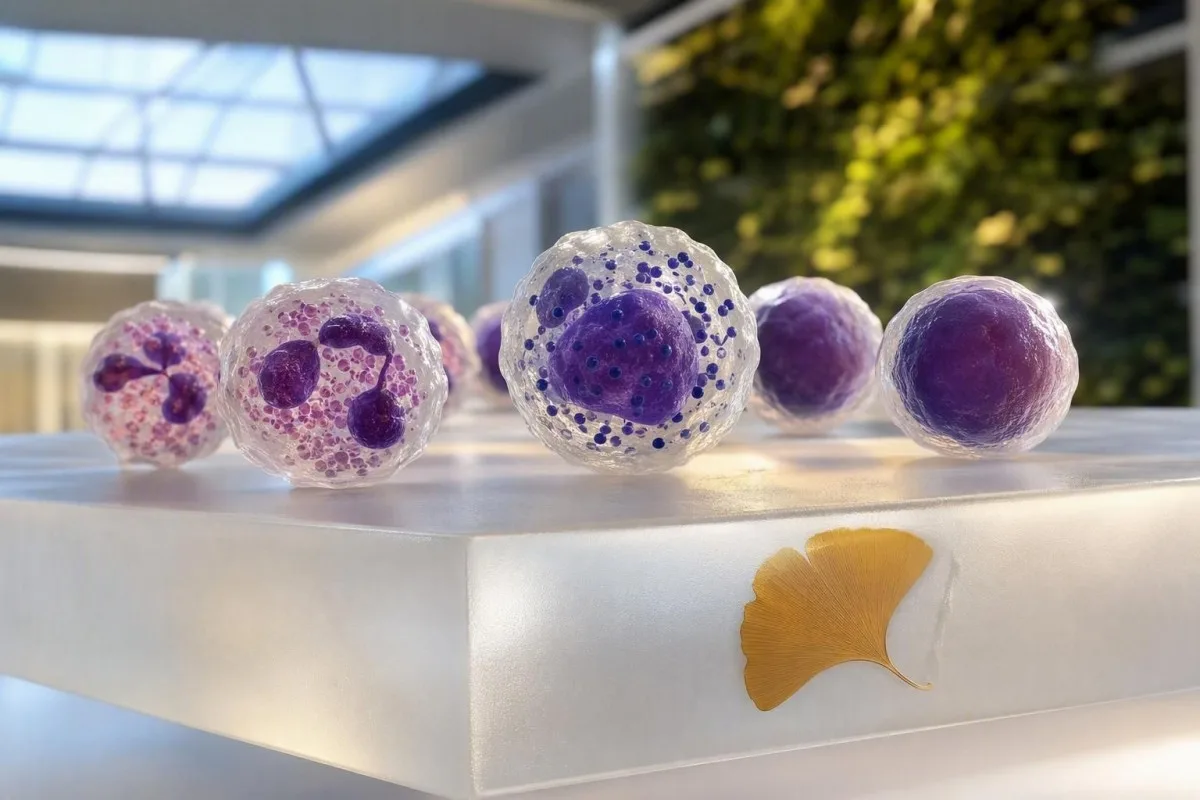
Kebanyakan orang dewasa memiliki basofil absolut 0,00–0,10 × 10⁹/L (0–100/µL), sedangkan persentasenya biasanya 0–1%. Persentase yang sedikit tidak biasa seringkali mencerminkan pergeseran pada sel darah putih lainnya; hitungan basofil absolut adalah hasil yang biasanya memandu tindak lanjut.


- Basofil absolut biasanya 0,00–0,10 × 10⁹/L (0–100/µL) pada orang dewasa dan lebih berguna secara klinis daripada persentase saja.
- Persentase basofil biasanya 0–1% dari sel darah putih, tetapi dapat meningkat ketika neutrofil atau limfosit turun meskipun hitungan absolutnya normal.
- Anak-anak sering menggunakan batas atas praktis yang sama yaitu 0,10 × 10⁹/L setelah masa bayi, tetapi interval spesifik usia laboratorium lebih diutamakan.
- CBC berulang dalam 2–8 minggu cukup masuk akal untuk basofilia ringan yang terisolasi setelah alergi, infeksi, atau perubahan obat.
- Basofilia persisten di atas 0,20 × 10⁹/L memerlukan tinjauan dokter, terutama dengan jumlah sel darah putih yang tinggi, anemia, splenomegali, atau gejala konstitusional.
- Tinjauan segera diperlukan untuk leukositosis yang nyata, penurunan berat badan yang tidak dapat dijelaskan, keringat malam yang membasahi, demam, atau rasa kenyang dini di bawah tulang rusuk kiri.
- Nol basofil pada hitung darah lengkap otomatis adalah hal biasa dan biasanya tidak memiliki signifikansi klinis.
- Kantesti AI membaca basofil bersama dengan total sel darah putih, eosinofil, hitung trombosit, hemoglobin, dan hasil sebelumnya daripada menganggap satu penanda sebagai diagnosis.
Basofil absolut versus persentase basofil
Basofil absolut 0,00–0,10 × 10⁹/L umumnya normal pada orang dewasa, sedangkan persentase basofil 0–11% hanyalah sebagian dari total hitung sel darah putih. Ketika keduanya tidak sesuai, dokter biasanya lebih mengutamakan hasil absolut.
Persentase bisa terlihat tinggi hanya karena jenis sel darah putih lain rendah. Misalnya, basofil 1,5% dengan hitung sel darah putih 3,0 × 10⁹/L menghasilkan hitung absolut hanya 0,045 × 10⁹/L—masih dalam banyak interval dewasa. Itulah sebabnya penanda persentase saja jarang memberikan gambaran lengkap.
Perhitungannya mudah: total sel darah putih × persentase basofil ÷ 100. Hitung sel darah putih 12,0 × 10⁹/L dan basofil 2% memberikan 0,24 × 10⁹/L, yang merupakan peningkatan nyata. Untuk konteks yang lebih luas, lihat panduan kami tentang apa saja yang termasuk dalam CBC.
Kantesti adalah seorang Analisa tes darah AI yang mengonversi persentase menjadi jumlah absolut yang dapat dibandingkan secara klinis ketika laporan sumber menyediakan diferensial. Berdasarkan pengalaman saya, konversi itu mencegah cukup banyak kekhawatiran yang tidak perlu setelah pemeriksaan kesehatan rutin.
Mengapa jumlah absolut lebih stabil
Penganalisis otomatis menghitung ribuan kejadian seluler, tetapi basofil biasanya jarang—seringkali kurang dari 1 dari 100 sel darah putih. Oleh karena itu, pergeseran analitis dan biologis kecil dapat menggerakkan persentase lebih nyata daripada jumlah absolut.
Interval referensi basofil praktis berdasarkan usia
Sebagian besar laboratorium menggunakan interval referensi basofil absolut 0,00–0,10 × 10⁹/L dari masa kanak-kanak hingga dewasa, tetapi kisaran bayi baru lahir mungkin lebih luas. Gunakan interval yang tercetak di samping hasil Anda sendiri, karena batas referensi bergantung pada metode penganalisis dan populasi sehat lokal laboratorium.
Untuk bayi dalam beberapa minggu pertama kehidupan, beberapa laboratorium anak menerima basofil absolut hingga sekitar 0,20–0,40 × 10⁹/L. Sistem kekebalan neonatal beradaptasi dengan cepat, sehingga ambang batas dewasa tidak boleh dipaksakan pada hasil bayi baru lahir tanpa masukan dari dokter anak.
Sejak sekitar 1 tahun ke depan, banyak layanan menerapkan batas atas praktis mendekati 0,10 × 10⁹/L, atau 100/µL. Hasil 0,11 × 10⁹/L pada anak yang sehat dengan hitung sel darah putih total normal biasanya memerlukan pertanyaan ulang dan konteks, bukan keadaan darurat.
CLSI EP28-A3c menjelaskan mengapa laboratorium menetapkan atau memverifikasi interval referensi mereka sendiri daripada meminjam rentang universal (CLSI, 2010). panduan kisaran usia neutrofil menunjukkan prinsip yang sama untuk hitung diferensial lainnya.
Memahami unit basofil pada laporan Inggris, AS, dan internasional
Jumlah basofil 0,10 × 10⁹/L setara dengan 100/µL, jadi laporan yang menggunakan satuan berbeda dapat menggambarkan hasil yang sama. Hitung darah lengkap di Inggris sering melaporkan dalam satuan ×10⁹/L, sedangkan laboratorium di AS umumnya menggunakan sel/µL atau K/µL.
Untuk mengubah ×10⁹/L menjadi sel/µL, kalikan dengan 1.000. Jadi 0,05 × 10⁹/L setara dengan 50/µL; 0,25 × 10⁹/L setara dengan 250/µL. Laporan yang menunjukkan 0,0 mungkin dibulatkan ke satu tempat desimal daripada membuktikan bahwa benar-benar tidak ada basofil.
Nilai yang tertera sebagai 0,2 K/µL setara dengan 0,20 × 10⁹/L. Perbedaan itu penting karena 0,2% dan 0,2 K/µL adalah pengukuran yang sama sekali berbeda. Pasien sering mencampuradukkannya saat membandingkan laporan dari dua negara.
Jika laporan Anda menyebutkan FBC daripada CBC, komponennya sebagian besar sama; penjelasan hitung darah lengkap di Inggris menerjemahkan terminologi umum.
Mengapa hitungan basofil naik atau turun
Basofilia ringan paling sering menyertai alergi, peradangan kronis, pemulihan dari infeksi, atau pergeseran kekebalan yang terkait dengan pengobatan. Jumlah rendah atau nol basofil biasanya tidak berarti karena sel-sel ini beredar dalam jumlah yang sangat kecil.
Basofil membawa reseptor untuk IgE dan dapat melepaskan histamin dan mediator lain setelah paparan alergen. Rinitis alergi musiman, urtikaria kronis, asma, dan beberapa gangguan kulit dapat bersamaan dengan peningkatan kecil, meskipun jumlah normal tidak menyingkirkan atau memasukkan salah satunya.
Hipotiroidisme, penyakit radang usus, gangguan rematik, dan beberapa infeksi kronis juga dapat dikaitkan dengan basofilia. Pertanyaan yang berguna bukanlah “penyakit apa yang menyebabkan ini?” tetapi “sinyal lain apa yang ada?”—CRP, eosinofil, gejala, riwayat pengobatan, dan lintasan semuanya penting.
Peningkatan IgE dan jumlah eosinofil dapat mendukung pola alergi, sementara gatal yang terisolasi mungkin memerlukan tinjauan yang lebih luas; artikel kami tentang tes darah untuk kulit gatal menjelaskan batasan praktis pengujian CBC.
Kapan Anda harus mengulang CBC untuk basofil?
Ulangi CBC dalam 2–8 minggu untuk peningkatan basofil ringan yang terisolasi setelah pemicu sementara, asalkan Anda merasa baik dan sisa hitungan meyakinkan. Ulangi lebih cepat, biasanya dalam beberapa hari hingga 2 minggu, ketika jumlah sel darah putih total meningkat atau ada beberapa garis sel abnormal.
Untuk hitung basofil absolut 0,11–0,20 × 10⁹/L setelah pilek, serangan demam, vaksinasi, atau pengobatan steroid singkat, saya sering lebih memilih satu pengulangan yang tenang daripada serangkaian tes. Cobalah untuk menggunakan laboratorium yang sama, dan catat penyakit baru-baru ini, obat-obatan baru, perubahan merokok, dan paparan steroid.
Jangan mencoba “memperbaiki” jumlah sebelum tes ulang. Hidrasi itu masuk akal, tetapi suplemen, antihistamin, kortikosteroid, dan latihan daya tahan yang intens dapat mengubah diferensial yang lebih luas. Kami panduan waktu tes darah merinci efek umum terkait waktu.
Kantesti adalah seorang platform interpretasi tes darah AI yang membandingkan diferensial saat ini dengan CBC sebelumnya dan menandai kenaikan yang konsisten secara berbeda dari penandaan sekali saja. Tren selama 3-6 bulan seringkali lebih informatif daripada satu titik desimal.
Cara mempersiapkan pengujian ulang basofil yang andal
Pengujian basofil biasanya tidak memerlukan puasa, tetapi pengulangan CBC paling dapat ditafsirkan ketika Anda tidak sakit parah dan kondisi pengambilan sampel serupa. Usahakan untuk minum cairan normal, makan biasa, dan menjalani hari yang rutin daripada melakukan perubahan ekstrem.
Hindari menjadwalkan tes ulang yang tidak mendesak selama demam, kekambuhan alergi yang signifikan, atau sehari setelah acara daya tahan yang luar biasa sulit jika tujuannya adalah untuk menetapkan nilai dasar. Hormon stres akut dan pergeseran cairan dapat memengaruhi beberapa subtipe sel darah putih selama berjam-jam hingga berhari-hari.
Beri tahu dokter atau ahli flebotomi tentang kortikosteroid sistemik, lithium, pengobatan yang mengandung epinefrin, terapi biologis baru-baru ini, dan suplemen apa pun. Steroid lebih sering menurunkan basofil dan eosinofil yang beredar, sehingga hasil yang “normal” saat mengonsumsinya mungkin tidak mewakili nilai dasar Anda yang tidak diobati.
Kualitas sampel tetap penting. Sampel EDTA yang membeku dan analisis yang tertunda dapat membuat diferensial otomatis kurang dapat diandalkan; jika beberapa nilai CBC terlihat aneh bersama-sama, tinjau kapan perlu pengambilan ulang.
Pola CBC yang membuat basofil meningkat lebih signifikan
Basofilia lebih mengkhawatirkan ketika basofil absolut melebihi 0,20 × 10⁹/L dan terjadi bersamaan dengan sel darah putih persisten di atas 11,0 × 10⁹/L, anemia, perubahan trombosit, atau sel imatur. Kombinasi—bukan hanya basofil saja—menentukan seberapa cepat dokter menyelidiki.
Seorang pasien berusia 44 tahun yang saya tinjau memiliki basofil 0,28 × 10⁹/L, sel darah putih 16,4 × 10⁹/L, trombosit 610 × 10⁹/L, dan rasa kenyang dini. Pola itu memerlukan jalur hematologi pada minggu yang sama; hasil basofil individu tidak membuat diagnosis, tetapi itu adalah petunjuk penting.
Basofilia bersamaan dengan neutrofil tinggi dan gejala limpa dapat terjadi pada keganasan mieloproliferatif, termasuk leukemia mieloid kronis. European LeukemiaNet menyarankan pengujian molekuler dan penilaian spesialis ketika pola klinis dan hitung darah menimbulkan kemungkinan tersebut (Hochhaus et al., 2020).
Apusan tepi dapat membedakan perubahan diferensial sejati dari ketidakpastian penganalisis dan mungkin menunjukkan pergeseran ke kiri atau sel atipikal. Baca selengkapnya tentang jalur CBC kanker darah tanpa berasumsi bahwa jumlah yang abnormal berarti kanker.
Gejala dan hasil yang memerlukan perhatian medis segera
Cari penilaian medis segera untuk basofilia dengan demam, keringat malam yang membasahi, penurunan berat badan yang tidak dapat dijelaskan, memar baru, sesak napas, kelelahan parah, atau rasa penuh di perut kiri atas. Gejala-gejala ini tidak disebabkan oleh hasil basofil yang sedikit meningkat itu sendiri; mereka menandakan bahwa gambaran klinis yang lebih luas perlu dinilai.
Jumlah sel darah putih total di atas 30 × 10⁹/L, peningkatan nilai yang cepat, atau granulosit imatur yang terlihat pada laporan harus segera dibahas dengan dokter yang memesan tes. Sakit kepala parah, perubahan penglihatan, nyeri dada, atau gejala neurologis memerlukan evaluasi darurat terlepas dari jumlah basofil.
Kebanyakan orang dengan basofil 0,11–0,20 × 10⁹/L dan tanpa gejala tidak memerlukan perawatan darurat. Namun, ini adalah salah satu area di mana konteks lebih penting daripada angka, terutama jika hasil sebelumnya adalah 0,02 × 10⁹/L dan jumlah baru meningkat.
Jika Anda juga mengalami sesak napas atau pucat, nilai hemoglobin dan trombosit yang menyertainya mungkin lebih penting segera; lihat kami panduan tes darah sesak napas.
Apa artinya basofil rendah atau hasil nol
Hasil basofil 0,00 × 10⁹/L biasanya normal dan jarang perlu diulang sendiri. Basofil mungkin berada di bawah ambang batas pelaporan penganalisis karena secara alami jarang ditemukan dalam sirkulasi.
Stres akut, infeksi, kehamilan, hipertiroidisme, dan pengobatan kortikosteroid semuanya dapat mengurangi basofil yang beredar untuk sementara. Namun, tidak ada sindrom gejala yang diakui yang disebabkan oleh basofil rendah yang terisolasi, tidak seperti neutropenia yang signifikan secara klinis.
Masalah analitis mudah terlewatkan: jika hanya sedikit basofil yang dihitung, variabilitas pengambilan sampel rutin dapat mengubah 0,01 × 10⁹/L menjadi 0,00 × 10⁹/L pada pengambilan berikutnya. Itu belum tentu perubahan biologis.
Saran praktis Dr. Thomas Klein adalah mengabaikan penanda basofil rendah ketika sisa CBC baik dan tidak ada gejala yang relevan. Panduan khusus kami menjelaskan basofil pada angka nol.
Basofil pada kehamilan dan kehidupan selanjutnya
Kehamilan dan penuaan tidak memiliki satu batas potong basofil khusus; interval laboratorium pelaporan dan pola sel darah putih lengkap tetap menjadi referensi terbaik. Kehamilan umumnya meningkatkan jumlah sel darah putih total melalui neutrofil, yang dapat membuat persentase basofil tampak lebih rendah tanpa penurunan basofil yang sebenarnya.
Selama kehamilan, jumlah sel darah putih total 12–15 × 10⁹/L dapat bersifat fisiologis, terutama pada akhir kehamilan, sehingga interpretasi berdasarkan persentase menjadi kurang dapat diandalkan. Jumlah absolut basofil tetap lebih disukai, tetapi gejala yang mengkhawatirkan tetap mengesampingkan interval referensi.
Pada orang tua, jumlah basofil baru yang menetap di atas 0,20 × 10⁹/L layak mendapat perhatian karena beban pengobatan dan kelainan sumsum tulang menjadi lebih umum seiring bertambahnya usia. Itu tidak menjadikannya diagnostik; itu hanya menurunkan ambang batas untuk melihat tren CBC dan apusan darah.
Untuk jebakan interpretasi spesifik kehamilan lainnya, tinjau pemeriksaan darah saat kehamilan.
Obat-obatan, alergi, dan fluktuasi basofil
Gejala alergi dapat bertepatan dengan basofil yang sedikit meningkat, sementara kortikosteroid sistemik sering menurunkannya dalam beberapa hari. Tidak ada pola yang mengkonfirmasi diagnosis alergi atau membuktikan bahwa obat bertanggung jawab.
Antihistamin terutama memblokir reseptor histamin; mereka tidak secara andal menormalkan jumlah basofil. Prednisolone oral dan glukokortikoid sistemik lainnya dapat mendistribusikan ulang sel darah putih, seringkali menurunkan eosinofil dan basofil sambil meningkatkan neutrofil yang beredar.
Litium adalah petunjuk pengobatan yang kurang umum tetapi berguna karena dapat meningkatkan produksi sel darah putih. Obat biologis, kemoterapi, dan pengobatan imunosupresif tidak boleh dihentikan karena satu hasil CBC—tanyakan kepada tim peresep bagaimana hasil tersebut sesuai dengan rencana pemantauan mereka.
Peningkatan jumlah basofil bersamaan dengan mengi, gatal-gatal, pembengkakan wajah, atau pingsan harus dikelola sebagai masalah gejala, bukan teka-teki laboratorium. panduan IgE tinggi menjelaskan di mana penanda alergi membantu dan di mana penanda tersebut menyesatkan.
Apa yang diperiksa dokter setelah basofilia persisten
Basofilia absolut yang menetap biasanya mendorong pengulangan CBC, tinjauan apusan darah manual, tinjauan obat dan gejala, kemudian pengujian yang ditargetkan jika jumlah sel darah putih total atau garis sel lainnya abnormal. Panel kanker luas bukanlah langkah pertama yang biasa untuk peningkatan terisolasi yang sedikit.
Titik percabangan pertama adalah apakah hasilnya terisolasi. Hemoglobin, trombosit, jumlah sel darah putih yang stabil, dan apusan darah normal sangat mendukung rencana konservatif; anemia, trombositosis, leukositosis, atau splenomegali mendorong penilaian ke arah yang berbeda.
Ketika kelainan mieloproliferatif masuk akal, dokter dapat meminta pengujian BCR::ABL1, pengujian JAK2, laktat dehidrogenase, urat, dan tinjauan spesialis. Valent dkk. menggambarkan basofilia yang menetap sebagai temuan yang bermakna dalam klasifikasi neoplasma basofilik dan mieloid (Valent dkk., 2022).
Jaringan saraf Kantesti mengidentifikasi kombinasi yang memerlukan tinjauan tetapi tidak mendiagnosis leukemia dari CBC. Kami validasi medis menjelaskan mengapa interpretasi laboratorium harus mempertahankan pengawasan klinis.
Cara melacak basofil tanpa bereaksi berlebihan
Tren basofil yang bermakna adalah perubahan arah yang persisten di seluruh CBC yang sebanding, bukan pergerakan tunggal dari 0,04 menjadi 0,08 × 10⁹/L. Dengan batas referensi dewasa 0,10 × 10⁹/L, kedua nilai tetap dalam rentang meskipun berbeda secara numerik.
Simpan hitungan absolut, persentase, total sel darah putih, neutrofil, eosinofil, hemoglobin, trombosit, tanggal, penyakit baru-baru ini, dan obat-obatan setelah setiap pengambilan sampel. Catatan kecil ini memberikan informasi yang lebih berguna bagi dokter Anda daripada tangkapan layar dari tanda bahaya yang terisolasi.
Kantesti adalah seorang Alat analisis pemeriksaan darah berbasis AI digunakan di 127+ negara untuk membandingkan hasil CBC secara longitudinal sambil mempertahankan interval yang dinyatakan oleh laboratorium sumber. Dr. Thomas Klein merekomendasikan peninjauan setidaknya dua hasil yang sebanding sebelum memberikan makna pada perubahan diferensial yang ambigu.
Aturan yang berguna: jika hitungan absolut tetap di bawah 0,10 × 10⁹/L, total hitungan sel darah putih stabil, dan Anda merasa sehat, tindak lanjut rutin pada tes darah terjadwal Anda berikutnya biasanya sudah cukup. Gunakan perbedaan hasil tes darah kami untuk menilai apakah pergeseran kemungkinan nyata.
Pertanyaan yang harus diajukan pada janji temu tindak lanjut
Pertanyaan tindak lanjut terbaik adalah “Berapa hitungan basofil absolut saya, dan apa lagi yang berubah pada CBC?” Pernyataan tersebut mengarahkan percakapan ke variabel yang benar-benar mengubah risiko klinis.
Tanyakan apakah hitungan tersebut baru, persisten, meningkat, atau kemungkinan reaktif; apakah peninjauan apusan diperlukan; dan kapan CBC berikutnya harus diambil. Bawa daftar infeksi baru-baru ini, gejala alergi, obat-obatan, suplemen, perjalanan, dan riwayat keluarga kelainan darah.
Jika Anda memiliki hitungan absolut di atas 0,20 × 10⁹/L ditambah total sel darah putih yang meningkat, tanyakan apakah masukan hematologi sesuai. Jika hitungan hanya sedikit di atas kisaran dan terisolasi, tanyakan perubahan apa yang akan memicu pengujian lebih awal daripada mengasumsikan yang terburuk.
Standar pendidikan yang ditinjau oleh dokter Kantesti diawasi melalui Dewan Penasehat Medis. kami. Per 30 Agustus 2026, pendekatan teraman tetap sederhana: interpretasikan hitungan absolut, konfirmasikan persistensi, dan bertindak lebih cepat hanya ketika pola yang lebih luas memerlukannya.
Pertanyaan yang Sering Diajukan
Berapakah jumlah basofil normal pada orang dewasa?
Interval referensi umum untuk dewasa untuk basofil absolut adalah 0,00–0,10 × 10⁹/L, yang setara dengan 0–100 sel/µL. Sebagian besar laboratorium melaporkan persentase basofil 0–1%, meskipun persentase dapat menyesatkan ketika jumlah total sel darah putih berubah. Interval referensi yang dicetak oleh laboratorium Anda sendiri lebih diutamakan karena metode dan populasi referensi lokal berbeda. Hasil terisolasi 0,11 × 10⁹/L biasanya memerlukan konteks atau pengulangan terjadwal daripada perawatan darurat.
Apakah basofil 2% tinggi?
Persentase basofil 2% berada di atas banyak interval persentase laboratorium, tetapi tidak cukup untuk menilai risiko tanpa jumlah total sel darah putih. Dengan sel darah putih 4,0 × 10⁹/L, 2% setara dengan jumlah absolut basofil 0,08 × 10⁹/L, yang seringkali normal. Dengan sel darah putih 15,0 × 10⁹/L, 2% yang sama setara dengan 0,30 × 10⁹/L dan memerlukan tinjauan klinis. Selalu cari jumlah absolut basofil sebelum menafsirkan persentasenya.
Kapan saya harus mengulang CBC untuk basofil tinggi?
Pemeriksaan CBC berulang dalam 2–8 minggu cukup beralasan untuk basofilia ringan yang terisolasi sekitar 0,11–0,20 × 10⁹/L setelah sakit, kekambuhan alergi, atau perubahan pengobatan. Ulangi lebih cepat ketika jumlah sel darah putih total meningkat, jumlah basofil di atas 0,20 × 10⁹/L, atau hemoglobin dan trombosit juga abnormal. Gunakan laboratorium yang sama jika memungkinkan karena metode penganalisis dan interval referensi bervariasi. Demam, penurunan berat badan, keringat malam, memar, atau rasa penuh di perut kiri atas memerlukan tinjauan medis segera daripada menunggu tes ulang rutin.
Apakah basofil nol berbahaya?
Jumlah basofil 0,00 × 10⁹/L biasanya tidak berbahaya dan umumnya tidak memerlukan tindak lanjut jika sisa CBC normal. Basofil adalah sel yang jarang ditemukan, sehingga diferensial otomatis rutin dapat melaporkan nol karena jumlah yang terdeteksi berada di bawah presisi pembulatan atau pelaporan. Kortikosteroid, stres akut, kehamilan, dan infeksi dapat menurunkan basofil yang beredar sementara. Klinisi tidak mendiagnosis defisiensi imun dari basofil rendah yang terisolasi.
Apakah alergi dapat menyebabkan basofil tinggi?
Kondisi alergi dapat terjadi bersamaan dengan peningkatan basofil ringan karena basofil berpartisipasi dalam respons kekebalan terkait IgE dan melepaskan mediator seperti histamin. Jumlah basofil yang tinggi tidak membuktikan bahwa alergi adalah penyebabnya, dan banyak orang dengan gejala alergi yang signifikan memiliki jumlah basofil normal. Jumlah di atas 0,20 × 10⁹/L yang menetap setelah gejala alergi mereda harus ditinjau bersama dengan seluruh hasil CBC. Eosinofil, total IgE, gejala kulit, dan paparan obat dapat memberikan konteks yang lebih berguna.
Berapa hitungan basofil yang menunjukkan leukemia?
Tidak ada hitung basofil tunggal yang mendiagnosis leukemia, tetapi basofilia absolut yang persisten di atas 0,20 × 10⁹/L dengan leukositosis, anemia, kelainan trombosit, granulosit imatur, atau gejala limpa harus mendorong evaluasi medis. Basofilia dapat terjadi pada leukemia mieloid kronis dan neoplasma mieloproliferatif lainnya, namun penyebab reaktif tetap lebih umum untuk peningkatan terisolasi yang ringan. Dokter dapat memesan apusan darah dan pengujian molekuler yang ditargetkan seperti BCR::ABL1 hanya ketika pola yang lebih luas mendukungnya. Jumlah sel darah putih total yang normal dan CBC yang stabil secara substansial mengubah tingkat kekhawatiran.
Dapatkan Analisis Tes Darah Berbasis AI Hari Ini
Bergabunglah dengan lebih dari 2 juta pengguna di seluruh dunia yang mempercayai Kantesti untuk analisis instan dan akurat terhadap tes lab. Unggah hasil tes darah Anda dan terima interpretasi komprehensif biomarker 15,000+ dalam hitungan detik.
📚 Publikasi Riset yang Dirujuk
Klein, T., Mitchell, S., & Weber, H. (2026). Panduan Golongan Darah B Negatif, Tes Darah LDH, dan Hitung Retikulosit. Kantesti Penelitian Medis AI.
Klein, T., Mitchell, S., & Weber, H. (2026). Diare Setelah Puasa, Bintik Hitam pada Tinja & Panduan GI 2026. Kantesti Penelitian Medis AI.
📖 Referensi Medis Eksternal
Clinical and Laboratory Standards Institute (2010). Mendefinisikan, Menetapkan, dan Memverifikasi Interval Referensi di Laboratorium Klinis. CLSI EP28-A3c.
⚕️ Penafian Medis
Artikel ini hanya untuk tujuan edukasi dan tidak merupakan nasihat medis. Selalu konsultasikan dengan penyedia layanan kesehatan yang berkualifikasi untuk keputusan diagnosis dan perawatan.
Sinyal Kepercayaan E-E-A-T
Pengalaman
Tinjauan klinis yang dipimpin dokter terhadap alur kerja interpretasi hasil lab.
Keahlian
Fokus pada kedokteran laboratorium tentang bagaimana biomarker berperilaku dalam konteks klinis.
Kewenangan
Ditulis oleh Dr. Thomas Klein dengan peninjauan oleh Dr. Sarah Mitchell dan Prof. Dr. Hans Weber.
Kepercayaan
Interpretasi berbasis bukti dengan jalur tindak lanjut yang jelas untuk mengurangi kepanikan.