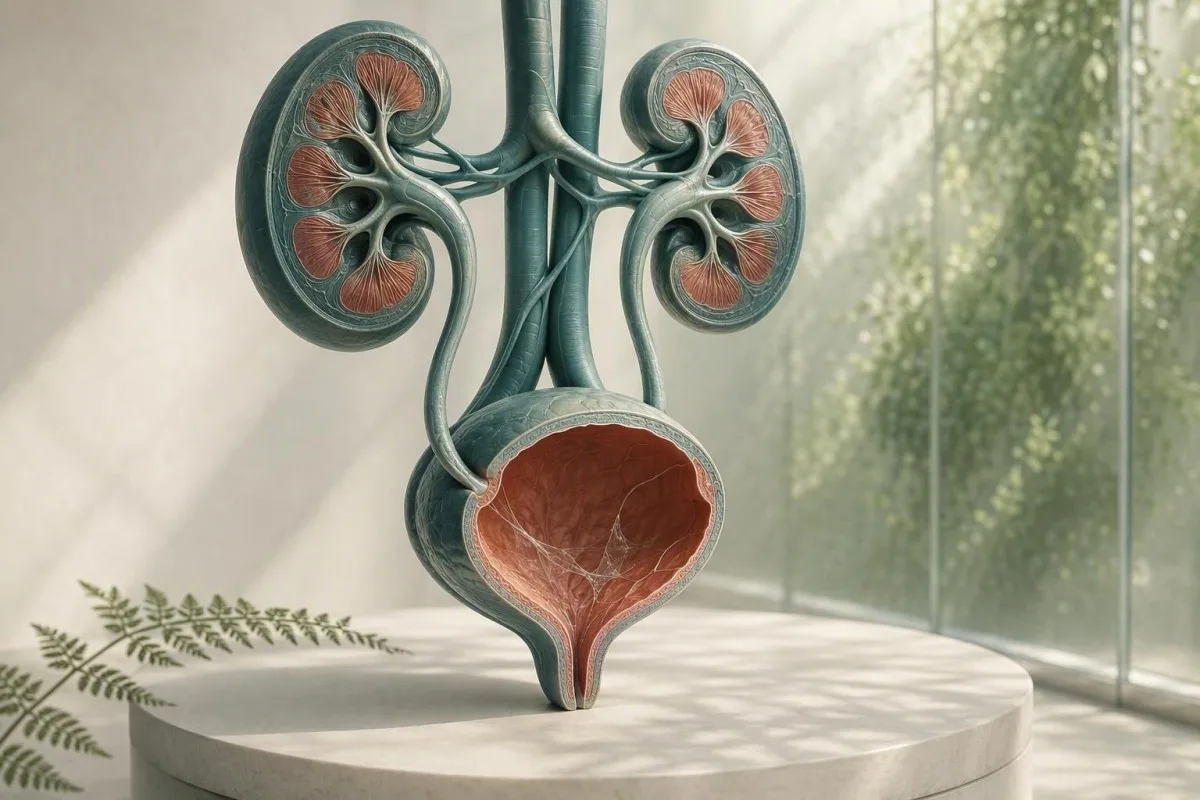
El mucos en un informe de microscòpia d'orina sol ser un problema de recollida, no un diagnòstic. Les troballes de l'anàlisi d'orina circumdants, els símptomes i la qualitat de la mostra determinen si necessita seguiment.


- Fils de mucos per si sols són sovint inofensius, especialment en una única mostra de micció neta sense símptomes urinàris.
- Llindar de piúria de més de 5 cèl·lules blanques per camp d'alta potència dóna suport a la inflamació del tracte urinari, però no prova una ITU bacteriana.
- Desencadenant de cultiu és mucos més cremor, urgència, febre, dolor al flanc, nitrits o glòbuls blancs significatius, no només mucos.
- Cèl·lules escamoses per sobre d'aproximadament 10 per camp d'alta potència sovint indiquen contaminació genital-cutània i fan que un resultat d'orina sigui menys fiable.
- Sang visible amb dolor col·licatiu al flanc necessita una avaluació urgent per a un càlcul, fins i tot si també s'informa de moc.
- Embaràs canvia el llindar de seguiment perquè la bacteriúria asimptomàtica normalment es detecta amb un cultiu d'orina, no només amb microscòpia.
- Orina tèrbola pot reflectir cristalls, orina concentrada, secrecions vaginals, semen o cèl·lules; no pot diagnosticar una infecció per la seva aparença.
- Mostra repetida és sensat quan el moc és l'únic troballa inusual i la recollida no va ser una captura neta de mig flux acurada.
Què solen significar els fils de mucos en una anàlisi d'orina
Els fils de moc a l'orina solen ser fils de secreció protectora normal o contaminació genital, i un resultat aïllat rarament indica malaltia renal. La troballa esdevé significativa quan apareix amb símptomes urinaris, leucòcits, bacteris, sang o proteïnes.
Els laboratoris identifiquen el moc com a fils prims i translúcids vistos al microscopi; molts informes simplement el classifiquen com a escàs, poc, moderat o abundant en lloc d'assignar un rang de referència numèric. L'orina conté de manera natural una petita quantitat de material ric en glicoproteïnes del tracte urinari, i les secrecions vaginals o uretrals poden afegir-ne més durant la recollida.
La redacció de l'informe és menys alarmant del que sona. A partir del 26 d'agost de 2026, no hi ha un recompte validat de fils de moc que diagnostiqui una ITU, un càlcul, càncer o insuficiència renal; és una observació microscòpica contextual. Per a un mapa més ampli dels altres elements d'un informe de tira reactiva i microscopi, consulteu la nostra guia completa d'anàlisi d'orina.
En la meva experiència clínica, un adult sense símptomes amb moc marcat com a “moderat”, 0-2 leucòcits per camp d'alta potència, nitrits negatius i sense sang normalment es beneficia millor de la tranquil·litat o d'una mostra repetida recollida adequadament. El Dr. Thomas Klein sovint veu una ansietat innecessària per antibiòtics sorgir perquè una alerta de laboratori es confon amb una etiqueta de malaltia.
Kantesti és una plataforma d'interpretació anàlisi de sang que pot situar marcadors sanguinis relacionats amb els ronyons, com ara la creatinina i l'eGFR, al costat d'una troballa d'anàlisi d'orina, però no pot diagnosticar una ITU només a partir del moc. Un resultat de microscòpia d'orina necessita la història clínica que l'acompanya.
Per què un laboratori l'alerta
Els sistemes d'informació de laboratori assenyalen el moc perquè és visualment present, no perquè el laboratori hagi establert un tall perillós. Per tant, una alerta significa “observat” en lloc de “marcador de malaltia anormal”, de manera similar a com una troballa traça aïllada pot no requerir tractament.
D'on prové el mucos en una mostra d'orina
El moc a l'orina pot provenir de la uretra, del revestiment de la bufeta, del coll de l'úter o de la vagina, del semen o de la pell genital externa durant la recollida. La seva font sovint s'infereix de la resta del patró microscòpic en lloc de dels fils mateixos.
La bufeta i la uretra tenen una capa superficial protectora que conté mucines, inclòs material associat a la uroplakina, que redueix la fricció i l'adhesió microbiana. Es poden desprendre petites quantitats a l'orina després de la deshidratació, activitat sexual recent, irritació menor, o simplement perquè una mostra concentrada del primer matí fa que els fils siguin més fàcils de veure.
Per a les persones que menstruen o tenen secrecions vaginals, els leucòcits i el moc poden entrar a la tassa sense provenir de la bufeta. Més de 10 cèl·lules epitelials escamoses per camp d'alta potència fa que la contaminació sigui més probable, tot i que els laboratoris utilitzen diferents llindars d'informe. La nostra guia per a cèl·lules epitelials a l'orina explica per què això canvia la confiança en un resultat.
El semen també pot crear material filamentós o entelament durant diverses hores després de l'ejaculació. Això no fa que l'orina sigui insegura, però pot dificultar la microscòpia; si es considera un cultiu, generalment aconsello recollir una nova mostra almenys 24 hores després, si és factible.
Per què el sexe i l'anatomia afecten l'informe
Una tassa d'orina no aïlla la bufeta dels teixits propers. És per això que es notifica “mucositat present” més sovint en mostres amb secrecions externes, mentre que de vegades s'utilitza una mostra cateteritzada quan els clínics necessiten una resposta més neta.
Quan els fils de mucos apunten cap a una infecció del tracte urinari
Els fils de mucositat només donen suport a una possible infecció del tracte urinari quan acompanyen símptomes i troballes inflamatòries objectives, en particular piúria, positivitat per nitrits o un cultiu convincent. La mucositat per si sola no és una prova d'infecció del tracte urinari.
Una infecció del tracte urinari inferior sintomàtica causa habitualment cremor, urgència, freqüència, molèsties suprapúbiques i de vegades una nova olor d'orina. En una mostra recollida correctament, més de 5 cèl·lules blanques per camp d'alt poder s'anomena sovint piúria; dóna suport a la inflamació del tracte urinari, però també pot ocórrer amb càlculs, infeccions de transmissió sexual i contaminació.
El nitrit és altament específic quan és positiu, però no detecta infeccions causades per organismes que no redueixen el nitrat, i un resultat negatiu del nitrit no descarta una infecció del tracte urinari. L'esterasa leucocitària detecta l'activitat enzimàtica dels glòbuls blancs i pot ser falsament positiva quan les secrecions vaginals contaminen la mostra; la nostra explicació de els resultats de l’esterasa leucocitària cobreix aquests paranys.
La guia de l'IDSA desaconsella el cribratge o el tractament de la bacteriúria asimptomàtica en adults sans no embarassades perquè els antibiòtics aporten danys sense beneficis (Nicolle et al., 2019). Aquest principi és especialment rellevant per a la mucositat: sense cremor, sense febre i sense procediment urològic planificat normalment significa que no hi ha antibiòtic simplement perquè un camp de microscòpia semblés desordenat.
Quan el cultiu és la millor prova
El cultiu d'orina és més útil que les tires reactives repetides quan els símptomes persisteixen, els símptomes recurrents dins de les 4 setmanes, la presència d'embaràs, la sospita de pielonefritis o la presència d'antibiòtics previs hagin pogut alterar el resultat. El creixement bacterià mixt sovint indica contaminació de la recollida en lloc d'un sol patogen urinari; vegeu interpretació del cultiu d’orina.
Mocus, cristalls, càlculs i irritació mecànica
La mucositat amb dolor intens al flanc similar a ones o sang a l'orina pot ocórrer amb un càlcul urinari, però la mucositat ni confirma ni exclou un càlcul. La sang, els cristalls, el patró del dolor, les imatges i la funció renal són més importants.
Un càlcul pot raspar o obstruir el revestiment urinari, produint glòbuls vermells, glòbuls blancs i mucositat addicional. El símptoma clàssic és un dolor còlic abrupta que irradia cap a l'engonal, sovint amb nàusees; l'orina vermella o de color te visible augmenta la urgència. Més informació sobre signes d'alarma de sang a l'orina en lloc d'assumir que cada mostra rosada és una simple infecció.
Els cristalls d'oxalat de calci poden aparèixer en persones sanes, especialment en orina àcida concentrada, de manera que un tipus de cristall no prova un càlcul actiu. En una persona amb dolor, càlculs recurrents o hematúria persistent, els clínics poden utilitzar ultrasons o TC de baixa dosi sense contrast en lloc de basar-se només en el sediment. El nostre recurs sobre cristalls d’oxalat càlcic detalla els límits dels informes de cristalls.
Una excepció important és l'obstrucció amb infecció: febre de 38,0 °C o superior, dolor al flanc, vòmits i incapacitat per passar orina justifiquen una avaluació d'emergència. La preocupació no és la mucositat; és un sistema urinari infectat i bloquejat, que pot deteriorar-se ràpidament.
Irritació sense càlcul
L'ús recent de catèter, els procediments de bufeta, el ciclisme intens i la radiació pèlvica poden irritar el tracte inferior i augmentar la mucositat o els glòbuls blancs. Un clínic ha d'interpretar aquests resultats en funció del moment, ja que una mostra recollida dins de les 48 hores posteriors a la instrumentació no equival a una mostra de cribratge rutinari.
Significat de l'orina tèrbola: què pot i què no pot dir-vos l'aparença
L'orina tèrbola pot ser causada per sals concentrades, cristalls, mucositat, cèl·lules, secreció genital o bacteris, de manera que l'aparença sola no pot diagnosticar una infecció. L'orina tèrbola però indolora i de curta durada és comunament no urgent.
Els cristalls de fosfat poden fer que l'orina alcalina sembli tèrbola un cop refredada, mentre que els cristalls d'urat poden enturbiar l'orina àcida concentrada. Una mostra deixada a temperatura ambient durant més de 2 hores pot tornar-se cada cop més tèrbola a mesura que les cèl·lules es degraden i els bacteris es multipliquen, per això és important el processament fresc o la refrigeració.
La turbidesa juntament amb disúria, urgència i piúria mereix proves; la turbidesa després de l'exercici o una ingesta inadequada de líquids sovint millora amb una hidratació normal. Apunteu a una orina groc pàl·lid en lloc de forçar una ingesta excessiva d'aigua; una orina molt clara no significa que els ronyons estiguin “netejaant” la infecció. La nostra revisió detallada de causes of cloudy urine separa pistes visuals de proves fiables.
Kantesti és una Analitzador de sang amb IA dissenyats per interpretar marcadors sanguinis en context clínic; una creatinina alta o una eGFR reduïda juntament amb anomalies urinàries poden justificar una revisió mèdica, mentre que l'orina tèrbola sola no estableix una filtració renal deficient. Un panel metabòlic bàsic pot afegir context útil quan els símptomes suggereixen deshidratació o obstrucció.
L'olor no és un cultiu
L'orina amb olor fort sovint reflecteix concentració, metabòlits de l'espàrrec, vitamines del grup B o un recipient que s'ha deixat massa temps. Una nova olor fètida amb febre o símptomes urinaris és motiu per buscar avaluació, però l'olor no és un substitut de la microscòpia i el cultiu.
Secrecions genitals i infeccions de transmissió sexual
La secreció uretral o vaginal pot semblar moc a l'orina, i una nova secreció amb cremades urinàries necessita proves de salut sexual, així com una avaluació de l'orina. El cultiu rutinari d'orina pot no detectar clamídia i gonorrea.
La clamídia i la gonorrea poden causar disúria i piúria estèril (glòbuls blancs sense creixement bacterià rutinari), especialment després d'una nova exposició sexual. La prova d'amplificació d'àcids nucleics, sovint utilitzant la primera micció en lloc d'una mostra de flux mitjà, és la prova adequada perquè el cultiu estàndard té com a objectiu organismes diferents.
En persones amb vagina, la vaginosis bacteriana, la candidiasi i la inflamació cervical poden afegir secreció a una tassa de flux mitjà; un hisop vaginal o un examen pot ser més informatiu que repetir la microscòpia d'orina. En persones amb penis, la secreció uretral visible no s'ha de descartar com a “filaments de moc”. La distinció pràctica és la secreció detectada fora de la micció enfront de fils reportats només pel laboratori.
La guia de tractament d'ETS de CDC de 2021 recomana proves basades en NAAT en llocs anatòmics rellevants segons l'historial d'exposició, no només els símptomes (Workowski et al., 2021). Si hi ha dolor pèlvic, dolor testicular, febre, embaràs o possible agressió, busqueu assessorament clínic el mateix dia en lloc d'automedicar-vos amb antibiòtics restants.
Per què els antibiòtics poden confondre el quadre
Prendre fins i tot 1 o 2 dosis d'antibiòtics abans d'un cultiu pot suprimir el creixement bacterià normal mentre persisteixen els símptomes urinaris i els glòbuls blancs. Digueu al metge exactament quin fàrmac, dosi i hora de l'última dosi es van utilitzar; aquest detall canvia com s'interpreta un cultiu negatiu.
Com recollir una mostra d'orina que respongui a la pregunta
Una mostra de flux mitjà net eviti millor el moc, les cèl·lules escamoses i el creixement bacterià mixt que recollir la primera o l'última part del flux. La tècnica és senzilla, però els primers 2 segons marquen una diferència desproporcionada.
Renteu-vos les mans, separeu la pell genital o retreu el prepuci si us sentiu còmode, netegeu segons les instruccions del kit, comenceu a orinar al vàter i després recolliu la part del mig sense que la tassa toqui la pell. Una mostra de 20-30 ml sol ser suficient; omplir un recipient gran fins a la vora no millora la prova.
Lliureu la tassa ràpidament, idealment en 1 hora; si el retard és inevitable, refrigereu-la segons les instruccions del laboratori i torneu-la dins de les 24 hores. La refrigeració retarda el creixement bacterià però no restaura una mostra que ja estava contaminada. Això és especialment important quan la sol·licitud inclou cultiu en lloc de només tira reactiva.
Kantesti és una Eina d’anàlisi d’analítica de sang impulsada per IA utilitzats a països de tot el món, i els nostres fluxos de treball revisats per clínics tracten la qualitat de la mostra com a part de la interpretació en lloc d'una nota a peu de pàgina. El mateix principi s'aplica a qualsevol valor de laboratori: una mostra tècnicament deficient pot crear un resultat mèdicament persuasatiu però enganyós. Vegeu la nostra llista de verificació d'exactitud del laboratori per a preguntes a fer abans d'actuar sobre una bandera aïllada.
No recolliu durant aquestes situacions si podeu esperar
Eviteu les proves rutinàries durant un flux menstrual abundant, immediatament després de les relacions sexuals o després d'utilitzar cremes vaginals, a menys que el metge ho sol·liciti específicament. Quan les proves no poden esperar, informeu al laboratori o al metge, ja que aquest context pot explicar la presència de moc, glòbuls vermells o cèl·lules externes.
Com els clínics interpreten el mucos amb la resta de l'anàlisi d'orina
El patrón de análisis de orina más útil combina síntomas con glóbulos blancos, glóbulos rojos, nitrito, esterasa leucocitaria, proteína, glucosa, gravedad específica y células epiteliales. El moco es una característica secundaria menor en este patrón.
Una muestra limpia con moco, 0-2 glóbulos blancos por campo de alta potencia, nitrito negativo y sin sangre generalmente no necesita tratamiento. Moco con más de 5 glóbulos blancos por campo de alta potencia y esterasa leucocitaria positiva aumenta la probabilidad de inflamación; la adición de nitrito o un cultivo de un solo organismo aumenta la confianza en que las bacterias son las responsables.
La proteína necesita su propio camino. La traza de proteína después de fiebre, ejercicio o orina concentrada puede ser temporal, pero la proteína persistente debe cuantificarse con una relación albúmina-creatinina en lugar de atribuirse al moco. Nuestra guía de proteïna a l’orina explica por qué la proteína de tira reactiva y el riesgo renal no son intercambiables.
Una gravetat específica de 1.003 a 1.030 es común en adultos, aunque los intervalos de referencia varían según el laboratorio. La alta gravedad específica puede concentrar el moco y crear un sedimento de apariencia más dramática, mientras que la baja gravedad específica puede lisisar las células y hacer que la microscopia sea engañosamente insípida; nuestro guia de densitat específica muestra cómo la hidratación afecta la interpretación.
El valor de los hallazgos negativos
La sangre, proteína, nitrito y esterasa leucocitaria negativos reducen significativamente la preocupación en una persona sin síntomas, incluso si el moco se informa como moderado. Ninguna prueba negativa única es perfecta, pero este conjunto es más tranquilizador que preocupante una gradación de moco.
Quan repetir la prova i quan sol·licitar un cultiu
Repita una muestra de orina cuando el moco esté aislado, las células escamosas sugieran contaminación o la recolección se hiciera apresuradamente; solicite cultivo cuando los síntomas sean persistentes, recurrentes, graves o de alto riesgo. Una prueba repetida no es “no hacer nada”: a menudo es el siguiente paso más diagnóstico.
Para un adulto no embarazada sin síntomas y con moco como única señal, un análisis de orina repetido de chorro medio dentro de 1 a 2 semanas es razonable si se necesita tranquilidad; muchos médicos no lo repetirían en absoluto. No trate una señal de laboratorio con antibióticos mientras espera a menos que un prescriptor identifique una indicación clínica.
El cultivo antes de los antibióticos es especialmente útil para fiebre, dolor en el flanco, embarazo, inmunosupresión, trasplante de riñón, uso de catéter urinario, síntomas urinarios en hombres o síntomas que regresan dentro de las 4 semanas. La guía de Gupta et al. (2011) apoya el cultivo en casos de sospecha de pielonefritis y situaciones en las que la resistencia o un diagnóstico alternativo son más probables.
Les comptes de culture doivent être lus en tenant compte de la qualité du prélèvement. Un seul organisme à 10^5 unités formant des colonies par mL a traditionnellement étayé la bactériurie dans les urines de milieu de jet propres, mais les patients symptomatiques peuvent présenter des taux inférieurs cliniquement pertinents ; une “ flore mixte ” incite généralement à un nouveau prélèvement plutôt qu'à un antibiotique à large spectre. Comparez les objectifs de anàlisi d’orina i cultiu avant de demander l'un ou l'autre.
La grossesse nécessite un seuil différent
La grossesse est une exception car la bactériurie asymptomatique peut augmenter le risque de pyélonéphrite et de résultats indésirables de grossesse. Les soins prénatals utilisent couramment une culture de dépistage tôt dans la grossesse ; le mucus à la microscopie ne peut remplacer cette culture.
Quan les proves de sang aporten un context útil del ronyó i d'infecció
Les analyses de sang sont utiles lorsque le mucus dans les urines s'accompagne de fièvre, de douleurs dans les flancs, d'infections récurrentes, de gonflement, d'une diminution du volume urinaire, ou de protéines ou de sang persistants. La créatinine et le DFG estimé évaluent la filtration, tandis qu'une NFS et une protéine C-réactive peuvent aider à juger de la maladie systémique.
Un eGFR per sota de 60 mL/min/1,73 m² durant almenys 3 mesos répond à un critère d'insuffisance rénale chronique, mais un seul résultat inférieur pendant la déshydratation ou une maladie aiguë n'est pas suffisant pour établir ce diagnostic. La créatinine est influencée par la masse musculaire, l'alimentation et certains médicaments, de sorte que les tendances et l'albuminurie sont souvent plus informatives qu'un seul chiffre.
Une numération leucocytaire élevée ou une CRP peut soutenir un processus inflammatoire mais ne peut pas identifier les voies urinaires comme source. Chez une personne fébrile avec des douleurs dans les flancs, les cliniciens peuvent vérifier la créatinine avant de choisir l'imagerie ou les médicaments, surtout si des vomissements ou une obstruction pourraient altérer la fonction rénale. Voir dels estadis de la malaltia renal crònica pour les catégories DFG estimé et albumine que les cliniciens utilisent.
Kantesti és una servei d’interpretació de proves del laboratori d’IA qui met en évidence les tendances de la créatinine, du DFG estimé, des électrolytes, de la NFS et des marqueurs inflammatoires plutôt que de traiter une simple mention de mucus comme un diagnostic rénal. Notre méthodologie est soumise à une surveillance de validation clinique, mais les symptômes urgents nécessitent toujours des soins médicaux directs, et non une interprétation basée sur une application.
Une distinction pratique de la déshydratation
La déshydratation peut augmenter la densité urinaire et augmenter temporairement la créatinine, en particulier après des diarrhées, une exposition à la chaleur ou un exercice intense. Une faible production d'urine persistante, des vertiges ou une baisse du DFG estimé après réhydratation justifient une évaluation par un clinicien plutôt que des tests à domicile répétés.
Senyals d'alarma urgents que no s'han d'esperar per a una prova de seguiment
Recherchez une évaluation urgente le jour même pour la présence de mucus dans les urines avec une température de 38,0 °C ou plus, des douleurs dans les flancs, des vomissements, du sang visible, une incapacité à uriner, une confusion ou des symptômes urinaires liés à la grossesse. Ces combinaisons sont importantes car elles peuvent signaler une infection des voies supérieures, une obstruction ou une autre condition aiguë.
La fièvre associée à une douleur d'un seul côté du dos ou des flancs est plus préoccupante pour une pyélonéphrite que pour une simple cystite, en particulier avec des frissons intenses ou des vomissements. Un traitement retardé peut entraîner une déshydratation, une septicémie ou un stress rénal ; un échantillon d'urine d'aspect normal à domicile ne l'exclut pas en toute sécurité.
La présence de sang visible doit être évaluée même lorsqu'une infection urinaire semble plausible, en particulier après 35 ans, chez les fumeurs, ou si le saignement persiste une fois les symptômes d'infection résolus. La directive de l'AUA sur la microhématurie recommande une évaluation basée sur le risque une fois les explications bénignes écartées (Barocas et al., 2020) ; le sang persistant ne s'explique pas par le mucus.
Les enfants, les adultes de plus de 65 ans, les personnes atteintes de diabète, les personnes prenant des médicaments immunosuppresseurs et celles ayant un rein unique méritent un seuil d'évaluation plus bas. La règle pratique du Dr Thomas Klein est simple : si les symptômes s'aggravent sur 6 à 12 heures, n'attendez pas une deuxième tasse pour vous rassurer.
Appelez les services d'urgence maintenant en cas de maladie grave
Appelez les services d'urgence en cas de nouvelle confusion, de perte de connaissance, de faiblesse sévère, de lèvres bleues ou grises, de difficultés respiratoires sévères ou d'incapacité à retenir les liquides avec des symptômes urinaires. Ce sont des signes de danger systémique, et non des symptômes d'infection urinaire de routine.
Mocus en orina durant l'embaràs, la infància i més tard a la vida
L'embaràs, els nens i els adults grans necessiten una interpretació més acurada perquè la contaminació és freqüent, però les conseqüències d'una infecció no detectada poden ser més greus. Els símptomes i la qualitat del cultiu segueixen sent més valuosos que el grau de moc en tots els grups d'edat.
Durant l'embaràs, la freqüència urinària pot ser normal, cosa que fa que els símptomes siguin menys específics; la febre, la disúria o el dolor lumbar han de justificar una avaluació obstètrica o clínica urgent. Normalment, es fa un cultiu de cribratge al principi de l'atenció prenatal, i es pot utilitzar un cultiu de repetició després del tractament, depenent del pla del metge.
En els nens, l'orina recollida amb bossa és propensa a la contaminació i generalment no s'ha d'utilitzar sola per diagnosticar infeccions del tracte urinari (ITU) amb cultiu. Pot ser necessari un especimen cateteritzat o obtingut amb cura d'un rentat net quan un nen petit té febre sense una font clara; el moc en un especimen de bossa és particularment inespecífic.
En la vida posterior, la bacteriúria i la piúria es tornen més freqüents sense causar símptomes. Un nou deliri sol ha de desencadenar una avaluació mèdica àmplia per a la deshidratació, els medicaments, el dolor, el restrenyiment i les fonts d'infecció, en lloc d'un tractament automàtic d'ITU; s'aplica la mateixa moderació recomanada per Nicolle et al. (2019).
Menstruació i canvis relacionats amb les hormones
La sang menstrual i el moc cervical poden alterar l'anàlisi d'orina durant diversos dies, i la sequedat vaginal postmenopàusica pot causar irritació local que s'assembla a cremades urinàries. Si els resultats i els símptomes no coincideixen, un metge pot avaluar causes genitals en lloc de prescriure un tractament repetit per a la ITU.
Errors comuns després de veure mucos en un informe de laboratori
No comenceu amb antibiòtics sobrants, no netegeu internament ni intenteu “eliminar” el moc amb una ingesta extrema d'aigua després d'una anàlisi d'orina amb aspecte anòmal. Aquestes accions poden emmascarar un cultiu, alterar la flora normal o retardar el diagnòstic correcte.
Els antibiòtics presos sense un cultiu poden fer que una prova posterior sigui falsament negativa i poden causar diarrea, erupcions cutànies, símptomes de llevat o resistència. Si els símptomes són lleus però persistents, obtingueu la mostra primer sempre que sigui possible, i després seguiu el pla de tractament d'un metge basat en el quadre general.
Els productes de nabius vermells poden reduir modestament el risc de recurrents infeccions no complicades del tracte urinari (ITU) en algunes persones, però no tracten la febre, el dolor al flanc o una infecció confirmada del tracte superior. Eviteu la vitamina C en dosis altes com a automedicació: pot alterar algunes reaccions de tires reactives i pot augmentar la càrrega d'oxalat en persones propenses a càlculs d'oxalat de calci.
No inspeccioneu repetidament la tassa del vàter a la recerca de fils. Les fibres de paper higiènic, els residus de neteja, les secrecions genitals i la turbulència de l'aigua poden imitar el moc; una mostra de laboratori recollida en un recipient estèril és el lloc adequat per avaluar-lo. Per als canvis de color relacionats, el nostre guia de color de l’orina ofereix un context visual més fiable.
La llista de medicaments és important
La fenazopiridina pot tornar l'orina de color taronja i interferir amb la interpretació visual, mentre que els diürètics poden concentrar o diluir l'orina depenent del moment. Porteu una llista de medicaments amb recepta, productes de venda lliure i suplements a la cita, incloses les dosis en mg.
Un pla de seguiment pràctic per als fils de mucos en orina
La majoria de les persones amb fils de moc a l'orina i sense símptomes no necessiten tractament; una anàlisi d'orina repetida acurada és raonable si la mostra era qüestionable. Els símptomes o les anomalies acompanyants determinen si són apropiats els cultius, les proves de transmissió sexual (ETS), la imatgeria o els anàlisis de sang.
Pas 1: comproveu si hi ha cremor, urgència, febre, dolor al flanc, sang visible, secreció, embaràs, procediments urinaris recents i exposició sexual recent. Pas 2: llegiu l'informe per veure glòbuls blancs, nitrits, esterasa de leucòcits, glòbuls vermells, proteïnes, bacteris i cèl·lules escamoses, no només moc.
Pas 3: si us sentiu bé i el moc és aïllat, recolliu una mostra de rentat net de mig flux en 1-2 setmanes només si el vostre metge recomana la confirmació. Pas 4: si hi ha símptomes, pregunteu si s'ha de recollir un cultiu d'orina abans del tractament i si les proves d'ETS són rellevants; els episodis recurrents mereixen una revisió més deliberada que un tercer antibiòtic empíric.
El Kantesti pot organitzar tendències de resultats sanguinis rellevants i preguntes per a una cita mèdica, mentre que el nostre Consell Assessor Mèdic dóna suport a les normes de seguretat dirigides pels metges. L'objectiu final no és un informe de microscòpia “net” perfecte, sinó una explicació que s'ajusti als vostres símptomes, la qualitat de la mostra i els factors de risc.
Preguntes per portar a la seva cita
Preguntar si la muestra tenía células escamosas, si el cultivo creció un organismo o flora mixta, y si la sangre o la proteína persistieron después de que los síntomas se resolvieron. Esas 3 preguntas a menudo producen respuestas más útiles que preguntar cuánta mucosidad se vio.
Context de la investigació i els límits de la informació sobre mucos
La clasificación de la mucosidad no está estandarizada entre los laboratorios, por lo que los médicos deben evitar usar “pocas”, “moderadas” o “muchas” como categorías de gravedad de la enfermedad. La técnica de microscopía, la edad de la muestra y el software de informes pueden cambiar la redacción.
Algunos laboratorios inspeccionan manualmente el sedimento después de centrifugar aproximadamente 10-15 mL de orina, mientras que otros utilizan el análisis automatizado de partículas con revisión manual de banderas seleccionadas. Esa variación significa que un resultado de “mucosidad moderada” de un laboratorio puede no reproducirse exactamente en otro laboratorio, incluso cuando el estado de salud de la persona no ha cambiado.
Una mentalidad de laboratorio útil es preguntar si un resultado es analíticamente real, clínicamente significativo y reproducible. Ese enfoque es familiar también en las pruebas de sangre: nuestro guia de biomarcadors sanguinis explica por qué los intervalos de referencia y las condiciones preanalíticas determinan si un marcador señalado merece acción.
Kantesti AI utiliza el contexto de laboratorio estructurado para explicar patrones de resultados en paneles importantes, pero la microscopía de orina aún requiere juicio clínico específico de la fuente. Para los lectores interesados en cómo evaluamos el rendimiento técnico y los límites clínicos, nuestro guia de tecnologia d’IA describe las salvaguardas detrás de nuestro enfoque interpretativo.
El que un bon informe hauria de deixar clar
Un informe útil identifica el tipo de muestra, la fecha de recolección, los elementos microscópicos y cualquier organismo de cultivo y resultados de susceptibilidad cuando se realiza el cultivo. Si el informe solo dice “hilos de mucosidad presentes”, es incompleto para el diagnóstico, pero a menudo es totalmente adecuado para un hallazgo incidental de bajo riesgo.
Preguntes freqüents
Les fils de mucus dans l'urine sont-ils normaux ?
Els fils de moc a l'orina són sovint normals o deguts a la contaminació per secrecions genitals, especialment quan una persona no té símptomes urinaris. Una troballa aïllada amb 0-2 leucòcits per camp d'alt augment, nitrit negatiu i sense sang ni proteïnes sol ser de baix risc. Els laboratoris no utilitzen un nombre validat de fils de moc per diagnosticar infeccions del tracte urinari (ITU) o malalties renals. Una repetició de la mostra d'orina mitjana recollida de forma neta és raonable si la recollida original es va fer de pressa o estava visiblement contaminada.
Els fils de moc a l'orina signifiquen que tinc una infecció d'orina?
Els fils de moc a l'orina no impliquen automàticament una infecció del tracte urinari (ITU). Una ITU és més probable quan es produeixen ardor, urgència, freqüència, febre o dolor suprapúbic, juntament amb més de 5 leucòcits per camp d'alt poder, esterasa leucocitària positiva, nitrits o un cultiu positiu. Un test de nitrits negatiu no descarta completament una ITU perquè no tots els bacteris produeixen nitrits. El cultiu sol ser més informatiu que la graduació de moc quan els símptomes persisteixen o es repeteixen.
La deshidratación puede causar mucosidad en la orina?
La deshidratació pot fer que el moc sigui més fàcil de veure perquè l'orina concentrada té menys aigua al voltant de secrecions i sediments normals. Una gravetat específica de l'orina alta, comunament cap a 1.025–1.030, pot acompanyar aquest efecte, tot i que no demostra deshidratació per si sola. Rehidratar normalment i repetir una mostra recollida correctament pot aclarir la troballa. La ingesta extrema d'aigua és innecessària i pot crear els seus propis riscos d'electròlits.
Què signifiquen el moc i els glòbuls blancs a l'orina?
El moco junto con los glóbulos blancos en la orina sugiere inflamación del tracto urinario o genital, pero no prueba una infección bacteriana. Más de 5 glóbulos blancos por campo de gran aumento pueden ocurrir con ITU, cálculos, infecciones de transmisión sexual, contaminación vaginal o instrumentación urinaria reciente. Los síntomas, el nitrito, las células epiteliales y los resultados del cultivo determinan el siguiente paso. La fiebre de 38,0 °C o superior con dolor en el flanco requiere una evaluación urgente.
La secreció vaginal pot causar moc en una anàlisi d'orina?
La secreció vaginal pot entrar en una mostra d'orina de flux mitjà i comunament causa que apareguin moc, cèl·lules epitelials escamoses i, de vegades, leucòcits a la microscòpia. Més de 10 cèl·lules escamoses per camp d'alt poder sovint fa més probable la contaminació, tot i que els laboratoris varien en la seva notificació. Una mostra acurada de captació neta recollida fora d'un flux menstrual abundant pot reduir aquest problema. Si hi ha secreció, picor, olor o dolor pèlvic, una valoració vaginal o un cultiu vaginal pot ser més útil que cultius d'orina repetits.
Quan m'he de preocupar per fils de moc i sang a l'orina?
Els fils de moc amb sang visible a l'orina s'han d'avaluar ràpidament, especialment quan la sang persisteix, hi ha dolor al flanc, coàguls, febre o dificultat per orinar. Un càlcul, una infecció d'orina, una lesió, una malaltia renal o, menys comunament, un creixement del tracte urinari poden causar sang; el moc no identifica quina causa hi ha present. L'AUA recomana una avaluació basada en el risc per a la hematúria microscòpica persistent després d'abordar les causes temporals. L'avaluació d'emergència és adequada per a febre, vòmits, dolor intens o retenció urinària.
Obteniu avui una anàlisi de sang amb IA
Uneix-te a més de 2 milions d’usuaris a tot el món que confien en Kantesti per a una anàlisi instantània i precisa de proves de laboratori. Pengeu els vostres resultats d’anàlisi de sang i rebeu una interpretació completa de biomarcadors 15,000+ en segons.
📚 Publicacions de recerca citades
Klein, T., Mitchell, S., & Weber, H. (2026). Rang normal de l'aPTT: dímer D, proteïna C Guia de coagulació sanguínia. Kantesti Recerca mèdica amb IA.
Klein, T., Mitchell, S., & Weber, H. (2026). Guia de proteïnes sèriques: anàlisi de sang de globulines, albúmina i relació A/G. Kantesti Recerca mèdica amb IA.
📖 Referències mèdiques externes
⚕️ Avís mèdic
Aquest article és només per a finalitats educatives i no constitueix assessorament mèdic. Consulteu sempre un professional sanitari qualificat per a decisions de diagnòstic i tractament.
Senyals de confiança E-E-A-T
Experiència
Revisió clínica liderada per metges dels fluxos de treball d’interpretació de laboratori.
Experiència
Enfocament en medicina de laboratori sobre com es comporten els biomarcadors en context clínic.
Autoritat
Escrit pel Dr. Thomas Klein amb revisió de la Dra. Sarah Mitchell i el Prof. Dr. Hans Weber.
Fiabilitat
Interpretació basada en l’evidència amb vies de seguiment clares per reduir l’alarma.