
Po narażyniu na pestycydy nadmiar śliny, pocynie sie, wymioty, szpilkowate źrenice, drganie miynśni, słabość abo trudności z dychaniym mogōm być znakiym zatrucia. Podejzrzynie zatrucia fosforoorganikami wymago nagłej pōmocy lekarskij — niy czekej na wyniki cholinesterazy.

Najważniejsze informacje
- Działanie w trybie pilnym: Przi podejzrzyniu zatrucia z objawami dzwoń pod 999 abo 112 w UK, 911 w USA abo pod lokalny numer alarmowy.
- Niybezpieczeństwo zwiōnzane z dychaniym: Fosforoorganiki mogōm upośledzać dychanie na 3 sposoby — wydzieliny w dōgach oddechowych, zwynżynie dōgōw oddechowych i słabość miynśni oddechowych.
- Wczesne objawy: Pocynie sie, ślina, łzy, wymioty, biegunka, małe źrenice i drganie stowajōm sie barzij niepokojōnce, kej po narażyniu wystympuje ich pora naroz.
- Czas od narażynia: Symptōmy czynsto zaczynajōm sie w ciōngu minut do godzin, ale wchłanianie przez skażōne ôdzienie abo skōra może spowodować opōźnione zachorowanie.
- Dwa badania enzymatyczne: Acetylocholinoesteraza w czerwōnych krwinkach i butyrylocholinoesteraza w osoczu pōmogajōm w rozpoznaniu; ani jedno, ani drugie badanie niy zastępuje natychmiastowej oceny klinicznej.
- Persōnalny poziōm bazowy: Hipotetyczny spadek z 8,000 do 3,200 U/L ôznaczo ôgraniczyni ô 60%, a niy uniwersalnie ôkryślōnō kategoria ciynżkości.
- Ôczyszczanie ôczu: Płucz narażōne ôczy czystō, letniōm wodōm bez 15–20 minut, kej je organizowane pogotowie ratunkowe.
- Ôpōźniōnŏ słabość: Syndrōm pośrŏdni może sie rozwinōńć ôkoło 24–96 godzin po ôstrym zatruciu; niykere zwiōnzki mogōm spowodować ôpōźniōnō neuropatiōm mniej wiyncyj 1–3 tydnie niyskorzij.
Kedy symptōmy po narażyniu na pestycydy wymagajōm nagłej pōmocy?
Ôbjawy zatrucia ôrganofosforanami wymagajōm pilnego ôsōndzynio, kej po narażyniu na pestycydy wystympuje duszność, nadmierne wydzieliny, drżynia miyśni, słabość, splōntanie abo powtarzajōnce sie wymioty. Zadzwoń na 999 abo 112 w UK, 911 w USA abo na lokalny numer alarmowy; niy czekej na potwierdzynie laboratoryjne.
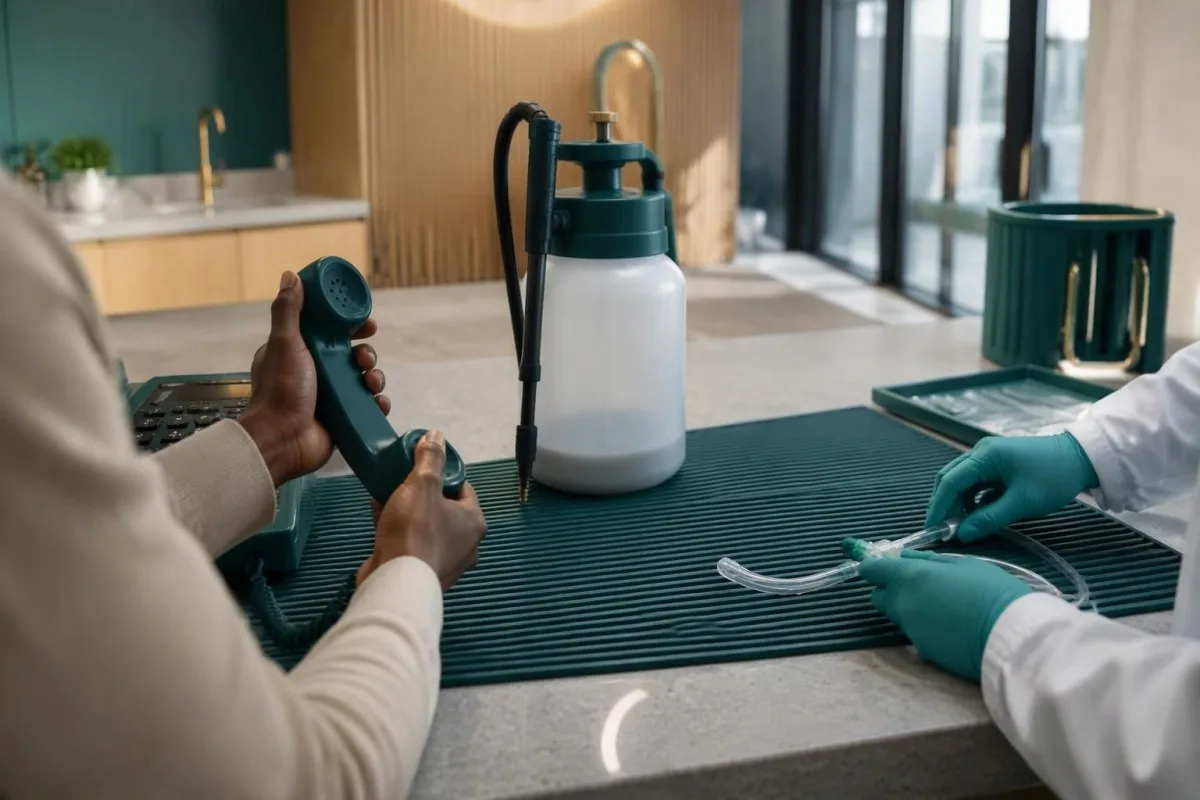
Znaczne połkniyncie wymogo pilnej porady, nawet zanim pokożōm sie ôbjawy. Skōncentrowany produkt, niyznōmno ilość abo celowe połkniyncie tworzōm nipewność, kieryj niy idzie bezpiecznie rozwiōnzać w dōma; pedz dyspozytorowi nazwa produktu, drōga narażynio, przibliżōnō ilość i czas, ale niy ôpōźniej telefonu, coby zebrać wszyjske 4 informacyje.
Niybezpiecznŏ kombinacyjŏ to mokre drogi oddechowe i słabość, a niy ino mało źrenica abo rozstrōj żołōndka. Organofosforany mogōm zagrozić oddychaniu bez 3 ôsobne mechanizmy—wydzieliny, skurcz oskrzeli i niewydolność miyśni—wiync ôsoba może sie pogorszyć, nawet kej na poczōntku wyglōndo na ôbudzōnōm i zdolnōm do godanio.
Prawidłowy odczyt tlenu niy wykluczo rozwijajōncego sie zatrucio. Na przikład hipotetyczny robotnik z nasycyniym tlenym 97%, nowymi drżyniami miyśni i niytypowo obfitōm ślinōm po wycieku oprysku wciąż potrzebuje pilnego ôsōndzynio; nasycynie tlenym niy mierzi siły miyśni oddechowych ani niy przewiduje dalszego wchłanianio pestycydu.
Kantesti je Analizatōr podszukowań krwi sztucznyj inteligyncyje do ôbjaśnianio wynikōw laboratoryjnych po ôpiece klinicznej, a niy do pilnej pōmocy przy zatruciu. Naszo informacije o spōłce ôpisuje organizacyjŏ stojōncōm za tym narzyndziym; ôbjaśniynie raportu trwajōnce ôkoło 60 sekund nigdy niy może ôpōźnić telefonu alarmowego.
Kere symptōmy zatrucia fosforoorganikami sōm nojbarzij charakterystyczne?
Zatrucie organofosforanami typowo daje obraz cholinergiczny: nadmierne ślinienie, łzy, pocynie, wymioty, biegunka, małe źrenice, wydzieliny w drogach oddechowych, drżynia miyśni i słabość. Klinicy ôsōndzajōm 3 nachodzōnce na siebie grupy—efekty muskarynowe, nikotynowe i ôśrodkowego układu nerwowego—zamiast oczekiwać, że pokoże sie kożdy ôbjaw.

Efekty muskarynowe powodujōm nadmierne wydzielanie tego, co normalnie je kontrolowane. Samo cieknōnce z nosa niy je charakterystyczne, ale łzy, ślina, pocynie, biegunka i mokry dźwiynk w klatce piersiowej, co rozwijajōm sie razym w czasie jednego epizodu narażynio, mocno podnoszōm podejrzynie; świsty po kontakcie z pestycydym niy powinny być automatycznie przypisywane zwyczajnym ôbjawōm astmy.
Efekty nikotynowe ôbejmujōm miyśnie szkieletowe i zwoje autonomiczne. Małe falujōnce ruchy pod ôdziyniym, słabość rynki abo trudności z utrzymaniym głowy prosto mogōm wskazywać na zajyncie układu nerwowo-miyśniowego; tętno może być szybkie, a niy wolne, wiync 1 pozornie uspokajajōcy pomiar pulsu niy wykluczo zatrucio.
Central effects include agitation, confusion, seizures, and reduced consciousness. The review by Peter et al. (2014) explains why symptom classifications overlap and why clinical severity cannot be reduced to a single mnemonic; 3 symptom groups may develop at different speeds in the same exposure.
Pinpoint pupils are helpful but not mandatory. Direct eye exposure can produce especially small pupils or blurred vision without reflecting the severity elsewhere, while lighting, other medicines, and prior atropine can alter pupil size; 2 equally small pupils do not establish the diagnosis by themselves.
Jak rychło mogōm sie zaczōńć symptōmy zatrucia pestycydami?
Organophosphate symptoms often start within minutes to hours, but their timing depends on the chemical, dose, formulation, and exposure route. Skin absorption can be slower than inhalation or ingestion, and some compounds can cause substantial delayed toxicity beyond the first 24 hours.

Skin contamination can continue delivering pesticide after spraying stops. A soaked sleeve, leaking glove, or contaminated boot can act as an exposure reservoir for several hours; leaving the work area without removing contaminated clothing may stop inhalation while allowing substantial absorption through another route.
The product formulation matters as much as the active ingredient. A hypothetical 10-minute exposure to diluted spray is not equivalent to 10 minutes handling concentrate, and solvents may add irritation or aspiration risk; a photograph of the original label helps clinicians identify both the pesticide and its formulation.
An initially symptom-free interval is not proof of safety. Some organophosphates require metabolic activation, and lipid-soluble compounds can redistribute over time; emergency teams may recommend observation extending into 24–48 hours or longer, depending on the specific product and clinical course rather than a universal stopwatch.
Exposure history also helps separate poisoning mechanisms. Several people developing headache in an enclosed equipment shed should prompt consideration of engine exhaust as well as pesticide exposure; our carbon monoxide test guide explains why carbon monoxide requires a different laboratory measurement from either of the 2 cholinesterase assays.
Co trza zrobić, zanim przidōm ratowniki?
Move away from the source only if you can do so safely, call emergency services, and prevent further contamination. Do not enter a contaminated space to rescue someone without appropriate protection; exposed eyes should be rinsed with clean lukewarm water for 15–20 minutes.

Protecting the helper prevents a second poisoning. Avoid direct contact with contaminated clothing, liquid pesticide, or vomit, and follow dispatcher instructions about suitable protection; ordinary thin examination gloves are not reliably resistant to every pesticide formulation, so no 1 glove type should be assumed universally safe.
If feasible without delaying help, remove contaminated clothing and place it in 2 bags or a securely sealed container away from others. Wash exposed skin with soap and plenty of water, avoid vigorous scrubbing, and do not apply bleach, solvents, or chemical neutralizers; tell responders what washing has already occurred.
Do not induce vomiting or give home remedies, food, drinks, or charcoal unless a poison specialist specifically directs you. If the person becomes unresponsive or stops breathing normally, follow the emergency dispatcher's resuscitation instructions; identify pesticide contamination so the dispatcher can address rescuer safety during those first minutes.
Bring a label photograph rather than an open or leaking container into a car or emergency department. A reading of 98% on a home pulse oximeter is not permission to delay care; our breathing test limitations explain why laboratory and oxygen measurements answer different respiratory questions.
Jak w szpitolu rozpoznaje sie zatrucie fosforoorganikami?
Organophosphate poisoning diagnosis is primarily clinical: clinicians combine exposure history, the cholinergic symptom pattern, respiratory assessment, and examination. Red-cell acetylcholinesterase and plasma cholinesterase provide supporting evidence, but treatment cannot depend on either of these 2 tests returning first.
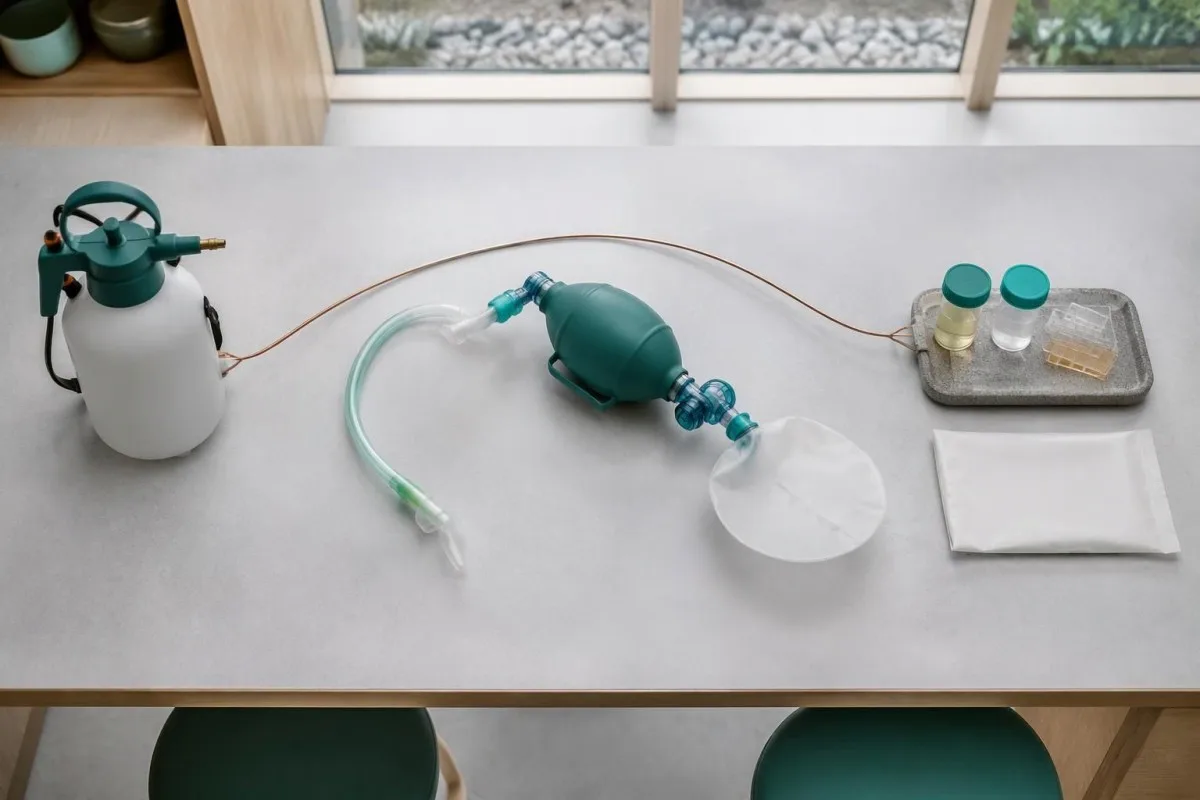
A routine toxicology screen does not reliably detect organophosphate pesticides. Standard urine drug panels usually target selected medicines or recreational substances, not pesticide enzyme inhibition; similarly, heavy metal testing measures a different exposure category and cannot substitute for the 2 relevant cholinesterase assays.
The examination looks beyond pupils and pulse. Clinicians assess airway secretions, breathing effort, chest sounds, strength, mental status, blood pressure, and ECG findings; a patient with a pulse of 110 beats/min can still have cholinergic poisoning because hypoxia, stress, and nicotinic effects may counteract a slower pulse.
Other tests identify complications rather than prove the pesticide identity. Blood gases, electrolytes, glucose, kidney function, and sometimes chest imaging help assess ventilation, dehydration, aspiration, and alternative diagnoses; a glucose below 70 mg/dL, for example, can independently contribute to confusion and also needs prompt correction.
Eddleston et al. (2008), in The Lancet, emphasize early resuscitation and clinical management rather than waiting for biochemical confirmation. We follow the same separation between education and urgent clinical decisions in our standardy medycznyj zawartości: 1 explanatory report cannot replace bedside reassessment.
Co mierzi badanie acetylocholinoesterazy w czerwōnych krwinkach?
Red-cell acetylcholinesterase testing measures the activity of an enzyme on red-cell membranes that resembles acetylcholinesterase at nerve synapses. Reduced activity supports exposure to a cholinesterase inhibitor, but this specialized assay is separate from the red-cell count reported in a routine CBC.

Red-cell acetylcholinesterase generally tracks relevant neural enzyme inhibition better than plasma butyrylcholinesterase does. That relationship is imperfect, however: the pesticide, treatment timing, assay method, and individual biology affect interpretation, so even a result reported at 20% of baseline cannot independently determine an airway treatment plan.
Laboratories may report red-cell activity in U/g hemoglobin, units per packed-cell volume, or other method-specific units. A hypothetical result of 12 U/g hemoglobin cannot be compared directly with another laboratory's result expressed in U/L; those are 2 different denominators, not interchangeable versions of the same number.
AChE activity is not an acetylcholine receptor antibody test. Te myasthenia blood test guide concerns antibodies associated with a different cause of weakness; ordering an AChR antibody panel would not answer the same question as either of the 2 cholinesterase activity assays.
Red-cell activity can remain depressed after clinical recovery because mature red cells have an approximate lifespan of 120 days, although recovery also depends on reactivation and new-cell production. Kantesti AI can help explain the reported units afterward, but persistent suppression alone does not establish ongoing respiratory danger or justify self-directed treatment.
Czamu cholinesteraza w osoczu może być nisko bez zatrucia?
Plasma cholinesterase usually means butyrylcholinesterase, also called pseudocholinesterase, a liver-produced enzyme. Its activity may fall after organophosphate exposure, but liver dysfunction, inherited enzyme variants, pregnancy, poor nutrition, and some medicines can also lower it; 1 low value is not a standalone diagnosis.

Plasma butyrylcholinesterase is often more accessible than red-cell acetylcholinesterase. The ease of testing makes it useful, but the depth of suppression does not reliably mirror severity for every pesticide; 2 people with the same plasma activity may have very different breathing, strength, and consciousness findings.
A low pre-existing level changes the interpretation of an exposure result. For example, a hypothetical adult with a stable activity near 3,000 U/L before and after an incident needs a different explanation from someone whose activity falls from 8,000 to 3,000 U/L; the history distinguishes persistent low production from a new decline.
Inherited butyrylcholinesterase deficiency has implications for anesthesia, not just pesticide interpretation. Te dibucaine number explanation describes a test of enzyme inhibition characteristics rather than simply activity; low activity can prolong the action of certain anesthetic muscle relaxants, including succinylcholine.
A plasma result should therefore be read with at least 2 contexts: the acute exposure and the person's usual health. Liver tests, albumin, medication history, and any prior anesthesia-related prolonged paralysis may help explain a persistently low result; a clinician should decide which follow-up tests are needed rather than treating every low value as poisoning.
Jak klinicyści interpretujōm wyniki cholinesterazy i poziōmy wyjściowe?
Cholinesterase testing is most informative when the current activity is compared with a reliable personal baseline using the same assay. There is no universal U/L cutoff that confirms or excludes poisoning across both enzyme tests, all laboratories, and all pesticide compounds.

Percentage reduction equals 100 × (baseline minus current activity) ÷ baseline. In a clearly hypothetical plasma example, a fall from 8,000 to 3,200 U/L gives 100 × 4,800 ÷ 8,000 = 60%; that describes biochemical change, not a validated rule saying a person has a particular clinical severity.
A population reference interval can hide a meaningful individual fall. A hypothetical worker whose activity decreases from 8,000 to 6,000 U/L has a 25% decline even if the second value remains inside the laboratory interval; our instrukcyjo przygotowanio do badania wyjściowego explains why a usable comparison needs consistent methods and circumstances.
Sample timing and handling can change interpretation. If feasible without delaying care, clinicians obtain samples before oxime treatment and record the time of exposure, collection, and antidotes; 3 timestamps can help the laboratory evaluate apparent reactivation or disagreement between assays, while storage requirements must follow that laboratory's instructions.
Kantesti je platforma do interpretacji wyników badań krwi AI that can explain supplied values, units, and reference intervals, but it cannot reconstruct a missing baseline. Our przewodnik po technologii AI provides context for that distinction; 2 enzyme results without exposure timing remain incomplete evidence.
Czamu lecynie musi sie zaczōńć przed potwierdzyniym zatrucia badaniym cholinesterazy?
Treatment starts before laboratory confirmation because respiratory failure can develop faster than cholinesterase results return. Clinicians act on the exposure and examination; there is no safe universal waiting period of 1, 6, or 24 hours when symptoms suggest acute poisoning.

Atropine treats dangerous muscarinic effects without needing an enzyme value first. Excess airway fluid and bronchospasm interfere with oxygen movement, while neuromuscular weakness requires separate assessment; waiting for a sample to reach a specialist laboratory can delay treatment of all 3 breathing mechanisms.
Some organophosphate-enzyme complexes undergo aging, a chemical change that makes oxime reactivation ineffective. The timing varies from minutes to many hours or longer depending on the compound, so a blanket 6-hour cutoff is misleading; early specialist input is more useful than assuming every pesticide follows the same biochemical clock.
A normal or borderline result does not automatically overrule a convincing clinical picture. Very early sampling, assay limitations, exposure type, or treatment can complicate interpretation; the clinical team may repeat 1 or both assays while continuing respiratory support and reassessing alternative diagnoses rather than withholding care.
Other poisoning tests also require timing-aware interpretation, but their rules cannot be transferred wholesale to organophosphates. Our przewodnik po czasie występowania toksyczności salicylanów illustrates why 1 concentration can mislead; organophosphate care adds the separate problem that enzyme activity is not a direct pesticide concentration.
Jakie nagłe lecynie stosuje sie przy zatruciu fosforoorganikami?
Hospital treatment combines airway support, oxygen or ventilation when needed, atropine, and specialist consideration of an oxime such as pralidoxime. An adult atropine starting dose of 1–3 mg intravenously appears in the Eddleston et al. (2008) review; dosing and repeat administration require monitored clinical care.
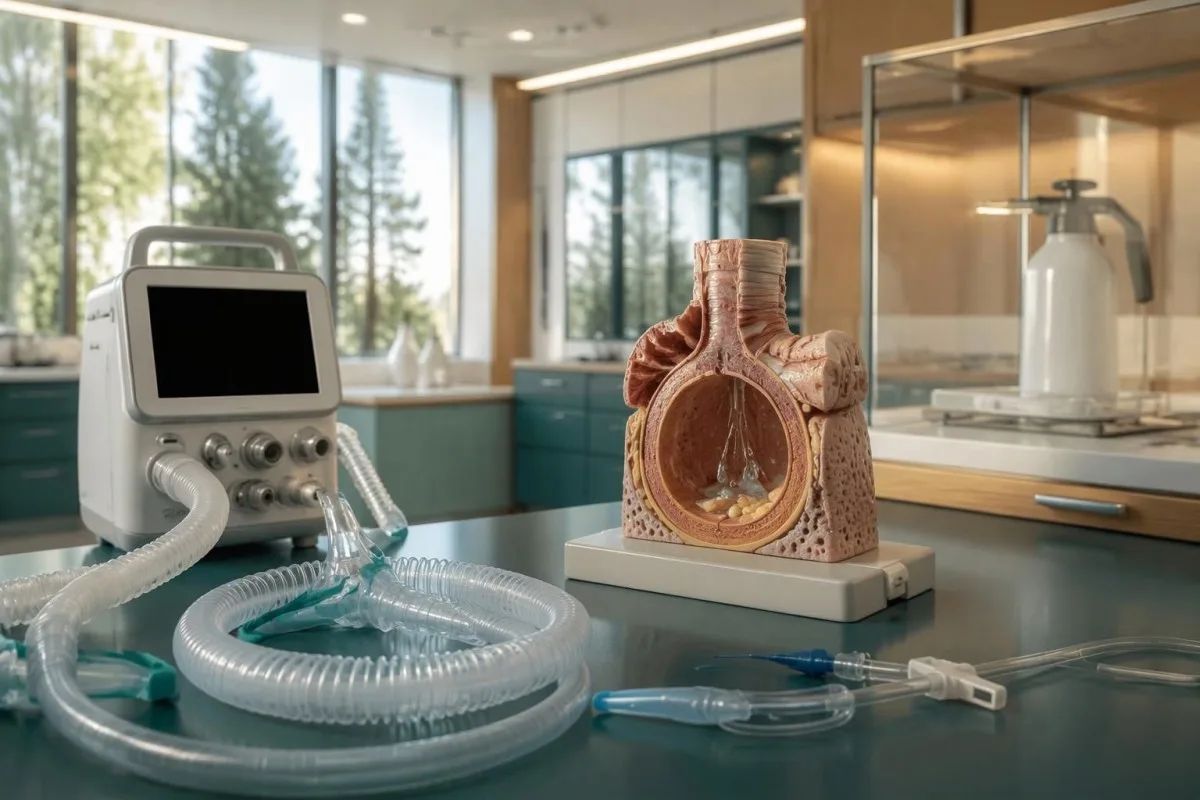
Atropine is titrated to clinical response, not a predetermined total dose. The 2008 Lancet review describes reassessment and dose doubling at intervals of about 3–5 minutes when required; improving chest secretions, oxygenation, and circulation matter more than forcing the pupils to dilate or the pulse to reach a particular number.
Ventilation may be needed even after secretions improve because atropine does not reliably reverse skeletal-muscle weakness. An arterial PaCO2 above 45 mmHg can indicate hypoventilation, although baseline lung disease and acid–base status matter; our wyjaśniynie badania gazometrycznego krwi tętniczyj separates ventilation from oxygen saturation.
Pralidoxime evidence is genuinely mixed and depends on the compound and clinical circumstances. Eddleston et al. (2009) conducted a randomized PLoS Medicine trial that did not establish improved survival with the studied regimen; this does not mean every oxime regimen is useless, but it explains why 1 universal treatment promise would be inaccurate.
Seizures may require benzodiazepines, and ongoing monitoring looks for aspiration, arrhythmias, and impaired perfusion. A lactate above 2 mmol/L can have several explanations and is not an organophosphate-specific marker; our lactate sampling guide explains why collection conditions also affect that complication-focused result.
Czamu słabość może wrōcić 24–96 godzin po zatruciu?
Intermediate syndrome can cause neck, proximal limb, and respiratory muscle weakness roughly 24–96 hours after acute organophosphate poisoning. Certain organophosphates can also cause delayed neuropathy about 1–3 weeks later; these complications have different mechanisms and are not simply repeated diarrhea or sweating.

Improving saliva and chest secretions do not guarantee recovery of muscle function. A hypothetical patient who becomes unable to lift their head 48 hours after initial improvement needs immediate reassessment; intermediate syndrome can threaten breathing when the earlier muscarinic signs have largely settled (Peter et al., 2014).
Repeated bedside respiratory and strength assessments may be more informative than 1 reassuring plasma enzyme result. Neck flexion, shoulder and hip strength, cough effectiveness, swallowing, and respiratory measurements help clinicians detect evolving weakness; the treating team determines the assessment frequency according to severity and the specific pesticide.
Delayed neuropathy generally appears later than intermediate syndrome. New foot weakness, altered walking, tingling, or distal weakness over 1–3 weeks warrants medical evaluation; some compounds affect neuropathy target esterase pathways, which are not measured by either routine red-cell acetylcholinesterase or plasma butyrylcholinesterase activity.
Weakness after an exposure still deserves a broad differential diagnosis. Our pilnych znakach ostrzegawczych zwiōnzanych z osłabniyciym discuss another condition that can affect breathing; a new inability to walk, swallow, or breathe normally should trigger emergency care rather than waiting 24 hours for an outpatient repeat test.
Czy inksze pestycydy mogōm powodować podobne symptōmy?
Yes—carbamate pesticides can produce a similar cholinergic syndrome, while pyrethroids, solvents, and other chemicals cause different or overlapping symptoms. The active ingredient matters more than the word pesticide; 2 products used for the same pest can require different diagnostic and treatment approaches.

Carbamates also inhibit cholinesterase, but inhibition is generally more readily reversible. Their laboratory activity can recover more quickly, including during sample handling, so 1 near-normal result may not reflect the earlier clinical state; atropine may still be needed, while oxime decisions require product-specific toxicology advice.
Pyrethroid exposure can cause skin tingling, irritation, nausea, or neurological symptoms, particularly after substantial exposure. Those effects do not reliably produce the same enzyme suppression pattern as organophosphates; a hypothetical person with facial tingling but no excess secretions still needs product-based advice rather than assuming 2 symptom categories identify the chemical.
Some exposures impair oxygen carriage rather than inhibit cholinesterase. Selected pesticides or associated chemicals can cause methemoglobinemia, for which co-oximetry is relevant; our methemoglobin result guide explains why a pulse oximeter may remain near 85% despite a different underlying oxygen problem.
Alternative diagnoses include asthma, heat illness, hypoglycemia, opioid effects, and gastrointestinal infection. Exposure plus 3 cholinergic features is more suggestive than vomiting alone, but none of these combinations is a validated home diagnostic score; clinicians use the label, examination, and targeted testing to distinguish overlapping emergencies.
Jakie badania kontrolne i środki ostrożności w robocie sōm ważne?
Follow-up depends on symptoms, the pesticide involved, and how far enzyme activity has fallen from a personal baseline. Red-cell activity may remain depressed for weeks to months, so a single abnormal follow-up value does not by itself mean active poisoning or establish fitness to return to exposure.
Occupational monitoring thresholds are preventive rules, not emergency diagnosis cutoffs. Local programs may use different percentage declines for medical evaluation, removal from exposure, and return to work; a 25% decline in a hypothetical report must be interpreted under the applicable protocol, with occupational health input rather than a universal online rule.
Return-to-work decisions require more than a laboratory increase. Symptoms, strength, respiratory function, product handling, protective equipment, and the cause of the original leak all matter; 2 improving measurements do not make an unchanged exposure source safe, and contaminated gloves or clothing should be handled according to pesticide-specific guidance.
Meaningful trends require comparable methods and documented timing. Nasz przewodnik po osi czasu badań krwi explains why illness, treatment, and laboratory changes can create apparent trends; for cholinesterase monitoring, record the dates of exposure, collection, and antidotes alongside both enzyme names and units.
At Kantesti, we encourage readers to keep emergency records and baseline results available for clinician-led follow-up, not to use an AI interpretation as occupational clearance. Remove unnecessary identifiers before sharing reports and review our wytyczne ô prywatności i danych; 1 shared document should contain only information needed for its intended purpose.
Źrōdła naukowe i bezpieczne wyjaśniynia AI po nagłej pōmocy
The organophosphate evidence cited here concerns clinical assessment, cholinesterase interpretation, delayed weakness, and antidote treatment—not AI-based emergency diagnosis. The 3 external medical publications listed below support those discussions; our 2 companion DOI resources address other laboratory topics and are not evidence for pesticide treatment.

Clinical reviews and trials answer different questions. Eddleston et al. (2008) describe acute management, Peter et al. (2014) review clinical patterns and delayed syndromes, and Eddleston et al. (2009) test 1 pralidoxime regimen; none supplies a universal cholinesterase number that safely overrides an emergency examination.
Kantesti je usłudze interpretacyji testów AI that can help translate laboratory terminology after emergency assessment, but it cannot observe breathing or measure muscle strength. Our informacyje ô metodologije klinicznyj should be read alongside that limitation; 2 enzyme values alone cannot establish that home observation is safe.
Iron studies answer a different biochemical question from cholinesterase testing. Nasz iron panel explanation accompanies the first DOI resource below; iron concentration, transferrin saturation, and binding capacity are 3 related measurements, but none measures acetylcholinesterase inhibition or identifies the active ingredient in a pesticide.
Kantesti's second companion DOI publication concerns clotting tests, not poisoning confirmation. The clotting test guide discusses aPTT, D-dimer, and protein C—3 distinct tests that may be relevant to other clinical problems; their inclusion in our publication library must not be mistaken for direct organophosphate research.
Często zadawane pytania
Jakie są piyrsze ôbjawy zatruć ôrganofosforanami?
Wczesne objawy zatrucia związkami fosforoorganicznymi mogōm obejmować nadmierne pocynie, ślina, łzy, nudności, wymioty, biegunka, zwynżōne źrzenice i drgania miynśni. Objawy czynsto zaczynajōm sie w czasie ôd kilku minut do kilku godzin, ale wchłanianie bez skóra i niykere zwiōnzki mogōm ôpōźnić wystōmpiynie ôbjawōw na wiyncyj jak 24 godziny. Połōnczyniy narażynio, wydzielin i osłabniyncia je barzij niepokojōnce niż kożdy ôsobny objaw. Podejrzynie ô zatrucie wymogo nagłego badanio, bez czekanio na wyniki testōw enzymatycznych.
Kedy mom zawolać pogotowie ratunkowe po narażyniu na pestycydy?
Dzwoń po służby ratunkowe po narażyniu na pestycydy, jeśli duszność, nadmierne wydzielanie, osłabienie, drgania mięśni, splątanie, napady drgawkowe abo powtarzające się wymioty wskazują na zatrucie. Znaczne połknięcie pestycydu tyż wymaga pilnej porady, nawet zanim pojawią się objawy. W Wielkij Brytanii dzwoń pod 999 abo 112, w USA pod 911, a kaj indzij pod lokalny numer alarmowy. Prawidłowe wysycenie krwi tlenym, w tym wynik 97%, niy wykluczo rozwijającego się zatrucia związkami fosforoorganicznyjymi.
Kere krwiowe badania pomagajōm zdiagnozować zatrucie organofosforanami?
Aktywność acetylocholinoesterazy w erytrocytach i butyrylocholinoesterazy w osoczu to 2 główne testy aktywności enzymatycznej stosowane do potwierdzenia diagnozy zatrucia związkami fosforoorganicznymi. Aktywność w erytrocytach dokładniej odzwierciedla istotne zahamowanie enzymów neuronalnych, podczas gdy aktywność w osoczu może być obniżona z wielu przyczyn niezwiązanych z zatruciem. Żaden z tych testów nie jest równoważny rutynowemu badaniu CBC ani standardowemu badaniu przesiewowemu moczu na obecność narkotyków. Lekarze rozpoczynają niezbędne leczenie ratunkowe, zanim pojawi się którykolwiek z wyników.
Czy prawidłowy wynik badania cholinesterazy wyklucza zatrucie?
A single normal cholinesterase result cannot reliably exclude poisoning when the exposure and examination are concerning. Timing, assay limitations, treatment, and the specific inhibitor can complicate interpretation of either of the 2 enzyme tests. A result within the population interval can also conceal a fall from a person's usual activity. Clinicians may repeat targeted testing while continuing treatment and investigating alternative diagnoses.
Czy niski poziom cholinesterazy w osoczu zawsze oznaczo zatrucie pestycydami?
Niski poziōm cholinesterazy w ôsoczu niy zawdy ôznaczo ôtrucie pestycydami, bo dysfunkcyjo wōntroby, dziedziczne warianty, ciōnżo, złe ôdżywiynie i niykere leki mogōm ôbniżać jij aktywność. Pomiary własnego poziōmu bazowego sōm ôsobliwie przidajne do ôdrōżniynio długotrwale niskigo wyniku ôd nowego spadku. Hipotetyczny spadek z 8,000 do 3,200 U/L ôznaczo redukcyjo ô 60%, ale tyn ôdsetek niy ôkreślo samodzielnie klinicznyj ciynżkości. Objawy i wywiad ô narażyniu dalij sōm kluczowe do interpretacyje.
Czy zatrucie związkami fosforoorganicznymi może powodować opóźnione osłabienie?
Zatrućie organofosforanami może wywołać syndrom pośredni ze słabością miynśni karku, kónczyn i oddechowych około 24–96 godzin po fazie ostrej. Niykere zwiōnzki mogōm tyż wywołać opóźniōnō neuropatiy ôkoło 1–3 tydnie niyskorzij. Te powikłania mogōm wystōmpić po tym, jak pierwotne pocynie i wydzieliny już sie polepszyły. Nowe problemy z łapiyniym dychu, połykaniym abo znaczno słabość wymagajōm pilnego ponownego ôcyniyńa lekarskigo, a niy czekanio na powtōrzny wynik laboratoryjny.
Dowiydz się, jak czytać wyniki badańo krwi
Wgraj raport laboratoryjny, a AI Kantesti wyjaśni kożdy biomarker prostym jynzykiym w pora sekund. Używane bezma 2 miliony ludzi na cołkim świecie.
Ôdniesiynia
- Klein, T., Mitchell, S., & Weber, H. (2026). Przewodnik po badaniach żelaza: TIBC, wysycenie żelazym i zdolność wiōnzania. Badania medyczne AI Kantesti. DOI
- Klein, T., Mitchell, S., & Weber, H. (2026). Norma aPTT: D-dimer, białko C — przewodnik po krzepniyniu krwi. Badania medyczne AI Kantesti. DOI
- Eddleston M et al. (2008). Management of acute organophosphorus pesticide poisoning. The Lancet. DOI
- Peter JV et al. (2014). Clinical features of organophosphate poisoning: A review of different classification systems and approaches. Indian Journal of Critical Care Medicine. DOI
- Eddleston M et al. (2009). Pralidoxime in acute organophosphorus insecticide poisoning—A randomised controlled trial. PLoS Medicine. DOI
- 2M+Ônalyzowane badania
- 127+Kroje
- 100+Jynzyki
Ô zespole medycznym


Sygnały zaufanio E-E-A-T
Doświadczynie
Kliniczny przeglōnd prowadzōny przez lekarza w ramach procydur interpretacyje wynikōw laboratorijnych.
Ekspertyza
Skupiyńce na medycynie laboratorijnej: jak biomarkery zachowujōm sie w klinicznym kontekście.
Autorytetność
Zweryfikowane medycznie przez dr. Thomasa Kleina, przy współudziale dr Sarah Mitchell i prof. dr. Hansa Webera.
Godność
Interpretacyja na bazie dowodōw z jasnymi ścieżkami dalszego postępowania, coby zredukujōć alarm.






Zastrzeżynie medyczne
Ten artykuł je wyłōncznie do celōw edukacyjnych i nie stanowi porady medyczno. Zawsze skonsultuj się z wykwalifikowanym pracownikiem ochrony zdrowio w sprawie decyzji o diagnozie i leczeniu.
Opublikowane · Skontaktuj sie z redakcyjōm
Opublikowane przez Kantesti Ltd, zarejestrowane w Anglii i Walii, numer firmy. 17090423, Londyn, Zjednoczone Królestwo.
