Aprèp una exposicion als pesticidas, una salivacion excessiva, la sudacion, los vomits, de pupillas puntiformas, de tremolaments musculars, una feblesa o una dificultat respiratòria pòdon indicar una intoxicacion. Una sospècha d'intoxicacion als organofosforats necessita de suenhs d'urgéncia — esperetz pas los resultats de colinesterasa.

Punts essencials
- Accion d’urgéncia: Telefona al 999 o al 112 al Reialme Unit, al 911 als Estats Units, o a ton numèro local d'urgéncia en cas d'intoxicacion sospèchada amb de simptòmas.
- Dangièr respiratòri: Los organofosforats pòdon comprometre la respiracion per 3 mecanismes — secrecions de las vias respiratòrias, estrenchament de las vias respiratòrias e feblesa dels muscles respiratòris.
- Simptòmas recents: La sudacion, la saliva, las lagremas, los vomits, la diarrea, las pupillas pichonas e los tremolaments son mai inquietants quand n'apareisson mantuns ensems aprèp l'exposicion.
- Moment de l'exposicion: Los simptòmas començan sovent dins las minutas o las oras, mas l'absorpcion per de vestits contaminats o per la pèl pòt provocar una malautiá retardada.
- Dos tèsts enzimàtics: L'acetilcolinesterasa dels globilhs roges e la butirilcolinesterasa plasmatica sostenon lo diagnostic; cap de las doas remplaça pas una avaloracion clinica immediata.
- Referéncia personala de basa: Una diminucion ipotetica de 8,000 a 3,200 U/L representa una reduccion de 60%, pas una categoria de gravetat definida universalament.
- Descontaminacion dels uèlhs: Rincatz los uèlhs expausats amb d’aiga neta e tebeja pendent 15–20 minutas mentre que se sollicita d’ajuda d’urgéncia.
- Feblesa tardiva: Un sindròma intermediari pòt se desvolopar aperaquí 24–96 oras après una intoxicacion aguda; certans compausats pòdon causar una neuropatia tardiva aperaquí 1–3 setmanas après.
Quand los simptòmas aprèp una exposicion als pesticidas necessitan una ajuda d'urgéncia?
Los simptòmas d’una intoxicacion pels organofosforats exigisson una evaluacion d’urgéncia quand una exposicion a de pesticidas es seguida de dificultat respiratòria, de secrecions excessivas, de fasciculacions, de feblesa, de confusion o de vomiments repetits. Apelatz lo 999 o lo 112 al Reialme Unit, lo 911 als Estats Units, o lo numèro d’urgéncia local; esperetz pas la confirmacion del laboratòri.
Una ingestion importanta justifica de demandar conselh d’urgéncia quitament abans l’aparicion de simptòmas. Un produit concentrat, una quantitat desconeguda o una ingestion intencionala crean una incertitud que pòt pas èsser resolguda sens risc a l’ostal; indicatz al telefonista lo nom del produit, la via d’exposicion, la quantitat aproximativa e l’ora, sens retardar l’apèl per recampar los 4 detalhs.
La combinason perilhosa es de vias aerianas umidas e de feblesa, pas simplament una pupilla pichona o un mal d’estomac. Los organofosforats pòdon comprometre la respiracion per 3 mecanismes diferents —secrecions, broncoespasme e insufisença muscular—, e una persona pòt doncas s’agreujar quitament se sembla al començament alerta e capabla de parlar.
Una lectura normala de l’oxigèn exclutz pas una intoxicacion en evolucion. Per exemple, un obrièr ipotetic amb una saturacion d’oxigèn de 97%, de novèlas fasciculacions e una salivacion inhabitualament abondanta après una fuga d’aspersion a totjorn besonh d’una evaluacion d’urgéncia; la saturacion d’oxigèn mesura pas la fòrça dels muscles respiratòris e permet pas de predire una absorpcion contunhada de pesticida.
Kantesti es un Analizador de tèst de sang d'IA per explicar los rapòrts de laboratòri après los suènhs clinics, pas coma servici d’urgéncia per intoxicacion. Nòstra informacion de la societat descriu l’organizacion que se tròba darrièr l’aisina; una explicacion del rapòrt que dura aperaquí 60 segondas deu jamai retardar un apèl d’urgéncia.
Quins simptòmas d'intoxicacion als organofosforats son los mai caracteristics?
Una intoxicacion pels organofosforats produch tipicament un quadre colinergic: salivacion, lacrimacion, sudacion, vomiments, diarrèa, pupillas pichonas, secrecions de las vias aerianas, fasciculacions muscularas e feblesa en excès. Los clinicians avaloran 3 grops que se recobrisson —efèctes muscarinics, nicotinics e sul sistèma nerviós central— puslèu que d’esperar l’aparicion de totes los simptòmas.

Los efèctes muscarinics rendon excessivas de secrecions normalament contrarotladas. Un nas que raja tot sol es un signe non especific, mas la lacrimacion, la salivacion, la sudacion, la diarrèa e un torax amb de bruch umide que se manifestan ensems al cors d’un sol episòdi d’exposicion aumentan fòrça la preocupacion; un siblet après un contacte amb de pesticidas deu pas èsser atribuit automaticament a de simptòmas ordinaris d’asma.
Los efèctes nicotinics concernisson los muscles esqueletics e los ganglions del sistèma nerviós autonòm. De pichons movements ondulants jos los vestits, una feblesa de la man o una dificultat a téner lo cap drech pòdon indicar una implicacion neuromusculara; lo ritme cardiac pòt èsser rapid puslèu que lent, per çò qu’una sola mesura de pols aparentament rassuranta exclutz pas una intoxicacion.
Central effects include agitation, confusion, seizures, and reduced consciousness. The review by Peter et al. (2014) explains why symptom classifications overlap and why clinical severity cannot be reduced to a single mnemonic; 3 symptom groups may develop at different speeds in the same exposure.
Pinpoint pupils are helpful but not mandatory. Direct eye exposure can produce especially small pupils or blurred vision without reflecting the severity elsewhere, while lighting, other medicines, and prior atropine can alter pupil size; 2 equally small pupils do not establish the diagnosis by themselves.
Quant de temps aprèp la contaminacion pels pesticidas pòdon començar los simptòmas?
Organophosphate symptoms often start within minutes to hours, but their timing depends on the chemical, dose, formulation, and exposure route. Skin absorption can be slower than inhalation or ingestion, and some compounds can cause substantial delayed toxicity beyond the first 24 hours.
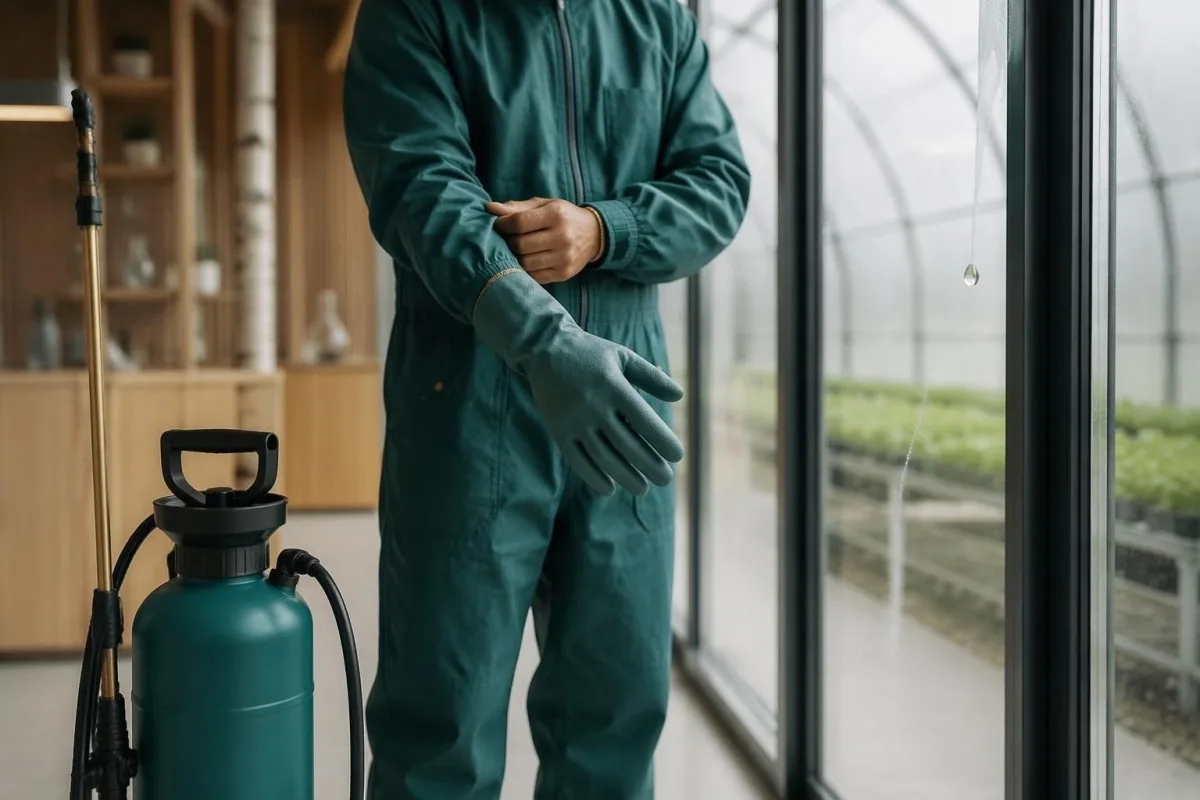
Skin contamination can continue delivering pesticide after spraying stops. A soaked sleeve, leaking glove, or contaminated boot can act as an exposure reservoir for several hours; leaving the work area without removing contaminated clothing may stop inhalation while allowing substantial absorption through another route.
The product formulation matters as much as the active ingredient. A hypothetical 10-minute exposure to diluted spray is not equivalent to 10 minutes handling concentrate, and solvents may add irritation or aspiration risk; a photograph of the original label helps clinicians identify both the pesticide and its formulation.
An initially symptom-free interval is not proof of safety. Some organophosphates require metabolic activation, and lipid-soluble compounds can redistribute over time; emergency teams may recommend observation extending into 24–48 hours or longer, depending on the specific product and clinical course rather than a universal stopwatch.
Exposure history also helps separate poisoning mechanisms. Several people developing headache in an enclosed equipment shed should prompt consideration of engine exhaust as well as pesticide exposure; our carbon monoxide test guide explains why carbon monoxide requires a different laboratory measurement from either of the 2 cholinesterase assays.
De qué cal far abans l'arribada dels secors d'urgéncia?
Move away from the source only if you can do so safely, call emergency services, and prevent further contamination. Do not enter a contaminated space to rescue someone without appropriate protection; exposed eyes should be rinsed with clean lukewarm water for 15–20 minutes.

Protecting the helper prevents a second poisoning. Avoid direct contact with contaminated clothing, liquid pesticide, or vomit, and follow dispatcher instructions about suitable protection; ordinary thin examination gloves are not reliably resistant to every pesticide formulation, so no 1 glove type should be assumed universally safe.
If feasible without delaying help, remove contaminated clothing and place it in 2 bags or a securely sealed container away from others. Wash exposed skin with soap and plenty of water, avoid vigorous scrubbing, and do not apply bleach, solvents, or chemical neutralizers; tell responders what washing has already occurred.
Do not induce vomiting or give home remedies, food, drinks, or charcoal unless a poison specialist specifically directs you. If the person becomes unresponsive or stops breathing normally, follow the emergency dispatcher's resuscitation instructions; identify pesticide contamination so the dispatcher can address rescuer safety during those first minutes.
Bring a label photograph rather than an open or leaking container into a car or emergency department. A reading of 98% on a home pulse oximeter is not permission to delay care; our breathing test limitations explain why laboratory and oxygen measurements answer different respiratory questions.
Cossí se diagnostica l'intoxicacion als organofosforats a l'espital?
Organophosphate poisoning diagnosis is primarily clinical: clinicians combine exposure history, the cholinergic symptom pattern, respiratory assessment, and examination. Red-cell acetylcholinesterase and plasma cholinesterase provide supporting evidence, but treatment cannot depend on either of these 2 tests returning first.
A routine toxicology screen does not reliably detect organophosphate pesticides. Standard urine drug panels usually target selected medicines or recreational substances, not pesticide enzyme inhibition; similarly, heavy metal testing measures a different exposure category and cannot substitute for the 2 relevant cholinesterase assays.
The examination looks beyond pupils and pulse. Clinicians assess airway secretions, breathing effort, chest sounds, strength, mental status, blood pressure, and ECG findings; a patient with a pulse of 110 beats/min can still have cholinergic poisoning because hypoxia, stress, and nicotinic effects may counteract a slower pulse.
Other tests identify complications rather than prove the pesticide identity. Blood gases, electrolytes, glucose, kidney function, and sometimes chest imaging help assess ventilation, dehydration, aspiration, and alternative diagnoses; a glucose below 70 mg/dL, for example, can independently contribute to confusion and also needs prompt correction.
Eddleston et al. (2008), in The Lancet, emphasize early resuscitation and clinical management rather than waiting for biochemical confirmation. We follow the same separation between education and urgent clinical decisions in our nòrmas de contengut medical: 1 explanatory report cannot replace bedside reassessment.
Qué mesura lo tèst de l'acetilcolinesterasa dels globilhs roges?
Red-cell acetylcholinesterase testing measures the activity of an enzyme on red-cell membranes that resembles acetylcholinesterase at nerve synapses. Reduced activity supports exposure to a cholinesterase inhibitor, but this specialized assay is separate from the red-cell count reported in a routine CBC.

Red-cell acetylcholinesterase generally tracks relevant neural enzyme inhibition better than plasma butyrylcholinesterase does. That relationship is imperfect, however: the pesticide, treatment timing, assay method, and individual biology affect interpretation, so even a result reported at 20% of baseline cannot independently determine an airway treatment plan.
Laboratories may report red-cell activity in U/g hemoglobin, units per packed-cell volume, or other method-specific units. A hypothetical result of 12 U/g hemoglobin cannot be compared directly with another laboratory's result expressed in U/L; those are 2 different denominators, not interchangeable versions of the same number.
AChE activity is not an acetylcholine receptor antibody test. Lo myasthenia blood test guide concerns antibodies associated with a different cause of weakness; ordering an AChR antibody panel would not answer the same question as either of the 2 cholinesterase activity assays.
Red-cell activity can remain depressed after clinical recovery because mature red cells have an approximate lifespan of 120 days, although recovery also depends on reactivation and new-cell production. Kantesti AI can help explain the reported units afterward, but persistent suppression alone does not establish ongoing respiratory danger or justify self-directed treatment.
Perqué la colinesterasa plasmatica pòt èsser bassa sens intoxicacion?
Plasma cholinesterase usually means butyrylcholinesterase, also called pseudocholinesterase, a liver-produced enzyme. Its activity may fall after organophosphate exposure, but liver dysfunction, inherited enzyme variants, pregnancy, poor nutrition, and some medicines can also lower it; 1 low value is not a standalone diagnosis.

Plasma butyrylcholinesterase is often more accessible than red-cell acetylcholinesterase. The ease of testing makes it useful, but the depth of suppression does not reliably mirror severity for every pesticide; 2 people with the same plasma activity may have very different breathing, strength, and consciousness findings.
A low pre-existing level changes the interpretation of an exposure result. For example, a hypothetical adult with a stable activity near 3,000 U/L before and after an incident needs a different explanation from someone whose activity falls from 8,000 to 3,000 U/L; the history distinguishes persistent low production from a new decline.
Inherited butyrylcholinesterase deficiency has implications for anesthesia, not just pesticide interpretation. Lo dibucaine number explanation describes a test of enzyme inhibition characteristics rather than simply activity; low activity can prolong the action of certain anesthetic muscle relaxants, including succinylcholine.
A plasma result should therefore be read with at least 2 contexts: the acute exposure and the person's usual health. Liver tests, albumin, medication history, and any prior anesthesia-related prolonged paralysis may help explain a persistently low result; a clinician should decide which follow-up tests are needed rather than treating every low value as poisoning.
Cossí los clinicians interprètan los resultats de colinesterasa e las valors de basa?
Cholinesterase testing is most informative when the current activity is compared with a reliable personal baseline using the same assay. There is no universal U/L cutoff that confirms or excludes poisoning across both enzyme tests, all laboratories, and all pesticide compounds.

Percentage reduction equals 100 × (baseline minus current activity) ÷ baseline. In a clearly hypothetical plasma example, a fall from 8,000 to 3,200 U/L gives 100 × 4,800 ÷ 8,000 = 60%; that describes biochemical change, not a validated rule saying a person has a particular clinical severity.
A population reference interval can hide a meaningful individual fall. A hypothetical worker whose activity decreases from 8,000 to 6,000 U/L has a 25% decline even if the second value remains inside the laboratory interval; our guida de preparacion al tèst de basa explains why a usable comparison needs consistent methods and circumstances.
Sample timing and handling can change interpretation. If feasible without delaying care, clinicians obtain samples before oxime treatment and record the time of exposure, collection, and antidotes; 3 timestamps can help the laboratory evaluate apparent reactivation or disagreement between assays, while storage requirements must follow that laboratory's instructions.
Kantesti es un plataforma d’interpretacion d’analisi de sang d’AI that can explain supplied values, units, and reference intervals, but it cannot reconstruct a missing baseline. Our guia de tecnologia amb IA provides context for that distinction; 2 enzyme results without exposure timing remain incomplete evidence.
Perqué cal començar lo tractament abans la confirmacion per colinesterasa?
Treatment starts before laboratory confirmation because respiratory failure can develop faster than cholinesterase results return. Clinicians act on the exposure and examination; there is no safe universal waiting period of 1, 6, or 24 hours when symptoms suggest acute poisoning.

Atropine treats dangerous muscarinic effects without needing an enzyme value first. Excess airway fluid and bronchospasm interfere with oxygen movement, while neuromuscular weakness requires separate assessment; waiting for a sample to reach a specialist laboratory can delay treatment of all 3 breathing mechanisms.
Some organophosphate-enzyme complexes undergo aging, a chemical change that makes oxime reactivation ineffective. The timing varies from minutes to many hours or longer depending on the compound, so a blanket 6-hour cutoff is misleading; early specialist input is more useful than assuming every pesticide follows the same biochemical clock.
A normal or borderline result does not automatically overrule a convincing clinical picture. Very early sampling, assay limitations, exposure type, or treatment can complicate interpretation; the clinical team may repeat 1 or both assays while continuing respiratory support and reassessing alternative diagnoses rather than withholding care.
Other poisoning tests also require timing-aware interpretation, but their rules cannot be transferred wholesale to organophosphates. Our guida sul moment de la toxicitat pels salicilats illustrates why 1 concentration can mislead; organophosphate care adds the separate problem that enzyme activity is not a direct pesticide concentration.
Quins tractaments d'urgéncia s'utilizan per l'intoxicacion als organofosforats?
Hospital treatment combines airway support, oxygen or ventilation when needed, atropine, and specialist consideration of an oxime such as pralidoxime. An adult atropine starting dose of 1–3 mg intravenously appears in the Eddleston et al. (2008) review; dosing and repeat administration require monitored clinical care.
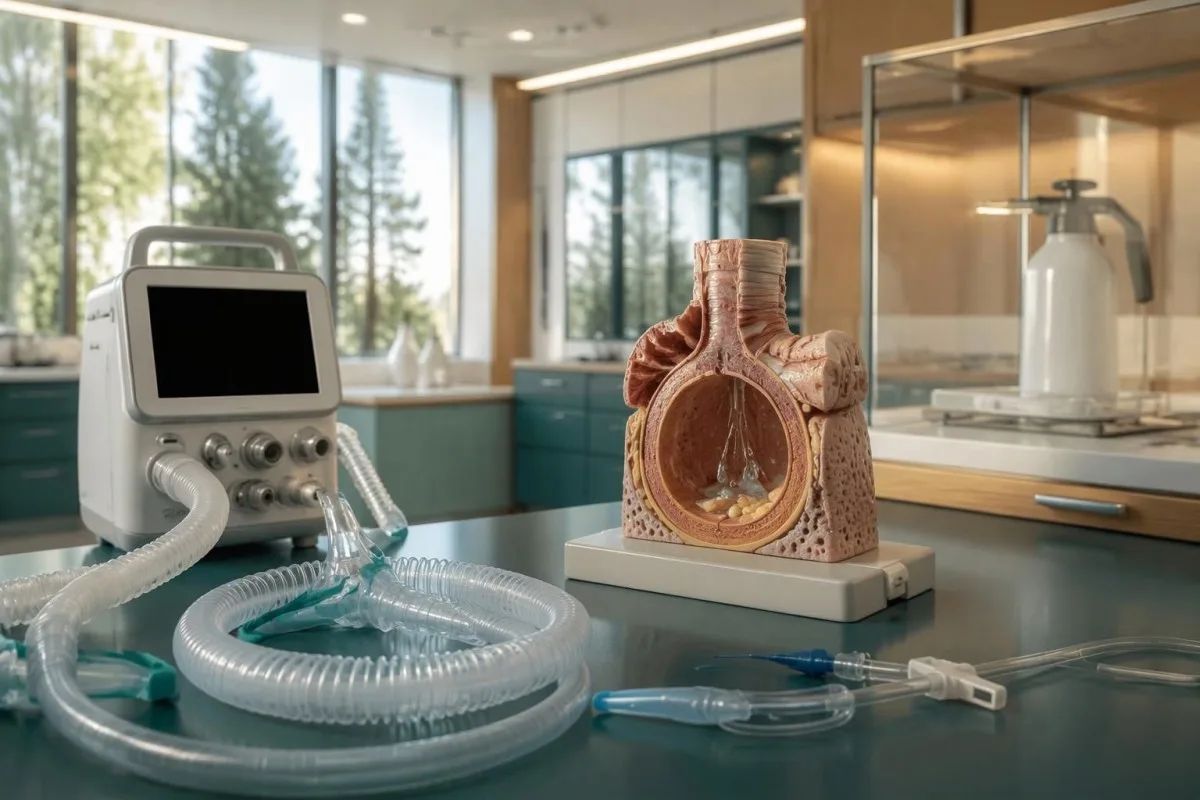
Atropine is titrated to clinical response, not a predetermined total dose. The 2008 Lancet review describes reassessment and dose doubling at intervals of about 3–5 minutes when required; improving chest secretions, oxygenation, and circulation matter more than forcing the pupils to dilate or the pulse to reach a particular number.
Ventilation may be needed even after secretions improve because atropine does not reliably reverse skeletal-muscle weakness. An arterial PaCO2 above 45 mmHg can indicate hypoventilation, although baseline lung disease and acid–base status matter; our explicacion de la gasometria arteriala separates ventilation from oxygen saturation.
Pralidoxime evidence is genuinely mixed and depends on the compound and clinical circumstances. Eddleston et al. (2009) conducted a randomized PLoS Medicine trial that did not establish improved survival with the studied regimen; this does not mean every oxime regimen is useless, but it explains why 1 universal treatment promise would be inaccurate.
Seizures may require benzodiazepines, and ongoing monitoring looks for aspiration, arrhythmias, and impaired perfusion. A lactate above 2 mmol/L can have several explanations and is not an organophosphate-specific marker; our lactate sampling guide explains why collection conditions also affect that complication-focused result.
Perqué una feblesa pòt tornar entre 24 e 96 oras aprèp l'intoxicacion?
Intermediate syndrome can cause neck, proximal limb, and respiratory muscle weakness roughly 24–96 hours after acute organophosphate poisoning. Certain organophosphates can also cause delayed neuropathy about 1–3 weeks later; these complications have different mechanisms and are not simply repeated diarrhea or sweating.

Improving saliva and chest secretions do not guarantee recovery of muscle function. A hypothetical patient who becomes unable to lift their head 48 hours after initial improvement needs immediate reassessment; intermediate syndrome can threaten breathing when the earlier muscarinic signs have largely settled (Peter et al., 2014).
Repeated bedside respiratory and strength assessments may be more informative than 1 reassuring plasma enzyme result. Neck flexion, shoulder and hip strength, cough effectiveness, swallowing, and respiratory measurements help clinicians detect evolving weakness; the treating team determines the assessment frequency according to severity and the specific pesticide.
Delayed neuropathy generally appears later than intermediate syndrome. New foot weakness, altered walking, tingling, or distal weakness over 1–3 weeks warrants medical evaluation; some compounds affect neuropathy target esterase pathways, which are not measured by either routine red-cell acetylcholinesterase or plasma butyrylcholinesterase activity.
Weakness after an exposure still deserves a broad differential diagnosis. Our los signes d’alarma de feblesa en urgéncia discuss another condition that can affect breathing; a new inability to walk, swallow, or breathe normally should trigger emergency care rather than waiting 24 hours for an outpatient repeat test.
D'autres pesticidas pòdon provocar de simptòmas semblables?
Yes—carbamate pesticides can produce a similar cholinergic syndrome, while pyrethroids, solvents, and other chemicals cause different or overlapping symptoms. The active ingredient matters more than the word pesticide; 2 products used for the same pest can require different diagnostic and treatment approaches.

Carbamates also inhibit cholinesterase, but inhibition is generally more readily reversible. Their laboratory activity can recover more quickly, including during sample handling, so 1 near-normal result may not reflect the earlier clinical state; atropine may still be needed, while oxime decisions require product-specific toxicology advice.
Pyrethroid exposure can cause skin tingling, irritation, nausea, or neurological symptoms, particularly after substantial exposure. Those effects do not reliably produce the same enzyme suppression pattern as organophosphates; a hypothetical person with facial tingling but no excess secretions still needs product-based advice rather than assuming 2 symptom categories identify the chemical.
Some exposures impair oxygen carriage rather than inhibit cholinesterase. Selected pesticides or associated chemicals can cause methemoglobinemia, for which co-oximetry is relevant; our methemoglobin result guide explains why a pulse oximeter may remain near 85% despite a different underlying oxygen problem.
Alternative diagnoses include asthma, heat illness, hypoglycemia, opioid effects, and gastrointestinal infection. Exposure plus 3 cholinergic features is more suggestive than vomiting alone, but none of these combinations is a validated home diagnostic score; clinicians use the label, examination, and targeted testing to distinguish overlapping emergencies.
Quins tèsts de seguit e precaucions al trabalh comptan?
Follow-up depends on symptoms, the pesticide involved, and how far enzyme activity has fallen from a personal baseline. Red-cell activity may remain depressed for weeks to months, so a single abnormal follow-up value does not by itself mean active poisoning or establish fitness to return to exposure.
Occupational monitoring thresholds are preventive rules, not emergency diagnosis cutoffs. Local programs may use different percentage declines for medical evaluation, removal from exposure, and return to work; a 25% decline in a hypothetical report must be interpreted under the applicable protocol, with occupational health input rather than a universal online rule.
Return-to-work decisions require more than a laboratory increase. Symptoms, strength, respiratory function, product handling, protective equipment, and the cause of the original leak all matter; 2 improving measurements do not make an unchanged exposure source safe, and contaminated gloves or clothing should be handled according to pesticide-specific guidance.
Meaningful trends require comparable methods and documented timing. Nòstre guia de cronologia dels analyses de sang explains why illness, treatment, and laboratory changes can create apparent trends; for cholinesterase monitoring, record the dates of exposure, collection, and antidotes alongside both enzyme names and units.
At Kantesti, we encourage readers to keep emergency records and baseline results available for clinician-led follow-up, not to use an AI interpretation as occupational clearance. Remove unnecessary identifiers before sharing reports and review our guida sus la confidencialitat e las donadas; 1 shared document should contain only information needed for its intended purpose.
Fuentes de recèrca e explicacions seguras per l'IA aprèp los suenhs d'urgéncia
The organophosphate evidence cited here concerns clinical assessment, cholinesterase interpretation, delayed weakness, and antidote treatment—not AI-based emergency diagnosis. The 3 external medical publications listed below support those discussions; our 2 companion DOI resources address other laboratory topics and are not evidence for pesticide treatment.
Clinical reviews and trials answer different questions. Eddleston et al. (2008) describe acute management, Peter et al. (2014) review clinical patterns and delayed syndromes, and Eddleston et al. (2009) test 1 pralidoxime regimen; none supplies a universal cholinesterase number that safely overrides an emergency examination.
Kantesti es un servici d’interpretacion de tests de l’IA that can help translate laboratory terminology after emergency assessment, but it cannot observe breathing or measure muscle strength. Our informacions sus la metodologia clinica should be read alongside that limitation; 2 enzyme values alone cannot establish that home observation is safe.
Iron studies answer a different biochemical question from cholinesterase testing. Nòstre iron panel explanation accompanies the first DOI resource below; iron concentration, transferrin saturation, and binding capacity are 3 related measurements, but none measures acetylcholinesterase inhibition or identifies the active ingredient in a pesticide.
Kantesti's second companion DOI publication concerns clotting tests, not poisoning confirmation. The clotting test guide discusses aPTT, D-dimer, and protein C—3 distinct tests that may be relevant to other clinical problems; their inclusion in our publication library must not be mistaken for direct organophosphate research.
Preguntes més freqüents
Quins son los primièrs simptòmas d'una intoxicacion pels organofosforats?
Los primièrs simptòmas d’una intoxicacion pels organofosforats pòdon inclure una sudoracion excessiva, de salivacion, de lacrimacion, de nàuseas, de vomissements, de diarrèa, de pupillas estrechas e de fasciculacions muscularas. Los simptòmas començan sovent dins las minutas o las oras, mas l’absorpcion per la pèl e cèrts compausats pòdon retardar la malautiá de mai de 24 oras. L’associacion d’una exposicion, de secrecions e d’una feblesa es mai inquietanta que quin simptòma que siá isolat. Una intoxicacion sospiechada exigís una evaluacion d’urgéncia, sens esperar los resultats dels tèsts enzimatics.
Quand devraiái apelar los servicis d’urgéncia aprèp una exposicion a un pesticida ?
Apelatz los servicis d’urgéncia aprèp una exposicion a de pesticides se de dificultats respiratòrias, de secrecions excessivas, de flaquesa, de tremolaments, de confusion, de convulsions o de vomiments repetits fan pensar a una intoxicacion. Una ingestion importanta requerís tanben un conselh urgent, quitament abans l’aparicion dels simptòmas. Apelatz lo 999 o lo 112 al Reialme Unit, lo 911 als Estats Units o lo numèro d’urgéncia local endacòm mai. Una saturacion d’oxigèn normala, quitament una mesura de 97 %, exclutz pas una toxicitat pels organofosforats en evolucion.
Quinas analisis de sang permeton de diagnosticar una intoxicacion pels organofosforats?
L’acetilcolinesterasa dels glòbuls roges e la butirilcolinesterasa plasmatica son los dos principals tèsts d’activitat enzimaticas utilizats per confirmar lo diagnostic d’intoxicacion als organofosforats. L’activitat dels glòbuls roges reflectís mai de pròche l’inibicion dels enzims neuronals pertinents, mentre que l’activitat plasmatica pòt èsser reducha per mantuna causa non ligada a una intoxicacion. Cap dels dos tèsts es equivalent a un CBC de rotina o a un tèst toxicologic estandard sus l’urina. Los mètges començan lo tractament d’urgéncia necessari abans que los resultats de l’un o de l’autre sián disponibles.
Un resultat normal de colinesterasa pòt descartar una intoxicacion ?
A single normal cholinesterase result cannot reliably exclude poisoning when the exposure and examination are concerning. Timing, assay limitations, treatment, and the specific inhibitor can complicate interpretation of either of the 2 enzyme tests. A result within the population interval can also conceal a fall from a person's usual activity. Clinicians may repeat targeted testing while continuing treatment and investigating alternative diagnoses.
Una colinesterasa plasmàtica baixa significa totjorn una intoxicacion pels pesticidas?
Una colinesterasa plasmàtica baixa significa pas totjorn una intoxicacion per pesticides, perque una disfoncion hepatica, de variants ereditàrias, la grossessa, una alimentacion insufisenta e qualques medicaments pòdon n’abaissar l’activitat. Las mesuras individualas de basa son particularament utilas per distinguir una valor bassada de longa data d’una diminucion novèla. Una diminucion ipotetica de 8,000 a 3,200 U/L representa una reduccion de 60%, mas aqueste percentatge determina pas per el sol la gravetat clinica. Los simptòmas e l’istòria de l’exposicion demòran centrals per l’interpretacion.
Una intoxicacion pels organofosforats pòt causar una feblesa retardada?
L’empoisonament pels organofosforats pòt causar un sindròme intermedi amb una feblesa dels muscles del còl, dels membres e respiratòris aproximativament 24–96 oras aprèp la fasa aguda. D’unes compausats pòdon tanben causar una neuropatia retardada aperaquí 1–3 setmanas mai tard. Aquestas complicacions pòdon aparéisser aprèp que la sudacion e las secrecions inicialas sián estadas melhoradas. Una dificultat respiratòria novèla, de problèmas per avalar o una feblesa importanta exigisson una reavaloracion medicala urgenta, puslèu que d’esperar un novèl resultat d’analisi.
Fasètz-vos explicar los resultats analisi de sang
Telecargatz vòstre compte rendut de laboratòri e l’IA de Kantesti explica cada biomarcador en lenga simpla en qualques segondas. Utilizat per mai de 2 milions de personas dins lo mond.
Referéncias
- Klein, T., Mitchell, S., & Weber, H. (2026). Guida dels bilançs del fèrre: TIBC, saturacion del fèrre e capacitat de ligam. Recèrca medicala per IA de Kantesti. DOI
- Klein, T., Mitchell, S., & Weber, H. (2026). Interval normal de l’aPTT: D-Dimer, proteïna C, guida sus la coagulacion sanguina. Recèrca medicala per IA de Kantesti. DOI
- Eddleston M et al. (2008). Management of acute organophosphorus pesticide poisoning. The Lancet. DOI
- Peter JV et al. (2014). Clinical features of organophosphate poisoning: A review of different classification systems and approaches. Indian Journal of Critical Care Medicine. DOI
- Eddleston M et al. (2009). Pralidoxime in acute organophosphorus insecticide poisoning—A randomised controlled trial. PLoS Medicine. DOI
- 2M+Tèsts analisats
- 127+Païses
- 100+Lengas
A prepaus de l’equipa medicala


Senhals de confiança E-E-A-T
Experiéncia
Revisión clinica menada pel metge de las practicas d’interpretacion de las analisis.
Expertisa
Fòcus sus la medicina de laboratòri sus cossí los biomarcadors se comportan dins un contèxte clinic.
Autoritat
Revisat medicalament pel Dr Thomas Klein, amb de contribucions de la Dr Sarah Mitchell e del Prof. Dr Hans Weber.
Fisança
Interpretacion basada sus d’evidéncias amb de camins de seguiment clars per reduzir l’alarmisme.






Avís medical
Aqueste article es solament per tòcas educatius e constituís pas de conselh medical. Consultatz totjorn un professional de la sant qualificat per las decisions de diagnostica e de tractament.
Publicat · Contactar l’equipa editoriala
Publicat per Kantesti Ltd, enregistrada en Anglatèrra e País de Galas, n° d’entrepresa. 17090423, Londres, Reialme Unit.
