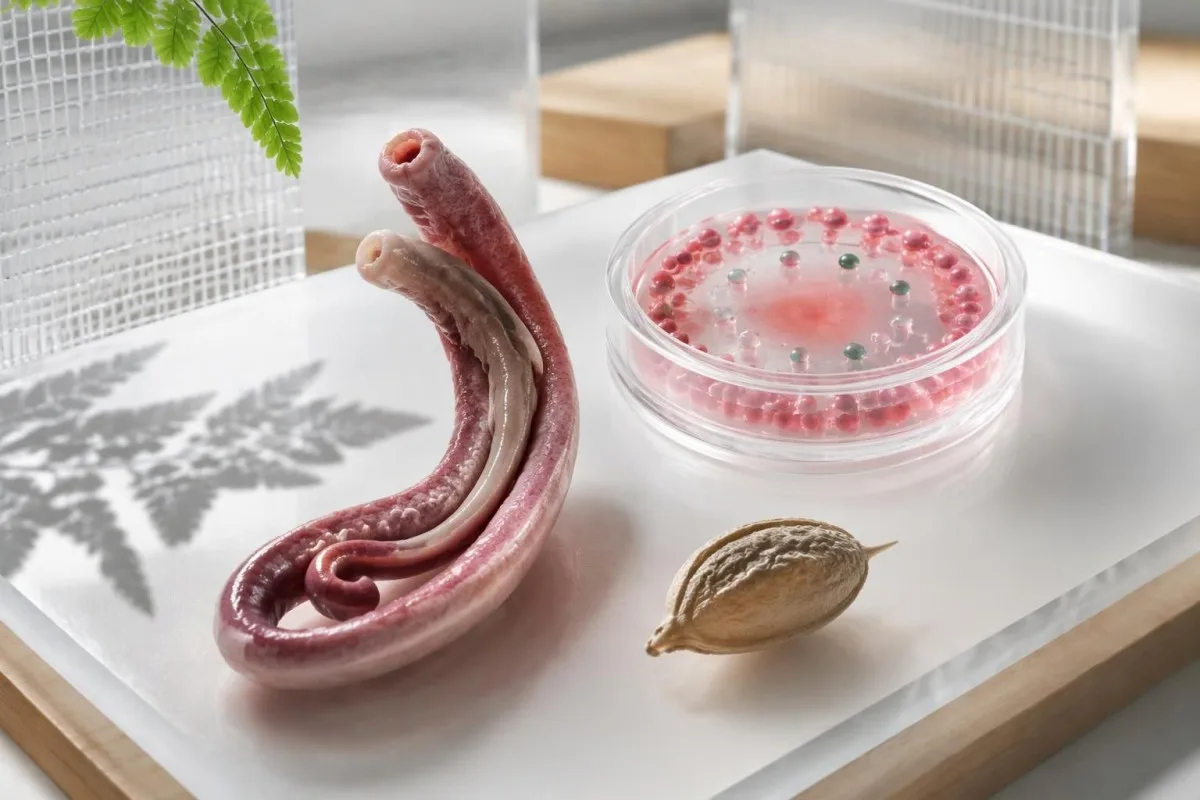
د شیسټوسوما د انټيباډي مثبته پایله، که مو له باوري تازهاوبو سره تماس لرلی وي او مخکې مو مناسبه درملنه نه وي کړې، ښايي د درملنې دلیل شي؛ خو فعاله عفونت نه شي ثابتولای او نه هم د رغېدو پخلی کولای شي. ستاسو د تماس نېټې، پخوانۍ درملنه او نورې ازموینې ټاکي چې بل ګام څه وي.

مهم ټکي
- مثبت انټي باډيز د شیسټوسوما د انټيجنونو پر وړاندې د معافیت غبرګون ښيي؛ 1 مثبته پایله نه شي کولای نادرمل شوې عفونت له پخوا درمل شوې عفونت څخه جلا کړي.
- د ازموینې کړکۍ مهم دی: CDC سپارښتنه کوي چې د شکمنې نوې عفونت لږ تر لږه 6–8 اوونۍ وروسته د انټيباډي نمونې واخیستل شي.
- له تازهاوبو سره تماس له احتمالي ککړو جهیلونو، سیندونو یا کانالونو سره د پوستکي تماس ته ویل کېږي—یوازې د یوې اغېزمنې شوې سیمې لیدلو ته نه.
- مایکروسکوپي معاینه هغه وخت ډېر معلومات ورکوي چې ډاکټران د غایطه موادو یا ادرار 3 نمونې وغواړي چې په بېلابېلو ورځو کې راټولې شوې وي.
- پرازیکوانټل معمولاً د S. mansoni او S. haematobium لپاره په 1 ورځ کې ټولټال 40 mg/kg ورکول کېږي، خو نسخه د نوعې او کلینیکي شرایطو له مخې ټاکل کېږي.
- د درملنې وخت په باثباته مسافرو کې معمولاً د وروستي تماس له تازهاوبو سره لږ تر لږه 6–8 اوونۍ انتظار کول دي، ځکه پرازیکوانټل پر بالغو چینجیو ښه اغېز کوي.
- تعقیبي مایکروسکوپي معاینه کېدای شي د درملنې 1–2 میاشتې وروسته وغوښتل شي، کله چې له درملنې مخکې هګۍ موجودې وې.
- د IgG دوامدار مثبتوالی له بریالۍ درملنې وروسته د کلونو لپاره مثبت پاتې کېدای شي؛ بله مثبته پایله په خپله د درملنې د بل پړاو توجیه نه کوي.
ایا د شیسټوسوما د انټيباډي مثبته پایله درملنې ته اړتیا لري؟
د شیستوسوما انټيباډي مثبته پایله په خپله دا معنا نه لري چې تاسو درملنې ته اړتیا لرئ. ډاکټران ډېری وخت د درملنې سپارښتنه کوي، کله چې د خوږو اوبو سره تماس د باور وړ وي او پخوانۍ کافي درملنه نه وي شوې، حتی که د مایکروسکوپۍ پایله منفي وي؛ له مستندې درملنې وروسته، که بیا له اوبو سره تماس نه وي شوی، 1 دوامداره مثبته پایله عموماً د بیا درملنې د توجیه لپاره بسنه نه کوي.
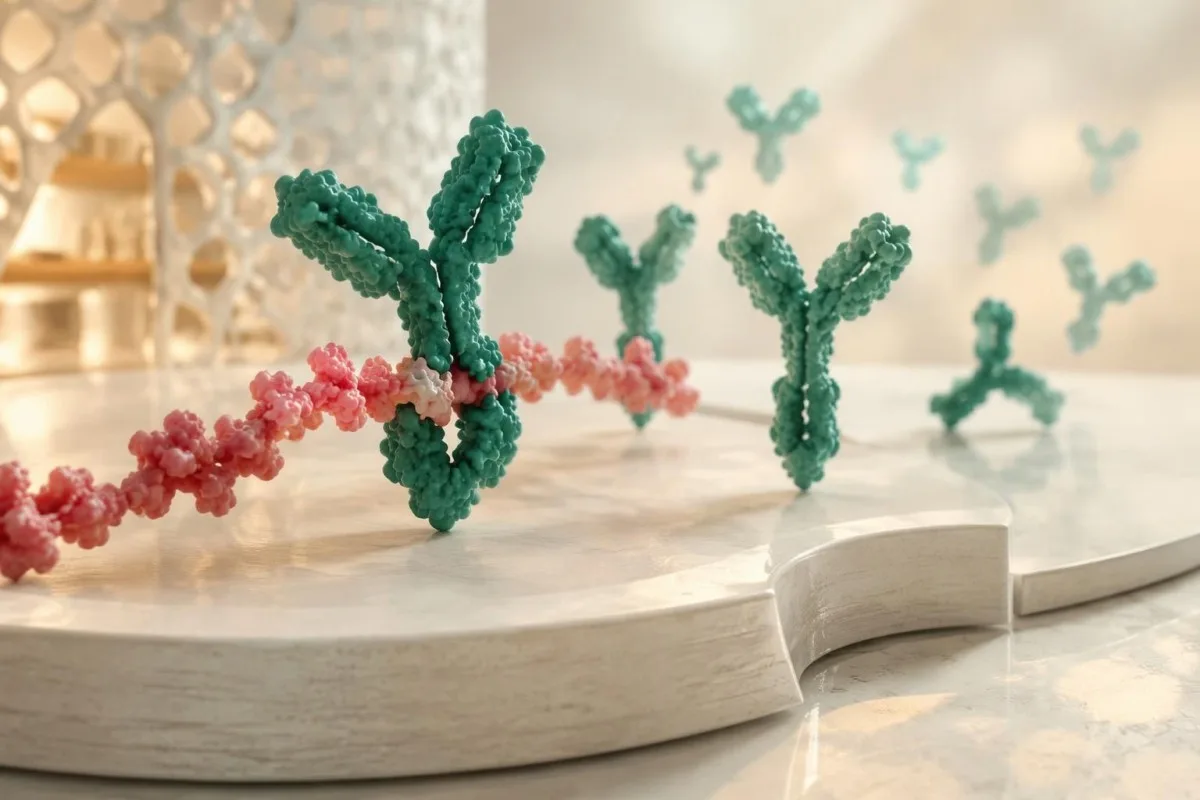
د شیستوسوما د IgG مثبتې پایلې مانا تر ټولو ښه د معافیتي پېژندنې د شواهدو په توګه درک کېږي، نه د ژوندیو چینجیو د شمېر په توګه. د انټيباډي ځواب ښايي له پرازیت څخه وروسته د کلونو لپاره پاتې شي، او 2 کسان چې راپور شوې پایله یې یو شان وي، ښايي بېلابېلې پاملرنې ته اړتیا ولري—یو د نه درمل شوې تماسموندنې له امله، بل له بریالۍ درملنې وروسته چې بیا یې له خوږو اوبو سره تماس نه وي نیولی.
پخوانۍ تماسموندنه او پخوانۍ درملنه جلا پوښتنې دي: پخوانی انتان درملنهنهشوی پاتې کېدای شي، حال دا چې پخوانۍ مثبته ازموینه تر رغېدو وروسته هم دوام کولی شي. مخکې له دې چې 1 راپور د فعالې ناروغۍ یا بېضرره مخینې په توګه تعبیر کړئ، د درملنې نوم، دوز، نېټه او له هغه وروسته له اوبو سره هر ډول تماس وګورئ؛ زموږ د مثبت انټي باډي پایلې تشریح د شواهدو دا بېلابېل ډولونه روښانوي.
Kantesti د وینې د ازموینو د تحلیل لپاره د AI وسیله ده چې د دې په تشریح کې مرسته کوي چې ولې د شیستوسوما د IgG 1 مثبته پایله فعال انتان نه شي ثابتولی، حتی کله چې بشپړ وینې شمیرنه عادي وي. زموږ دنده د راپور تشریح ده—نه د پرازیت پېژندل او نه د درملو تجویز—او زموږ سازمان او هدف باید دلته د تشریح شوو، د ډاکټر تر لارښوونې لاندې پرېکړو څخه جلا درک شي.
له کومو تازهاوبو سره تماس دا پایله باوريتر کوي؟
په یوه د لېږد په سیمه کې د خوږو اوبو سره د پوستکي تماس مثبته پایله له کلینیکي پلوه ډېرې مانا لرونکې کوي. په ډنډونو، سیندونو او د اوبو لګولو ویالو کې لامبو وهل، په اوبو کې ګرځېدل، غسل کول، د بېړۍ په واسطه سفر کول یا مینځل د تماسموندنې لامل کېدای شي؛ د هرې پېښې 3 جزئیات ثبت کړئ: دقیق ځای، فعالیت او ستاسو د وروستي تماس نېټه.

د خوږو اوبو د حلزونونو له خوا خوشې شوې د شیستوسوما لاروا د پوستکي له لارې ننوځي؛ د اوبو تېرول اړین نه دي. لنډ وخت په اوبو کې ګرځېدل هم تماسموندنه ګڼل کېږي، او د خارښلرونکې دانې نشتوالی یې نه ردوي؛ نو یو فرضي مسافر چې د 5 دقیقو لپاره جهیل ته ننوتی وي، باید دا پېښه یاده کړي، نه دا چې یوازې د اوږدې لامبو ناستې ثبت کړي.
د سمندر اوبه او په سمه توګه کلورینلرونکي د لامبو حوضونه د شیستوسومیازس د تماسموندنې معمولې سرچینې نه دي. له خوږو اوبو سره تماس د نورو هغو ناروغیو په اړه هم اندېښنه راپورته کولی شي چې ازموینې او درملنه یې توپیر لري، په شمول د له اوبو سره تر تماس وروسته لپتوسپیروز; ؛ د سیند پر غاړه د فعالیت 1 اونۍ وروسته پیل شوې تبه باید له پراخې ارزونې پرته د شیستوسوما انټيباډیو ته منسوبه نه شي.
یوازې د یوه هېواد نوم د فردي خطر د ثابتولو لپاره بسنه نه کوي، ځکه لېږد په هېوادونو او د اوبو په بېلابېلو ځایونو کې توپیر لري. حتی 1 هېر شوی فعالیت هم له سره ورپه یاد کړئ—لکه د سیند تر څنګ د وسایلو مینځل—او د پرازیت له تماسموندنې څخه د واکسین د ریکارډونو توپیر وکړئ؛; د سفر پر مهال د انټيباډي معاینات یوې بلې پوښتنې ته ځواب ورکوي او د شیستوسومیازس پر وړاندې ساتنه نه برابروي.
له سفر وروسته باید د شیستوسومیاسس ازموینه کله وشي؟
د شیستوسومیازس لپاره د انټيباډي ازموینه عموماً د شکمن نوي انتان له 6–8 اونیو وروسته ډېر معلومات ورکوي. د شیستوسومیازس د کلینیکي ازموینې او تشخیص په اړه د CDC لارښود تشریح کوي چې دا موده د انټيباډیو د جوړېدو لپاره وخت برابروي؛ له دې مودې مخکې اخیستل شوې منفي پایله د خوږو اوبو له لارې د وروستي انتان د ردولو لپاره د باور وړ نه ده.
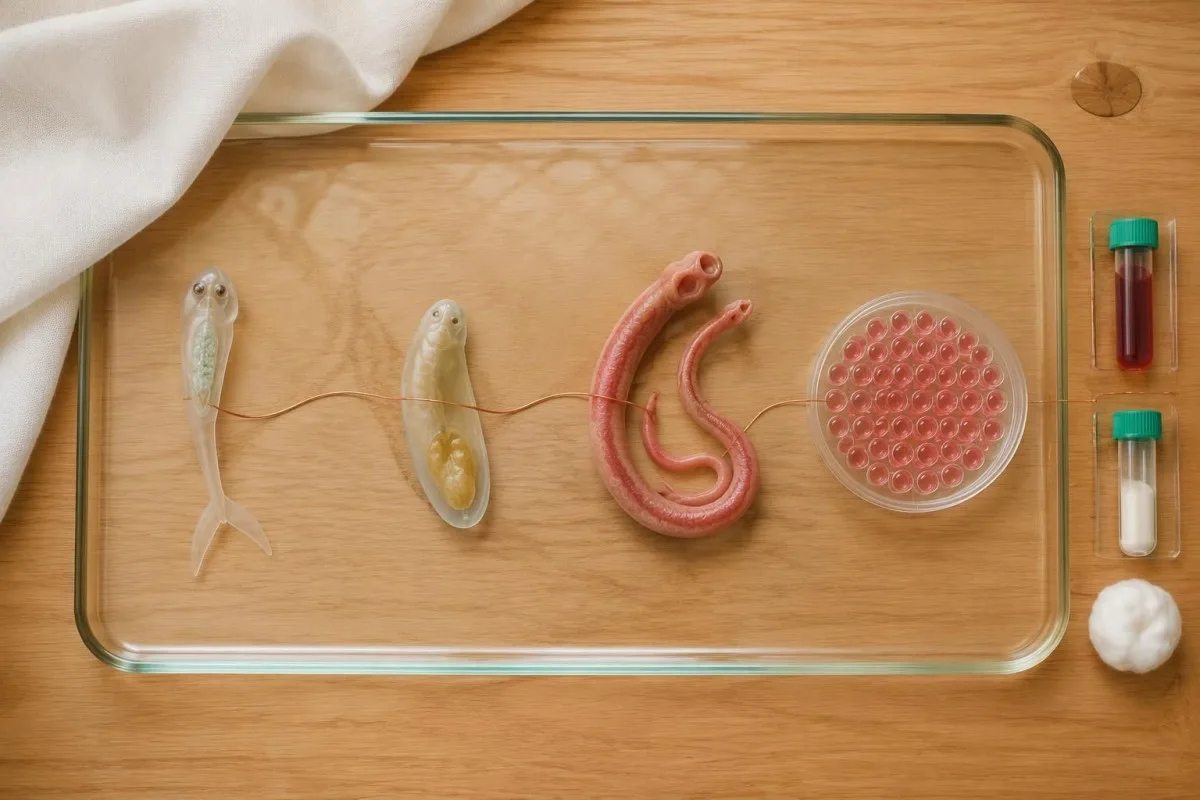
The last freshwater contact is a practical anchor when a trip involved several possible exposures. For example, a hypothetical traveler who swam on both the first and final day of a 3-week holiday should calculate the testing interval from the final swim, rather than assuming that the first exposure makes an immediate post-trip result conclusive.
Seroconversion is not identical across people or assays, so 6–8 weeks is a useful testing window rather than a guarantee of detection. When exposure is persuasive and an initial result is negative, a clinician may arrange another sample later, sometimes around 12 weeks after exposure; a second date should be agreed rather than inferred from a generic laboratory reference range.
Fever or significant symptoms after travel should be assessed without waiting for an antibody window to close, especially after a malaria-risk itinerary. At Kantesti, we encourage readers to keep 2 dates visible—last freshwater contact and sample collection—because د انفیکشن ازموینې وخت can change the meaning of a negative report even though each organism requires its own diagnostic strategy.
ایا د شیسټوسوما انټيباډي په ناسمه توګه مثبته کېدای شي؟
Schistosoma antibody tests can produce false-positive or cross-reactive results, and their performance varies by assay. There is no universal IgG concentration or index that proves active schistosomiasis; 2 laboratories may use different antigen preparations, reporting units and thresholds, making direct numerical comparisons unreliable.
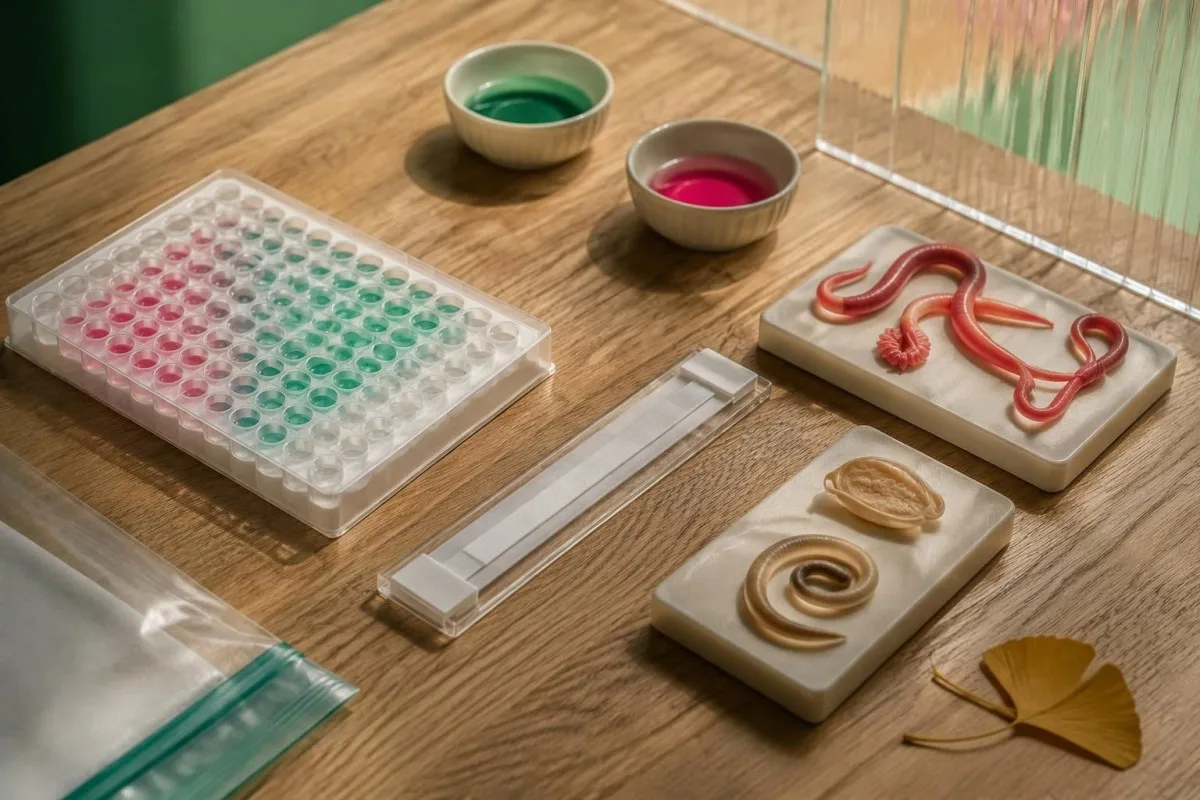
Cross-reactivity with other helminth antibodies depends on the test rather than occurring uniformly in every person. A laboratory may recommend an alternative assay or reference-laboratory review when the exposure history does not fit; 1 additional positive parasite antibody result also needs independent interpretation, as explained in our discussion of Toxocara antibody findings.
A hypothetical probability example shows why background risk matters: assume an imaginary test has 90% sensitivity and 95% specificity in 10,000 people, of whom 1% have the target infection. It would identify approximately 90 true positives and 495 false positives, so only about 15% of positive results would be true positives—these are teaching assumptions, not measured Schistosoma assay performance.
A high index should not be read as a high worm count, and a borderline index should not automatically be dismissed when exposure is strong. Ask for the assay name and the laboratory's interpretation of 1 equivocal or weakly positive result; confirmation with a different method can address assay uncertainty, but another antibody test still cannot reliably separate active infection from treated history.
د غایطه موادو او ادرار مایکروسکوپي معاینه څه شی ثابتولای شي؟
Finding characteristic Schistosoma eggs provides direct parasitological evidence, whereas negative microscopy does not exclude a light infection. CDC recommends examining 3 stool or urine samples collected on different days to improve sensitivity, because egg output can be sparse and intermittent, particularly in travelers with a low parasite burden.
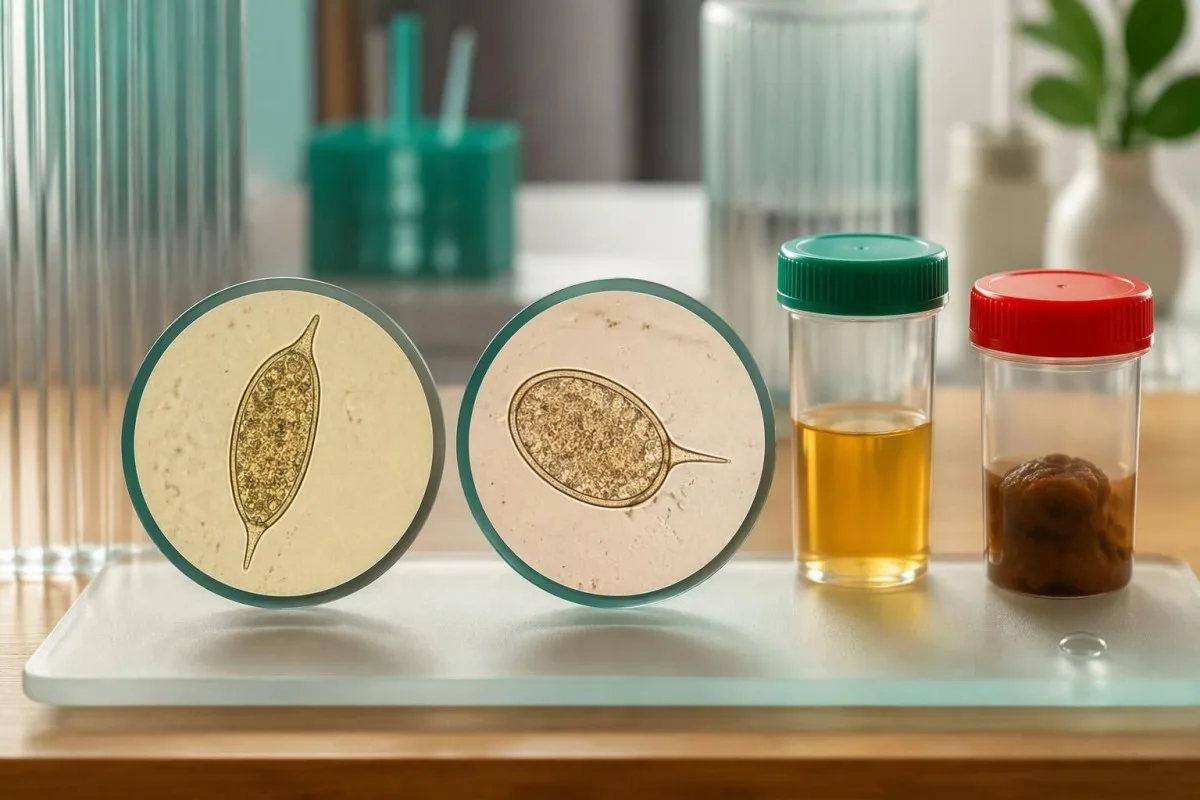
The suspected species determines specimen choice: S. mansoni and S. japonicum are usually investigated through stool, while S. haematobium is usually investigated through urine. Some exposure histories warrant both, so 1 negative stool examination does not address a possible urinary infection; د پیشاب د رسوباتو تفسیر also explains why ordinary urinary findings are not equivalent to parasite identification.
Urinary egg excretion often peaks around midday, and laboratories may request a sample between approximately 12 noon and 3 pm. Urine filtration may use a measured volume such as 10 mL, but collection, transport and processing instructions vary; follow the receiving laboratory's protocol rather than improvising exercise, fluid restriction or a collection time.
Routine dipstick testing is not a substitute for a specific Schistosoma egg examination, and 1 routine stool pathogen panel may omit the parasite entirely. Check the exact tests ordered, including concentration or filtration methods when appropriate; our urinalysis method guide helps distinguish screening for cells and chemistry from targeted parasitology.
ایا د انټيجن ازموینې یا PCR فعاله عفونت په روښانه توګه ښيي؟
Schistosoma antigen tests can provide evidence more closely linked to living worms than antibody tests, but access and performance differ. Circulating anodic antigen, or CAA, and circulating cathodic antigen, or CCA, are 2 distinct targets; PCR detects parasite DNA and needs interpretation according to specimen, timing and the laboratory method.
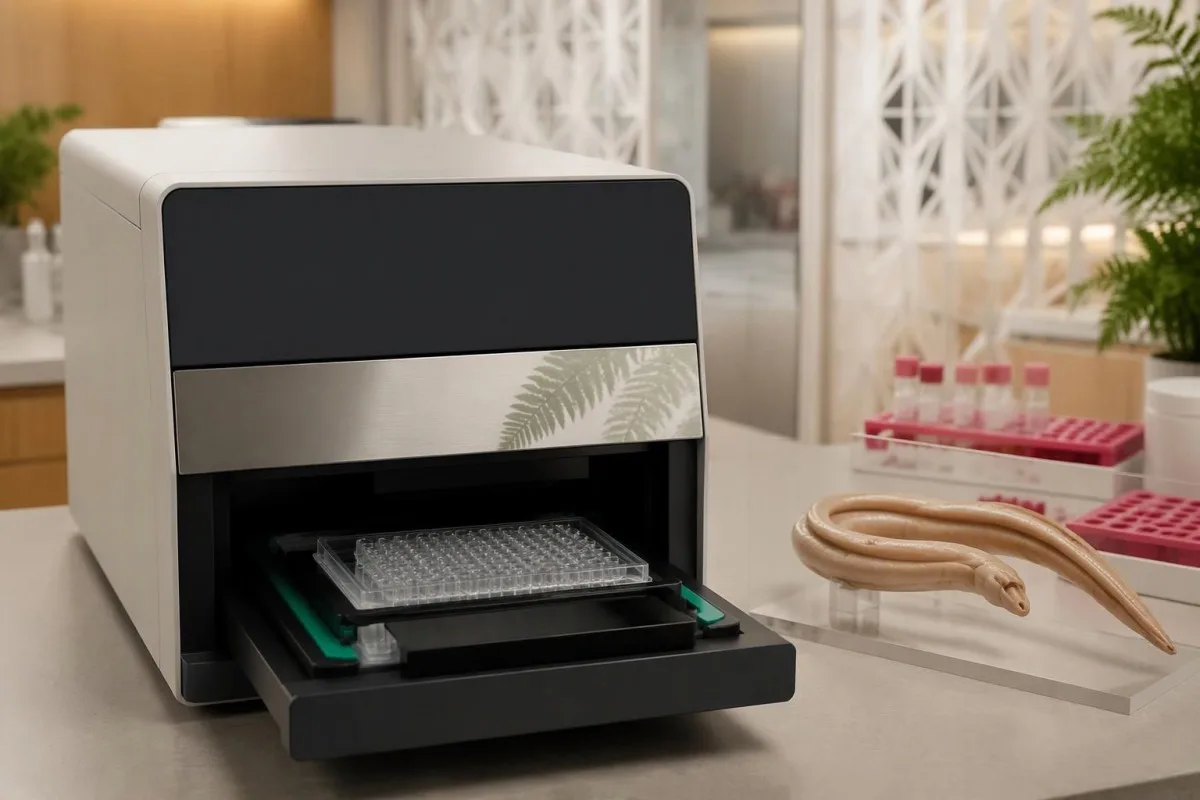
CAA assays can detect antigens released by living schistosomes, including some low-burden infections that microscopy misses. Urine CCA testing is used especially for S. mansoni, but trace readings and performance for other species complicate interpretation; 1 negative point-of-care CCA test should not be treated as a universal exclusion of urinary or intestinal schistosomiasis.
PCR may support diagnosis when microscopy is negative, but DNA detection is not identical to proving that every detected parasite component remains viable after treatment. The specimen matters—serum, stool and urine are not interchangeable—and 1 positive molecular result must be interpreted against the laboratory's validated application; antibodies versus direct detection illustrates this distinction in a different parasitic condition.
Kantesti is an AI lab test interpretation service that can explain the difference between 2 reports labeled Schistosoma IgG and Schistosoma PCR without treating them as interchangeable evidence. Our د AI تفسیر میتودونه do not replace reference-laboratory expertise, and an antigen test's usefulness depends on whether the local service can obtain and validate it for your clinical question.
د وینې او ادرار کومې ملګرې موندنې مهمې دي؟
Eosinophilia, urinary abnormalities and signs of organ involvement can strengthen the case for further assessment, but none proves schistosomiasis alone. An absolute eosinophil count above approximately 0.5 × 10⁹/L is commonly considered elevated; a normal count does not exclude infection, especially outside the early immune-response phase.
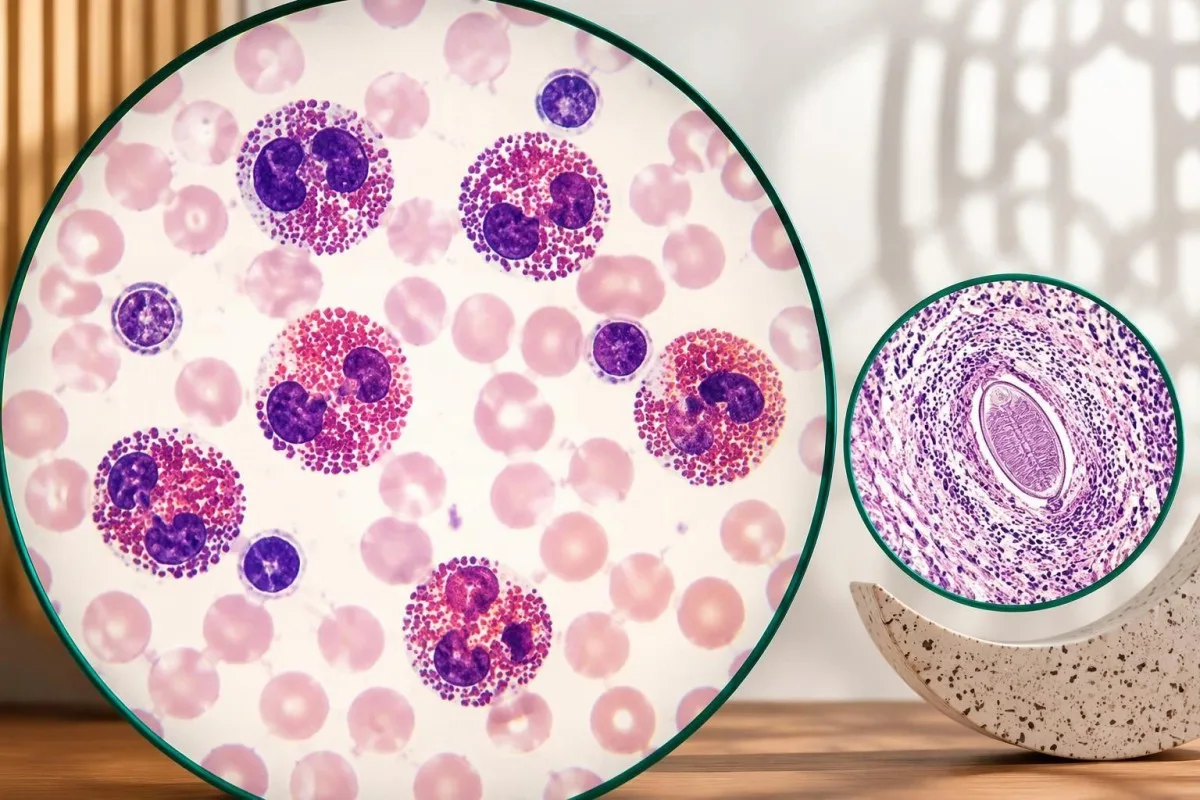
The absolute eosinophil count is usually more informative than the percentage because a percentage depends on the other white-cell populations. A hypothetical count of 0.8 × 10⁹/L may reflect schistosomiasis, another parasite, allergy or a medicine effect; persistent counts at or above 1.5 × 10⁹/L generally warrant broader evaluation, as discussed in our eosinophil count guide.
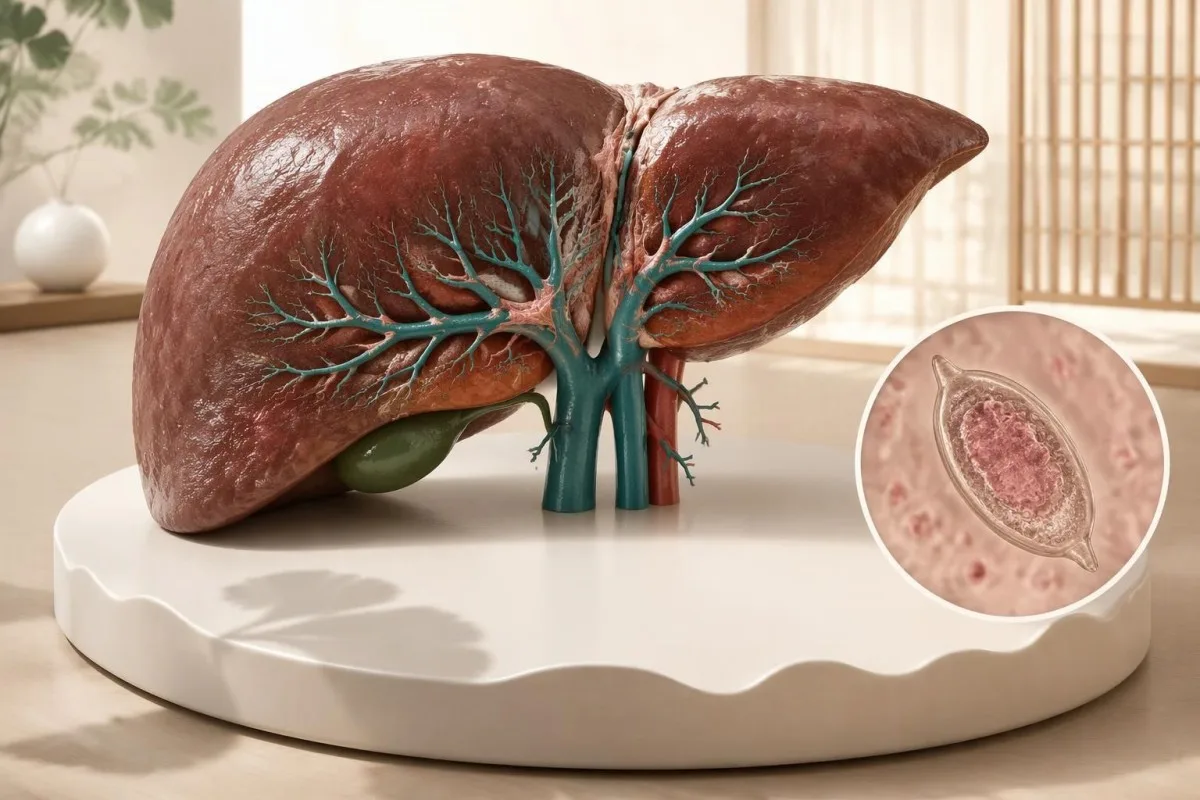
Normal liver enzymes do not reliably exclude hepatosplenic schistosomiasis because periportal fibrosis and portal hypertension can occur without the usual pattern of cirrhosis. For example, an ALT of 24 IU/L cannot overrule an enlarged spleen or suggestive ultrasound; د جګر پینل تفسیر explains why enzyme results answer different questions from structural imaging.
Blood in urine, protein in urine, persistent diarrhea or genital symptoms can change which investigations are appropriate. At Kantesti, we encourage keeping at least 3 evidence categories separate—exposure, parasite tests and organ findings—because a positive antibody result should not obscure a urinary obstruction, significant anemia or another explanation that requires its own assessment.
ولې کېدای شي مایکروسکوپي معاینه منفي وي، خو بیا هم درملنه وړاندیز شي؟
Clinicians may treat a seropositive person with credible exposure and no adequate treatment history despite negative microscopy. This approach recognizes that light infections can escape egg detection and untreated adult worms can persist for years; the decision balances 3 factors: exposure probability, diagnostic limitations and the person's treatment risks.
Absence of symptoms does not establish absence of infection or eliminate the potential benefit of treatment. A hypothetical traveler tested 10 weeks after a lake swim, with positive IgG and 3 negative stool examinations, may still be offered praziquantel if the exposure was credible and no earlier treatment occurred; negative microscopy lowers certainty but does not settle the question.
Documented earlier treatment changes the reasoning, particularly when no freshwater re-exposure has occurred. A person with a positive test 5 years after an appropriately timed course does not automatically need another course; the clinician should investigate whether treatment was complete, whether the initial infection was confirmed and whether any symptoms or direct tests now suggest persistence.
Visible blood in urine requires assessment even when Schistosoma antibodies are positive, because 1 parasite result does not exclude stones, other infections or cancer. Chronic urinary schistosomiasis is associated with increased bladder cancer risk, but risk is not diagnosis; our guide to bladder warning symptoms explains why persistent or recurrent urinary changes deserve separate attention.
د پرازیکوانټل دوز او د درملنې وخت څنګه ټاکل کېږي؟
Praziquantel is the standard medicine for schistosomiasis, but dose and timing depend on species and clinical circumstances. CDC's Clinical Care of Schistosomiasis guidance lists 40 mg/kg over 1 day in 2 divided doses for S. mansoni, S. haematobium and S. intercalatum, and 60 mg/kg in 3 divided doses for S. japonicum and S. mekongi.
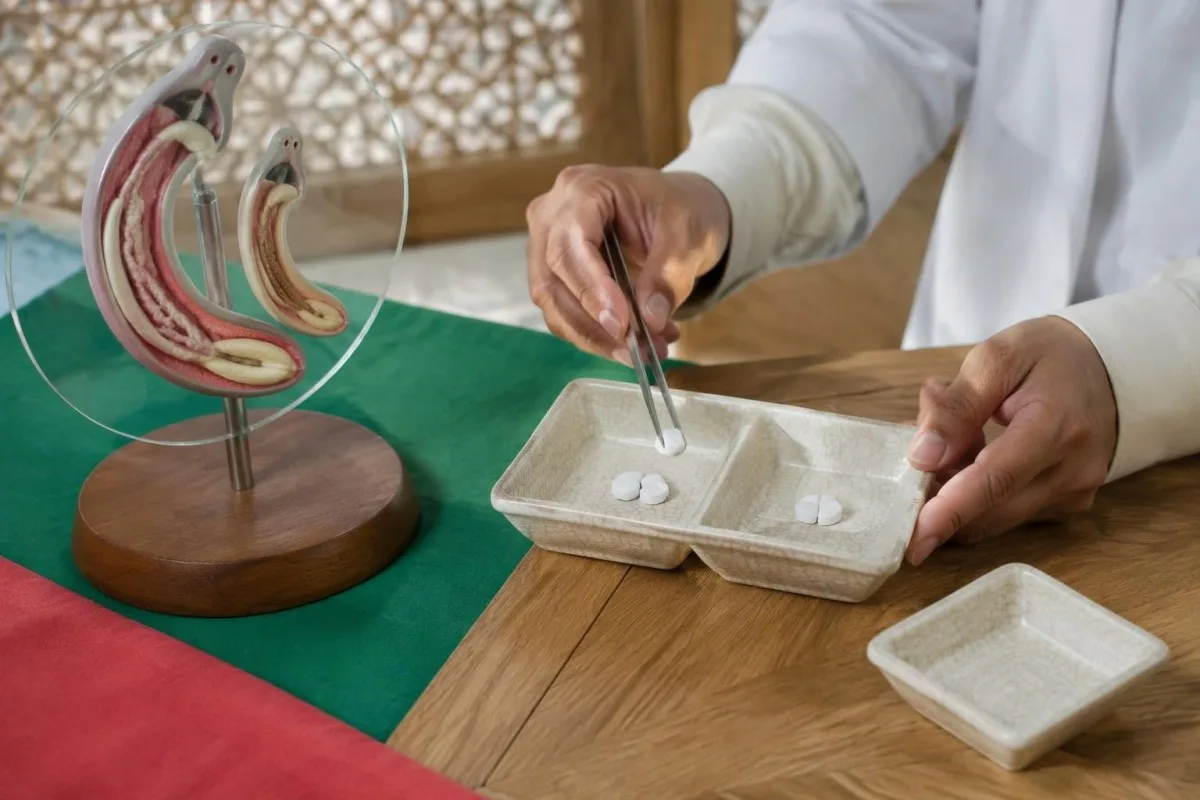
Praziquantel works best against mature worms, so otherwise stable travelers are generally treated at least 6–8 weeks after their last freshwater exposure. Taking it immediately after a swim is not reliable preventive treatment; if a course was given very early, the clinician may plan another course after maturation rather than assuming the initial prescription covered all developing worms.
A clearly hypothetical calculation illustrates a 40 mg/kg regimen: a 60 kg adult would receive 2,400 mg total over 1 day, split into 2 doses of 1,200 mg. Where 600 mg tablets are supplied, that arithmetic corresponds to 2 tablets per dose, but it is not an individual prescription—species, available formulation, rounding, swallowing ability and medical history must be checked.
Repeat treatment after 2–4 weeks may be appropriate in selected patients, especially with light infections or concerns about an incomplete response; it is not required solely because IgG remains positive. Medication review matters because rifampicin and enzyme-inducing antiseizure medicines can reduce praziquantel exposure, so patients taking carbamazepine should bring their regimen and any carbamazepine monitoring information rather than adjusting either medicine themselves.
کومې نښې سمدستي یا بیړنۍ ارزونې ته اړتیا لري؟
Fever after travel needs prompt assessment, and new weakness, seizures or bladder-control changes need emergency evaluation. Acute schistosomiasis can cause fever, cough, rash, diarrhea and eosinophilia around 2–8 weeks after exposure, but these symptoms overlap with other conditions and cannot be diagnosed from antibodies alone.
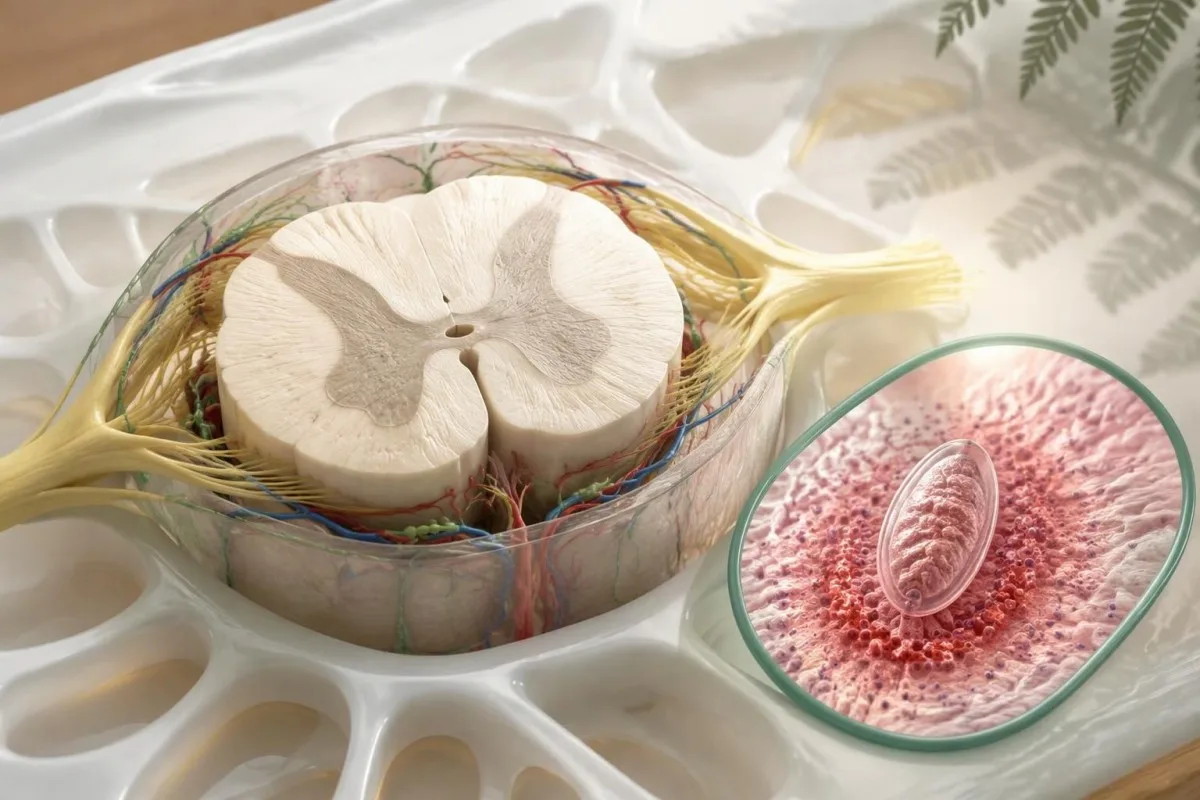
New leg weakness, difficulty walking, urinary retention or loss of bowel control can signal spinal cord involvement and should not wait for routine repeat serology. Schistosoma eggs can occasionally affect neurological tissue, but 1 positive antibody result does not establish the cause; emergency clinicians may need imaging and a broad differential diagnosis before specialist treatment is selected.
Acute systemic or neurological schistosomiasis may require specialist-directed corticosteroids alongside a carefully timed antiparasitic plan. If the exposure history also suggests Strongyloides, assess that possibility before immunosuppression when feasible, because steroids can precipitate dangerous hyperinfection; a Strongyloides IgG result needs its own management rather than assuming 1 antiparasitic medicine treats both organisms.
Fever after a malaria-risk itinerary should be assessed the same day, even if Schistosoma antibodies offer a plausible alternative explanation. Do not wait 6–8 weeks for repeat serology when there is persistent high fever, breathing difficulty, confusion, fainting, significant gastrointestinal bleeding or inability to pass urine; the immediate priority is identifying and treating the acute problem.
امیندوارۍ، ماشومتوب او نورې ناروغۍ درملنه څنګه بدلوي؟
Pregnancy, young age and complex illness require individualized treatment decisions rather than automatically withholding or prescribing praziquantel. The WHO guideline on control and elimination of human schistosomiasis (2022) supports preventive treatment from age 2 years and includes pregnant women after the first trimester and lactating women in eligible programs.
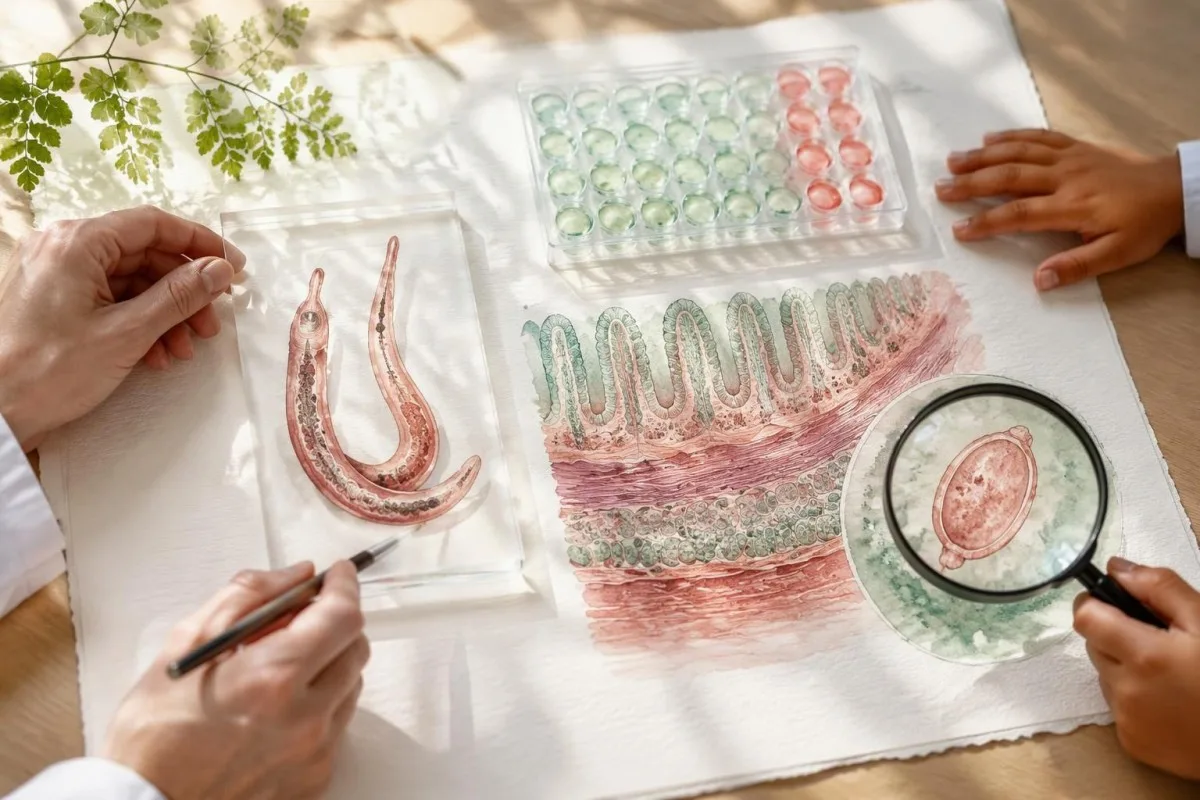
WHO program recommendations and treatment of an individual imported infection answer related but different questions. A hypothetical patient at 10 weeks of pregnancy needs a clinician-led balance of infection likelihood, severity and treatment timing; the recommendation to include pregnancy after the first trimester in preventive programs should not be turned into a blanket rule for every symptomatic patient.
Children's dosing requires an accurate weight and a formulation they can take safely; adult tablet arithmetic is not enough. WHO's inclusion of children aged 2 years and older in preventive chemotherapy does not make every product licensed for every younger age in every country, and our discussion of children's interpretation limits explains why pediatric results need age-specific clinical oversight.
A history of seizures, possible cysticercosis, significant liver disease or neurological symptoms should be reviewed before treatment. For 1 person with a straightforward travel-acquired infection, routine outpatient prescribing may be appropriate; another with possible central nervous system involvement may need specialist planning because the immune response to parasite treatment can itself affect symptoms.
ولې د بریالۍ درملنې وروسته د شیسټوسوما IgG مثبت پاتې کېدای شي؟
Schistosoma IgG can remain positive for years after successful treatment and is not a reliable test of cure. CDC recommends considering repeat stool or urine examination 1–2 months after treatment when eggs were detected before treatment; follow-up must match the evidence used to establish infection and the person's subsequent clinical course.
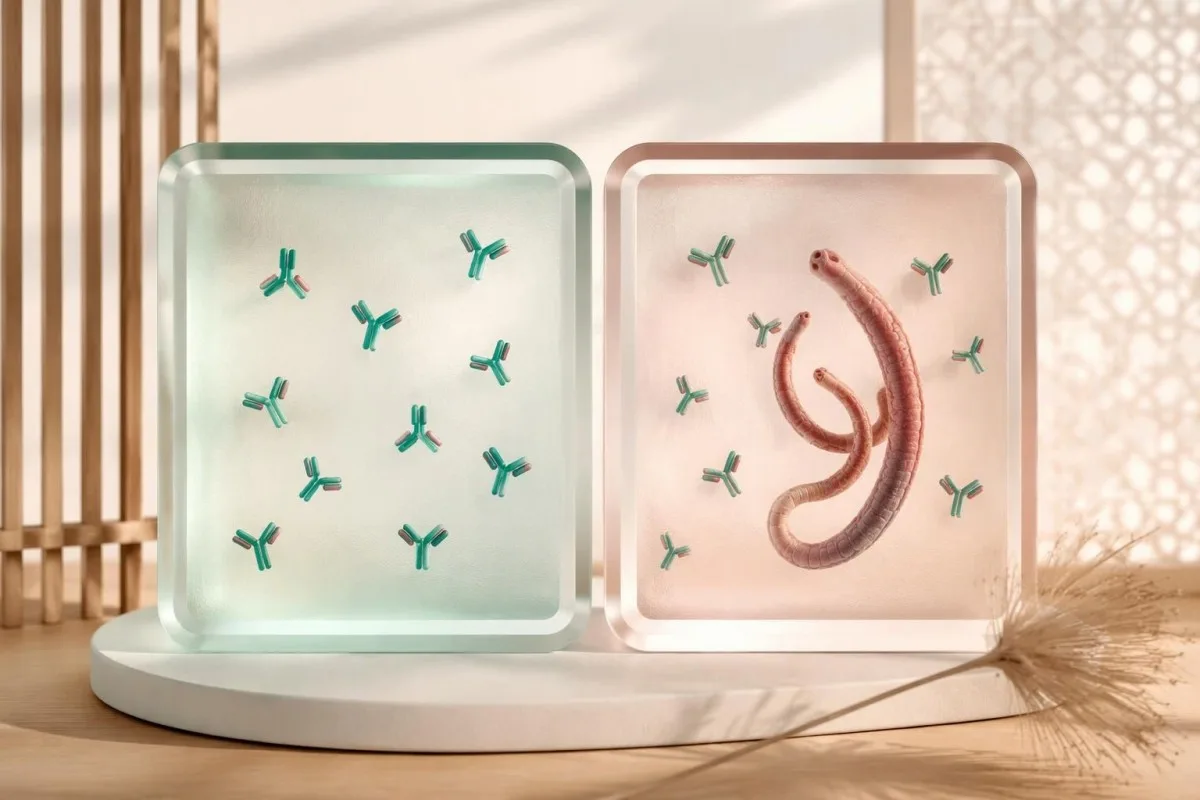
A positive IgG result 6 months after treatment does not, by itself, demonstrate treatment failure. Antibody decline varies, and a stable or temporarily higher signal cannot reliably quantify surviving worms; comparing results from 2 different laboratories adds assay differences, making numerical trend interpretation even less suitable for declaring cure.
Persistent symptoms or eosinophilia deserve reassessment, but neither automatically proves living Schistosoma remain. If eggs are still found at the 1–2 month follow-up, specialists may consider egg viability, collection details, treatment timing and whether another course is needed; PCR positivity can also require caution because detecting parasite DNA is not the same as identifying viable adult worms.
Kantesti can help organize 3 follow-up dates—treatment, specimen collection and any re-exposure—without labeling persistent IgG as treatment failure. Our د درملو د رجحان تحلیل لارښود explains why trends must be matched to the right clinical endpoint; an available validated antigen assay may be more useful than serial antibodies, but its follow-up schedule belongs to the treating service.
څنګه یوه مثبته پایله بېلابېلو پرېکړو ته لار هوارولای شي؟
The same positive Schistosoma IgG result can lead to treatment, additional testing or observation because the surrounding evidence differs. The following 4 examples are hypothetical teaching scenarios—not patient encounters—and illustrate how exposure dates, prior therapy, assay uncertainty and organ findings can outweigh the apparent simplicity of a positive flag.
A hypothetical 28-year-old returns from a freshwater swim, tests positive 10 weeks later and has never received praziquantel; treatment may be reasonable despite negative microscopy. A hypothetical 44-year-old treated appropriately 4 years earlier, with no further exposure and no concerning findings, may not need retreatment; the timeline of laboratory results helps keep these histories distinct.
A hypothetical 35-year-old with no plausible freshwater exposure has a weakly positive screening assay and normal supporting investigations. The next step may be checking the original indication, assay and cross-reactivity rather than immediate treatment; changing a report from weak positive to strong positive on 1 repeat antibody assay still does not create a documented exposure or prove active infection.
A hypothetical 54-year-old who lived near endemic freshwater 20 years earlier has positive IgG, an enlarged spleen and an ALT of 24 IU/L within the local range. That combination merits assessment for portal and other organ disease despite normal enzymes; an old exposure is not automatically resolved, and common liver fibrosis scores should not be assumed validated for schistosomal periportal fibrosis.
د تعقیبي کتنې لپاره باید څه درسره یوسئ، او د درملنې ملاتړ کومې سرچینې کوي؟
Bring your exposure history, complete laboratory report and treatment record to a clinician experienced in travel medicine, infectious diseases or tropical medicine. Prepare 3 questions: whether the result fits your exposure, which direct tests could change the decision and how treatment response will be assessed without relying on antibody disappearance.
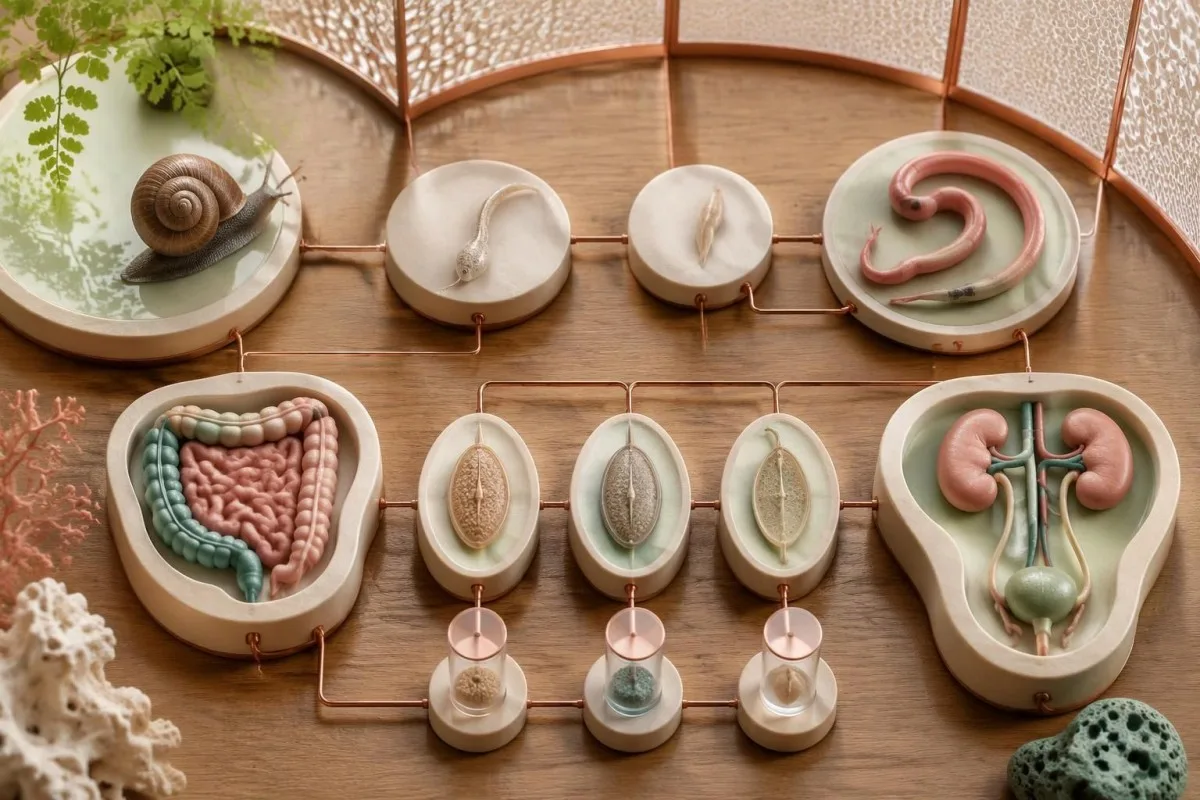
Your report should retain the assay name, units or index, reference interpretation and collection date, rather than only a cropped positive flag. Add 1 concise exposure timeline, previous praziquantel doses and dates, current medicines, pregnancy status where relevant and any urinary or neurological symptoms; this makes uncertainty visible and reduces the chance of repeating an uninformative antibody test.
Kantesti is an AI blood test interpretation platform that helps explain why 1 Schistosoma antibody result must be considered alongside exposure and treatment history, not used as a prescribing instruction. Our کلینیکي تایید چوکاټ. describes methodology and oversight, while our د محرمیت او د معلوماتو د سمبالښت information explains how to review data choices before sharing a travel or laboratory record.
The 2 Zenodo publications below describe Kantesti's validation framework and aggregate platform reporting; they are not clinical schistosomiasis guidelines and do not establish the sensitivity of a Schistosoma assay. Clinical recommendations in this article draw on CDC diagnostic and treatment guidance and the WHO guideline (2022), with our د طبي محتوا معیارونه distinguishing published evidence, hypothetical calculations and the limits of AI-supported explanation.
پرله پسې پوښتل شوي پوښتنې
ایا د شیستوسوما د IgG مثبت نتیجه دا معنا لري چې زه فعاله عفونت لرم؟
د Schistosoma IgG مثبته پایله په باوري ډول د فعال عفونت او پخوا درمل شوي عفونت ترمنځ توپیر نه شي کولی. انټيباډيګانې د کلونو لپاره د موندلو وړ پاتې کېدای شي، نو ۱ مثبت راپور باید د تازه اوبو سره د تماس او د درملنې د مخینې په رڼا کې تفسیر شي. ډاکټران ښايي د لا مستقیمو شواهدو د ترلاسه کولو لپاره، چېرې چې مناسبه وي، د غایطه موادو یا ادرار مایکروسکوپي معاینه، د انټيجن ازموینه یا PCR وکاروي. د باور وړ تماس او له دې مخکې د کافي درملنې نشتوالی ښايي درملنه توجیه کړي، ان که مایکروسکوپي معاینه منفي هم وي.
ایا زه د غایطې او ادرار د منفي ازموینو سره شیستوسومیازس لرلای شم؟
د غایطه موادو یا ادرار منفي مایکروسکوپي معاینه شستوسومیازس نه ردوي، په ځانګړي ډول له سفر وروسته چې د پرازیتونو شمېر کم وي. CDC سپارښتنه کوي چې ۳ نمونې په بېلابېلو ورځو کې وکتل شي، ځکه د هګیو دفع کېدل وخت ناوخت وي. د شکمنې نوعې له مخې دا هم ټاکل کېږي چې غایطه مواد، ادرار، که دواړه باید معاینه شي. که انټيباډۍ مثبتې وي، د اخته کېدو احتمال د باور وړ وي او د پخوانۍ کافي درملنې اسناد نه وي، کلینیسین ښايي بیا هم د درملنې سپارښتنه وکړي.
له خوږو اوبو سره تر تماس وروسته باید څومره موده کې معاینه وکړم؟
0 د CDC سپارښتنه کوي چې د Schistosoma د انټيباډۍ نمونې د شکمنې نوې انتان له رامنځته کېدو لږ تر لږه ۶–۸ اوونۍ وروسته راټولې شي. که د سفر پر مهال څو ځله له خوږو اوبو سره تماس شوی وي، د عملي مرجع په توګه له خوږو اوبو سره وروستی تماس وکاروئ. ښايي پخوانۍ منفي پایلې بیا تکرارولو ته اړتیا ولري، ځکه کېدای شي انټيباډۍ لا تر اوسه د موندلو وړ نه وي. تبه یا نورې د پام وړ نښې سمدستي ارزونې ته اړتیا لري، نه دا چې د ازموینې د دې مودې تر رسېدو پورې انتظار وشي.
ولې د پرازیکوانټېل تر درملنې وروسته هم د شیستوزوما انټيباډي مثبت یم؟
د شیسټوزوما انټيباډۍ د پرازیکوانټل له بریالۍ درملنې وروسته هم د کلونو لپاره مثبتې پاتې کېدای شي، ځکه چې معافیتي غبرګون د پرازیت تر له منځه تلو وروسته هم دوام کوي. له درملنې ۶ میاشتې وروسته مثبته پایله په خپله د درملنې ناکامي نه ثابتوي او نه د درملنې د بل پړاو توجیه کوي. کله چې له درملنې مخکې هګۍ موندل شوې وي، ډاکټران ښايي ۱–۲ میاشتې وروسته د غایطه موادو یا ادرار بیا معاینه وغواړي. نوی تماس، دوامداره نښې او د مستقیمو ازموینو موندنې د انټيباډۍ له یوازېني دوام څخه ډېرې معلوماتي دي.
د شستوزومیازس لپاره د پرازیکوانټل کوم دوز کارول کېږي؟
0. CDC د S. mansoni، S. haematobium او S. intercalatum لپاره د ۱ ورځې په اوږدو کې په ۲ وېشل شویو دوزونو کې د 40 mg/kg پرازیکوانټیل سپارښتنه کوي. د S. japonicum او S. mekongi لپاره لېست شوی درملنیز رژیم د ۱ ورځې په اوږدو کې په ۳ وېشل شویو دوزونو کې 60 mg/kg دی. په نورو حالاتو کې، په عمومي ډول د هغو مسافرو درملنه چې وضعیت یې ثابت وي، د تازه اوبو سره د وروستي تماس لږ تر لږه 6–8 اوونۍ وروسته کېږي، ځکه پرازیکوانټیل د بالغو چینجیو پر وړاندې تر ټولو ښه اغېز کوي. یو ډاکټر باید درملنیز رژیم وټاکي او درمل، امیندوارۍ، عمر او احتمالي عصبي ښکېلتیا وارزوي.
ایا د شیستوزوما د انټيباډي مثبت ټېسټ کاذب مثبت کېدای شي؟
د شیستوسوما د انټيباډي ازموینه کېدای شي په ناسم ډول مثبته وي یا د نورو پرازیتونو له انټيباډیو سره متقابل غبرګون وښيي، چې دا د ازموینې پر طریقې پورې اړه لري. داسې یو نړیوال شاخص ارزښت نشته چې فعاله عفونت ثابت کړي، او کېدای شي دوه لابراتوارونه د انټيجن بېلابېل چمتو شوي مواد او د پرېکون بېلابېل حدونه وکاروي. که د خوږو اوبو سره د احتمالي تماس سابقه نه وي، نو په کمزوري ډول مثبتې پایلې لپاره ښايي د لابراتوار بیاکتنه یا د تایید بله طریقه مناسبه وي. یوازې د انټيباډیو بیا ازمویل لا هم په باوري ډول د درملنې شوې پخوانۍ سابقې او ژوندیو چینجیو ترمنځ توپیر نه شي کولای.
د وینې ازموینې پایلې څنګه ولولئ
خپل لابراتواري راپور پورته کړئ، او د Kantesti AI به په څو ثانیو کې هر بایومارکر په ساده ژبه تشریح کړي. په ټوله نړۍ کې له 2 میلیونو څخه زیاتو کسانو ترې کار اخیستی.
ماخذونه
- کلاین، ټي.، میچل، ایس.، او وېبر، ایچ. (۲۰۲۶). د کلینیکي تایید چوکاټ v2.0 (د طبي تایید پاڼه). د Kantesti AI طبي څېړنه. د دفاع وزارت
- کلاین، ټي.، میچل، ایس.، او وېبر، ایچ. (۲۰۲۶). د AI وینې د ازموینې شنونکی: 2.5M ازموینې تحلیل شوې | د نړیوال روغتیا راپور 2026. د Kantesti AI طبي څېړنه. د دفاع وزارت
- د ناروغیو د کنټرول او مخنیوي مرکزونه (2024). Clinical Testing and Diagnosis for Schistosomiasis. CDC Schistosomiasis Clinical Guidance.
- د ناروغیو د کنټرول او مخنیوي مرکزونه (2024). Clinical Care of Schistosomiasis. CDC Schistosomiasis Clinical Guidance.
- World Health Organization (2022). WHO guideline on control and elimination of human schistosomiasis. World Health Organization Guidelines.
- ۲ میلیونه+تحلیل شوې ازموینې
- 127+هېوادونه
- 100+ژبې
د طبي ټیم په اړه


د E-E-A-T باور نښې
تجربه
د ډاکټر تر مشرۍ لاندې کلینیکي بیاکتنه د لابراتواري تفسیر د کاري بهیرونو لپاره.
تخصص
د لابراتواري طب تمرکز پر دې چې بایومارکرونه په کلینیکي شرایطو کې څنګه چلند کوي.
واک ورکول
د ډاکټر توماس کلاین له خوا طبي بیاکتنه شوې، د ډاکټر سارا میچل او پروفیسور ډاکټر هانس وېبر په مرسته.
اعتبار
د شواهدو پر بنسټ تفسیر د روښانه تعقیبي لارو چارو سره، تر څو اندیښنه کمه شي.






طبي سلبِ مسئولیت
دا مقاله یوازې د زده کړې لپاره ده او طبي مشوره نه جوړوي. د تشخیص او درملنې د پرېکړو لپاره تل د وړ روغتیايي خدمت وړاندې کوونکي سره سلا وکړئ.
خپور شوی · له تحریري ټیم سره اړیکه ونیسئ
خپروونکی یې Kantesti Ltd دی، چې په انګلستان او وېلز کې ثبت شوی، د شرکت شمېره. 17090423, ، لندن، بریتانیا.
