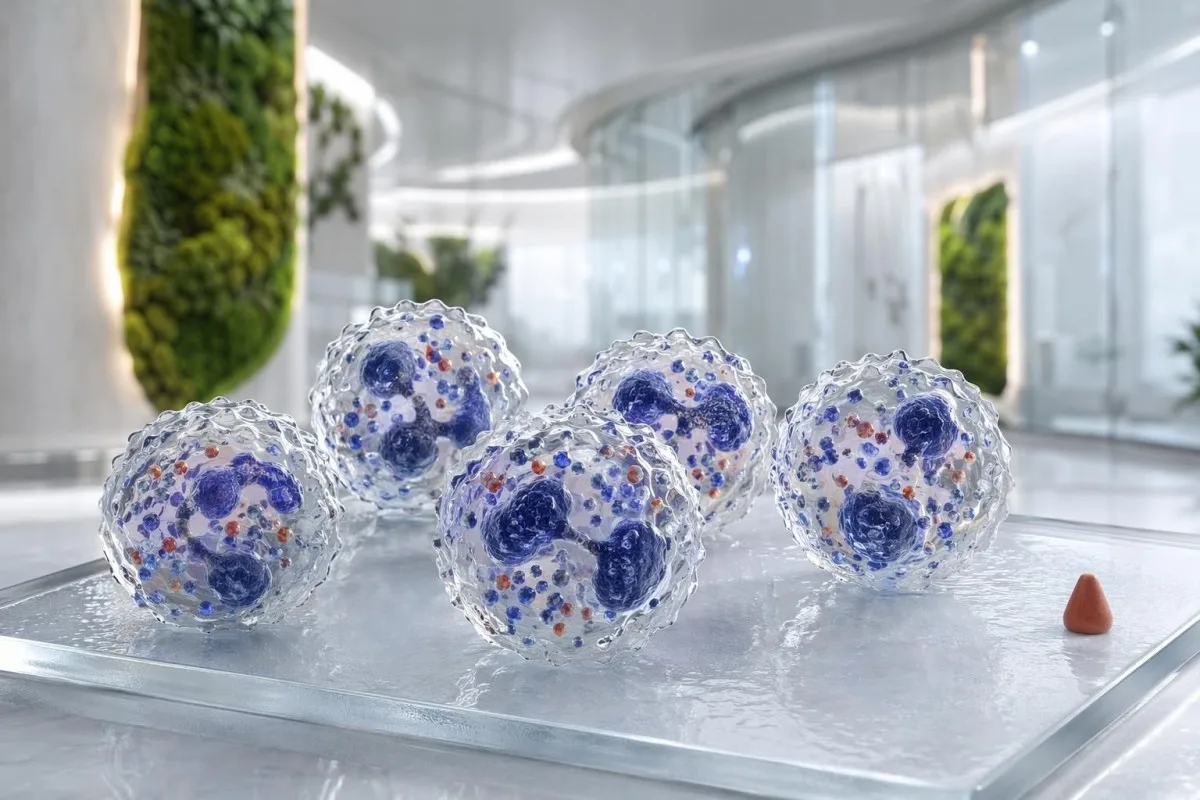
A practical physician guide to toxic granulation, Döhle bodies, left shift, pregnancy changes and the symptom patterns that make a smear flag urgent.


- Toxic granulation neutrophils means coarse dark granules are seen inside neutrophils on a manual smear; it is a reaction pattern, not a diagnosis.
- Urgent symptoms include fever above 38.0°C, shaking chills, confusion, breathlessness, systolic blood pressure below 90 mmHg or lactate at least 2 mmol/L.
- Adult ANC is usually about 1.5-7.5 × 10^9/L; toxic changes are more concerning when ANC is rising with bands or immature granulocytes.
- Dohle bodies neutrophils refers to pale blue cytoplasmic inclusions that often travel with toxic granulation during strong marrow stress.
- Pregnancy can raise WBC to roughly 15.9 × 10^9/L in late gestation, but fever, flank pain or reduced fetal movement changes the risk picture.
- G-CSF treatment such as filgrastim 5 µg/kg/day can cause marked neutrophil toxic changes without bacterial infection.
- Safe recheck is usually reasonable in 1-2 weeks if you feel well, have no fever, and the WBC/ANC pattern is stable or improving.
- Manual differential quality matters: delayed slides over 8-12 hours can create vacuoles that look more alarming than the patient actually is.
What toxic granulation in neutrophils actually means
Toxic granulation in neutrophils means a laboratory professional saw coarse, dark granules inside neutrophils on a peripheral smear. As of June 17, 2026, I treat it as a clue of marrow stress—often bacterial infection or major inflammation—but it can also appear in pregnancy, after G-CSF, or during recovery from chemotherapy.
Kantesti is an AI blood test analyzer that reads neutrophil flags in the same context as WBC, ANC, CRP, symptoms and timing, because a smear comment alone has poor specificity. In our 15,000+ biomarker guide, we treat morphology as pattern data rather than a stand-alone verdict.
A normal adult white blood cell count is commonly about 4.0-11.0 × 10^9/L, and a typical adult absolute neutrophil count is about 1.5-7.5 × 10^9/L. Toxic granulation can appear even when the total WBC is not dramatically high, especially in older adults or people whose marrow reserve is limited.
The word “toxic” frightens patients, but it does not mean poison in the bloodstream. The term comes from older microscopy language describing darker primary granules that persist when neutrophils are produced quickly under cytokine pressure.
When I, Thomas Klein, MD, review a report saying neutrophil toxic changes present, I ask 4 practical questions first: fever today, recent G-CSF, pregnancy or postpartum state, and whether bands or immature granulocytes are also flagged. Those 4 answers often decide whether the result needs same-day care or a calm repeat.
Why bacterial infection can make neutrophils look toxic
Bacterial infection can cause toxic granulation because inflammatory cytokines push the marrow to release neutrophils faster than usual. The accelerated production leaves prominent primary granules, and severe infection may also add vacuoles, Döhle bodies and a left shift.
The strongest bacterial pattern is not just toxic granulation; it is toxic granulation plus neutrophilia plus bands. A WBC of 18.0 × 10^9/L, ANC of 15.0 × 10^9/L, CRP above 100 mg/L and fever is a very different situation from rare toxic granules in someone who feels well.
For a broader lab pattern, compare the smear with CRP, procalcitonin and culture results; our guide to infection blood tests explains why procalcitonin around 0.5 ng/mL may support bacterial infection but should never replace bedside assessment. Procalcitonin can stay low in localized abscesses and can rise after major surgery.
I see this often with pneumonia: the chest symptoms arrive before the lab looks dramatic. A patient may have toxic granulation at WBC 11.8 × 10^9/L on day 1, then show a clearer neutrophil rise by day 2 or 3.
Toxic granulation is less helpful for distinguishing bacterial from viral infection when the patient has already taken antibiotics, steroids or G-CSF within the prior 7 days. Medication timing can blur the clean textbook pattern.
How toxic granulation differs from a left shift
A left shift means younger neutrophil forms, especially bands, are increased in circulation; toxic granulation describes how mature-looking neutrophils appear under the microscope. They often occur together, but they answer different clinical questions.
Bands above roughly 10% are often called a left shift, although some laboratories use absolute band counts instead of percentages. Percentages can mislead: 12% bands with WBC 4.0 × 10^9/L is not the same marrow signal as 12% bands with WBC 22.0 × 10^9/L.
Our article on band neutrophils goes deeper into why absolute counts usually beat percentages. In practice, I read ANC, immature granulocytes, bands and toxic changes as a single marrow-stress cluster.
The absolute neutrophil count is calculated from total WBC multiplied by the neutrophil percentage, and adult ANC below 1.0 × 10^9/L increases infection risk. Toxic granulation with a low ANC can be more serious than toxic granulation with a high ANC, because the body may be struggling to mount enough response.
A left shift without toxic granulation can happen after exercise, corticosteroids or acute stress. Toxic granulation without many bands can happen when inflammation is present but the marrow still has enough mature neutrophils to release.
Döhle bodies, vacuoles and neutrophil toxic changes
Dohle bodies neutrophils refers to pale blue inclusions in neutrophil cytoplasm, and they are one of the classic neutrophil toxic changes. The combination of toxic granulation, Döhle bodies and cytoplasmic vacuoles is more informative than any one feature alone.
Döhle bodies are usually remnants of rough endoplasmic reticulum, not bacteria inside the cell. They can be seen in infection, burns, pregnancy, G-CSF use and rare inherited conditions such as May-Hegglin anomaly.
Cytoplasmic vacuoles are trickier. True phagocytic vacuoles in fresh samples can support severe bacterial infection, but vacuoles appearing after 8-12 hours in EDTA may simply reflect storage artifact.
The ICSH morphology recommendations standardize terms such as toxic granulation and Döhle bodies so that labs speak a more consistent language (Palmer et al., 2015). If your report also mentions immature granulocytes, that adds a separate clue about marrow release of early myeloid cells.
One nuance patients rarely hear: toxic granulation can fade before the WBC count normalizes. I have seen smears look cleaner 24-48 hours after antibiotics even while the ANC remains above 9.0 × 10^9/L.
Pregnancy, postpartum shifts and toxic granulation
Pregnancy can raise neutrophils and occasionally show toxic granulation because the immune and marrow systems are physiologically activated. The finding is often benign when the patient is well, but fever, urinary symptoms, abdominal pain or reduced fetal movement should override reassurance.
Abbassi-Ghanavati et al. reported pregnancy reference intervals showing WBC can rise well above non-pregnant ranges, with late-pregnancy upper values around 15.9 × 10^9/L in many tables (Abbassi-Ghanavati et al., 2009). During labor and the first postpartum day, WBC can transiently reach 25-30 × 10^9/L without sepsis.
That said, pregnancy changes the threshold for caution. A temperature of 38.0°C, flank pain, uterine tenderness, heart rate above 120/min or feeling faint deserves same-day clinical advice even if the smear flag looks mild.
Our guide to pregnancy blood tests covers the situations where a routine lab result becomes urgent because of symptoms. In our clinical review process, we flag neutrophil toxic changes differently in trimester 3 than in a non-pregnant adult with the same WBC.
The practical trap is assuming every pregnancy leukocytosis is normal. I have seen pyelonephritis present with WBC only 13.5 × 10^9/L, but the smear showed toxic granulation and the patient had rigors.
G-CSF, chemotherapy recovery and smear flags
G-CSF drugs can cause toxic granulation in neutrophils without bacterial infection. Filgrastim, pegfilgrastim and similar medicines deliberately stimulate neutrophil production, so the smear may look “toxic” while the expected treatment effect is actually working.
Filgrastim is commonly dosed around 5 µg/kg/day, while pegfilgrastim is often given as 6 mg once per chemotherapy cycle in adults. After either drug, ANC can climb above 10.0 × 10^9/L and the smear may show toxic granulation, Döhle bodies and left shift.
The timing matters. A smear taken 2-5 days after pegfilgrastim can look alarming to a patient reading the portal, yet be exactly what the oncology team expected.
Our chemotherapy lab guide explains how to interpret blood test changes during chemo without confusing marrow recovery for infection. The same patient can move from ANC 0.4 × 10^9/L to ANC 12.0 × 10^9/L within a week after growth-factor support.
Fever after chemotherapy is different. If temperature is 38.0°C or higher and ANC is below 0.5 × 10^9/L, that is febrile neutropenia until proven otherwise, even if toxic granulation is not reported.
Inflammation and tissue injury can mimic infection clues
Toxic granulation can appear in strong non-bacterial inflammation, including autoimmune flares, major trauma, pancreatitis, burns, myocardial injury and severe gout. The smear is showing neutrophil activation, not naming the trigger.
CRP above 10 mg/L signals inflammation but does not specify infection, and CRP above 100 mg/L can occur in bacterial infection, vasculitis, severe inflammatory bowel disease or major tissue injury. ESR above 100 mm/hour is uncommon and usually deserves a serious search for infection, inflammatory disease or malignancy.
For painful inflammatory presentations, our guide to high ESR patterns explains why ESR, CRP and CBC often move at different speeds. ESR may stay high for weeks, while neutrophil toxic changes can change over 1-3 days.
Our AI biomarker interpretation platform reads inflammation panels as time-based patterns because one inflammatory marker can lag behind another by 24-72 hours. Kantesti does not label toxic granulation as bacterial by default; the model checks symptom context and accompanying markers first.
A real example: a middle-aged patient with a gout flare had WBC 14.2 × 10^9/L, ANC 11.6 × 10^9/L, CRP 86 mg/L and toxic granulation, but cultures were negative and symptoms localized to one joint. The smear was telling us the immune system was loud, not that bacteria were definitely present.
When toxic granulation should be treated as urgent
Toxic granulation is urgent when it appears with sepsis-type symptoms: fever, shaking chills, confusion, breathlessness, low blood pressure, very fast heart rate or reduced urine output. In that setting, the smear flag supports immediate clinical assessment rather than watchful waiting.
The 2021 Surviving Sepsis Campaign guideline emphasizes early recognition, cultures, antibiotics when infection is likely, fluids when hypotensive and lactate measurement in suspected sepsis (Evans et al., 2021). Lactate ≥2 mmol/L raises concern, and lactate ≥4 mmol/L is a high-risk finding in the right clinical setting.
Our sepsis marker guide explains why lactate, platelets, creatinine, bilirubin and mental status often matter more than the smear wording. A WBC of 3.0 × 10^9/L with toxic changes and confusion can be more dangerous than WBC 18.0 × 10^9/L in a well-appearing patient.
Go same day if toxic granulation appears with temperature ≥38.0°C, systolic blood pressure below 90 mmHg, oxygen saturation below 92%, new confusion, severe abdominal pain or a spreading skin infection. Please do not wait for a repeat CBC in those situations.
This is one of those areas where context matters more than the number. A frail 82-year-old with WBC 9.8 × 10^9/L, toxic granulation and new drowsiness worries me more than a fit 28-year-old after a hard race with WBC 12.5 × 10^9/L and no symptoms.
When it is usually safe to recheck the CBC
A recheck is usually safe when toxic granulation is mild, you feel well, vital signs are normal and there is a clear benign reason such as pregnancy, recent G-CSF or recent inflammation that is improving. Many clinicians repeat the CBC in 1-2 weeks.
If the WBC is below 12.0 × 10^9/L, ANC is near baseline and there are no symptoms, I often suggest repeating the CBC with differential after 7-14 days. If the patient recently had an acute illness, a 48-72 hour repeat may be chosen when symptoms are still evolving.
Our guide to repeating abnormal labs lays out which results can wait and which should not. Toxic granulation without fever, without a rising WBC and without organ symptoms is usually not an emergency by itself.
Kantesti is an AI lab test interpretation service that can compare today’s CBC with prior results, which is useful when your personal ANC baseline is 2.0 × 10^9/L rather than 6.0 × 10^9/L. A “normal range” result can still be a meaningful jump for one individual.
Use the recheck to answer a specific question, not just to chase a flag. Ask whether toxic changes disappeared, whether ANC normalized, and whether CRP or symptoms moved in the same direction.
How labs report toxic changes on manual differential
Toxic granulation is usually a manual smear comment, not a precise automated number. Laboratories may report it as “toxic granulation present,” “neutrophil toxic changes,” “1+ to 3+,” or as part of a broader morphology review.
Automated hematology analyzers are excellent at counting thousands of cells, but morphology still relies on slide preparation, stain quality and trained review. A manual differential may count 100-200 white cells, while an analyzer evaluates far more events but cannot always name classic smear features with human-level nuance.
Our article on manual differential results explains why automated and manual results can disagree. A machine may flag immature granulocytes at 0.08 × 10^9/L, while the human smear report adds toxic granulation and Döhle bodies.
Kantesti’s clinical standards are reviewed against defined methodology, and our medical validation page describes how we benchmark interpretation workflows rather than treating flags as isolated labels. That matters because morphology language varies substantially between laboratories.
Palmer et al. noted that standardized morphology nomenclature improves consistency, but real-world reporting still differs by country and lab network (Palmer et al., 2015). Some European laboratories avoid numeric toxic granulation grades entirely, while others use 1+, 2+ and 3+.
Artifacts that can exaggerate toxic-looking neutrophils
Delayed processing, thick smear areas, staining variation and old EDTA samples can exaggerate toxic-looking neutrophil changes. Vacuoles are especially vulnerable to artifact when a sample sits for many hours before slide review.
A good smear is ideally prepared within 2-4 hours of collection, although laboratory logistics vary. After 8-12 hours, cytoplasmic vacuolization and nuclear detail may become less reliable, particularly if transport temperature was poor.
If a report has surprising morphology but the WBC, platelets and hemoglobin look oddly discordant, consider pre-analytic issues. Our guide to high WBC lab error covers clots, platelet clumps, smudge cells and analyzer flags that can distort CBC interpretation.
Stain intensity also matters. Over-staining can make normal neutrophil granules look darker, while under-staining may hide mild toxic granulation entirely.
I become more comfortable with the result when the smear comment fits the patient and the numbers. If the patient feels perfectly well and the sample was processed late, a clean repeat CBC in 7 days is often more useful than spiraling over one morphology sentence.
Tests that help interpret toxic granulation
The best companion tests depend on symptoms, but common pairings include CRP, procalcitonin, lactate, blood cultures, urinalysis, urine culture, renal function and liver tests. Toxic granulation tells you neutrophils are activated; companion tests help localize why.
For urinary symptoms, nitrites, leukocyte esterase and a properly collected urine culture may matter more than the CBC. Our urine culture guide explains why colony counts such as 10^5 CFU/mL are useful but not absolute in symptomatic patients.
For possible systemic infection, lactate ≥2 mmol/L, creatinine rise of ≥0.3 mg/dL in 48 hours, platelets below 150 × 10^9/L or bilirubin above 2.0 mg/dL can shift concern upward. Those organ markers often decide whether a patient is observed, admitted or treated urgently.
For inflammatory disease, ESR and CRP trend differently: CRP can rise within 6-8 hours, while ESR often lags and may remain elevated after symptoms improve. That mismatch is not a lab mistake; it reflects different biology.
Blood cultures should be collected before antibiotics when sepsis is suspected and doing so will not cause a dangerous delay. In real clinics, this becomes a timing judgment measured in minutes, not hours.
How Kantesti reads neutrophil smear context
Kantesti AI interprets toxic granulation by reading it alongside CBC counts, differential percentages, prior trends, medication timing and symptom inputs. The goal is not to diagnose from a smear flag; it is to separate “recheck soon” from “seek care now.”
Kantesti is an AI-powered blood test analysis tool used by people across 127+ countries, so the model has to recognize that units, reference intervals and morphology wording differ by region. A WBC reported as 9.8 × 10^9/L and one reported as 9800/µL describe the same count.
Our technology guide explains how our platform parses PDFs and photos, maps biomarkers, checks units and returns interpretation in about 60 seconds. For smear flags, Kantesti’s neural network gives more weight to combinations such as toxic granulation plus bands plus rising CRP than to a lone comment.
Kantesti is an AI biomarker interpretation platform that also asks for context humans naturally ask in clinic: pregnancy, chemotherapy, fever, antibiotics, steroids and growth-factor use. Without those details, even a physician can overcall or undercall a smear finding.
There are limits. Our article on AI lab interpretation explains why severe symptoms, abnormal vital signs and suspected sepsis always require human medical care, not just software triage.
Research notes, limitations and physician review
The evidence behind toxic granulation is clinically useful but not perfectly quantified, because smear grading is observer-dependent and varies across laboratories. That is why I, Thomas Klein, MD, treat it as a probability shifter rather than a binary infection test.
This article was prepared for patient education and reviewed through Kantesti’s physician-led workflow, with additional governance described by our medical advisory board. A smear flag should never overrule a patient who looks unwell; bedside physiology beats morphology every time.
Kantesti Research Group. (2026). B Negative Blood Type, LDH Blood Test & Reticulocyte Count Guide. Figshare. Figshare DOI record. ResearchGate listing. Academia.edu listing.
Kantesti Research Group. (2026). Diarrhea After Fasting, Black Specks in Stool & GI Guide 2026. Figshare. Figshare DOI entry. ResearchGate search. Academia.edu search.
My practical bottom line is simple: toxic granulation in neutrophils is meaningful when it fits the patient, the trend and the rest of the panel. If symptoms are mild or absent, repeat testing often clarifies the picture; if symptoms are severe, do not wait for the smear to become more dramatic.
Frequently Asked Questions
Does toxic granulation in neutrophils always mean infection?
Toxic granulation in neutrophils does not always mean infection. It can appear with bacterial infection, severe inflammation, pregnancy, burns, tissue injury and G-CSF medicines such as filgrastim. The finding becomes more concerning when it appears with fever above 38.0°C, rising ANC, bands above about 10%, high CRP or symptoms such as confusion or breathlessness.
What are neutrophil toxic changes on a CBC?
Neutrophil toxic changes are smear findings such as toxic granulation, Döhle bodies and cytoplasmic vacuoles. They are usually reported after a manual differential rather than as a precise automated number. These changes suggest accelerated neutrophil production or activation, but the cause may be infection, inflammation, pregnancy or medication effect.
Are Dohle bodies in neutrophils dangerous?
Dohle bodies in neutrophils are not dangerous by themselves; they are pale blue inclusions that signal neutrophil activation or rapid production. They are more concerning when combined with toxic granulation, vacuoles, WBC above about 15.0 × 10^9/L or systemic symptoms. In pregnancy or after G-CSF, Dohle bodies may be expected and less alarming if the patient feels well.
When should I go to urgent care for toxic granulation?
Seek same-day urgent care if toxic granulation appears with temperature at least 38.0°C, shaking chills, new confusion, breathlessness, fainting, systolic blood pressure below 90 mmHg or oxygen saturation below 92%. A lactate of 2 mmol/L or higher also raises concern in suspected infection. Do not wait 1-2 weeks for a repeat CBC if these symptoms are present.
Can pregnancy cause toxic granulation neutrophils?
Pregnancy can cause higher neutrophils and sometimes toxic granulation because the immune system and marrow are more activated. WBC can reach about 15.9 × 10^9/L in late pregnancy and may rise to 25-30 × 10^9/L around labor. Fever, flank pain, uterine tenderness, fast heart rate or reduced fetal movement should still prompt same-day medical advice.
Can G-CSF cause toxic granulation without infection?
G-CSF can cause toxic granulation without infection because it deliberately stimulates rapid neutrophil production. Filgrastim is often given around 5 µg/kg/day, and pegfilgrastim is commonly given as 6 mg once per chemotherapy cycle in adults. ANC may rise above 10.0 × 10^9/L with toxic granulation, Döhle bodies and a left shift after these medicines.
How soon should toxic granulation be rechecked?
If you feel well, have no fever and the WBC/ANC pattern is mild or improving, many clinicians repeat the CBC with differential in 7-14 days. A 48-72 hour repeat may be chosen when symptoms are changing or when infection is being actively monitored. Rechecking is not a substitute for urgent assessment when there is fever, low blood pressure, confusion or shortness of breath.
How long can toxic granulation remain visible after I start recovering?
It often fades as infection, inflammation, or marrow stimulation settles, but the timing varies with the cause and your blood-count recovery. Your clinician may follow the CBC trend and repeat smear rather than expecting the appearance to normalize immediately.
Get AI-Powered Blood Test Analysis Today
Join over 2 million users worldwide who trust Kantesti for instant, accurate lab test analysis. Upload your blood test results and receive comprehensive interpretation of 15,000+ biomarkers in seconds.
📚 Referenced Research Publications
Klein, T., Mitchell, S., & Weber, H. (2026). B Negative Blood Type, LDH Blood Test & Reticulocyte Count Guide. Kantesti AI Medical Research.
Klein, T., Mitchell, S., & Weber, H. (2026). Diarrhea After Fasting, Black Specks in Stool & GI Guide 2026. Kantesti AI Medical Research.
📖 External Medical References
⚕️ Medical Disclaimer
This article is for educational purposes only and does not constitute medical advice. Always consult a qualified healthcare provider for diagnosis and treatment decisions.
E-E-A-T Trust Signals
Experience
Physician-led clinical review of lab interpretation workflows.
Expertise
Laboratory medicine focus on how biomarkers behave in clinical context.
Authoritativeness
Written by Dr. Thomas Klein with review by Dr. Sarah Mitchell and Prof. Dr. Hans Weber.
Trustworthiness
Evidence-based interpretation with clear follow-up pathways to reduce alarm.