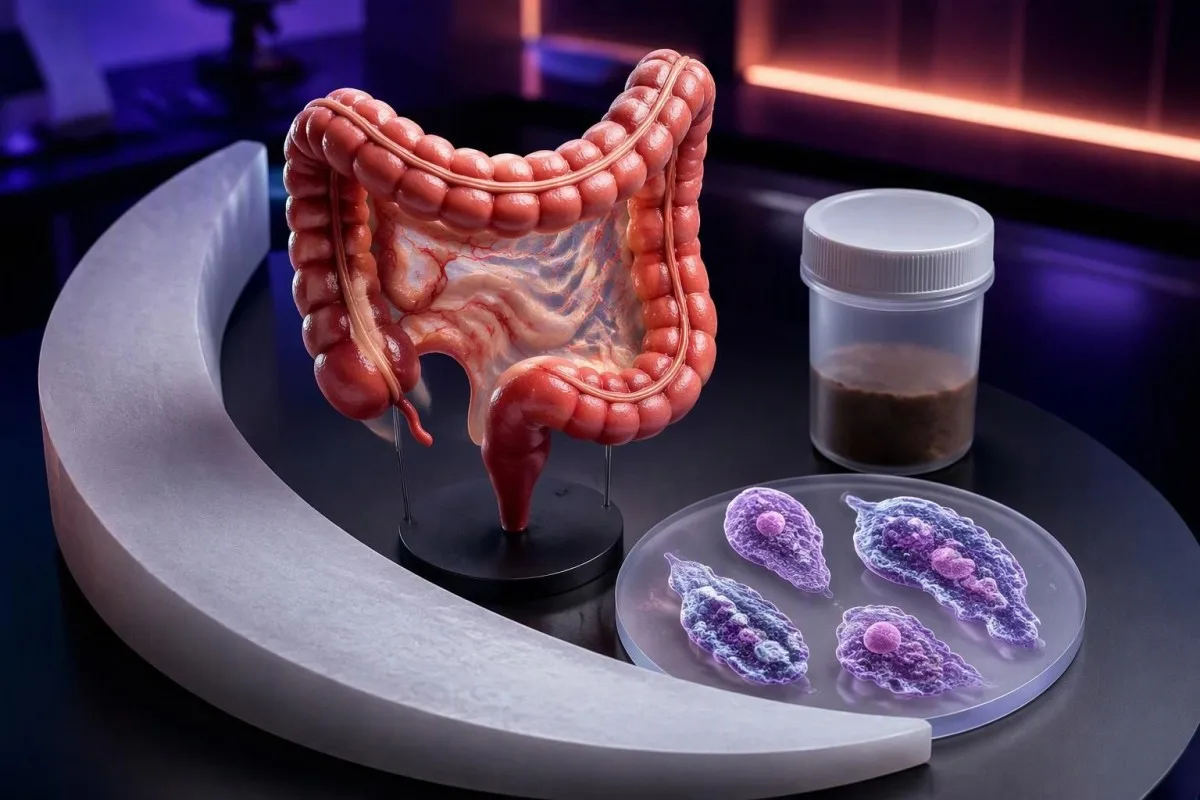
Kipimo cha PCR cha kinyesi chenye majibu chanya hakimaanishi moja kwa moja kwamba unahitaji dawa. Maamuzi ya matibabu hutegemea dalili zinazoendelea, maelezo mengine yanayoweza kusababisha dalili hizo, na uhusiano usio na uhakika kati ya kuondoa kiumbe huyo na kujisikia vizuri.

Mambo muhimu ya kukumbuka
- PCR Chanya hugundua vinasaba vya Dientamoeba fragilis; matokeo 1 chanya hayathibitishi kwamba kiumbe huyo ndiye aliyesababisha dalili zako za mfumo wa mmeng'enyo wa chakula.
- Hakuna dalili kwa kawaida humaanisha kwamba matibabu hayahitajiki, hata kipimo cha kinyesi kinapogundua Dientamoeba fragilis.
- Kuhara kunakoendelea kwa siku 14 au zaidi kunastahili tathmini upya, lakini muda pekee hauthibitishi kwamba Dientamoeba fragilis ndiyo chanzo.
- Ushahidi wa matibabu unajumuisha jaribio lililodhibitiwa bila upendeleo la watoto 96, ambapo metronidazole haikuboresha matokeo ya kliniki zaidi ya placebo.
- Paromomycin ni chaguo linalochaguliwa na daktari; mwongozo wa CDC kwa watu wazima unaorodhesha 25–35 mg/kg/siku katika dozi 3 zilizogawanywa kwa siku 7.
- Calprotectin chini ya 50 µg/g ni kiwango cha marejeo cha kawaida cha maabara kwa watu wazima, si kipimo kinachothibitisha au kuondoa uwezekano wa Dientamoeba fragilis yenye dalili.
- Dalili za onyo kama vile damu kwenye kinyesi, maumivu makali ya tumbo, upungufu wa maji mwilini, au kupungua uzito bila kukusudia zinahitaji tathmini zaidi ya PCR chanya.
- Ufuatiliaji inapaswa kupima dalili pamoja na matokeo ya vipimo; kutokuwepo kwa kiumbe hicho na kupona kwa dalili ni matokeo 2 tofauti.
Je, matokeo chanya ya kipimo cha Dientamoeba fragilis yanahitaji matibabu?
PCR chanya ya kinyesi kwa Dientamoeba fragilis haihitaji matibabu moja kwa moja. Kwa kawaida, watu wasio na dalili hawahitaji dawa; madaktari wanaweza kufikiria matibabu dalili za mfumo wa mmeng’enyo zinapoendelea, kiumbe hicho kinapoonekana kuwa huenda kinahusika, na sababu nyingine zinapokuwa zimetathminiwa.
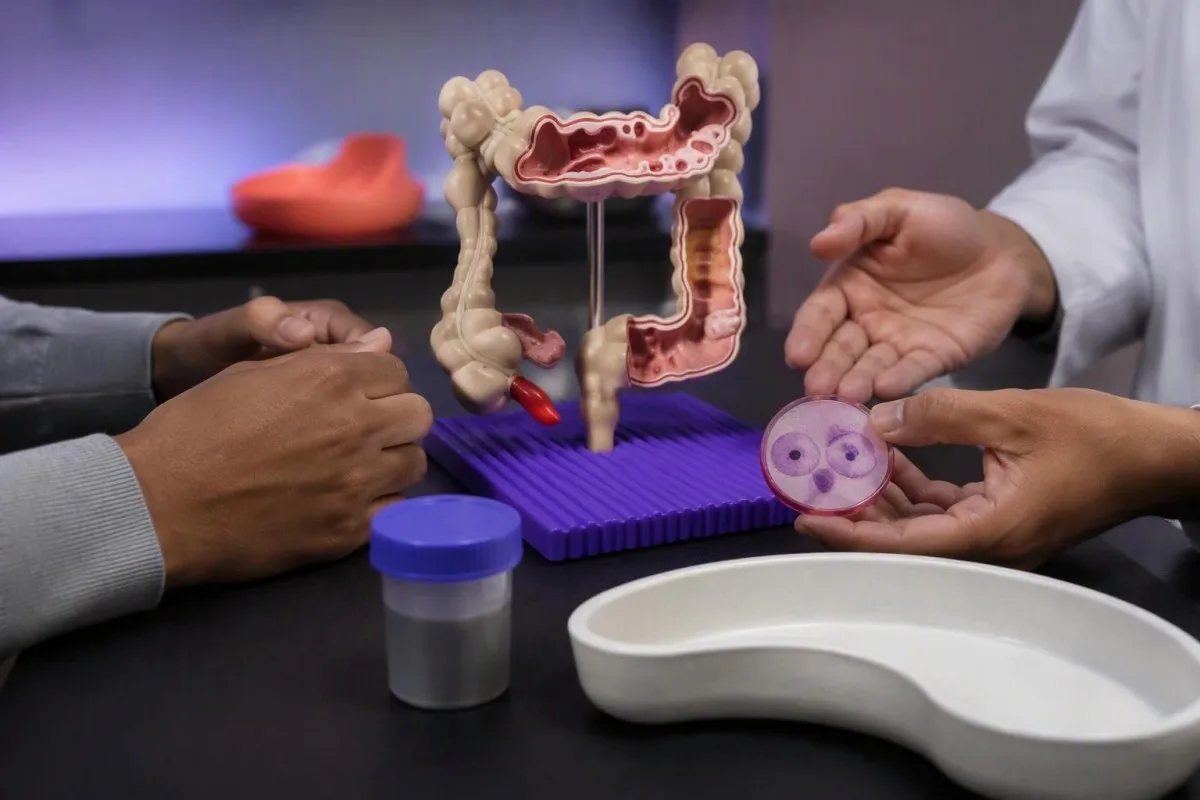
Kugundua na kuthibitisha chanzo ni maswali tofauti. Kipimo cha kinyesi kinaweza kutambua kiumbe kwa usahihi bila kubaini kwa nini mtu ana maumivu ya tumbo au kuhara, kwa hiyo matokeo 1 chanya ni ugunduzi unaopaswa kufasiriwa badala ya kichocheo cha kuandika maagizo ya dawa; huenda kiumbe hicho kimepatikana kwa bahati tu, kinachangia hali hiyo, au hakihusiani na ugonjwa wa sasa.
The Mwongozo wa CDC kuhusu huduma za kliniki unasema kuwa kugunduliwa kwa Dientamoeba fragilis kwa mtu asiye na dalili kwa kawaida hakuhitaji matibabu na kwamba dawa zinaweza kuwasaidia baadhi ya watu wenye dalili ikiwa ndicho kiumbe pekee kilichopatikana (CDC, 2024). Kupata kiumbe 1 tu kunaimarisha uwezekano wa kuwa ni maelezo, lakini bado hakuondoi uwezekano wa ugonjwa wa celiac, athari za dawa, au ugonjwa wa utendaji kazi wa utumbo.
Kwa mfano, fikiria mtu mzima wa kubuniwa ambaye ana kinyesi chepesi kwa siku 2 baada ya mtu wa nyumbani kuugua ugonjwa wa tumbo, na ambaye kipimo cha paneli kinagundua Dientamoeba fragilis. Ikiwa dalili zinaanza kutulia na kiwango cha maji mwilini kinatosha, kumwangalia mgonjwa kunaweza kuwa na busara zaidi kuliko kuongeza mara moja dawa ya kuua vijidudu, ambayo yenyewe inaweza kusababisha kichefuchefu au kuhara.
Kantesti ni kichanganuzi cha vipimo vya damu kinachotumia AI ambacho kinaweza kueleza matokeo ya maabara yanayoambatana na kipimo, lakini hakiwezi kubaini kutokana na PCR ya kinyesi kama kiumbe hiki ndicho kilichosababisha dalili zako. Tunaeleza mpaka huo kupitia taarifa zetu za shirika; uamuzi wa kitabibu hutegemea zaidi ya matokeo 1 ya maabara.
Kipimo cha kinyesi cha Dientamoeba fragilis hugundua nini hasa?
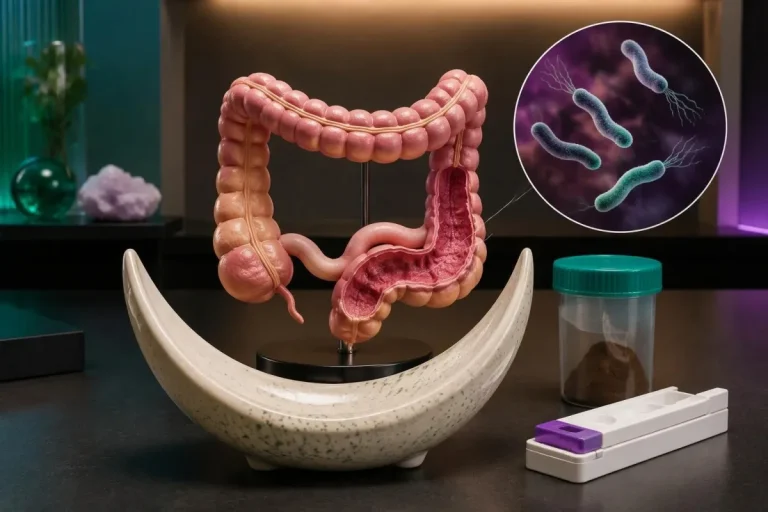
PCR ya kinyesi kwa Dientamoeba fragilis hugundua vinasaba vya kiumbe hicho katika sampuli iliyowasilishwa. Haithibitishi moja kwa moja uhai wa kiumbe hicho, uharibifu wa tishu, au kwamba ndicho kilichosababisha dalili, na hakuna kiwango cha jumla cha PCR kilichothibitishwa kinachoamua kama matibabu yanahitajika.
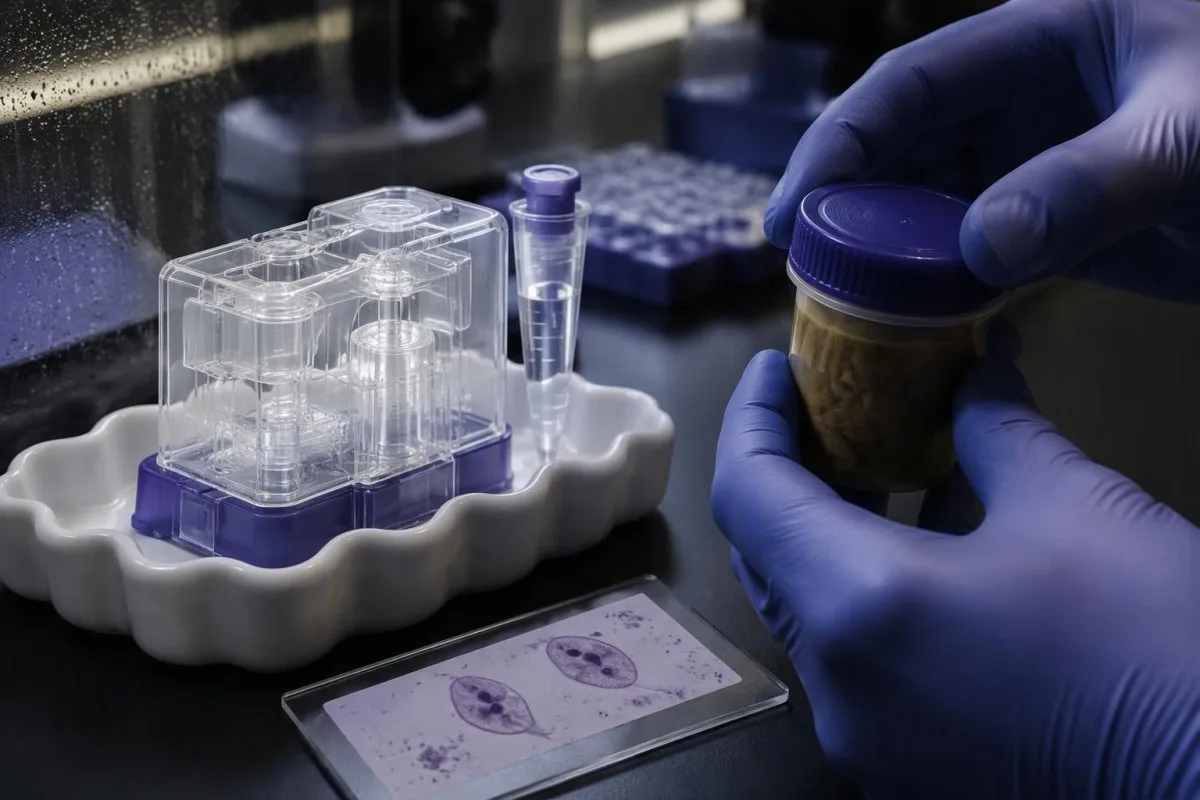
Dientamoeba fragilis ni kimelea cha protozoa cha utumbo, si mnyoo. Jina lake linaweza kupotosha: ni ya kundi linalohusiana na trichomonad badala ya amiba za kawaida, na trofozoiti zinazoonekana kwa hadubini kwa kawaida huwa na kiini 1 au 2; kuona jina hilo kwenye ripoti hakumaanishi kuwa kuna maambukizi vamizi katika mwili wote.
Ripoti nyingi za kliniki hutumia imegunduliwa/haijagunduliwa, badala ya kipimo cha ukali wa ugonjwa kilichothibitishwa kitabibu. Ikiwa maabara inatoa kiwango cha mzunguko, thamani ya chini kwa kawaida huashiria kiasi kikubwa zaidi cha vinasaba lengwa ndani ya kipimo hicho, lakini tofauti za uchimbaji, uthabiti wa kinyesi, na majukwaa huzuia nambari hiyo kutumika kama kiwango cha jumla cha kuamua matibabu; yetu matokeo ya ubora na kiasi inaelezea tofauti ya kuripoti.
PCR na hadubini vinaweza kutofautiana bila mojawapo ya matokeo hayo kukosa maana. PCR is generally more sensitive, whereas microscopy depends on preservation, staining, and expertise; traditional parasite microscopy may require specimens collected on 3 separate days because organism shedding and visibility vary, while a validated molecular assay may use a single specimen.
Check the actual panel contents before assuming other infections were excluded. A negative result for 5 listed pathogens says nothing about an organism the panel never tested, and some gastrointestinal panels do not include Dientamoeba fragilis at all; ask whether your result came from a targeted assay or a broader panel.
Ni wakati gani uwezekano mkubwa zaidi kwamba PCR chanya inaonyesha kubeba kiumbe bila dalili?
Incidental carriage is more likely when the person has no symptoms, symptoms have already resolved, or another explanation fits better. A repeated positive result can demonstrate ongoing detection, but 2 positive samples still do not establish that Dientamoeba fragilis is causing illness.
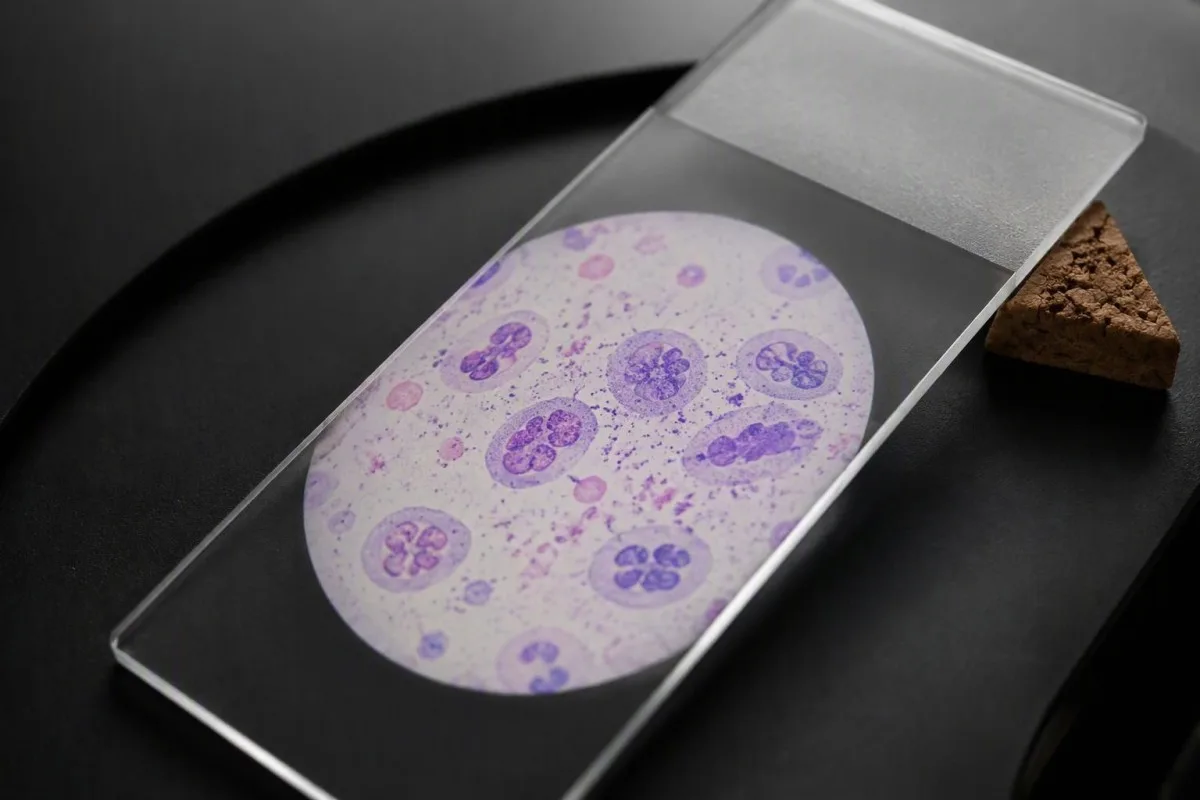
Asymptomatic detection is real, not automatically a laboratory error. Sensitive PCR testing finds organisms that older methods missed, including in people who feel well; because prevalence differs substantially between settings, age groups, and assays, a single percentage from 1 population should not be used to estimate your personal likelihood of illness.
The timing of symptoms can weaken an apparent association. A hypothetical person with 5 years of alternating constipation and diarrhea who receives a first positive stool PCR has not necessarily acquired a new explanation for those longstanding symptoms; the test cannot date acquisition or show whether the organism was present before symptoms started.
A positive commercial microbiome report is not equivalent to a clinical diagnosis. Relative abundance, proprietary risk scores, and organisms reported outside validated pathogen testing may not have established treatment implications; before acting on 1 highlighted finding, review our discussion of mapungufu ya upimaji wa mikrobiomu.
An asymptomatic household contact is not automatically a treatment candidate. Screening and treating every family member after 1 positive result can create avoidable medication exposure; contact testing is more reasonably discussed when several people have persistent compatible symptoms, or when a specialist or local public-health team identifies a specific reason.
Ni dalili zipi za Dientamoeba fragilis ambazo zinaweza kuwa muhimu?
Reported Dientamoeba fragilis symptoms include loose stools, abdominal discomfort, bloating, and sometimes nausea or reduced appetite. None is specific to this organism, so clinicians assess the symptom pattern, duration, and functional impact rather than assuming that 1 positive PCR explains everything.
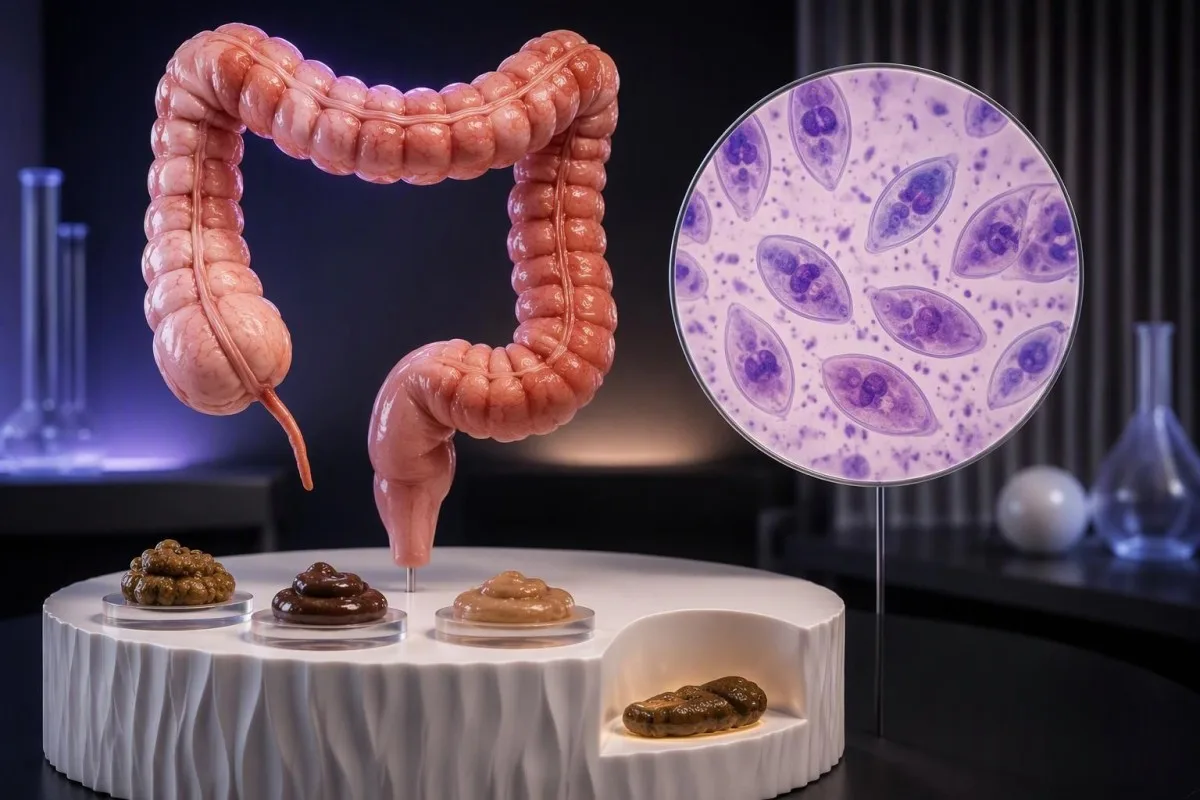
Stool consistency is often more useful than the word diarrhea. On the 7-category Bristol Stool Chart, types 6 and 7 describe mushy and watery stools; recording those types alongside frequency helps distinguish persistent loose stools from frequent but formed bowel movements, as explained in our uthabiti wa kinyesi.
A 7-day symptom diary can clarify whether the illness is continuous or meal-related. Record bowel frequency, stool type, nighttime waking, abdominal discomfort, medicines, and missed activities; a pattern that repeatedly follows a particular food may suggest malabsorption or intolerance, although dietary associations alone do not diagnose either condition.
Stool color does not identify Dientamoeba fragilis. Yellow stools can accompany rapid transit, dietary changes, or fat malabsorption, and 1 unusual bowel movement is not a parasite-specific sign; our explanation of yellow stool causes helps separate color changes from more informative accompanying features.
For example, a hypothetical adult with 4 loose stools daily for 6 weeks, stable weight, and no other pathogen detected has a more plausible treatment discussion than someone whose brief illness has ended. Even then, the assessment should consider medication effects, celiac disease, and inflammatory or functional conditions before assigning causation.
Ni dalili zipi ambazo hazipaswi kulaumiwa kwa Dientamoeba fragilis?
Blood in stool, substantial dehydration, severe or localized abdominal pain, persistent fever, and unintentional weight loss need assessment beyond a positive Dientamoeba fragilis result. These findings can signal another condition, and clinicians should not allow 1 detected organism to delay appropriate investigation.
Seek urgent medical help for severe pain, collapse, confusion, or inability to keep fluids down. A temperature around 38°C or higher combined with significant illness deserves prompt advice, although age, immune status, and other symptoms matter more than a single cutoff; emergency symptoms should not wait for a repeat parasite test.
Inayoonekana red blood or black, tarry stool is not a typical finding to dismiss as uncomplicated dientamoebiasis. Iron tablets and some foods can change stool color, but 1 episode accompanied by dizziness, weakness, or significant pain warrants prompt assessment; our dalili za tahadhari kuhusu damu kwenye kinyesi explain why appearance and accompanying symptoms matter.
Diarrhea that wakes someone from sleep and progressive weight loss broaden the differential diagnosis. Unintentional loss of more than 5% of body weight over 6–12 months is a commonly used clinical warning threshold, but smaller losses can still matter in children, frail adults, or someone losing weight rapidly.
Reduced urine output can indicate upungufu wa maji mwilini, especially when accompanied by thirst, dizziness, or dry mouth. Do not wait for a precise number of hours if the person appears unwell; infants, older adults, pregnant people, and those with kidney disease need a lower threshold for clinical advice than a healthy adult with 1 mild loose stool.
Vipi ikiwa kipimo cha kinyesi kinagundua pathojeni nyingine pia?
When another pathogen is detected, clinicians compare its established disease pattern with the symptoms before prioritizing Dientamoeba fragilis treatment. A panel with 2 positive targets may reflect coinfection, persistent shedding, or incidental carriage; it does not automatically justify treating both organisms.
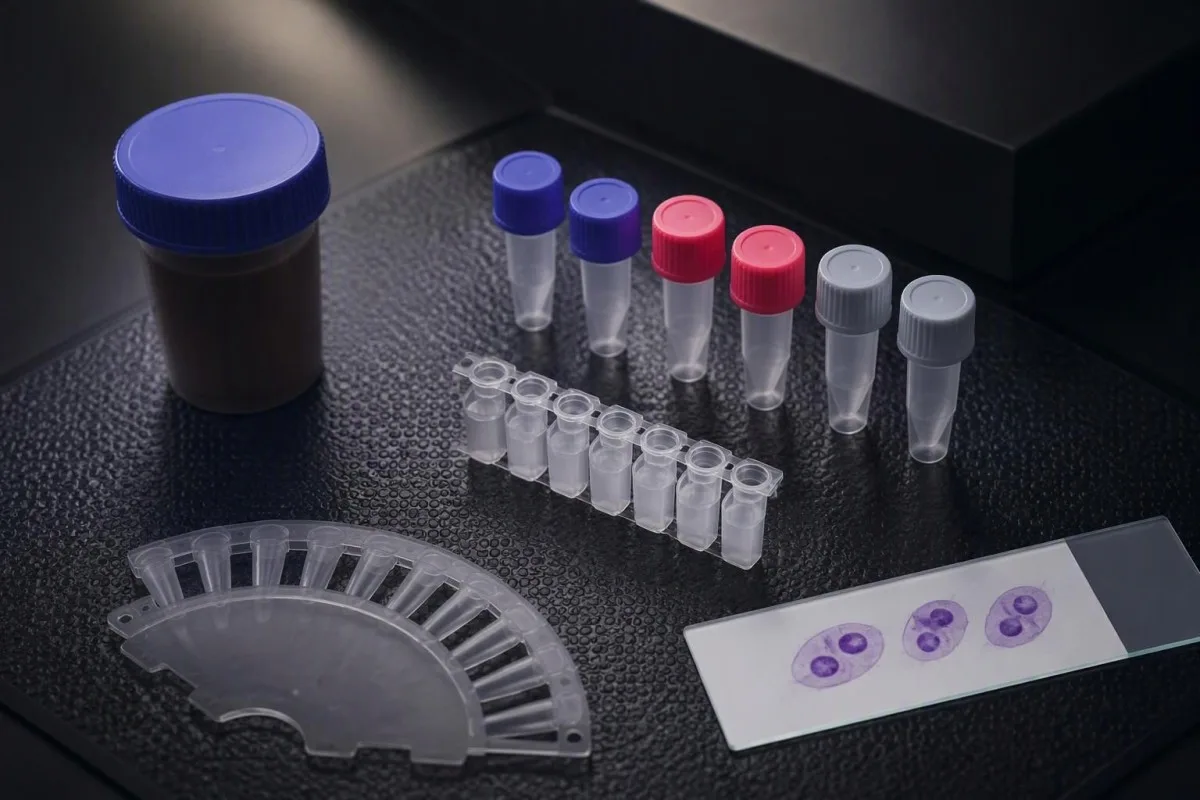
Giardia has a better-established relationship with persistent diarrhea and malabsorption than Dientamoeba fragilis. If both are detected in a hypothetical person with 3 weeks of loose, greasy stools after untreated-water exposure, a clinician may prioritize Giardia-directed care; our Giardia treatment and recovery guide explains the different evidence base.
Campylobacter detection does not automatically require antibiotics either, despite its established role in gastroenteritis. Severity, illness duration, and vulnerability determine the decision, so 2 detected organisms still require 2 separate clinical judgments; compare our discussion of Campylobacter antibiotic decisions rather than assuming all stool positives follow one rule.
Hivi karibuni antibiotic exposure changes the assessment because it raises concern for antibiotic-associated diarrhea and C. difficile. A positive screening assay with a negative toxin result creates another detection-versus-disease problem, particularly when someone does not have at least 3 unformed stools in 24 hours; our matokeo yasiyolingana ya C. difficile guide describes that distinction.
A negative panel is not a complete gastrointestinal evaluation. Even a panel covering 20 organisms cannot identify bile acid diarrhea, microscopic colitis, celiac disease, or every travel-related infection; the test menu, exposure history, and symptom duration determine whether additional microbiology or a noninfectious workup makes more sense.
Je, matibabu ya Dientamoeba fragilis huboresha dalili kwa uhakika?
Dientamoeba fragilis treatment does not reliably produce symptom improvement, and the evidence is mixed. A randomized, placebo-controlled trial involving 96 children found that metronidazole did not improve clinical outcomes more than placebo, even though treatment initially increased organism eradication.
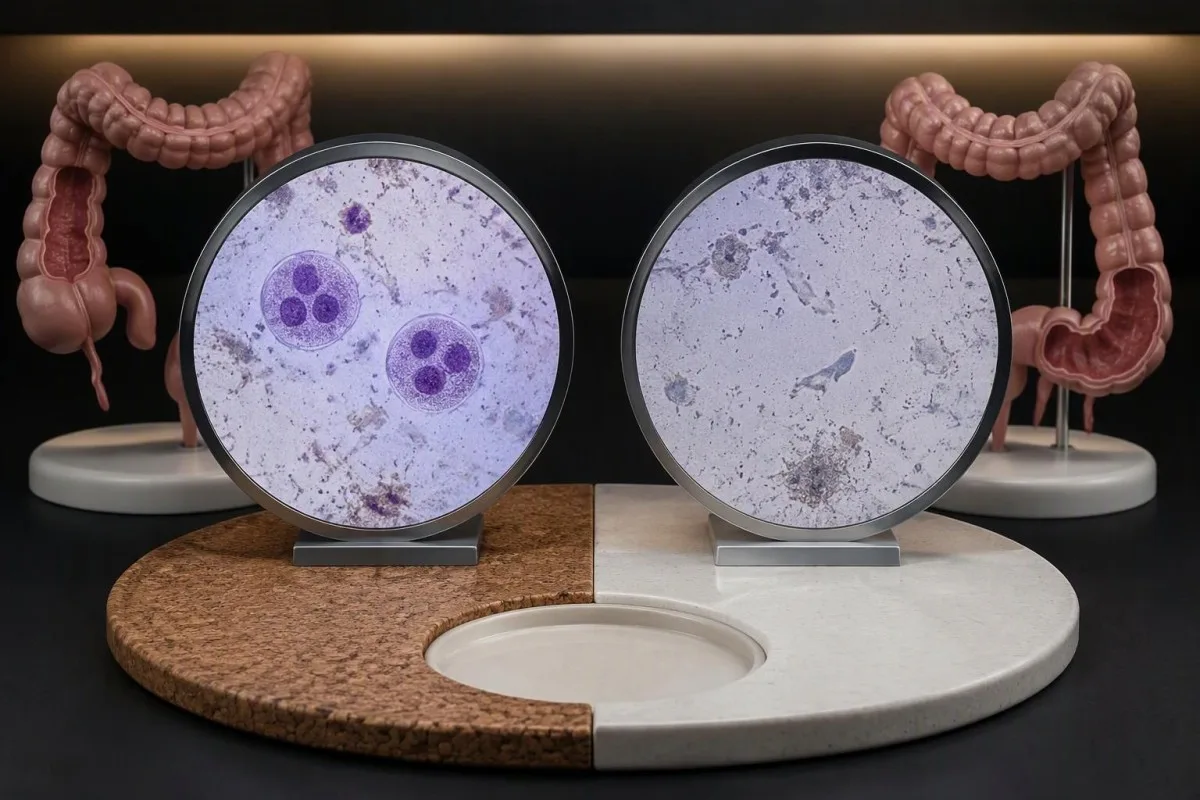
Röser et al. reported the trial in Clinical Infectious Diseases in 2014. Children aged 3–12 years received a 10-day course of metronidazole or placebo, and the study did not establish a clinical benefit from metronidazole; that result argues against routine treatment of every symptomatic child with a positive test.
The trial does not prove that all treatments are ineffective in every patient. It evaluated 1 medication in a particular pediatric population, so its findings cannot automatically be extended to paromomycin, every adult presentation, or unusual clinical circumstances; uncertainty should narrow claims rather than be converted into either universal treatment or universal dismissal.
Before-and-after improvement is weaker evidence than a randomized comparison. Over a 2-week period, symptoms may improve naturally, fluctuate, or respond to changes in diet and other medicines; an uncontrolled report of feeling better after treatment cannot reliably separate those explanations from a specific effect on Dientamoeba fragilis.
Katika Kantesti, we distinguish organism eradication, symptom recovery, and study design as 3 separate issues when explaining this uncertainty. Our digestive symptom research guide provides broader context, but it is not direct evidence that antimicrobial treatment improves outcomes in Dientamoeba-positive patients.
Madaktari wanaweza kutumia dawa zipi, na zina mipaka gani?
Clinicians may use paromomycin or metronidazole for selected symptomatic patients, but medication choice does not resolve uncertainty about causation. CDC adult guidance lists paromomycin at 25–35 mg/kg/day in 3 divided doses for 7 days; this is prescribing information, not an instruction to self-treat.
Paromomycin mainly acts within the intestinal lumen. A retrospective adult study by van Hellemond et al. in 2012 found better eradication with paromomycin than some alternatives, but the nonrandomized design cannot establish superior symptom relief; its findings support a medication discussion, not a guaranteed cure for abdominal discomfort.
The CDC adult metronidazole regimen is 500–750 mg orally 3 times daily for 10 days (CDC, 2024). Nausea, altered taste, medication interactions, and occasional neurologic adverse effects matter; pediatric dosing differs, and pregnancy, breastfeeding, liver disease, or other medical conditions require a prescriber to assess the specific choice.
Medication reconciliation should happen before prescribing. Metronidazole can increase warfarin's anticoagulant effect, so a person taking warfarin may need an individualized INR monitoring plan rather than merely a routine 10-day prescription; our guide to viua vijasumu na mabadiliko ya INR explains the mechanism and monitoring considerations.
A penicillin allergy label does not automatically prohibit either of these medicines because they are not penicillins. However, any previous reaction to the proposed drug itself needs review, and 1 vague historical allergy label should not substitute for a full medication history; our allergy label reassessment guide explains that separate issue.
Ni wakati gani madaktari huchunguza visababishi vingine kabla ya kuagiza dawa?
Clinicians often investigate other causes before prescribing when symptoms are longstanding, atypical, associated with warning signs, or poorly explained by the stool result. Diarrhea lasting 4 weeks or longer is commonly classified as chronic, making a structured noninfectious assessment particularly useful.
Medication effects are a high-yield starting point. Metformin, magnesium-containing products, laxatives, and some antibiotics can cause loose stools; if a hypothetical person develops diarrhea 1 week after a dose increase, that timeline may be more informative than incidental parasite detection, although prescribed medicines should not be stopped without advice.
A fecal calprotectin below 50 µg/g is a common adult laboratory reference threshold, while values above roughly 250 µg/g may strengthen concern for intestinal inflammation in an appropriate clinical pathway. These are not universal diagnostic boundaries: age, infection, NSAID use, and laboratory methods affect interpretation, as discussed in our borderline calprotectin follow-up vinavyoongoza.
Celiac screening commonly combines tissue transglutaminase IgA with total IgA. Reducing gluten before testing can make results falsely reassuring, and IgA deficiency changes which antibody tests are appropriate; if gluten has already been removed for several weeks, our gluten challenge planning guide explains why clinicians individualize the next step.
A normal initial workup does not make every alternative disappear. In someone with 6 months of watery diarrhea, clinicians may consider bile acid diarrhea or microscopic colitis; the latter can require colon examination with tissue sampling even when the bowel looks normal, while an IBS diagnosis depends on a compatible pattern and appropriate exclusion of warning features.
Je, vipimo vya damu vinaweza kuonyesha ikiwa Dientamoeba fragilis ndiyo inayosababisha ugonjwa?
Routine blood tests cannot establish that Dientamoeba fragilis caused digestive symptoms. They can identify consequences or competing explanations, such as dehydration, anemia, inflammation, or nutrient deficiency; no validated CBC, CRP, or eosinophil cutoff confirms symptomatic disease from this organism.

CBC and ferritin can reveal an alternative reason for fatigue. In otherwise healthy adults, ferritin below 15 µg/L strongly supports depleted iron stores, although inflammation can raise ferritin and obscure deficiency; fatigue with low iron should not automatically be attributed to 1 stool finding, as our mwongozo wa dalili za kiwango cha chini cha feritin inavyoeleza.
For example, imagine an adult with ferritin 9 µg/L and hemoglobin 108 g/L alongside a positive stool PCR. Those hypothetical results warrant investigation of iron deficiency and its cause, not an assumption that treating the protozoan will correct the anemia; our mwongozo wa kutafsiri vipimo vya chuma shows why multiple markers matter.
Eosinophilia is not a reliable marker of Dientamoeba fragilis disease. An eosinophil count above 0.5 × 10^9/L is commonly considered elevated, but allergies, medicines, and some helminth infections are more typical explanations; a positive Dientamoeba test should not stop clinicians from investigating substantial or persistent eosinophilia separately.
Kantesti is an AI blood test interpretation platform that explains CBC, ferritin, CRP, and kidney-function results without treating them as proof of parasite causation. A CRP of 3 mg/L may fall within a laboratory's standard reference interval, yet normal inflammatory markers do not exclude celiac disease, microscopic colitis, or other explanations for persistent diarrhea.
Maamuzi ya matibabu hutofautianaje kwa watoto na watu wazima walio katika hatari zaidi?
Children, pregnant people, frail adults, and immunocompromised patients need individualized assessment rather than an automatic response to positive PCR. In children, growth, hydration, and symptom severity matter especially; the randomized metronidazole trial in 96 children supports caution about routine prescribing.

Growth faltering should prompt a broader pediatric evaluation. A hypothetical child with 6 weeks of loose stools and a falling growth trajectory needs assessment of intake, celiac disease, inflammation, and other causes; Dientamoeba fragilis detection may be relevant, but it should not become the only explanation considered.
Children can become dehydrated more quickly than healthy adults, particularly when vomiting accompanies diarrhea. Oral rehydration solution prepared exactly as directed is preferable to guessing electrolyte amounts, and 1 clearly unwell child with reduced urine, unusual drowsiness, or inability to drink needs prompt advice rather than waiting for a medication trial.
Pregnancy changes medication selection, not the meaning of PCR. A positive result still does not establish causation, while gestational stage, symptom burden, and drug-specific safety information influence prescribing; a person who is 10 weeks pregnant should discuss treatment with the maternity or prescribing team rather than using another household member's medication.
Immunosuppression lowers the threshold for evaluating other opportunistic causes, but it does not make this organism automatically responsible. Kantesti AI does not replace pediatric or specialist assessment; our discussion of Ufafanuzi wa AI kwa watoto explains why adult reference ranges and 1 abnormal result can be misleading.
Je, unapaswa kurudia kipimo cha kinyesi baada ya matibabu?
Repeat testing is not automatically necessary after symptoms resolve, and a test-of-cure plan should be agreed with the treating clinician. Persistent symptoms require reassessment; 1 repeat positive PCR does not by itself justify another course, and a negative result does not explain ongoing symptoms.
Testing immediately after treatment can be difficult to interpret. PCR detects genetic material rather than directly measuring living organisms, and there is no universal Dientamoeba-specific interval that makes every result definitive; instead of choosing an arbitrary day 3 test, ask what question the repeat test is intended to answer.
A positive repeat result may reflect persistence, reacquisition, or assay-related timing considerations. Those possibilities have different implications, so before prescribing course 2 a clinician should review adherence, the original symptom pattern, household exposures, and whether the first course changed anything that mattered to the patient.
A negative PCR with ongoing bloating shifts attention toward other explanations rather than proving treatment failure. Selected patients with risk factors may warrant a breath-test discussion, but bloating alone should not trigger indiscriminate SIBO testing; our breath test preparation guide explains why protocol and pretest probability matter.
Define success before treatment starts. For a hypothetical adult, improvement from 5 watery stools per day to 1–2 formed stools is a meaningful outcome, whereas an unchanged symptom diary with a negative PCR is laboratory clearance without demonstrated symptom benefit; documenting both prevents repeated medication from becoming the default response.
Ni hatua zipi za vitendo zinazosaidia bila kutibu watu wa nyumbani bila sababu?
Handwashing, careful bathroom hygiene, safe food handling, and clear follow-up records are reasonable steps after a positive result. The exact transmission routes of Dientamoeba fragilis remain incompletely resolved, so 1 positive household test does not justify promises that a particular cleaning routine will prevent recurrence.

Wash hands with soap and water after toilet use and before preparing food. Scrubbing for about 20 seconds is a standard general hygiene recommendation, not a Dientamoeba-specific eradication method; gloves do not replace handwashing, and bathrooms should be cleaned using ordinary product instructions rather than improvised chemical mixtures.
The proposed connection with pinworm transmission is not settled. Nighttime anal itching may justify a separate assessment, sometimes involving a morning tape test on 3 occasions, but a positive Dientamoeba PCR alone is not a reason to give everyone a deworming medicine or assume pinworms are present.
Kantesti is an AI-powered blood test analysis tool that can help explain accompanying laboratory results while stool-management decisions remain with the clinician. Keep the symptom diary, medicine list, and test dates together as 3 distinct records; our mifano ya mtiririko wa tafsiri (interpretation workflows) describe educational workflows rather than evidence that our service treats intestinal parasites.
A shared household record should respect consent and minimize unnecessary identifiers. If 2 family members have symptoms, each person's clinical assessment and treatment decision remain separate; our faragha na mbinu za data explain how we approach information handling, but your clinician's secure communication channel should be used for prescribing and urgent advice.
Unapaswa kumuuliza daktari wako nini, na ni utafiti gani unaounga mkono uamuzi huo?
Ask whether Dientamoeba fragilis plausibly explains your symptoms, which alternatives need checking, and what benefit would justify treatment. The most useful evidence separates symptom outcomes from organism eradication; a 10-day treatment course and a negative follow-up test are not, by themselves, proof of clinical benefit.

Bring 4 items to the appointment: the full stool report, a medication list, a symptom timeline, and any relevant accompanying laboratory results. Ask what would change the decision—another pathogen, celiac antibodies, a concerning calprotectin result, or spontaneous improvement—and agree on when to return if symptoms persist or warning signs develop.
A 7-day diary can make observation an active plan rather than doing nothing. Maintain fluids and tolerated foods; oral rehydration solution can help replace diarrheal losses, but restrictive diets, herbal parasite cleanses, and supplements have no established role in eradicating Dientamoeba fragilis and should not delay investigation of persistent symptoms.
The 3 external sources below have different evidentiary roles: CDC provides clinical prescribing guidance, Röser et al. provide randomized pediatric symptom-outcome evidence, and van Hellemond et al. provide retrospective adult eradication data. Kantesti applies viwango vya maudhui ya matibabu that distinguish these study designs instead of presenting them as equally strong proof.
The 2 Figshare publications listed below are general educational resources, not trials of Dientamoeba fragilis treatment; the women's health guide does not provide direct evidence for this decision. A DOI establishes a persistent identifier, not clinical validation, and our technical and clinical methodology should likewise not be mistaken for proof that AI can establish the cause of digestive symptoms.
Maswali ya mara kwa mara
Je, kipimo cha PCR chenye matokeo chanya ya Dientamoeba fragilis kinamaanisha ninahitaji antibiotiki?
Kipimo chanya cha PCR cha Dientamoeba fragilis haimaanishi moja kwa moja kwamba unahitaji matibabu ya dawa za kuua vijidudu. Kwa kawaida, watu wasio na dalili hawahitaji dawa, na matokeo 1 chanya ya kipimo cha kinyesi hayawezi kubaini sababu ya dalili za mmeng’enyo wa chakula. Wahudumu wa afya wanaweza kuzingatia matibabu dalili zinapoendelea, sababu nyingine zinapokuwa zimechunguzwa, na kiumbe hicho kinapoonekana kuwa huenda kinahusika. Maumivu makali, upungufu wa maji mwilini, au damu kwenye kinyesi kunahitaji tathmini zaidi ya matokeo ya PCR.
Je, Dientamoeba fragilis inaweza kuisha bila matibabu?
0 Utambuzi wa Dientamoeba fragilis unaweza kuwa hasi bila matibabu, na dalili za mfumo wa mmeng'enyo wa chakula zinaweza pia kuisha bila kutegemea kuondoka kwa kiumbe hicho. Kuweka kumbukumbu ya dalili kwa siku 7 kunaweza kusaidia kuandika hali inapoboreka wakati ufuatiliaji unapofaa. Kupona kwa hiari wala matokeo hasi ya PCR baadaye hayathibitishi kwamba kiumbe hicho ndicho kilichosababisha ugonjwa wa awali. Dalili zinazoendelea au zinazozidi kuwa mbaya zinapaswa kuchochea tathmini upya badala ya kusubiri bila kikomo.
Ni matibabu gani bora zaidi kwa Dientamoeba fragilis?
Hakuna tiba bora iliyothibitishwa kote kwa ajili ya kupunguza dalili kwa kila mgonjwa mwenye kipimo chanya cha Dientamoeba fragilis. Mwongozo wa CDC kwa watu wazima unaorodhesha paromomycin kwa kipimo cha 25–35 mg/kg/day katika dozi 3 zilizogawanywa kwa siku 7, huku metronidazole ikiwa chaguo jingine. Ushahidi wa tafiti za nyuma unapendelea paromomycin kwa kutokomeza kimelea, lakini kukitokomeza si sawa na kuboresha dalili. Mtoa huduma anayeandika dawa lazima achague tiba inayomfaa mgonjwa mmoja mmoja, kwa kuzingatia umri, ujauzito, hali za kiafya na mwingiliano wa dawa.
0 Kwa nini bado nina dalili baada ya matibabu ya Dientamoeba fragilis?
Dalili zinazoendelea baada ya matibabu ya Dientamoeba fragilis zinaweza kumaanisha kuwa kiumbe hicho hakikuwa chanzo kikuu, kuna hali nyingine, au matibabu hayakuondoa kiumbe hicho kabisa. Matokeo hasi ya PCR hayamaanishi kuwa ugonjwa wa celiac, kuhara kunakohusiana na dawa, kolitis ya kimaikroskopu, au tatizo la utendaji wa utumbo yameondolewa. Kuhara kunakodumu kwa wiki 4 au zaidi kwa kawaida huhitaji tathmini iliyopangwa ya kuhara kwa muda mrefu. Kozi nyingine ya dawa inapaswa kufuata tathmini upya badala ya kuagizwa kwa sababu tu dalili zinaendelea.
Je, watoto wenye Dientamoeba fragilis wanapaswa kutibiwa?
Watoto walio na Dientamoeba fragilis hawapaswi kutibiwa moja kwa moja kwa msingi wa matokeo chanya ya PCR ya kinyesi. Jaribio lililodhibitiwa kwa bahati nasibu la watoto 96 wenye umri wa miaka 3–12 halikubaini matokeo bora zaidi ya kiafya kwa kozi ya metronidazole ya siku 10 kuliko placebo. Maamuzi kuhusu watoto yanapaswa kuzingatia dalili zinazoendelea, hali ya unyevu mwilini, ukuaji, utambuzi mbadala na usalama mahususi wa dawa. Kudumaa kwa ukuaji au mtoto aliye katika hali mbaya inayoonekana anahitaji tathmini ya kliniki bila kujali matokeo ya kipimo cha vimelea.
Je, familia yangu inapaswa kupimwa au kutibiwa ikiwa matokeo yangu ni chanya?
Mwana mmoja wa kaya aliyepatikana na Dientamoeba fragilis hapaswi moja kwa moja kupelekea kupima au kutibu kila mtu aliye karibu naye. Kwa kawaida, mtu asiye na dalili akigundulika kuwa na vimelea hahitaji matibabu, ilhali watu 2 au zaidi wenye dalili zinazoendana na maambukizi zinazoendelea wanaweza kuhitaji kujadiliana kuhusu kaya nzima na daktari. Kunawa mikono kwa sabuni na maji kwa takriban sekunde 20 ni usafi wa jumla unaofaa, lakini si hakikisho lililothibitishwa la kuzuia kujirudia kwa Dientamoeba. Tathmini ya minyoo ya pinworm ni uamuzi tofauti, si jambo linalofanywa moja kwa moja baada ya kupata matokeo chanya ya PCR.
Pata maelezo ya jinsi ya kusoma matokeo ya vipimo vya damu
Pakia ripoti yako ya maabara na AI ya Kantesti itaeleza kila kiashiria cha kibayolojia kwa lugha rahisi ndani ya sekunde chache. Inatumiwa na zaidi ya watu milioni 2 duniani kote.
Marejeleo
- Klein, T., Mitchell, S., & Weber, H. (2026). Kuhara Baada ya Kufunga, Madoadoa Meusi kwenye Kinyesi na Mwongozo wa Mfumo wa Mmeng'enyo wa Chakula 2026. Utafiti wa Kimatibabu wa AI ya Kantesti. DOI
- Klein, T., Mitchell, S., & Weber, H. (2026). Mwongozo wa Afya ya Wanawake: Ovulesheni, Kukoma Hedhi na Dalili za Homoni. Utafiti wa Kimatibabu wa AI ya Kantesti. DOI
- Vituo vya Kudhibiti na Kuzuia Magonjwa (2024). Clinical Care of Dientamoeba fragilis. CDC Clinical Guidance.
- Röser D et al. (2014). Metronidazole Therapy for Treating Dientamoebiasis in Children Is Not Associated With Better Clinical Outcomes: A Randomized, Double-Blinded and Placebo-Controlled Clinical Trial. Magonjwa ya Kuambukiza ya Kliniki. DOI
- van Hellemond JJ et al. (2012). Is paromomycin the drug of choice for eradication of Dientamoeba fragilis in adults? International Journal for Parasitology: Drugs and Drug Resistance.
- 2M+Vipimo vilivyochanganuliwa
- 127+Nchi
- 100+Lugha
Kuhusu timu ya matibabu


E-E-A-T Trust Signals
Uzoefu
Mapitio ya kimatibabu inayoongozwa na daktari ya mifumo ya tafsiri ya maabara.
Utaalamu
Kuzingatia dawa za maabara kuhusu jinsi viashiria (biomarkers) vinavyobadilika katika muktadha wa kliniki.
Mamlaka
Imekaguliwa kimatibabu na Dkt. Thomas Klein, kwa michango kutoka kwa Dkt. Sarah Mitchell na Prof. Dkt. Hans Weber.
Uaminifu
Tafsiri inayotegemea ushahidi yenye njia zilizo wazi za ufuatiliaji ili kupunguza tahadhari za hofu.




Kanusho la kimatibabu
Makala haya ni kwa madhumuni ya elimu tu na si ushauri wa kimatibabu. Wasiliana na mtoa huduma aliyehitimu kila wakati kwa maamuzi ya utambuzi na matibabu.
Imechapishwa · Wasiliana na timu ya uhariri
Imechapishwa na Kantesti Ltd, imesajiliwa nchini Uingereza na Wales, nambari ya kampuni. 17090423, London, Uingereza.
