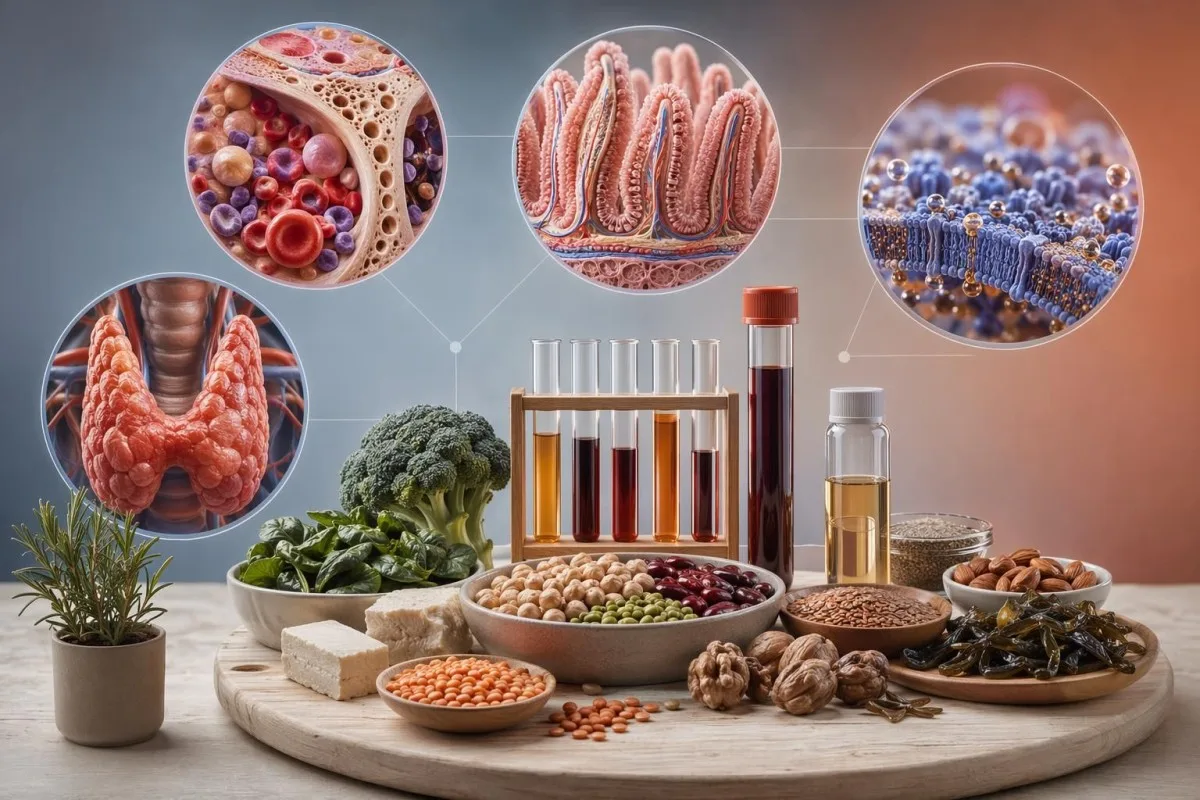
Lacto-ovo and plant-forward diets do not need a copy-paste vegan supplement stack. The smarter move is to test the nutrients most likely to drift, then supplement only where the pattern fits.


- Ferritin below 30 ng/mL usually means depleted iron stores, even when hemoglobin still looks normal.
- Serum B12 below 200 pg/mL strongly supports deficiency; 200-350 pg/mL needs MMA or homocysteine context.
- 25-OH vitamin D below 20 ng/mL is deficiency; many adults recheck after 8-12 weeks of D3.
- Plasma zinc below 70 µg/dL can suggest low zinc intake, but morning fasting collection matters.
- TSH with free T4 is more useful than iodine guessing; iodine excess and deficiency can both raise TSH.
- Omega-3 index below 4% suggests low EPA/DHA status; algae oil is the cleanest vegetarian correction.
- Lacto-ovo vegetarians may get B12 from eggs and dairy, but absorption problems still happen after age 50.
- Lab-guided dosing prevents common mistakes: iron when ferritin is high, iodine with thyroid autoimmunity, or zinc without copper monitoring.
Which labs decide the right supplements for vegetarians?
The best supplements for vegetarians are the ones your labs justify: ferritin with iron studies, B12 with MMA or homocysteine when borderline, 25-OH vitamin D, plasma zinc, TSH plus free T4 for iodine-related thyroid effects, and an omega-3 index. Lacto-ovo eaters often need less B12 than strict vegans, but they can still run low on iron, vitamin D, zinc, or EPA/DHA. Our Kantesti AI interpretation reads these patterns together, not as isolated red flags.
As of May 16, 2026, I would not tell a plant-forward patient to copy a vegan protocol unless the diet is essentially vegan. A person eating eggs, Greek yoghurt, fortified milk, and occasional fish-free omega products has a different risk profile than someone eating only unfortified plants for 5 years.
A basic nutrient panel is more useful than a drawer of capsules. For a broader primer on deficiency markers, our guide to vitamin deficiency blood tests explains why serum levels, storage markers, and functional markers disagree.
In our analysis of 2M+ blood test uploads, the pattern I see most is not dramatic deficiency. It is borderline ferritin at 18-35 ng/mL, B12 around 250-400 pg/mL, and vitamin D drifting below 25 ng/mL during winter; those are fixable, but only if you know which lever to pull.
Why lacto-ovo vegetarians should not copy vegan protocols
Lacto-ovo vegetarians usually have lower deficiency risk for B12, calcium, and iodine than strict vegans, but they may still need targeted supplements when labs show a gap. A vegan protocol often overcorrects one nutrient while ignoring another.
A lacto-ovo vegetarian eating 2 eggs daily may receive roughly 1.0-1.2 µg of B12 from eggs, while a serving of dairy can add another 0.8-1.4 µg depending on the product. That still may not reach the adult intake target of about 2.4 µg/day if portions are small or absorption is poor.
The thing is, plant-forward eating varies wildly. I have reviewed panels from patients who call themselves vegetarian but eat fish twice a month, and others who avoid dairy, eggs, fortified foods, and iodized salt. The lab pattern usually tells the truth faster than the label.
Kantesti LTD is a UK company with medical review, data security controls, and clinical governance described on our About Us page. When Thomas Klein, MD reviews a vegetarian panel, the first clinical question is not what supplement trend is popular; it is which measured store or functional marker is actually low.
A practical split helps: strict vegans usually need routine B12, many vegetarians need winter vitamin D, menstruating vegetarians often need iron surveillance, and low-fish plant-forward eaters commonly need EPA/DHA testing. Our vegan yearly lab checklist is useful, but lacto-ovo eaters should modify it rather than copy it.
Ferritin shows iron stores before anemia appears
Ferritin is the most useful first test for vegetarian iron stores because it often falls months before hemoglobin becomes abnormal. Ferritin below 30 ng/mL strongly suggests iron deficiency in adults unless inflammation or liver disease is distorting the result.
The normal ferritin range for adult women is often reported around 12-150 ng/mL, and for adult men around 30-400 ng/mL, but the lower edge of the lab range is not the same as optimal iron stores. In my clinic, a menstruating vegetarian with ferritin 14 ng/mL and fatigue is not reassured by a normal hemoglobin.
A 28-year-old runner comes to mind: hemoglobin 13.2 g/dL, MCV 86 fL, ferritin 18 ng/mL, transferrin saturation 14%, and restless legs at night. Her CBC looked fine, but her iron reserve was thin enough that training tipped her into symptoms.
Iron studies matter when ferritin is confusing. Low ferritin with high TIBC supports deficiency, while ferritin 80 ng/mL with low iron saturation may point toward inflammation, recent illness, or functional iron restriction; our iron studies guide goes deeper into that pattern.
Vegetarians asking about supplements for low iron should avoid blind high-dose iron if ferritin is already high. A safer starting point is to confirm ferritin, serum iron, TIBC, transferrin saturation, CRP, and the CBC pattern; our ferritin range guide explains why a single iron value can mislead.
B12 testing needs functional markers when results are borderline
Serum B12 below 200 pg/mL usually supports B12 deficiency, but 200-350 pg/mL is a grey zone where methylmalonic acid or homocysteine can reveal tissue-level deficiency. Vegetarians with normal hemoglobin can still have low B12 symptoms.
The normal serum B12 range is commonly about 200-900 pg/mL, although some European labs flag values below 180 pg/mL while others treat 250 pg/mL as borderline. O'Leary and Samman reviewed B12 physiology in Nutrients and described why serum B12 alone can miss functional deficiency (O'Leary & Samman, 2010).
Methylmalonic acid above about 0.40 µmol/L supports B12 deficiency, particularly when kidney function is normal. Homocysteine above 15 µmol/L is less specific because folate, B6, thyroid status, kidney function, and genetics can all push it upward.
I see a surprisingly common pattern in older lacto-ovo vegetarians: B12 280 pg/mL, MCV 94 fL, homocysteine 18 µmol/L, and numb toes. They eat eggs and yoghurt, but stomach acid, metformin, proton-pump inhibitors, or autoimmune gastritis can reduce absorption.
If you are comparing supplements for B12 deficiency, dose is not the only question. Our B12 blood test guide and homocysteine guide explain why oral cyanocobalamin 1,000 µg/day can work well for many patients, while injections are considered when neurologic symptoms, malabsorption, or very low levels are present.
25-OH vitamin D is the test that guides dosing
The correct lab for vitamin D status is 25-hydroxyvitamin D, not active 1,25-dihydroxyvitamin D for routine screening. A 25-OH vitamin D below 20 ng/mL is deficiency, while 20-29 ng/mL is commonly treated as insufficiency.
The Endocrine Society guideline by Holick et al. defined vitamin D deficiency as 25-OH vitamin D below 20 ng/mL and insufficiency as 21-29 ng/mL, although some bone-health groups accept 20 ng/mL as adequate for many adults (Holick et al., 2011). Clinicians still disagree here, especially for people without bone symptoms.
Vegetarians are not automatically vitamin D deficient, but risk rises with darker skin, indoor work, winter latitude, covering clothing, higher body fat, and low intake of fortified dairy or eggs. A patient in London with 25-OH vitamin D of 14 ng/mL in February is a different story from someone at 31 ng/mL in August.
Supplements for vitamin D deficiency usually use vitamin D3 because it raises 25-OH levels more reliably than D2 in many comparative studies, though D2 remains acceptable for some plant-based preferences. Our D3 versus D2 guide lays out the practical differences.
A common adult correction range is 1,000-2,000 IU/day for mild insufficiency and 4,000 IU/day short term for more significant deficiency, with clinician supervision above that. The safest way is to pair dosing with calcium, creatinine/eGFR, sometimes PTH, and a retest plan; our vitamin D dose guide gives lab-based ranges.
Zinc labs are useful but easy to misread
Plasma zinc can help identify low zinc status in vegetarians, but it is sensitive to timing, meals, infection, and albumin. A fasting morning plasma zinc below 70 µg/dL is commonly treated as a possible deficiency signal.
The usual plasma zinc reference range is roughly 70-120 µg/dL, but afternoon collection can run lower than morning collection. Acute illness can lower zinc transiently, so I avoid diagnosing deficiency from a single low value drawn during a viral week.
Vegetarian diets can be zinc-rich on paper and still low in absorbed zinc because phytates in grains, legumes, nuts, and seeds bind minerals. Soaking, sprouting, sourdough fermentation, and pairing zinc sources with protein can improve absorption without adding a supplement.
A clinical clue I respect is low-normal alkaline phosphatase with low zinc and poor wound healing or taste change. ALP below about 40 IU/L is not diagnostic, but in the right context it makes me look harder at zinc, magnesium, thyroid status, and overall protein intake.
If zinc is low, 15-30 mg elemental zinc daily for 8-12 weeks is a typical supervised trial; long-term doses above 40 mg/day can lower copper. Our guide to zinc-rich foods and testing covers food-first strategies before tablets.
Iodine status is best inferred through thyroid patterns
For individuals, iodine status is usually inferred from diet history plus TSH and free T4, because spot urinary iodine is noisy for one person. High TSH with low free T4 suggests hypothyroidism, but iodine deficiency is only one possible cause.
Zimmermann's Endocrine Reviews paper described urinary iodine as excellent for population monitoring, not a perfect individual test (Zimmermann, 2009). A median urinary iodine below 100 µg/L suggests population insufficiency, but one patient's spot value can swing after a single seaweed meal.
The adult TSH reference range is often about 0.4-4.0 mIU/L, though pregnancy, age, assay method, and thyroid medication change interpretation. Free T4 below the lab range with TSH above 10 mIU/L is much more concerning than a TSH of 4.6 mIU/L after a sleepless night.
Vegetarians who avoid fish, dairy, eggs, and iodized salt can drift low in iodine; those using kelp tablets can overshoot badly. I have seen kelp supplements deliver hundreds or thousands of micrograms per day, while the adult recommended intake is about 150 µg/day and the tolerable upper intake level is about 1,100 µg/day.
Before adding iodine, check TSH, free T4, thyroid antibodies when appropriate, and biotin use. Our thyroid panel guide and TSH normal range guide explain why Hashimoto's disease, iodine excess, and assay interference can look deceptively similar.
Omega-3 status is about EPA and DHA, not just flax
The omega-3 index measures EPA plus DHA in red cell membranes and is more informative than asking how often someone eats flaxseed. An omega-3 index below 4% is commonly considered low, 4-8% intermediate, and above 8% a frequent target range.
Vegetarians often eat plenty of ALA from chia, walnuts, and flax, but conversion from ALA to EPA and DHA is limited. In many adults, DHA conversion is below 5%, and it varies with genetics, sex hormones, insulin resistance, and competing omega-6 intake.
A low omega-3 index does not diagnose disease, but it tells you whether your membranes are actually receiving EPA/DHA. For patients with dry eyes, high triglycerides, inflammatory symptoms, or pregnancy planning, I take that number more seriously than a food diary alone.
Algae oil is the most direct vegetarian EPA/DHA option. Typical maintenance doses range from 250-500 mg/day combined EPA+DHA, while higher doses should be discussed with a clinician if you take anticoagulants, have surgery planned, or use high-dose fish-free concentrates.
Kantesti AI interprets omega-3 status alongside triglycerides, HDL, hs-CRP, platelet count, and medication history because the same omega-3 result can mean different things in different patients. Our omega-3 index guide explains how to read EPA, DHA, and the full fatty acid panel.
CBC patterns separate iron loss from B12 or folate gaps
A CBC helps distinguish iron deficiency, B12 deficiency, folate deficiency, and mixed patterns, but it may stay normal early. Low MCV points toward iron or thalassemia trait, while high MCV points toward B12, folate, alcohol, liver disease, or thyroid issues.
MCV normally sits around 80-100 fL in adults. An MCV below 80 fL with high RDW and low ferritin is a classic iron-deficiency pattern, while an MCV above 100 fL with low B12 or high MMA suggests megaloblastic change.
Mixed deficiencies can cancel each other out. A vegetarian with ferritin 9 ng/mL and B12 190 pg/mL may have an MCV of 88 fL, which looks normal because iron deficiency pulls cell size down while B12 deficiency pushes it up.
That is why I read RDW, MCH, MCHC, hemoglobin, platelets, ferritin, B12, and sometimes reticulocytes together. Our anemia pattern guide is useful when the CBC and nutrient markers seem to disagree.
A platelet count above 450 x 10^9/L can appear with iron deficiency, especially in menstruating patients. It is not specific, but when platelets are high, ferritin is low, and CRP is normal, iron loss moves higher on my list.
How lab patterns translate into supplement choices
Lab-guided vegetarian supplementation means matching dose and duration to the abnormal marker, not taking every nutrient indefinitely. Iron, B12, vitamin D, zinc, iodine, and omega-3 each have different retest windows and safety limits.
For ferritin below 30 ng/mL, many adults respond to 40-65 mg elemental iron every other day, which may improve absorption and tolerability compared with daily dosing. I usually separate iron from calcium, tea, coffee, and zinc by at least 2 hours.
For B12 below 200 pg/mL without severe neurologic symptoms, oral B12 1,000 µg/day for 8-12 weeks is a common approach, followed by maintenance dosing. If there is numbness, gait change, cognitive change, or malabsorption, medical review should happen quickly.
For vitamin D below 20 ng/mL, 1,000-4,000 IU/day of D3 is a common adult range depending on baseline, body size, sun exposure, and risk. Calcium and creatinine help keep dosing safe, especially in people with kidney stones, sarcoidosis, or high calcium.
For zinc below 70 µg/dL, 15-30 mg elemental zinc daily can be reasonable short term, but copper should not be forgotten. Our timing guide on supplements not to take together is practical because the wrong schedule can make a good supplement look ineffective.
A simple lab-to-supplement map
Low ferritin points toward iron; low B12 or high MMA points toward B12; low 25-OH vitamin D points toward D3 or D2; low plasma zinc points toward zinc plus copper awareness; low omega-3 index points toward algae EPA/DHA; abnormal TSH/free T4 means pause before iodine.
Retest timing prevents both underdosing and overshooting
Most vegetarian supplement trials should be retested after a defined interval: ferritin in 8-12 weeks, B12 markers in 8-12 weeks, vitamin D in 8-12 weeks, zinc in about 8 weeks, and omega-3 index in 3-4 months. Testing too early creates noise.
Ferritin rises slowly because you are rebuilding stores, not just changing a circulating vitamin. A hemoglobin rise of about 1 g/dL over 2-4 weeks can occur in true iron-deficiency anemia if treatment and absorption are adequate, but ferritin often needs longer.
B12 can rise fast in serum after supplementation, sometimes within days, which is why a high B12 value after tablets does not prove tissues are fully corrected. MMA and homocysteine tend to be more helpful when symptoms persist despite a normal-looking B12.
Vitamin D retesting before 8 weeks is usually premature because 25-OH vitamin D has a multi-week half-life. I often see patients panic after 3 weeks of D3 because the number has not moved enough; patience is part of the treatment.
Kantesti's neural network tracks personal baselines across uploads, which is more informative than one isolated result. Our blood test progress guide shows how trend direction, lab method, and units change interpretation.
Supplement safety depends on interactions and hidden context
Vegetarian supplements can cause harm when they are stacked without context: iron can worsen iron overload, iodine can destabilize autoimmune thyroid disease, zinc can deplete copper, and biotin can distort thyroid labs. More is not safer.
Biotin deserves special mention because high-dose hair and nail products can interfere with some immunoassays. A falsely low TSH or falsely high free T4 pattern can lead to the wrong thyroid conclusion, especially if the lab uses a biotin-sensitive method.
Iron should not be taken just because someone is vegetarian. Ferritin above 300 ng/mL in women or 400 ng/mL in men needs context first, especially if ALT, AST, GGT, fasting glucose, or transferrin saturation are abnormal.
Zinc and copper act like a seesaw. Long-term zinc above 40 mg/day can contribute to copper deficiency, which may cause anemia, low neutrophils, or neurologic symptoms that look uncomfortably similar to B12 deficiency.
Our medical reviewers are listed on the Medical Advisory Board because supplement advice is still medical advice when it changes lab values. Thomas Klein, MD routinely tells patients to bring supplement bottles to appointments; the dose on the front label is often not the elemental dose.
Who needs a tighter vegetarian lab plan?
Pregnant people, heavy exercisers, older adults, adolescents, bariatric surgery patients, and people with gastrointestinal disease need tighter monitoring than the average lacto-ovo vegetarian. Their nutrient turnover, absorption, or safety thresholds are different.
Menstruating endurance athletes are a classic ferritin-drop group. Foot-strike hemolysis, sweat losses, low energy availability, and menstrual losses can pull ferritin below 30 ng/mL while hemoglobin remains in range.
Older adults can have B12 deficiency despite animal-derived foods because absorption declines with gastritis, metformin, acid suppression, or autoimmune disease. A B12 of 260 pg/mL in a 72-year-old with numbness is not the same as 260 pg/mL in an asymptomatic 22-year-old.
People planning pregnancy should not guess with iodine, iron, B12, or vitamin D. The balance changes because deficiency matters, but excess iodine and high-dose retinol-containing supplements can also create risk; our preconception lab guide gives a safer checklist.
Vegetarian runners often ask whether they need iron, magnesium, B12, creatine, and protein at once. Usually they need a CBC, ferritin, vitamin D, B12, thyroid markers, and kidney function first; our runner supplement guide covers that athlete-specific pattern.
How Kantesti AI reads vegetarian nutrient panels
Kantesti AI interprets vegetarian supplement labs by comparing biomarkers against reference ranges, personal trends, symptom context, diet pattern, medications, age, sex, pregnancy status, and known assay pitfalls. The goal is not to replace a clinician; it is to make the next clinical conversation much sharper.
Our platform can read a blood test PDF or photo in about 60 seconds and organize more than 15,000 biomarkers into clinically coherent patterns. A ferritin of 22 ng/mL, B12 of 310 pg/mL, vitamin D of 18 ng/mL, and TSH of 4.8 mIU/L should not be interpreted as four disconnected facts.
Kantesti AI blood test interpretation links nutrient markers with CBC indices, inflammation markers, kidney function, liver enzymes, and medication clues. If CRP is high, ferritin may be falsely reassuring; if eGFR is low, MMA can rise without classic B12 deficiency.
Our clinical standards, validation methodology, and safety constraints are described in Medical Validation, and the broader AI workflow is covered in our AI blood test interpretation guide. We also publish engineering validation work, including multilingual triage research at Kantesti AI research.
Red flags still need a human clinician: hemoglobin below 8 g/dL, neurologic symptoms with suspected B12 deficiency, calcium above range with high vitamin D, TSH above 10 mIU/L with low free T4, or ferritin above range with transferrin saturation above 45%. For routine panels, our AI blood test platform helps patients see what to ask next.
Research notes and the bottom-line action plan
The bottom line is simple: choose supplements for vegetarians from measured gaps, not diet identity alone. Ferritin, B12 function, 25-OH vitamin D, zinc, thyroid markers, and omega-3 index tell you whether iron, B12, D3, zinc, iodine, or algae EPA/DHA is actually needed.
My practical sequence is ferritin plus iron studies, CBC, B12 with MMA or homocysteine when borderline, 25-OH vitamin D, plasma zinc, TSH with free T4, and omega-3 index. If one result is abnormal, fix that result and retest before adding a second or third supplement.
Kantesti LTD. (2026). Multilingual AI Assisted Clinical Decision Support for Early Hantavirus Triage: Design, Engineering Validation, and Real-World Deployment Across 50,000 Interpreted Blood Test Reports. Figshare. DOI: 10.6084/m9.figshare.32230290. ResearchGate: ResearchGate link. Academia.edu: Academia.edu link.
Kantesti LTD. (2026). Serum Proteins Guide: Globulins, Albumin & A/G Ratio Blood Test. Zenodo. DOI: 10.5281/zenodo.18316300. ResearchGate: ResearchGate link. Academia.edu: Academia.edu link.
If you already have results, upload the PDF or a clear photo to free AI blood test analysis and look for the pattern before buying another bottle. Most patients find that one or two targeted supplements, retested properly, beats a twelve-capsule routine that nobody can interpret.
Frequently Asked Questions
What supplements should vegetarians actually take based on blood tests?
Vegetarians should consider supplements only for measured or high-risk gaps: iron when ferritin is usually below 30 ng/mL, B12 when serum B12 is below 200 pg/mL or MMA is high, vitamin D when 25-OH vitamin D is below 20-30 ng/mL, zinc when fasting plasma zinc is below about 70 µg/dL, and algae EPA/DHA when omega-3 index is below 4-8%. Iodine should be guided by diet history plus TSH and free T4, not taken blindly. Lacto-ovo vegetarians often need fewer routine supplements than strict vegans.
Is ferritin more useful than serum iron for vegetarian iron deficiency?
Ferritin is usually more useful than serum iron because ferritin reflects iron stores, while serum iron can swing during the day and after meals. Ferritin below 30 ng/mL strongly supports iron deficiency in most adults, even if hemoglobin is still normal. Serum iron becomes more useful when combined with TIBC and transferrin saturation, especially if inflammation may be raising ferritin.
Can vegetarians have B12 deficiency even if they eat eggs and dairy?
Yes, lacto-ovo vegetarians can have B12 deficiency even with eggs and dairy if intake is inconsistent or absorption is impaired. Serum B12 below 200 pg/mL supports deficiency, while 200-350 pg/mL may need methylmalonic acid or homocysteine testing. Age over 50, metformin, acid-suppressing medication, gastritis, and autoimmune conditions can reduce absorption enough to cause symptoms.
Which vitamin D blood test should vegetarians order?
Vegetarians should order 25-hydroxyvitamin D, also called 25-OH vitamin D, to assess vitamin D stores. A level below 20 ng/mL is commonly defined as deficiency, while 20-29 ng/mL is often called insufficiency. The active 1,25-dihydroxyvitamin D test is not the right routine screening test for typical vitamin D deficiency.
Do vegetarians need iodine supplements for thyroid health?
Vegetarians do not automatically need iodine supplements, because iodine status depends on iodized salt, dairy, eggs, seaweed, fortified foods, and local food supply. Adults generally need about 150 µg/day, but kelp products can contain hundreds or thousands of micrograms and may worsen thyroid dysfunction. Check TSH and free T4 first, and consider thyroid antibodies if Hashimoto's disease is possible.
Is flaxseed enough for omega-3 if I am vegetarian?
Flaxseed provides ALA, but it does not reliably raise EPA and DHA status in every person. The omega-3 index measures EPA plus DHA in red cell membranes, with below 4% considered low and above 8% often used as a target. If the omega-3 index is low, algae-derived EPA/DHA is the most direct vegetarian supplement option.
How soon should I retest after starting vegetarian supplements?
Most nutrient supplements should be retested after 8-12 weeks, including iron stores, B12 markers, and 25-OH vitamin D. Plasma zinc is often rechecked after about 8 weeks, while omega-3 index usually needs 3-4 months to show membrane change. Testing too early can make an effective supplement look like it failed.
Should I take folic acid if my CBC shows large red blood cells?
Not until B12 deficiency has been considered. Folic acid can improve anemia while nerve problems from untreated B12 deficiency continue, so clinicians commonly check B12 and, when needed, MMA or homocysteine first.
Can regular blood donation lower ferritin in vegetarians?
Yes. A standard whole-blood donation removes roughly 200 to 250 mg of iron, which may lower ferritin even when hemoglobin meets donation criteria. Vegetarian donors who give regularly should discuss ferritin monitoring and individualized iron replacement with a clinician.
Can metformin or acid-reducing medicines affect B12 levels in vegetarians?
Yes. Metformin and long-term acid-reducing medicines can lower B12 absorption, so vegetarians using them may need closer B12 monitoring even with eggs or dairy in the diet.
Get AI-Powered Blood Test Analysis Today
Join over 2 million users worldwide who trust Kantesti for instant, accurate lab test analysis. Upload your blood test results and receive comprehensive interpretation of 15,000+ biomarkers in seconds.
📚 Referenced Research Publications
Klein, T., Mitchell, S., & Weber, H. (2026). Multilingual AI Assisted Clinical Decision Support for Early Hantavirus Triage: Design, Engineering Validation, and Real-World Deployment Across 50,000 Interpreted Blood Test Reports. Kantesti AI Medical Research.
Klein, T., Mitchell, S., & Weber, H. (2026). Serum Proteins Guide: Globulins, Albumin & A/G Ratio Blood Test. Kantesti AI Medical Research.
📖 External Medical References
⚕️ Medical Disclaimer
This article is for educational purposes only and does not constitute medical advice. Always consult a qualified healthcare provider for diagnosis and treatment decisions.
E-E-A-T Trust Signals
Experience
Physician-led clinical review of lab interpretation workflows.
Expertise
Laboratory medicine focus on how biomarkers behave in clinical context.
Authoritativeness
Written by Dr. Thomas Klein with review by Dr. Sarah Mitchell and Prof. Dr. Hans Weber.
Trustworthiness
Evidence-based interpretation with clear follow-up pathways to reduce alarm.