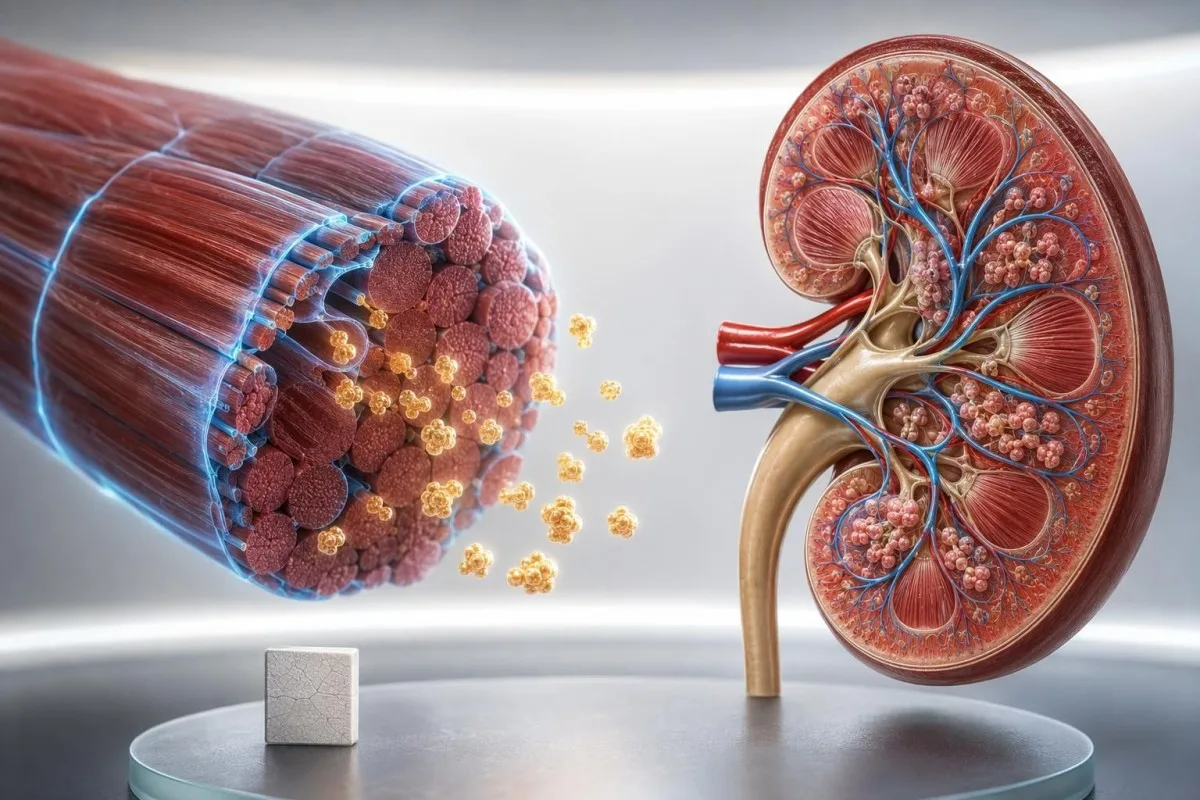
A patient-focused guide to elevated CK after exercise, injury, statins, heat illness or rhabdomyolysis — with practical recheck timing and ER red flags.


- High creatine kinase symptoms usually come from muscle injury, not CK itself: severe muscle pain, weakness, swelling, dark cola urine and reduced urination matter most.
- CK above 1,000 U/L is often treated as possible rhabdomyolysis, especially if it is more than 5 times your lab’s upper limit.
- CK above 5,000 U/L raises concern for kidney stress and usually needs same-day medical advice, kidney tests, electrolytes and urinalysis.
- CK above 10,000 U/L is a high-risk result; many patients need urgent care or hospital monitoring even if they feel better.
- After hard exercise, CK can rise for 24-72 hours and may stay elevated for 3-7 days; repeat testing after rest prevents many false alarms.
- Statin muscle symptoms with CK above 4 times the upper limit deserve prompt clinician review; CK above 10 times the upper limit usually means stopping the statin while being assessed.
- ER warning signs include dark urine, very low urine output, fainting, confusion, severe swelling, chest pain, fever, or potassium above 6.0 mmol/L.
- Recheck timing depends on risk: mild asymptomatic CK can be repeated after 3-7 days of rest, while symptomatic CK or CK above 1,000 U/L often needs repeat labs within 24-48 hours.
Is high creatine kinase dangerous or just a lab flag?
High creatine kinase is dangerous when it signals ongoing muscle breakdown, kidney stress or electrolyte disturbance. As of July 17, 2026, I treat CK above 1,000 U/L with symptoms as possible rhabdomyolysis until proven otherwise, and CK above 5,000 U/L as a same-day medical problem. Kantesti is an AI blood test interpretation platform built by Kantesti Ltd; our clinical work is described on About Us.
Creatine kinase is an enzyme that leaks from injured muscle cells into the bloodstream. The number itself does not cause pain; the injury behind it can. In clinic, a CK of 450 U/L after a gym session is usually a recheck problem, while CK of 8,000 U/L with brown urine is an emergency pattern.
I am Thomas Klein, MD, and I have seen the same trap many times: a patient feels well, sees a red CK flag, and panics. The better question is not “is high creatine kinase dangerous?” but “is this CK paired with muscle symptoms, kidney changes, potassium shift or ongoing injury?”
High CK symptoms that change urgency are severe muscle tenderness, new weakness, swollen tight muscles, tea-coloured urine, nausea, confusion and peeing much less than usual. If you have chest pain, fainting, or a potassium result above 6.0 mmol/L, do not wait for a routine appointment.
What CK measures and what counts as elevated CK levels
CK measures muscle-cell enzyme release, and elevated CK levels are usually defined relative to your lab’s upper reference limit. Many adult labs use roughly 30-200 U/L for women and 50-300 U/L for men, but ranges differ by method, muscle mass, ancestry and training status. For basics, our CK lab abbreviation guide explains the name behind the result.
A CK result above 1,000 U/L is commonly used as a practical rhabdomyolysis threshold. This is not magic; it is about 5 times the upper limit in many laboratories, where the probability of clinically meaningful muscle injury rises. Some European labs use lower CK reference ranges, so the same person may look “more abnormal” on one report than another.
CK-MM comes mostly from skeletal muscle, CK-MB is enriched in heart muscle but not heart-specific, and CK-BB is mostly brain and smooth tissue. Most routine CK reports show total CK only, which is why the surrounding panel matters more than a single number in isolation.
Kantesti’s biomarker guide groups CK with creatinine, eGFR, potassium, phosphate, calcium, AST, ALT and urinalysis because those combinations predict risk better than CK alone. A muscular 28-year-old lifter may sit at CK 600 U/L at baseline, while CK 600 U/L in a frail older adult after a fall may deserve a closer look.
Creatine kinase typically rises within 2-12 hours after muscle injury, peaks at 24-72 hours, and then falls with a half-life of roughly 36 hours if injury stops. That timing explains why a CK drawn immediately after pain begins can be falsely reassuring.
High CK symptoms patients actually notice
High CK symptoms are muscle symptoms first: pain, tenderness, weakness, swelling and dark urine. CK is invisible to you, so the body clues come from injured muscle fibres, myoglobin release, dehydration or electrolyte changes. Patients comparing CK with fatigue should also read our guide to muscle weakness labs.
Severe muscle pain out of proportion to the workout is more concerning than ordinary soreness. Delayed-onset soreness usually peaks 24-48 hours after exercise and improves with gentle movement. Rhabdomyolysis pain often feels deep, swollen, and “wrong,” especially in thighs, calves, shoulders or lower back.
Dark cola-coloured urine after muscle pain is an emergency clue even before CK results return. Myoglobin can colour urine and injure kidney tubules, and it may disappear faster than CK because its half-life is only about 2-3 hours. A normal-looking urine sample later in the day does not always erase the earlier warning.
Weakness matters more when it is functional: you cannot climb stairs, lift your arms to wash your hair, or rise from a chair. I worry less about “my legs feel heavy after squats” and more about “I cannot walk normally 36 hours later.”
Swelling with tightness or numbness can suggest compartment pressure, a limb-threatening emergency. That can occur even when CK is still climbing and before kidney blood tests look abnormal.
Exercise-related CK: normal training effect or rhabdomyolysis?
Exercise can raise CK from a few hundred U/L to several thousand U/L without kidney injury, but symptoms decide urgency. Eccentric exercise, downhill running, unaccustomed high-rep lifting and very long endurance events are the usual culprits. Our guide to exercise-shifted labs covers CK, AST and white-cell changes after training.
A CK of 800-2,000 U/L after a marathon or heavy leg day can be physiologic if urine, creatinine and potassium are normal. I once reviewed a 52-year-old marathon runner with CK 2,400 U/L and AST 89 U/L; the pattern settled after 5 days of rest and hydration.
The danger rises when the workout was unaccustomed, hot, dehydrating, or done while ill. Chavez et al. noted in Critical Care that rhabdomyolysis is a syndrome, not just a CK value, because kidney injury depends on volume status, electrolytes and the cause of muscle breakdown (Chavez et al., 2016).
Creatinine can also rise after exercise, especially after endurance events, creatine supplementation or dehydration. If CK and creatinine rise together, I treat it differently from isolated CK; our creatinine exercise guide explains why a 0.3 mg/dL creatinine change can be clinically meaningful.
A practical rule: if CK is below 1,000 U/L, urine is normal, and soreness is improving, rest 3-7 days before repeating. If CK is above 1,000 U/L with dark urine or worsening weakness, same-day assessment is safer.
Injury, crush pressure and heat patterns that worry us
CK after trauma, prolonged pressure or heat illness is more dangerous than CK after a predictable workout. Falls with hours on the floor, seizures, heat stroke, electrical injury and crush pressure can drive CK above 10,000 U/L and disturb potassium quickly. Athletes should know the same warning pattern described in our CrossFit rhabdo flags.
Prolonged immobilisation is a classic hidden cause of rhabdomyolysis. An older person who falls at 2 a.m. and is found at 9 a.m. may have CK 6,000 U/L without dramatic pain, because pressure injury developed while they were unable to move.
Heat changes the equation. A CK of 1,500 U/L after a cool-weather run may be watched, but CK 1,500 U/L after collapse in high heat deserves electrolyte and kidney checks because sodium, potassium and core temperature may also be abnormal.
Seizures can produce CK rises that peak 1-3 days later. I often repeat CK and creatinine 24 hours after an initial normal result if the seizure was prolonged, because the first test may be too early.
Bosch et al. described in the New England Journal of Medicine that acute kidney injury in rhabdomyolysis is driven by myoglobin, low circulating volume, acid urine and tubular obstruction, not CK alone (Bosch et al., 2009). That is why fluids and kidney monitoring matter more than chasing the enzyme number.
Statins, medicines and supplements: CK clues to act on
Statins can cause muscle symptoms with normal CK, mild CK elevation or rarely severe rhabdomyolysis. New symmetrical thigh or shoulder pain within weeks of a dose change deserves a CK check, especially if weakness appears. Before treatment starts, our before starting statins checklist explains baseline liver and muscle context.
For statin users, CK above 4 times the lab upper limit with muscle symptoms usually warrants stopping the drug temporarily and calling the prescriber. CK above 10 times the upper limit is treated as a serious statin-associated muscle injury until another cause is found.
The European Atherosclerosis Society consensus statement by Stroes et al. recommends assessing symptom timing, dechallenge and rechallenge rather than assuming every ache is statin toxicity (Stroes et al., 2015). In real practice, that means we look at dose, interacting medicines, thyroid status, vitamin D, kidney function and recent workouts.
Risk rises with high-dose statins, older age, hypothyroidism, heavy alcohol intake, kidney disease and drug interactions such as clarithromycin, certain antivirals, ciclosporin, gemfibrozil and some azole antifungals. Red yeast rice is not “statin-free”; it can contain monacolin K and can raise CK like a statin.
Do not stop a statin silently for months because of a single CK of 350 U/L. Heart-risk treatment may still be needed, and many patients tolerate a lower dose, alternate-day dosing or a different statin after CK normalises.
Why rhabdomyolysis can become a kidney emergency
Rhabdomyolysis becomes dangerous when muscle contents enter circulation faster than the kidneys can clear them. Myoglobin, dehydration, acid urine and high potassium can combine into acute kidney injury. Kantesti is an AI blood test analyzer that reads CK alongside eGFR and creatinine; patients with chronic risk can compare results with our kidney stages guide.
A rising creatinine is the kidney warning sign doctors take seriously. Acute kidney injury can be defined as creatinine rising by at least 0.3 mg/dL within 48 hours or 1.5 times baseline within 7 days, even if urine still looks acceptable.
McMahon et al. built a risk score for rhabdomyolysis using age, cause, creatinine, calcium, phosphate, bicarbonate and CK above 40,000 U/L; the highest scores predicted kidney failure or death far better than CK alone (McMahon et al., 2013). In their model, a score below 5 had about 2.3% risk, while a score above 10 had about 61% risk.
Potassium above 6.0 mmol/L with CK elevation is urgent because it can trigger dangerous heart rhythms. Phosphate may rise, calcium may fall early, and bicarbonate may drop if acidosis develops. These are not “wellness markers”; they are safety markers.
Hospital treatment often uses IV isotonic fluid, sometimes 200-500 mL per hour, adjusted for age, heart failure and urine output. Drinking huge amounts of water at home is not a safe substitute if you are vomiting, confused, swollen or barely urinating.
AST, ALT, LDH and myoglobin patterns beyond CK
A high CK often travels with high AST, LDH and sometimes ALT because muscle contains these enzymes too. The pattern is different from classic liver injury when bilirubin, GGT and alkaline phosphatase stay normal. Our AST muscle-liver pattern article goes deeper into this common confusion.
AST can rise from skeletal muscle and may exceed ALT after intense exercise or rhabdomyolysis. I have seen AST around 150 U/L with CK 12,000 U/L and a completely normal bilirubin; calling that “liver failure” would be wrong.
GGT is useful because it is not released from skeletal muscle in the same way. If CK and AST are high but GGT and bilirubin are normal, muscle becomes the more likely source, though alcohol, fatty liver and medicines can still blur the picture.
Myoglobin rises and falls faster than CK, so a normal myoglobin does not exclude earlier rhabdomyolysis. CK is the slower marker and is often easier to trend over 24-72 hours.
LDH is less specific because it comes from many tissues. A high LDH with CK, AST and urine heme positivity points toward tissue injury, but LDH alone cannot tell you whether the problem is muscle, liver, red-cell breakdown or something else.
Urine clues: dark colour, heme flags and hydration
Dark tea or cola urine after muscle pain is one of the clearest rhabdomyolysis warning signs. A urine dipstick may show “heme” even when microscopy shows few or no red cells, because the strip can react to myoglobin. For visual patient guidance, see our urine colour warning signs.
A heme-positive dipstick with few red cells suggests myoglobin or hemoglobin rather than ordinary urinary bleeding. In the CK setting, myoglobin is the concern because it can stress kidney tubules, especially when urine is concentrated.
Urine specific gravity above 1.020 often suggests concentration, though it is not a perfect hydration meter. If CK is high and urine is very concentrated, clinicians are more likely to push fluids and repeat kidney tests.
Low urine output is more concerning than dark colour alone. Adults who produce very little urine for 6-8 hours, especially with nausea, dizziness or swelling, need urgent review.
Be careful with colour explanations. Beetroot, food dyes, some antibiotics and dehydration can darken urine, but none of those should be used to dismiss cola urine after severe muscle pain.
When to repeat CK after exercise, statins or illness
Repeat CK timing depends on the suspected cause, symptoms and kidney results. Mild asymptomatic CK after exercise is usually repeated after 3-7 days of rest; CK above 1,000 U/L with symptoms is usually repeated within 24-48 hours with creatinine, eGFR, potassium and urinalysis. Our repeat abnormal labs guide covers this broader recheck logic.
If CK is below 1,000 U/L and you feel well, avoid hard training for 3-7 days before retesting. Also avoid intramuscular injections, heavy lifting, long runs and alcohol during that window, because each can keep CK elevated.
If CK is 1,000-5,000 U/L, I usually want a same-day or next-day clinical plan, even if the patient looks well. The repeat panel should include creatinine, eGFR, potassium, phosphate, calcium, bicarbonate, AST, ALT and urinalysis.
If CK is above 5,000 U/L, recheck is not just “later this week.” Many clinicians repeat CK and kidney markers every 6-12 hours in acute care until CK is clearly falling and urine output is safe.
Kantesti’s trend view is useful when a patient has repeated CK results from different labs or countries, because units and reference intervals can shift. A fall from 8,000 to 3,000 U/L over 48 hours is often reassuring; a rise from 900 to 4,500 U/L after rest is not.
When high CK is not exercise: thyroid, autoimmune and inherited causes
High CK without a workout, injury or medication trigger needs a broader muscle workup. Hypothyroidism, inflammatory myositis, muscular dystrophies, metabolic muscle disorders and viral myositis can all raise CK, sometimes above 1,000 U/L. Persistent weakness belongs with a clinician, and our myositis antibody workup explains one common pathway.
Hypothyroidism can cause muscle aches, cramps and CK elevation, often improving after thyroid hormone is corrected. I usually check TSH and free T4 when CK stays elevated after 7 days of rest, especially if there is cold intolerance, constipation, dry skin or slow pulse.
Inflammatory myositis tends to cause proximal weakness: hips, thighs, shoulders and neck flexors. CK can be 2,000-20,000 U/L, but a normal or mildly raised CK does not fully exclude some myositis subtypes.
Inherited muscle conditions may first show up as “unexplained high CK” in an adult. A family history of exercise intolerance, recurrent dark urine, anaesthetic complications or male relatives with muscle disease changes the workup.
Viral illness can do it too. Influenza, COVID-19 and other infections may raise CK, and the risk is higher when fever, dehydration and bed rest pile on top of muscle inflammation.
Chest pain and CK-MB: why troponin changed the rules
Chest pain with elevated CK should be assessed as a possible heart emergency, but troponin is now the main heart-injury test. CK-MB can rise from heart muscle, yet it can also be affected by skeletal muscle injury. For timing differences, see our cardiac enzyme timing guide.
High-sensitivity troponin is preferred for suspected heart attack because it is more cardiac-specific than total CK. A normal CK does not rule out a heart attack, and a high CK does not prove one.
CK-MB is still occasionally used in special situations, such as reinfarction timing in some hospitals, but it is not the first-line test for most chest pain pathways. Skeletal muscle injury can make CK-MB harder to interpret.
Go to emergency care for chest pressure, shortness of breath, sweating, fainting or pain spreading to the jaw or arm, regardless of the CK number. The decision is based on symptoms, ECG and troponin kinetics, not a wellness panel.
I tell patients this plainly: do not use CK to self-triage chest pain. A CK of 180 U/L can occur during a heart attack, and a CK of 5,000 U/L can come from leg muscles after exertion.
How Kantesti AI reads elevated CK levels in context
AI interpretation is useful for CK only when it reads the full pattern, not just the red flag. Kantesti is an AI-powered blood test analysis tool used across many languages to connect CK with kidney markers, electrolytes, liver enzymes, urine findings and timing notes. Our technology guide explains the structured lab-reading approach.
Kantesti’s neural network treats CK 900 U/L after a triathlon differently from CK 900 U/L after a fall, fever and low urine output. The same number can mean recovery, risk or simply a baseline trait depending on time course and companion labs.
Our engine checks for unit mismatches, reference-range drift and OCR errors when users upload PDF or photo results. That matters because CK may be reported as U/L, IU/L or with local reference intervals that make a result look more alarming than it is.
Technical validation matters in medical AI because a plausible-sounding explanation is not enough. Kantesti AI’s rubric-based testing approach is described in our technical benchmark, including stress tests for abnormal clusters and safety-flag logic.
The clinical limitation is real: AI cannot examine a tight calf, measure urine output, perform an ECG or give IV fluids. It can organise the signal, but danger signs still need a human clinician.
What to do next: home care, clinician call or ER
Your next step depends on CK level, symptoms and kidney-safety markers. Home rest may be reasonable for mild asymptomatic CK after exercise, but dark urine, low urine output, severe weakness, CK above 5,000 U/L or potassium above 6.0 mmol/L belongs in urgent care or the ER. Our doctors behind this guidance are listed on the Medical Advisory Board.
For CK below 1,000 U/L with improving soreness, stop intense exercise, hydrate normally and repeat after 3-7 days. Avoid NSAID overuse if you are dehydrated or kidney function is uncertain, because ibuprofen and similar drugs can worsen kidney stress in the wrong setting.
Call a clinician the same day for CK 1,000-5,000 U/L, new weakness, statin symptoms or urine changes. Ask specifically for creatinine/eGFR, potassium, phosphate, calcium, bicarbonate, AST/ALT and urinalysis; a CK-only repeat misses the safety question.
Go to the ER now for cola urine, very low urine output, fainting, confusion, severe muscle swelling, chest pain, fever with collapse, or CK above 10,000 U/L. If you have heart failure, advanced kidney disease or are pregnant, I would lower the threshold for urgent assessment.
At Kantesti, we try to reduce both dangerous delays and unnecessary panic. Dr Thomas Klein’s practical rule is simple: a high CK number gets attention, but high CK plus symptoms, kidney changes or potassium shift gets action.
Frequently Asked Questions
What are the most common high creatine kinase symptoms?
The most common high creatine kinase symptoms are muscle pain, tenderness, weakness, swelling and reduced exercise tolerance, but CK itself does not cause symptoms. Dark tea or cola-coloured urine after muscle pain is a warning sign for possible myoglobin release. Severe weakness, tight swollen muscles, low urine output or confusion with CK above 1,000 U/L needs prompt medical assessment.
Is high creatine kinase dangerous after exercise?
High creatine kinase after exercise is not always dangerous, especially if CK is below 1,000 U/L, urine is normal and soreness is improving. CK can peak 24-72 hours after hard training and stay elevated for 3-7 days. CK above 5,000 U/L, dark urine, worsening weakness or rising creatinine should be treated as a same-day medical concern.
What CK level means rhabdomyolysis?
Many clinicians use CK above 1,000 U/L, or more than 5 times the lab upper limit, as a practical threshold for possible rhabdomyolysis. The diagnosis still depends on context, including muscle symptoms, urine findings, creatinine, potassium and the cause of injury. CK above 10,000 U/L is generally high risk and often needs urgent monitoring.
When should I go to the ER for high CK?
Go to the ER for high CK if you have dark cola urine, very low urine output, severe muscle swelling, fainting, confusion, chest pain, heat collapse or potassium above 6.0 mmol/L. CK above 5,000 U/L with symptoms should be assessed urgently, and CK above 10,000 U/L is often managed in acute care. Do not wait for a routine repeat if symptoms are worsening.
How long should I rest before repeating CK?
If CK is mildly elevated and you feel well, rest from strenuous exercise for 3-7 days before repeating CK. If CK is above 1,000 U/L or symptoms are present, repeat testing is often needed within 24-48 hours with creatinine, eGFR, potassium and urinalysis. If CK is above 5,000 U/L, recheck timing should be decided by a clinician the same day.
Can statins raise CK without rhabdomyolysis?
Yes, statins can cause muscle aches with normal CK or mild CK elevation, and most cases are not rhabdomyolysis. CK above 4 times the upper limit with symptoms usually deserves prompt prescriber review, while CK above 10 times the upper limit is treated more seriously. Drug interactions, hypothyroidism, kidney disease and recent heavy exercise should be checked before blaming the statin alone.
Can CK be high if my kidneys are normal?
Yes, CK can be high while kidney function remains normal, especially after exercise, seizures, injections, minor trauma or medication effects. The reassuring pattern is stable creatinine, normal potassium, normal urine output and CK falling on repeat testing. Kidney risk rises when CK stays high, dehydration is present, urine becomes dark or creatinine increases by 0.3 mg/dL within 48 hours.
Can a seizure cause a high CK even if I did not exercise?
Yes. A generalized seizure can cause intense involuntary muscle activity and raise CK, sometimes with levels peaking over the next 1-3 days. Seek prompt care after a seizure if you have severe soreness, dark urine, reduced urination, fever, or confusion, especially if recovery is not normal.
Get AI-Powered Blood Test Analysis Today
Join over 2 million users worldwide who trust Kantesti for instant, accurate lab test analysis. Upload your blood test results and receive comprehensive interpretation of 15,000+ biomarkers in seconds.
📚 Referenced Research Publications
Klein, T., Mitchell, S., & Weber, H. (2026). AI Blood Test Analyzer: 2.5M Tests Analyzed | Global Health Report 2026. Kantesti AI Medical Research.
Klein, T., Mitchell, S., & Weber, H. (2026). RDW Blood Test: Complete Guide to RDW-CV, MCV & MCHC. Kantesti AI Medical Research.
📖 External Medical References
⚕️ Medical Disclaimer
This article is for educational purposes only and does not constitute medical advice. Always consult a qualified healthcare provider for diagnosis and treatment decisions.
E-E-A-T Trust Signals
Experience
Physician-led clinical review of lab interpretation workflows.
Expertise
Laboratory medicine focus on how biomarkers behave in clinical context.
Authoritativeness
Written by Dr. Thomas Klein with review by Dr. Sarah Mitchell and Prof. Dr. Hans Weber.
Trustworthiness
Evidence-based interpretation with clear follow-up pathways to reduce alarm.