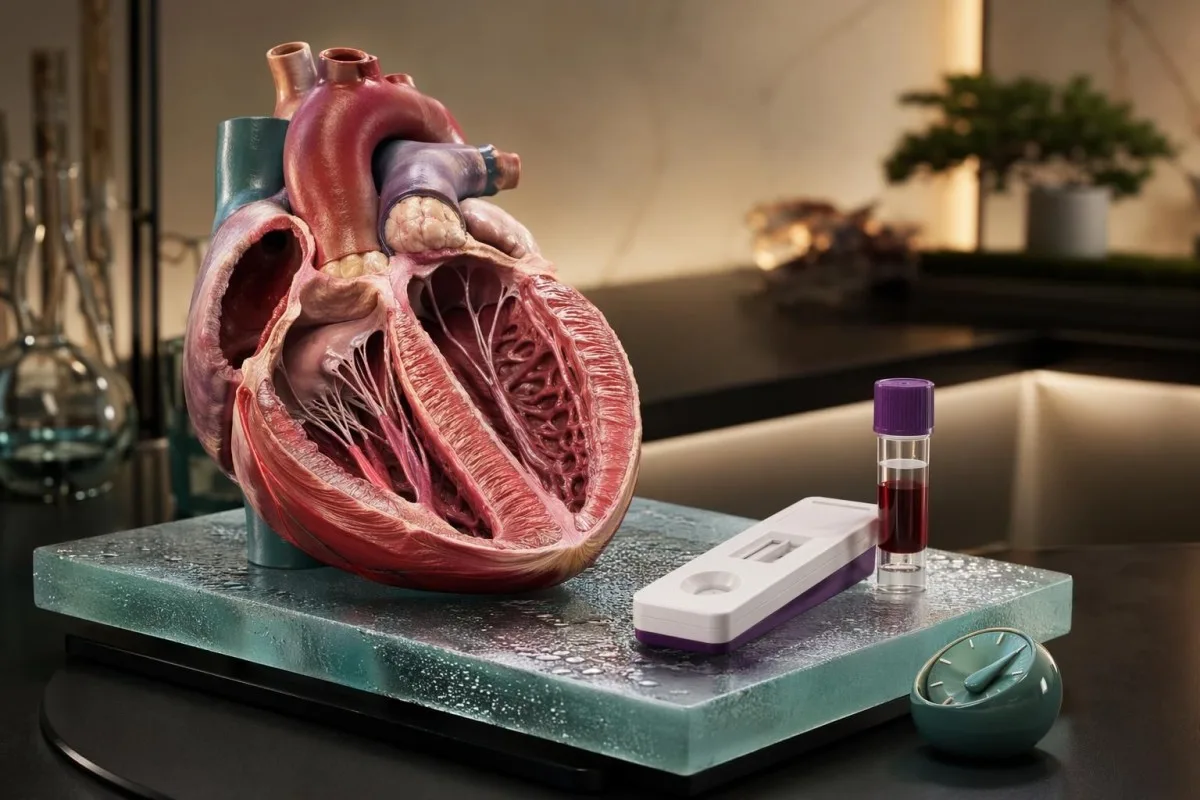
A practical physician’s guide to troponin, CK-MB, myoglobin and the timing traps that make one “normal” result less reassuring than patients expect.


- Troponin usually becomes detectable within 2-3 hours with high-sensitivity assays, peaks around 12-48 hours, and may stay elevated for 5-14 days after heart muscle injury.
- CK-MB typically rises 3-6 hours after injury, peaks at 12-24 hours, and returns toward baseline within 48-72 hours.
- Myoglobin can rise within 1-2 hours, but it is not heart-specific and is rarely used alone to diagnose a heart attack in 2026.
- Cardiac enzymes blood test is a legacy phrase; modern emergency departments usually mean cardiac troponin testing when they say cardiac enzymes.
- A troponin value above the 99th percentile for that assay means myocardial injury, but myocardial infarction also requires a rise or fall plus clinical evidence of ischemia.
- Repeat troponin testing is often done at 1-3 hours with high-sensitivity assays, or 3-6 hours with older conventional assays.
- Normal first troponin does not fully rule out a heart attack if chest pain began less than 2 hours before the sample was collected.
- CK-MB test can still help in selected cases, especially suspected re-infarction when troponin remains elevated from a recent event.
- Exercise, kidney disease, sepsis, pulmonary embolism, myocarditis and fast arrhythmias can raise troponin without a classic blocked coronary artery.
- Chest pain with sweating, breathlessness, fainting, jaw or arm discomfort needs emergency care now; do not wait for an app or repeat outpatient lab.
Which cardiac enzyme rises first after heart injury?
High-sensitivity troponin is the main cardiac enzymes blood test used today, and it often becomes abnormal within 2-3 hours after heart muscle injury. Myoglobin can rise earlier, around 1-2 hours, but it is not heart-specific. CK-MB usually rises after 3-6 hours. If chest pain began recently, one normal result may be too early, so doctors repeat troponin at 1-3 hours or 3-6 hours depending on the assay.
The phrase cardiac enzymes survives because older emergency rooms used AST, LDH and CK-MB before troponin became widely available. In 2026, when a clinician says “cardiac enzymes,” they usually mean a troponin test, not a broad enzyme panel; our Kantesti AI lab interpretation flags that distinction because many uploaded reports still use old wording.
A 54-year-old man I saw years ago had crushing chest pressure at 07:10 and a first troponin at 07:45 that was still below the lab cutoff. His repeat value 2 hours later rose clearly; that is the timing trap. For related markers beyond troponin, our guide to heart problem blood tests explains where BNP, lipids and electrolytes fit.
A cardiac troponin value above the assay-specific 99th percentile upper reference limit defines myocardial injury, while a heart attack diagnosis requires a rise or fall plus symptoms, ECG changes, imaging findings or angiographic evidence. The Fourth Universal Definition of Myocardial Infarction states this clearly and separates injury from infarction, a distinction that prevents both missed heart attacks and unnecessary panic (Thygesen et al., 2018).
What the cardiac enzymes blood test actually measures
A cardiac enzymes blood test measures proteins released when heart muscle cells are injured, mainly troponin I or troponin T. CK-MB measures a creatine kinase isoenzyme found more in heart muscle than skeletal muscle, but it is less specific than troponin.
Troponin is not technically an enzyme; it is a contractile protein complex that helps heart muscle respond to calcium. That wording matters because patients often expect “enzyme” results to behave like liver enzymes such as ALT or AST, but cardiac troponin behaves more like a leak marker from injured myocardium.
The troponin test usually reports either cardiac troponin I or cardiac troponin T in ng/L, sometimes still shown as ng/mL on older reports. A result of 14 ng/L equals 0.014 ng/mL, and unit confusion is one of the most common mistakes we see when people upload reports through blood test PDF upload.
Kantesti AI interprets cardiac enzymes by reading the assay name, units, reference interval, time between samples and symptom context when provided. Our clinical rules are reviewed against documented standards through medical validation, because a troponin of 18 ng/L can mean different things in a 34-year-old athlete, an 87-year-old with kidney disease, and a patient 90 minutes into chest pain.
Most labs do not report “positive” or “negative” troponin in the simple way home pregnancy tests do. They report a number, and the change over time is often more informative than the first number alone.
Why troponin replaced older cardiac enzyme markers
Troponin replaced CK-MB, AST and LDH because it is more specific to heart muscle and detects smaller injuries earlier. CK-MB can rise from skeletal muscle injury, surgery, intense exercise and some muscle disorders, which makes it less reliable for chest pain triage.
The old enzyme sequence was slow: CK-MB rose in hours, AST was nonspecific, and LDH isoenzymes peaked so late that many decisions had already been made. In real emergency care, a test that peaks after 24-48 hours is more historical evidence than immediate triage.
The 2020 ESC guideline for non-ST-elevation acute coronary syndromes recommends high-sensitivity cardiac troponin as the preferred biomarker because it improves early rule-out and rule-in when used with validated serial testing algorithms (Collet et al., 2021). That guideline is one reason many hospitals moved from overnight observation to 0/1-hour, 0/2-hour or 0/3-hour pathways.
I still see CK-MB on some reports from smaller hospitals, surgical units and international labs. When I review a CK-MB test alongside high AST after a heavy gym session, I immediately check whether the pattern resembles muscle release rather than coronary occlusion; our article on exercise-shifted lab values is useful for that exact confusion.
Troponin is not perfect. It tells us heart muscle injury occurred; it does not automatically tell us why.
Troponin timing after chest pain: the real window
Troponin usually rises within 2-3 hours after heart muscle injury when a high-sensitivity assay is used, but a very early sample can still be normal. Most protocols repeat testing 1-3 hours later if the first result is low and symptoms are recent.
A high-sensitivity troponin drawn 6 hours after typical chest pain is far more reassuring than the same value drawn 35 minutes after symptoms began. Timing is not a footnote; it is half the interpretation.
One widely used high-sensitivity troponin T strategy rules out many low-risk patients when the baseline value is very low and the 1-hour change is minimal, while rule-in thresholds require a higher starting value or a larger delta. Exact numbers differ by assay, so a safe interpretation must use the lab’s own cutoff rather than a copied internet threshold.
Kantesti AI reads the timestamp when it appears on uploaded reports and compares serial values against the stated collection times. If your report lacks a symptom onset time, add it manually in our AI blood test analyzer notes field; a “normal” troponin at 08:00 has a different meaning if pain began at 02:00 versus 07:40.
Reichlin and colleagues showed in the New England Journal of Medicine that sensitive troponin assays improved early myocardial infarction diagnosis compared with older assays, especially during the first hours of presentation (Reichlin et al., 2009). In clinic language: the newer tests see smaller signals sooner, but they also force us to interpret more low-level positives.
CK-MB test timing and when it still helps
CK-MB rises about 3-6 hours after myocardial injury, peaks around 12-24 hours, and usually returns to baseline within 48-72 hours. Its shorter duration can sometimes help detect re-infarction when troponin remains elevated from a recent heart attack.
CK-MB is a creatine kinase isoenzyme enriched in heart muscle, but skeletal muscle also contains enough CK-MB to cause false alarms. A marathon, muscle trauma, injections, seizure activity or major surgery can push CK and sometimes CK-MB upward without a blocked coronary artery.
A CK-MB relative index above about 2.5-3.0% was historically used to separate cardiac from skeletal muscle sources, but it is not reliable enough to replace troponin. If total CK is 4,000 U/L after rhabdomyolysis, a modest CK-MB fraction can still confuse the picture.
In my experience, CK-MB is most helpful when the question is not “was there any myocardial injury?” but “did something new happen today on top of last week’s injury?” That is a narrow use case, and it is why many cardiology services now order CK-MB selectively rather than routinely.
If your report shows high CK-MB with high AST but normal ALT, review the muscle-versus-liver pattern in our AST muscle guide. That pattern is surprisingly common after intense exercise, falls, or statin-associated muscle symptoms.
When doctors repeat cardiac enzymes after chest pain
Doctors repeat cardiac enzymes when the first troponin is too early, borderline, rising, or inconsistent with the ECG and symptoms. High-sensitivity protocols commonly repeat at 1-3 hours; conventional troponin often needs 3-6 hours.
The most dangerous phrase in chest pain care is “the first troponin was normal.” A first value below cutoff has different weight at 8 hours after pain than at 45 minutes after pain.
Emergency clinicians combine troponin with the ECG, blood pressure, oxygen level, risk factors and symptom pattern. Our guide to heart attack prediction labs explains why cholesterol and Lp(a) predict risk over years, while troponin answers whether injury is happening now.
A repeat troponin is also needed when the first result is slightly elevated but stable. A stable 28 ng/L in a patient with chronic kidney disease may point toward chronic myocardial injury, while 12 ng/L rising to 74 ng/L over 2 hours is a very different signal.
Thomas Klein, MD note from practice: I worry more about a small, fast delta than a single modest number with no movement. The heart is telling us a story over time.
Why one normal troponin may not be enough
One normal troponin test may not rule out a heart attack if chest pain started less than 2 hours before testing, if the assay is conventional rather than high-sensitivity, or if symptoms are strongly suggestive of ischemia. Serial testing reduces that blind spot.
A “negative” result can be falsely reassuring when the biology has not had time to show up in plasma. Heart muscle injury releases troponin gradually; even high-sensitivity assays are not magic.
Patients sometimes ask whether they can upload a single normal troponin and avoid urgent care. If symptoms are active, severe or typical, the answer is no; AI-powered blood test interpretation can help you understand results, but it cannot replace emergency ECG monitoring or bedside assessment.
The HEART score and similar tools use age, risk factors, ECG findings, symptom features and troponin together. That combined approach is why a 29-year-old with sharp pain while breathing and a normal ECG is handled differently from a 68-year-old diabetic with pressure-like chest discomfort and sweating.
If your report says “sample hemolyzed,” “quantity not sufficient,” or “interference suspected,” treat the number carefully. Lab quality issues are not rare, and our blood test variability guide covers when a result deserves repeat confirmation.
High troponin without a classic heart attack
High troponin means heart muscle injury, but not every elevated troponin is a type 1 myocardial infarction from a ruptured coronary plaque. Sepsis, pulmonary embolism, myocarditis, kidney disease, heart failure, tachyarrhythmias and strenuous exercise can all raise troponin.
This is where patients get whiplash: “My troponin is high, but they said it was not a heart attack.” Both statements can be true. Troponin is an injury marker, not a plaque-rupture detector.
Type 2 myocardial infarction happens when oxygen supply and demand are mismatched, such as severe anemia, very fast atrial fibrillation, shock or low oxygen. That differs from type 1 myocardial infarction, where a coronary artery clot is usually the central problem, as described in the Fourth Universal Definition (Thygesen et al., 2018).
Kidney disease adds another layer because chronic troponin elevation is common when eGFR is low, partly from structural heart disease and partly from altered clearance and comorbidity. If creatinine or eGFR is abnormal, pair the cardiac marker with our kidney result guide.
A troponin of 40 ng/L that stays 39-41 ng/L over 6 hours is clinically different from 12 ng/L rising to 40 ng/L. The delta is the clue.
Troponin units, cutoffs and the 99th percentile
Troponin cutoffs are assay-specific, and the key medical threshold is the 99th percentile upper reference limit from a healthy reference population. High-sensitivity troponin is usually reported in ng/L, while older reports may use ng/mL.
A result of 0.04 ng/mL equals 40 ng/L. That conversion mistake can turn a mild elevation into a terrifying-looking number, or the reverse, if the reader misses the unit.
Many hs-cTnT assays use a 99th percentile around 14 ng/L, while hs-cTnI thresholds vary more and may be sex-specific. Some labs report lower female cutoffs and higher male cutoffs because healthy reference distributions differ; clinicians still disagree about how aggressively sex-specific limits should be applied in every setting.
Kantesti AI checks units against the printed reference interval before interpreting a cardiac enzymes result. Our broader biomarker guide explains why a flag beside a result is only the beginning, not the interpretation.
Do not compare your troponin number with a friend’s unless the assay is the same. Troponin I from one manufacturer and troponin T from another are not interchangeable scales.
A practical conversion rule
For troponin, 1 ng/mL equals 1,000 ng/L. A report showing 0.012 ng/mL is therefore 12 ng/L, which may be below some hs-cTnT cutoffs but not necessarily below every hs-cTnI cutoff.
Why the troponin delta can matter more than the number
The troponin delta is the change between serial results, and it helps separate acute injury from chronic elevation. A small stable elevation may reflect chronic myocardial stress, while a clear rise or fall suggests a recent or ongoing injury.
Clinicians look for both an absolute change, such as several ng/L, and a relative change, such as 20% or more, but the best cutoff depends on assay and baseline level. At very low values, absolute change is usually more useful than percentage change.
A rise from 8 to 15 ng/L may matter more than it looks if the lab’s cutoff is 14 ng/L and symptoms are typical. A rise from 220 to 240 ng/L may be less dramatic if the patient had a large heart attack yesterday and the curve is already plateauing.
This is exactly why trend analysis is built into Kantesti’s neural network rather than treating each report as a separate snapshot. If you keep older reports, our blood test history workflow can show whether a “high” result is new, chronic or resolving.
The delta is also why repeat testing should be timed properly. Two samples 15 minutes apart usually say less than two samples 2-3 hours apart.
Other blood tests doctors pair with cardiac enzymes
Doctors often pair cardiac enzymes with electrolytes, kidney function, CBC, glucose, coagulation markers and sometimes BNP or D-dimer. These tests do not diagnose a heart attack by themselves, but they explain triggers, mimics and treatment risks.
Potassium is one of the first numbers I check when chest pain comes with palpitations or an irregular rhythm. A potassium below 3.0 mmol/L or above 6.0 mmol/L can provoke dangerous electrical instability even when troponin is not the primary issue.
Kidney markers matter because creatinine affects medication choices, contrast scan safety and interpretation of chronic troponin elevation. Emergency teams often order a BMP quickly; our BMP emergency guide explains why sodium, potassium, CO2 and creatinine appear so early in acute care.
BNP or NT-proBNP is useful when breathlessness could be heart failure rather than coronary occlusion. A very high NT-proBNP does not prove a heart attack, but it changes the risk picture and may explain chronic low-level troponin release; our BNP blood test article breaks down the age-adjusted ranges.
D-dimer sometimes enters the picture when pulmonary embolism is a realistic alternative diagnosis. That pathway is separate from troponin, but a large pulmonary embolism can strain the right ventricle enough to raise troponin.
Exercise, athletes and temporary cardiac enzyme rises
Strenuous endurance exercise can cause temporary troponin and CK increases, often peaking within hours and falling over 24-48 hours. In well athletes, the pattern is usually transient, but chest pain, fainting or abnormal ECG findings change the risk immediately.
After marathons and ultramarathons, studies have reported measurable troponin elevations in a sizeable proportion of finishers, sometimes above the 99th percentile. The practical distinction is that exercise-related values usually fall quickly, while infarction often shows a more sustained rise and fall pattern with compatible symptoms.
A 52-year-old marathon runner with CK 1,200 U/L, AST 89 U/L and a tiny troponin bump after a race needs context, not reflex panic. But if that same runner has pressure-like chest discomfort at rest, I do not blame the marathon until the ECG and serial troponin are safe.
Kantesti AI asks about recent exercise because CK-MB, AST and total CK are particularly vulnerable to misreading after training. For a deeper look at that pattern, read our guide to athlete blood tests.
A useful patient tip: if you are having planned non-urgent labs that include CK, avoid unusually hard exercise for 48-72 hours beforehand. For emergency chest pain, do not delay testing because you exercised.
False positives, lab interference and odd troponin patterns
Troponin false positives are uncommon, but assay interference can occur from heterophile antibodies, macro-troponin, fibrin clots, hemolysis or high-dose biotin in certain immunoassays. An implausible result should be repeated or checked with another method when the clinical picture does not fit.
The clue is mismatch. A patient feels well, has a normal ECG, normal imaging, no symptoms, and the troponin is persistently high without a sensible rise or fall.
Macro-troponin is a complex between troponin and immunoglobulin that can linger and confuse immunoassays. It is not common, but I have seen enough odd flat elevations to ask the lab whether an interference workup is possible.
Biotin deserves a mention because hair-and-nail supplements may contain 5,000-10,000 micrograms, far above normal dietary intake. Depending on the assay design, high-dose biotin can distort some immunoassay results; our biotin lab interference guide discusses the same issue in thyroid testing.
When the number and patient do not match, do not argue with the lab value in isolation. Repeat the sample, check the assay, and let the clinician integrate the ECG and imaging.
What to do when your cardiac enzymes are abnormal
Abnormal cardiac enzymes need action based on symptoms, ECG findings, timing and the size of the rise. Chest pressure, breathlessness, sweating, fainting, new weakness, or pain spreading to the jaw, back or arm should be treated as an emergency.
If you are having active chest pain, call emergency services. Do not upload a result and wait for reassurance; even a perfect interpretation cannot monitor your rhythm, repeat an ECG, or treat a blocked artery.
If the abnormal value was found after the emergency visit and you are now stable, ask for the exact troponin series, ECG interpretation, discharge diagnosis and follow-up plan. Our critical lab results guide can help you separate “red flag now” results from values that need scheduled review.
Patients often leave with the phrase “troponin leak” and no explanation. I dislike that phrase unless someone explains the cause: heart failure, rapid arrhythmia, severe infection, kidney disease, myocarditis or supply-demand mismatch.
Upload your report to try free AI blood test analysis once urgent symptoms are addressed. Kantesti can organize the numbers, but your clinician must decide whether you need imaging, medication changes or cardiology follow-up.
How Kantesti interprets cardiac enzymes safely
Kantesti interprets cardiac enzymes by combining the marker name, units, reference interval, timing between samples, age, sex, kidney markers and related labs. Our AI does not diagnose a heart attack from one number; it explains risk patterns and flags when urgent care is needed.
In our analysis of 2M+ blood tests across 127+ countries, we see the same recurring problem: patients compare troponin values without knowing the assay or unit. That is why our platform checks whether the result is ng/L, ng/mL, µg/L or a qualitative flag before producing an explanation.
Kantesti’s cardiac marker logic is overseen by physicians and aligned with clinical standards through our medical advisory board. I am Thomas Klein, MD, and I would rather our AI say “this needs urgent clinical correlation” than over-simplify a borderline troponin into a green or red label.
Our AI lab interpretation workflow uses guardrails for emergency markers, including troponin, potassium, sodium, D-dimer and severe anemia flags. The model is designed to educate and triage safely, not replace emergency medicine.
For technical readers, our clinical performance work is documented in the Kantesti AI Engine benchmark, including trap cases where overdiagnosis would be harmful. The pre-registered benchmark is available as a clinical validation study.
Smart questions to ask after troponin or CK-MB testing
After troponin or CK-MB testing, ask what assay was used, whether the value changed over time, and what diagnosis explains the result. The safest question is not “was it positive?” but “what was the pattern and what should happen next?”
Ask for the actual numbers and collection times: for example, 9 ng/L at 10:05 and 10 ng/L at 12:10 means something different from 9 ng/L rising to 61 ng/L. If the report only says “normal,” request the detailed lab printout.
Ask whether the ECG was normal, nonspecific or ischemic. Troponin and ECG answer different questions; one looks at injury proteins, the other looks at electrical patterns and acute ischemia clues.
Ask whether kidney function, potassium, hemoglobin and BNP changed the interpretation. If you are preparing for a new clinician visit after an emergency evaluation, our checklist on new doctor blood tests helps organize what to bring.
Finally, ask what symptoms should make you return immediately. A discharge plan without return precautions is incomplete, especially in the first 24-72 hours after chest pain.
Kantesti research publications and review notes
Kantesti maintains a research library so readers can inspect how our medical education work is documented and updated. These publications do not replace cardiology guidelines, but they show our commitment to traceable, reviewed health content.
As of May 9, 2026, this article was medically reviewed for patient education by Kantesti’s physician team and aligned with major troponin guidance from ESC and the Fourth Universal Definition of Myocardial Infarction. You can learn more about Kantesti as an organization and how we structure clinical review.
Klein, T. (2026). B Negative Blood Type, LDH Blood Test & Reticulocyte Count Guide. Figshare. https://doi.org/10.6084/m9.figshare.31333819. DOI | ResearchGate | Academia.edu. This hematology reference is relevant here because LDH was historically used as a late cardiac marker before troponin replaced it.
Klein, T. (2026). Diarrhea After Fasting, Black Specks in Stool & GI Guide 2026. Figshare. https://doi.org/10.6084/m9.figshare.31438111. DOI | ResearchGate | Academia.edu. We include it in the research index because systemic illness, dehydration and electrolyte shifts can sometimes overlap with chest discomfort presentations.
For ongoing updates, the Kantesti blog tracks changes in blood test interpretation, reference intervals and patient-facing safety guidance. Cardiac marker interpretation evolves quickly because assay sensitivity keeps improving.
Frequently Asked Questions
Which cardiac enzyme rises first after a heart attack?
Myoglobin can rise first, often within 1-2 hours after muscle injury, but it is not specific to the heart and is rarely used alone in 2026. High-sensitivity troponin often becomes abnormal within 2-3 hours and is the main marker used for suspected heart attack. CK-MB usually rises later, around 3-6 hours, and peaks at 12-24 hours. A very early normal troponin should usually be repeated if symptoms suggest ischemia.
Why is troponin better than CK-MB?
Troponin is better than CK-MB because it is more specific to heart muscle and detects smaller amounts of myocardial injury. CK-MB can rise from skeletal muscle injury, seizures, surgery, heavy exercise and muscle disorders. Troponin above the assay-specific 99th percentile indicates myocardial injury, and a rise or fall over 1-6 hours helps identify acute injury. CK-MB still has a limited role when doctors suspect a second event shortly after a recent heart attack.
How long after chest pain should troponin be checked?
Troponin is usually checked immediately when a patient presents with concerning chest pain, then repeated based on the assay and clinical risk. High-sensitivity troponin protocols often repeat testing after 1-3 hours. Conventional troponin testing may require a repeat sample at 3-6 hours, especially if symptoms started recently. A normal test drawn less than 2 hours after symptom onset may be too early to rule out myocardial injury.
Can troponin be high without a heart attack?
Troponin can be high without a classic type 1 heart attack from a blocked coronary artery. Causes include heart failure, kidney disease, pulmonary embolism, myocarditis, sepsis, stroke, severe anemia and very fast heart rhythms. The diagnosis depends on symptoms, ECG findings, imaging and whether troponin rises or falls over time. A stable mild elevation is different from a rapid increase over 1-3 hours.
What is a normal troponin level?
A normal troponin level depends on the exact assay, but many high-sensitivity troponin T reports use an upper reference limit around 14 ng/L. High-sensitivity troponin I cutoffs vary more and may use sex-specific limits, such as lower thresholds for women and higher thresholds for men. The key medical definition is the 99th percentile upper reference limit printed by the reporting laboratory. Units matter: 0.014 ng/mL equals 14 ng/L.
How long does troponin stay elevated?
Troponin may stay elevated for 5-14 days after a significant myocardial infarction, depending on the size of injury and the assay. CK-MB usually returns toward baseline faster, often within 48-72 hours. This is why CK-MB can sometimes help when doctors suspect a new injury soon after a recent heart attack. Serial troponin changes remain more useful than a single isolated value.
Should I upload cardiac enzymes results to Kantesti?
You can upload cardiac enzymes results to Kantesti for interpretation if you are not having active emergency symptoms. Kantesti can explain troponin units, reference ranges, serial changes and related markers in about 60 seconds. If you have chest pressure, shortness of breath, fainting, sweating or pain spreading to the jaw or arm, seek emergency care first. AI interpretation should never delay urgent assessment for possible heart attack.
Does pregnancy change what an elevated troponin means?
Pregnancy itself does not usually cause a meaningful troponin rise. Chest pain, severe breathlessness, fainting, or an elevated troponin during pregnancy needs urgent assessment, since conditions such as preeclampsia, pulmonary embolism, or spontaneous coronary artery dissection can affect the heart.
Can anxiety or panic attacks raise troponin?
A panic attack by itself usually does not raise troponin, but it can feel very similar to a heart problem. If troponin is elevated, doctors look for another cause such as fast heart rhythm, blood pressure strain, myocarditis, or reduced blood flow.
Get AI-Powered Blood Test Analysis Today
Join over 2 million users worldwide who trust Kantesti for instant, accurate lab test analysis. Upload your blood test results and receive comprehensive interpretation of 15,000+ biomarkers in seconds.
📚 Referenced Research Publications
Klein, T., Mitchell, S., & Weber, H. (2026). B Negative Blood Type, LDH Blood Test & Reticulocyte Count Guide. Kantesti AI Medical Research.
Klein, T., Mitchell, S., & Weber, H. (2026). Diarrhea After Fasting, Black Specks in Stool & GI Guide 2026. Kantesti AI Medical Research.
📖 External Medical References
⚕️ Medical Disclaimer
This article is for educational purposes only and does not constitute medical advice. Always consult a qualified healthcare provider for diagnosis and treatment decisions.
E-E-A-T Trust Signals
Experience
Physician-led clinical review of lab interpretation workflows.
Expertise
Laboratory medicine focus on how biomarkers behave in clinical context.
Authoritativeness
Written by Dr. Thomas Klein with review by Dr. Sarah Mitchell and Prof. Dr. Hans Weber.
Trustworthiness
Evidence-based interpretation with clear follow-up pathways to reduce alarm.