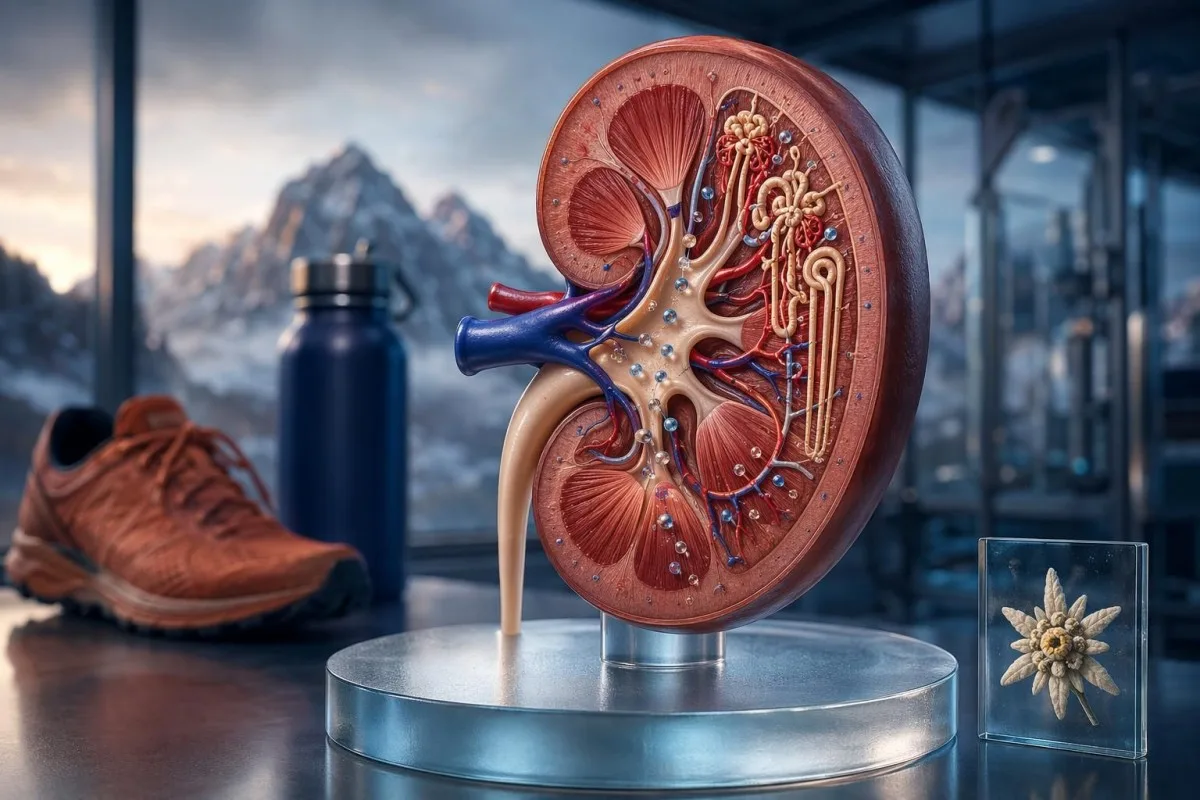
Hard training can nudge creatinine upward for a day or two, especially with dehydration, creatine supplements, high meat intake, or muscle injury. The trick is separating a temporary muscle signal from true kidney trouble.


- Creatinine levels often rise 10-30% for 24-48 hours after hard exercise, especially resistance training, racing, or heat exposure.
- High creatinine after a workout is more concerning when it comes with low urine output, swelling, high potassium, protein in urine, or a falling eGFR trend.
- GFR test estimates can look falsely low in muscular people because creatinine is partly a muscle-mass marker, not just a kidney marker.
- Renal panel patterns help: dehydration often raises BUN or urea along with creatinine, while muscle injury may raise CK, AST, LDH, and sometimes potassium.
- Creatine supplements can raise serum creatinine by about 0.1-0.3 mg/dL in some users without reducing true filtration.
- Repeat testing is usually best after 48-72 hours without hard training, good hydration, and no large cooked-meat meal the night before.
- Rhabdomyolysis risk rises when CK is above 1,000 IU/L and becomes more urgent above 5,000 IU/L, especially with dark urine or weakness.
- Kidney disease is usually defined by eGFR below 60 mL/min/1.73 m² for at least 3 months or urine albumin-creatinine ratio of 30 mg/g or higher.
Why hard workouts can raise creatinine levels
Hard exercise can temporarily raise creatinine levels because working muscle produces more creatinine, dehydration concentrates the blood, and muscle fiber stress releases related markers. In a well person, the rise is usually small, often 10-30%, and settles within 24-72 hours; a persistent rise, abnormal urine, high potassium, or falling eGFR needs medical review.
I’m Thomas Klein, MD, and this is one of the most common false alarms I see after weekend races or heavy lifting blocks. A 34-year-old cyclist once sent us a renal panel with creatinine 1.42 mg/dL after a mountain stage; 72 hours later, rested and hydrated, it was 1.03 mg/dL, with a normal urine albumin result.
Kantesti is an AI blood test analyzer that reads creatinine in context with eGFR, BUN or urea, electrolytes, urine markers, age, sex, and recent training notes. As a company, Kantesti Ltd sees many post-exercise lab patterns that look alarming on a single PDF but become far less scary once timing is added.
Here is the clinical fork in the road: a one-off high result after intense training is not the same as chronic kidney disease. KDIGO’s 2024 guideline defines chronic kidney disease by kidney structure or function abnormalities for at least 3 months, such as eGFR below 60 mL/min/1.73 m² or albuminuria at 30 mg/g or higher (KDIGO CKD Work Group, 2024).
What creatinine measures and the usual adult ranges
Creatinine is a waste product from creatine phosphate turnover in muscle, and the kidneys remove most of it through filtration. Typical adult reference ranges are about 0.7-1.3 mg/dL for men and 0.5-1.0 mg/dL for women, though muscular build, age, pregnancy, and lab method shift the expected number.
In SI units, many UK and European labs report creatinine as roughly 62-115 µmol/L for adult men and 44-88 µmol/L for adult women. Some European labs use slightly narrower ranges, which is why a result can look flagged in one country and normal in another.
Creatinine is not a pure kidney marker. Baxmann et al. found that serum creatinine correlates with lean mass and physical activity, while cystatin C was less affected by muscle mass in healthy adults (Baxmann et al., 2008).
A 22-year-old powerlifter and a 72-year-old sedentary adult can have the same creatinine of 1.1 mg/dL and very different kidney implications. For sex-specific interpretation, our guide to female creatinine ranges explains why smaller body size and lower muscle mass often lower the expected baseline.
How long creatinine stays high after training
Exercise-related high creatinine usually peaks the same day or the morning after a hard session and improves within 24-72 hours. Eccentric lifting, downhill running, sprint intervals, and long races create the biggest temporary shifts because they stress muscle fibers more than easy aerobic work.
I usually ask patients three questions before reacting to a mild creatinine flag: what workout happened in the prior 72 hours, how much fluid was lost, and whether there was unusual soreness. If the answer is heavy squats, a hot race, and sore legs, the lab may be recording recovery rather than kidney disease.
After a marathon or high-volume strength session, creatinine may rise while CK, AST, LDH, and white blood cells also drift upward. Our article on exercise-shifted labs goes deeper into why CK and AST can look dramatic even when the athlete is recovering normally.
The practical retest window is boring but useful: avoid hard training for 48-72 hours, drink normally, and repeat the renal panel in the morning. If creatinine falls back to your usual baseline, the previous value was probably a timing artifact; if it stays high, the conversation changes.
Dehydration patterns on a renal panel
Dehydration can raise creatinine by reducing kidney blood flow and concentrating the blood sample. On a renal panel, dehydration often raises BUN in the US or urea in the UK, sometimes producing a BUN-to-creatinine ratio above 20:1.
A creatinine of 1.35 mg/dL with BUN 34 mg/dL after a hot training day tells a different story than creatinine 1.35 mg/dL with normal BUN and abnormal urine albumin. The first pattern often points toward prerenal concentration; the second pushes me to look harder at kidney structure and urine findings.
The BUN-to-creatinine ratio is not perfect because high protein intake, corticosteroids, gastrointestinal bleeding, and catabolic states can also raise BUN. Still, a ratio above 20:1 after sweating heavily is a useful clue, and our BUN creatinine guide covers the conversion traps between BUN and urea reporting.
Urine specific gravity adds another layer. A value above 1.020 after exercise suggests concentrated urine, while very dilute urine with high creatinine may point somewhere else; sodium, CO2 or bicarbonate, and chloride help identify heat stress or overhydration patterns.
Creatine supplements can nudge creatinine upward
Creatine supplements can increase measured creatinine because creatine naturally converts to creatinine, and the effect does not automatically mean kidney damage. In healthy adults, 3-5 g/day of creatine monohydrate commonly changes creatinine slightly, often by about 0.1-0.3 mg/dL, depending on muscle mass and assay timing.
Kreider et al. reviewed creatine safety for the International Society of Sports Nutrition and concluded that creatine monohydrate is not shown to damage kidneys in healthy people when used at recommended doses (Kreider et al., 2017). That said, I still check context carefully in patients with known kidney disease, diabetes, high blood pressure, or concurrent nephrotoxic medication.
A loading phase of 20 g/day for 5-7 days is more likely to create a confusing lab week than a maintenance dose of 3-5 g/day. Creatine ethyl ester is a special nuisance because it can convert to creatinine more readily and has produced surprisingly high creatinine results in case reports.
If you use creatine, tell your clinician before assuming the eGFR is truly low. Our guide to creatine and labs explains why cystatin C or measured creatinine clearance may be more informative when the creatinine-based estimate and your clinical picture disagree.
When muscle injury turns a lab bump into an emergency
Muscle injury becomes urgent when creatinine rises alongside very high CK, dark urine, weakness, swelling, or high potassium. Rhabdomyolysis is often defined by CK above 5 times the upper limit of normal, commonly above 1,000 IU/L, and kidney risk rises substantially when CK exceeds 5,000 IU/L.
This is where I stop reassuring and start triaging. A CrossFit athlete with creatinine 1.6 mg/dL, CK 18,000 IU/L, potassium 5.8 mmol/L, and cola-colored urine needs urgent care, not a casual retest next week.
Creatinine alone cannot diagnose rhabdomyolysis because a muscular person may sit near the upper reference range at baseline. The dangerous pattern is a rising creatinine plus CK in the thousands, potassium above about 5.5 mmol/L, phosphate elevation, low calcium early on, or falling urine output.
Patients often underestimate the role of heat, new movements, and unaccustomed eccentric load. Our CrossFit rhabdo guide lists the lab and symptom combinations that should prompt same-day medical assessment.
How clinicians separate exercise effects from kidney disease
Doctors separate a temporary creatinine rise from kidney disease by checking trend, eGFR persistence, urine albumin, urine sediment, blood pressure, and risk factors. A single creatinine result after exercise is weak evidence; repeated abnormal results over at least 3 months carry much more weight.
KDIGO 2024 keeps the diagnosis anchored in duration and damage markers, not panic over one flagged number. An eGFR below 60 mL/min/1.73 m² for 3 months, or urine albumin-creatinine ratio at or above 30 mg/g, is far more concerning than a one-day post-race creatinine bump.
Urine albumin is the quiet test people miss. A urine ACR below 30 mg/g is generally normal, 30-300 mg/g is moderately increased, and above 300 mg/g is severely increased; our urine ACR guide explains why this can identify early kidney damage while creatinine still looks acceptable.
The pattern I trust least is a normal-looking creatinine in a frail older adult. Low muscle mass can hide kidney impairment, so a creatinine of 0.9 mg/dL may be reassuring in a rower but less reassuring in an 84-year-old who has lost 8 kg.
Why the GFR test can mislead athletes
A creatinine-based GFR test can underestimate kidney function in muscular athletes because the equation assumes average creatinine production. Cystatin C-based eGFR is often useful when muscle mass, creatine use, or intense training makes creatinine hard to interpret.
Most lab reports calculate eGFR from creatinine, age, and sex, and many no longer use race coefficients. That is a good change, but it does not solve the muscle-mass problem; a lean 100 kg sprinter may generate more creatinine than the equation expects.
Cystatin C is produced by nucleated cells and is less tied to muscle mass, though thyroid disease, inflammation, corticosteroids, smoking, and obesity can affect it. In messy cases, the combined creatinine-cystatin C equation often gives a more clinically believable estimate than either marker alone.
If your eGFR is 58 mL/min/1.73 m² after a lifting block but cystatin C eGFR is 88 and urine ACR is normal, I would not label you with kidney disease on that data alone. For a detailed explanation, see our cystatin C GFR guide.
Renal panel patterns that change the interpretation
A renal panel is more useful than creatinine alone because sodium, potassium, chloride, CO2 or bicarbonate, BUN or urea, calcium, phosphate, albumin, and sometimes magnesium show the physiology around the result. The surrounding markers tell us whether the body looks dehydrated, overhydrated, acid-stressed, or injured.
High creatinine with sodium 148 mmol/L, high albumin, and high urine specific gravity looks like fluid loss. High creatinine with potassium 6.0 mmol/L and low bicarbonate is a different animal and needs urgent review, especially if the result is new.
CO2 or bicarbonate below about 22 mmol/L after extreme exercise may reflect metabolic acidosis, lab timing, kidney handling, or illness. Chloride above 107 mmol/L can appear with saline exposure or certain acid-base patterns; potassium above 5.5 mmol/L is the electrolyte that changes the speed of response.
Fasting is rarely required for a renal panel, but meal timing and supplements can still muddy the water. Our guide to renal panel fasting explains why a large protein meal may move urea more than creatinine.
When to repeat creatinine after exercise
Most mildly high post-exercise creatinine results should be repeated after 48-72 hours of no hard training and normal hydration. Repeat sooner, often same day or next day, if creatinine is clearly high, potassium is elevated, urine output is reduced, or symptoms suggest muscle injury or kidney stress.
For a small bump, I prefer a clean repeat rather than an immediate cascade of tests. No maximal lifts, no long run, no sauna, no dehydration strategy, and no large cooked-meat meal for 24 hours before the draw; morning testing reduces day-to-day noise.
If the repeat creatinine returns to baseline and urine ACR is normal, many clinicians simply document exercise timing and move on. If the result remains elevated, I ask for prior labs from 6-24 months back because a slow trend often matters more than a reference flag.
A useful threshold: a creatinine increase of 0.3 mg/dL within 48 hours can meet acute kidney injury criteria in the right clinical setting. Our guide to repeating abnormal labs explains why timing, symptoms, and prior baseline determine whether a repeat is routine or urgent.
Who should not dismiss high creatinine as exercise
People with diabetes, high blood pressure, known kidney disease, heart failure, pregnancy, older age, or one kidney should not automatically blame exercise for high creatinine. In these groups, even a mild rise may uncover reduced kidney reserve or medication sensitivity.
A 1.2 mg/dL creatinine in a 28-year-old bodybuilder may be normal for him; the same number in a 52 kg older woman can mean a much lower eGFR. Age matters because eGFR normally declines over decades, and albuminuria adds risk even when eGFR is above 60.
Patients with diabetes should pay special attention to urine ACR because early diabetic kidney disease may appear as albumin leakage before creatinine rises. Blood pressure above 130/80 mmHg, repeated albuminuria, or eGFR below 60 mL/min/1.73 m² changes the follow-up plan.
Diet advice also changes once true kidney disease is present. Our kidney diet guide focuses on lab-safe choices because aggressive protein loading, potassium-rich supplements, and dehydration tactics can backfire in people with reduced kidney reserve.
Food, medicines, and supplements that confound results
Cooked meat, high protein intake, creatine, NSAIDs, trimethoprim, cimetidine, some antivirals, and heavy training can all raise or distort creatinine interpretation. Some increase true kidney stress, while others mainly block creatinine secretion or increase creatinine generation.
A large cooked-meat meal can raise serum creatinine for several hours because cooking converts creatine in meat to creatinine. If you are repeating a borderline result, skip the steakhouse experiment the night before and keep protein intake ordinary.
NSAIDs are the medication class I ask about most after endurance events. Ibuprofen or naproxen taken during dehydration can reduce kidney blood flow, and the combination of heat, low circulating volume, and NSAIDs is a classic setup for an avoidable creatinine rise.
Trimethoprim and cimetidine can raise serum creatinine by reducing tubular secretion without necessarily reducing true GFR. High-protein diets complicate BUN and urea interpretation too, which is why our protein diet lab guide separates protein metabolism from kidney filtration.
How Kantesti reads creatinine in context
Kantesti AI interprets creatinine by combining the number with eGFR, BUN or urea, electrolytes, urine findings, CK if available, prior baselines, age, sex, and user-entered context such as intense exercise or creatine use. That pattern-based reading is safer than treating a single red flag as a diagnosis.
Kantesti is an AI blood test interpretation platform used by people in 127+ countries, so our system has to handle mg/dL, µmol/L, urea, BUN, different reference ranges, and translated lab PDFs. The point is not to replace a clinician; it is to make the next question obvious.
Our AI looks for combinations I would also look for at the desk: creatinine up with BUN up, creatinine up with CK up, creatinine up with potassium up, or creatinine up but cystatin C and urine ACR normal. For readers interested in methodology rather than marketing, our AI technology guide explains how Kantesti’s neural network handles units and cross-marker context.
In my experience, the trend graph is where many false alarms calm down. A creatinine of 1.28 mg/dL is less concerning if your last six values were 1.22-1.31 mg/dL, and more concerning if your usual baseline is 0.72 mg/dL; our blood test trend guide shows why slope often beats a single flag.
What to ask your doctor before worrying
Before worrying about post-workout creatinine, ask whether the result matches your baseline, whether eGFR is persistently low, whether urine ACR is abnormal, and whether CK or potassium suggests muscle injury. Those four questions usually separate a temporary training effect from a kidney workup.
Bring the exact training timeline: last hard session, race distance, sauna or heat exposure, fluid loss, creatine dose, NSAID use, and any dark urine or unusual weakness. A vague note saying I exercise a lot is less useful than saying I did 90 minutes of downhill repeats 18 hours before the draw.
Kantesti is an AI biomarker interpretation platform, but medical oversight still matters when a result could represent acute kidney injury, rhabdomyolysis, or chronic kidney disease. Our physicians and advisors review clinical guardrails through the Medical Advisory Board, and our approach to safety thresholds is described in medical validation.
Bottom line: repeat a mild isolated creatinine rise after 48-72 hours of rest and normal hydration, but do not wait if potassium is high, urine output drops, swelling appears, or CK is in the thousands. As of July 5, 2026, that remains the practical, patient-safe middle ground between ignoring a real kidney signal and overcalling a workout artifact.
Frequently Asked Questions
Can exercise raise creatinine levels?
Yes, hard exercise can raise creatinine levels temporarily, usually by about 10-30% for 24-48 hours and sometimes up to 72 hours after very intense training. The rise is more likely after heavy resistance training, downhill running, racing, heat exposure, dehydration, or unusual soreness. A repeat renal panel after 48-72 hours of rest and normal hydration often clarifies whether the result was exercise-related.
How long should I avoid workouts before a creatinine blood test?
For the cleanest creatinine result, avoid hard workouts for 48-72 hours before testing, especially heavy lifting, long runs, sprint intervals, and hot-weather endurance sessions. Easy walking or gentle mobility usually has little effect. If your prior result was high, also avoid dehydration, sauna use, NSAIDs when possible, and a large cooked-meat meal for 24 hours before the repeat test.
Does creatine make creatinine look high?
Creatine can make creatinine look mildly high because some creatine converts naturally into creatinine. A typical 3-5 g/day creatine monohydrate dose may raise serum creatinine by about 0.1-0.3 mg/dL in some users without meaning kidney damage. If creatinine-based eGFR looks unexpectedly low in a creatine user, cystatin C, urine ACR, and prior trends can help decide whether kidney filtration is truly reduced.
What creatinine level after exercise is dangerous?
No single creatinine number is dangerous without context, but a new creatinine above about 1.7-2.0 mg/dL, a rise of 0.3 mg/dL within 48 hours, or a rapidly falling eGFR deserves prompt review. It becomes more urgent if potassium is above 5.5 mmol/L, CK is above 1,000 IU/L, urine is dark, or urine output falls. CK above 5,000 IU/L after exercise can signal higher rhabdomyolysis-related kidney risk.
Can a GFR test be wrong in muscular people?
A creatinine-based GFR test can underestimate kidney function in muscular people because the equation assumes average creatinine production. A muscular athlete may have creatinine near 1.3 mg/dL with normal kidney filtration, while a frail older adult can have kidney impairment with creatinine near 1.0 mg/dL. Cystatin C-based eGFR or combined creatinine-cystatin C eGFR is often more useful when muscle mass distorts the result.
What renal panel results suggest dehydration rather than kidney disease?
Dehydration often raises creatinine together with BUN or urea, high-normal sodium, high albumin, and concentrated urine. A BUN-to-creatinine ratio above 20:1 can support dehydration, though high protein intake, steroids, and gastrointestinal bleeding can also raise BUN. Kidney disease becomes more likely when eGFR remains low for at least 3 months or urine albumin-creatinine ratio is 30 mg/g or higher.
Should I repeat creatinine if it was high after a workout?
Yes, a mild isolated high creatinine after a workout is commonly repeated after 48-72 hours of rest, normal hydration, and ordinary eating. Repeat testing should include eGFR and often BUN or urea, electrolytes, and urine ACR if the result remains abnormal. Seek same-day medical advice instead of waiting if you have dark urine, severe muscle pain, weakness, swelling, low urine output, or high potassium.
Should I drink extra water to bring my creatinine down before retesting?
Drink your usual amounts and avoid arriving dehydrated; forcing large amounts of water quickly can dangerously lower blood sodium. If you have a prescribed fluid limit for heart or kidney disease, keep following it unless your clinician advises otherwise.
Can my period affect the urine tests ordered with a high creatinine result?
Menstrual blood can contaminate a urine sample and make blood or protein results harder to interpret, although it does not raise blood creatinine. Tell the laboratory or clinician, and ask whether the urine test should be repeated after bleeding stops.
Get AI-Powered Blood Test Analysis Today
Join over 2 million users worldwide who trust Kantesti for instant, accurate lab test analysis. Upload your blood test results and receive comprehensive interpretation of 15,000+ biomarkers in seconds.
📚 Referenced Research Publications
Klein, T., Mitchell, S., & Weber, H. (2026). AI Blood Test Analyzer: 2.5M Tests Analyzed | Global Health Report 2026. Kantesti AI Medical Research.
Klein, T., Mitchell, S., & Weber, H. (2026). RDW Blood Test: Complete Guide to RDW-CV, MCV & MCHC. Kantesti AI Medical Research.
📖 External Medical References
KDIGO CKD Work Group (2024). KDIGO 2024 Clinical Practice Guideline for the Evaluation and Management of Chronic Kidney Disease. Kidney International.
⚕️ Medical Disclaimer
This article is for educational purposes only and does not constitute medical advice. Always consult a qualified healthcare provider for diagnosis and treatment decisions.
E-E-A-T Trust Signals
Experience
Physician-led clinical review of lab interpretation workflows.
Expertise
Laboratory medicine focus on how biomarkers behave in clinical context.
Authoritativeness
Written by Dr. Thomas Klein with review by Dr. Sarah Mitchell and Prof. Dr. Hans Weber.
Trustworthiness
Evidence-based interpretation with clear follow-up pathways to reduce alarm.