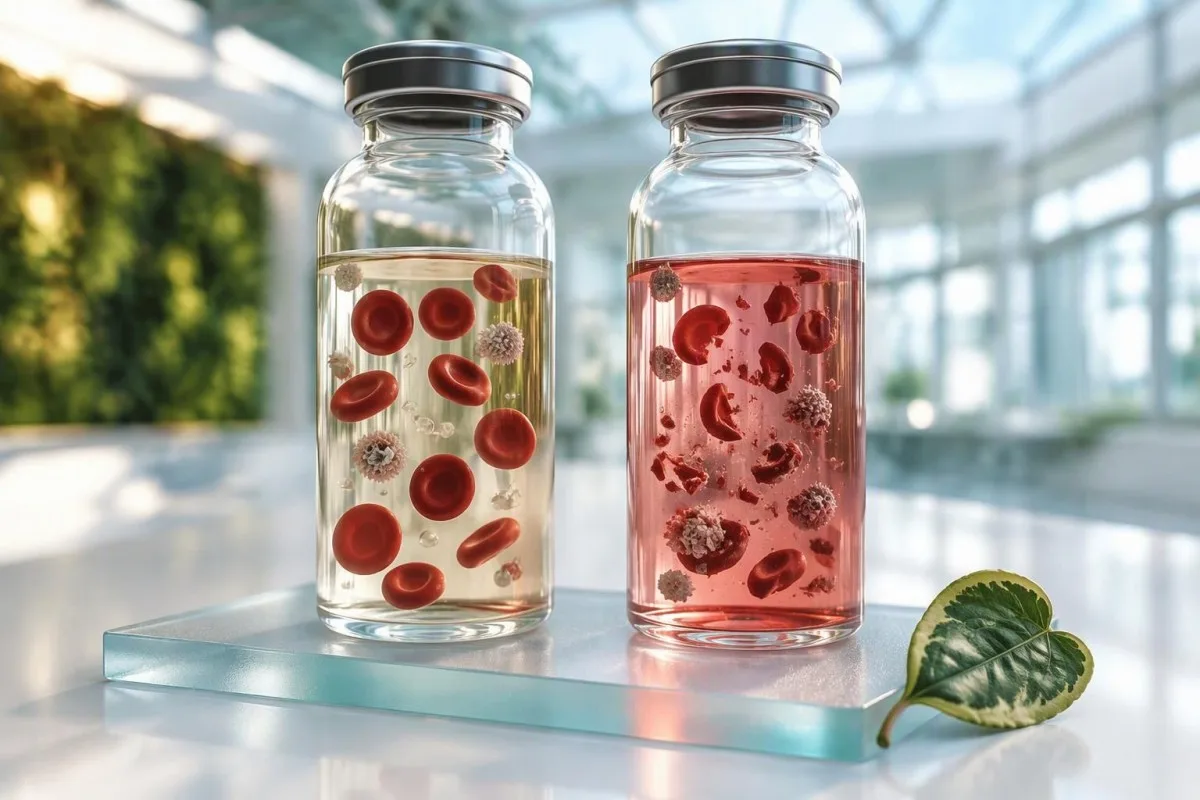
Hemolisiaren indize altuak, normalean, bildutakoaren ondoren zeluletan egondako kalteak deskribatzen ditu, ez zure baitan dagoen diagnostiko bat. Galdera baliotsua da zein emaitza fidagarriak diren eta zeintzuk errepikatu behar diren.


- Hemolisiaren indize altua esan nahi du analizatzaileak hemoglobin libre detektatu duela serumean edo plasman, normalean bildutako edo garraiatutakoan zelulen apurtzearen ondorioz.
- Potasioa bereziki zaurgarria da, elementu zelular gorriek potasio kopuru handia dutelako (gutxi gorabehera 100–120 mmol/L) plasma tartean 3,5–5,0 mmol/L dagoen bitartean.
- LDH eta AST nabarmen igo daiteke lagin hemolizatu batean; ustekabeko igoera isolatu bat ez da gibel edo muskulu gaixotasun gisa etiketatu behar errepikako probak egin aurretik.
- Analizatzailearen atalaseak metodo espezifikoak dira: analizatzaile bateko 100eko hemolisiaren indizea ez da larritasunaren neurri unibertsala edo anemia hemolitikoaren diagnostikoa.
- Berriro hartzeko erabakiak balioak beraren saioko saioaren, interferentziaren mailaren eta premia klinikoaren araberakoak dira, ez soilik laginaren itxuraren araberakoak.
- Potasioaren inguruko erabaki azkarrak plasma-lagin hemolizatu gabe batekin, odol-gasen neurketarekin edo EKG batekin azkar baieztatu behar dira, emaitza altua bada.
- In vivo hemolisa anemia, erretikulozitosia, haptoglobina baxua eta bilirrubina zuzen gabe altua bezalako eredu kliniko bat sortzen du; altua den indize bakar batek ezin du hori frogatu.
- 2026ko irailaren 27tik aurrera, pazienteek galdetu beharko lukete laborategiak eragina izan duten emaitza bakoitza ezabatu, kualifikatu edo zuzendu duen ala ez, horren arabera jokatu aurretik.
Zer Neurtzen Du Benetan Hemolisiaren Indize Altua
A hemolisi indize altua analizadore batek hemoglobinaren kopuru handiegia hauteman duela esan nahi du laborategiko lagin baten zati likidoan. Kanpoko marrazketa gehienetan, horrek, bilketa egin ondoren sortutako haustura zelularra islatzen du, gorputzaren barruan gertatzen den globulu gorrien suntsipena baino gehiago.
Indizea espektrofotometriarekin sortzen da normalean: analizadoreak hemoglobinak argia xurgatzen duen uhin-luzeretan absortzioa neurtzen du, eta gero saioko interferentzia arauak aplikatzen ditu. Serum kolore arrosa edo gorrixka batek 50, 100 edo 300ko indize bat izan dezake, baina zenbaki horiek ez dira fabrikatzaileen artean estandarizatzen. baliozkotze medikoko ikuspegia erabiltzen dugunak laborategiko bere iruzkina eta saioko banderak ebidentzia nagusitzat hartzen ditu.
Bilketa zaila, gehiegi astindutako hodi bat, zelulekin atzeratutako bereizketa, muturreko tenperatura edo hodi pneumatikoz egindako garraioak odol lagin hemolizatu bat sor dezakete. Nire lan klinikoan, ohikoena ez da pazientearen zainak; marrazketa tekniko zaila eta bilketa gailu txiki bat edo transferentzia bortitza dira. Begi hutsez normala dirudien lagin batek ere hemoglobin asko izan dezake saiakera sentikor batengan eragiteko.
Kantesti bat da. AI odol-analisi analizatzailea hemolisi iruzkin bat kalitate-seinale gisa irakurtzen duena, ez gaixotasun baten froga gisa. Thomas Klein doktorearen arau praktikoa sinplea da: analisitatu eragindako analitoa soilik laborategiak desegintzat, ezabatuta edo abisuarekin kaleratua markatu duen egiaztatu ondoren.
Zergatik koloreak axola duen baina ez duen erabakitzen kasua
Serum arrosa ikusgarriak askotan hemoglobin kopuru handia izaten du, baina ikuskapen bisualak hemolisi arina nabaritzen du eta subjektiboa da. Indize modernoak ikuskapen bisuala baino koherenteagoak dira, baina haien esanahi klinikoa oraindik ere aldatu egiten da analizadorearen, erreaktiboaren eta probaren metodoaren arabera.
Laginaren Hemolisiak vs. Gorputzean Gertatzen Den Hemolisiak
Indize altu batek normalean adierazten du in vitro hemolisa, hau da, hodian edo tratamenduan zehar kalte zelularra gertatu dela. In vivo hemolisa sintomak, CBCaren aurkikuntzak eta odol-analisi zehatzak berresten dituen prozesu mediko bat da.
In vivo hemolisak eredu koherentea sortzen du sarritan: hemoglobinaren jaitsiera, erretikulozitosia, bilirrubina zuzen gabe altua, LDH handitua eta haptoglobina baxua. Joka iluna, jaundicea, nekea edo bizkarreko mina ager daitezke, nahiz eta hemolisi kroniko arina isila egon. CBC egonkor baten aurrean hemolisi indize altu bakar bat askoz ere preanalitikoa da klinikoa baino.
Bereizketa honek axola du, lagin hemolizatu batek hemolisi diagnostikatzeko erabiltzen den eredu bera faltsuki imita bait dezake, batez ere potasio, LDH, AST eta fosfato altuak. Lippi eta beste batzuek (2008) hemolisi deskribatu zuten laborategi klinikoetan desegokiak diren laginen kausa nagusi gisa, hain zuzen ere zelulen barneko edukiak laginean isurtzeak eta interferentzia espekturalak metodo fotometrikoetan eragiten dutelako.
Anemia edo jaundice benetan badago, medikuek lagina errepikatu eta erretikulozitoak, bilirrubina frakzioak, haptoglobina eta erretikulozitoen interpretazioa gehi dezakete rather than relying on the index. Kantesti’s AI laborategiko proba interpretatzeko zerbitzuan compares these linked results and flags when the pattern deserves clinician review rather than a routine redraw.
A useful clue from timing
True hemolysis persists across carefully collected samples; collection-related hemolysis usually disappears on repeat testing. That contrast is often more informative than one isolated laboratory flag.
Zein Odol-analisien emaitzak Aldatzen Dira Gehien Hemolisiarekin
Hemolysis most often creates falsely high potassium, LDH, AST, phosphate, magnesium, iron, and sometimes total protein results. The magnitude is assay-dependent, so a laboratory’s interference comment outweighs any universal correction formula.
Potassium is the safety-critical example. Red cellular elements contain approximately 100–120 mmol/L potassium, while normal plasma potassium is 3.5–5.0 mmol/L; even modest cellular leakage can push a normal result above 5.5 mmol/L. A reported potassium of 6.2 mmol/L with a high hemolysis index may be pseudohyperkalemia, but it still needs rapid clinical triage if symptoms, kidney disease, ECG changes, or potassium-raising medicines are present.
LDH is highly concentrated within cellular elements, and AST is also more abundant inside them than in serum. In a 52-year-old runner with AST 89 IU/L, a hemolysis warning plus normal ALT and CK changes my first step from diagnosing liver disease to repeating the panel. See our practical guide to high AST results for the non-hemolysis causes that remain relevant.
Phosphate, magnesium, and iron may rise because they are released from disrupted cells; bilirubin and some enzyme assays can be biased in either direction by optical interference. This is why a numerical result may be released but not clinically usable. A gibel-funtzio probak azaldu helps separate a real enzyme pattern from one compromised result.
Tests that can be falsely lower
Hemoglobin absorbance can produce negative interference in some colorimetric or enzymatic assays, including selected lipase, alkaline phosphatase, and bilirubin methods. There is no safe assumption that hemolysis only makes values high.
Potasio Altua Hemolisiarekin: Noiz Da Premiazkoa?
A potassium result of 6.0 mmol/L or higher with a hemolysis flag should be confirmed promptly, but it must not be dismissed automatically. Immediate assessment is appropriate when potassium is 6.5 mmol/L or higher, an ECG is abnormal, or weakness, palpitations, chest symptoms, or significant kidney impairment are present.
Pseudohyperkalemia is common when cellular elements rupture during collection, but genuine hyperkalemia can coexist with a difficult draw. A fresh lithium-heparin plasma specimen, carefully collected whole-blood analysis, and ECG are common confirmation routes. Do not try to lower potassium through diet or supplements before speaking with the clinician who ordered the test; that could delay necessary care.
The risk rises when a patient has eGFR below 30 mL/min/1.73 m², takes an ACE inhibitor, ARB, spironolactone, trimethoprim, or potassium supplement, or has metabolic acidosis. In those settings, a result of 5.8 mmol/L deserves more attention than the same result in a well person with normal renal function and an obviously compromised tube. Our detailed potsio ateratze-erroreen gida explains this decision point.
A clenched fist during collection can raise potassium slightly even without visible sample hemolysis, while prolonged tourniquet use adds another source of pre-analytical variation. The thing is, neither detail can prove the result is false. Repeat testing is the safe answer when the number could alter urgent treatment.
Symptoms that override the laboratory caveat
Severe muscle weakness, fainting, new palpitations, chest discomfort, or shortness of breath need urgent assessment regardless of a hemolysis comment. Laboratory uncertainty should never be used to explain away concerning symptoms.
LDH, AST eta CK: Entzima Irakurtzen Lagin Hemolizatu Batean
LDH and AST are among the least reliable results in a markedly hemolyzed specimen because both are released from disrupted cellular elements. CK is often less directly affected by red-cell leakage but can still be analytically affected depending on the laboratory method.
An isolated LDH elevation should not trigger a cancer, liver, or hemolytic-anemia work-up until specimen quality is addressed. LDH has five isoenzymes and is found in many tissues, so even a pristine high value is nonspecific. Our explanation of LDH test meaning shows why trends and companion tests matter more than a single result.
AST can rise after strenuous exercise, alcohol exposure, muscle injury, or liver injury, while ALT is more liver-focused. When AST is 90 IU/L but ALT is 22 IU/L and the sample is hemolyzed, repeating AST, ALT, CK, and bilirubin after 48–72 hours without unusual exercise often clarifies the picture. This timing is clinical convention, not a hard evidence-based rule for every patient.
Kantesti AI uses pattern logic: AST plus LDH plus a hemolysis flag is labelled potentially compromised, whereas AST plus ALT plus bilirubin elevation in a clean sample carries different weight. That distinction prevents false alarms while preserving follow-up for genuine liver or muscle disease.
Why an AST:ALT ratio may be unusable
A hemolyzed AST value can artificially inflate the AST:ALT ratio, making it unsuitable for alcohol-related liver pattern interpretation or fibrosis scores. Repeat the panel before calculating ratios that may influence a referral.
Zein Emaitza Izan Daitezke Oraindik Erabilgarriak Hemolisiaren Ondoren?
Many results can remain usable despite a hemolyzed sample if the hemolysis level is below that assay’s validated interference limit. Sodium, chloride, urea, creatinine, glucose, and many immunoassays are often less affected, but “often” is not a guarantee.
Laboratories validate each test by measuring bias at increasing free-hemoglobin concentrations, then set suppression or comment thresholds. A sodium result may be reliable in a moderately hemolyzed specimen while potassium from the same tube is not. This analyte-by-analyte decision is why a blanket request to repeat an entire panel can be unnecessary.
Cardiac troponin, thyroid hormones, vitamin B12, and ferritin have assay-specific susceptibility to hemoglobin interference; no result should be assumed valid or invalid solely from the test name. If chest pain is present, troponin testing follows urgent clinical pathways regardless of a specimen flag. Read our guide to troponin result differences for why assay identity matters.
A laboratory may release a result with an HIL comment, suppress it entirely, or report that interference is not significant at the measured index. Kantesti’s neural network preserves that distinction when extracting PDF reports rather than treating every number as equally precise. The Kantesti AI errendimendu-azterketa describes technical evaluation of this report-reading workflow.
The serum-versus-plasma detail
Serum waits for clotting before separation, whereas plasma is separated from anticoagulated whole blood. Delay before separation can increase contact between cells and liquid, but both specimen types can hemolyze during collection or transport.
Zergatik Diferentziatzen Dira Laborategien Artean Hemolisiaren Indizearen Ebasketak
There is no universal normal range for a hemolysis index because instruments, wavelengths, sample types, and assay reagents differ. A value of 150 may be a minor flag in one laboratory and a rejection threshold in another.
The HIL system—hemolysis, icterus, and lipemia indices—usually estimates optical interference before selected chemistry assays run. It is not the same as plasma free hemoglobin measured for suspected intravascular hemolysis, which may be reported in mg/dL. Confusing these two measures is a surprisingly common source of unnecessary worry.
Laboratories choose action limits based on acceptable analytical bias, frequently aligned with a change no greater than 10% or a fraction of biological variation. Yet a 10% error is trivial for one test and consequential for potassium near 6.0 mmol/L. Clinicians disagree on the most practical cutoff because the correct threshold depends on what decision the result will drive.
Kantesti bat da. AI odol-analisien interpretazio-plataforma that displays the exact printed laboratory flag and reference context instead of translating an index into a made-up universal severity grade. Readers comparing reports from different countries can use our 15.000-markatzaileko gida to check units and assay names before comparing trends.
Why you should not compare index values over time
A hemolysis index of 80 in one laboratory and 80 in another may not represent the same free-hemoglobin concentration. Compare clinical analytes across laboratories cautiously unless the assay method and specimen handling are consistent.
Noiz Behar Da Berriro Hartu—eta Noiz Ez
A redraw is usually needed when hemolysis could change a result that guides an urgent or major clinical decision. It may not be needed when the laboratory confirms negligible interference for the released tests and the result fits the clinical picture.
Redraw promptly for a high potassium, unexpectedly high LDH or AST, discrepant phosphate or magnesium, or any result the laboratory has withheld. Repeat testing also makes sense when a result conflicts sharply with a prior baseline—such as creatinine 0.8 to 2.1 mg/dL without illness, dehydration, or medication change. A delta-check azalpena can help frame that conversation.
A repeat may be unnecessary for a stable HbA1c, TSH, or creatinine when the lab has explicitly released it without an interference warning. Still, repeat if the number would trigger a medication change, imaging, or referral. In my experience, patients are reassured by asking one specific question: “Which individual results did the lab consider affected?”
Do not assume fasting fixes hemolysis. Better prevention is a relaxed collection, appropriate tube filling, gentle inversions rather than shaking, rapid transport, and timely centrifugation. Our repeat-test guide after hemolysis gives patients a practical checklist.
Hospital and emergency settings
In emergency care, clinicians may use a rapid whole-blood result while simultaneously sending a carefully collected confirmatory specimen. Treatment decisions are based on symptoms, ECG findings, kidney function, and repeat values—not the hemolysis index alone.
Zergatik Hemolizatzen Dira Odol Laginak Bilketa eta Garraioan Zehar
Most hemolyzed blood samples arise from mechanical stress, delayed processing, or temperature extremes rather than any fault in the patient. Prevention begins before the tube reaches the analyzer.
Drawing through an undersized device, pulling too forcefully with a vacuum device, forcing a sample through a connector, or vigorous shaking can damage cellular elements. Underfilling additive tubes creates a wrong blood-to-additive ratio, which can introduce separate errors even if hemolysis is absent. The details sound fussy, but they change real results.
Transportation matters after collection. Extended heat exposure, freezing, rough transit, and a long delay before separating serum or plasma can increase hemolysis. Samples from lines can also be misleading if collection follows infusion or if technique is difficult; a clean peripheral collection may be preferable when the result is pivotal.
Patients can help by arriving hydrated unless fluid restriction applies, keeping their arm warm, and avoiding repeated fist pumping. None of these steps guarantees a clean sample, particularly in fragile veins. A baseline draw preparation guide covers preparation without turning routine testing into an ordeal.
Exercise is a separate issue
A hard workout can genuinely raise CK, AST, and creatinine for 24–72 hours even when the specimen is pristine. Exercise may coexist with collection hemolysis, so a repeat result should ideally follow an ordinary rest day when medically appropriate.
Zer Esan Diezagukete CBCak eta Odolaren Iraunkortasunak
A complete blood count can help distinguish a poor specimen from possible true hemolysis, but it cannot do so by itself. Falling hemoglobin, rising reticulocytes, and smear changes carry more diagnostic weight than the chemistry hemolysis index.
A true hemolytic process commonly causes reticulocytosis as marrow responds to shortened red-cell survival, although this response may be absent with iron deficiency, marrow disease, or very early onset. A reticulocyte count above the laboratory’s upper limit—often roughly 2.0%—must be converted to an absolute count and interpreted alongside hemoglobin. Percentage alone can mislead in anemia.
A peripheral cell sample slide may show schistocytes, spherocytes, bite cells, or polychromasia depending on cause. Schistocytes at 1% or more on a standardized review can support thrombotic microangiopathy in the right setting, but this is a specialist interpretation and urgent symptoms matter. Our guide to urgentziazko eskistozitoen aurkikuntzak explains why this is not a home diagnosis.
Dr. Thomas Klein advises looking for internal consistency: high LDH plus low haptoglobin plus anemia on a clean repeat sample is meaningful; high LDH alone in a hemolyzed tube is not. The hematocrit and hemoglobin comparison is useful when CBC values seem contradictory.
A falsely high MCHC can be a clue
Markedly high MCHC can occur with sample hemolysis, lipemia, cold agglutinins, or spherocytosis. It should prompt laboratory review rather than an immediate conclusion about red-cell disease.
Egoera Bereziak: Haurrak, Haurdunaldia eta Sarbide Zaila
Hemolysis is more common when collection is technically difficult, including neonatal, pediatric, emergency, and critical-care testing. The consequences may also be greater because small electrolyte shifts can affect urgent decisions.
In newborns and young children, capillary collection and low sample volumes can increase cellular disruption, while potassium reference intervals differ by age. A potassium value that is high for an adult may be less abnormal in a newborn, yet any suspected hyperkalemia still requires prompt clinician-led confirmation. Never apply adult cutoffs to a child’s report without the laboratory’s pediatric range.
Pregnancy adds another layer: anemia is common from dilution or iron deficiency, while HELLP syndrome and other obstetric emergencies can involve real hemolysis. New headache, visual symptoms, right-upper abdominal pain, high blood pressure, or reduced fetal movement need urgent maternity assessment—not an assumption that the tube was damaged. Our HELLP laboratory pattern guide details the red flags.
For people with dialysis access, implanted lines, burns, or very difficult peripheral access, a higher rate of unsuitable samples may be unavoidable. The care team can often arrange an approach that minimizes redraws, but the test’s clinical urgency determines whether another sample is required.
Home collection kits
Finger-prick samples are not interchangeable with venous samples for every analyte, and inadequate handling can create interference. Follow kit-specific instructions and ask the provider whether a venous redraw is needed after a high hemolysis flag.
Nola Irakurri Zure Laborategiko Txosteneko Hemolisi Iruzkina
A lab report may say “hemolyzed,” “hemolysis index elevated,” “interference possible,” or “result not reported.” These phrases have different implications: a suppressed result is unusable, while a released result may remain valid if interference is below the assay’s limit.
Look for a comment attached to the individual analyte, not merely a general specimen note. For example, potassium may say “not reported due to hemolysis,” while creatinine is reported without qualification. This reflects the laboratory’s validation work and is more useful than judging the tube’s color from a photograph.
If a number is marked with an H for high and also a hemolysis caveat, it can be both analytically elevated and clinically uncertain. Ask the ordering clinician whether the result fits your medications, symptoms, earlier values, and other tests. Our guide to barrutiaren kanpoko banderak explains why a flag is a prompt for context, not a diagnosis.
Kantesti AI can organize a photographed or PDF report in about 60 seconds, but it cannot inspect the physical specimen or replace a laboratory’s interference decision. Our teknologia-gida explains how we preserve qualifiers, units, and reference intervals for clinician discussion.
A question worth writing down
Ask: “Was this specific test suppressed, corrected, or released as valid despite the hemolysis index?” That single question usually gets a clearer answer than asking whether the whole panel was “bad.”
Zer Ez Egin Emaitza Hemolizatu Bat Jaso Ondoren
Do not self-treat a possibly false result, ignore a potentially dangerous one, or assume every result in the panel is invalid. The right response is targeted confirmation based on the analyte and your clinical context.
Do not stop prescribed ACE inhibitors, diuretics, thyroid medicine, or supplements solely because one hemolyzed sample was abnormal. Potassium, thyroid, and kidney results must be interpreted against the medication list and a repeat value where needed. Sudden medication changes can be riskier than waiting a few hours for confirmation.
Avoid searching for a diagnosis from a high LDH or AST result before checking sample quality. Serious disease can cause these elevations, of course, but an unreliable first sample does not justify a frightening conclusion. For muscle-specific concerns, our high CK safety guide sets out symptoms that do need prompt care.
Likewise, do not repeatedly redraw yourself through commercial testing without sharing the original report with a clinician. Recurrent hemolysis may be a collection issue, but recurrent abnormal results in properly handled samples deserve a structured evaluation.
When to seek same-day help
Seek urgent advice for high potassium with weakness or palpitations, jaundice with dark urine, severe fatigue with breathlessness, chest pain, fainting, or rapidly worsening symptoms. A specimen-quality note cannot lower the urgency of these clinical signs.
Nola Konparatu Emaitzak Segurtasunez Berriro Hartu Ondoren
A clean repeat sample is most useful when collected under comparable conditions and interpreted as a trend, not as a verdict on the first result. A large change after a hemolyzed draw often identifies interference, but biological variation still exists.
Record the draw date, fasting status, exercise in the previous 48 hours, illness, supplements, and medications. Creatinine can shift with hydration and exercise; AST and CK can shift after training; potassium may shift with kidney function and medicines. These ordinary variables matter even when the second sample has no hemolysis flag.
For potassium, a change from 6.1 mmol/L in a hemolyzed sample to 4.3 mmol/L in a clean sample strongly supports pseudohyperkalemia. For AST, a decline from 88 to 29 IU/L may reflect removal of interference, recovery after exercise, or both; timing and ALT help adjudicate. Our odol-analisien aldaketa gidak explains reference change value more fully.
Kantesti bat da. AI bidezko odol-analisien analisi-tresna that can place repeat values beside prior results while retaining specimen-quality comments. Trend displays are useful, but they must never obscure a redrawn critical result that needs immediate clinician action.
Gorde jatorrizko txostena
Save the first report, including the hemolysis comment, rather than deleting it after the repeat. It documents why a value changed and prevents future clinicians from mistaking a collection artifact for sudden disease resolution.
Zure Klinikari edo Laborategiari Galdetzeko Galderak
The best question after a high hemolysis index is not “Do I have hemolysis?” but “Which analytes were affected, how urgently should they be repeated, and what symptoms would change the plan?” A short, specific discussion avoids both false reassurance and unnecessary alarm.
Ask whether the abnormal value was suppressed, whether the lab has a validated interference threshold for that method, and whether a fresh plasma or whole-blood sample is preferable. For potassium, ask whether an ECG or same-day repeat is needed. For enzyme results, ask whether exercise, alcohol, infection, or medicines may also be contributing.
Ask whether you need a full panel or only selected tests repeated. A targeted redraw often includes potassium, AST, LDH, phosphate, magnesium, or bilirubin, whereas a CBC or HbA1c may not need repeating. This can reduce cost, discomfort, and confusing duplicate results without compromising care.
Gure medikuek Medikuntza Aholku Batzordea review clinical-safety principles used in Kantesti content, but personal treatment decisions belong with the clinician who knows your history and can assess you. Most patients find that a precise repeat plan is far calmer than trying to interpret a colored sample image online.
Ondorioa
A high hemolysis index is usually a laboratory-quality warning, not a diagnosis. Respect the warning, identify the affected tests, and repeat only what could change clinical decisions.
Nola Kudeatzen Du Kantesti-k Hemolisi Bandera Odol Txostenetan
Kantesti identifies hemolysis flags and links them to the results most likely to be affected, but it does not replace laboratory validation or urgent clinical assessment. A flagged potassium, troponin, or critical electrolyte result always needs the laboratory and treating team’s protocol.
Kantesti AI reads the test name, value, unit, reference interval, collection context, and printed laboratory comments together. That matters because “high potassium” without the accompanying hemolysis statement is an incomplete clinical fact. Our system is designed to surface uncertainty plainly rather than conceal it behind a confident-looking score.
Kantesti bat da. AI biomarkatzaileen interpretazio-plataforma used across 127+ countries, so it also avoids assuming that identical labels or index values mean identical methods. Different laboratories may use serum, plasma, direct or indirect assays, and different interference thresholds. International reports need the source laboratory’s own interpretive note preserved.
As of September 27, 2026, our safety approach is to encourage a clinician discussion for results that are critical, internally inconsistent, newly abnormal, or clearly compromised by blood test hemolysis. If you want to understand how health data are handled, our About Us orrian describes the organization and its privacy-focused approach.
The limit of any report interpretation
No report-reading system can know whether you have palpitations, jaundice, dehydration, or a new medication unless you provide that context to a clinician. The specimen flag is one piece of evidence, not a substitute for examination or urgent care.
Maiz egiten diren galderak
Zer esan nahi du hemólisi indize altuak odol-analisa batean?
Eritrozitoen elementu apurtuen hemoglobinaren presentzia askea serum edo plasman detektatu duela esan nahi du hemolisiaren indize altu batek laborategiko analizatzailean. Kasu gehienak biltzean, garraioan edo prozesatzean sortzen dira, pazientearen egoera mediko batengatik baino gehiago. Indize honek potasio, LDH, AST, fosfato, magnesio eta burdinaren emaitzak fidagarriak ez izatea eragin dezake, baina eragina saiakuntzaren araberakoa da. Hemolisiaren indizea ez da anemia hemolitikoaren proba diagnostiko bat.
Hemólisi-indize altuak potasio altua sor al dezake?
Bai, hemólisi-indize altuak pseudohiperkalemia sor dezake, gorputzeko zelula gorriek potasio kopuru handia (100–120 mmol/L) baitute, plasma-potasio maila normala 3,5–5,0 mmol/L den bitartean. Zelulen apurketak, nahiz eta txikiak izan, neurtutako potasio maila 5,5 mmol/Ltik gora faltsuki igo dezake. 6,0 mmol/L edo gehiagoko potasio-emaitza berehala baieztatu beharko litzateke, bereziki giltzurrun-gaixotasuna, potasioa igotzen duten botikak, ahulezia edo taupadak badira. EKG bat eta arreta handiz hartutako lagin berri bat beharrezkoak izan daitezke.
Odol-analisi guztiak errepikatu behar ditut hemolizatutako lagin baten ondoren?
Ez, lagin hemolizatu batek ez du automatikoki baliozkontzat ematen odol-proba guztiak. Laborategiek interferentzia ebaluatzen dute analisirako bereizita, eta sodioa, kloruroa, kreatinina, glukosa eta immunoassay batzuk erabilgarriak izan daitezke hemólisi-maila jakin batean. Errepikatu laborategiak ezabatu, kualifikatu edo erabaki premiazko bat aldatuko luketen probak, hala nola potasioa edo ustekabeko LDH eta AST altuak. Galdetu zein analito zehatz kaltetu ziren panel osoa berriz egiteko antolatu aurretik.
Lagindutako lagin batek hemolitik anemia dudala esan nahi al du?
Lagin hemolizatu batek ez du esan nahi hemolisi anemiarik duzunik. Anemia hemolitikoa erakusten duen eredu batek lagunduta dago, zeinak hemoglobinaren jaitsiera, erretikulozito altuak,Handling-ez gain, bilirrubina eta LDH altua, eta haptoglobina baxua izan ditzakeen, lagin bat behar bezala bilduta baldin bada. Jaundice, gernu iluna, arnasteko zailtasuna edo neke handia bezalako sintomak kezka handiagoa sortzen dute, baina paziente batzuek sintoma arinak dituzte. Lagin berri bat jasotzeak, normalean, bildutako hemolisi bereizteko lehen modua da, benetako globulu gorrien suntsipenetik.
Hemolisia gertatu ondoren zenbat denbora itxaron behar dut odol analisiak errepikatu aurretik?
Errepikapena sarritan egun berean egin daiteke potasioa, elektrolito kritikoa, troponina edo beste emaitza premiazko bat tartean dagoenean. Ariketa fisiko biziaren ondoren AST, CK edo LDH anomalia ez-premiazkoren kasuan, klinikoek 48–72 ordu igaro ondoren errepikatzen dute batzuetan, ariketa ez-ohikoak saihestu ondoren, ariketa berak entzimak igo ditzakeelako. Ez dago hemolysis-indize altu baterako itxaronaldi-aldi unibertsalik; proba garrantzitsua eta probaren arrazoia dira denbora zehazten dutenak. Laborategiak edo eskaera egin duen klinikoak plan zehatza eman beharko luke.
Dehidratazioak hemólisi-indize altua sor al dezake?
Deshidratazioak ez du zuzenean hemólisi-indize altua eragiten, baina zaildu egin dezake lagina biltzea eta balizko zailtasunez betetako ateratze baten aukera areagotu dezake. Bildutakoan beroaren eraginak edo bilketa osteko biltegiratze eskasak ere kalte egin diezaieke zelulei eta indizea igo dezakete. Hidratazioak zainetarako sarbidea lagun dezake fluidorik mugatuta ez duten pertsonentzat, baina ezin du zuzendu bildutako lagina hemolizatuta egonez gero. Lagin fresko eta behar bezala maneiatua da berrespen egokia.
Lortu gaur AI bidezko odol-analisien analisia
Batu mundu osoko 2 milioi erabiltzaile baino gehiagok Kantesti-n konfiantza dutenak, laborategiko analisiak berehala eta zehaztasunez aztertzeko. Igo zure odol-analisien emaitzak eta jaso 15,000+ biomarkatzaileen interpretazio integrala segundo gutxitan.
📚 Erreferentziatutako ikerketa-argitalpenak
Klein, T., Mitchell, S., & Weber, H. (2026). Klein, T. (2026). A Pre-Registered, Rubric-Based Automated Technical Benchmark of the Kantesti Blood-Test Interpretation Engine on 100,000 Synthetic Test Cases. Figshare. https://doi.org/10.6084/m9.figshare.32095435. Kantesti AI Medical Research.
Klein, T., Mitchell, S., & Weber, H. (2026). Kantesti LTD. (2026). Clinical Validation Framework v2.0 (Orrialde Medikoa Balidatuz). Zenodo. https://doi.org/10.5281/zenodo.17993721. Kantesti AI Medical Research.
📖 Kanpoko erreferentzia medikoak
⚕️ Ohar medikoa
Artikulu hau hezkuntza-helburuetarako da soilik eta ez du mediku-aholkurik ematen. Diagnostiko- eta tratamendu-erabakietarako, beti kontsultatu osasun-profesional kualifikatu bati.
E-E-A-T Konfiantza-seinaleak
Esperientzia
Medikuek gidatutako berrikuspen klinikoa laborategiko interpretazioaren lan-fluxuei buruz.
Espezializazioa
Laborategiko medikuntzaren ikuspegia biomarkatzaileek testuinguru klinikoan nola jokatzen duten aztertzean.
Autoritatea
Dr. Thomas Klein-ek idatzia, eta Dr. Sarah Mitchell eta Prof. Dr. Hans Weber-ek berrikusia.
Fidagarritasuna
Ebidentzian oinarritutako interpretazioa, alarma murrizteko jarraipen-bide argiekin.