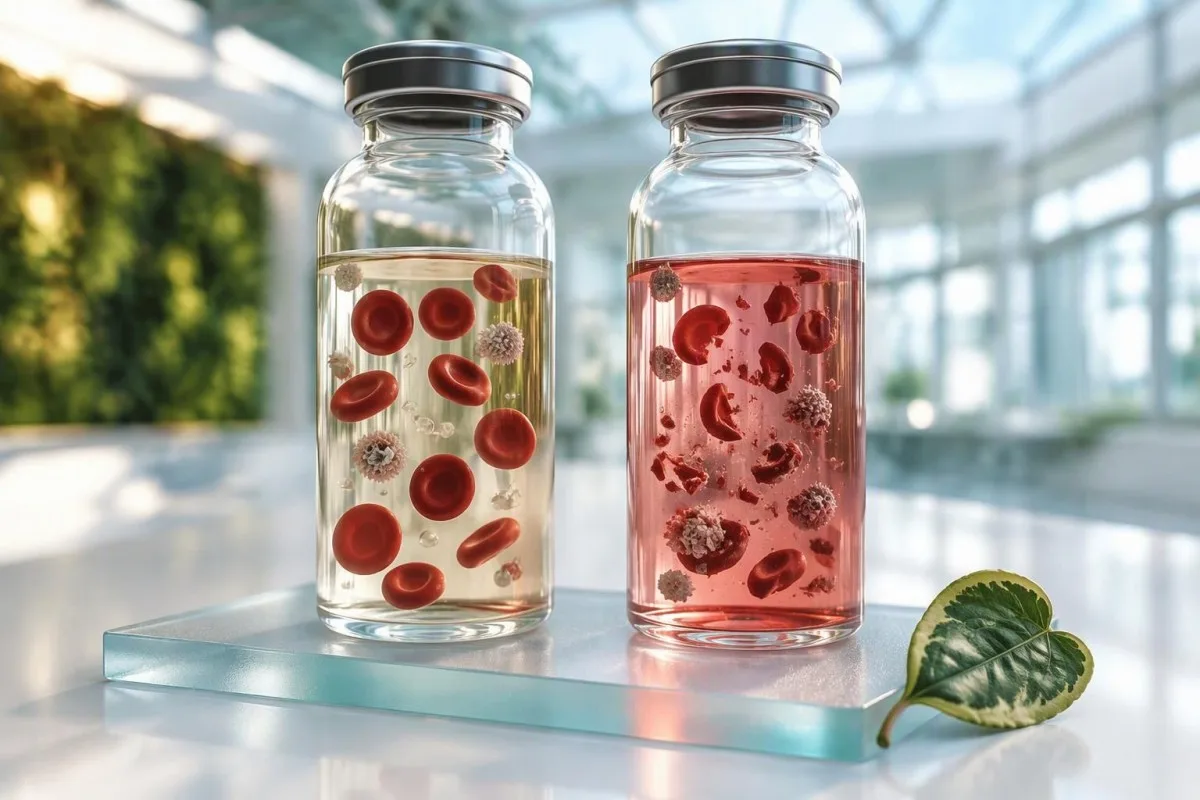
Yuqori gemoliz indeksi odatda diagnostika emas, balki namuna olgandan keyingi hujayra shikastlanishini tavsiflaydi. Muhim savol shundaki, qaysi natijalar ishonchli qoladi va qaysilari takrorlanishi kerak.


- Yuqori gemoliz indeksi analizator sarum yoki plazmada erkin gemoglobinni aniqlaganini bildiradi, odatda namuna olish yoki tashish paytida hujayra sinishi natijasida.
- Kaliy ayniqsa zaifdir, chunki qizil qon hujayralari elementlari plazma diapazoni 3,5–5,0 mmol/L ga nisbatan taxminan 100–120 mmol/L kaliyni o'z ichiga oladi.
- LDH va AST gemolizlangan namunada sezilarli darajada ko'tarilishi mumkin; jigar yoki mushak kasalligini takroriy tekshiruvdan oldin izolyatsiya qilingan kutilmagan ko'tarilishni belgilash kerak emas.
- Analizator chegaralari usulga xosdir: bir analizatordagi 100 gemoliz indeksi gemolitik anemiya yoki uning og'irligi haqida universal o'lchov emas.
- Qayta namuna olish qarorlari individual tahlil, ta'sir darajasi va klinik shoshilinchlikka bog'liq bo'lib, faqat namuna ko'rinishiga emas.
- Shoshilinch kaliy qarorlari natija yuqori bo'lganida, gemolizlanmagan plazma namunasini, butun qon gazini o'lchashni yoki EKGni tezkor tasdiqlashni talab qiladi.
- In-vivo gemoliz kamqonlik, retikulotsitoz, past gaptoglobin va yuqori bilrubinning bilrubin kabi klinik ko'rinishni keltirib chiqaradi; faqat yuqori indeks buni aniqlay olmaydi.
- 27-sentabr, 2026-yildan boshlab, bemorlar har bir ta'sirlangan natijani harakatga keltirishdan oldin laboratoriya tomonidan bekor qilinganmi, malakali bo'lganmi yoki analitik tuzatilganmi, deb so'rashlari kerak.
Yuqori gemoliz indeksi aslida nimani o'lchaydi
A yuqori gemoliz indeksi analizator laboratoriya namunasi suyuq qismida ortiqcha erkin gemoglobinni aniqlaganligini bildiradi. Aksariyat poliklinika chizmalarida bu tana ichida yuzaga keladigan qizil qon hujayralarining parchalanishidan ko'ra, to'plangandan keyin hujayralarning parchalanishini aks ettiradi.
Indeks ko'pincha spektrofotometriya orqali hosil qilinadi: analizator gemoglobin yorug'likni o'zlashtiradigan to'lqin uzunliklarida assimilyatsiyani o'lchaydi, keyin tahlilga xos bo'lgan ta'sir qoidalari qo'llaniladi. Pushti dan qizil ranggacha bo'lgan sarum namunasida 50, 100 yoki 300 sifatida belgilangan indeks bo'lishi mumkin, ammo bu raqamlar ishlab chiqaruvchilar orasida standartlashtirilmagan. tibbiy validatsiya yondashuvimiz biz ishlatadigan laboratoriyaning o'z sharhini va tahlil bayroqlarini asosiy dalil sifatida qabul qiladi.
Qiyin to'plash, juda kuchli chayqatilgan naycha, hujayralardan kechiktirilgan ajratish, ekstremal harorat yoki pnevmatik quvur orqali tashish hammasi gemolizlangan qon namunasi hosil qilishi mumkin. Mening klinik ishlarimda eng keng tarqalgan aybdor bemorning tomirlari emas; bu texnik jihatdan qiyin bo'lgan tortishish juda kichik to'plash moslamasi yoki kuchli uzatish bilan birgalikda. Oddiy ko'rinadigan namuna ham sezgir tahlilni ta'sir qiladigan erkin gemoglobinni o'z ichiga oladi.
Kantesti - bu AI qon testi analizatori gemoliz sharhini kasallik isboti sifatida emas, balki namunaning sifat belgisi sifatida qabul qiladi. Doktor Tomas Klaynning amaliy qoidasi oddiy: laboratoriya uni ishonchsiz deb belgilaganligini, uni bekor qilganligini yoki ogohlantirish bilan chiqarganligini tekshirgandan so'ng faqat ta'sirlangan analitni talqin qiling.
Nima uchun rang muhim, lekin ishni hal qilmaydi
Ko'rinadigan pushti sarum ko'pincha sezilarli erkin gemoglobinni o'z ichiga oladi, ammo vizual tekshiruv engil gemolizni o'tkazib yuboradi va sub'ektivdir. Zamonaviy indekslar vizual baholashdan ko'ra izchilroqdir, ammo ularning klinik ma'nosi hali ham analizator, reagent va test usuli bo'yicha farq qiladi.
Namunadagi gemoliz va tana ichidagi gemoliz
Yuqori indeks odatda ko'rsatadi in-vitro gemoliz, bu naychada yoki ishlov berish paytida hujayra shikastlanishi yuzaga kelganligini anglatadi. In-vivo gemoliz daliliy alomatlar, QK topshirish va maqsadli qon testlarini talab qiladigan tibbiy jarayon.
In-vivo gemoliz ko'pincha bir-biriga bog'liq bo'lgan modelni hosil qiladi: tushayotgan gemoglobin, retikulotsitoz, bilrubinning bilrubin ko'tarilishi, LDH ning ko'payishi va past gaptoglobin. Qorong'i siydik, sarg'ayish, charchoq yoki bel og'rig'i yuzaga kelishi mumkin, ammo surunkali engil gemoliz jim bo'lishi mumkin. Boshqa jihatdan barqaror bo'lgan QK bilan bitta yuqori gemoliz indeksi ko'pincha klinikadan ko'ra preklinikadir.
Bu farq muhimdir, chunki gemolizlangan namuna gemolizni tashxislash uchun ishlatiladigan aynan shu modelga - ayniqsa yuqori kaliy, LDH, AST va fosfatga soxta taqlid qilishi mumkin. Lippi va boshqalar. gemolizni klinik laboratoriyalarda mos kelmaydigan namunalar uchun asosiy sabab deb ta'riflagan, aynan hujayra ichidagi tarkiblar namunaga to'kilishi va spektral ta'sir fotometrik usullarga ta'sir qilishi sababli (Lippi va boshqalar, 2008).
Agar kamqonlik yoki sarg'ayish haqiqatan ham mavjud bo'lsa, klinisyenlarga namunani takrorlash va retikulotsitlar, bilrubin fraktsiyalari, gaptoglobin va retikulotsitlar talqini qo'shish mumkin rather than relying on the index. Kantesti’s AI lab test interpretatsiya xizmati compares these linked results and flags when the pattern deserves clinician review rather than a routine redraw.
A useful clue from timing
True hemolysis persists across carefully collected samples; collection-related hemolysis usually disappears on repeat testing. That contrast is often more informative than one isolated laboratory flag.
Gemoliz bilan qaysi qon tahlili natijalari eng ko'p o'zgaradi
Hemolysis most often creates falsely high potassium, LDH, AST, phosphate, magnesium, iron, and sometimes total protein results. The magnitude is assay-dependent, so a laboratory’s interference comment outweighs any universal correction formula.
Potassium is the safety-critical example. Red cellular elements contain approximately 100–120 mmol/L potassium, while normal plasma potassium is 3.5–5.0 mmol/L; even modest cellular leakage can push a normal result above 5.5 mmol/L. A reported potassium of 6.2 mmol/L with a high hemolysis index may be pseudohyperkalemia, but it still needs rapid clinical triage if symptoms, kidney disease, ECG changes, or potassium-raising medicines are present.
LDH is highly concentrated within cellular elements, and AST is also more abundant inside them than in serum. In a 52-year-old runner with AST 89 IU/L, a hemolysis warning plus normal ALT and CK changes my first step from diagnosing liver disease to repeating the panel. See our practical guide to high AST results for the non-hemolysis causes that remain relevant.
Phosphate, magnesium, and iron may rise because they are released from disrupted cells; bilirubin and some enzyme assays can be biased in either direction by optical interference. This is why a numerical result may be released but not clinically usable. A jigar paneli tushuntirishchisi helps separate a real enzyme pattern from one compromised result.
Tests that can be falsely lower
Hemoglobin absorbance can produce negative interference in some colorimetric or enzymatic assays, including selected lipase, alkaline phosphatase, and bilirubin methods. There is no safe assumption that hemolysis only makes values high.
Gemoliz bilan yuqori kaliy: qachon shoshilinch?
A potassium result of 6.0 mmol/L or higher with a hemolysis flag should be confirmed promptly, but it must not be dismissed automatically. Immediate assessment is appropriate when potassium is 6.5 mmol/L or higher, an ECG is abnormal, or weakness, palpitations, chest symptoms, or significant kidney impairment are present.
Pseudohyperkalemia is common when cellular elements rupture during collection, but genuine hyperkalemia can coexist with a difficult draw. A fresh lithium-heparin plasma specimen, carefully collected whole-blood analysis, and ECG are common confirmation routes. Do not try to lower potassium through diet or supplements before speaking with the clinician who ordered the test; that could delay necessary care.
The risk rises when a patient has eGFR below 30 mL/min/1.73 m², takes an ACE inhibitor, ARB, spironolactone, trimethoprim, or potassium supplement, or has metabolic acidosis. In those settings, a result of 5.8 mmol/L deserves more attention than the same result in a well person with normal renal function and an obviously compromised tube. Our detailed kaliy qon olish xatosi bo'yicha qo'llanma explains this decision point.
A clenched fist during collection can raise potassium slightly even without visible sample hemolysis, while prolonged tourniquet use adds another source of pre-analytical variation. The thing is, neither detail can prove the result is false. Repeat testing is the safe answer when the number could alter urgent treatment.
Symptoms that override the laboratory caveat
Severe muscle weakness, fainting, new palpitations, chest discomfort, or shortness of breath need urgent assessment regardless of a hemolysis comment. Laboratory uncertainty should never be used to explain away concerning symptoms.
LDH, AST va CK: gemolizlangan namunadagi fermentlarni o'qish
LDH and AST are among the least reliable results in a markedly hemolyzed specimen because both are released from disrupted cellular elements. CK is often less directly affected by red-cell leakage but can still be analytically affected depending on the laboratory method.
An isolated LDH elevation should not trigger a cancer, liver, or hemolytic-anemia work-up until specimen quality is addressed. LDH has five isoenzymes and is found in many tissues, so even a pristine high value is nonspecific. Our explanation of LDH test meaning shows why trends and companion tests matter more than a single result.
AST can rise after strenuous exercise, alcohol exposure, muscle injury, or liver injury, while ALT is more liver-focused. When AST is 90 IU/L but ALT is 22 IU/L and the sample is hemolyzed, repeating AST, ALT, CK, and bilirubin after 48–72 hours without unusual exercise often clarifies the picture. This timing is clinical convention, not a hard evidence-based rule for every patient.
Kantesti AI uses pattern logic: AST plus LDH plus a hemolysis flag is labelled potentially compromised, whereas AST plus ALT plus bilirubin elevation in a clean sample carries different weight. That distinction prevents false alarms while preserving follow-up for genuine liver or muscle disease.
Why an AST:ALT ratio may be unusable
A hemolyzed AST value can artificially inflate the AST:ALT ratio, making it unsuitable for alcohol-related liver pattern interpretation or fibrosis scores. Repeat the panel before calculating ratios that may influence a referral.
Gemolizdan keyin qaysi natijalar hali ham ishlatilishi mumkin?
Many results can remain usable despite a hemolyzed sample if the hemolysis level is below that assay’s validated interference limit. Sodium, chloride, urea, creatinine, glucose, and many immunoassays are often less affected, but “often” is not a guarantee.
Laboratories validate each test by measuring bias at increasing free-hemoglobin concentrations, then set suppression or comment thresholds. A sodium result may be reliable in a moderately hemolyzed specimen while potassium from the same tube is not. This analyte-by-analyte decision is why a blanket request to repeat an entire panel can be unnecessary.
Cardiac troponin, thyroid hormones, vitamin B12, and ferritin have assay-specific susceptibility to hemoglobin interference; no result should be assumed valid or invalid solely from the test name. If chest pain is present, troponin testing follows urgent clinical pathways regardless of a specimen flag. Read our guide to troponin result differences for why assay identity matters.
A laboratory may release a result with an HIL comment, suppress it entirely, or report that interference is not significant at the measured index. Kantesti’s neural network preserves that distinction when extracting PDF reports rather than treating every number as equally precise. The Kantesti AI benchmark describes technical evaluation of this report-reading workflow.
The serum-versus-plasma detail
Serum waits for clotting before separation, whereas plasma is separated from anticoagulated whole blood. Delay before separation can increase contact between cells and liquid, but both specimen types can hemolyze during collection or transport.
Nima uchun gemoliz indeksi laboratoriyalar o'rtasida farq qiladi
There is no universal normal range for a hemolysis index because instruments, wavelengths, sample types, and assay reagents differ. A value of 150 may be a minor flag in one laboratory and a rejection threshold in another.
The HIL system—hemolysis, icterus, and lipemia indices—usually estimates optical interference before selected chemistry assays run. It is not the same as plasma free hemoglobin measured for suspected intravascular hemolysis, which may be reported in mg/dL. Confusing these two measures is a surprisingly common source of unnecessary worry.
Laboratories choose action limits based on acceptable analytical bias, frequently aligned with a change no greater than 10% or a fraction of biological variation. Yet a 10% error is trivial for one test and consequential for potassium near 6.0 mmol/L. Clinicians disagree on the most practical cutoff because the correct threshold depends on what decision the result will drive.
Kantesti - bu AI qon tahlili natijalari platformasi that displays the exact printed laboratory flag and reference context instead of translating an index into a made-up universal severity grade. Readers comparing reports from different countries can use our 15,000-marker qo‘llanma to check units and assay names before comparing trends.
Why you should not compare index values over time
A hemolysis index of 80 in one laboratory and 80 in another may not represent the same free-hemoglobin concentration. Compare clinical analytes across laboratories cautiously unless the assay method and specimen handling are consistent.
Qachon qayta namuna olish kerak va qachon kerak emas
A redraw is usually needed when hemolysis could change a result that guides an urgent or major clinical decision. It may not be needed when the laboratory confirms negligible interference for the released tests and the result fits the clinical picture.
Redraw promptly for a high potassium, unexpectedly high LDH or AST, discrepant phosphate or magnesium, or any result the laboratory has withheld. Repeat testing also makes sense when a result conflicts sharply with a prior baseline—such as creatinine 0.8 to 2.1 mg/dL without illness, dehydration, or medication change. A delta-check izohi can help frame that conversation.
A repeat may be unnecessary for a stable HbA1c, TSH, or creatinine when the lab has explicitly released it without an interference warning. Still, repeat if the number would trigger a medication change, imaging, or referral. In my experience, patients are reassured by asking one specific question: “Which individual results did the lab consider affected?”
Do not assume fasting fixes hemolysis. Better prevention is a relaxed collection, appropriate tube filling, gentle inversions rather than shaking, rapid transport, and timely centrifugation. Our repeat-test guide after hemolysis gives patients a practical checklist.
Hospital and emergency settings
In emergency care, clinicians may use a rapid whole-blood result while simultaneously sending a carefully collected confirmatory specimen. Treatment decisions are based on symptoms, ECG findings, kidney function, and repeat values—not the hemolysis index alone.
Nima uchun qon namunalari yig'ish va tashish paytida gemolizlanadi
Most hemolyzed blood samples arise from mechanical stress, delayed processing, or temperature extremes rather than any fault in the patient. Prevention begins before the tube reaches the analyzer.
Drawing through an undersized device, pulling too forcefully with a vacuum device, forcing a sample through a connector, or vigorous shaking can damage cellular elements. Underfilling additive tubes creates a wrong blood-to-additive ratio, which can introduce separate errors even if hemolysis is absent. The details sound fussy, but they change real results.
Transportation matters after collection. Extended heat exposure, freezing, rough transit, and a long delay before separating serum or plasma can increase hemolysis. Samples from lines can also be misleading if collection follows infusion or if technique is difficult; a clean peripheral collection may be preferable when the result is pivotal.
Patients can help by arriving hydrated unless fluid restriction applies, keeping their arm warm, and avoiding repeated fist pumping. None of these steps guarantees a clean sample, particularly in fragile veins. A baseline draw preparation guide covers preparation without turning routine testing into an ordeal.
Exercise is a separate issue
A hard workout can genuinely raise CK, AST, and creatinine for 24–72 hours even when the specimen is pristine. Exercise may coexist with collection hemolysis, so a repeat result should ideally follow an ordinary rest day when medically appropriate.
CBC va qon surtmasi sizga nimani aytishi mumkin
A complete blood count can help distinguish a poor specimen from possible true hemolysis, but it cannot do so by itself. Falling hemoglobin, rising reticulocytes, and smear changes carry more diagnostic weight than the chemistry hemolysis index.
A true hemolytic process commonly causes reticulocytosis as marrow responds to shortened red-cell survival, although this response may be absent with iron deficiency, marrow disease, or very early onset. A reticulocyte count above the laboratory’s upper limit—often roughly 2.0%—must be converted to an absolute count and interpreted alongside hemoglobin. Percentage alone can mislead in anemia.
A peripheral cell sample slide may show schistocytes, spherocytes, bite cells, or polychromasia depending on cause. Schistocytes at 1% or more on a standardized review can support thrombotic microangiopathy in the right setting, but this is a specialist interpretation and urgent symptoms matter. Our guide to shoshilinch shistotsit topilmalari explains why this is not a home diagnosis.
Dr. Thomas Klein advises looking for internal consistency: high LDH plus low haptoglobin plus anemia on a clean repeat sample is meaningful; high LDH alone in a hemolyzed tube is not. The hematocrit and hemoglobin comparison is useful when CBC values seem contradictory.
A falsely high MCHC can be a clue
Markedly high MCHC can occur with sample hemolysis, lipemia, cold agglutinins, or spherocytosis. It should prompt laboratory review rather than an immediate conclusion about red-cell disease.
Maxsus vaziyatlar: bolalar, homiladorlik va qiyin kirish
Hemolysis is more common when collection is technically difficult, including neonatal, pediatric, emergency, and critical-care testing. The consequences may also be greater because small electrolyte shifts can affect urgent decisions.
In newborns and young children, capillary collection and low sample volumes can increase cellular disruption, while potassium reference intervals differ by age. A potassium value that is high for an adult may be less abnormal in a newborn, yet any suspected hyperkalemia still requires prompt clinician-led confirmation. Never apply adult cutoffs to a child’s report without the laboratory’s pediatric range.
Pregnancy adds another layer: anemia is common from dilution or iron deficiency, while HELLP syndrome and other obstetric emergencies can involve real hemolysis. New headache, visual symptoms, right-upper abdominal pain, high blood pressure, or reduced fetal movement need urgent maternity assessment—not an assumption that the tube was damaged. Our HELLP laboratory pattern guide details the red flags.
For people with dialysis access, implanted lines, burns, or very difficult peripheral access, a higher rate of unsuitable samples may be unavoidable. The care team can often arrange an approach that minimizes redraws, but the test’s clinical urgency determines whether another sample is required.
Home collection kits
Finger-prick samples are not interchangeable with venous samples for every analyte, and inadequate handling can create interference. Follow kit-specific instructions and ask the provider whether a venous redraw is needed after a high hemolysis flag.
Laboratoriya hisobotidagi gemoliz belgisi haqida ma'lumotni qanday o'qish kerak
A lab report may say “hemolyzed,” “hemolysis index elevated,” “interference possible,” or “result not reported.” These phrases have different implications: a suppressed result is unusable, while a released result may remain valid if interference is below the assay’s limit.
Look for a comment attached to the individual analyte, not merely a general specimen note. For example, potassium may say “not reported due to hemolysis,” while creatinine is reported without qualification. This reflects the laboratory’s validation work and is more useful than judging the tube’s color from a photograph.
If a number is marked with an H for high and also a hemolysis caveat, it can be both analytically elevated and clinically uncertain. Ask the ordering clinician whether the result fits your medications, symptoms, earlier values, and other tests. Our guide to me’yoridan chetga chiqish belgilari explains why a flag is a prompt for context, not a diagnosis.
Kantesti AI can organize a photographed or PDF report in about 60 seconds, but it cannot inspect the physical specimen or replace a laboratory’s interference decision. Our texnologiya qo‘llanmasi explains how we preserve qualifiers, units, and reference intervals for clinician discussion.
A question worth writing down
Ask: “Was this specific test suppressed, corrected, or released as valid despite the hemolysis index?” That single question usually gets a clearer answer than asking whether the whole panel was “bad.”
Gemolizlangan natijadan keyin nima qilish kerak emas
Do not self-treat a possibly false result, ignore a potentially dangerous one, or assume every result in the panel is invalid. The right response is targeted confirmation based on the analyte and your clinical context.
Do not stop prescribed ACE inhibitors, diuretics, thyroid medicine, or supplements solely because one hemolyzed sample was abnormal. Potassium, thyroid, and kidney results must be interpreted against the medication list and a repeat value where needed. Sudden medication changes can be riskier than waiting a few hours for confirmation.
Avoid searching for a diagnosis from a high LDH or AST result before checking sample quality. Serious disease can cause these elevations, of course, but an unreliable first sample does not justify a frightening conclusion. For muscle-specific concerns, our high CK safety guide sets out symptoms that do need prompt care.
Likewise, do not repeatedly redraw yourself through commercial testing without sharing the original report with a clinician. Recurrent hemolysis may be a collection issue, but recurrent abnormal results in properly handled samples deserve a structured evaluation.
When to seek same-day help
Seek urgent advice for high potassium with weakness or palpitations, jaundice with dark urine, severe fatigue with breathlessness, chest pain, fainting, or rapidly worsening symptoms. A specimen-quality note cannot lower the urgency of these clinical signs.
Qayta namuna olgandan keyin natijalarni xavfsiz taqqoslash
A clean repeat sample is most useful when collected under comparable conditions and interpreted as a trend, not as a verdict on the first result. A large change after a hemolyzed draw often identifies interference, but biological variation still exists.
Record the draw date, fasting status, exercise in the previous 48 hours, illness, supplements, and medications. Creatinine can shift with hydration and exercise; AST and CK can shift after training; potassium may shift with kidney function and medicines. These ordinary variables matter even when the second sample has no hemolysis flag.
For potassium, a change from 6.1 mmol/L in a hemolyzed sample to 4.3 mmol/L in a clean sample strongly supports pseudohyperkalemia. For AST, a decline from 88 to 29 IU/L may reflect removal of interference, recovery after exercise, or both; timing and ALT help adjudicate. Our qon tahlili o‘zgarishlari bo‘yicha qo‘llanma explains reference change value more fully.
Kantesti - bu AI asosidagi qon tahlili analiz vositasi that can place repeat values beside prior results while retaining specimen-quality comments. Trend displays are useful, but they must never obscure a redrawn critical result that needs immediate clinician action.
Asl hisobotni saqlang
Save the first report, including the hemolysis comment, rather than deleting it after the repeat. It documents why a value changed and prevents future clinicians from mistaking a collection artifact for sudden disease resolution.
Shifokoringiz yoki laboratoriyangizga beriladigan savollar
The best question after a high hemolysis index is not “Do I have hemolysis?” but “Which analytes were affected, how urgently should they be repeated, and what symptoms would change the plan?” A short, specific discussion avoids both false reassurance and unnecessary alarm.
Ask whether the abnormal value was suppressed, whether the lab has a validated interference threshold for that method, and whether a fresh plasma or whole-blood sample is preferable. For potassium, ask whether an ECG or same-day repeat is needed. For enzyme results, ask whether exercise, alcohol, infection, or medicines may also be contributing.
Ask whether you need a full panel or only selected tests repeated. A targeted redraw often includes potassium, AST, LDH, phosphate, magnesium, or bilirubin, whereas a CBC or HbA1c may not need repeating. This can reduce cost, discomfort, and confusing duplicate results without compromising care.
Bizning shifokorlar Tibbiy maslahat kengashi review clinical-safety principles used in Kantesti content, but personal treatment decisions belong with the clinician who knows your history and can assess you. Most patients find that a precise repeat plan is far calmer than trying to interpret a colored sample image online.
Xulosa
A high hemolysis index is usually a laboratory-quality warning, not a diagnosis. Respect the warning, identify the affected tests, and repeat only what could change clinical decisions.
Kantesti qon hisobotlaridagi gemoliz bayroqchalarini qanday boshqaradi
Kantesti identifies hemolysis flags and links them to the results most likely to be affected, but it does not replace laboratory validation or urgent clinical assessment. A flagged potassium, troponin, or critical electrolyte result always needs the laboratory and treating team’s protocol.
Kantesti AI reads the test name, value, unit, reference interval, collection context, and printed laboratory comments together. That matters because “high potassium” without the accompanying hemolysis statement is an incomplete clinical fact. Our system is designed to surface uncertainty plainly rather than conceal it behind a confident-looking score.
Kantesti - bu AI biomarker talqin platformasi used across 127+ countries, so it also avoids assuming that identical labels or index values mean identical methods. Different laboratories may use serum, plasma, direct or indirect assays, and different interference thresholds. International reports need the source laboratory’s own interpretive note preserved.
As of September 27, 2026, our safety approach is to encourage a clinician discussion for results that are critical, internally inconsistent, newly abnormal, or clearly compromised by blood test hemolysis. If you want to understand how health data are handled, our Biz haqimizda sahifamizda describes the organization and its privacy-focused approach.
The limit of any report interpretation
No report-reading system can know whether you have palpitations, jaundice, dehydration, or a new medication unless you provide that context to a clinician. The specimen flag is one piece of evidence, not a substitute for examination or urgent care.
Tez-tez so'raladigan savollar
Qon tahlilida yuqori gemoliz indeksi nimani anglatadi?
Yuqori gemoliz indeksi laboratoriya analizatori sarum yoki plazmadagi qizil qon hujayralari elementlarining buzilishi natijasida erkin gemoglobinni aniqlaganligini bildiradi. Ko'pgina holatlar bemordagi tibbiy holatdan ko'ra, yig'ish, tashish yoki qayta ishlash paytida yuzaga keladi. Indeks kaliy, LDH, AST, fosfat, magniy va temir natijalarini ishonchsiz qilishi mumkin, ammo ta'sir tahlilga bog'liq. Gemoliz indeksi gemolitik anemiya uchun diagnostik test emas.
Yuqori gemoliz indeksi yuqori kaliy miqdoriga olib kelishi mumkinmi?
Ha, yuqori gemoliz indeksi psedo'giperkaliyemiyaga olib kelishi mumkin, chunki qizil qon hujayralari taxminan 100–120 mmol/L kaliyni o'z ichiga oladi, normal plazma kaliysi esa 3,5–5,0 mmol/L ni tashkil qiladi. Hujayralarning cheklangan buzilishi ham o'lchangan kaliyni 5,5 mmol/L dan yuqori ko'rsatishi mumkin. 6,0 mmol/L yoki undan yuqori kaliy natijasi, ayniqsa buyrak kasalliklari, kaliyni ko'taruvchi dori-darmonlar, zaiflik yoki yurak urishi bilan birga darhol tasdiqlanishi kerak. EKG va ehtiyotkorlik bilan olingan takroriy namuna kerak bo'lishi mumkin.
Gemolizlangan namunadan keyin barcha qon testlarini takrorlashim kerakmi?
Yo'q, gemolizlangan namuna avtomatik ravishda har bir qon testini haqiqiy emas deb hisoblamaydi. Laboratoriyalar har bir tahlil uchun alohida aralashuvni baholaydi va gemoliz darajasiga qarab natriy, xlorid, kreatinin, glyukoza va ba'zi immunoassaylar hali ham ishlatilishi mumkin. Laboratoriya tomonidan bekor qilingan, malakali yoki K+ yoki kutilmaganda yuqori LDH va AST kabi shoshilinch qarorni o'zgartirishi mumkin bo'lgan testlarni takrorlang. To'liq panelni qayta olishni tashkil qilishdan oldin qaysi o'ziga xos analitlar ta'sir qilganligini so'rang.
Gemolizlangan namuna gemolitik anemiyam borligini anglatishi mumkinmi?
Gemolizlangan namuna o'z-o'zidan gemolitik anemiyaga ega ekanligingizni anglatmaydi. Gemolitik anemiya, to'g'ri olingan namuna asosida gemoglobinning pasayishi, retikulotsitlarning ko'payishi, bilubirinning oshishi va LDH, hamda gaptoglobinning kamayishi kabi holatlarni o'z ichiga oladi. Sariyanoq, quyuq siydik, nafas qisishi yoki kuchli charchoq kabi alomatlar xavotirni kuchaytiradi, ammo ba'zi bemorlarda yengil alomatlar bo'lishi mumkin. Qayta toza namuna olish odatda to'plash bilan bog'liq gemolizni haqiqiy qizil qon hujayralarining parchalanishidan ajratishning birinchi usuli hisoblanadi.
Gemolizdan keyin qon tekshiruvini takrorlashdan oldin qancha kutishim kerak?
Agar kaliy, troponin yoki boshqa shoshilinch natijalar bo'lsa, ko'pincha bir xil kuni takroriy tekshiruv o'tkazilishi mumkin. AST, CK yoki LDH ning g'ayrioddiy jismoniy mashqlardan so'ng paydo bo'lgan, shoshilinch bo'lmagan o'zgarishlari uchun, klinisyennlar ba'zan ushbu fermentlarni ko'tarishi mumkin bo'lgan mashqlarni 48–72 soat davomida cheklab, keyin takrorlaydilar. Yuqori gemoliz ko'rsatkichi uchun universal kutish muddati yo'q; tegishli test va testdan o'tkazish sababi vaqtni aniqlaydi. Laboratoriya yoki buyurtma bergan klinisyen aniq reja berishi kerak.
Suvsizlanish gemoliz indeksining yuqori bo'lishiga olib kelishi mumkinmi?
Suvsizlanish to'g'ridan-to'g'ri yuqori gemoliz indeksiga olib kelmaydi, lekin to'plamni qiyinlashtirishi va texnik jihatdan qiyin bo'lgan tortishish imkoniyatini oshirishi mumkin. To'plangandan keyin issiqlikka duchor bo'lish yoki yomon saqlash ham hujayra elementlariga zarar etkazishi va indeksni oshirishi mumkin. Haddan tashqari suyuqlik cheklovi bo'lmaganlar uchun venaga kirishga yordam berishi mumkin, lekin to'plangandan keyin gemolizlangan namuna buzilishini tuzata olmaydi. Yangi to'g'ri ishlov berilgan namuna mos tasdiqlashdir.
Bugun AI asosidagi qon tahlilini tahlil qilishni oling
Kantesti’ga tezkor va aniq laboratoriya tahlili uchun ishonadigan butun dunyo bo‘ylab 2 milliondan ortiq foydalanuvchiga qo‘shiling. Qon tahlili natijalaringizni yuklang va soniyalar ichida 15,000+ biomarkerlarining to‘liq talqinini oling.
📚 Havola qilingan ilmiy tadqiqot nashrlari
Klein, T., Mitchell, S., & Weber, H. (2026). Klein, T. (2026). A Pre-Registered, Rubric-Based Automated Technical Benchmark of the Kantesti Blood-Test Interpretation Engine on 100,000 Synthetic Test Cases. Figshare. https://doi.org/10.6084/m9.figshare.32095435. Kantesti AI tibbiy tadqiqoti.
Klein, T., Mitchell, S., & Weber, H. (2026). Kantesti LTD. (2026). Klinik validatsiya doirasi v2.0 (Tibbiy validatsiya sahifasi). Zenodo. https://doi.org/10.5281/zenodo.17993721. Kantesti AI tibbiy tadqiqoti.
📖 Tashqi tibbiy manbalar
⚕️ Tibbiy ogohlantirish
Ushbu maqola faqat ta’lim maqsadlari uchun mo‘ljallangan va tibbiy maslahatni anglatmaydi. Tashxis va davolash bo‘yicha qarorlar uchun har doim malakali sog‘liqni saqlash mutaxassisiga murojaat qiling.
E-E-A-T ishonch signallari
Tajriba
Shifokor boshchiligidagi laboratoriya talqin qilish ish jarayonlarini klinik ko‘rib chiqish.
Tajriba
Laboratoriya tibbiyoti biomarkerlarning klinik kontekstda qanday o‘zini tutishini yoritadi.
Vakolatlilik
Dr. Tomas Klein tomonidan yozilgan, Dr. Sarah Mitchell va Prof. Dr. Hans Weber tomonidan ko‘rib chiqilgan.
Ishonchlilik
Xavotirni kamaytirish uchun aniq keyingi qadamlar yo‘nalishlari bilan dalillarga asoslangan talqin.