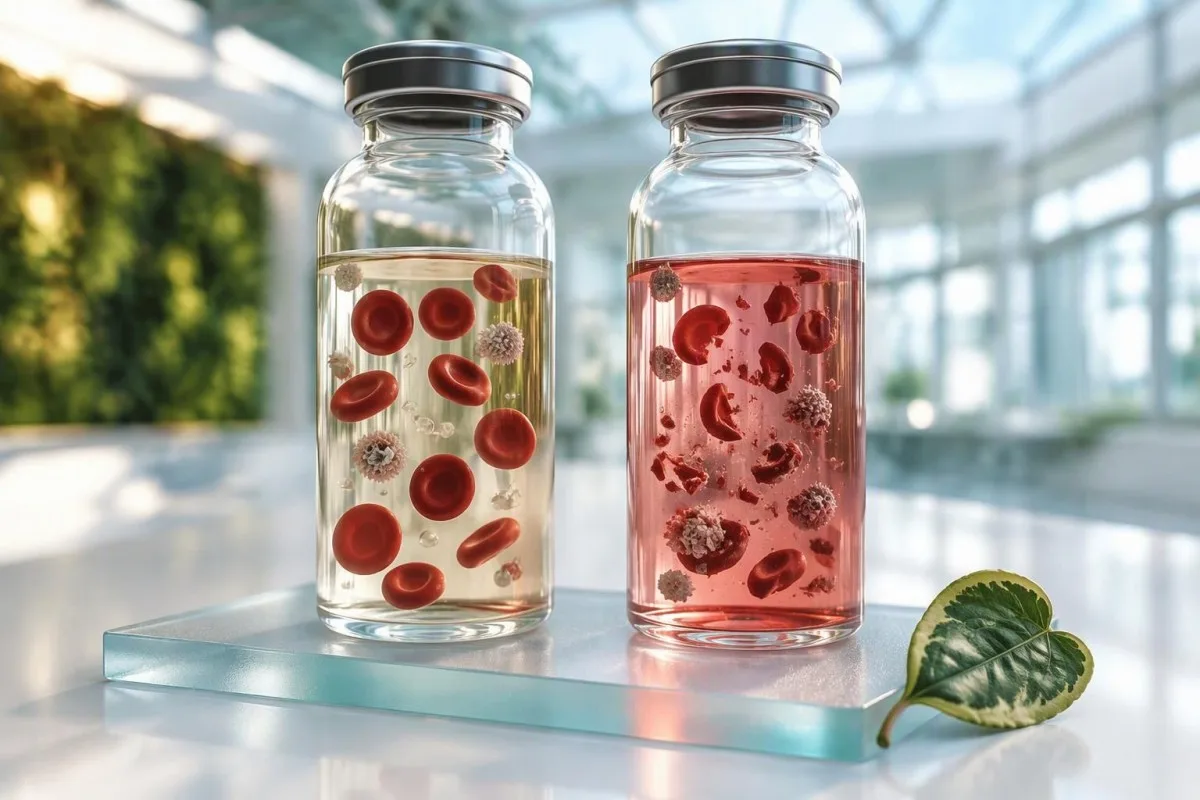
Një indeks i lartë i hemolizës zakonisht përshkruan dëmtimin e qelizave pas mbledhjes, jo një diagnozë tek ju. Pyetja e dobishme është se cilat rezultate të raportuara mbeten të besueshme dhe cilat kanë nevojë për përsëritje.


- Indeks i lartë i hemolizës do të thotë se analizatori zbuloi hemoglobinë të lirë në serum ose plazmë, zakonisht nga thyerja e qelizave gjatë mbledhjes ose transportit.
- Kalium është veçanërisht e ndjeshme sepse elementët qelizorë të kuq përmbajnë rreth 100–120 mmol/L kalium kundrejt një diapazoni plazme prej 3.5–5.0 mmol/L.
- LDH dhe AST mund të rritet dukshëm në një mostër të hemolizuar; një ngritje e izoluar e papritur nuk duhet të quhet sëmundje e mëlçisë ose muskujve para testimeve të përsëritura.
- Pragjet e analizatorit janë specifikë për metodën: një indeks hemolize prej 100 në një analizator nuk është një masë universale e ashpërsisë ose një diagnozë e anemisë hemolitike.
- Vendimet për ripërpunim varet nga sasia individuale, shkalla e ndërhyrjes dhe urgjenca klinike—jo vetëm nga pamja e mostrës.
- Vendimet urgjente për kaliumin kërkojnë konfirmim të shpejtë nga një mostër plazme jo-hemolitike, matje e gazit të gjakut me gjak të plotë, ose EKG kur rezultati është i lartë.
- Hemoliza in vivo shkakton një model klinik siç është anemia, retikulocitoza, haptoglobina e ulët dhe bilirubina e tërthortë e rritur; një indeks i lartë vetëm nuk mund ta vërtetojë atë.
- Që nga 27 shtatori 2026, pacientët duhet të pyesin nëse laboratori ka fshirë, kualifikuar, ose korrigjuar analitikisht çdo rezultat të prekur para se të veprojnë mbi të.
Çfarë Mat në të Vërtetë një Indeks i Lartë Hemolize
A indeks i lartë hemolize do të thotë se një analizues ka zbuluar hemoglobinë të lirë të tepërt në pjesën e lëngët të një prove laboratorike. Në shumicën e nxjerrjeve ambulatoriale, kjo pasqyron thyerjen e qelizave pas mbledhjes, dhe jo shkatërrimin e qelizave të kuqe që ndodh brenda trupit.
Indeksi krijohet zakonisht nga spektrofotometria: analizuesi mat absorbancën në gjatësi vale ku hemoglobina absorbon dritën, pastaj zbaton rregulla ndërhyrjeje specifike për analizën. Një mostër e serumit rozë në të kuqe mund të ketë një indeks të shënuar si 50, 100, ose 300, por ato numra nuk janë standardizuar mes prodhuesve. Të e validimit mjekësor ne përdorim i trajtojmë komentet e laboratorit dhe shenjat e analizës si provë parësore.
Një mbledhje e vështirë, një tub i tundur shumë fort, vonesë në ndarjen nga qelizat, temperaturë ekstreme, ose transport përmes tubit pneumatik mund të krijojnë një mostër gjaku të hemolizuar. Në punën time klinike, shkaku më i zakonshëm nuk janë venat e pacientit; është një nxjerrje teknikisht sfiduese e kombinuar me një pajisje mbledhjeje shumë të vogël ose transferim të fuqishëm. Edhe një mostër që duket normale me sy mund të ketë hemoglobinë të lirë të mjaftueshme për të ndikuar në një analizë të ndjeshme.
Kantesti është një Analizues i testeve të gjakut AI që lexon një koment hemolize si sinjal të cilësisë së specimenit, jo si provë të një sëmundjeje. Rregulla praktike e Dr. Thomas Klein është e thjeshtë: interpretoni analitin e prekur vetëm pasi të keni kontrolluar nëse laboratori e ka shënuar atë si të pabesueshëm, e ka fshirë, ose e ka liruar me një paralajmërim.
Pse ngjyra ka rëndësi por nuk vendos rastin
Serumi rozë i dukshëm shpesh i korrespondon hemoglobinës së lirë substanciale, megjithatë inspektimi vizual humbet hemolizën e butë dhe është subjektiv. Indekset moderne janë më konzistente se gradimi vizual, por kuptimi i tyre klinik ende ndryshon sipas analizuesit, reagentit dhe metodës së testit.
Hemoliza e Kampit Kundrejt Hemolizës që Ndodh në Trupin
Një indeks i lartë zakonisht tregon hemolizë in vitro, që do të thotë se dëmtimi qelizor ndodhi në tub ose gjatë trajtimit. Hemoliza in vivo është një proces mjekësor që kërkon simptoma konfirmuese, rezultate CBC dhe teste të synuara të gjakut.
Hemoliza in vivo shpesh prodhon një model koherent: rënia e hemoglobinës, retikulocitoza, rritja e bilirubinës së tërthortë, LDH e rritur dhe haptoglobina e ulët. Mund të paraqitet urinë e errët, verdhëza, lodhje ose dhimbje shpine, megjithëse hemoliza kronike e butë mund të jetë e heshtur. Një indeks i vetëm i lartë hemolize me një CBC përndryshe stabël është shumë më shpesh para-analitik sesa klinikisht.
Kjo dallim ka rëndësi sepse një mostër e hemolizuar mund të imitojë në mënyrë të rreme vetë modelin e përdorur për të diagnostikuar hemolizën—sidomos kaliumin, LDH, AST dhe fosfatin e rritur. Lippi et al. përshkruan hemolizën si shkakun kryesor të specimeneve të papërshtatshme në laboratorët klinikë, pikërisht sepse përmbajtjet brendaqelizore derdhen në mostër dhe ndërhyrja spektrale ndikon metodat fotometrike (Lippi et al., 2008).
Nëse anemia ose verdhëza janë me të vërtetë të pranishme, mjekët mund të përsëritin mostrën dhe të shtojnë retikulocitet, fraksione bilirubine, haptoglobinë dhe një interpretim retikulocitësh rather than relying on the index. Kantesti’s shërbimin e interpretimit të analizave të AI compares these linked results and flags when the pattern deserves clinician review rather than a routine redraw.
A useful clue from timing
True hemolysis persists across carefully collected samples; collection-related hemolysis usually disappears on repeat testing. That contrast is often more informative than one isolated laboratory flag.
Cilat Rezultate të Analizave të Gjakut Ndryshojnë Më Shumë me Hemolizën
Hemolysis most often creates falsely high potassium, LDH, AST, phosphate, magnesium, iron, and sometimes total protein results. The magnitude is assay-dependent, so a laboratory’s interference comment outweighs any universal correction formula.
Potassium is the safety-critical example. Red cellular elements contain approximately 100–120 mmol/L potassium, while normal plasma potassium is 3.5–5.0 mmol/L; even modest cellular leakage can push a normal result above 5.5 mmol/L. A reported potassium of 6.2 mmol/L with a high hemolysis index may be pseudohyperkalemia, but it still needs rapid clinical triage if symptoms, kidney disease, ECG changes, or potassium-raising medicines are present.
LDH is highly concentrated within cellular elements, and AST is also more abundant inside them than in serum. In a 52-year-old runner with AST 89 IU/L, a hemolysis warning plus normal ALT and CK changes my first step from diagnosing liver disease to repeating the panel. See our practical guide to high AST results for the non-hemolysis causes that remain relevant.
Phosphate, magnesium, and iron may rise because they are released from disrupted cells; bilirubin and some enzyme assays can be biased in either direction by optical interference. This is why a numerical result may be released but not clinically usable. A shpjeguesi i panelit të mëlçisë helps separate a real enzyme pattern from one compromised result.
Tests that can be falsely lower
Hemoglobin absorbance can produce negative interference in some colorimetric or enzymatic assays, including selected lipase, alkaline phosphatase, and bilirubin methods. There is no safe assumption that hemolysis only makes values high.
Kalium i Lartë me Hemolizë: Kur është Urgjente?
A potassium result of 6.0 mmol/L or higher with a hemolysis flag should be confirmed promptly, but it must not be dismissed automatically. Immediate assessment is appropriate when potassium is 6.5 mmol/L or higher, an ECG is abnormal, or weakness, palpitations, chest symptoms, or significant kidney impairment are present.
Pseudohyperkalemia is common when cellular elements rupture during collection, but genuine hyperkalemia can coexist with a difficult draw. A fresh lithium-heparin plasma specimen, carefully collected whole-blood analysis, and ECG are common confirmation routes. Do not try to lower potassium through diet or supplements before speaking with the clinician who ordered the test; that could delay necessary care.
The risk rises when a patient has eGFR below 30 mL/min/1.73 m², takes an ACE inhibitor, ARB, spironolactone, trimethoprim, or potassium supplement, or has metabolic acidosis. In those settings, a result of 5.8 mmol/L deserves more attention than the same result in a well person with normal renal function and an obviously compromised tube. Our detailed udhëzues për gabimin e mbledhjes së potasiumit explains this decision point.
A clenched fist during collection can raise potassium slightly even without visible sample hemolysis, while prolonged tourniquet use adds another source of pre-analytical variation. The thing is, neither detail can prove the result is false. Repeat testing is the safe answer when the number could alter urgent treatment.
Symptoms that override the laboratory caveat
Severe muscle weakness, fainting, new palpitations, chest discomfort, or shortness of breath need urgent assessment regardless of a hemolysis comment. Laboratory uncertainty should never be used to explain away concerning symptoms.
LDH, AST dhe CK: Leximi i Enzimave në një Kamp të Hemolizuar
LDH and AST are among the least reliable results in a markedly hemolyzed specimen because both are released from disrupted cellular elements. CK is often less directly affected by red-cell leakage but can still be analytically affected depending on the laboratory method.
An isolated LDH elevation should not trigger a cancer, liver, or hemolytic-anemia work-up until specimen quality is addressed. LDH has five isoenzymes and is found in many tissues, so even a pristine high value is nonspecific. Our explanation of LDH test meaning shows why trends and companion tests matter more than a single result.
AST can rise after strenuous exercise, alcohol exposure, muscle injury, or liver injury, while ALT is more liver-focused. When AST is 90 IU/L but ALT is 22 IU/L and the sample is hemolyzed, repeating AST, ALT, CK, and bilirubin after 48–72 hours without unusual exercise often clarifies the picture. This timing is clinical convention, not a hard evidence-based rule for every patient.
Kantesti AI uses pattern logic: AST plus LDH plus a hemolysis flag is labelled potentially compromised, whereas AST plus ALT plus bilirubin elevation in a clean sample carries different weight. That distinction prevents false alarms while preserving follow-up for genuine liver or muscle disease.
Why an AST:ALT ratio may be unusable
A hemolyzed AST value can artificially inflate the AST:ALT ratio, making it unsuitable for alcohol-related liver pattern interpretation or fibrosis scores. Repeat the panel before calculating ratios that may influence a referral.
Cilat Rezultate Mund të Jenë Ende të Përdorshme Pas Hemolizës?
Many results can remain usable despite a hemolyzed sample if the hemolysis level is below that assay’s validated interference limit. Sodium, chloride, urea, creatinine, glucose, and many immunoassays are often less affected, but “often” is not a guarantee.
Laboratories validate each test by measuring bias at increasing free-hemoglobin concentrations, then set suppression or comment thresholds. A sodium result may be reliable in a moderately hemolyzed specimen while potassium from the same tube is not. This analyte-by-analyte decision is why a blanket request to repeat an entire panel can be unnecessary.
Cardiac troponin, thyroid hormones, vitamin B12, and ferritin have assay-specific susceptibility to hemoglobin interference; no result should be assumed valid or invalid solely from the test name. If chest pain is present, troponin testing follows urgent clinical pathways regardless of a specimen flag. Read our guide to troponin result differences for why assay identity matters.
A laboratory may release a result with an HIL comment, suppress it entirely, or report that interference is not significant at the measured index. Kantesti’s neural network preserves that distinction when extracting PDF reports rather than treating every number as equally precise. The Standardi i AI Kantesti describes technical evaluation of this report-reading workflow.
The serum-versus-plasma detail
Serum waits for clotting before separation, whereas plasma is separated from anticoagulated whole blood. Delay before separation can increase contact between cells and liquid, but both specimen types can hemolyze during collection or transport.
Pse Pragu i Indeksit të Hemolizës Ndryshon Midis Laboratorëve
There is no universal normal range for a hemolysis index because instruments, wavelengths, sample types, and assay reagents differ. A value of 150 may be a minor flag in one laboratory and a rejection threshold in another.
The HIL system—hemolysis, icterus, and lipemia indices—usually estimates optical interference before selected chemistry assays run. It is not the same as plasma free hemoglobin measured for suspected intravascular hemolysis, which may be reported in mg/dL. Confusing these two measures is a surprisingly common source of unnecessary worry.
Laboratories choose action limits based on acceptable analytical bias, frequently aligned with a change no greater than 10% or a fraction of biological variation. Yet a 10% error is trivial for one test and consequential for potassium near 6.0 mmol/L. Clinicians disagree on the most practical cutoff because the correct threshold depends on what decision the result will drive.
Kantesti është një platformë e interpretimit të analizave të gjakut AI that displays the exact printed laboratory flag and reference context instead of translating an index into a made-up universal severity grade. Readers comparing reports from different countries can use our 15,000-marker to check units and assay names before comparing trends.
Why you should not compare index values over time
A hemolysis index of 80 in one laboratory and 80 in another may not represent the same free-hemoglobin concentration. Compare clinical analytes across laboratories cautiously unless the assay method and specimen handling are consistent.
Kur Nevojitet një Ripërpunim—dhe Kur Nuk Nevojitet
A redraw is usually needed when hemolysis could change a result that guides an urgent or major clinical decision. It may not be needed when the laboratory confirms negligible interference for the released tests and the result fits the clinical picture.
Redraw promptly for a high potassium, unexpectedly high LDH or AST, discrepant phosphate or magnesium, or any result the laboratory has withheld. Repeat testing also makes sense when a result conflicts sharply with a prior baseline—such as creatinine 0.8 to 2.1 mg/dL without illness, dehydration, or medication change. A shpjegimi i delta-check can help frame that conversation.
A repeat may be unnecessary for a stable HbA1c, TSH, or creatinine when the lab has explicitly released it without an interference warning. Still, repeat if the number would trigger a medication change, imaging, or referral. In my experience, patients are reassured by asking one specific question: “Which individual results did the lab consider affected?”
Do not assume fasting fixes hemolysis. Better prevention is a relaxed collection, appropriate tube filling, gentle inversions rather than shaking, rapid transport, and timely centrifugation. Our repeat-test guide after hemolysis gives patients a practical checklist.
Hospital and emergency settings
In emergency care, clinicians may use a rapid whole-blood result while simultaneously sending a carefully collected confirmatory specimen. Treatment decisions are based on symptoms, ECG findings, kidney function, and repeat values—not the hemolysis index alone.
Pse Kampet e Gjakut Hemolizohen Gjatë Mbledhjes dhe Transportit
Most hemolyzed blood samples arise from mechanical stress, delayed processing, or temperature extremes rather than any fault in the patient. Prevention begins before the tube reaches the analyzer.
Drawing through an undersized device, pulling too forcefully with a vacuum device, forcing a sample through a connector, or vigorous shaking can damage cellular elements. Underfilling additive tubes creates a wrong blood-to-additive ratio, which can introduce separate errors even if hemolysis is absent. The details sound fussy, but they change real results.
Transportation matters after collection. Extended heat exposure, freezing, rough transit, and a long delay before separating serum or plasma can increase hemolysis. Samples from lines can also be misleading if collection follows infusion or if technique is difficult; a clean peripheral collection may be preferable when the result is pivotal.
Patients can help by arriving hydrated unless fluid restriction applies, keeping their arm warm, and avoiding repeated fist pumping. None of these steps guarantees a clean sample, particularly in fragile veins. A baseline draw preparation guide covers preparation without turning routine testing into an ordeal.
Exercise is a separate issue
A hard workout can genuinely raise CK, AST, and creatinine for 24–72 hours even when the specimen is pristine. Exercise may coexist with collection hemolysis, so a repeat result should ideally follow an ordinary rest day when medically appropriate.
Çfarë Mund të Tregojnë CBC dhe Smear Gjakut
A complete blood count can help distinguish a poor specimen from possible true hemolysis, but it cannot do so by itself. Falling hemoglobin, rising reticulocytes, and smear changes carry more diagnostic weight than the chemistry hemolysis index.
A true hemolytic process commonly causes reticulocytosis as marrow responds to shortened red-cell survival, although this response may be absent with iron deficiency, marrow disease, or very early onset. A reticulocyte count above the laboratory’s upper limit—often roughly 2.0%—must be converted to an absolute count and interpreted alongside hemoglobin. Percentage alone can mislead in anemia.
A peripheral cell sample slide may show schistocytes, spherocytes, bite cells, or polychromasia depending on cause. Schistocytes at 1% or more on a standardized review can support thrombotic microangiopathy in the right setting, but this is a specialist interpretation and urgent symptoms matter. Our guide to gjetjet urgjente të shistociteve explains why this is not a home diagnosis.
Dr. Thomas Klein advises looking for internal consistency: high LDH plus low haptoglobin plus anemia on a clean repeat sample is meaningful; high LDH alone in a hemolyzed tube is not. The hematocrit and hemoglobin comparison is useful when CBC values seem contradictory.
A falsely high MCHC can be a clue
Markedly high MCHC can occur with sample hemolysis, lipemia, cold agglutinins, or spherocytosis. It should prompt laboratory review rather than an immediate conclusion about red-cell disease.
Situata Speciale: Fëmijët, Shtatzënia dhe Qasja e Vështirë
Hemolysis is more common when collection is technically difficult, including neonatal, pediatric, emergency, and critical-care testing. The consequences may also be greater because small electrolyte shifts can affect urgent decisions.
In newborns and young children, capillary collection and low sample volumes can increase cellular disruption, while potassium reference intervals differ by age. A potassium value that is high for an adult may be less abnormal in a newborn, yet any suspected hyperkalemia still requires prompt clinician-led confirmation. Never apply adult cutoffs to a child’s report without the laboratory’s pediatric range.
Pregnancy adds another layer: anemia is common from dilution or iron deficiency, while HELLP syndrome and other obstetric emergencies can involve real hemolysis. New headache, visual symptoms, right-upper abdominal pain, high blood pressure, or reduced fetal movement need urgent maternity assessment—not an assumption that the tube was damaged. Our HELLP laboratory pattern guide details the red flags.
For people with dialysis access, implanted lines, burns, or very difficult peripheral access, a higher rate of unsuitable samples may be unavoidable. The care team can often arrange an approach that minimizes redraws, but the test’s clinical urgency determines whether another sample is required.
Home collection kits
Finger-prick samples are not interchangeable with venous samples for every analyte, and inadequate handling can create interference. Follow kit-specific instructions and ask the provider whether a venous redraw is needed after a high hemolysis flag.
Si të Lexoni një Koment për Hemolizën në Raportin tuaj të Laboratorit
A lab report may say “hemolyzed,” “hemolysis index elevated,” “interference possible,” or “result not reported.” These phrases have different implications: a suppressed result is unusable, while a released result may remain valid if interference is below the assay’s limit.
Look for a comment attached to the individual analyte, not merely a general specimen note. For example, potassium may say “not reported due to hemolysis,” while creatinine is reported without qualification. This reflects the laboratory’s validation work and is more useful than judging the tube’s color from a photograph.
If a number is marked with an H for high and also a hemolysis caveat, it can be both analytically elevated and clinically uncertain. Ask the ordering clinician whether the result fits your medications, symptoms, earlier values, and other tests. Our guide to flamujve jashtë intervalit explains why a flag is a prompt for context, not a diagnosis.
Kantesti AI can organize a photographed or PDF report in about 60 seconds, but it cannot inspect the physical specimen or replace a laboratory’s interference decision. Our udhëzuesi i teknologjisë explains how we preserve qualifiers, units, and reference intervals for clinician discussion.
A question worth writing down
Ask: “Was this specific test suppressed, corrected, or released as valid despite the hemolysis index?” That single question usually gets a clearer answer than asking whether the whole panel was “bad.”
Çfarë Të Mos Bëni Pas një Rezultati të Hemolizuar
Do not self-treat a possibly false result, ignore a potentially dangerous one, or assume every result in the panel is invalid. The right response is targeted confirmation based on the analyte and your clinical context.
Do not stop prescribed ACE inhibitors, diuretics, thyroid medicine, or supplements solely because one hemolyzed sample was abnormal. Potassium, thyroid, and kidney results must be interpreted against the medication list and a repeat value where needed. Sudden medication changes can be riskier than waiting a few hours for confirmation.
Avoid searching for a diagnosis from a high LDH or AST result before checking sample quality. Serious disease can cause these elevations, of course, but an unreliable first sample does not justify a frightening conclusion. For muscle-specific concerns, our high CK safety guide sets out symptoms that do need prompt care.
Likewise, do not repeatedly redraw yourself through commercial testing without sharing the original report with a clinician. Recurrent hemolysis may be a collection issue, but recurrent abnormal results in properly handled samples deserve a structured evaluation.
When to seek same-day help
Seek urgent advice for high potassium with weakness or palpitations, jaundice with dark urine, severe fatigue with breathlessness, chest pain, fainting, or rapidly worsening symptoms. A specimen-quality note cannot lower the urgency of these clinical signs.
Si të Krahasoni Rezultatet në Mënyrë të Sigurt Pas një Ripërpunimi
A clean repeat sample is most useful when collected under comparable conditions and interpreted as a trend, not as a verdict on the first result. A large change after a hemolyzed draw often identifies interference, but biological variation still exists.
Record the draw date, fasting status, exercise in the previous 48 hours, illness, supplements, and medications. Creatinine can shift with hydration and exercise; AST and CK can shift after training; potassium may shift with kidney function and medicines. These ordinary variables matter even when the second sample has no hemolysis flag.
For potassium, a change from 6.1 mmol/L in a hemolyzed sample to 4.3 mmol/L in a clean sample strongly supports pseudohyperkalemia. For AST, a decline from 88 to 29 IU/L may reflect removal of interference, recovery after exercise, or both; timing and ALT help adjudicate. Our udhëzuesi për ndryshimin e analizave të gjakut explains reference change value more fully.
Kantesti është një Mjet për analizën e testeve të gjakut me AI that can place repeat values beside prior results while retaining specimen-quality comments. Trend displays are useful, but they must never obscure a redrawn critical result that needs immediate clinician action.
Ruani raportin origjinal
Save the first report, including the hemolysis comment, rather than deleting it after the repeat. It documents why a value changed and prevents future clinicians from mistaking a collection artifact for sudden disease resolution.
Pyetje për të Bërë tek Mjeku juaj ose Laboratori
The best question after a high hemolysis index is not “Do I have hemolysis?” but “Which analytes were affected, how urgently should they be repeated, and what symptoms would change the plan?” A short, specific discussion avoids both false reassurance and unnecessary alarm.
Ask whether the abnormal value was suppressed, whether the lab has a validated interference threshold for that method, and whether a fresh plasma or whole-blood sample is preferable. For potassium, ask whether an ECG or same-day repeat is needed. For enzyme results, ask whether exercise, alcohol, infection, or medicines may also be contributing.
Ask whether you need a full panel or only selected tests repeated. A targeted redraw often includes potassium, AST, LDH, phosphate, magnesium, or bilirubin, whereas a CBC or HbA1c may not need repeating. This can reduce cost, discomfort, and confusing duplicate results without compromising care.
Mjekët tanë në Bordi Këshillimor Mjekësor review clinical-safety principles used in Kantesti content, but personal treatment decisions belong with the clinician who knows your history and can assess you. Most patients find that a precise repeat plan is far calmer than trying to interpret a colored sample image online.
Përfundimi
A high hemolysis index is usually a laboratory-quality warning, not a diagnosis. Respect the warning, identify the affected tests, and repeat only what could change clinical decisions.
Si e Trajton Kantesti Flamurin e Hemolizës në Raportet e Gjakut
Kantesti identifies hemolysis flags and links them to the results most likely to be affected, but it does not replace laboratory validation or urgent clinical assessment. A flagged potassium, troponin, or critical electrolyte result always needs the laboratory and treating team’s protocol.
Kantesti AI reads the test name, value, unit, reference interval, collection context, and printed laboratory comments together. That matters because “high potassium” without the accompanying hemolysis statement is an incomplete clinical fact. Our system is designed to surface uncertainty plainly rather than conceal it behind a confident-looking score.
Kantesti është një platformë për interpretimin e biomarkerëve nga AI used across 127+ countries, so it also avoids assuming that identical labels or index values mean identical methods. Different laboratories may use serum, plasma, direct or indirect assays, and different interference thresholds. International reports need the source laboratory’s own interpretive note preserved.
As of September 27, 2026, our safety approach is to encourage a clinician discussion for results that are critical, internally inconsistent, newly abnormal, or clearly compromised by blood test hemolysis. If you want to understand how health data are handled, our Rreth Nesh describes the organization and its privacy-focused approach.
The limit of any report interpretation
No report-reading system can know whether you have palpitations, jaundice, dehydration, or a new medication unless you provide that context to a clinician. The specimen flag is one piece of evidence, not a substitute for examination or urgent care.
Pyetje të Shpeshta
Çfarë do të thotë një indeks i lartë hemolizë në një analizë gjaku?
Një indeks i lartë i hemolizës do të thotë se analizuesi laboratorik ka zbuluar hemoglobinë të lirë nga elementët qelizorë të kuq të shkatërruar në serum ose plazmë. Shumica e rasteve shfaqen gjatë mbledhjes, transportit ose përpunimit, në vend që të vijnë nga një gjendje mjekësore te pacienti. Indeksi mund t'i bëjë rezultatet e kaliumit, LDH, AST, fosfatit, magnezit dhe hekurit të paqëndrueshme, por efekti varet nga analiza. Indeksi i hemolizës nuk është test diagnostikues për aneminë hemolitike.
A mundet indeksi i lartë i hemolizës të shkaktojë kalium të lartë?
Po, një indeks i lartë i hemolizës mund të shkaktojë pseudohiperkalemi sepse elementët qelizorë të kuq përmbajnë rreth 100–120 mmol/L kalium ndërsa kaliumi normal i plazmës është 3.5–5.0 mmol/L. Edhe shqetësimi i kufizuar qelizor mund të ngrejë në mënyrë të rreme një kalium të matur mbi 5.5 mmol/L. Një rezultat kaliumi prej 6.0 mmol/L ose më i lartë duhet të konfirmohet menjëherë, veçanërisht me sëmundje renale, ilaçe që rrisin kaliumin, dobësi ose palpitacione. Mund të nevojiten një EKG dhe një mostër e re e mbledhur me kujdes.
A kam nevojë të përsëris të gjitha testet e gjakut pas një mostre hemolize?
Jo, një mostër e hemolizuar nuk i pavlefson automatikisht të gjitha testet e gjakut. Laboratorët vlerësojnë ndërhyrjen veçmas për çdo analizë, dhe natriumi, kloruri, kreatinina, glukoza dhe disa imuno-analiza mund të mbeten të përdorshme në një nivel të caktuar hemolize. Përsëritni testet që laboratori i shtypi, kualifikoi ose që do të ndryshonin një vendim urgjent, siç janë potasiumi ose LDH dhe AST që janë papritur të larta. Pyetni se cilët analitë specifikë u prekën para se të organizoni një rikthim të plotë.
A mund të tregojë një mostër e hemolizuar se kam anemi hemolitike?
Një mostër e hemolizuar nuk do të thotë vetvetiu që keni anemi hemolitike. Anemia hemolitike mbështetet nga një model që mund të përfshijë hemoglobinë në rënie, retikulocite të larta, bilirubinë indirekte të ngritur dhe LDH, plus haptoglobinë të ulët në një mostër të mbledhur me kujdes. Simptomat si verdhëza, urina e errët, vështirësi në frymëmarrje, ose lodhje e theksuar rrisin shqetësimin, por disa pacientë kanë simptoma të lehta. Një mostër e pastër e përsëritur zakonisht është mënyra e parë për të ndarë hemolizën e lidhur me mbledhjen nga shkatërrimi i vërtetë i qelizave të kuqe.
Sa kohë duhet të pres para se të përsëris analizën e gjakut pas hemolizës?
Një përsëritje mund të kryhet shpesh të njëjtën ditë kur përfshihet kaliumi, një elektrolit kritik, troponina, ose një rezultat tjetër urgjent. Për AST, CK, ose anomali LDH jo-urgjente pas aktivitetit të lodhshëm, mjekët ndonjëherë përsëritin pas 48–72 orësh duke shmangur ushtrime të pazakonta sepse vetë ushtrimi mund t'i rrisë këto enzima. Nuk ka periudhë pritjeje universale për një indeks të lartë hemolize; testi relevant dhe arsyeja për testimin përcaktojnë kohën. Laboratori ose mjeku që ka urdhëruar testin duhet të japë planin specifik.
A mund të shkaktojë dehidrimi një indeks të lartë hemolize?
Dehidrimi nuk shkakton drejtpërdrejtë një indeks të lartë hemolize, por mund ta bëjë mbledhjen më të vështirë dhe mund të rrisë mundësinë e një nxjerrjeje teknikisht sfiduese. Ekspozimi ndaj nxehtësisë ose ruajtja e dobët pas mbledhjes gjithashtu mund të dëmtojë elementët qelizorë dhe të rrisë indeksin. Hidratimi mund të ndihmojë në qasjen e venave për njerëzit që nuk janë të kufizuar nga lëngjet, por nuk mund të korrigjojë një mostër të hemolizuar pasi të jetë mbledhur. Një mostër e freskët e trajtuar siç duhet është konfirmimi i përshtatshëm.
Merrni sot analizë të analizave të gjakut me AI
Bashkohuni me mbi 2 milionë përdorues në mbarë botën që i besojnë Kantesti për analizë të menjëhershme dhe të saktë të analizave laboratorike. Ngarkoni rezultatet e analizave të gjakut dhe merrni interpretim gjithëpërfshirës të biomarkerëve të 15,000+ brenda sekondash.
📚 Publikime kërkimore të cituara
Klein, T., Mitchell, S., & Weber, H. (2026). Klein, T. (2026). A Pre-Registered, Rubric-Based Automated Technical Benchmark of the Kantesti Blood-Test Interpretation Engine on 100,000 Synthetic Test Cases. Figshare. https://doi.org/10.6084/m9.figshare.32095435. Kantesti Kërkim Mjekësor me AI.
Klein, T., Mitchell, S., & Weber, H. (2026). Kantesti LTD. (2026). Kornizë për Validimin Klinik v2.0 (Faqe e Validimit Mjekësor). Zenodo. https://doi.org/10.5281/zenodo.17993721. Kantesti Kërkim Mjekësor me AI.
📖 Referenca të jashtme mjekësore
⚕️ Mohim përgjegjësie mjekësore
Ky artikull është vetëm për qëllime edukative dhe nuk përbën këshilla mjekësore. Gjithmonë konsultohuni me një ofrues të kualifikuar të kujdesit shëndetësor për vendimet e diagnozës dhe trajtimit.
Sinjalet e Besimit E-E-A-T
Përvoja
Rishikim klinik i udhëhequr nga mjeku i flukseve të punës për interpretimin e analizave.
Ekspertizë
Fokus i mjekësisë laboratorike mbi mënyrën se si sillen biomarkerët në kontekstin klinik.
Autoritariteti
Shkruar nga Dr. Thomas Klein me rishikim nga Dr. Sarah Mitchell dhe Prof. Dr. Hans Weber.
Besueshmëria
Interpretim i bazuar në prova, me rrugë të qarta për ndjekje për të reduktuar alarmin.