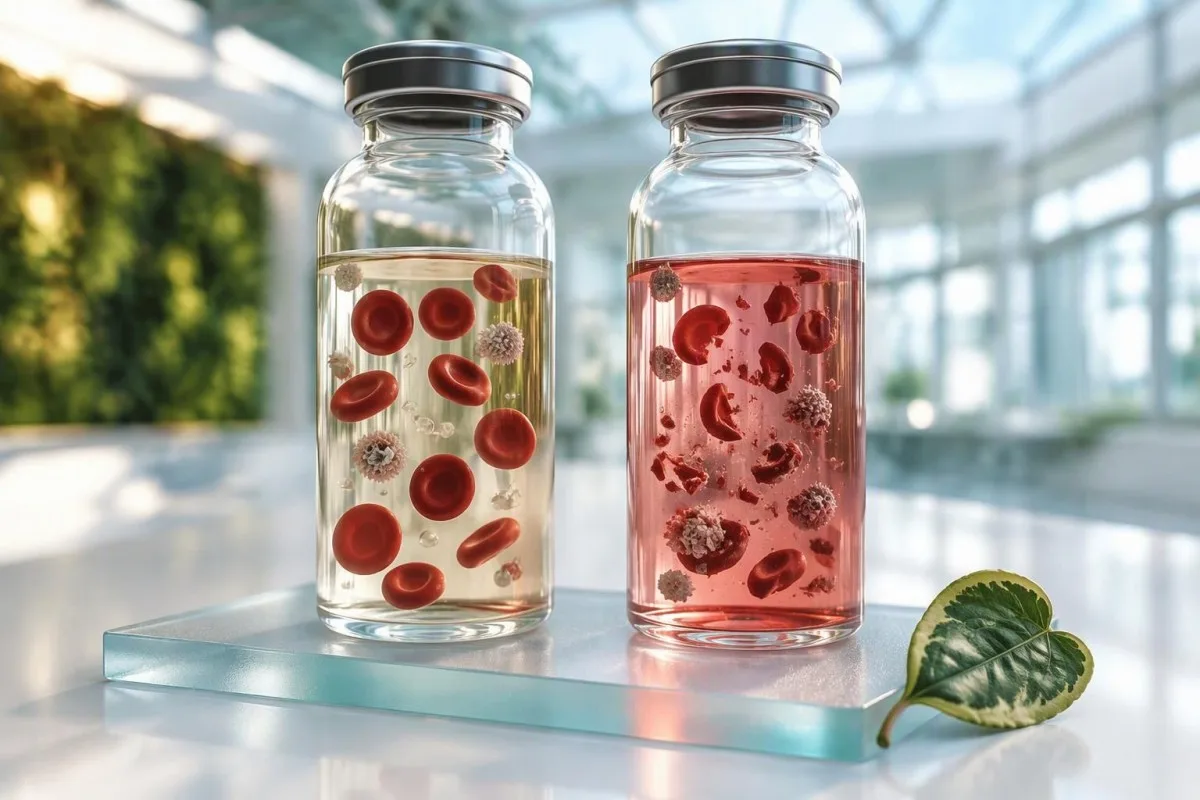
Yüksək hemoliz indeksi adətən toplandıqdan sonra hüceyrələrin zədələnməsini təsvir edir, diaqnoz qoymur. Sual ondan ibarətdir ki, hansı nəticələr etibarlı qalır və hansılar təkrarlanmalıdır.


- Yüksək hemoliz indeksi o deməkdir ki, analizator serumda və ya plazmada sərbəst hemoqlobin aşkar edib, adətən toplama və ya nəqliyyat zamanı hüceyrələrin parçalanmasından yaranır.
- kalium xüsusilə həssasdır, çünki qırmızı qan hüceyrələrinin tərkibində plazma aralığı 3,5–5,0 mmol/l olan yerinə təxminən 100–120 mmol/l kalium var.
- LDH və AST hemolizli nümunədə əhəmiyyətli dərəcədə arta bilər; təcrid olunmuş gözlənilməz yüksəlmə, təkrarlanan testdən əvvəl qaraciyər və ya əzələ xəstəliyi kimi etiketlənməməlidir.
- Analizator həddləri metoddən asılıdır: bir analizator üzərində 100 hemoliz indeksi, şiddətin universal ölçüsü və ya hemolitik anemiya diaqnozu deyil.
- Yenidən qan götürmə qərarları təhlükəsizlik təhlükəsizliyinin səviyyəsindən, müdaxilə dərəcəsindən və kliniki təcili vəziyyətdən asılıdır — yalnız nümunənin görünüşündən deyil.
- Təcili kalium qərarları nəticə yüksək olduqda qeyri-hemoliz edilmiş plazma nümunəsi, tam qanlı qan-qaz ölçülməsi və ya EKQ tərəfindən sürətli təsdiq tələb edir.
- In-vivo hemoliz anemiya, retikulositoz, aşağı haptoglobin və yüksəlmiş dolayı bilirubin kimi klinik bir nümunəyə səbəb olur; yalnız yüksək indeks bunu təsdiq edə bilməz.
- 27 sentyabr 2026-cı il tarixinə, xəstələr hər bir təsirli nəticəyə əməl etməzdən əvvəl laboratoriyanın bu nəticəni gizlətdiyini, təsnif etdiyini və ya analitik olaraq düzəltdiyini soruşmalıdırlar.
Yüksək Hemoliz İndeksi Əslində Nə Ölçür
A yüksək hemoliz indeksi analizatorun laboratoriya nümunəsinin maye hissəsində artıq sərbəst hemoqlobin aşkar etdiyini bildirir. Əksər ambulator çəkilərdə bu, orqanizmdə baş verən qırmızı qan hüceyrələrinin məhv olmasından çox, toplandıqdan sonra hüceyrənin parçalanmasını əks etdirir.
İndeks ümumiyyətlə spektrofotometriya ilə yaradılır: analizator hemoqlobinin işığı udduğu dalğalarda udma ölçür, sonra təhlükəsizliyə xas müdaxilə qaydalarını tətbiq edir. Çəhrayıdan qırmızıya qədər olan serum nümunəsi 50, 100 və ya 300 kimi işarələnmiş indeksə sahib ola bilər, lakin bu rəqəmlər istehsalçılar arasında standartlaşdırılmamışdır. tibbi validasiya yanaşmamız biz istifadə edirik laboratoriyanın öz şərhini və təhlükəsizlik bayraqlarını əsas dəlil kimi qəbul edir.
Çətin çəkilmə, çox güclü silkələnmiş boru, hüceyrələrdən gec ayrılma, həddindən artıq temperatur və ya pnevmatik boru vasitəsilə daşıma hamısı hemoliz olunmuş qan nümunəsi yarada bilər. Mənim klinik işimdə ən çox rast gəlinən səbəb xəstənin damarları deyil; bu, texniki cəhətdən çətin olan çəkilmənin çox kiçik bir toplama cihazı və ya güclü köçürmə ilə birləşməsidir. Gözlə normal görünən bir nümunə belə həssas bir təhlilə təsir edə biləcək qədər sərbəst hemoqlobinə sahib ola bilər.
Kantesti bir AI qan testi analizatoru hemoliz şərhini xəstəlik sübutu kimi deyil, nümunənin keyfiyyət siqnalı kimi qəbul edən. Dr. Thomas Klein-in praktik qaydası sadədir: laboratoriya onu etibarsız olaraq işarələdiyini, gizlətdiyini və ya xəbərdarlıqla buraxdığını yoxladıqdan sonra yalnız təsirli analiti təfsir edin.
Niyə rəng vacibdir, lakin işi həll etmir
Görünən çəhrayı serum tez-tez əhəmiyyətli sərbəst hemoqlobinə uyğun gəlir, lakin vizual müayinə yüngül hemolizi qaçırır və subyektivdir. Müasir indekslər vizual qiymətləndirmədən daha tutarlıdır, lakin onların klinik mənaları hələ də analizator, reagent və test üsuluna görə dəyişir.
Nümunə hemolizi bədəndə baş verən hemolizə qarşı
Yüksək indeks adətən göstərir in-vitro hemoliz, bu da hüceyrə zədələnməsinin test borusunda və ya idarəetmə zamanı baş verdiyi deməkdir. In-vivo hemoliz təsdiqləyici simptomlar, CBC nəticələri və hədəfli qan testləri tələb edən tibbi bir prosesdir.
In-vivo hemoliz tez-tez tutarlı bir nümunəyə səbəb olur: hemoglobinin düşməsi, retikulositoz, dolayı bilirubin yüksəlməsi, LDH artımı və aşağı haptoglobin. Tünd sidik, sarılıq, yorğunluq və ya bel ağrısı baş verə bilər, baxmayaraq ki, xroniki yüngül hemoliz sakit ola bilər. Əks halda sabit CBC ilə yalnız bir yüksək hemoliz indeksi klinik deyil, çox vaxt analitik əvvəlki səbəblərdən yaranır.
Bu fərq vacibdir, çünki hemoliz olunmuş nümunə hemolizi diaqnoz etmək üçün istifadə olunan nümunəni - xüsusilə yüksəlmiş kalium, LDH, AST və fosfatı saxta təqlid edə bilər. Lippi və həmkarları hemolizi klinik laboratoriyalarda uyğun olmayan nümunələrin aparıcı səbəbi kimi təsvir etmişlər, məhz ona görə ki, hüceyrə daxili tərkiblər nümunəyə tökülür və spektral müdaxilə fotometrik üsullara təsir edir (Lippi və həmkarları, 2008).
Anemiya və ya sarılıq həqiqətən mövcuddursa, həkimlər nümunəni təkrarlaya və retikulositlər, bilirubin fraksiyaları, haptoglobin və bir retikulosit təfsiri əlavə edə bilərlər. rather than relying on the index. Kantesti’s AI laboratoriya testi şərh xidməti compares these linked results and flags when the pattern deserves clinician review rather than a routine redraw.
A useful clue from timing
True hemolysis persists across carefully collected samples; collection-related hemolysis usually disappears on repeat testing. That contrast is often more informative than one isolated laboratory flag.
Hemolizlə Hansı Qan Analizinin Nəticələri Daha Çox Dəyişir
Hemolysis most often creates falsely high potassium, LDH, AST, phosphate, magnesium, iron, and sometimes total protein results. The magnitude is assay-dependent, so a laboratory’s interference comment outweighs any universal correction formula.
Potassium is the safety-critical example. Red cellular elements contain approximately 100–120 mmol/L potassium, while normal plasma potassium is 3.5–5.0 mmol/L; even modest cellular leakage can push a normal result above 5.5 mmol/L. A reported potassium of 6.2 mmol/L with a high hemolysis index may be pseudohyperkalemia, but it still needs rapid clinical triage if symptoms, kidney disease, ECG changes, or potassium-raising medicines are present.
LDH is highly concentrated within cellular elements, and AST is also more abundant inside them than in serum. In a 52-year-old runner with AST 89 IU/L, a hemolysis warning plus normal ALT and CK changes my first step from diagnosing liver disease to repeating the panel. See our practical guide to high AST results for the non-hemolysis causes that remain relevant.
Phosphate, magnesium, and iron may rise because they are released from disrupted cells; bilirubin and some enzyme assays can be biased in either direction by optical interference. This is why a numerical result may be released but not clinically usable. A qaraciyər panelinin izahı helps separate a real enzyme pattern from one compromised result.
Tests that can be falsely lower
Hemoglobin absorbance can produce negative interference in some colorimetric or enzymatic assays, including selected lipase, alkaline phosphatase, and bilirubin methods. There is no safe assumption that hemolysis only makes values high.
Hemolizlə Yüksək Kalium: Nə Zaman Təcili Hallır?
A potassium result of 6.0 mmol/L or higher with a hemolysis flag should be confirmed promptly, but it must not be dismissed automatically. Immediate assessment is appropriate when potassium is 6.5 mmol/L or higher, an ECG is abnormal, or weakness, palpitations, chest symptoms, or significant kidney impairment are present.
Pseudohyperkalemia is common when cellular elements rupture during collection, but genuine hyperkalemia can coexist with a difficult draw. A fresh lithium-heparin plasma specimen, carefully collected whole-blood analysis, and ECG are common confirmation routes. Do not try to lower potassium through diet or supplements before speaking with the clinician who ordered the test; that could delay necessary care.
The risk rises when a patient has eGFR below 30 mL/min/1.73 m², takes an ACE inhibitor, ARB, spironolactone, trimethoprim, or potassium supplement, or has metabolic acidosis. In those settings, a result of 5.8 mmol/L deserves more attention than the same result in a well person with normal renal function and an obviously compromised tube. Our detailed kalium nümunə səhvi təlimatı explains this decision point.
A clenched fist during collection can raise potassium slightly even without visible sample hemolysis, while prolonged tourniquet use adds another source of pre-analytical variation. The thing is, neither detail can prove the result is false. Repeat testing is the safe answer when the number could alter urgent treatment.
Symptoms that override the laboratory caveat
Severe muscle weakness, fainting, new palpitations, chest discomfort, or shortness of breath need urgent assessment regardless of a hemolysis comment. Laboratory uncertainty should never be used to explain away concerning symptoms.
LDH, AST və CK: Hemolizli Nümunədə Enzimləri Oxumaq
LDH and AST are among the least reliable results in a markedly hemolyzed specimen because both are released from disrupted cellular elements. CK is often less directly affected by red-cell leakage but can still be analytically affected depending on the laboratory method.
An isolated LDH elevation should not trigger a cancer, liver, or hemolytic-anemia work-up until specimen quality is addressed. LDH has five isoenzymes and is found in many tissues, so even a pristine high value is nonspecific. Our explanation of LDH test meaning shows why trends and companion tests matter more than a single result.
AST can rise after strenuous exercise, alcohol exposure, muscle injury, or liver injury, while ALT is more liver-focused. When AST is 90 IU/L but ALT is 22 IU/L and the sample is hemolyzed, repeating AST, ALT, CK, and bilirubin after 48–72 hours without unusual exercise often clarifies the picture. This timing is clinical convention, not a hard evidence-based rule for every patient.
Kantesti AI uses pattern logic: AST plus LDH plus a hemolysis flag is labelled potentially compromised, whereas AST plus ALT plus bilirubin elevation in a clean sample carries different weight. That distinction prevents false alarms while preserving follow-up for genuine liver or muscle disease.
Why an AST:ALT ratio may be unusable
A hemolyzed AST value can artificially inflate the AST:ALT ratio, making it unsuitable for alcohol-related liver pattern interpretation or fibrosis scores. Repeat the panel before calculating ratios that may influence a referral.
Hemolizdən Sonra Hansı Nəticələr Hələ də İstifadə Oluna Bilər?
Many results can remain usable despite a hemolyzed sample if the hemolysis level is below that assay’s validated interference limit. Sodium, chloride, urea, creatinine, glucose, and many immunoassays are often less affected, but “often” is not a guarantee.
Laboratories validate each test by measuring bias at increasing free-hemoglobin concentrations, then set suppression or comment thresholds. A sodium result may be reliable in a moderately hemolyzed specimen while potassium from the same tube is not. This analyte-by-analyte decision is why a blanket request to repeat an entire panel can be unnecessary.
Cardiac troponin, thyroid hormones, vitamin B12, and ferritin have assay-specific susceptibility to hemoglobin interference; no result should be assumed valid or invalid solely from the test name. If chest pain is present, troponin testing follows urgent clinical pathways regardless of a specimen flag. Read our guide to troponin result differences for why assay identity matters.
A laboratory may release a result with an HIL comment, suppress it entirely, or report that interference is not significant at the measured index. Kantesti’s neural network preserves that distinction when extracting PDF reports rather than treating every number as equally precise. The Kantesti AI benchmark describes technical evaluation of this report-reading workflow.
The serum-versus-plasma detail
Serum waits for clotting before separation, whereas plasma is separated from anticoagulated whole blood. Delay before separation can increase contact between cells and liquid, but both specimen types can hemolyze during collection or transport.
Niyə Hemoliz İndeksi Kəsimləri Laboratoriyalar Arasında Fərqlənir
There is no universal normal range for a hemolysis index because instruments, wavelengths, sample types, and assay reagents differ. A value of 150 may be a minor flag in one laboratory and a rejection threshold in another.
The HIL system—hemolysis, icterus, and lipemia indices—usually estimates optical interference before selected chemistry assays run. It is not the same as plasma free hemoglobin measured for suspected intravascular hemolysis, which may be reported in mg/dL. Confusing these two measures is a surprisingly common source of unnecessary worry.
Laboratories choose action limits based on acceptable analytical bias, frequently aligned with a change no greater than 10% or a fraction of biological variation. Yet a 10% error is trivial for one test and consequential for potassium near 6.0 mmol/L. Clinicians disagree on the most practical cutoff because the correct threshold depends on what decision the result will drive.
Kantesti bir AI qan analizi nəticələrinin şərhi platforması that displays the exact printed laboratory flag and reference context instead of translating an index into a made-up universal severity grade. Readers comparing reports from different countries can use our 15.000-marker bələdçimiz to check units and assay names before comparing trends.
Why you should not compare index values over time
A hemolysis index of 80 in one laboratory and 80 in another may not represent the same free-hemoglobin concentration. Compare clinical analytes across laboratories cautiously unless the assay method and specimen handling are consistent.
Nə Zaman Qan Qaytarılmalıdır - Və Nə Zaman Yox
A redraw is usually needed when hemolysis could change a result that guides an urgent or major clinical decision. It may not be needed when the laboratory confirms negligible interference for the released tests and the result fits the clinical picture.
Redraw promptly for a high potassium, unexpectedly high LDH or AST, discrepant phosphate or magnesium, or any result the laboratory has withheld. Repeat testing also makes sense when a result conflicts sharply with a prior baseline—such as creatinine 0.8 to 2.1 mg/dL without illness, dehydration, or medication change. A delta-check izahı can help frame that conversation.
A repeat may be unnecessary for a stable HbA1c, TSH, or creatinine when the lab has explicitly released it without an interference warning. Still, repeat if the number would trigger a medication change, imaging, or referral. In my experience, patients are reassured by asking one specific question: “Which individual results did the lab consider affected?”
Do not assume fasting fixes hemolysis. Better prevention is a relaxed collection, appropriate tube filling, gentle inversions rather than shaking, rapid transport, and timely centrifugation. Our repeat-test guide after hemolysis gives patients a practical checklist.
Hospital and emergency settings
In emergency care, clinicians may use a rapid whole-blood result while simultaneously sending a carefully collected confirmatory specimen. Treatment decisions are based on symptoms, ECG findings, kidney function, and repeat values—not the hemolysis index alone.
Niyə Qan Nümunələri Toplama və Nəqliyyat Zamanı Hemolizə Uğrayır
Most hemolyzed blood samples arise from mechanical stress, delayed processing, or temperature extremes rather than any fault in the patient. Prevention begins before the tube reaches the analyzer.
Drawing through an undersized device, pulling too forcefully with a vacuum device, forcing a sample through a connector, or vigorous shaking can damage cellular elements. Underfilling additive tubes creates a wrong blood-to-additive ratio, which can introduce separate errors even if hemolysis is absent. The details sound fussy, but they change real results.
Transportation matters after collection. Extended heat exposure, freezing, rough transit, and a long delay before separating serum or plasma can increase hemolysis. Samples from lines can also be misleading if collection follows infusion or if technique is difficult; a clean peripheral collection may be preferable when the result is pivotal.
Patients can help by arriving hydrated unless fluid restriction applies, keeping their arm warm, and avoiding repeated fist pumping. None of these steps guarantees a clean sample, particularly in fragile veins. A baseline draw preparation guide covers preparation without turning routine testing into an ordeal.
Exercise is a separate issue
A hard workout can genuinely raise CK, AST, and creatinine for 24–72 hours even when the specimen is pristine. Exercise may coexist with collection hemolysis, so a repeat result should ideally follow an ordinary rest day when medically appropriate.
Qan Sayımı (CBC) və Qan Sürtkü Nümunəsi Sizə Nə Deyə Bilər
A complete blood count can help distinguish a poor specimen from possible true hemolysis, but it cannot do so by itself. Falling hemoglobin, rising reticulocytes, and smear changes carry more diagnostic weight than the chemistry hemolysis index.
A true hemolytic process commonly causes reticulocytosis as marrow responds to shortened red-cell survival, although this response may be absent with iron deficiency, marrow disease, or very early onset. A reticulocyte count above the laboratory’s upper limit—often roughly 2.0%—must be converted to an absolute count and interpreted alongside hemoglobin. Percentage alone can mislead in anemia.
A peripheral cell sample slide may show schistocytes, spherocytes, bite cells, or polychromasia depending on cause. Schistocytes at 1% or more on a standardized review can support thrombotic microangiopathy in the right setting, but this is a specialist interpretation and urgent symptoms matter. Our guide to təcili şistosit tapıntıları explains why this is not a home diagnosis.
Dr. Thomas Klein advises looking for internal consistency: high LDH plus low haptoglobin plus anemia on a clean repeat sample is meaningful; high LDH alone in a hemolyzed tube is not. The hematocrit and hemoglobin comparison is useful when CBC values seem contradictory.
A falsely high MCHC can be a clue
Markedly high MCHC can occur with sample hemolysis, lipemia, cold agglutinins, or spherocytosis. It should prompt laboratory review rather than an immediate conclusion about red-cell disease.
Xüsusi Hallar: Uşaqlar, Hamiləlik və Çətin Giriş
Hemolysis is more common when collection is technically difficult, including neonatal, pediatric, emergency, and critical-care testing. The consequences may also be greater because small electrolyte shifts can affect urgent decisions.
In newborns and young children, capillary collection and low sample volumes can increase cellular disruption, while potassium reference intervals differ by age. A potassium value that is high for an adult may be less abnormal in a newborn, yet any suspected hyperkalemia still requires prompt clinician-led confirmation. Never apply adult cutoffs to a child’s report without the laboratory’s pediatric range.
Pregnancy adds another layer: anemia is common from dilution or iron deficiency, while HELLP syndrome and other obstetric emergencies can involve real hemolysis. New headache, visual symptoms, right-upper abdominal pain, high blood pressure, or reduced fetal movement need urgent maternity assessment—not an assumption that the tube was damaged. Our HELLP laboratory pattern guide details the red flags.
For people with dialysis access, implanted lines, burns, or very difficult peripheral access, a higher rate of unsuitable samples may be unavoidable. The care team can often arrange an approach that minimizes redraws, but the test’s clinical urgency determines whether another sample is required.
Home collection kits
Finger-prick samples are not interchangeable with venous samples for every analyte, and inadequate handling can create interference. Follow kit-specific instructions and ask the provider whether a venous redraw is needed after a high hemolysis flag.
Laboratoriya Hesabatınızda Hemoliz Şərhini Necə Oxumaq Olar
A lab report may say “hemolyzed,” “hemolysis index elevated,” “interference possible,” or “result not reported.” These phrases have different implications: a suppressed result is unusable, while a released result may remain valid if interference is below the assay’s limit.
Look for a comment attached to the individual analyte, not merely a general specimen note. For example, potassium may say “not reported due to hemolysis,” while creatinine is reported without qualification. This reflects the laboratory’s validation work and is more useful than judging the tube’s color from a photograph.
If a number is marked with an H for high and also a hemolysis caveat, it can be both analytically elevated and clinically uncertain. Ask the ordering clinician whether the result fits your medications, symptoms, earlier values, and other tests. Our guide to diapazondan kənar işarələri explains why a flag is a prompt for context, not a diagnosis.
Kantesti AI can organize a photographed or PDF report in about 60 seconds, but it cannot inspect the physical specimen or replace a laboratory’s interference decision. Our texnologiya bələdçisi explains how we preserve qualifiers, units, and reference intervals for clinician discussion.
A question worth writing down
Ask: “Was this specific test suppressed, corrected, or released as valid despite the hemolysis index?” That single question usually gets a clearer answer than asking whether the whole panel was “bad.”
Hemolizli Nəticədən Sonra Nə Etməməli
Do not self-treat a possibly false result, ignore a potentially dangerous one, or assume every result in the panel is invalid. The right response is targeted confirmation based on the analyte and your clinical context.
Do not stop prescribed ACE inhibitors, diuretics, thyroid medicine, or supplements solely because one hemolyzed sample was abnormal. Potassium, thyroid, and kidney results must be interpreted against the medication list and a repeat value where needed. Sudden medication changes can be riskier than waiting a few hours for confirmation.
Avoid searching for a diagnosis from a high LDH or AST result before checking sample quality. Serious disease can cause these elevations, of course, but an unreliable first sample does not justify a frightening conclusion. For muscle-specific concerns, our high CK safety guide sets out symptoms that do need prompt care.
Likewise, do not repeatedly redraw yourself through commercial testing without sharing the original report with a clinician. Recurrent hemolysis may be a collection issue, but recurrent abnormal results in properly handled samples deserve a structured evaluation.
When to seek same-day help
Seek urgent advice for high potassium with weakness or palpitations, jaundice with dark urine, severe fatigue with breathlessness, chest pain, fainting, or rapidly worsening symptoms. A specimen-quality note cannot lower the urgency of these clinical signs.
Təkrar Qan Alındıqdan Sonra Nəticələri Təhlükəsiz Şəkildə Necə Müqayisə Etmək
A clean repeat sample is most useful when collected under comparable conditions and interpreted as a trend, not as a verdict on the first result. A large change after a hemolyzed draw often identifies interference, but biological variation still exists.
Record the draw date, fasting status, exercise in the previous 48 hours, illness, supplements, and medications. Creatinine can shift with hydration and exercise; AST and CK can shift after training; potassium may shift with kidney function and medicines. These ordinary variables matter even when the second sample has no hemolysis flag.
For potassium, a change from 6.1 mmol/L in a hemolyzed sample to 4.3 mmol/L in a clean sample strongly supports pseudohyperkalemia. For AST, a decline from 88 to 29 IU/L may reflect removal of interference, recovery after exercise, or both; timing and ALT help adjudicate. Our qan analizi dəyişiklik bələdçimiz explains reference change value more fully.
Kantesti bir Süni intellektlə işləyən qan testi analizi aləti that can place repeat values beside prior results while retaining specimen-quality comments. Trend displays are useful, but they must never obscure a redrawn critical result that needs immediate clinician action.
Orijinal hesabatı saxlayın
Save the first report, including the hemolysis comment, rather than deleting it after the repeat. It documents why a value changed and prevents future clinicians from mistaking a collection artifact for sudden disease resolution.
Həkiminizə və ya Laboratoriyaya Verməli Olduğunuz Suallar
The best question after a high hemolysis index is not “Do I have hemolysis?” but “Which analytes were affected, how urgently should they be repeated, and what symptoms would change the plan?” A short, specific discussion avoids both false reassurance and unnecessary alarm.
Ask whether the abnormal value was suppressed, whether the lab has a validated interference threshold for that method, and whether a fresh plasma or whole-blood sample is preferable. For potassium, ask whether an ECG or same-day repeat is needed. For enzyme results, ask whether exercise, alcohol, infection, or medicines may also be contributing.
Ask whether you need a full panel or only selected tests repeated. A targeted redraw often includes potassium, AST, LDH, phosphate, magnesium, or bilirubin, whereas a CBC or HbA1c may not need repeating. This can reduce cost, discomfort, and confusing duplicate results without compromising care.
Bizim Tibbi Məsləhət Şurası review clinical-safety principles used in Kantesti content, but personal treatment decisions belong with the clinician who knows your history and can assess you. Most patients find that a precise repeat plan is far calmer than trying to interpret a colored sample image online.
Nəticə
A high hemolysis index is usually a laboratory-quality warning, not a diagnosis. Respect the warning, identify the affected tests, and repeat only what could change clinical decisions.
Qan Hesabatlarında Hemoliz Bayraqlarını Necə İdarə Edir
Kantesti identifies hemolysis flags and links them to the results most likely to be affected, but it does not replace laboratory validation or urgent clinical assessment. A flagged potassium, troponin, or critical electrolyte result always needs the laboratory and treating team’s protocol.
Kantesti AI reads the test name, value, unit, reference interval, collection context, and printed laboratory comments together. That matters because “high potassium” without the accompanying hemolysis statement is an incomplete clinical fact. Our system is designed to surface uncertainty plainly rather than conceal it behind a confident-looking score.
Kantesti bir AI biomarker şərhi platforması used across 127+ countries, so it also avoids assuming that identical labels or index values mean identical methods. Different laboratories may use serum, plasma, direct or indirect assays, and different interference thresholds. International reports need the source laboratory’s own interpretive note preserved.
As of September 27, 2026, our safety approach is to encourage a clinician discussion for results that are critical, internally inconsistent, newly abnormal, or clearly compromised by blood test hemolysis. If you want to understand how health data are handled, our 29 mart 2026-cı il tarixinə olan məlumata görə, əksər qaydalar hələ də simptomsuz yetkinlərdə universal illik describes the organization and its privacy-focused approach.
The limit of any report interpretation
No report-reading system can know whether you have palpitations, jaundice, dehydration, or a new medication unless you provide that context to a clinician. The specimen flag is one piece of evidence, not a substitute for examination or urgent care.
Tez-tez verilən suallar
Qan analizində yüksək hemoliz indeksi nə deməkdir?
Yüksək hemoliz indeksi o deməkdir ki, laboratoriya analizatoru zərdab və ya plazmadakı qırmızı qan hüceyrələrinin dağılmasından yaranan sərbəst hemoqlobini aşkar edib. Əksər hallarda bu, xəstənin tibbi vəziyyətindən deyil, nümunənin toplanması, daşınması və ya emalı zamanı baş verir. İndeks kalium, LDH, AST, fosfat, maqnezium və dəmir nəticələrini etibarsız edə bilər, lakin təsiri analizdən asılıdır. Hemoliz indeksi hemolitik anemiya üçün diaqnostik test deyil.
Yüksək hemoliz indeksi yüksək kaliuma səbəb ola bilərmi?
Bəli, yüksək hemoliz indeksi psevdohiperkaliyemiyaya səbəb ola bilər, çünki qırmızı qan hüceyrələrində təxminən 100–120 mmol/L kalium olur, normal plazma kaliumu isə 3.5–5.0 mmol/L-dir. Hüceyrələrin məhdud dağılması belə ölçülmüş kaliumu 5.5 mmol/L-dən yuxarı qaldıra bilər. 6.0 mmol/L və ya daha yüksək kalium nəticəsi, xüsusilə böyrək xəstəliyi, kaliumu artıran dərmanlar, zəiflik və ya ürəkbulanma hallarında dərhal təsdiqlənməlidir. EKG və diqqətlə götürülmüş təkrar nümunə lazım ola bilər.
Hemolizli nümunəyə görə bütün qan testlərini təkrarlamalıyam?
Xeyr, hemoliz olunmuş nümunə avtomatik olaraq bütün qan testlərini etibarsız saymır. Laboratoriyalar hər bir təhlil üçün maneəni ayrıca qiymətləndirir və natrium, xlorid, kreatinin, qlükoza və bəzi immünoloji təhlillər müəyyən hemoliz səviyyəsində istifadəyə yararlı qala bilər. Laboratoriya tərəfindən ləğv edilmiş, şərtli hesab edilmiş və ya təcili qərarı dəyişə biləcək, məsələn, kalium və ya gözlənilməz dərəcədə yüksək LDH və AST kimi testləri təkrarlayın. Tam panelin yenidən çəkilməsini təşkil etməzdən əvvəl hansı spesifik analitlərin təsirləndiyini soruşun.
Hemoliz olunmuş nümunə mənə hemolitik anemiyam olduğunu göstərə bilər?
Hemolizə olunmuş nümunə özlüyündə hemolitik anemiya olduğunu bildirmir. Hemolitik anemiya, diqqətlə toplanmış nümunədə düşən hemoqlobin, yüksək retikülositlər, artmış dolayı bilirubin və LDH, həmçinin aşağı haptoqlobin kimi əlamətlərlə təsdiqlənir. Sarılıq, tünd sidik, nəfəs darlığı və ya yorğunluq kimi simptomlar narahatlığı artırır, lakin bəzi xəstələrdə yüngül simptomlar olur. Təkrar təmiz nümunə adətən toplama ilə əlaqəli hemolizlə həqiqi qırmızı qan hüceyrələrinin dağılmasını ayırmanın ilk yoludur.
Hemolizdən sonra qan nümunəsini yenidən götürməzdən əvvəl nə qədər gözləməliyəm?
Kalium, mühüm elektrolit, troponin və ya başqa bir təcili nəticə olduqda, təkrari müayinə tez-tez eyni gündə aparıla bilər. AST, CK və ya LDH-nin gərgin fəaliyyətdən sonra qeyri-təcili pozulmaları üçün, həkimlər bəzən qeyri-adi məşqlərdən 48–72 saat çəkinildikdən sonra təkrarlayırlar, çünki məşq özü bu fermentləri artıra bilər. Yüksək hemoliz indeksi üçün universal gözləmə müddəti yoxdur; müvafiq test və testin səbəbi vaxtı müəyyən edir. Laboratoriya və ya sifariş verən həkim xüsusi planı təqdim etməlidir.
Dehidrasiya yüksək hemoliz indeksinə səbəb ola bilərmi?
Susuzluq birbaşa yüksək hemoliz indeksinə səbəb olmur, lakin bu, toplamağı çətinləşdirə bilər və texniki cəhətdən çətin nümunə götürmə şansını artıra bilər. Toplanmadan sonra istiyə məruz qalma və ya pis saxlanma da hüceyrəvi elementlərə zərər verə bilər və indeksi artıra bilər. Maye məhdudiyyəti olmayan insanlar üçün nəqliyyat vasitəsinə daxil olmağa kömək edə bilər, lakin toplandıqdan sonra hemoliz olunmuş nümunəni düzəldə bilməz. Təzə düzgün idarə olunan nümunə uyğun təsdiqdir.
Bu gün AI ilə gücləndirilmiş qan analizi nəticələrinin şərhini əldə edin
Ani və dəqiq laborator analiz şərhinə güvənən dünya üzrə 2 milyondan çox istifadəçiyə qoşulun. Qan analizinin nəticələrini yükləyin və bir neçə saniyəyə 15,000+ biomarkerlərinin hərtərəfli şərhini alın.
📚 İstinad edilən tədqiqat nəşrləri
Klein, T., Mitchell, S., & Weber, H. (2026). Klein, T. (2026). A Pre-Registered, Rubric-Based Automated Technical Benchmark of the Kantesti Blood-Test Interpretation Engine on 100,000 Synthetic Test Cases. Figshare. https://doi.org/10.6084/m9.figshare.32095435. Kantesti AI Tibbi Tədqiqatlar.
Klein, T., Mitchell, S., & Weber, H. (2026). Kantesti LTD. (2026). Klinik Validasiya Çərçivəsi v2.0 (Tibbi Validasiya Səhifəsi). Zenodo. https://doi.org/10.5281/zenodo.17993721. Kantesti AI Tibbi Tədqiqatlar.
📖 Xarici Tibbi İstinadlar
⚕️ Tibbi Məsuliyyətdən İmtina
Bu məqalə yalnız təhsil məqsədlidir və tibbi məsləhət təşkil etmir. Diaqnoz və müalicə qərarları üçün həmişə ixtisaslı səhiyyə işçisi ilə məsləhətləşin.
E-E-A-T Etibar Siqnalları
Təcrübə
Həkim rəhbərliyi ilə laborator şərh iş axınlarının klinik icmalı.
Ekspertiza
Biomarkerlərin klinik kontekstdə necə davrandığına dair laboratoriya təbabəti diqqəti.
Səlahiyyətlilik
Dr. Thomas Klein tərəfindən yazılıb; Dr. Sarah Mitchell və Prof. Dr. Hans Weber tərəfindən nəzərdən keçirilib.
Etibarlılıq
Aydın izləmə yolları ilə həyəcanı azaltmağa yönəlmiş sübuta əsaslanan şərh.