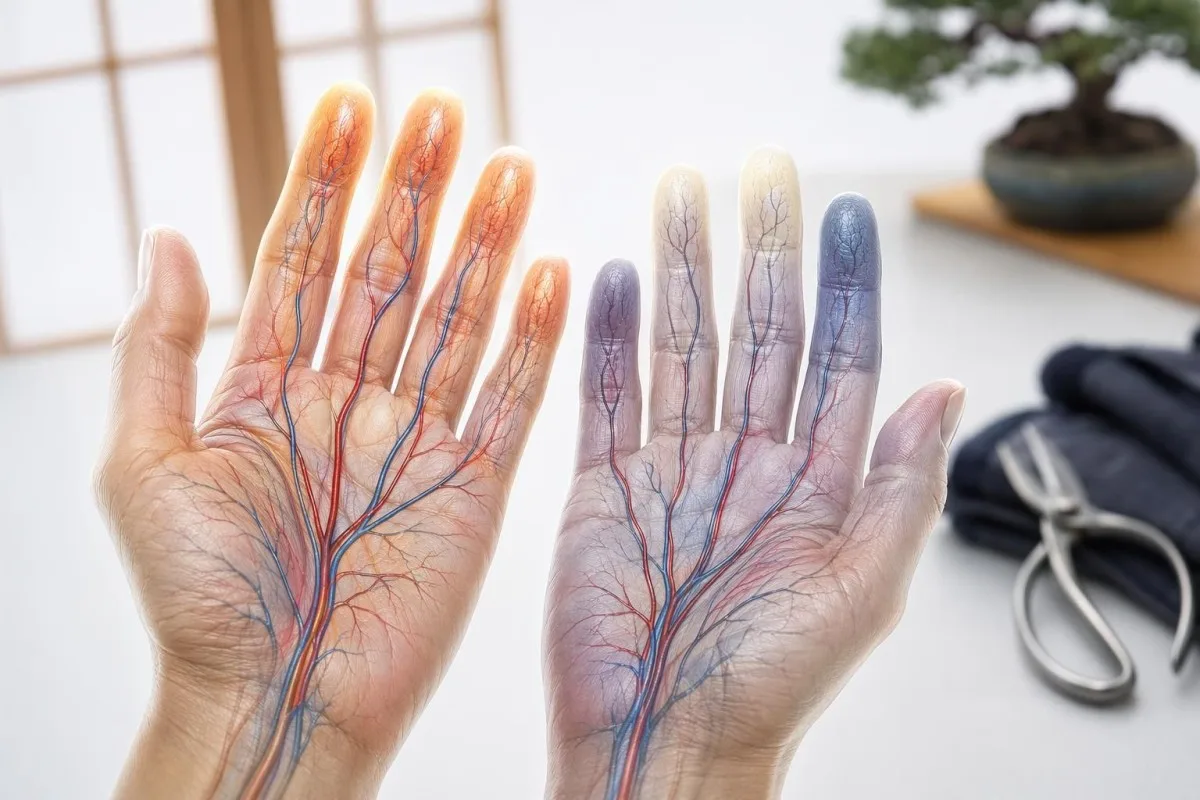
Localized cold fingers and toes are not the same as feeling cold everywhere. The useful lab workup looks for patterns: anemia, thyroid slowing, autoimmune Raynaud’s signals, and vascular risk markers that deserve follow-up.


- Blood test for cold hands and feet cannot diagnose Raynaud’s alone; it checks anemia, thyroid disease, autoimmune clues and vascular risk.
- Raynaud pattern usually means white-blue-red finger or toe color change triggered by cold or stress, often lasting 5–20 minutes.
- Hemoglobin below about 12.0 g/dL in adult women or 13.5 g/dL in adult men supports anemia as a cold-sensitivity contributor.
- Ferritin below 30 ng/mL commonly suggests iron deficiency, even when hemoglobin is still normal.
- TSH above 4.0–4.5 mIU/L with low free T4 supports hypothyroidism, a common systemic cold-intolerance pattern.
- ANA titer of 1:160 or higher is more meaningful than a weak 1:80 result, especially with ulcers, puffy fingers or abnormal nailfold capillaries.
- ESR and CRP help separate inflammatory Raynaud’s from benign vasospasm, but normal results do not rule out early connective tissue disease.
- ABI below 0.90 suggests peripheral artery disease and is more useful than routine blood work for true leg circulation assessment.
- Urgent symptoms include one cold painful finger or toe, new blue-black color, numbness, weakness or a missing pulse.
What a blood test can and cannot answer
A blood test for cold hands and feet does not diagnose Raynaud’s by itself. The useful workup checks four buckets: CBC and ferritin for anemia or iron loss, TSH and free T4 for hypothyroidism, ANA or related immune markers for secondary Raynaud’s, and glucose, lipids and kidney markers for vascular risk. Localized white-blue-red finger or toe attacks lasting 5–20 minutes point more toward Raynaud’s phenomenon; all-over chilliness points more toward anemia, thyroid slowing, low body weight, medication effects or low blood pressure.
I’m Thomas Klein, MD, and I usually start by asking patients to separate cold sensitivity from vasospasm. If every part of you feels cold in a 22°C room, I think about hemoglobin, ferritin, TSH, calorie intake and medications; if two fingers turn white then blue after holding a cold drink, I think about Raynaud’s first.
Raynaud’s affects an estimated 3–5% of the general population, though rates vary by climate, sex and how the question is asked. Herrick’s 2012 review in Nature Reviews Rheumatology describes Raynaud’s as a vascular overreaction to cold or emotional stress, not a low-body-temperature disorder (Herrick, 2012).
Kantesti is an AI blood test analyzer that reads cold-finger workups as patterns rather than isolated abnormal flags. Our clinical team describes our structure on About Us, and readers with all-over cold intolerance may also want the separate cold intolerance labs guide.
Raynaud’s versus benign cold sensitivity
Raynaud’s phenomenon is suggested by sharply demarcated finger or toe color change triggered by cold or stress. Benign cold sensitivity usually causes diffuse coolness without a clear white-blue-red sequence, without numbness in a single digit, and without skin sores or fingertip pitting.
The 2014 international consensus criteria led by Maverakis and colleagues emphasized that Raynaud’s is mainly a clinical diagnosis, not a lab diagnosis (Maverakis et al., 2014). In clinic, I ask for phone photos because a 20-second image of white fingertips often beats a page of normal blood tests.
Primary Raynaud’s typically starts before age 30, is symmetric, spares the thumb, and leaves no ulcers. Secondary Raynaud’s is more suspicious when it starts after age 30–40, affects one side more than the other, causes fingertip sores, or appears with puffy fingers, joint swelling, reflux, dry eyes or shortness of breath.
A cold fingers blood test is most useful when it is tied to symptoms recorded by time, temperature and duration. Kantesti maps those symptoms against 15,000+ analytes in our biomarker guide, but the patient’s story still drives the interpretation.
First-pass labs doctors usually order
The first lab set for localized cold fingers or toes usually includes CBC with differential, ferritin or iron studies, TSH with free T4, CMP, fasting glucose or HbA1c, lipid markers, ESR and CRP. These tests do not prove circulation is poor; they screen for common drivers that can make cold symptoms worse or signal secondary disease.
A CBC can show anemia, high platelets from inflammation, or a white-cell pattern that changes the urgency of the visit. If you are unsure what each CBC line means, our CBC components guide explains hemoglobin, MCV, RDW, platelets and differential counts.
A CMP adds creatinine, eGFR, albumin, liver enzymes, calcium and electrolytes; it is not a circulation test, but it catches kidney disease, low albumin and metabolic patterns that alter vascular risk. I rarely order a “circulation lab” without checking blood pressure, pulses and medication history at the same visit.
As of June 20, 2026, my practical minimum panel for persistent localized cold digits is CBC, ferritin, TSH, free T4, CMP, HbA1c, lipid panel, ESR and CRP. If the patient has ulcers, puffy fingers, inflammatory joint pain or abnormal nailfold capillaries, ANA with reflex ENA becomes a first-line test rather than a later add-on.
CBC, ferritin and anemia patterns
Anemia can make hands and feet feel cold because less oxygen is carried to tissues and the body shunts flow toward core organs. Hemoglobin below about 12.0 g/dL in adult women or 13.5 g/dL in adult men supports anemia, while ferritin below 30 ng/mL commonly suggests iron deficiency before anemia is visible.
Ferritin is the storage marker I watch most closely when a patient says, “My fingers are freezing but my CBC is normal.” A ferritin of 12 ng/mL with hemoglobin 12.6 g/dL can still explain fatigue, cold sensitivity, hair shedding and restless legs in a menstruating patient.
MCV below about 80 fL suggests microcytosis, often from iron deficiency or thalassaemia trait; MCV above about 100 fL suggests macrocytosis, often from B12, folate, alcohol, liver disease or medications. For the deeper binding-capacity pattern, the Kantesti iron studies guide explains serum iron, TIBC and transferrin saturation.
Inflammation complicates ferritin because ferritin rises as an acute-phase reactant. In my practice, ferritin 60–100 ng/mL with CRP above 10 mg/L and transferrin saturation below 20% can still represent functionally low iron availability, especially in inflammatory bowel disease, rheumatoid disease or chronic infection.
Thyroid patterns that mimic circulation problems
Hypothyroidism commonly causes whole-body cold intolerance, dry skin, constipation, weight gain, slow pulse and fatigue rather than sharply localized Raynaud attacks. TSH above 4.0–4.5 mIU/L with low free T4 supports overt hypothyroidism, while TSH 4.5–10 mIU/L with normal free T4 is usually called subclinical hypothyroidism.
The clue is distribution. A patient with TSH 8.2 mIU/L and free T4 in range may say they are cold everywhere, while a patient with Raynaud’s often says, “Only my index and middle fingers go white after cold exposure.”
Free T3 is less helpful as a screening test unless there is a specific endocrine question, recent severe illness, or discordant results. Our thyroid panel guide walks through when free T4, free T3, TPO antibodies and thyroglobulin antibodies add value.
Kantesti is an AI lab test interpretation service that treats borderline TSH differently when ferritin is 9 ng/mL, LDL is 190 mg/dL, or the patient recently changed levothyroxine dose. That matters because two people with the same TSH can have very different next steps.
Autoimmune screening in Raynaud’s workup
Raynaud blood tests for autoimmune disease usually include ANA by immunofluorescence, ENA antibodies when ANA is positive or suspicion is high, ESR, CRP, C3, C4, urinalysis and sometimes rheumatoid factor or anti-CCP. ANA titers of 1:160 or higher are more meaningful than weak 1:80 results, but symptoms decide the risk.
A weak ANA is common enough that I do not call it disease without supporting clues. In many labs, ANA at 1:80 can appear in healthy adults, whereas a titer of 1:320 with centromere pattern, puffy fingers and reflux changes the conversation.
Koenig and colleagues followed patients with Raynaud’s for 20 years and found that scleroderma-specific autoantibodies plus nailfold microvascular damage predicted progression far more strongly than either clue alone (Koenig et al., 2008). In that study, patients with both high-risk features had roughly an 80% progression rate, while those with neither feature had under 2% progression.
For patients reading an ANA report for the first time, our positive ANA guide explains titer and pattern language. The Kantesti C3 C4 guide covers complement levels, which are often around C3 90–180 mg/dL and C4 10–40 mg/dL, depending on the laboratory.
How pattern-based interpretation helps
Pattern-based interpretation helps because cold hands and feet usually come from clusters, not single numbers. A normal CBC with ferritin 14 ng/mL, TSH 6.8 mIU/L and positive ANA 1:160 means something very different from the same CBC with normal iron, normal thyroid and a negative autoimmune screen.
Kantesti is an AI biomarker interpretation platform used by patients in 127+ countries to compare uploaded PDFs and photos in about 60 seconds. The point is not to replace a clinician’s fingers on the pulse; it is to reduce missed clusters in large lab reports.
Our medical team audits pattern logic against known clinical rules, unit conversions and red-flag combinations. You can read more about our clinical standards and benchmarking approach in medical validation.
Trend data matters more than most people think. A ferritin drifting from 72 to 28 ng/mL over 14 months, or TSH rising from 2.1 to 5.9 mIU/L across two winters, is easier to interpret with longitudinal analysis than with one isolated printout.
Cold feet circulation labs and vascular risk
Cold feet circulation labs do not directly measure leg blood flow; they identify vascular risk factors that make poor circulation more likely. HbA1c, fasting glucose, lipid panel, ApoB, kidney function, urine albumin-creatinine ratio and smoking-related markers help decide whether a pulse exam, ankle-brachial index or vascular referral is needed.
An ankle-brachial index below 0.90 supports peripheral artery disease, while ABI above 1.30 can suggest stiff calcified vessels, especially in diabetes or kidney disease. No routine blood test can replace that bedside pressure comparison.
HbA1c of 5.7–6.4% meets the usual prediabetes range, and HbA1c of 6.5% or higher supports diabetes when confirmed. Our diabetes lab guide explains why neuropathy can cause cold-feeling feet even when the skin temperature is not truly low.
ApoB above 130 mg/dL is a high atherogenic-particle signal in many prevention frameworks, and LDL-C above 190 mg/dL is treated as a severe hypercholesterolemia threshold. If a patient has cold feet, calf pain while walking and high ApoB, our ApoB risk guide is more relevant than another thyroid repeat.
Cryoglobulins, vasculitis and cold proteins
Cryoglobulins are immune proteins that can precipitate in cooler temperatures and cause cold-triggered color change, purpura, numbness, kidney findings or vasculitis. The cryoglobulin test is unusually fragile: the sample must be kept warm at about 37°C until serum is separated, or the result can be falsely negative.
I have seen cryoglobulin results reported negative three times before a properly handled fourth sample changed the diagnosis. When symptoms include purple spots on the legs, neuropathy, low complement C4 or kidney urine abnormalities, I do not trust a casual send-out result.
Common follow-up tests include hepatitis C antibody with RNA confirmation, hepatitis B markers, HIV testing when appropriate, C3, C4, rheumatoid factor, serum protein electrophoresis and urinalysis. Our cryoglobulin test guide covers the pre-analytical handling problem in more detail.
Vasculitis workups can also include ANCA, urine protein, urine red cells, creatinine and inflammatory markers. If cold digits come with rash, kidney changes or nerve symptoms, our vasculitis blood tests article is the better next read.
When normal labs do not end the workup
Normal blood tests do not always end a Raynaud workup because primary Raynaud’s can have completely normal CBC, thyroid, ESR, CRP and ANA results. If symptoms are classic but screening labs are normal, the next useful checks are nailfold capillaroscopy, medication review, pulse exam and symptom photography.
The most common medication culprits I ask about are stimulants, decongestants, migraine vasoconstrictors, some beta blockers, nicotine, chemotherapy agents and high-dose caffeine. A patient can have a perfect ANA and still have medication-driven vasospasm.
A negative ANA lowers the probability of lupus, systemic sclerosis and related connective tissue disease, but it is not a magic eraser. Our negative ANA guide explains why symptoms such as dry eyes, inflammatory arthritis or kidney findings may still need targeted testing.
In primary Raynaud’s, I usually monitor symptom change rather than chase monthly labs. Worsening asymmetry, new ulcers, thumb involvement or attacks lasting longer than 30–60 minutes are reasons to re-open the workup even if last winter’s results looked reassuring.
Red flags that need same-day care
Same-day care is needed for one cold painful finger or toe, new blue-black discoloration, sudden numbness or weakness, a missing pulse, chest pain, severe shortness of breath, fever with confusion, or rapidly spreading skin color change. Those signs suggest ischemia, embolus, severe infection, clotting disorder or another urgent process rather than ordinary Raynaud’s.
A dramatic one-sided change is the pattern that makes me lean forward in clinic. Raynaud’s is usually episodic and reversible; a persistently cold, painful, pale toe with reduced capillary refill is a vascular problem until proven otherwise.
D-dimer is not a screening test for “bad circulation” in well people; it is used when symptoms and exam create a real clot question. If D-dimer is above the lab cutoff, age-adjusted interpretation is often used after age 50, but imaging decisions depend on the whole clinical picture.
Critical lab flags also matter. Our critical results guide explains why potassium above 6.0 mmol/L, hemoglobin below 7–8 g/dL, or glucose above 300 mg/dL with symptoms should not wait for a routine follow-up message.
How to order and repeat tests sensibly
A sensible cold-hands lab plan starts with one broad screen, then repeats only the markers that were abnormal or clinically uncertain. Repeating CBC, ferritin, TSH, free T4, ESR, CRP or ANA too quickly can create noise unless symptoms changed or the first result was borderline, unexpected or technically questionable.
Ferritin usually needs 8–12 weeks to move meaningfully after iron therapy, unless there has been bleeding or an infusion. TSH usually needs about 6–8 weeks after a levothyroxine dose change because thyroid-axis feedback is slow.
ANA does not need frequent repetition if the diagnosis question is unchanged. I repeat ANA or ENA when new symptoms appear, such as puffy fingers, inflammatory joint swelling, fingertip ulcers, pleuritic chest pain, protein in urine or unexplained shortness of breath.
Patients can upload a PDF or photo to try free analysis when they want their CBC, ferritin, thyroid and inflammatory markers organized before a clinician visit. Kantesti does not diagnose Raynaud’s from a screenshot; it helps make the next conversation more precise.
What to bring to your follow-up visit
Bring photos of color changes, a temperature trigger diary, medication and supplement list, family autoimmune history, smoking or nicotine history, and every recent lab report with reference ranges. A clinician can interpret Raynaud risk far better when the lab pattern is paired with timing, symmetry, pulses, nailfold findings and skin changes.
For the diary, record ambient temperature, which digits changed color, whether the thumb was involved, pain or numbness severity from 0–10, and how long recovery took. A 7-day diary with three photographed attacks is often more useful than five extra antibody tests.
I’m Thomas Klein, MD, and I would rather see one organized page than a shoebox of disconnected results. Kantesti’s medical oversight model is described by our Medical Advisory Board, and our doctors review how automated interpretation should flag uncertainty, not pretend it has examined your hands.
Research references at the bottom of this article include Kantesti publications on serum proteins and complement testing because globulin patterns, ANA titers, C3 and C4 often appear in secondary Raynaud workups. The honest bottom line: labs guide the workup, but the diagnosis still lives in the combination of symptoms, examination and trend.
Frequently Asked Questions
What blood test checks cold hands and feet?
No single blood test checks cold hands and feet directly. A practical first panel usually includes CBC, ferritin or iron studies, TSH, free T4, CMP, HbA1c, lipid panel, ESR and CRP. If Raynaud’s is suspected, ANA with reflex ENA, C3, C4 and urinalysis may be added. True circulation problems in the legs are often assessed with pulse exam and ankle-brachial index, where ABI below 0.90 suggests peripheral artery disease.
Can Raynaud’s be diagnosed with a blood test?
Raynaud’s is usually diagnosed from the symptom pattern, not from one blood test. The classic pattern is cold- or stress-triggered white, blue and red color change in fingers or toes, often lasting 5–20 minutes. Blood tests help distinguish primary Raynaud’s from secondary causes such as systemic sclerosis, lupus, thyroid disease, anemia or cryoglobulins. ANA titers of 1:160 or higher are more concerning when paired with puffy fingers, ulcers or abnormal nailfold capillaries.
What labs suggest anemia as the cause of cold hands?
Anemia is suggested by hemoglobin below about 12.0 g/dL in adult women or 13.5 g/dL in adult men, though each lab has its own range. Ferritin below 30 ng/mL commonly supports iron deficiency, even if hemoglobin remains normal. MCV below 80 fL points toward microcytosis from iron deficiency or thalassaemia trait, while MCV above 100 fL suggests B12, folate, liver, alcohol or medication-related causes. Ferritin interpretation should include CRP because inflammation can falsely raise ferritin.
Which thyroid results are linked to feeling cold?
Hypothyroidism is the thyroid pattern most linked to feeling cold, especially when coldness is whole-body rather than limited to a few fingers or toes. TSH above 4.0–4.5 mIU/L with low free T4 supports overt hypothyroidism. TSH between about 4.5 and 10 mIU/L with normal free T4 is often called subclinical hypothyroidism and should be interpreted with symptoms, TPO antibodies, lipids, pregnancy plans and repeat testing. Thyroid disease can coexist with Raynaud’s, so distribution of symptoms matters.
When are cold feet a circulation warning sign?
Cold feet are more concerning when one foot is colder than the other, pulses are weak, walking causes calf pain, skin color stays pale or blue, or there is sudden numbness or weakness. ABI below 0.90 supports peripheral artery disease, while ABI above 1.30 may suggest stiff calcified vessels in diabetes or kidney disease. Blood tests such as HbA1c, lipid panel, ApoB, creatinine and urine albumin-creatinine ratio help define vascular risk but do not measure blood flow directly. Sudden painful coldness in one limb needs same-day care.
Should I repeat ANA if my Raynaud symptoms continue?
Repeating ANA is usually not helpful if the first result was negative and symptoms have not changed. It becomes more reasonable if new features appear, such as fingertip ulcers, puffy fingers, inflammatory joint swelling, protein in urine, unexplained shortness of breath, or abnormal nailfold capillaries. A low-positive ANA such as 1:80 may be nonspecific, while 1:160 or higher deserves more context-based review. ENA antibodies, C3, C4, urinalysis and rheumatology assessment may be more useful than simply repeating ANA.
Do I need to fast before blood tests for cold hands and feet?
Most tests used in a Raynaud’s evaluation, including CBC, ferritin, TSH, ANA, ESR, and CRP, do not require fasting. If glucose or a lipid panel is also ordered, follow the laboratory’s instructions; drinking water is usually allowed.
Can medicines or nicotine make my Raynaud’s symptoms worse?
Yes. Nicotine, stimulant medicines, some migraine treatments, beta-blockers, and decongestants containing pseudoephedrine can narrow blood vessels and trigger attacks in some people. Do not stop prescribed medicine on your own; ask the prescriber whether a safer alternative or dose change is appropriate.
Get AI-Powered Blood Test Analysis Today
Join over 2 million users worldwide who trust Kantesti for instant, accurate lab test analysis. Upload your blood test results and receive comprehensive interpretation of 15,000+ biomarkers in seconds.
📚 Referenced Research Publications
Klein, T., Mitchell, S., & Weber, H. (2026). Serum Proteins Guide: Globulins, Albumin & A/G Ratio Blood Test. Kantesti AI Medical Research.
Klein, T., Mitchell, S., & Weber, H. (2026). C3 C4 Complement Blood Test & ANA Titer Guide. Kantesti AI Medical Research.
📖 External Medical References
⚕️ Medical Disclaimer
This article is for educational purposes only and does not constitute medical advice. Always consult a qualified healthcare provider for diagnosis and treatment decisions.
E-E-A-T Trust Signals
Experience
Physician-led clinical review of lab interpretation workflows.
Expertise
Laboratory medicine focus on how biomarkers behave in clinical context.
Authoritativeness
Written by Dr. Thomas Klein with review by Dr. Sarah Mitchell and Prof. Dr. Hans Weber.
Trustworthiness
Evidence-based interpretation with clear follow-up pathways to reduce alarm.