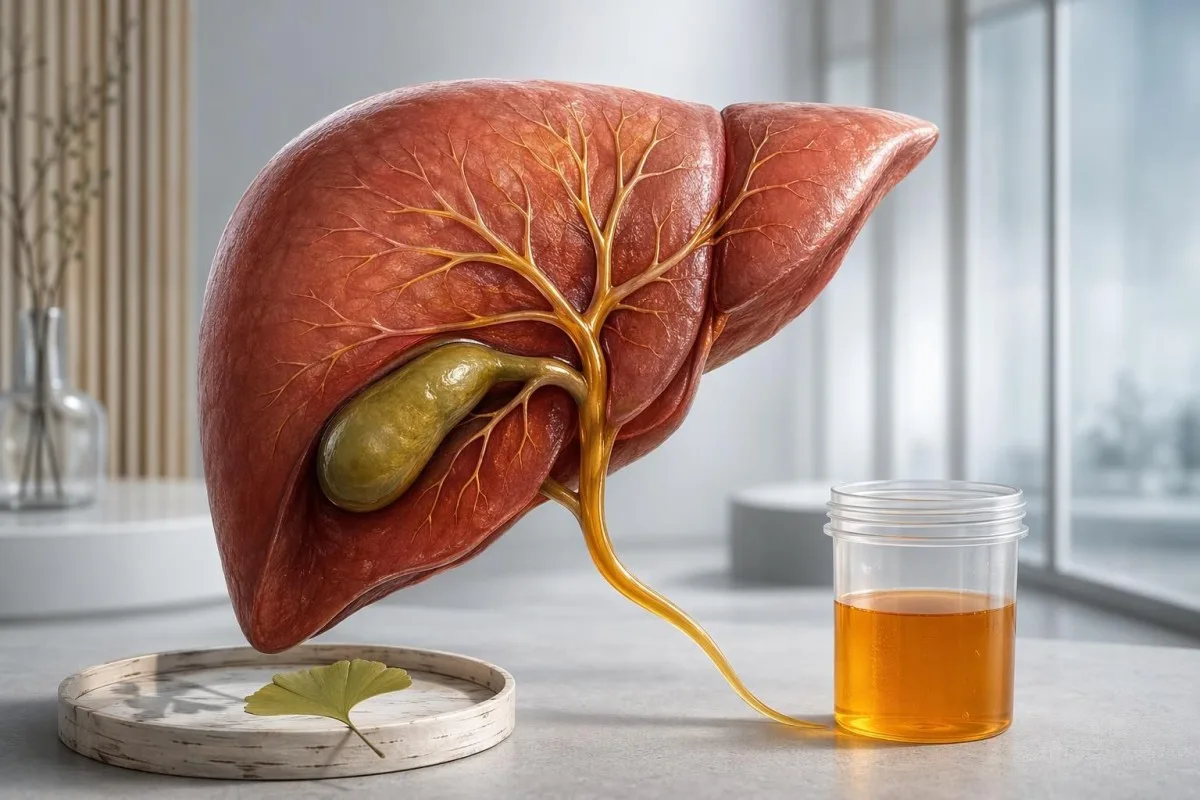
A patient-focused guide to separating harmless bilirubin bumps from jaundice, obstruction, hemolysis and liver warning patterns.


- Total bilirubin above 3.0 mg/dL or 51 µmol/L often makes jaundice visible and deserves prompt medical advice.
- Borderline bilirubin meaning is usually 1.2-2.0 mg/dL with otherwise normal liver enzymes, often from fasting, dehydration or Gilbert syndrome.
- Dark cola urine suggests conjugated bilirubin in urine; normal urine should have no measurable bilirubin.
- Pale or clay-colored stool with dark urine suggests reduced bile flow and needs same-day clinical assessment.
- Direct bilirubin above 0.3 mg/dL or more than 20% of total bilirubin points away from simple Gilbert syndrome.
- High ALP and GGT with raised direct bilirubin is a cholestatic or obstruction pattern, not just a harmless bilirubin bump.
- Anemia plus high indirect bilirubin raises concern for hemolysis, especially with high LDH, low haptoglobin and raised reticulocytes.
- New yellow eyes, fever, confusion, severe right-upper-abdominal pain or easy bruising should not wait for a routine appointment.
When bilirubin needs same-day medical advice
Worry about bilirubin when total bilirubin is above about 3.0 mg/dL or 51 µmol/L, rising quickly, mostly direct, or paired with yellow eyes, dark urine, pale stools, fever, right-upper-abdominal pain, confusion, easy bruising or anemia symptoms. A slightly high bilirubin around 1.2-2.0 mg/dL with normal ALT, AST, ALP, GGT and CBC is often rechecked rather than treated.
The practical split is simple: isolated mild bilirubin is often benign, while bilirubin plus symptoms is not. In clinic, I worry much more about a patient with bilirubin 2.1 mg/dL and cola-colored urine than someone with 1.8 mg/dL after fasting, normal enzymes and no yellowing.
Kantesti is an AI blood test analyzer that reads bilirubin alongside ALT, AST, ALP, GGT and CBC rather than treating one yellow flag as a diagnosis. Our Kantesti story matters here because bilirubin interpretation is exactly where pattern-reading beats single-number panic.
Thomas Klein, MD, has seen many patients frightened by a bilirubin of 1.4 mg/dL printed in red on a portal at 10 p.m. The number matters, yes, but the company it keeps matters more: pale stools, dark urine, itching, fever, anemia, low platelets or abnormal clotting change the conversation immediately.
Direct versus indirect bilirubin changes the story
Direct bilirubin is processed by the liver and can spill into urine; indirect bilirubin is not water-soluble and usually reflects bilirubin production, transport or conjugation. Adult total bilirubin is commonly about 0.2-1.2 mg/dL or 3-21 µmol/L, though reference ranges vary by laboratory.
A direct bilirubin above 0.3 mg/dL or above roughly 20% of total bilirubin suggests a conjugated component, which clinicians link to hepatocellular injury or impaired bile flow. The American College of Gastroenterology guideline recommends fractionating bilirubin when liver chemistries are abnormal because total bilirubin alone can mislead (Kwo et al., 2017).
Indirect bilirubin often rises when red cells are being broken down faster, when the liver is temporarily overwhelmed, or when conjugation is genetically slower, as in Gilbert syndrome. For a more granular pattern guide, our article on direct and indirect bilirubin walks through the common combinations doctors use.
One odd but useful clue: urine bilirubin almost always means direct bilirubin, because indirect bilirubin cannot dissolve well enough to pass through the kidney filter. That is why yellow eyes without dark urine can behave very differently from yellow eyes with tea-colored urine.
Borderline bilirubin meaning: the numbers I use
Borderline bilirubin meaning usually refers to total bilirubin just above the lab range, often 1.2-2.0 mg/dL or 21-34 µmol/L, with no alarming symptoms. In that band, the next step is usually fractionated bilirubin and a pattern check, not an emergency diagnosis.
Labs differ. Some European reports flag total bilirubin above 17 µmol/L while many US labs flag above 1.2 mg/dL, so the same patient can look abnormal in one country and acceptable in another. This is why a portal flag should be read with the unit, reference interval and prior baseline.
A bilirubin of 1.5 mg/dL with ALT 22 IU/L, AST 24 IU/L, ALP 76 IU/L and normal hemoglobin behaves very differently from bilirubin 1.5 mg/dL with ALP 330 IU/L. If your report says normal but you still feel unwell, our guide to normal-limit flags explains why ranges are not the whole story.
In our analysis of 2M+ blood tests, isolated borderline bilirubin is one of the commonest anxiety triggers because it is visible, literally, in people's minds. Most of those cases are not liver failure; the work is finding the minority with a conjugated or obstructive pattern.
Yellow skin or yellow eyes: what the color means
Yellow eyes or yellow skin usually becomes visible when total bilirubin reaches about 2.5-3.0 mg/dL or 43-51 µmol/L. New jaundice in an adult is never something I would dismiss without checking direct bilirubin, liver enzymes, blood count and urine findings.
The whites of the eyes often show color earlier than skin because the sclera binds bilirubin-rich pigment differently. In darker skin tones, eye color, urine color and stool color are often more reliable clues than subtle skin changes.
Patients sometimes mistake carotene from carrots, sweet potato or supplements for jaundice. Carotenemia can yellow the palms and soles but usually spares the whites of the eyes; our guide to skin-related blood tests explains when color changes deserve lab work.
One clinical trick I still use: check color in daylight, not under warm bathroom lighting. If a partner says the eyes look yellow, and the urine has turned dark despite normal hydration, I advise same-day care even before the repeat lab is back.
Dark urine and pale stools point to conjugated bilirubin
Dark urine with pale or clay-colored stool is a red-flag bilirubin pattern because it suggests conjugated bilirubin is leaving through urine while too little bile pigment reaches the gut. Normal urine should have no detectable bilirubin on dipstick testing.
Dark urine from dehydration usually improves after fluids and remains yellow to amber. Bilirubin-positive urine is often tea or cola-colored and may persist even when the person is drinking normally; our urinalysis guide covers how urine bilirubin and urobilinogen are read together.
Pale stool is different from one light bowel movement after a low-fat meal. Repeated chalky, gray or clay-colored stool for 24-48 hours, especially with dark urine or itching, pushes me to think about bile flow obstruction until proven otherwise.
Kantesti AI interprets urine bilirubin as a context marker, not a standalone diagnosis. When urine bilirubin is positive and serum direct bilirubin is high, Kantesti's neural network flags the combination as more concerning than either result alone.
Liver obstruction patterns: ALP, GGT, ALT and AST
A bilirubin rise is more concerning when ALP and GGT are high, because that pattern suggests cholestasis or bile duct obstruction. ALT and AST tell a different story: they rise more with liver-cell injury than with pure blockage.
A classic obstruction pattern might show total bilirubin 4.2 mg/dL, direct bilirubin 3.1 mg/dL, ALP 420 IU/L and GGT 310 IU/L, with only moderate ALT and AST elevation. Newsome et al. in Gut advise interpreting abnormal liver blood tests by pattern rather than by isolated flags (Newsome et al., 2018).
The British guideline and EASL cholestasis guidance both treat cholestatic patterns as a reason to consider imaging, usually ultrasound first, when symptoms or persistence are present (EASL, 2009; Newsome et al., 2018). For the exact components patients see, our standard liver panel guide explains what ALT, AST, ALP, GGT, albumin and bilirubin each add.
GGT is useful because ALP can come from bone, placenta or liver. If ALP is high and GGT is normal, I slow down and look for bone, vitamin D, growth or pregnancy-related explanations before assuming bile duct disease.
Anemia clues: when bilirubin comes from red-cell breakdown
High indirect bilirubin with anemia can mean hemolysis, which is faster breakdown of red cells. The typical hemolysis cluster is indirect bilirubin above range, high LDH, low haptoglobin and raised reticulocytes.
A hemoglobin drop from 13.8 to 10.9 g/dL over a few weeks changes the meaning of bilirubin 2.0 mg/dL. The bilirubin may be a by-product of cell turnover rather than a blocked bile duct, and that distinction affects urgency and treatment.
Kantesti is an AI lab test interpretation service that checks bilirubin against hemoglobin, reticulocytes, LDH and haptoglobin in the same report. If you have anemia clues, our article on haptoglobin patterns explains why low haptoglobin can be so informative.
In my experience, patients with hemolysis often report fatigue, shortness of breath, rapid heartbeat or darker urine after exertion. Jaundice from hemolysis usually has less pale stool than obstruction, though real life is messy and mixed patterns do happen.
Slightly high bilirubin after fasting, illness or exercise
A slightly high bilirubin after fasting, dehydration, intense exercise or a recent viral illness is often temporary when other liver tests are normal. Gilbert syndrome commonly causes intermittent unconjugated bilirubin elevations, often below 3.0 mg/dL.
Gilbert syndrome affects roughly 3-10% of many populations, though prevalence depends on ancestry and how it is tested. The usual pattern is normal ALT, AST, ALP, GGT and CBC, with indirect bilirubin drifting up during fasting, stress, sleep loss or illness.
A 28-year-old runner might show bilirubin 1.9 mg/dL after a long fasted training session and return to 1.0 mg/dL two weeks later after eating normally before the draw. Our fasting bilirubin guide goes deeper into why caloric restriction can unmask this pattern.
The recheck I like is boring but effective: hydrate normally, avoid extreme exercise for 24-48 hours, do not fast longer than requested, and repeat fractionated bilirubin with a liver panel. If direct bilirubin stays high, the story changes.
Medicines, supplements and alcohol can shift bilirubin
Medicines, supplements and alcohol can raise bilirubin by irritating liver cells, slowing bile flow or changing red-cell turnover. Any new bilirubin rise should be reviewed against the last 4-12 weeks of prescriptions, over-the-counter products and herbal supplements.
Common culprits include anabolic steroids, some antibiotics, antiepileptics, antiretrovirals and high-risk bodybuilding or weight-loss supplements. Alcohol more often raises GGT and AST, but bilirubin can climb when liver injury or bile flow impairment becomes significant.
The evidence around many liver supplements is honestly mixed, and product purity varies more than patients expect. Before adding products marketed for detox, review our liver supplement risks because green labels do not guarantee liver safety.
Kantesti's neural network weighs timing heavily: a bilirubin rise 10 days after starting a new medication is different from a stable bilirubin pattern present for 10 years. Bring the bottle list, doses and start dates to your clinician; it saves time.
Gallstones and bile duct blockage: symptoms that change risk
Gallstones become more urgent when bilirubin rises with fever, chills, vomiting or right-upper-abdominal pain. A blocked common bile duct often raises direct bilirubin, ALP and GGT before the problem is obvious from symptoms alone.
The pain pattern is often under the right ribs or upper middle abdomen, sometimes going to the back or right shoulder. If fever joins jaundice and pain, clinicians worry about cholangitis, a potentially serious bile duct infection requiring urgent assessment.
Not every gallstone blocks anything. Many people have stones without bilirubin changes, but pale stools or worsening itch suggest bile is not reaching the intestine; our guide to pale stool causes explains why stool color is such a useful clue.
A typical ultrasound-first pathway looks for gallbladder stones, bile duct dilation and liver texture. If the duct is dilated or bilirubin keeps rising, clinicians may move to MRCP, endoscopic ultrasound or ERCP depending on local services and severity.
Children, newborns and pregnancy have different rules
Newborn bilirubin is interpreted by age in hours, gestational age and risk factors, not by adult cutoffs. Pregnancy also changes the differential diagnosis, because itching, high bile acids or cholestatic liver tests can signal pregnancy-specific liver disease.
The 2022 American Academy of Pediatrics guideline uses hour-specific bilirubin thresholds to decide monitoring and phototherapy for infants 35 weeks' gestation or older (AAP Subcommittee on Hyperbilirubinemia, 2022). A newborn bilirubin that is acceptable at 72 hours may be unsafe at 18 hours, especially with prematurity or hemolysis risk.
In pregnancy, itching of palms and soles with abnormal bile acids can suggest intrahepatic cholestasis of pregnancy even before bilirubin is impressive. Adult reference ranges are a poor substitute for obstetric review when symptoms and gestational age point in that direction.
Children are not miniature adults; their ALP may be high from growth, and their normal ranges change quickly. Our pediatric ranges guide helps parents avoid comparing a toddler's report with an adult table.
Blood test for yellow skin: what to ask for
The best blood test for yellow skin is not one test but a bundle: fractionated bilirubin, ALT, AST, ALP, GGT, albumin, PT/INR, CBC and reticulocyte count. Urinalysis for bilirubin and urobilinogen often adds fast context.
Kantesti is an AI-powered blood test analysis tool used by 2M+ people across 127 countries, and our platform reads bilirubin best when the uploaded report includes both liver chemistry and CBC data. If your result is only total bilirubin, ask whether direct and indirect fractions can be added.
The high-yield add-ons depend on the pattern: haptoglobin and LDH for suspected hemolysis, hepatitis serology for infection risk, autoimmune markers for persistent unexplained liver injury, and lipase if pain suggests pancreatic involvement. Our biomarker guide lists many of these markers in patient-friendly language.
Do not forget clotting. A high PT/INR or low albumin can imply reduced liver synthetic function, which is different from a small bilirubin bump; INR above 1.5 with jaundice is a same-day medical issue in my book.
Thomas Klein, MD, often tells patients to bring three things to the visit: the current report, the oldest comparable report and a medication list with start dates. That trio answers more bilirubin questions than a long symptom diary alone.
Repeating bilirubin safely and spotting lab errors
Repeat bilirubin testing is reasonable for an isolated mild elevation, but not for jaundice with red flags. For a stable adult with total bilirubin 1.3-2.0 mg/dL, normal enzymes and no symptoms, many clinicians repeat in 1-4 weeks with fractions.
Pre-analytic details matter. Prolonged fasting, delayed processing, hemolysed samples and unit conversion errors can all distort interpretation, which is why the repeat should be done under calmer conditions rather than after a dehydrating workout or acute illness.
Kantesti AI supports trend analysis by comparing the current bilirubin to prior reports, not just the printed reference range. Our clinical validation page describes how clinician oversight and benchmark testing shape these interpretation safeguards.
A delta matters more than many people think: bilirubin moving from 0.8 to 2.4 mg/dL in a month deserves a different response from bilirubin sitting between 1.4 and 1.8 mg/dL for five years. The slope, symptoms and fraction decide the urgency.
What to do today if your bilirubin is high
As of July 15, 2026, my advice is to seek same-day care for high bilirubin with yellow eyes, dark urine, pale stools, fever, severe abdominal pain, confusion, fainting, pregnancy, newborn jaundice or bleeding/bruising. If bilirubin is mildly high and isolated, book a non-urgent review and repeat fractionated testing.
Go urgent if you have jaundice plus fever, right-upper-abdominal pain or vomiting, because that combination can reflect bile duct infection or obstruction. Go urgent if you are drowsy, confused, bleeding easily or your INR is high; those are not watch-and-wait findings.
If you feel well and the only abnormality is total bilirubin 1.4 mg/dL, ask for direct bilirubin, repeat liver enzymes and CBC rather than spiraling. Most patients find it reassuring to see the pattern written down: isolated indirect bilirubin is a very different animal from direct bilirubin with ALP and GGT elevation.
Kantesti content is medically reviewed with physician oversight, and readers can see the clinicians behind our work on the medical advisory board. Still, a lab app cannot examine your abdomen, see your eye color in daylight or judge how ill you look; those human details still matter.
Frequently Asked Questions
When should I worry about high bilirubin?
You should worry about high bilirubin when total bilirubin is above about 3.0 mg/dL or 51 µmol/L, when it is rising quickly, or when it comes with yellow eyes, dark urine, pale stools, fever, confusion, easy bruising or right-upper-abdominal pain. A mildly high total bilirubin of 1.2-2.0 mg/dL can be benign if ALT, AST, ALP, GGT and CBC are normal. New jaundice in an adult deserves prompt medical advice even before all repeat tests are back.
What does borderline bilirubin mean?
Borderline bilirubin usually means total bilirubin just above the laboratory range, often around 1.2-2.0 mg/dL or 21-34 µmol/L. If direct bilirubin, liver enzymes and blood count are normal, common explanations include Gilbert syndrome, fasting, dehydration, recent illness or a normal personal baseline. Borderline bilirubin becomes more concerning if direct bilirubin is high, ALP or GGT is elevated, or symptoms such as dark urine or pale stools appear.
Can slightly high bilirubin be harmless?
Yes, slightly high bilirubin can be harmless when it is isolated, stable and mainly indirect. Gilbert syndrome commonly causes intermittent bilirubin elevations, often below 3.0 mg/dL, especially during fasting, stress, dehydration or illness. It is less reassuring if the rise is new, direct bilirubin is elevated, or liver enzymes, hemoglobin or urine bilirubin are abnormal.
What blood test should I ask for if my skin looks yellow?
For yellow skin or yellow eyes, ask for fractionated bilirubin, ALT, AST, ALP, GGT, albumin, PT/INR, CBC and reticulocyte count. Urinalysis for bilirubin and urobilinogen can help distinguish conjugated bilirubin patterns from dehydration or pigment changes. If bilirubin is above 3.0 mg/dL or symptoms are present, testing should be arranged promptly rather than delayed for a routine annual check.
Does dark urine always mean bilirubin is dangerous?
Dark urine does not always mean dangerous bilirubin because dehydration, foods and medicines can darken urine. However, cola-colored urine that persists despite normal hydration, especially with yellow eyes or pale stools, suggests conjugated bilirubin in urine and needs medical review. Normal urine should have no detectable bilirubin on dipstick testing.
Can fasting raise bilirubin before a blood test?
Fasting can raise bilirubin, especially in people with Gilbert syndrome, and the increase is usually indirect bilirubin. A typical fasting-related result might be total bilirubin 1.5-2.5 mg/dL with normal ALT, AST, ALP, GGT and CBC. Repeating the test after normal hydration, avoiding extreme exercise for 24-48 hours and not fasting longer than requested often clarifies the pattern.
Will I need hepatitis testing if my bilirubin is high?
Possibly, but not everyone with high bilirubin needs hepatitis testing. A clinician may order hepatitis A, B, or C tests when jaundice is new, liver enzymes are elevated, or there are relevant exposures; isolated indirect bilirubin elevation with normal tests often points elsewhere.
Get AI-Powered Blood Test Analysis Today
Join over 2 million users worldwide who trust Kantesti for instant, accurate lab test analysis. Upload your blood test results and receive comprehensive interpretation of 15,000+ biomarkers in seconds.
📚 Referenced Research Publications
Klein, T., Mitchell, S., & Weber, H. (2026). Multilingual AI Assisted Clinical Decision Support for Early Hantavirus Triage: Design, Engineering Validation, and Real-World Deployment Across 50,000 Interpreted Blood Test Reports. Kantesti AI Medical Research.
Klein, T., Mitchell, S., & Weber, H. (2026). A Pre-Registered, Rubric-Based Automated Technical Benchmark of the Kantesti Blood-Test Interpretation Engine on 100,000 Synthetic Test Cases. Kantesti AI Medical Research.
📖 External Medical References
⚕️ Medical Disclaimer
This article is for educational purposes only and does not constitute medical advice. Always consult a qualified healthcare provider for diagnosis and treatment decisions.
E-E-A-T Trust Signals
Experience
Physician-led clinical review of lab interpretation workflows.
Expertise
Laboratory medicine focus on how biomarkers behave in clinical context.
Authoritativeness
Written by Dr. Thomas Klein with review by Dr. Sarah Mitchell and Prof. Dr. Hans Weber.
Trustworthiness
Evidence-based interpretation with clear follow-up pathways to reduce alarm.