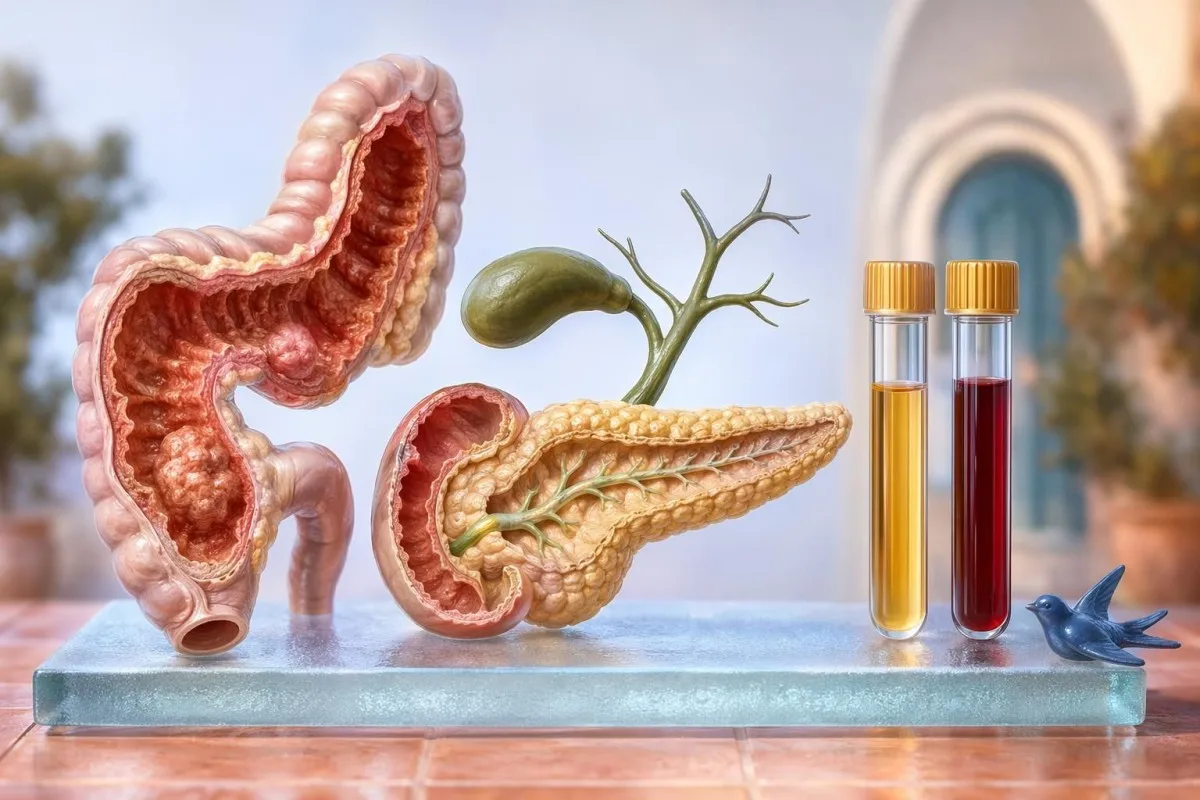
CEA and CA 19-9 are not interchangeable cancer tests. The useful clue is usually the pattern: cancer type, baseline value, benign triggers, and whether the number keeps moving in the same direction.


- CEA vs CA 19-9 usually means colorectal surveillance versus pancreaticobiliary monitoring, not a general cancer screen.
- CEA tumor marker is commonly normal below 3 ng/mL in non-smokers and below 5 ng/mL in smokers, though lab cutoffs vary.
- CA 19-9 test is usually reported as normal below 37 U/mL, but bile duct blockage can raise it into the hundreds or thousands without cancer.
- Colon cancer marker use is strongest for CEA trends after treatment; a single normal CEA does not rule out colon cancer.
- Pancreatic cancer monitoring often uses CA 19-9, but 5-10% of people are Lewis antigen negative and may not produce CA 19-9 at all.
- Benign CEA rises can come from smoking, COPD, inflammatory bowel disease, pancreatitis, liver disease, kidney impairment, and hypothyroidism.
- Benign CA 19-9 rises often track with cholestasis, cholangitis, pancreatitis, liver inflammation, ovarian cysts, and uncontrolled diabetes.
- Trend interpretation usually requires the same lab method, at least two comparable results, and clinical context such as bilirubin, imaging, symptoms, and treatment timing.
CEA vs CA 19-9 in plain clinical language
CEA vs CA 19-9 mainly separates colorectal cancer follow-up from pancreaticobiliary cancer monitoring. CEA is used most often after colon or rectal cancer treatment; CA 19-9 is used most often in pancreatic, bile duct, and gallbladder disease. Neither marker is a reliable screening test for healthy people. Kantesti is an AI blood test analyzer that reads tumor markers beside liver enzymes, bilirubin, CBC changes, and prior results rather than treating one number as a diagnosis.
As Thomas Klein, MD, I often see the same worry in portal messages: a marker is above range, so the patient assumes cancer has been found. That is rarely how these tests work. A CEA of 6.2 ng/mL in a smoker and a CA 19-9 of 52 U/mL during gallstone jaundice are very different from the same values rising month after month after cancer treatment.
The 2006 ASCO gastrointestinal tumor marker guideline states that CEA and CA 19-9 should not be used as stand-alone diagnostic or population screening tests (Locker et al., 2006). I would rather see one well-documented trend than five isolated printouts with missing dates, because assay method, timing, and symptoms change the meaning.
If your result is rising after treatment, start with our focused guide to tumor marker trends before assuming the worst. The practical question is not simply high or normal; it is whether the marker fits the cancer type, the treatment timeline, and the rest of the lab pattern.
What the CEA tumor marker actually measures
The CEA tumor marker measures carcinoembryonic antigen, a glycoprotein expressed at low levels in adult tissues and more strongly by some adenocarcinomas. CEA is most useful in colorectal cancer follow-up, especially when the patient had an elevated baseline before surgery.
CEA is not a pure colon cancer marker. It may rise in colorectal, gastric, pancreatic, lung, breast, and medullary thyroid cancers, but its day-to-day oncology value is strongest in treated colon and rectal cancer. In early stage colorectal cancer, CEA can be normal; sensitivity for stage I disease is often below 40%.
For colon cancer screening, stool tests and colonoscopy still carry the main workload. If you are comparing screening choices rather than post-treatment markers, our FIT versus colonoscopy guide is a more relevant starting point than ordering CEA privately.
A pre-treatment CEA of 18 ng/mL that falls to 2.4 ng/mL after curative surgery is clinically useful because it creates a personal baseline. A person whose CEA was 1.8 ng/mL at diagnosis may never show a marker rise even if disease returns; that is why imaging, symptoms, and colonoscopy do not disappear from follow-up.
What the CA 19-9 test tells doctors
The CA 19-9 test measures a carbohydrate antigen linked to pancreaticobiliary tissue and mucin-producing cancers. It is most often used in pancreatic cancer, cholangiocarcinoma, gallbladder cancer, and selected gastric cancers, but it is highly vulnerable to false elevation from bile flow problems.
In symptomatic pancreatic cancer, CA 19-9 is often quoted at roughly 79-81% sensitivity and 82-90% specificity, depending on cutoff and study population; Ballehaninna and Chamberlain described these ranges in their 2012 evidence review. Those numbers sound better than they feel in clinic, because a jaundiced patient with stones can look biochemically similar to a patient with cancer.
The overlooked detail is Lewis antigen status. About 5-10% of people are Lewis antigen negative and cannot make meaningful CA 19-9, so a CA 19-9 of 4 U/mL does not rule out pancreatic cancer in the wrong clinical setting. When stool changes and malabsorption are part of the picture, pancreatic function testing such as stool elastase may add a different kind of clue.
I have seen CA 19-9 values above 1,000 U/mL fall dramatically after biliary drainage when the final diagnosis was not pancreatic cancer. That is why a marker drawn during bilirubin of 8 mg/dL should usually be repeated after obstruction improves, often 2-4 weeks later.
Reference ranges doctors use for CEA and CA 19-9
Typical adult reference ranges are CEA below 3 ng/mL in non-smokers, CEA below 5 ng/mL in smokers, and CA 19-9 below 37 U/mL. These cutoffs are screening flags, not verdicts, and each laboratory may use a slightly different assay.
A CEA of 4.8 ng/mL can be normal for a smoker in one lab and flagged high in another. A CA 19-9 of 39 U/mL is technically above many ranges, but I would not interpret it without bilirubin, alkaline phosphatase, GGT, symptoms, and the reason the test was ordered.
Unit confusion causes unnecessary panic. CEA is usually reported in ng/mL, while CA 19-9 is usually reported in U/mL or kU/L; if a result seems to jump after moving countries, check our guide on different lab units before comparing values.
Kantesti AI maps marker values against its larger biomarker guide so that bilirubin of 4.2 mg/dL changes the interpretation of CA 19-9, and smoking history changes the interpretation of CEA. That context is not decoration; it is the test.
Cancer type clues: when each marker is used
CEA is the more established marker for colorectal cancer surveillance, while CA 19-9 is the more typical marker for pancreatic and bile duct cancers. In gastric and other gastrointestinal cancers, doctors may use either marker selectively, but neither replaces tissue diagnosis or imaging.
For treated stage II or III colon cancer, many oncology protocols check CEA every 3-6 months for several years if the patient would be fit for surgery or systemic treatment if recurrence were found. That is very different from ordering CEA in a healthy 34-year-old with bloating.
CA 19-9 is often tracked in pancreatic cancer before treatment and during therapy, commonly every 1-3 months depending on the treatment plan. A falling CA 19-9 after chemotherapy can be encouraging, but I have also seen it fall just because a bile duct stent started working.
Liquid biopsy and circulating tumor DNA are changing some follow-up conversations, but they answer different questions from protein markers. Our plain-language primer on liquid biopsy limits explains why ctDNA, CEA, and CA 19-9 should not be mashed into one mental category.
Why CEA can rise without cancer
CEA can rise without cancer because smoking, chronic lung disease, inflammatory bowel disease, pancreatitis, liver disease, kidney impairment, and hypothyroidism can all increase circulating CEA. Mild isolated CEA elevations between 5 and 10 ng/mL are often non-malignant.
The liver clears CEA, so cirrhosis, cholestasis, and hepatitis can push the marker up even when no cancer is present. If CEA rises with alkaline phosphatase or GGT, I first ask whether the liver pattern explains the marker; our GGT range guide covers that distinction well.
Smokers often run a CEA baseline 1-3 ng/mL higher than non-smokers. A 61-year-old smoker with COPD and CEA of 6.1 ng/mL needs a thoughtful review, not an automatic cancer label, especially if the value is stable over 6-12 months.
Inflammatory bowel disease can also raise CEA, particularly during active colitis. The sneaky part is that IBD itself can increase colorectal cancer risk over time, so the answer may be colonoscopy surveillance rather than repeating CEA every few weeks.
Why CA 19-9 can rise without cancer
CA 19-9 can rise without cancer when bile flow is blocked or pancreaticobiliary tissue is irritated. Gallstones, cholangitis, pancreatitis, cirrhosis, liver inflammation, diabetes, and some benign cysts can push CA 19-9 above 37 U/mL.
Bile duct obstruction is the classic trap. A CA 19-9 of 480 U/mL with bilirubin of 6 mg/dL may fall below 50 U/mL after drainage, while the same CA 19-9 with normal bilirubin and a pancreatic mass means something else entirely.
Pale stools, dark urine, itching, and jaundice make CA 19-9 interpretation much less straightforward. If those symptoms are present, our guide to pale stool causes explains why bile flow markers often matter before tumor marker interpretation.
Pancreatitis is another confounder. I usually want amylase, lipase, liver enzymes, bilirubin, imaging, and timing of pain before I assign much meaning to a CA 19-9 drawn during an acute episode.
Why doctors trust trends more than single values
Doctors trust tumor marker trends because single values are distorted by assay variation, smoking, inflammation, bile obstruction, and recent treatment. A sustained rise across two or more comparable tests is usually more meaningful than one abnormal result.
Kantesti is an AI biomarker interpretation platform that treats CEA and CA 19-9 as time-series signals, not yes-or-no cancer switches. A change from 3.1 to 3.6 ng/mL may be noise, while a change from 3.1 to 8.9 ng/mL over three visits is a different conversation.
Analytical variation matters. For many immunoassays, a 20-30% shift can occur from biological and method variation, so I am more persuaded by a consistent slope than by one borderline marker taken after an infection or procedure.
The FACS randomized clinical trial in JAMA found that scheduled CEA and CT follow-up detected treatable colorectal cancer recurrence earlier in some patients, but CEA alone was not a magic safety net (Primrose et al., 2014). For patients saving serial reports, our lab trend graph guide shows how slope, spacing, and baseline change the interpretation.
How CEA and CA 19-9 behave after treatment
After successful colorectal cancer surgery, an elevated CEA should usually fall toward baseline within 4-6 weeks. After pancreaticobiliary treatment, CA 19-9 trends are interpreted more cautiously because drainage, bilirubin changes, and inflammation can move the marker independent of cancer burden.
CEA has a short serum half-life, often estimated around 3-7 days, but clinicians allow several weeks after surgery before judging the new baseline. A CEA of 22 ng/mL before colon surgery and 4 ng/mL six weeks later is reassuring; 22 to 18 ng/mL is not.
CA 19-9 can fall quickly when obstruction resolves, but I usually wait until bilirubin has improved before calling a trend therapeutic. A patient can look like they are responding to chemotherapy when the real biochemical event is a stent restoring bile drainage.
Chemotherapy also shifts CBC, liver enzymes, albumin, and inflammatory markers, so tumor marker interpretation during treatment should be paired with the full blood picture. Our guide to chemo lab changes explains why neutrophils, platelets, bilirubin, and albumin can change the meaning of a marker trend.
Why these markers are poor screening tests
CEA and CA 19-9 are poor screening tests because many early cancers do not raise them and many benign conditions do. In a low-risk person with no symptoms, a mildly abnormal marker often creates more false alarms than useful diagnoses.
A normal CEA does not rule out colon cancer. Some early colorectal cancers produce little or no CEA, which is why stool-based screening and colonoscopy remain central; a negative marker can be falsely comforting.
A mildly high CA 19-9 in a healthy person often triggers scans that find incidental cysts, fatty liver, or gallstones. Incidental findings are not harmless; they can lead to repeat imaging, anxiety, and procedures with small but real risks.
If your concern is colon cancer screening, a positive stool DNA or stool blood test needs its own pathway. Our article on Cologuard results explains why a positive stool screening test is followed by colonoscopy rather than by CEA.
What doctors check after an abnormal marker
After an abnormal CEA or CA 19-9, doctors first check the reason for testing, prior cancer history, symptoms, smoking status, liver enzymes, bilirubin, and whether the same lab method was used. The next step is often repeat testing plus targeted imaging, not immediate treatment.
For CEA, I ask about smoking, COPD, bowel inflammation, recent infection, liver disease, and prior colorectal cancer stage. For CA 19-9, I look hard at bilirubin, alkaline phosphatase, GGT, recent pancreatitis, diabetes control, and whether there is jaundice.
Weight loss changes the threshold for action. A CA 19-9 of 65 U/mL with normal imaging may be watched, but 65 U/mL plus new jaundice, pale stools, and 8 kg unintentional weight loss deserves urgent evaluation.
When symptoms are vague, a broader lab pattern can reveal the safer next step. Our unexplained weight loss guide lists the CBC, CRP, ESR, thyroid, liver, kidney, glucose, and nutritional markers clinicians often check before narrowing the workup.
How AI can help without overcalling cancer
AI can help interpret tumor markers when it compares the result with the full lab panel, previous values, symptoms, and known cancer history. AI should not diagnose cancer from CEA or CA 19-9 alone, and our medical review process is designed around that boundary.
Kantesti AI is an AI-powered blood test analysis tool used by 2M+ people across 127+ countries, and our platform flags tumor markers as context-dependent findings. A CA 19-9 rise with bilirubin of 5 mg/dL is handled differently from a CA 19-9 rise with normal bile flow markers.
Our engineering team explains the model architecture, multilingual handling, and report parsing in the technology guide. In clinical review, the marker is never isolated; it is read beside liver function, inflammatory markers, CBC, kidney function, and trend history.
Accuracy claims in medical AI need clinical oversight, not marketing sparkle. Our medical validation page describes how Kantesti AI is benchmarked and reviewed, including escalation language for results that should be discussed with an oncologist or treating physician.
Lab method issues that can distort results
CEA and CA 19-9 results can be distorted by different assay platforms, sample handling, heterophile antibodies, high-dose biotin, and simple reporting mismatches. A suspicious jump should be confirmed before major decisions are made.
A patient who changes hospitals may unknowingly change immunoassay platforms. A CEA of 4.2 ng/mL on one platform and 5.1 ng/mL on another may not represent true biological progression, especially if the interval is short and imaging is stable.
High-dose biotin can interfere with some immunoassays, particularly when people take 5-10 mg/day for hair or nail supplements. Heterophile antibodies are rarer, but they can create stubborn results that do not match imaging, symptoms, or biology.
Thomas Klein, MD, often tells patients to ask one boring question before panicking: was this the same lab, same assay, and same clinical situation? Our lab error checks article explains delta checks, sample mix-ups, OCR mistakes, and result patterns that deserve repeat confirmation.
Questions to ask before you panic
The safest questions are practical: why was the marker ordered, what was my baseline, what benign causes fit, and what repeat timing makes sense? A marker result without a plan usually creates anxiety rather than clarity.
Ask whether the marker was elevated before treatment. If your CEA was 24 ng/mL before colon surgery, a rise from 2.1 to 6.8 ng/mL later is more meaningful than the same rise in someone whose cancer never produced CEA.
Ask whether liver or bile tests explain the result. If CA 19-9 is 120 U/mL and bilirubin is 3.5 mg/dL, many clinicians repeat the marker after the bile problem is treated rather than escalating immediately.
Ask how soon to repeat it. For borderline isolated results, 4-8 weeks is a common practical interval; for post-treatment oncology surveillance, the schedule is set by the treating team. If you need help organizing serial records for a consultation, our blood test summary guide can make the visit more efficient.
Bottom line and red flags that should not wait
The bottom line is that CEA and CA 19-9 are follow-up and context markers, not cancer yes-or-no tests. Seek prompt medical care if an abnormal marker comes with jaundice, progressive weight loss, persistent vomiting, black stools, new bowel obstruction symptoms, severe abdominal pain, or a rapidly rising trend.
A CEA above 10 ng/mL after colorectal cancer treatment deserves timely review, especially if it is rising on repeat testing. A CA 19-9 above 100 U/mL with jaundice or a pancreatic mass is not automatically cancer, but it should not sit in an inbox for a month.
Kantesti is an AI lab test interpretation service, not a replacement for your oncologist, gastroenterologist, surgeon, or primary doctor. Our role is to make the pattern clearer so that the right human conversation happens faster.
This article reflects physician-reviewed interpretation standards used by our clinical team, with medical governance described by our Medical Advisory Board. If your marker is rising after cancer treatment, call the team that knows your cancer stage, operation date, chemotherapy timeline, and imaging history.
Frequently Asked Questions
Is CEA or CA 19-9 better for colon cancer?
CEA is the more useful marker for colon and rectal cancer follow-up, especially when it was elevated before treatment. Typical CEA reference limits are below 3 ng/mL for non-smokers and below 5 ng/mL for smokers, but a normal CEA does not rule out colon cancer. CA 19-9 is not the usual colon cancer marker, although it may be checked in selected advanced gastrointestinal cancers. Screening for colon cancer should use validated pathways such as FIT, stool DNA testing, or colonoscopy rather than CEA.
Can CA 19-9 be high without cancer?
Yes, CA 19-9 can be high without cancer, especially when bile flow is blocked. Gallstones, cholangitis, pancreatitis, cirrhosis, hepatitis, diabetes, and benign cysts can raise CA 19-9 above the common cutoff of 37 U/mL. Values in the hundreds or even above 1,000 U/mL can occur with severe cholestasis. Doctors often repeat CA 19-9 after bilirubin improves, commonly after 2-4 weeks.
Can CEA be high without cancer?
Yes, CEA can rise without cancer, and mild elevations between 5 and 10 ng/mL are often benign. Smoking, COPD, inflammatory bowel disease, pancreatitis, liver disease, kidney impairment, and hypothyroidism can all raise CEA. A stable CEA of 6 ng/mL in a smoker has a different meaning from a CEA rising from 3 to 12 ng/mL after colon cancer surgery. Trends and clinical context matter more than one result.
What CA 19-9 level is concerning?
A CA 19-9 above 37 U/mL is usually flagged as abnormal, but concern depends on context. A value above 100 U/mL is more concerning when paired with jaundice, a pancreatic mass, unexplained weight loss, or abnormal bile duct imaging. A value above 1,000 U/mL can be seen in advanced pancreaticobiliary cancer, but severe benign obstruction can also produce very high results. Bilirubin and imaging are essential for interpretation.
What CEA level suggests cancer recurrence?
No single CEA level proves recurrence, but a persistent rise above 10 ng/mL after colorectal cancer treatment usually warrants prompt review. A marker that doubles or rises across two or more comparable tests is more concerning than one borderline result. After curative surgery, a previously elevated CEA usually falls toward baseline within 4-6 weeks. Doctors interpret the trend with CT imaging, symptoms, colonoscopy history, and the original cancer stage.
Should I order CEA and CA 19-9 as a private cancer screen?
CEA and CA 19-9 are not recommended as general cancer screening tests in healthy people. Early cancers may not raise these markers, and benign conditions frequently cause abnormal results. A random CA 19-9 of 45 U/mL or CEA of 5.5 ng/mL can lead to unnecessary anxiety and incidental imaging findings. Screening should be based on age, symptoms, family history, and guideline-supported tests.
Why would my marker rise but my scan be normal?
A marker can rise before imaging shows a clear finding, but it can also rise from benign inflammation, bile obstruction, smoking, assay variation, or lab method differences. Doctors usually confirm the rise with repeat testing and check whether the same laboratory platform was used. For small changes, a 20-30% shift may be within biological or analytical variation. A persistent upward trend over several months deserves a more careful review.
Should I stop vitamins or supplements before having CEA or CA 19-9 tested?
Do not stop prescription medicines without advice, but tell your clinician and laboratory about all supplements. High-dose biotin, often found in hair and nail products, can interfere with some immunoassays; the lab may recommend pausing it for 48 hours or longer before testing.
Get AI-Powered Blood Test Analysis Today
Join over 2 million users worldwide who trust Kantesti for instant, accurate lab test analysis. Upload your blood test results and receive comprehensive interpretation of 15,000+ biomarkers in seconds.
📚 Referenced Research Publications
Klein, T., Mitchell, S., & Weber, H. (2026). Iron Studies Guide: TIBC, Iron Saturation & Binding Capacity. Kantesti AI Medical Research.
Klein, T., Mitchell, S., & Weber, H. (2026). aPTT Normal Range: D-Dimer, Protein C Blood Clotting Guide. Kantesti AI Medical Research.
📖 External Medical References
⚕️ Medical Disclaimer
This article is for educational purposes only and does not constitute medical advice. Always consult a qualified healthcare provider for diagnosis and treatment decisions.
E-E-A-T Trust Signals
Experience
Physician-led clinical review of lab interpretation workflows.
Expertise
Laboratory medicine focus on how biomarkers behave in clinical context.
Authoritativeness
Written by Dr. Thomas Klein with review by Dr. Sarah Mitchell and Prof. Dr. Hans Weber.
Trustworthiness
Evidence-based interpretation with clear follow-up pathways to reduce alarm.