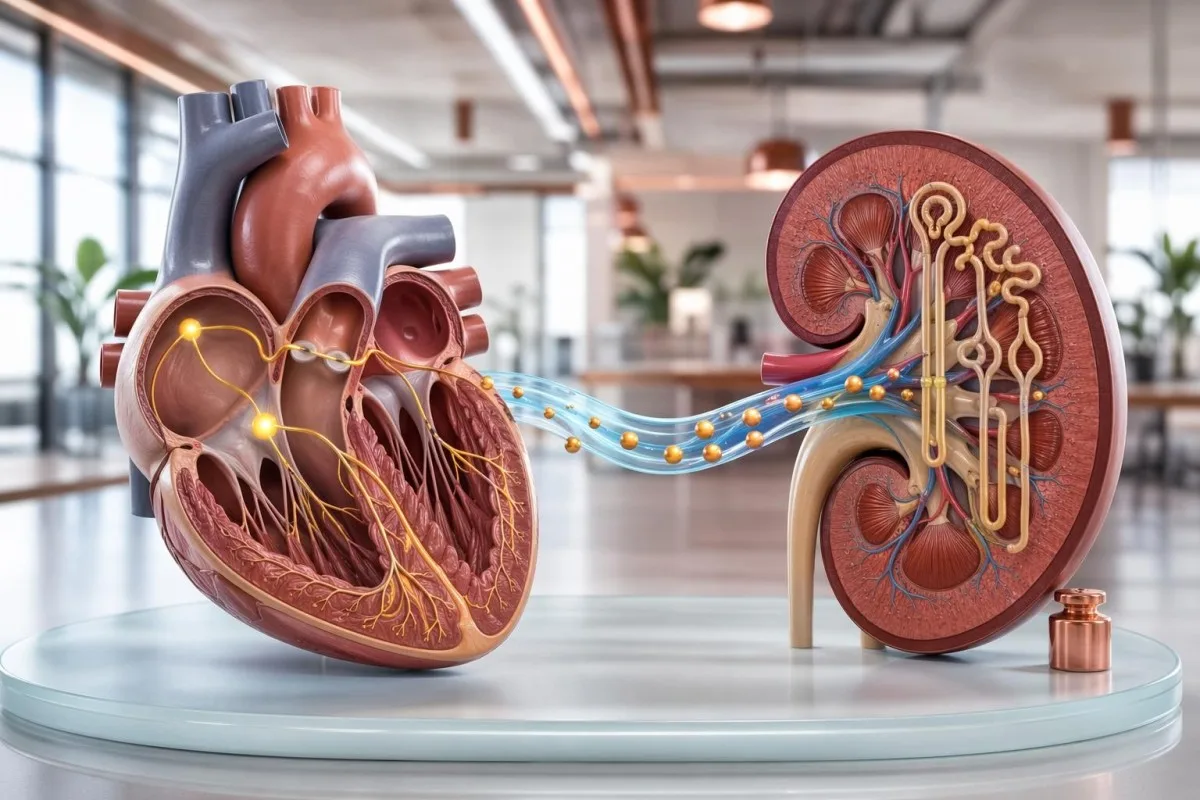
A potassium of 5.1-5.5 mmol/L is usually a recheck problem, not an ER problem, unless symptoms, kidney disease, risky medicines, or ECG changes are present. The real question is whether the result is true, hemolyzed, or part of a dangerous pattern.


- Slightly elevated potassium meaning usually means potassium is 5.1-5.5 mmol/L and should be repeated, especially if the sample was hemolyzed.
- Normal potassium is commonly 3.5-5.0 mmol/L, though some labs use 5.1 or 5.2 mmol/L as the upper limit.
- Borderline potassium meaning depends on context: 5.2 mmol/L in a hemolyzed tube is very different from 5.2 mmol/L with eGFR 24.
- When to worry about potassium is when it reaches 6.0 mmol/L, rises quickly, causes symptoms, or appears with ECG changes.
- Mild high potassium blood test results should usually be repeated within 24-72 hours if well, sooner if kidney disease or high-risk medicines are involved.
- ECG triggers include potassium around 6.0 mmol/L or higher, palpitations, fainting, chest pain, severe weakness, dialysis, or known kidney failure.
- ER symptoms include chest pain, shortness of breath, collapse, new irregular heartbeat, severe muscle weakness, or paralysis.
- Draw artifact is common after hemolysis, prolonged tourniquet time, fist clenching, delayed processing, or very high platelet or white cell counts.
What a slightly elevated potassium result usually means
A slightly elevated potassium result usually means 5.1-5.5 mmol/L and most often calls for a repeat test, not panic. Go urgent sooner if you have chest pain, fainting, severe weakness, palpitations, kidney failure, missed dialysis, or a potassium near 6.0 mmol/L. Kantesti is an AI blood test analyzer that treats this as a triage question, not just a red flag.
In my clinic, a potassium of 5.3 mmol/L is one of the commonest messages patients receive before anyone has explained whether the sample was hemolyzed. If you saw the result in a portal before review, our guide to online lab flags explains why that gap feels so unsettling.
The normal adult potassium range is usually 3.5-5.0 mmol/L, and potassium is reported in mmol/L or mEq/L because the numbers are equivalent for this ion. A result of 5.2 mmol/L may be clinically trivial in a hemolyzed outpatient sample, but the same number can matter in someone with eGFR 22 mL/min/1.73 m² taking spironolactone.
As of July 15, 2026, I still advise patients not to self-treat a mild potassium flag with extreme diet restriction unless a clinician confirms it is real. The fastest safe move is usually to verify the sample and review kidney function, bicarbonate or CO2, glucose, medicines, and whether an ECG is needed.
When a mild high potassium blood test is a draw artifact
A mild high potassium blood test is a draw artifact when potassium leaks from cellular elements after collection or the tube is handled in a way that distorts the value. Hemolysis, fist clenching, prolonged tourniquet time, delayed processing, and difficult sample collection can push a true 4.4 mmol/L result into the 5.4-5.8 mmol/L range.
Red cellular elements contain roughly 25-35 times more potassium than plasma, so even a small amount of cell disruption can falsely raise the reported value. Asirvatham, Moses, and Bjornson described these pre-analytic potassium errors clearly in the North American Journal of Medical Sciences in 2013, and I still see those exact errors every week.
The classic clue is a lab comment such as hemolyzed sample, but not every lab displays a hemolysis index to patients. For a deeper look at the mechanics, see our article on potassium draw errors, because the technique details are more useful than the potassium number alone.
A serum potassium can also appear higher than plasma potassium when platelets are very high, especially above 500 × 10⁹/L, because clotting releases potassium. Very high white cell counts, often above 50 × 10⁹/L, can create pseudo-hyperkalemia too; that is why I look at the CBC before deciding whether a borderline potassium is real.
Small collection details that matter
Tourniquet time over 60 seconds, repeated fist pumping, transport through a pneumatic tube system, and delayed centrifugation can all matter. If the repeat sample is drawn gently, processed quickly, and reported as plasma potassium, a false 5.6 mmol/L often returns to the mid-4s.
How soon should borderline potassium be repeated?
Borderline potassium should usually be repeated within 24-72 hours if you feel well and the result is 5.1-5.5 mmol/L. Repeat the same day if potassium is 5.6-6.0 mmol/L, if kidney function is reduced, if the sample was not clearly hemolyzed, or if a high-risk medicine was recently started.
A repeat potassium should ideally be paired with creatinine, eGFR, bicarbonate or CO2, glucose, and magnesium because potassium rarely becomes dangerous in isolation. If you are comparing abnormal results across visits, our guide to repeating abnormal labs gives a practical framework.
For a well outpatient with potassium 5.2 mmol/L, normal eGFR, and a hemolyzed sample comment, a repeat in 2-7 days may be reasonable if the clinician agrees. For potassium 5.7 mmol/L in someone taking lisinopril plus spironolactone, I would not wait a week; I would want same-day advice and often an ECG.
When I review these results as Thomas Klein, MD, I ask one question first: did the potassium change from the patient’s baseline by more than 0.5 mmol/L? A shift from 4.7 to 5.2 is less alarming than a jump from 3.9 to 5.4 after a new medicine.
When an ECG is the right next step
An ECG is usually appropriate when potassium is around 6.0 mmol/L or higher, when symptoms suggest rhythm disturbance, or when kidney failure or missed dialysis makes the result more dangerous. A normal ECG lowers immediate concern but does not completely exclude potassium risk.
The ECG changes doctors look for include peaked T waves, PR prolongation, loss of P waves, QRS widening, and eventually a sine-wave pattern. Montague, Ouellette, and Buller found in Clinical Journal of the American Society of Nephrology in 2008 that ECG findings do not correlate perfectly with potassium level, which is why symptoms and context still matter.
Kantesti AI treats a potassium of 5.8 mmol/L plus palpitations very differently from 5.8 mmol/L in a hemolyzed sample with no symptoms. If your concern is an irregular rhythm, the linked guide on electrolyte clues explains why potassium, magnesium, calcium, and thyroid tests are often checked together.
Some patients ask whether they can skip the ECG if the potassium is only mildly high. In my experience, an ECG is not usually needed for a single asymptomatic 5.2 mmol/L result with normal kidneys, but it becomes sensible when there is rapid change, heart disease, digoxin use, dialysis, or potassium above about 5.8-6.0 mmol/L.
Do not use a wearable watch rhythm strip as a substitute for a 12-lead ECG in this scenario. Wearables may detect atrial fibrillation, but they do not reliably show the QRS widening or T-wave morphology that clinicians worry about in hyperkalemia.
Symptoms that make high potassium an ER problem
High potassium becomes an ER problem when it causes chest pain, fainting, severe weakness, paralysis, shortness of breath, or a new irregular heartbeat. Potassium above 6.0 mmol/L also deserves urgent clinician contact even without symptoms, because dangerous rhythm changes can be silent at first.
The tricky part is that many patients with potassium 5.5-6.5 mmol/L feel completely normal. That is why I do not reassure based only on how someone feels if the number is rising, kidney function is poor, or the medicine list contains multiple potassium-raising drugs.
Chest pain is not automatically caused by potassium, but it changes the risk calculation immediately. If chest pain, sweating, collapse, or breathlessness is present, our article on urgent cardiac symptoms explains why emergency teams check ECG, troponin, electrolytes, and kidney markers together.
Muscle symptoms matter too. Mild cramps are non-specific, but progressive leg heaviness, inability to climb stairs, or true weakness after a potassium result of 5.9 mmol/L is different; that patient should not wait for a routine portal message.
In my 15 years of clinical practice, the cases that worry me most are not the isolated 5.2 mmol/L results. They are the 5.7 mmol/L results in patients who recently started spironolactone, doubled an ACE inhibitor, became dehydrated, and have an eGFR under 45 mL/min/1.73 m².
Medicines that turn mild potassium into a follow-up trigger
Medicines make mild potassium more meaningful when they reduce kidney potassium excretion or shift potassium out of cells. ACE inhibitors, ARBs, spironolactone, eplerenone, amiloride, trimethoprim, NSAIDs, heparin, tacrolimus, cyclosporine, and some beta blockers can all raise potassium.
A potassium increase of 0.2-0.4 mmol/L after starting an ACE inhibitor or ARB can be expected, but a rise above 5.5 mmol/L is a signal to review dose, kidney function, diet, and interacting drugs. Clase et al. highlighted in the KDIGO Controversies Conference report that potassium management in kidney disease is often about keeping beneficial medicines safely rather than stopping them reflexively.
The combination I see causing trouble is ACE inhibitor or ARB plus spironolactone plus an NSAID during a dehydration episode. If your potassium changed after a prescription adjustment, our piece on medicine-change timing is more useful than a generic food list.
Trimethoprim deserves special mention because it behaves a bit like a potassium-sparing diuretic at the kidney tubule. In an older adult with CKD, potassium can rise into the 5.5-6.5 mmol/L range within several days of starting it, especially if an ACE inhibitor is already on board.
Please do not stop heart failure or kidney-protective medicines without speaking to your clinician. The safer workflow is usually repeat potassium, check creatinine and bicarbonate, remove avoidable NSAIDs or salt substitutes, and decide whether the prescription needs adjustment.
Why kidney function changes the meaning of potassium
Kidney function changes potassium meaning because the kidneys remove most excess potassium from the body. A potassium of 5.3 mmol/L with eGFR 95 is usually lower risk than 5.3 mmol/L with eGFR 24, albuminuria, diabetes, or recent acute kidney injury.
Kantesti is an AI biomarker interpretation platform that reads potassium alongside eGFR, creatinine, urea or BUN, bicarbonate, glucose, and urine albumin when those values are available. For patients trying to understand kidney patterns, our research guide on BUN/creatinine patterns helps separate dehydration signals from chronic kidney trends.
The risk rises sharply once eGFR falls below about 30 mL/min/1.73 m², although medication and dehydration can make potassium rise at higher eGFR values too. A stable CKD patient with potassium 5.2 mmol/L may need planned adjustment, while an acute creatinine jump from 0.9 to 1.8 mg/dL plus potassium 5.6 mmol/L is a same-day problem.
KDIGO’s dyskalemia conference report by Clase et al. in Kidney International emphasized that both low and high potassium predict worse outcomes in kidney disease. Clinically, that means the goal is not to drive potassium as low as possible; it is to keep it in a safe zone, often near 4.0-5.0 mmol/L, while preserving kidney and heart treatments.
Urine albumin-to-creatinine ratio, often called ACR, adds another layer. ACR above 30 mg/g or 3 mg/mmol suggests kidney damage even when eGFR still looks acceptable, and that can make a borderline potassium more worth tracking over time.
Sodium, CO2 and adrenal clues doctors read with potassium
Potassium is more concerning when it appears with low sodium, low bicarbonate or CO2, high glucose, or low blood pressure. This pattern can point toward adrenal insufficiency, metabolic acidosis, diabetic ketoacidosis, severe dehydration, or kidney tubular problems rather than a simple lab artifact.
A sodium below 135 mmol/L plus potassium above 5.0 mmol/L makes me think about aldosterone deficiency, adrenal insufficiency, or certain kidney tubular disorders. If cortisol symptoms are present, our guide to the Addison pattern explains why sodium, potassium, cortisol, and ACTH are often reviewed together.
Low bicarbonate or CO2, often below 22 mmol/L, tells a different story. Acidosis shifts potassium out of cells and reduces kidney handling, so a potassium of 5.4 mmol/L plus CO2 of 17 mmol/L is not the same as 5.4 mmol/L with CO2 of 27 mmol/L.
High glucose can also distort potassium interpretation. In diabetic ketoacidosis, potassium may be high on the blood test while total body potassium is actually depleted, which is why insulin treatment can make potassium fall quickly and why this belongs in urgent medical care.
The subtle clue patients often miss is blood pressure. A person with potassium 5.3 mmol/L, sodium 130 mmol/L, dizziness on standing, and unintentional weight loss needs a very different workup from a person with potassium 5.3 mmol/L after a difficult sample collection.
Food, salt substitutes and supplements: what actually moves potassium
Food alone rarely causes dangerous high potassium when kidney function is normal, but potassium chloride salt substitutes and supplements can raise levels quickly in susceptible patients. A quarter teaspoon of potassium chloride salt substitute can contain roughly 650-800 mg of potassium.
The usual daily adequate intake targets are about 2,600 mg/day for adult women and 3,400 mg/day for adult men, though recommendations differ by country. Many patients with a one-off 5.2 mmol/L result do not need to avoid bananas; they need the sample repeated correctly.
Where I get cautious is with concentrated potassium: electrolyte powders, low-sodium salt, potassium citrate, and high-dose replacement tablets. For everyday food context, our guide to high-potassium foods explains why beans, potatoes, tomato products, coconut water, and dried fruit affect people differently depending on kidney function.
Coconut water is a common surprise. A large bottle can contain 900-1,500 mg of potassium, and I have seen endurance athletes combine it with electrolyte capsules, then wonder why a repeat renal panel looks worse.
Do not start a very low-potassium diet without clinician guidance if you have heart failure, hypertension, or kidney disease. Over-restriction can reduce dietary quality, lower fibre, and make blood pressure control harder, especially when the original result was an artifact.
Exercise, muscle injury and potassium after hard training
Hard exercise can transiently shift potassium, but persistent high potassium after training raises concern for muscle injury, dehydration, kidney stress, or sample artifact. If creatine kinase is above about 1,000 IU/L, clinicians start thinking about rhabdomyolysis rather than simple soreness.
During intense intervals, potassium can move out of muscle cells and rise briefly, then normalize within minutes to an hour in most healthy people. A lab drawn the next morning should not stay high just because you trained unless there is muscle damage, dehydration, kidney impairment, or a collection issue.
The pattern I watch is potassium 5.5 mmol/L plus creatinine above baseline plus CK several times the upper limit of normal. For intense gym sessions, our rhabdomyolysis red flags article explains why dark urine, severe muscle swelling, and weakness change the urgency.
Creatine supplements do not directly contain potassium, but they can raise creatinine by changing creatine turnover or muscle mass interpretation. That can make kidney context harder to read, especially in bodybuilders with high-protein diets and borderline eGFR calculations.
A practical repeat strategy is to avoid unusually hard training for 48-72 hours before a non-urgent recheck, hydrate normally, and tell the clinician about supplements. I do not ask athletes to stop all exercise; I ask them to avoid the workout that would make CK and AST hard to interpret.
Pregnancy, children and older adults: the mild flag is different
Mild potassium flags need age and pregnancy context because reference ranges, collection technique, and medication risk differ. Neonatal and pediatric samples hemolyze more easily, pregnancy adds kidney and blood pressure context, and older adults are more likely to take potassium-raising medicines.
In infants and small children, collection is technically harder, and mild hemolysis is common. A child with potassium 5.4 mmol/L in a difficult sample may simply need a clean repeat, but symptoms, dehydration, kidney disease, or abnormal acid-base results should shorten the timeline.
Pregnancy does not make a potassium of 5.8 mmol/L harmless. If high potassium appears with high blood pressure, rising creatinine, low platelets, severe vomiting, or reduced fetal movement concerns, our guide to pregnancy lab red flags is a sensible next read while contacting care.
Older adults often have less kidney reserve even when creatinine looks normal because lower muscle mass can hide reduced filtration. A creatinine of 1.0 mg/dL can be reassuring in a muscular 35-year-old and misleading in a frail 85-year-old.
Medication review is the quiet lifesaver here. I have seen older patients take an ACE inhibitor, spironolactone, ibuprofen, and a potassium salt substitute together; their potassium did not become dangerous because of one banana.
How AI can help fill the triage gap after a potassium flag
AI can help after a potassium flag by organizing the result with kidney markers, sample comments, medicines, symptoms, and prior trends. Kantesti is an AI blood test interpretation platform that flags a mild potassium result differently when it appears with hemolysis, low eGFR, low CO2, or a risky drug combination.
Our neural network does not diagnose hyperkalemia by number alone. It looks for patterns such as potassium 5.4 mmol/L plus hemolysis comment, potassium 5.4 mmol/L plus eGFR 25, or potassium 5.4 mmol/L plus sodium 130 and CO2 18.
The useful output is not a generic warning; it is a structured list of what to verify next. The method is explained in our AI analyzer technology, including how trend analysis and context weighting reduce false alarm language.
I still want patients to contact a clinician for urgent thresholds or symptoms. AI is good at spotting the triage gap, but it cannot listen to your chest, perform a 12-lead ECG, check the sample tube, or give emergency treatment.
Where patients tell us Kantesti helps most is the 60-second translation of a confusing portal result into questions: was it hemolyzed, should I repeat today, do I need ECG, and which medicine or kidney marker changes the plan?
What to ask your doctor after a borderline potassium result
After a borderline potassium result, ask whether the sample was hemolyzed, when to repeat it, whether kidney function changed, and whether any medicine should be held or adjusted. Also ask whether symptoms or your exact potassium level mean you need an ECG.
A useful message is short: my potassium is 5.4 mmol/L, creatinine is 1.2 mg/dL, eGFR is 62, CO2 is 24, and the report says mild hemolysis; do you want a repeat and when? That gives a clinician more to work with than asking whether potassium is bad.
As Thomas Klein, MD, I also ask patients to list supplements and non-prescription medicines because they are often missing from the chart. Ibuprofen, electrolyte powders, potassium citrate, and salt substitutes can matter as much as prescription tablets.
Kantesti’s clinical content is reviewed with medical oversight, and our medical advisory board helps us keep patient-facing advice aligned with real-world triage. Still, a potassium result near 6.0 mmol/L should not wait for a long email thread if symptoms are present.
If the repeat is normal, ask whether the first result should be documented as probable pseudo-hyperkalemia. That small note can prevent future panic when another clinician sees an isolated historical potassium of 5.6 mmol/L.
Bottom line: recheck, ECG or ER?
Recheck a well patient with potassium 5.1-5.5 mmol/L, consider ECG or same-day review around 5.6-6.0 mmol/L with risk factors, and seek urgent care for symptoms, ECG changes, missed dialysis, or potassium above 6.0 mmol/L. That simple split prevents both underreaction and unnecessary panic.
The phrase slightly elevated potassium meaning should not be translated as danger by default. It means verify the sample, compare the baseline, check kidney and acid-base context, and decide whether the person in front of you is low-risk or high-risk.
Kantesti AI summarizes this decision as three buckets: likely artifact and repeat, true mild elevation and clinician follow-up, or urgent rhythm-risk scenario. Our approach is documented through clinical validation work because lab interpretation is only useful when it changes the next safe action.
If you remember one number, remember 6.0 mmol/L as the point where same-day medical advice becomes much more likely, especially with CKD, heart disease, diabetes, potassium-raising medicines, or no hemolysis comment. If you remember one symptom cluster, remember chest pain, fainting, severe weakness, paralysis, or palpitations.
Most patients with a one-off potassium of 5.2 or 5.3 mmol/L do well after a clean repeat and medication review. The few who need urgent care are usually identifiable from the pattern: symptoms, kidney failure, rapid rise, concerning ECG, or a true value moving beyond mild range.
Frequently Asked Questions
Is slightly elevated potassium dangerous?
Slightly elevated potassium is usually not dangerous when it is 5.1-5.5 mmol/L, you feel well, kidney function is normal, and the sample may be hemolyzed. It becomes more concerning when potassium approaches 6.0 mmol/L, rises quickly, or appears with reduced eGFR, low CO2, diabetes, heart disease, or potassium-raising medicines. Chest pain, fainting, severe weakness, paralysis, or palpitations should prompt urgent medical assessment.
What does borderline potassium mean on a blood test?
Borderline potassium usually means a potassium result just above the lab range, commonly 5.1-5.5 mmol/L in adults. The meaning depends on whether the sample was hemolyzed, whether your baseline is lower, and whether kidney markers such as creatinine and eGFR are abnormal. A borderline result is often repeated before treatment decisions are made.
When should potassium be rechecked after a mild high result?
Potassium is often rechecked within 24-72 hours when the result is 5.1-5.5 mmol/L and risk factors are present. If the person is well, kidney function is normal, and the sample was clearly hemolyzed, a clinician may choose a repeat within 2-7 days. A value of 5.6-6.0 mmol/L usually deserves same-day clinician contact or a prompt repeat.
Can a blood draw mistake cause high potassium?
Yes, a collection or processing issue can falsely raise potassium by 0.5 mmol/L or more. Hemolysis, fist clenching, a tourniquet kept on longer than about 60 seconds, delayed centrifugation, and difficult sample collection can all cause pseudo-hyperkalemia. Very high platelet counts above 500 × 10⁹/L or white cell counts above 50 × 10⁹/L can also make serum potassium look falsely high.
At what potassium level do you need an ECG?
An ECG is commonly considered when potassium is around 6.0 mmol/L or higher, or at lower levels if symptoms or major risk factors are present. Symptoms that support ECG testing include palpitations, fainting, chest pain, shortness of breath, severe weakness, or paralysis. A normal ECG is reassuring, but it does not always rule out clinically significant hyperkalemia.
Should I avoid bananas if my potassium is 5.3?
A potassium of 5.3 mmol/L does not automatically mean you must avoid bananas. Food restriction is usually not the first step unless kidney disease, repeated true high potassium, or potassium-raising medicines are present. Concentrated potassium sources such as potassium chloride salt substitutes, electrolyte powders, and potassium supplements matter more than a single serving of fruit for many patients.
When should I go to the ER for high potassium?
Go to urgent care or the ER if high potassium is accompanied by chest pain, fainting, severe weakness, paralysis, shortness of breath, or a new irregular heartbeat. Potassium above 6.0 mmol/L, missed dialysis, known kidney failure, or ECG changes also deserves urgent assessment even if symptoms are mild. If your report says potassium is critically high, do not wait for a routine appointment.
Should I stop my ACE inhibitor or spironolactone while waiting for a repeat potassium test?
Do not stop or restart a prescribed medicine on your own unless a clinician has already given you a plan. Contact the prescriber promptly for individual advice, particularly if you have reduced kidney function, take more than one potassium-raising medicine, or your level is approaching 6.0 mmol/L.
Get AI-Powered Blood Test Analysis Today
Join over 2 million users worldwide who trust Kantesti for instant, accurate lab test analysis. Upload your blood test results and receive comprehensive interpretation of 15,000+ biomarkers in seconds.
📚 Referenced Research Publications
Klein, T., Mitchell, S., & Weber, H. (2026). Diarrhea After Fasting, Black Specks in Stool & GI Guide 2026. Kantesti AI Medical Research.
Klein, T., Mitchell, S., & Weber, H. (2026). Women's Health Guide: Ovulation, Menopause & Hormonal Symptoms. Kantesti AI Medical Research.
📖 External Medical References
Asirvatham JR et al. (2013). Errors in potassium measurement: a laboratory perspective for the clinician. North American Journal of Medical Sciences.
⚕️ Medical Disclaimer
This article is for educational purposes only and does not constitute medical advice. Always consult a qualified healthcare provider for diagnosis and treatment decisions.
E-E-A-T Trust Signals
Experience
Physician-led clinical review of lab interpretation workflows.
Expertise
Laboratory medicine focus on how biomarkers behave in clinical context.
Authoritativeness
Written by Dr. Thomas Klein with review by Dr. Sarah Mitchell and Prof. Dr. Hans Weber.
Trustworthiness
Evidence-based interpretation with clear follow-up pathways to reduce alarm.