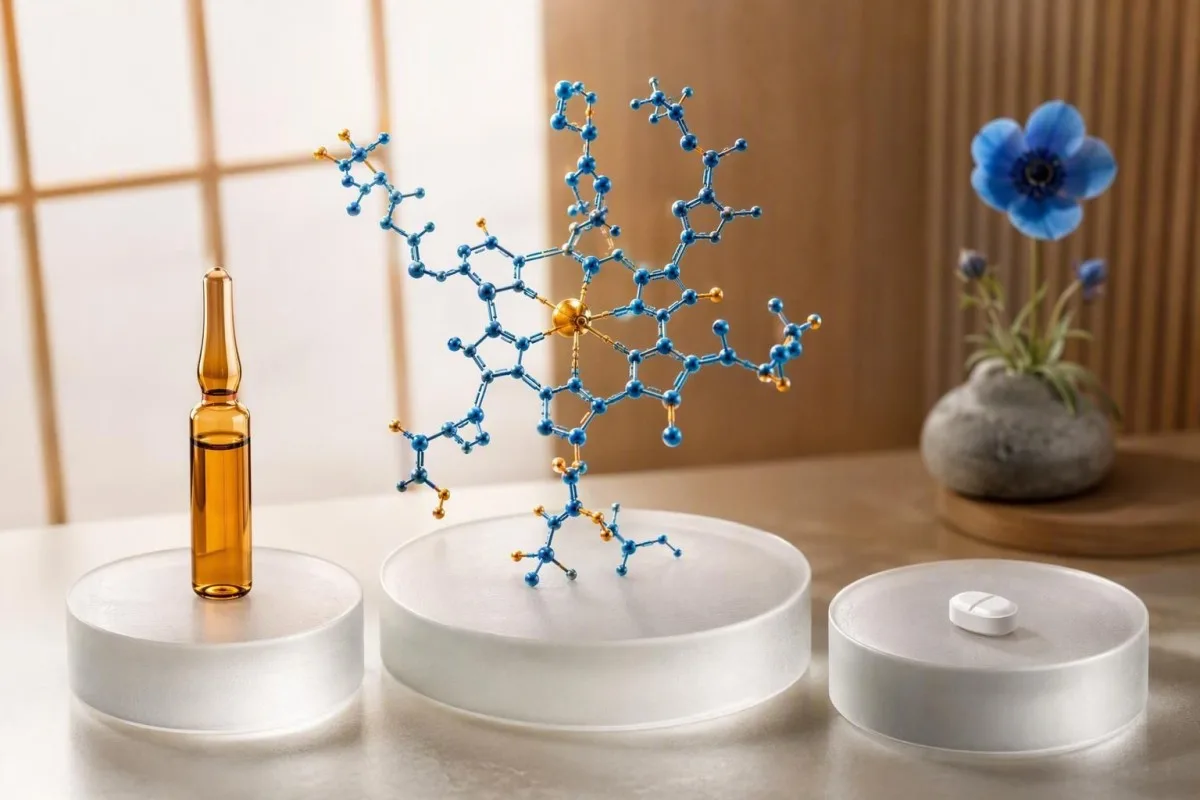
Injektioner ger en omedelbar serumtopp, men högdos oral B12 korrigerar ofta bristen lika effektivt över veckor. Den avgörande faktorn är vanligtvis orsaken och svårighetsgraden av bristen – inte bara preferens.


- Snabbast serumökning: En intramuskulär B12-injektion på 1 000 mikrogram höjer cirkulerande B12 inom timmar, medan tabletter ökar mer gradvis över dagar.
- Jämförbar ersättning: Oral cyanokobalamin 1 000–2 000 mikrogram dagligen kan uppnå liknande kortvariga blod- och symtomresultat som intramuskulär terapi för många vuxna.
- Indikation för injektion: Svåra neurologiska symtom, djup anemi, oförmåga att ta tabletter eller opålitlig absorption motiverar vanligtvis injektioner ledda av kliniker.
- Gränsfallresultat: Serum B12 under 180 pg/mL (133 pmol/L) anses ofta vara brist; 180–350 pg/mL behöver ofta MMA- eller homocysteinbekräftelse.
- Passiv absorption: Cirka 1% av en stor oral B12-dos tas upp genom passiv diffusion, vilket är anledningen till att en tablett på 1 000 mikrogram kan fungera trots nedsatt intrinsic factor.
- Tidpunkt för omtest: En CBC och klinisk respons är oftast mer användbara efter 4-8 veckor än ett B12-värde taget omedelbart efter behandling.
- Säkerhetspunkt: Behandla inte oförklarlig domningar enbart med folsyra; folat kan förbättra anemi medan B12-relaterad nervskada fortskrider.
- Orsaken spelar roll: Metformin, protonpumpshämmare, veganska dieter, celiaki, magsäcksoperation och perniciös anemi kräver olika uppföljningsplaner.
Vilket alternativ höjer vitamin B12-nivåerna snabbare?
B12-injektioner höjer det uppmätta serumvärdet snabbare än tabletter, ofta inom timmar, eftersom de kringgår tarmen. För de flesta stabila vuxna med bekräftad brist kan en oral dos på 1000-2000 mikrogram dagligen dock fylla på kroppens depåer och förbättra blodvärdena över veckor i en kliniskt likartad takt.
En injektion ger en skarp tidig topp eftersom hydroxokobalamin eller cyanokobalamin levereras direkt i muskeln och sedan i cirkulationen. Den laboratoriemässiga toppen är inte samma sak som återställda vävnadsdepåer eller reparerad nervfunktion; i min praktik mäts symtomåterhämtning i veckor till månader, inte nästa morgon.
Den praktiska jämförelsen är ofta timmar kontra dagar för serumkoncentration, men ungefär 4-8 veckor för en meningsfull hematologisk respons med någon av de adekvata vägarna. Retikulocyter ökar vanligtvis inom 3-5 dagar, hemoglobin börjar förbättras efter cirka 1-2 veckor, och makrocytos kan ta upp till 8 veckor att normaliseras.
Kantesti är en AI blodprovsanalysator som placerar B12 bredvid MCV, hemoglobin, folat, kreatinin och tidigare resultat snarare än att behandla en B12-spik efter behandling som bevis för att det underliggande problemet är löst. Läsare kan också jämföra sitt resultat med vår B12-referensintervallguide.
Vad “snabbare” faktiskt betyder
Ett högt resultat efter en injektion bekräftar nylig exponering, inte nödvändigtvis adekvat cellulär leverans. Metylmalonsyra, neurologiska fynd och CBC-trenden är mer informativa när den ursprungliga diagnosen var osäker.
Hur oral B12-absorption fungerar när intrinsic factor är lågt
Högdos oral B12 kan fungera även när intrinsic-factor-absorptionen är nedsatt eftersom en liten andel tas upp genom passiv diffusion. Cirka 1% av en dos på 1000 mikrogram kan absorberas passivt, vilket ger cirka 10 mikrogram – långt över det genomsnittliga dagliga behovet på 2,4 mikrogram för vuxna.
Normalt B12 från mat måste frigöras av magsyra, binda intrinsic factor och tas upp i den terminala ileum. Detta system med flera steg förklarar varför långvarig syrahämning, autoimmun gastrit, ileumsjukdom och bariatriska procedurer kan orsaka brist; det förklarar också varför en standardmultivitamin ofta är en för låg dos för behandling.
Oral B12-absorption är dosberoende men inte linjär. Intrinsic-factor-vägen mättas vid ungefär 1,5-2 mikrogram per måltid, medan passiv diffusion bara blir kliniskt användbar med milligramdoser i tablettform. Ett tillskott på 50 mikrogram är en rimlig prevention för vissa personer, men det motsvarar inte 1000 mikrogram för etablerad brist.
För patienter som använder omeprazol, pantoprazol eller en annan PPI, kontrollerar jag det bredare mönstret – kost, ålder, anemi och duration av användning – snarare än att anta att läkemedlet är hela förklaringen. Vår genomgång av långtidsövervakning av PPI-laboratorievärden förklarar varför magnesium och järn också kan vara viktiga.
Vad kliniska studier visar om tabletter jämfört med injektioner
Randomiserad evidens tyder på att oralt B12 i doser om 1 000–2 000 mikrogram dagligen kan vara lika effektivt som intramuskulärt B12 för många personer med brist. Evidensunderlaget är inte enormt, och det innehåller färre patienter med allvarlig neurologisk sjukdom än vad kliniker skulle önska.
Cochrane-granskningen av Wang och kollegor fann att oralt B12 i hög dos gav liknande B12-blodnivåer som intramuskulär behandling i de små randomiserade studier som fanns tillgängliga (Wang et al., 2018). En studie använde 2 000 mikrogram oralt varje dag; en annan använde 1 000 mikrogram oralt efter ett inledande schema, så “oral terapi” betyder inte en lågdosprodukt från livsmedelsbutiken.
Den tidigare studien av Kuzminski et al. rapporterade högre serum B12-koncentrationer med 2 000 mikrogram oralt cyanokobalamin än med en 1 000 mikrogram injektionskur, men kliniska resultat var den fråga som betydde något (Kuzminski et al., 1998). Evidensen är ärligt talat blandad gällande det ideala protokollet eftersom studier använde olika injektionsintervall och uppföljningsperioder.
En tablett fungerar bara om den tas. Missade dagliga doser kan göra en injektion som ges var 2-3 månad mer pålitlig i verkligheten, särskilt för sköra vuxna eller personer med komplexa medicineringsscheman. Vår guiden för blodprovstagning kan hjälpa till att skilja en verklig behandlingsförändring från en dåligt tajmad omtestning.
När B12-injektioner är medicinskt nödvändiga
B12-injektioner är vanligtvis medicinskt nödvändiga när bristen är allvarlig, neurologiska symtom förekommer, oralt intag är omöjligt, eller absorption och följsamhet inte kan förlitas på. De är inte automatiskt obligatoriska bara för att perniciös anemi misstänks, förutsatt att oral behandling i hög dos och uppföljning är genomförbart.
Brådskande bedömning av läkare är lämplig vid ny gångobalans, progressiv domning, svaghet, förvirring, synförändring, markant anemi eller graviditet med betydande brist. Neurologisk B12-skada kan bli delvis irreversibel; i den situationen skulle jag inte fördröja parenteral terapi medan jag debatterar bekvämlighet.
NICE guideline NG239 rekommenderar intramuskulär behandling när malabsorption misstänks eller bekräftas och rekommenderar livslång intramuskulär ersättning för autoimmun gastrit i många fall (NICE, 2024). Praxis varierar internationellt: vissa kliniker använder oralt 1-2 mg dagligen hos pålitliga patienter med perniciös anemi, medan andra föredrar injektioner eftersom konsekvenserna av ett avbrott är högre.
Ett hemoglobin under 80 g/L, symtomatisk andfåddhet, takykardi eller möjlig ryggmärgspåverkan motiverar omedelbar medicinsk granskning snarare än egenbehandling. För att förstå hur anemimönster framträder vid rutinprovtagning, se vad en fullständig blodstatus inkluderar.
Behandlingsdoser för B12-brist som kliniker faktiskt använder
Vanliga orala behandlingsdoser är 1 000–2 000 mikrogram dagligen, medan vanliga intramuskulära kurer använder 1 000 mikrogram per dos med en inledande laddningsfas. Produkten, nationell riktlinje och orsaken till bristen avgör det exakta schemat.
I brittisk praxis ges hydroxokobalamin 1 000 mikrogram intramuskulärt ofta tre gånger i veckan i 2 veckor när det inte finns någon neurologisk påverkan, sedan var 2-3 månad för underhåll; protokoll skiljer sig mellan lokala tjänster. Med neurologiska symtom ges initiala doser ofta varannan dag tills ingen ytterligare förbättring ses, sedan följer underhåll specialiserad rådgivning.
En typisk oral plan är cyanokobalamin 1 000 mikrogram dagligen i 8-12 veckor, följt av 1 000 mikrogram dagligen eller ett lägre underhållsschema om kost var den enda orsaken. Sublinguala produkter har inte visat sig överträffa svalda tabletter; när de väl har lösts upp sväljs det mesta ändå.
Improvisera inte en laddningskur baserad på råd från sociala medier. jämförelsen mellan metylerat B12 och cyanokobalamin förklarar varför dosen och konsistensen generellt sett är viktigare än marknadsföringspåståenden om B12-formen.
Hur man tolkar ett lågt eller gränsfall B12-resultat
Serum B12 under 180 pg/mL (133 pmol/L) stöder vanligtvis brist, medan värden från cirka 180–350 pg/mL är en obestämd zon där MMA eller homocystein kan klargöra cellulär brist. Individuella laboratorieintervall skiljer sig åt, och ett normalt serumvärde utesluter inte helt brist efter nyligen genomförd supplementation.
Metylmalonsyra stiger när B12-beroende metabolism är nedsatt, men nedsatt njurfunktion kan höja MMA oberoende. Homocystein kan stiga vid B12-brist, folatbrist, vitamin B6-brist, hypotyreos och njursvikt, så ingen av dessa bekräftande tester bör tolkas isolerat.
Makrocytos är stödjande men inte nödvändigt. Ett medelcellvolym över 100 fL ökar misstanken om B12- eller folatbrist, alkoholkonsumtion, leversjukdom, hypotyreos, benmärgssjukdomar eller läkemedelspåverkan; ungefär en fjärdedel av symptomatiska B12-bristpatienter kan ha en normal MCV.
Kantesti AI tolkar B12-resultat genom att kontrollera mönstret av MCV, RDW, hemoglobin, folat och historiska värden, inklusive ledtrådar om att ett folattillskott kan maskera makrocytos. Vår artikel om hög MCV uppföljning täcker de vanliga alternativen.
Perniciös anemi ändrar den långsiktiga planen, inte alltid vägen
Perniciös anemi är autoimmun förlust av intrinsic-factor-funktion och kräver livslång B12-ersättning efter diagnos. Injektioner erbjuder pålitlig leverans, men högdos oral terapi kan fortfarande upprätthålla adekvat status hos utvalda, nära övervakade vuxna.
De tester som oftast används är intrinsic-factor-antikroppar och parietalcellsantikroppar, tillsammans med B12, CBC och ibland gastrin. En positiv intrinsic-factor-antikropp är mycket specifik men inte särskilt känslig, så ett negativt resultat utesluter inte tillståndet; detta är ett av de områden där kontexten är viktigare än en enskild antikropp.
Perniciös anemi är mer än ett absorptionsproblem. Autoimmun gastrit kan förekomma samtidigt med järnbrist innan B12-brist blir uppenbar, och långvarig sjukdom medför övervakningsöverväganden för magsäcken som bör diskuteras med den behandlande läkaren. Vår guide för testning av perniciös anemi detaljerar den diagnostiska sekvensen.
Kantesti är en AI-plattform för tolkning av blodprov används i 127+ länder, men en AI-tolkning kan inte diagnostisera autoimmun gastrit eller välja ett livslångt injektionsintervall. En läkare behöver koppla samman symtom, antikroppar, endoskopisk historia och det laboratoriemässiga mönstret.
Varför neurologiska symtom kräver snabbare klinisk åtgärd
Domningar, förlust av vibrationssinne, ostadig gång, kognitiva förändringar eller svaghet med lågt B12 bör utlösa en omedelbar personlig bedömning och vanligtvis injektionsbehandling. Nervåterhämtning är mindre förutsägbar än återhämtning av anemi och kan förbli ofullständig efter månader av brist.
Ryggmärgens baksträngar och perifera nerver är känsliga för B12-brist, vilket ger ett mönster som läkare kallar subakut kombinerad degeneration i avancerade fall. Ett normalt hemoglobin skyddar inte mot detta; jag har sett patienter vars domningar i fötterna och onormalt vibrationssinne föregick någon uppenbar anemi.
Förbättring börjar ofta inom 1 vecka efter effektiv behandling, men sensoriska symtom kan ta 3-12 månader och kanske inte helt försvinna. Det säkraste tillvägagångssättet är att dokumentera grundfunktionen – gångsträcka, fall, handfingerfärdighet, vibrationssinne – eftersom ett stigande serum B12 ensamt inte är ett mått på återhämtning.
Neuropati har också många mimiker, inklusive diabetes, alkoholrelaterad nervskada, sköldkörtelsjukdom, överskott av vitamin B6 och vissa läkemedel. Patienter med domningar kan använda vår guide för nervsymtom vid vitamin B6 för att förbereda bättre frågor, men progressiv svaghet kräver omedelbar medicinsk vård.
När tabletter oftast räcker för brist på B12 från kosten
Tabletter räcker vanligtvis när lågt B12 beror på otillräckligt intag och tarmen kan absorbera tillskott. Veganer, personer som äter mycket lite animalisk mat och vuxna med tillfälliga kostrestriktioner svarar vanligtvis bra på oral cyanokobalamin 1 000 mikrogram dagligen.
Vitamin B12 är naturligt koncentrerat i animaliska livsmedel och berikade livsmedel, så en strikt vegansk kost kräver en pålitlig strategi med berikade livsmedel eller tillskott. Växtbaserade livsmedel som marknadsförs som naturliga B12-källor är inkonsekventa; tång och fermenterade livsmedel kan innehålla inaktiva analoger som inte är pålitliga behandlingar.
Kostbrist bör fortfarande föranleda en kort anamnes. En 23-årig vegan med B12 på 142 pg/mL, normal MMA efter behandling och utan tarmbesvär skiljer sig från en 68-åring med samma resultat, viktnedgång och järnbrist. Ålder, läkemedel och gastrointestinala symptom förändrar utredningen.
För kostplanering, vår guide för vattenlösliga vitaminer skiljer förebyggande doser från bristbehandling. Anta inte att enbart nutrition kommer att korrigera neurologiska symptom tillräckligt snabbt.
Läkemedel och tarmsjukdomar som påverkar valet av B12-behandling
Metformin, syrahämmande läkemedel, celiaki, Crohns sjukdom som påverkar ileum, pankreasinsufficiens och magsäcksoperation kan alla minska B12-tillgängligheten. En tablettstudie kan vara rimlig i vissa fall, men injektioner väljs ofta när absorptionen är osäker eller symptomen är betydande.
Metformin-associerad B12-brist är tillräckligt vanlig för att tillsynsmyndigheter rekommenderar att kontrollera nivåerna hos patienter med neuropati, anemi eller andra riskfaktorer, särskilt vid högre doser eller långvarig behandling. Mekanismen involverar sannolikt kalcium-beroende upptag av B12-intrinsic factor-komplexet i ileum, inte bara dålig kost.
Efter sleeve-gastrektomi eller gastric bypass bör behandlingsbeslut följa bariatriska teamets protokoll eftersom järn, folsyra, tiamin, vitamin D och koppar kan påverkas samtidigt. Diarré, lågt albumin, oförklarlig viktnedgång eller fet avföring bör föranleda utredning snarare än ändlösa tillskottsförändringar.
Lågt koppar kan också orsaka anemi och neurologiska symptom som liknar B12-brist, särskilt efter bariatrisk kirurgi eller överdriven zink. Våra kliniska ledtrådar för lågt koppar förklarar varför det att endast kontrollera B12 kan missa den verkliga förklaringen.
Hur snart man ska testa om efter B12-behandling
En CBC och genomgång av symptom efter cirka 4-8 veckor är generellt mer användbart än att upprepa serum B12 omedelbart efter en injektion eller tablettkur. Ett mycket högt B12-resultat kort efter behandling återspeglar främst den dos som tagits.
Ett retikulocytsvar runt dag 3-5 ger en tidig ledtråd om att benmärgsproduktionen återhämtar sig, medan hemoglobinet bör stiga under de följande veckorna om B12-brist var en drivande faktor. Brist på förbättring bör öppna upp differentialdiagnosen igen: järnbrist, pågående blodförlust, folsyrabrist, inflammation, njursjukdom eller en felaktig diagnos.
För ett okomplicerat kostunderskott, kontrollerar jag ofta CBC och B12 igen efter 8-12 veckor, för att sedan bekräfta en hållbar underhållsplan. Vid neurologisk sjukdom, autoimmun gastrit, graviditet, njurfunktionsnedsättning eller multipla brister, måste uppföljningen individualiseras och börjar vanligtvis tidigare.
Kantesti:s AI-baserat analysverktyg för blodprov kan jämföra sekventiella B12-, MCV-, RDW- och hemoglobinresultat snarare än att visa varje provtagning som en isolerad händelse. guide för jämförelse av laboratorier sida vid sida visar vad som ska registreras mellan testerna.
Varför ett högt B12-resultat efter behandling inte alltid är betryggande
Ett högt B12-värde efter en injektion eller tablett med hög dos återspeglar vanligtvis tillskott och bevisar inte att symptomen har en annan orsak. Omvänt, en oförklarlig kvarstående B12-höjning utan tillskott förtjänar klinisk granskning, särskilt när lever-, njur- eller blodbildsavvikelser samexisterar.
Serum B12 kan överstiga en laboratorieövre gräns på cirka 900-1 000 pg/mL efter behandling, beroende på analys och tidpunkt. Detta är förväntat och vanligtvis inte toxiskt; B12 har ingen etablerad tolererbar övre gräns för intag hos friska vuxna eftersom överskottet till stor del utsöndras, även om akneutslag förekommer hos en liten minoritet.
Frågan jag ställer är enkel: togs provet efter ett tillskott, en injektion, ett multivitamin, en energidryck eller en berikad produkt? Om inte, kan förhöjt B12 förekomma vid leversjukdom, nedsatt njurclearance, inflammation eller vissa hematologiska tillstånd, och det kräver kontext snarare än alarm.
Vår guide för högt vitamin B12 förklarar skillnaden mellan förväntad tillskottrelaterad höjning och en oförklarlig laboratorieanomali.
Vanliga misstag vid B12-behandling som fördröjer återhämtning
Det mest konsekvensrika misstaget är att ta folsyra ensamt när B12-brist inte har uteslutits. Folsyra kan normalisera anemi samtidigt som nervskador relaterade till B12 fortskrider, särskilt när doserna överstiger det vanliga kostintaget.
Använd inte symtom ensamma för att välja mellan injektioner och tabletter. Trötthet, hjärndimma och nedstämdhet är verkliga men ospecifika; sömnbrist, sköldkörtelsjukdom, järnbrist, depression, diabetes och läkemedel kan ge liknande besvär. Ett B12-resultat nära 250 pg/mL motiverar oftare en bekräftelse än en automatisk injektion.
Ett annat misstag är att fördröja ett test tills efter att tillskott har påbörjats när det är möjligt. Även 50-500 mikrogram dagligen kan skifta serum B12 tillräckligt för att komplicera diagnosen, även om akuta neurologiska symtom alltid bör behandlas först. Den höga folat- och dolda B12-frågan är särskilt relevant för personer som tar prenatal- eller energitillskott.
Från och med den 27 augusti 2026 är mitt råd som Dr. Thomas Klein att välja den minst betungande vägen som är medicinskt pålitlig, och sedan verifiera återhämtning med symtom och trender. Injektionsbehandling är utmärkt medicin när det är indicerat; det är inte inneboende starkare medicin för varje lågt resultat.
Ett praktiskt beslutssystem för B12-injektioner eller tabletter
Välj injektioner när risken är hög eller oral tillförlitlighet är låg; välj högdos tabletter när bristen är mild till måttlig, intaget är huvudproblemet och uppföljningen är pålitlig. Den bästa vägen är den som korrigerar bristen utan att försena utredningen av dess orsak.
Tabletter passar bäst när B12 är lågt på grund av kost, inga neurologiska tecken finns, sväljning är säker och personen kan ta 1 000-2 000 mikrogram dagligen konsekvent. Injektioner passar bäst med neurologiska fynd, svår symtomatisk anemi, kräkningar, betydande malabsorption, postoperativ anatomi eller osäker följsamhet.
Ta med fyra saker till mötet: det ursprungliga B12-resultatet med enheter, en CBC, varje tillskott och medicindos, och en symtomtidslinje. Dr. Thomas Kleins kliniska regel är att orsaken bör fastställas innan underhållsbehandlingen görs odefinierad närhelst det kan göras på ett säkert sätt.
Kantesti AI är en Tolkningstjänst för AI-labbtester utformad för att organisera laboratoriekontext för patienter och kliniker, medan slutlig diagnos och förskrivning förblir kliniska beslut. Vår Medicinsk rådgivande nämnd och kliniska valideringsstrategi beskriver den medicinska tillsynen bakom den gränsen.
Vanliga frågor
Fungerar B12-injektioner snabbare än tabletter?
B12-injektioner höjer B12-nivåerna i serum snabbare än tabletter eftersom en intramuskulär dos på 1 000 mikrogram kringgår tarmabsorptionen och kan öka cirkulerande nivåer inom några timmar. Oral B12 i hög dos, vanligtvis 1 000–2 000 mikrogram dagligen, kan fortfarande effektivt korrigera brist inom flera veckor hos många vuxna. De meningsfulla slutpunkterna är förbättring av symtom, retikulocyter inom 3–5 dagar och CBC-återhämtning inom ungefär 4–8 veckor, inte bara den omedelbara serumtoppen. Injektioner föredras vid neurologiska symtom, svår anemi eller opålitlig absorption.
Kan oral B12 fungera om jag har perniciös anemi?
Högdos B12 oralt kan fungera hos vissa personer med perniciös anemi eftersom ungefär 1% av en stor dos absorberas genom passiv diffusion utan intrinsisk faktor. En daglig oral dos på 1 000–2 000 mikrogram kan därför ge 10–20 mikrogram absorberat B12, vilket överstiger det dagliga behovet för vuxna på 2,4 mikrogram. NICE riktlinjer stöder vanligtvis livslång intramuskulär ersättning vid autoimmun gastrit, särskilt där tillförlitligheten är osäker. Administreringsvägen bör överenskommas med den kliniker som ansvarar för diagnosen och följas upp med symtom och en CBC.
Hur många B12-tabletter motsvarar en injektion?
Det finns ingen exakt omvandling från tablett till injektion eftersom injektioner ger nära fullständig systemisk tillgänglighet medan oral absorption är dosberoende och delvis mättbar. En injektion på 1 000 mikrogram och 1 000–2 000 mikrogram oralt dagligen är båda vanliga behandlingsdoser, men de är inte farmakologiskt utbytbara på en dos-för-dos-basis. Ungefär 1% av en oral dos på 1 000 mikrogram kan tas upp genom passiv diffusion, medan ytterligare absorption sker via intrinsic factor när den vägen fungerar. Behandlingssvar och orsaken till brist bör styra eventuella byten.
Hur lång tid tar det innan B12-injektioner förbättrar trötthet?
B12-injektioner kan förbättra energinivån inom dagar till några veckor om brist är den verkliga orsaken till trötthet, men tidslinjen varierar kraftigt. Retikulocytproduktionen stiger ofta inom 3-5 dagar, hemoglobinet börjar vanligtvis stiga efter 1-2 veckor, och fullständig korrigering av makrocytos kan ta upp till 8 veckor. Domningar, balansproblem och kognitiva symtom tar ofta 3-12 månader och kan vara ofullständiga om bristen var långvarig. Kvarstående trötthet efter en normaliserande CBC bör leda till utredning av järnbrist, sköldkörtelsjukdom, sömnproblem och andra orsaker.
Bör jag ta B12-tabletter före ett blodprov?
Om provtagning planeras för att diagnostisera oklara B12-brister och patienten är kliniskt stabil, undvik att påbörja tillskott innan provet har tagits eftersom även 50-500 mikrogram dagligen kan påverka serum B12-nivåer. Det finns ingen universell utfasningsperiod, eftersom laboratorier och doser skiljer sig åt, så rådfråga läkaren eller laboratoriet angående deras förberedelser. Fördröj inte behandlingen för att få en perfekt baslinje om patienten har neurologiska symtom, svår anemi, graviditetsrelaterade besvär eller signifikant klinisk försämring. Dokumentera dos och startdatum så att resultatet kan tolkas korrekt.
Är en B12-nivå på 200 pg/mL tillräckligt låg för injektioner?
Ett B12-värde på 200 pg/mL är gränsfall till lågt och avgör inte ensamt om injektioner krävs. Många laboratorier anser att värden under 180 pg/mL är tydligt bristfälliga, medan värden från cirka 180-350 pg/mL kan behöva undersökas med metylmalonsyra, homocystein, CBC-fynd och symtomsgranskning. Injektioner är rimliga vid 200 pg/mL när neurologiska symtom, anemi, malabsorption, graviditet eller oförmåga att ta oral behandling föreligger. En stabil person med kostrisk och inga neurologiska fynd kan svara bra på 1 000-2 000 mikrogram oral B12 dagligen med planerad uppföljning.
Få AI-drivna analyser av blodprov redan idag
Gå med i över 2 miljoner användare världen över som litar på Kantesti för snabb och korrekt analys av blodprover. Ladda upp dina blodprovsresultat och få en heltäckande tolkning av 15,000+-biomarkörer på sekunder.
📚 Refererade forskningspublikationer
Klein, T., Mitchell, S., & Weber, H. (2026). Kantesti LTD. (2026). En förhandsregistrerad, rubric-baserad automatisk teknisk benchmark av Kantesti Blood-Test Interpretation Engine för 100 000 syntetiska testfall. Figshare.. Kantesti AI Medical Research.
Klein, T., Mitchell, S., & Weber, H. (2026). Kantesti LTD. (2026). Klinisk valideringsram v2.0 (Medicinsk valideringssida). Zenodo.. Kantesti AI Medical Research.
📖 Externa medicinska referenser
NICE (2024). Vitamin B12-brist hos personer över 16 år: diagnostik och behandling. NICE-riktlinje NG239.
⚕️ Medicinsk ansvarsfriskrivning
Den här artikeln är endast avsedd för utbildningsändamål och utgör inte medicinsk rådgivning. Rådgör alltid med en behörig vårdgivare för beslut om diagnos och behandling.
E-E-A-T förtroendesignaler
Uppleva
Läkarledd klinisk granskning av arbetsflöden för laboratorietolkning.
Expertis
Laboratoriemedicinskt fokus på hur biomarkörer beter sig i kliniskt sammanhang.
Auktoritet
Skrivet av Dr. Thomas Klein med granskning av Dr. Sarah Mitchell och Prof. Dr. Hans Weber.
Trovärdighet
Evidensbaserad tolkning med tydliga uppföljningsspår för att minska larm.