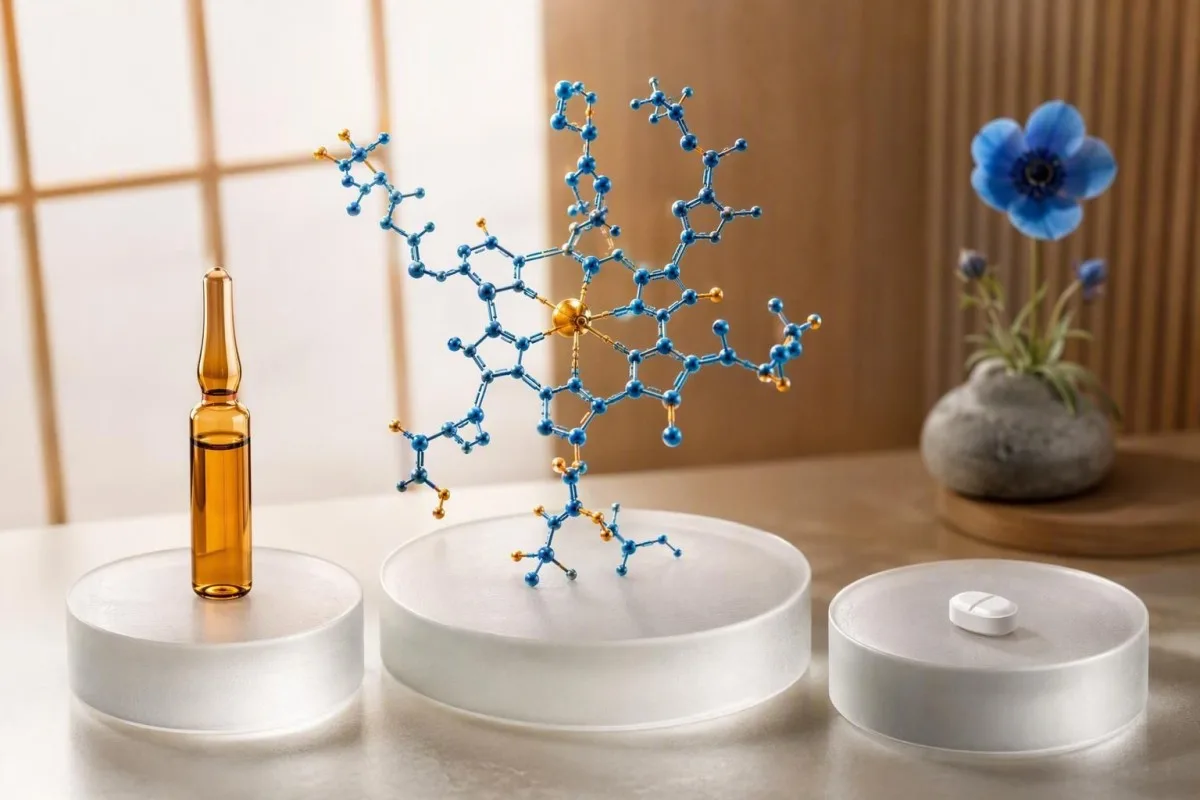
Sindano hutoa kiwango cha juu cha damu mara moja, lakini B12 ya mdomo ya kipimo cha juu mara nyingi hurekebisha upungufu kwa ufanisi sawa kwa wiki. Jambo la kuamua kawaida ni sababu na ukali wa upungufu—sio mapendeleo pekee.


- Ongezeko la haraka la serum: Sindano ya misuli ya B12 ya mikrogamu 1,000 huongeza B12 kwenye damu ndani ya saa chache, wakati vidonge huongezeka polepole zaidi kwa siku.
- Ubadilishaji unaofanana: Cyanocobalamin ya mdomoni miligramu 1,000-2,000 kwa siku inaweza kufikia matokeo sawa ya muda mfupi wa damu na dalili kama tiba ya misuli kwa watu wengi wazima.
- Dalili za sindano: Dalili kali za mfumo wa neva, upungufu mkali wa damu, kutoweza kutumia vidonge, au ufyonzwaji usioaminika mara nyingi huruhusu sindano zinazoongozwa na daktari.
- Matokeo ya mpakani: B12 ya Serum chini ya 180 pg/mL (133 pmol/L) mara nyingi huchukuliwa kuwa upungufu; 180-350 pg/mL mara nyingi huhitaji uthibitisho wa MMA au homosisteini.
- Ufyonzwaji wa kiasili: Kuhusu 1% ya kipimo kikubwa cha mdomo cha B12 huingia kupitia upenyaji tulivu, ndiyo sababu kibao cha mikrogramu 1,000 kinaweza kufanya kazi licha ya uharibifu wa kimsingi.
- Muda wa kurudia kipimo: CBC na mwitikio wa kliniki kawaida huwa na manufaa zaidi baada ya wiki 4-8 kuliko kiwango cha B12 kinachochorwa mara baada ya matibabu.
- Sehemu ya usalama: Usitibu ganzi isiyoeleweka kwa asidi ya foliki pekee; folate inaweza kuboresha upungufu wa damu huku uharibifu wa neva unaohusiana na B12 ukiendelea.
- Sababu ni muhimu: Metformin, vizuizi vya proton-pump, vyakula vya vegan, coeliac disease, upasuaji wa tumbo, na anemia mbaya zinahitaji mipango tofauti ya ufuatiliaji.
Ni njia ipi huongeza viwango vya vitamini B12 kwa haraka zaidi?
Sindano za B12 huongeza kiwango cha serum kilichopimwa haraka kuliko vidonge, mara nyingi ndani ya saa, kwa sababu hupita njia ya utumbo. Kwa watu wengi wazima walio na uhaba uliothibitishwa, hata hivyo, kipimo cha mdomo cha mikrogramu 1,000-2,000 kila siku kinaweza kujaza akiba ya mwili na kuboresha hesabu za damu kwa wiki kwa kasi sawa na kimatibabu.
Sindano huunda kilele cha juu cha mapema kwa sababu hydroxocobalamin au cyanocobalamin huletwa moja kwa moja kwenye misuli na kisha mzunguko wa damu. Kilele hicho cha maabara si kitu kile kile na akiba ya tishu iliyorejeshwa au kazi ya neva iliyorekebishwa; katika mazoezi yangu, kupona kwa dalili hupimwa kwa wiki hadi miezi, si kesho asubuhi.
Ulinganisho wa vitendo mara nyingi ni saa dhidi ya siku kwa mkusanyiko wa serum, lakini takriban wiki 4-8 kwa mwitikio wa maana wa damu kwa njia yoyote iliyo sahihi. Reticulocytes huongezeka kwa siku 3-5, hemoglobin huanza kuboreka baada ya kama wiki 1-2, na macrocytosis inaweza kuchukua hadi wiki 8 kutulia.
Kantesti ni Mchambuzi wa mtihani wa damu wa AI ambayo huweka B12 kando ya MCV, hemoglobin, folate, creatinine na matokeo ya awali badala ya kutibu kuongezeka kwa B12 baada ya matibabu kama uthibitisho kwamba tatizo la msingi limetatuliwa. Wasomaji wanaweza pia kulinganisha matokeo yao na yetu mwongozo wa kiwango cha marejeleo cha B12.
“Haraka” kunamaanisha nini hasa
Matokeo ya juu baada ya sindano huhakikisha mfiduo wa hivi karibuni, sio lazima uwasilishaji wa seli wa kutosha. Asidi ya methylmalonic, matokeo ya neva na mwelekeo wa CBC ni wa taarifa zaidi wakati utambuzi wa awali haukuwa na uhakika.
Jinsi vitamini B12 kinavyofyonzwa mdomoni wakati kipengele cha ndani (intrinsic factor) kiko chini
B12 ya mdomo ya kipimo kikubwa inaweza kufanya kazi hata wakati upatikanaji wa kimsingi umeharibika kwa sababu sehemu ndogo huingia kupitia upenyaji tulivu. Takriban 1% ya kipimo cha mikrogramu 1,000 inaweza kupatikana kupitia upenyaji tulivu, ikitoa takriban mikrogramu 10—juu zaidi ya mahitaji ya wastani ya kila siku ya mikrogramu 2.4 kwa watu wazima.
B12 ya chakula ya kawaida lazima itolewe na asidi ya tumbo, ifunge kimsingi, na ipatikane katika terminal ileum. Mfumo huu wa hatua nyingi unaelezea kwa nini utawala wa asidi wa muda mrefu, gastritis ya autoimmune, ugonjwa wa ileal na taratibu za bariatric zinaweza kusababisha uhaba; pia inaelezea kwa nini vitamini mbalimbali vya kawaida mara nyingi huwa kipimo kidogo sana cha matibabu.
Upatikanaji wa B12 wa mdomo unategemea kipimo lakini sio laini. Njia ya kimsingi hujaa kwa takriban mikrogramu 1.5-2 kwa mlo, wakati upenyaji tulivu unakuwa muhimu sana tu kwa vidonge vya kiwango cha miligramu. Nyongeza ya mikrogramu 50 ni kinga inayofaa kwa watu wengine, lakini si sawa na mikrogramu 1,000 kwa upungufu uliokwisha thibitishwa.
Kwa wagonjwa wanaotumia omeprazole, pantoprazole au PPI nyingine, mimi huangalia muundo mpana—lishe, umri, upungufu wa damu na muda wa matumizi—badala ya kudhani kuwa dawa ndiyo sababu kuu. Uhakiki wetu wa ufuatiliaji wa maabara wa PPI wa muda mrefu ana kwa nini magnesiamu na chuma huenda pia zikapeleka umuhimu.
Utafiti wa kimatibabu unaonyesha nini kuhusu vidonge dhidi ya sindano
Ushahidi uliopatikana kwa njia ya nasibu unaonyesha kuwa B12 ya kumeza ya micrograms 1,000-2,000 kila siku inaweza kuwa sawa na B12 ya sindano kwa watu wengi wenye upungufu. Msingi wa ushahidi si mkubwa, na unajumuisha wagonjwa wachache wenye magonjwa makali ya neva kuliko wangependa wataalamu wa afya.
Mapitio ya Cochrane na Wang na wenzake waligundua kuwa B12 ya kumeza yenye dozi kubwa ilitoa majibu sawa ya viwango vya B12 kwenye damu na matibabu ya sindano katika tafiti ndogo zilizopatikana (Wang et al., 2018). Utafiti mmoja ulitumia micrograms 2,000 za kumeza kila siku; mwingine ulitumia micrograms 1,000 za kumeza baada ya ratiba ya awali, kwa hivyo “tiba ya kumeza” haimaanishi bidhaa ya dukani yenye dozi ndogo.
Jaribio la awali na Kuzminski et al. liliripoti viwango vya juu zaidi vya B12 kwenye seramu kwa cyanocobalamin ya kumeza ya micrograms 2,000 kuliko na mpango wa sindano wa micrograms 1,000, hata hivyo matokeo ya kimatibabu yalikuwa swali muhimu (Kuzminski et al., 1998). Ushahidi umekanganywa kuhusu mpango bora kwa sababu tafiti zilitumia vipindi tofauti vya sindano na vipindi vya ufuatiliaji.
Kidonge hufanya kazi tu ikiwa kinatumiwa. Kukosa dozi za kila siku kunaweza kufanya sindano inayotolewa kila baada ya miezi 2-3 kuwa ya kutegemewa zaidi katika maisha halisi, hasa kwa watu wazima walio dhaifu au watu wenye ratiba ngumu za dawa. mwongozo wa ratiba ya vipimo vya damu inaweza kusaidia kutofautisha mabadiliko halisi ya matibabu kutoka kwa upimaji upya uliofanywa vibaya.
Linapokuwa sahihi kitabibu kutumia sindano za B12
Sindano za B12 kwa kawaida huhitajika kiafya wakati upungufu ni mkali, dalili za neva zipo, ulaji wa kumeza hauwezekani, au ufyonzwaji na utii haviwezi kutegemewa. Hazihitajiki moja kwa moja kwa sababu tu anemic pernicious inashukiwa, mradi tu matibabu ya kumeza yenye dozi kubwa na ufuatiliaji unawezekana.
Tathmini ya daktari kwa haraka inafaa kwa usumbufu mpya wa kutembea, msisimuko unaoendelea, udhaifu, kuchanganyikiwa, mabadiliko ya kuona, upungufu mkali wa damu, au ujauzito na upungufu mkubwa. Jeraha la B12 kwenye mfumo wa neva linaweza kuwa lisiloweza kurekebishwa kikamilifu; katika hali hiyo, sitachelewesha tiba ya sindano wakati wa kujadili urahisi.
Mwongozo wa NICE NG239 unashauri matibabu ya sindano wakati ufyonzwaji mbaya unashukiwa au kuthibitishwa na unapendekeza urejesho wa sindano wa maisha kwa gastritis ya kinga mwenyewe katika hali nyingi (NICE, 2024). Mazoezi hutofautiana kimataifa: wataalamu wengine hutumia miligramu 1-2 za kumeza kila siku kwa wagonjwa wanaotegemewa wenye anemic pernicious, wakati wengine wanapendelea sindano kwa sababu matokeo ya kukosea ni makubwa zaidi.
Hemoglobini chini ya 80 g/L, kupumua kwa shida, tachycardia, au uwezekano wa kuhusika kwa uti wa mgongo unahitaji mapitio ya haraka ya kimatibabu badala ya kujitibu. Ili kuelewa jinsi ruwaza za upungufu wa damu zinavyoonekana kwenye upimaji wa kawaida, ona nini hesabu kamili ya damu inajumuisha.
Vipimo vya matibabu ya upungufu wa B12 vinavyotumiwa na wataalamu wa afya
Dozi za kawaida za matibabu ya kumeza ni micrograms 1,000-2,000 kila siku, wakati mipango ya kawaida ya sindano hutumia micrograms 1,000 kwa dozi na awamu ya awali ya kuanza. Bidhaa, mwongozo wa kitaifa na sababu ya upungufu huamua ratiba halisi.
Katika mazoezi ya Uingereza, hydroxocobalamin 1,000 micrograms ya sindano mara tatu kwa wiki kwa wiki 2 mara nyingi hutolewa wakati hakuna usumbufu wa neva, kisha kila baada ya miezi 2-3 kwa ajili ya matengenezo; mipango hutofautiana na huduma ya eneo husika. Kwa dalili za neva, dozi za awali mara nyingi hutolewa kila siku nyingine hadi hakuna uboreshaji zaidi, kisha matengenezo hufuata ushauri wa wataalamu.
Mpango wa kawaida wa kumeza ni cyanocobalamin 1,000 micrograms kila siku kwa wiki 8-12, ikifuatiwa na 1,000 micrograms kila siku au ratiba ya matengenezo ya chini ikiwa lishe ilikuwa sababu pekee. Bidhaa za sublingual hazijathibitishwa kuzidi vidonge vilivyomezwa; mara tu vinapoyeyuka, vingi humezwa.
Usivumbue mpango wa kuanza kutoka kwa ushauri wa mitandao ya kijamii. ulinganifu wa B12 iliyopambanuliwa dhidi ya cyanocobalamin anaeleza kwa nini dozi na uthabiti kwa ujumla huenda zaidi ya madai ya uuzaji kuhusu aina ya B12.
Jinsi ya kutafsiri matokeo ya chini au ya mpakani ya B12
B12 ya seramu chini ya 180 pg/mL (133 pmol/L) kwa kawaida huunga mkono upungufu, wakati maadili kutoka kuhusu 180-350 pg/mL ni eneo lisiloeleweka ambalo MMA au homocysteine inaweza kufafanua upungufu wa seli. Vipindi tofauti vya maabara ya mtu binafsi hutofautiana, na thamani ya kawaida ya seramu haizuii kikamilifu upungufu baada ya nyongeza ya hivi karibuni.
Asidi ya methylmalonic huongezeka wakati kimetaboliki inayotegemea B12 imeharibika, lakini utendakazi duni wa figo unaweza kuongeza MMA bila kutegemea. Homocysteine inaweza kuongezeka na upungufu wa B12, upungufu wa folate, upungufu wa vitamini B6, hypothyroidism na uharibifu wa figo, kwa hivyo hakuna kati ya vipimo vya kuthibitisha vinavyopaswa kusomwa kivyake.
Macrocytosis inasaidia lakini si lazima. Kiwango cha juu cha ujazo wa kiini kisicho kawaida kinachoendelea kinatoa shaka kwa upungufu wa B12 au folate, mfiduo wa pombe, ugonjwa wa ini, hypothyroidism, magonjwa ya marongo au athari za dawa; takriban robo moja ya wagonjwa wenye upungufu wa B12 wenye dalili wanaweza kuwa na MCV ya kawaida.
Kantesti AI hutafsiri matokeo ya B12 kwa kuangalia muundo ya MCV, RDW, hemoglobin, folate na maadili ya kihistoria, ikiwa ni pamoja na dalili kwamba nyongeza ya folate inaweza kuwa inaficha macrocytosis. Makala yetu kuhusu uchunguzi wa juu wa MCV inashughulikia mbadala za kawaida.
Anemia mbaya hubadilisha mpango wa muda mrefu, si mara zote njia ya matibabu
Anemia ya Pernicious ni upotezaji wa kiotomatiki wa utendakazi wa ndani wa kiini, na inahitaji ulaji wa kudumu wa B12 baada ya kugunduliwa. Sindano hutoa utoaji wa kutegemewa, lakini matibabu ya kipimo cha juu cha mdomo bado yanaweza kudumisha hali ya kutosha kwa watu wazima waliochaguliwa, wanaofuatiliwa kwa karibu.
Vipimo vinavyotumiwa zaidi ni vizuizi dhidi ya kiini cha ndani na vizuizi dhidi ya kiini cha parietal, pamoja na B12, CBC na wakati mwingine gastrin. Kizuizi cha kiini cha ndani chenye matokeo chanya ni maalum sana lakini si mseto sana, kwa hivyo matokeo hasi hayatengui hali hiyo; hii ni moja ya maeneo hayo ambapo muktadha huathiri zaidi kuliko kizuizi kimoja.
Anemia ya Pernicious ni zaidi ya tatizo la ufyonzwaji. Gastritis ya kiotomatiki inaweza kuwepo pamoja na upungufu wa chuma kabla ya upungufu wa B12 kuwa dhahiri, na ugonjwa wa muda mrefu hubeba mazingatio ya ufuatiliaji wa tumbo ambayo yanapaswa kujadiliwa na daktari anayemtibu. Mwongozo wetu wa upimaji wa anemia ya pernicious unaelezea mpangilio wa uchunguzi.
Kantesti ni jukwaa la tafsiri ya vipimo vya damu la AI zinazotumiwa katika nchi 127+, lakini tafsiri ya AI haiwezi kugundua gastritis ya kiotomatiki au kuchagua muda wa sindano wa maisha yote. Daktari anahitaji kuunganisha dalili, vizuizi, historia ya uchunguzi na muundo wa maabara.
Kwa nini dalili za mfumo wa neva zinahitaji hatua za haraka kitabibu
Kuwashwa, kupoteza hisia za mtetemo, kutembea bila msimamo, mabadiliko ya utambuzi au udhaifu na B12 ya chini unapaswa kusababisha tathmini ya haraka ana kwa ana na kawaida matibabu kwa sindano. Urejeshaji wa neva hauna uhakika kuliko urejeshaji wa upungufu wa damu na unaweza kubaki haukamiliki baada ya miezi ya upungufu.
Safu za mgongo na neva za pembeni huathirika na upungufu wa B12, na kusababisha muundo ambao madaktari huita uharibifu wa pamoja wa baada ya papo hapo katika kesi za juu. Hemoglobin ya kawaida hailindi dhidi ya hii; Nimeona wagonjwa ambao miguu yao iliyopooza na hisia za mtetemo zisizo za kawaida zilitangulia upungufu wowote wa damu.
Uboreshaji mara nyingi huanza ndani ya wiki 1 ya matibabu yenye ufanisi, lakini dalili za hisia zinaweza kuchukua miezi 3-12 na huenda zisirejeshwe kikamilifu. Njia salama zaidi ni kurekodi hali ya msingi—umbali wa kutembea, kuanguka, wepesi wa mikono, hisia za mtetemo—kwa sababu B12 ya juu mwilini pekee si alama ya kupona.
Neuropathy pia ina waimbua wengi, ikiwa ni pamoja na ugonjwa wa kisukari, uharibifu wa neva unaohusishwa na pombe, ugonjwa wa tezi, vitamini B6 nyingi na dawa zingine. Wagonjwa wenye kuwashwa wanaweza kutumia mwongozo wetu wa wa dalili za neva za vitamini B6 kujiandaa maswali bora zaidi, lakini udhaifu unaoendelea unahitaji huduma ya kimatibabu sasa.
Linapokuwa vidonge vya kutosha kwa upungufu wa B12 unaosababishwa na lishe
Vidonge kawaida huwa vya kutosha wakati B12 ya chini inatokana na ulaji usiofaa na utumbo unaweza kufyonza virutubisho. Wegeni, watu wanaokula chakula kidogo sana cha asili ya wanyama, na watu wazima wenye kizuizi cha muda cha lishe kawaida hujibu vizuri kwa cyanocobalamin ya mdomo ya micrograms 1,000 kila siku.
Viamine B12 kwa kawaida hujilimbikizia katika vyakula vinavyotokana na wanyama na vyakula vilivyoimarishwa, kwa hivyo lishe kali ya mboga inahitaji mkakati wa kuaminika wa chakula au nyongeza. Vyakula vya mimea vinavyouzwa kama vyanzo asili vya B12 havina uhakika; mwani na vyakula vilivyochachushwa vinaweza kuwa na vitu vinavyofanana visivyo na ufanisi ambavyo si tiba ya uhakika.
Upungufu wa lishe bado unapaswa kusababisha historia fupi. Mlo wa mboga wa miaka 23 na B12 wa 142 pg/mL, MMA ya kawaida baada ya matibabu na hakuna dalili za utumbo ni tofauti na mtu wa miaka 68 mwenye matokeo sawa, kupungua uzito na upungufu wa chuma. Umri, dawa na dalili za utumbo hubadilisha uchunguzi.
Kwa mipango ya chakula, yetu mwongozo wa vitamini mumunyifu katika maji hutenganisha vipimo vya kuzuia kutoka kwa matibabu ya upungufu. Usidhanie lishe pekee itarekebisha dalili za neva kwa haraka vya kutosha.
Dawa na hali za utumbo zinazobadilisha uchaguzi wa matibabu ya B12
Metformin, dawa za kupunguza asidi, ugonjwa wa celiac, ugonjwa wa Crohn unaoathiri utumbo mdogo, upungufu wa kongosho na upasuaji wa tumbo zote zinaweza kupunguza upatikanaji wa B12. Kesi ya kidonge inaweza kuwa ya busara katika baadhi ya matukio, lakini sindano mara nyingi huchaguliwa wakati uchukuaji hauna uhakika au dalili ni kubwa.
Upungufu wa B12 unaohusiana na Metformin ni wa kawaida sana hata watunga sera wanashauri kuangalia viwango kwa wagonjwa wenye neuropathy, upungufu wa damu au vipengele vingine vya hatari, hasa kwa dozi za juu au muda mrefu. Utaratibu huo huenda unahusisha uchukuaji unaotegemea kalsiamu wa tata ya B12-intrinsic factor katika utumbo mdogo, si tu lishe duni.
Baada ya sleeve gastrectomy au gastric bypass, maamuzi ya matibabu yanapaswa kufuata itifaki ya timu ya bariatric kwa sababu chuma, folate, thiamine, vitamini D na shaba zinaweza kuathiriwa pamoja. Kuhara, albin ya chini, kupungua kwa uzito bila kueleweka au kinyesi chenye mafuta vinapaswa kusababisha uchunguzi badala ya mabadiliko mengi ya nyongeza.
Upungufu wa shaba pia unaweza kusababisha upungufu wa damu na dalili za neva zinazofanana na upungufu wa B12, hasa baada ya upasuaji wa bariatric au zinki nyingi. Yetu dalili za kliniki za upungufu wa shaba zinaelezea kwa nini kuangalia B12 tu kunaweza kukosa maelezo halisi.
Inachukua muda gani kupima tena baada ya matibabu ya B12
Uchunguzi wa CBC na ukaguzi wa dalili kwa takriban wiki 4-8 kwa ujumla ni muhimu zaidi kuliko kurudia serum B12 mara moja baada ya sindano au kozi ya kidonge. Matokeo ya juu sana ya B12 muda mfupi baada ya matibabu huakisi kipimo kilichochukuliwa.
Majibu ya reticulocyte karibu siku ya 3-5 hutoa dalili ya mapema kwamba uzalishaji wa mafuta unarejeshwa, wakati hemoglobin inapaswa kuongezeka kwa wiki zinazofuata ikiwa upungufu wa B12 ulikuwa dereva mkuu. Ukosefu wa maboresho unapaswa kufungua upya tofauti: upungufu wa chuma, kupoteza damu unaoendelea, upungufu wa folate, kuvimba, ugonjwa wa figo au utambuzi usio sahihi.
Kwa upungufu wa lishe usio ngumu, mara nyingi huangalia tena CBC na B12 kwa wiki 8-12, kisha kuthibitisha mpango endelevu wa matengenezo. Kwa magonjwa ya neva, gastritis autoimmune, ujauzito, uharibifu wa figo au upungufu mwingi, ufuatiliaji unahitaji kuwa wa mtu binafsi na mara nyingi huanza mapema.
Kantesti’s Zana ya uchambuzi wa vipimo vya damu inayotumia AI inaweza kulinganisha matokeo ya B12, MCV, RDW na hemoglobin mfululizo badala ya kuonyesha kila kuchora kama tukio lililotengwa. mwongozo wa kulinganisha maabara kwa upande-kwa-upande inaonyesha nini cha kurekodi kati ya vipimo.
Kwa nini matokeo ya juu ya B12 baada ya matibabu si mara zote yenye kutuliza
Kiwango cha juu cha B12 baada ya sindano au kidonge cha dozi ya juu mara nyingi huakisi nyongeza na haithibitishi kwamba dalili zina sababu nyingine. Kinyume chake, kuongezeka kwa B12 bila kueleweka bila nyongeza kunastahili ukaguzi wa kimatibabu, hasa wakati uboreshaji wa ini, figo au hesabu za damu unapatikana pamoja.
Serum B12 inaweza kuzidi kikomo cha juu cha maabara cha takriban 900-1,000 pg/mL baada ya matibabu, kulingana na uchambuzi na wakati. Hii inatarajiwa na kwa kawaida si sumu; B12 haina kiwango cha juu kinachokubalika cha ulaji kwa watu wazima wenye afya kwa sababu ziada hutolewa kwa kiasi kikubwa, ingawa milipuko ya chunusi hutokea kwa wachache.
Swali ninajiuliza ni rahisi: je, sampuli ilitolewa baada ya nyongeza, sindano, multivitamin, kinywaji cha nishati au bidhaa iliyoimarishwa? Ikiwa sivyo, kuongezeka kwa B12 kunaweza kuambatana na ugonjwa wa ini, kupungua kwa kibali cha figo, kuvimba au hali fulani za damu, na inahitaji muktadha badala ya hofu.
Yetu mwongozo wa juu wa vitamini B12 unaelezea tofauti kati ya ongezeko linalotarajiwa linalohusiana na virutubisho na dalili ya maabara isiyoeleweka.
Makosa ya kawaida katika matibabu ya B12 yanayochelewesha kupona
Kosa kubwa zaidi ni kuchukua asidi ya foliki pekee wakati upungufu wa B12 haujatengwa. Asidi ya foliki inaweza kusababisha upungufu wa damu kuwa wa kawaida huku ikiruhusu uharibifu wa neva unaohusiana na B12 kuendelea, hasa wakati dozi zinazidi kiwango cha kawaida cha lishe.
Usitumie dalili pekee kuamua kati ya sindano na vidonge. Uchovu, ukungu wa ubongo na hali mbaya ya moyo ni halisi lakini hazina maana maalum; kukosa usingizi, ugonjwa wa tezi, upungufu wa chuma, unyogovu, kisukari na athari za dawa vinaweza kusababisha malalamiko sawa. Matokeo ya B12 karibu na 250 pg/mL yanahitaji uthibitisho mara nyingi zaidi kuliko sindano ya moja kwa moja.
Kosa lingine ni kuchelewesha kipimo hadi baada ya kuanza virutubisho inapowezekana. Hata micrograms 50-500 kila siku inaweza kubadilisha serum B12 vya kutosha ili kuchelewesha utambuzi, ingawa dalili kali za neva zinapaswa kutibiwa kwanza kila wakati. tatizo la juu la folate na B12 iliyofichwa ni muhimu sana kwa watu wanaochukua virutubisho vya kabla ya kuzaa au vya nishati.
Kufikia Agosti 27, 2026, ushauri wangu kama Daktari Thomas Klein ni kuchagua njia iliyo na mzigo mdogo zaidi ambayo ni ya kuaminika kimatibabu, kisha kuthibitisha ahueni kwa dalili na mitindo. Matibabu ya sindano ni dawa bora inapohitajika; si dawa yenye nguvu zaidi kwa kila matokeo ya chini.
Mfumo wa kufanya maamuzi wa vitendo kwa sindano au vidonge vya B12
Chagua sindano wakati hatari ni kubwa au uaminifu wa mdomo ni mdogo; chagua vidonge vya kiwango cha juu wakati upungufu ni mdogo hadi wa wastani, ulaji ndio suala kuu na ufuatiliaji ni wa kuaminika. Njia bora ni ile inayorekebisha upungufu bila kuchelewesha uchunguzi wa sababu yake.
Vidonge vinafaa zaidi wakati B12 iko chini kutokana na lishe, hakuna dalili za neva, kumeza ni salama na mtu anaweza kuchukua micrograms 1,000-2,000 kila siku mara kwa mara. Sindano zinafaa zaidi na dalili za neva, upungufu wa damu wenye dalili kali, kutapika, ufyonzwaji mkuu, anatomia ya baada ya upasuaji au ufuatiliaji usio na uhakika.
Leta vitu vinne kwenye miadi: matokeo asili ya B12 na vipimo, CBC, kila kidonge cha ziada na kipimo cha dawa, na kalenda ya dalili. Kanuni ya kimatibabu ya Daktari Thomas Klein ni kwamba sababu inapaswa kutajwa kabla ya matengenezo kufanywa kwa muda usiojulikana wakati wowote inaweza kufanywa kwa usalama.
Kantesti AI ni huduma ya kutafsiri vipimo vya maabara ya AI iliyoundwa kuandaa mazingira ya maabara kwa wagonjwa na wataalamu wa afya, wakati utambuzi wa mwisho na kuagiza dawa hubaki maamuzi ya kimatibabu. Yetu Bodi ya Ushauri wa Matibabu na mbinu ya uthibitisho wa kimatibabu huelezea usimamizi wa kimatibabu nyuma ya mpaka huo.
Maswali Yanayoulizwa Mara Kwa Mara
Je, sindano za B12 hufanya kazi haraka kuliko vidonge?
Injektioner med B12 höjer B12-nivåerna i serum snabbare än tabletter eftersom en intramuskulär dos på 1 000 mikrogram kringgår tarmabsorptionen och kan öka cirkulerande nivåer inom några timmar. Högdos oral B12, vanligtvis 1 000–2 000 mikrogram dagligen, kan ändå korrigera brist effektivt över flera veckor hos många vuxna. Meningsfulla slutpunkter är förbättring av symtom, retikulocyter inom 3–5 dagar och CBC-återhämtning inom ungefär 4–8 veckor, inte bara den omedelbara serumtoppen. Injektioner föredras vid neurologiska symtom, svår anemi eller opålitlig absorption.
Je, B12 ya mdomo inaweza kufanya kazi ikiwa nina upungufu wa damu wa pernisi?
Mkusanyiko mrefu wa vitamini B12 kwa mdomo unaweza kufanya kazi kwa baadhi ya watu wenye upungufu wa damu wa pernisiwa kwa sababu takriban 1% ya kipimo kikubwa hufyonzwa na mchakato wa kawaida bila kuwa na kipengele cha ndani. Kwa hivyo, kipimo cha kila siku cha micrograms 1,000-2,000 kwa mdomo kinaweza kutoa micrograms 10-20 za B12 iliyofyonzwa, ikizidi mahitaji ya kila siku ya watu wazima ya micrograms 2.4. Mwongozo wa NICE kwa kawaida huunga mkono uingizwaji wa kudumu wa misuli kwa gastritis ya autoimmune, hasa ambapo kuegemea kuna mashaka. Njia inapaswa kukubaliwa na daktari anayesimamia utambuzi na kufuatiliwa kwa dalili na CBC.
Hur många B12-tabletter motsvarar en injektion?
Hakuna mgao kamili wa kidonge hadi sindano kwa sababu sindano hutoa upatikanaji kamili wa mfumo wakati ngozi ya mdomo inategemea kipimo na hufikia kikomo. Sindano ya mikrogamu 1,000 na mdomo wa mikrogamu 1,000-2,000 kila siku zote ni dozi za kawaida za matibabu, lakini hazibadiliki kwa njia ya dawa kwa msingi wa kipimo kwa kipimo. Takriban 1% ya dozi ya mdomo ya mikrogamu 1,000 inaweza kuingia kwa kuenea kwa pasipo, wakati ngozi ya ziada hufanyika kupitia kipengele cha ndani wakati njia hiyo inafanya kazi. Jibu la matibabu na sababu ya upungufu inapaswa kuongoza mabadiliko yoyote.
Je, inachukua muda gani kwa sindano za B12 kuboresha uchovu?
Vituaji vya B12 vinaweza kuboresha nishati ndani ya siku hadi wiki chache wakati upungufu ndio sababu halisi ya uchovu, lakini muda unabadilika sana. Uzalishaji wa reticulocyte mara nyingi huongezeka kwa siku 3-5, hemoglobin kawaida huanza kuongezeka baada ya wiki 1-2, na marekebisho kamili ya macrocytosis inaweza kuchukua hadi wiki 8. Numbness, shida za usawa na dalili za utambuzi mara nyingi huchukua miezi 3-12 na inaweza kuwa haijakamilika ikiwa upungufu uliendelea kwa muda mrefu. Uchovu unaoendelea baada ya CBC ya kawaida unapaswa kuchochea ukaguzi kwa upungufu wa chuma, ugonjwa wa tezi, shida za kulala na sababu zingine.
Ska jag ta B12-tabletter före ett blodprov?
Kama upimaji umepangwa kugundua upungufu wa B12 ambao haueleweki na wewe uko thabiti kimatibabu, epuka kuanza virutubisho hadi sampuli ikusanywe kwa sababu hata micrograms 50-500 kila siku inaweza kubadilisha kiwango cha B12 katika damu. Hakuna muda wa kusafisha wa ulimwengu wote, kwani maabara na vipimo vinatofautiana, kwa hivyo muulize daktari au maabara kwa ushauri wao wa maandalizi. Usicheleweshe matibabu kupata hali ya msingi inayofaa ikiwa una dalili za ujasiri, upungufu mkubwa wa damu, wasiwasi unaohusiana na ujauzito au kuzorota kwa hali ya kimatibabu. Rekodi kipimo na tarehe ya kuanza ili matokeo yaweze kutafsiriwa kwa usahihi.
Je li razina B12 od 200 pg/mL dovoljno niska za injekcije?
Kiwango cha B12 cha 200 pg/mL ni cha chini kabisa na haiamui peke yake kama sindano zinahitajika. Maabara nyingi huchukulia viwango vilivyo chini ya 180 pg/mL kuwa ni upungufu dhahiri, huku viwango kutoka takriban 180-350 pg/mL vikihitaji methylmalonic acid, homocysteine, matokeo ya CBC na tathmini ya dalili. Sindano ni za busara kwa 200 pg/mL wakati dalili za neva, upungufu wa damu, matatizo ya kunyonya chakula, mimba au kutokuwa na uwezo wa kutumia matibabu kwa njia ya mdomo zipo. Mtu mwenye afya njema na hatari ya lishe na bila dalili za neva anaweza kuitikia vizuri na micrograms 1,000-2,000 za B12 kwa mdomo kila siku na ufuatiliaji uliopangwa.
Pata Uchambuzi wa Vipimo vya Damu kwa AI Leo
Jiunge na zaidi ya watumiaji 2 milioni duniani kote wanaoamini Kantesti kwa uchambuzi wa papo hapo na sahihi wa vipimo vya maabara. Pakia matokeo yako ya vipimo vya damu na upate tafsiri ya kina ya viashiria vya 15,000+ ndani ya sekunde.
📚 Machapisho ya Utafiti Yanayorejelewa
Klein, T., Mitchell, S., & Weber, H. (2026). Kantesti LTD. (2026). Kigezo cha Kiotomatiki cha Kiufundi chenye Rubric kilichosajiliwa mapema cha Injini ya Tafsiri ya Vipimo vya Damu ya Kantesti kwenye Kesi 100,000 za Majaribio ya Synthetic. Figshare.. Kantesti uchambuzi wa damu kwa AI ya utafiti wa matibabu.
Klein, T., Mitchell, S., & Weber, H. (2026). Kantesti LTD. (2026). Mfumo wa Uthibitisho wa Kliniki v2.0 (Ukurasa wa Uthibitisho wa Matibabu). Zenodo.. Kantesti uchambuzi wa damu kwa AI ya utafiti wa matibabu.
📖 Marejeo ya Nje ya Tiba
NICE (2024). Upungufu wa vitamini B12 kwa zaidi ya miaka 16: utambuzi na usimamizi. NICE Guideline NG239.
⚕️ Kanusho la Kimatibabu
Makala haya ni kwa madhumuni ya elimu tu na si ushauri wa kimatibabu. Wasiliana na mtoa huduma aliyehitimu kila wakati kwa maamuzi ya utambuzi na matibabu.
E-E-A-T Trust Signals
Uzoefu
Mapitio ya kimatibabu inayoongozwa na daktari ya mifumo ya tafsiri ya maabara.
Utaalamu
Kuzingatia dawa za maabara kuhusu jinsi viashiria (biomarkers) vinavyobadilika katika muktadha wa kliniki.
Mamlaka
Imeandikwa na Dk. Thomas Klein kwa mapitio ya Dk. Sarah Mitchell na Prof. Dk. Hans Weber.
Uaminifu
Tafsiri inayotegemea ushahidi yenye njia zilizo wazi za ufuatiliaji ili kupunguza tahadhari za hofu.