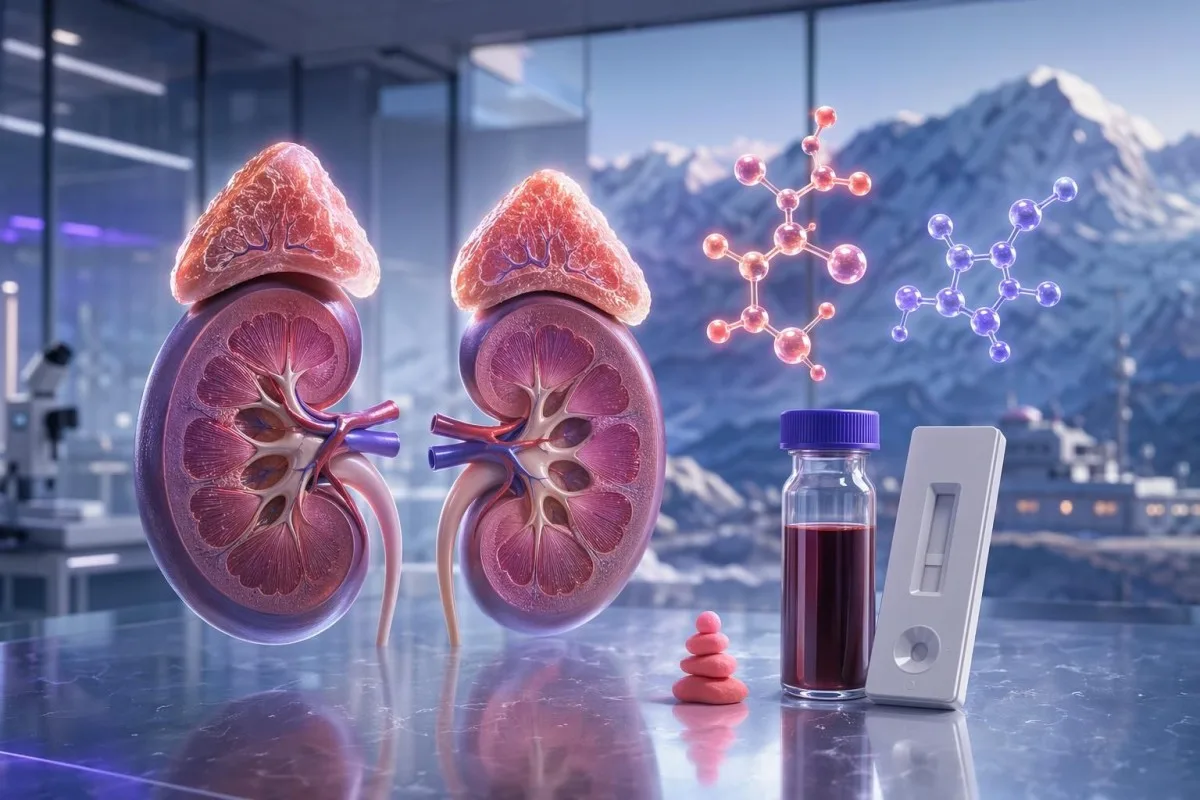
Plasma free metanephrines and 24-hour urine metanephrines are powerful screening tests, but collection posture, stress, medicines, and assay choice can change the result more than many patients expect.


- Pheochromocytoma blood test usually means plasma free metanephrines; a normal properly collected result makes pheochromocytoma unlikely in most patients.
- Plasma metanephrines are most reliable when drawn after 20-30 minutes lying flat, preferably fasting and calm.
- Urine metanephrines require a complete 24-hour collection; low urine creatinine can mean the collection was incomplete.
- Mild elevations of 1-2 times the upper limit are often false positives, especially with seated blood draws, illness, panic, caffeine, nicotine, or certain medicines.
- Levels above 3 times the upper reference limit strongly suggest pheochromocytoma or paraganglioma and usually justify endocrine referral and imaging.
- Medication review should include SNRIs, tricyclic antidepressants, stimulants, decongestants, MAO inhibitors, levodopa, labetalol, nicotine, and recreational sympathomimetics.
- Imaging should usually follow convincing biochemical evidence; scanning first can create confusion because adrenal incidentalomas are common after age 50.
- Repeat testing questions should cover posture, rest time, assay method, age-adjusted ranges, collection completeness, and whether the raised marker was metanephrine or normetanephrine.
What the pheochromocytoma blood test actually measures
A pheochromocytoma blood test screens for excess catecholamine production by measuring plasma free metanephrines, mainly metanephrine and normetanephrine. These metabolites are more stable than adrenaline and noradrenaline, so they catch tumors that release hormones in bursts. A normal, properly collected plasma result usually makes pheochromocytoma unlikely; a result above 3 times the upper limit needs prompt endocrine review.
Pheochromocytomas are rare catecholamine-producing tumors, with estimates around 2-8 cases per million people per year, yet they matter because untreated episodes can trigger severe hypertension, arrhythmia, stroke, or cardiomyopathy. The Endocrine Society guideline recommends either plasma free metanephrines or urinary fractionated metanephrines as the initial biochemical screen for pheochromocytoma and paraganglioma (Lenders et al., 2014).
Kantesti is an AI blood test analyzer that reads endocrine results in context, not as isolated red or green flags. When our clinicians review metanephrine patterns, we look at posture, medications, kidney function, blood pressure history, and whether the report uses nmol/L, pg/mL, or μg/24 h; our broader biomarker guide explains why units and reference intervals matter so much.
I’m Thomas Klein, MD, and in practice I see the same trap repeatedly: a patient with a mildly high normetanephrine is sent for a scan before anyone asks how the specimen was collected. That sequence can turn one noisy lab value into months of anxiety, particularly when a harmless adrenal nodule is found.
Plasma free metanephrines: when the blood test is best
Plasma free metanephrines are usually the most sensitive screening test when pheochromocytoma is a real concern. The test performs best when blood is collected after 20-30 minutes of quiet supine rest, because sitting upright can raise normetanephrine enough to create a false alarm.
A common adult upper reference limit for supine plasma free metanephrine is about 0.50 nmol/L, and for normetanephrine about 0.90 nmol/L, though each laboratory must be read on its own method-specific range. In Lenders et al. 2002 in JAMA, plasma free metanephrines had sensitivity near 99% in a high-risk testing population, which is why endocrinologists trust a clean negative result.
The practical detail patients rarely hear is that the blood draw environment matters. If someone runs from the car park, argues at reception, sits upright for 5 minutes, then has a draw, the sympathetic nervous system has already been activated; for the sample type itself, our guide to serum and plasma helps explain why tube handling is not just lab trivia.
Plasma testing is often preferred when symptoms are dramatic, when there is a known hereditary syndrome, or when a clinician needs a high-sensitivity screen quickly. It is less tidy in severe illness, untreated sleep apnea, renal failure, or after stimulant exposure, where the pre-analytical story can matter as much as the number.
24-hour urine metanephrines: when urine beats plasma
Urine metanephrines measure the total metanephrine and normetanephrine excreted over 24 hours, which can smooth out short hormone surges. A complete collection is essential; missing even one morning void can falsely lower the result and make the test hard to interpret.
Typical adult 24-hour urine reference intervals are roughly metanephrine below 300 μg/24 h and normetanephrine below 600 μg/24 h, but laboratories vary widely by assay and creatinine correction. Many reports also give total metanephrines, and a value above 2-3 times the upper limit carries more weight than a borderline single fraction.
Urine testing can be useful when a patient cannot lie quietly for a plasma draw or when an initial plasma result is mildly abnormal and the clinician wants a second biochemical angle. I still ask about urine volume, creatinine, and missed voids, much as I do when reviewing urine concentration results after dehydration or overhydration.
The collection begins after discarding the first urine of day 1 and ends by saving the first urine of day 2 at the same clock time. If the 24-hour urine creatinine is unexpectedly low for body size, I treat a normal metanephrine result with caution rather than reassurance.
How high is high: ranges, ratios, and gray zones
Metanephrine results are interpreted by how many times they exceed the laboratory’s upper reference limit. Values above 3 times the upper limit are strongly suspicious, while values 1-2 times the limit are the classic gray zone where collection error and medication effects dominate.
A plasma normetanephrine of 1.1 nmol/L may be borderline in one laboratory and clearly high in another, especially if age-adjusted ranges are used. This is why I pay more attention to fold elevation than the raw value, and why patients should keep the original PDF rather than copying one number into a message.
Kantesti AI interprets plasma metanephrines by normalizing the result against the stated reference interval and unit system, a method we align with our clinical validation processes. If your old result was in pg/mL and your new result is in nmol/L, our primer on changing lab units explains why the trend can look falsely alarming.
In my clinic, a metanephrine fraction above 3 times the upper limit gets a very different conversation from a 1.2 times result after a night shift and two coffees. The first calls for endocrine imaging planning; the second usually calls for a cleaner repeat.
Why false positives happen so often
False positive metanephrines happen because the sympathetic nervous system reacts to posture, pain, panic, hypoglycemia, nicotine, sleep deprivation, and many medicines. Normetanephrine is especially vulnerable because normal nerve endings produce noradrenaline during everyday stress.
Tricyclic antidepressants, SNRIs, MAO inhibitors, amphetamines, methylphenidate, decongestants, cocaine, levodopa, nicotine, and withdrawal from clonidine or alcohol can all raise catecholamine or metanephrine readings. Eisenhofer et al. 2003 emphasized that distinguishing true from false positives often depends on the degree of elevation, drug exposure, and sampling conditions.
Do not stop prescribed medication just to make a lab result prettier. Instead, bring a complete medication list, including inhalers, patches, pre-workout powders, nasal sprays, and weight-loss stimulants; our medication monitoring guide is useful for building that timeline before a repeat draw.
The highest false positive rate I see is the patient tested during an emergency department visit for chest tightness, vomiting, migraine, or panic. A borderline plasma normetanephrine drawn during acute illness is not the same biological question as a calm fasting morning specimen.
Prep clues before repeating plasma metanephrines
The best repeat plasma metanephrine test is usually a morning, fasting draw after 20-30 minutes lying flat in a quiet room. Avoiding caffeine, nicotine, intense exercise, and alcohol for about 24 hours can reduce false positive results, unless your clinician gives different instructions.
A clean repeat is not just doing the same test again. I ask patients to sleep normally, avoid hard training for 24 hours, skip nicotine and caffeine that morning, stay warm, and arrive early enough that the body is not still in traffic mode when the tube is filled.
Kantesti is an AI lab test interpretation service that flags whether a repeat result should be interpreted against the same assay, same posture, and same medication context. When a result changes from 1.8 times to 0.9 times the upper limit after proper preparation, that pattern often says more about collection than disease; our repeat abnormal labs guide covers similar retest logic.
Some clinicians also use clonidine suppression testing for borderline normetanephrine elevations, but this is specialist territory and not suitable for every patient. It can be unsafe or uninterpretable in people taking certain blood pressure medicines, so I prefer endocrinology supervision rather than DIY scheduling.
Symptom patterns that raise or lower pretest probability
Classic pheochromocytoma symptoms are episodic headache, sweating, palpitations, tremor, and high blood pressure, often in sudden attacks lasting 10-60 minutes. The combination matters more than any single symptom because anxiety, thyroid disease, menopause, hypoglycemia, and medications can look similar.
About 80-90% of pheochromocytomas produce hypertension at least intermittently, but not every patient is hypertensive in clinic. A patient who records home blood pressure spikes of 220/115 mmHg with pounding palpitations is a different risk category from someone with steady mild anxiety and normal readings.
I see excessive sweating referrals where the metanephrine result is normal and the real clue is thyroid status, glucose swings, infection, or medication side effects. If sweating is your main symptom, our sweating lab guide gives a broader differential before assuming an adrenal tumor.
Low pretest probability does not mean the result can be ignored; it means the threshold for repeating under ideal conditions is lower than the threshold for immediate scanning. A 1.3 times normetanephrine in a patient on venlafaxine after poor sleep is usually a different story from 4.5 times elevation with paroxysmal hypertension.
When imaging should wait—and when it should not
CT or MRI should usually wait until biochemical testing is clearly positive, because adrenal nodules are common and many do not produce catecholamines. Imaging becomes appropriate when metanephrines are above 3 times the upper limit, symptoms are convincing, or a specialist sees a high-risk hereditary pattern.
Adrenal incidentalomas appear in roughly 4-7% of abdominal CT scans in older adults, so scanning first can create a second problem: finding a lump that is unrelated to the symptoms. Once that happens, patients often ask whether every adrenal nodule is dangerous; the honest answer is no, but every adrenal mass deserves structured hormonal assessment.
If imaging is needed, CT abdomen is commonly used first for adrenal pheochromocytoma, while MRI may be preferred in younger patients, pregnancy considerations, contrast concerns, or suspected extra-adrenal paraganglioma. For related adrenal hormone workups, our aldosterone test article explains why blood pressure plus potassium can point to a different adrenal condition.
Functional imaging such as MIBG, DOTATATE PET, or FDOPA PET is not a first-line screen for most patients. It is used when disease is multifocal, metastatic, recurrent, hereditary, or not well localized on standard imaging.
Adrenal incidentalomas and the adrenal tumor blood test
An adrenal tumor blood test panel is not just metanephrines; it often includes tests for cortisol excess and aldosterone excess depending on blood pressure and potassium. Metanephrines are especially urgent because an unrecognized pheochromocytoma can make biopsy, anesthesia, or surgery dangerous.
For an adrenal incidentaloma, clinicians commonly check plasma free or urine fractionated metanephrines, a 1 mg overnight dexamethasone suppression test, and aldosterone-renin ratio if hypertension or low potassium is present. A small lipid-rich adenoma on CT can still require biochemical screening because imaging appearance alone does not prove hormone silence.
Family history changes the workup. Pheochromocytoma and paraganglioma can be linked to RET, VHL, NF1, SDHB, SDHD, SDHC, TMEM127, MAX, and other genes, so early age, bilateral tumors, extra-adrenal disease, or relatives with endocrine tumors should trigger genetic counseling; our hereditary marker guide helps patients prepare family-history details.
A hard rule in endocrine practice: do not biopsy an adrenal mass until pheochromocytoma has been excluded. I have seen referral letters where biopsy was suggested before metanephrines were back, and that is exactly the kind of sequence we try to prevent.
Special populations: pregnancy, kidney disease, and children
Pregnancy, chronic kidney disease, dialysis, and childhood testing all change how metanephrines should be interpreted. The same numeric result can carry a different false-positive risk when renal clearance, plasma volume, stress physiology, or age-based reference intervals differ.
In chronic kidney disease, plasma free metanephrines are often preferred over urine because 24-hour urine collection and renal excretion become less reliable. Even then, sympathetic activation in advanced kidney disease can raise normetanephrine, so an endocrinologist may rely more on fold elevation and assay method than on a single cutoff.
Pheochromocytoma in pregnancy is rare but high risk, and symptoms can be confused with preeclampsia, panic, hyperthyroidism, or migraine. If severe paroxysmal hypertension appears during pregnancy, testing should be coordinated with obstetric and endocrine teams; our pregnancy lab red flags guide explains which blood pressure patterns need same-day attention.
Children need pediatric reference intervals, not adult shortcuts. A borderline adult-style elevation in a 12-year-old may be meaningless or meaningful depending on body size, collection conditions, and family syndrome risk, so I would rather see a pediatric endocrine review than a rushed scan.
Questions to ask before a repeat test or scan
Before repeating metanephrines or booking imaging, ask whether the first sample was seated or supine, how long you rested, which assay was used, and which medication exposures could interfere. These questions often decide whether the next step is a careful repeat or a CT/MRI referral.
My short patient checklist is blunt: Was I lying down for 20-30 minutes? Was I fasting? Did I use caffeine, nicotine, decongestants, stimulants, or antidepressants? Was I acutely ill, in pain, sleep-deprived, or withdrawing from medication? Was urine creatinine adequate for a 24-hour collection?
Ask for the exact fraction that was high. Isolated normetanephrine elevation often points to sympathetic activation or medications, while marked metanephrine elevation can be more specific for an adrenal source; if you feel stuck, a blood test second opinion can help organize the questions for your clinician.
Also ask what result would change management. If your doctor says imaging will happen only if the repeat is above 2-3 times the upper limit, that gives you a clear threshold; if the plan is vague, request an endocrine referral rather than drifting from one test to the next.
How Kantesti AI reads metanephrines in context
Kantesti AI does not diagnose pheochromocytoma, but it can organize metanephrine results, units, medication context, and trend patterns so patients ask sharper questions. A lab interpretation tool is most useful when it separates urgent patterns from noisy borderline values.
Kantesti is an AI biomarker interpretation platform used by 2M+ people across 127+ countries, with multilingual interpretation for complex lab PDFs and photos. For metanephrines, Kantesti's neural network looks for fold elevation, the named fraction, unit conversions, paired kidney markers, and whether the result resembles a screening signal or a pre-analytical problem.
Our AI is deliberately conservative with rare endocrine tumors. It can flag that a 4 times upper-limit normetanephrine needs clinician escalation, but it should not tell someone they have a tumor; our technology guide explains how pattern-based interpretation differs from automated diagnosis.
In our review workflow, a borderline result is paired with practical prompts: confirm posture, check medication list, compare assay method, and document symptoms with home blood pressure readings. That is often the difference between a productive endocrine appointment and a frightened search spiral at midnight.
Red flags: when high metanephrines need urgent care
High metanephrines plus severe symptoms need urgent medical assessment, especially with blood pressure above 180/120 mmHg, chest pain, fainting, neurologic symptoms, or a sustained irregular heartbeat. These signs can reflect catecholamine crisis or another emergency that cannot wait for outpatient interpretation.
Pheochromocytoma crisis can present with severe hypertension, headache, sweating, chest pain, pulmonary edema, shock-like swings, or stress cardiomyopathy. A metanephrine result above 3 times the upper limit is not itself an ambulance trigger, but the same result with crushing chest pain or neurologic deficits changes the urgency completely.
Before planned surgery for confirmed pheochromocytoma, patients typically need alpha-adrenergic blockade for 7-14 days, often with salt and fluid expansion, before beta-blockers are added if needed. Starting a beta-blocker first can worsen hypertension in unblocked catecholamine excess, a detail I still see missed outside endocrine pathways.
If palpitations or rhythm symptoms are part of the story, document the episode timing against the lab draw and blood pressure reading. Our irregular heartbeat labs guide covers electrolyte and thyroid checks that often run alongside endocrine testing.
Bottom line: a practical repeat-testing checklist
A borderline pheochromocytoma screen deserves a disciplined repeat before imaging unless symptoms or levels are clearly high risk. The safest plan is to fix collection conditions, review medicines with a clinician, confirm units and assay method, then decide whether endocrine imaging is justified.
As of July 3, 2026, my practical threshold is simple: below the upper limit with good collection is reassuring, 1-2 times the upper limit needs cleanup and repeat, 2-3 times needs endocrine discussion, and above 3 times usually deserves imaging after specialist review. Thomas Klein, MD advice here is intentionally cautious because both over-testing and under-testing can harm patients.
Kantesti’s medical content is reviewed with physician oversight through our Medical Advisory Board, and our engineering validation work is documented separately, including a pre-registered technical benchmark. That matters because rare-tumor lab interpretation should be transparent about limits, not dressed up as certainty.
Bring your original lab report, a medication and supplement list, home blood pressure readings, symptom timing, and any adrenal imaging report to the appointment. Most patients find that one organized page beats ten screenshots, and it gives your clinician enough detail to choose repeat testing, specialist referral, or imaging without guesswork.
Frequently Asked Questions
What is the best blood test for pheochromocytoma?
The best blood test for pheochromocytoma screening is usually plasma free metanephrines, especially when collected after 20-30 minutes lying flat. A properly collected normal result makes pheochromocytoma unlikely in most patients because sensitivity is usually above 95% and can approach 99% in high-risk cohorts. The test is not perfectly specific, so borderline elevations often need repeat testing before imaging.
How high do metanephrines need to be for pheochromocytoma?
Metanephrine or normetanephrine values above 3 times the laboratory’s upper reference limit are strongly suspicious for pheochromocytoma or paraganglioma. Results 1-2 times the upper limit are much more often caused by posture, stress, illness, caffeine, nicotine, or medication interference. Results between 2 and 3 times the upper limit usually need endocrinology review and either careful repeat testing or imaging depending on symptoms.
Can anxiety cause high plasma metanephrines?
Anxiety, panic, pain, poor sleep, and recent exercise can raise sympathetic nervous system activity and may mildly increase plasma normetanephrine. This usually causes borderline elevations, often 1-2 times the upper reference limit, rather than very high results above 3 times the limit. A repeat test after 20-30 minutes of quiet supine rest is often the cleanest way to separate stress physiology from a true endocrine signal.
Which medicines can cause false positive metanephrines?
Medicines that can raise or interfere with metanephrines include tricyclic antidepressants, SNRIs, MAO inhibitors, amphetamines, methylphenidate, levodopa, decongestants, labetalol, nicotine, and some recreational stimulants. Withdrawal from clonidine or alcohol can also increase catecholamine physiology. Patients should not stop prescribed medication without medical advice; the safer step is to review the list with the ordering clinician before repeat testing.
Is a 24-hour urine metanephrine test better than plasma?
A 24-hour urine metanephrine test is not universally better than plasma; it answers the question differently by measuring total excretion over a full day. Plasma free metanephrines are usually more sensitive when collected correctly, while urine testing can be useful for confirmation or when supine plasma collection is not practical. The urine test is only reliable if the full 24-hour collection is complete and urine creatinine supports adequate collection.
Should I get a CT scan after high metanephrines?
CT or MRI is usually appropriate after clearly positive metanephrines, especially when a fraction is above 3 times the upper reference limit or symptoms strongly fit pheochromocytoma. For borderline results of 1-2 times the limit, many endocrinologists repeat testing under ideal conditions before imaging because adrenal incidentalomas are common. Imaging first can confuse the diagnosis if a non-functioning adrenal nodule is found.
What should I ask before repeating a pheochromocytoma blood test?
Before repeating a pheochromocytoma blood test, ask whether the sample will be drawn fasting, after 20-30 minutes lying flat, and using the same assay method as the first test. Ask whether your medicines, nicotine, caffeine, exercise, acute illness, or sleep deprivation could affect the result. Also ask which fraction was high, metanephrine or normetanephrine, and what fold elevation would trigger imaging or endocrinology referral.
Can I keep taking my blood pressure medicine before metanephrine testing?
Do not stop blood pressure medicine on your own, particularly alpha-blockers or beta-blockers, because sudden changes can be risky. Tell the ordering clinician exactly what you take so they can decide whether a drug could affect the result or whether testing should proceed unchanged.
Get AI-Powered Blood Test Analysis Today
Join over 2 million users worldwide who trust Kantesti for instant, accurate lab test analysis. Upload your blood test results and receive comprehensive interpretation of 15,000+ biomarkers in seconds.
📚 Referenced Research Publications
Klein, T., Mitchell, S., & Weber, H. (2026). Clinical Validation Framework v2.0 (Medical Validation Page). Kantesti AI Medical Research.
Klein, T., Mitchell, S., & Weber, H. (2026). AI Blood Test Analyzer: 2.5M Tests Analyzed | Global Health Report 2026. Kantesti AI Medical Research.
📖 External Medical References
Eisenhofer G et al. (2003). Biochemical diagnosis of pheochromocytoma: how to distinguish true- from false-positive test results. Journal of Clinical Endocrinology & Metabolism.
⚕️ Medical Disclaimer
This article is for educational purposes only and does not constitute medical advice. Always consult a qualified healthcare provider for diagnosis and treatment decisions.
E-E-A-T Trust Signals
Experience
Physician-led clinical review of lab interpretation workflows.
Expertise
Laboratory medicine focus on how biomarkers behave in clinical context.
Authoritativeness
Written by Dr. Thomas Klein with review by Dr. Sarah Mitchell and Prof. Dr. Hans Weber.
Trustworthiness
Evidence-based interpretation with clear follow-up pathways to reduce alarm.