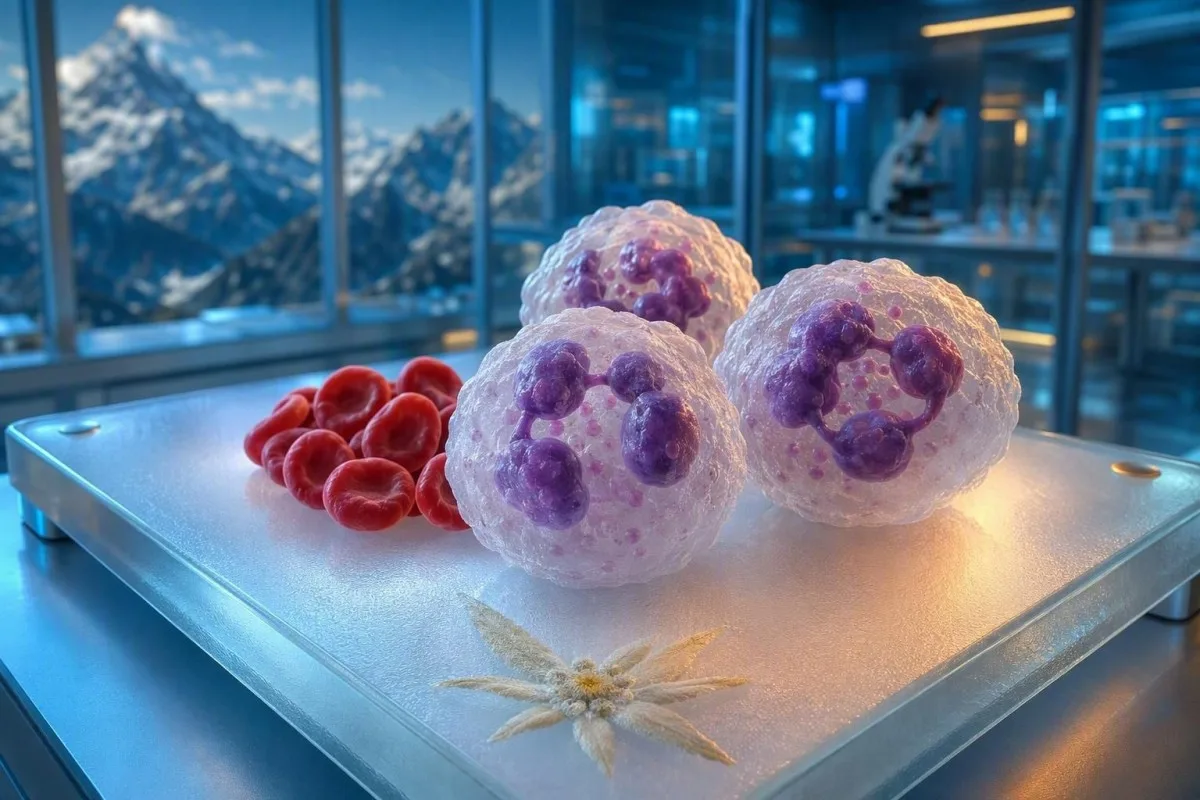
Een licht verhoogd neutrofielenresultaat is vaak tijdelijk, maar de absolute neutrofielen telling, de rest van de CBC, symptomen en de trend bepalen of er actie nodig is.


- Grenswaarde neutrofielen betekent meestal een ANC net boven de laboratoriumbovengrens, vaak rond 7,0-7,5 × 10⁹/L bij volwassenen.
- Absoluut aantal neutrofielen is informatiever dan het neutrofielenpercentage; bereken ANC als WBC × neutrofielenpercentage ÷ 100.
- Lichte neutrofilie onder 15 × 10⁹/L zonder alarmerende symptomen is vaak reactief en kan volgen op infectie, roken, inspanning of steroïdebehandeling.
- Herhaalinterval is meestal 2-6 weken na herstel van een korte ziekte, zware inspanning, vaccinatie of een medicijnverandering.
- Spoedbeoordeling is geschikt bij koorts met ernstige ziekte, kortademigheid, verwardheid, snel stijgende tellingen, blasten, bloedarmoede of lage bloedplaatjes.
- Steroïden en adrenaline kunnen circulerende neutrofielen binnen enkele uren verhogen door cellen van vaatwanden naar de gemeten bloedpool te verschuiven.
- Aanhoudende verhoging voor meer dan 3 maanden, vooral boven 15-20 × 10⁹/L, verdient een door een clinicus geleide beoordeling en vaak een bloeduitstrijkje.
- Zwangerschap kan normaal gesproken het neutrofielenaantal verhogen, met name in het derde trimester, zodat referentiewaarden voor niet-zwangere volwassenen misleidend kunnen zijn.
Wat een grenswaarde neutrofielenresultaat daadwerkelijk betekent
Grenswaarden neutrofielen betekenen meestal een lichte stijging van het absolute neutrofielenaantal (ANC), geen diagnose. Bij de meeste gezonde volwassenen stabiliseert een ANC die slechts iets boven het laboratoriumbereik ligt wanneer de tijdelijke trigger voorbijgaat; de eerste taak is om het absolute aantal, het totale aantal witte bloedcellen en de symptomen te controleren in plaats van te reageren op een gemarkeerd percentage.
Referentie-intervallen voor ANC bij volwassenen lopen gewoonlijk van ongeveer 1,5 tot 7,5 × 10⁹/L, hoewel de bovengrens verschilt per analyzer, afkomst, zwangerschapsstatus en lokale laboratoriummethode. Een waarde van 7,8 × 10⁹/L is klinisch heel anders dan 28 × 10⁹/L, ook al kunnen beide als hoog worden gemarkeerd; zie onze gids voor het normale neutrofielenbereik.
De neutrofielenpercentage kan hoog lijken simpelweg omdat lymfocyten daalden na stress of blootstelling aan corticosteroïden. Bijvoorbeeld, een WBC van 6,0 × 10⁹/L met 78% neutrofielen geeft een ANC van 4,68 × 10⁹/L, wat normaal is ondanks het hoge percentage.
Kantesti is een AI-bloedtestanalysator die de CBC-differentiatie leest naast de totale WBC, hemoglobine, bloedplaatjes en eerdere resultaten, in plaats van één oranje vlag als een ziekte-etiket te behandelen. Vanaf 28 augustus 2026 blijft die patroon-eerst-aanpak de veiligste manier om grenswaarden te interpreteren.
Waarom laboratoriumvlaggen geen diagnoses zijn
Referentie-intervallen dekken het centrale 95% van een geselecteerde populatie, dus ongeveer 1 op de 20 gezonde metingen kunnen toevallig buiten een opgegeven bereik vallen. Een vlag is een aanwijzing voor context, geen bewijs dat er iets mis is.
Waarom de absolute neutrofielen telling belangrijker is dan het percentage
ANC is het aantal dat clinici gebruiken om neutrofielenverhoging te beoordelen omdat het de totale WBC combineert met de differentiatie. Een hoog neutrofielenpercentage met een normale ANC is vaak een proportionele verschuiving, terwijl een hoge ANC ware neutrofilie bevestigt.
De formule is eenvoudig: ANC = WBC × (% neutrofielen + % banden) ÷ 100. Met WBC 12,0 × 10⁹/L en neutrofielen 75%, is de ANC 9,0 × 10⁹/L; dit is milde neutrofilie, op zichzelf geen spoedgeval.
Ik zie vaak vermijdbare angst wanneer een portaal 82% neutrofielen meldt, maar de berekening niet duidelijk weergeeft. De praktische regel van Dr. Thomas Klein is om de WBC, ANC, hemoglobine, trombocytenaantal en eventuele immature granulocytenvlag op te schrijven voordat wordt besloten wat het resultaat betekent; onze CBC-onderdeelgids helpt met de termen.
Een WBC boven 11 × 10⁹/L wordt bij niet-zwangere volwassenen vaak leukocytose genoemd, maar de oorzaak kan niet alleen uit dat getal worden afgeleid. Riley en Rupert (2015) adviseren clinici om de CBC te herhalen en een perifeer uitstrijkje te beoordelen wanneer leukocytose onverklaard of aanhoudend is.
Veelvoorkomende tijdelijke oorzaken van milde neutrofilie
Milde neutrofilie weerspiegelt meestal een tijdelijk reactief proces: een recente infectie, fysieke stress, roken, ontsteking, medicijneffect of zwangerschap. Deze oorzaken verhogen circulerende neutrofielen zonder noodzakelijkerwijs te betekenen dat het beenmerg abnormale cellen produceert.
Een verkoudheid, tandontsteking, urinewegsymptomen, een huiduitslag of zelfs de eerste dagen na een virale ziekte kunnen de ANC verhogen tot in het 8-14 × 10⁹/L bereik. Neutrofielen kunnen dagenlang licht verhoogd blijven nadat de koorts is verdwenen, omdat de beenmergproductie en weefselherstel niet op hetzelfde moment stoppen.
Een zware intervaltraining, marathon, paniekaanval of acute pijn kan demarginalisatie—cellen die eerder langs vaatwanden rustten komen in het circulerende monster. Deze stijging kan binnen enkele minuten tot uren optreden en is een reden waarom ik atleten vraag om ongewoon zware trainingen 24-48 uur voor een geplande CBC te vermijden; onze door inspanning gerelateerde timinggids voor laboratoriumonderzoek legt het bredere patroon uit.
Roken is geassocieerd met hogere WBC- en neutrofielenwaarden, terwijl obesitas, chronische tandvleesontsteking en inflammatoire huidaandoeningen een bescheiden stijging kunnen aanhouden. De licht verhoogde neutrofielenbetekenis gaat daarom vaak over blootstelling en fysiologie, niet over een verborgen bacteriële infectie.
Medicijnen, vaccins en levensgebeurtenissen die neutrofielen kunnen verhogen
Coticosteroïden, bèta-agonist inhalatoren, lithium en medicijnen die stimulerende koloniën bevorderen, kunnen neutrofielen verhogen, soms aanzienlijk. Stop een voorgeschreven medicijn niet vanwege een CBC-vlag; documenteer in plaats daarvan het medicijn, de dosis en de timing voor de clinicus die het resultaat beoordeelt.
Prednison en vergelijkbare glucocorticoïden kunnen circulerende neutrofielen verhogen binnen 4-6 uur door demarginalisatie, vertraagde beweging naar weefsels en verminderde klaring van cellen. Steroïd-geassocieerde neutrofilie mist vaak de toxische granulatie of uitgesproken linkerverschuiving die gepaard kan gaan met ernstige bacteriële infectie, hoewel een bloeduitstrijkje nodig is om dit correct te beoordelen.
Lithium kan de productie van granulocyten verhogen, terwijl filgrastim en gerelateerde behandelingen opzettelijk de neutrofielenwaarden verhogen; recente chirurgie, trauma en bevalling triggeren ook een stressreactie. Een vaccin kan een differentiatie voorbijgaand veranderen, dus een routine test die binnen 7-14 dagen na vaccinatie wordt afgenomen, is mogelijk minder representatief voor de basislijn; lees meer over post-vaccinatie labverschuivingen.
Kantesti is een AI-bloedonderzoek uitslagplatform waarmee mensen medicatie- en ziektecontext met een resultaat kunnen opslaan, wat klinisch nuttiger is dan het vergelijken van kale getallen. Een medicatielijst moet inhalatoren, steroïde crèmes, injecties en “natuurlijke” producten bevatten - niet alleen tabletten.
Wanneer een CBC herhaald moet worden voor grenswaarde neutrofielen
Voor een verder gezonde persoon met milde geïsoleerde neutrofilie, is het herhalen van een CBC met differentiatie over 2-6 weken meestal redelijk nadat de waarschijnlijke trigger is verdwenen. Test opnieuw - binnen enkele dagen - als de symptomen verergeren, het aantal stijgt, of het oorspronkelijke resultaat opvallend hoog was.
Kies een stabiele dag voor de nieuwe bloedafname: geen koorts, geen intensieve training gedurende 24-48 uur, normale hydratatie en geen recent gestarte steroïden, tenzij de voorschrijver anders aangeeft. Nuchter zijn is over het algemeen niet vereist voor een CBC, maar het matchen van tijdstip en omstandigheden maakt veranderingen gemakkelijker te interpreteren; onze gids voor tijdlijnen van bloedtesten details hierover.
Als de ANC 7,6-12 × 10⁹/L is en alle andere celtypen normaal zijn, geef ik vaak de voorkeur aan één geplande hercontrole in plaats van seriële testen om de paar dagen. Een herhaling na 4 weken kan misleidend zijn als de patiënt nog herstellende is van een longontsteking, is begonnen met prednisolon, of heeft getraind voor een duurloop.
Aanhoudendheid is belangrijker dan één geïsoleerd getal. Neutrofilie die langer aanhoudt dan 3 maanden, zonder duidelijke reactieve verklaring, vereist over het algemeen een beoordeling door de huisarts, een handmatige bloeduitstrijk en gerichte testen op basis van de symptomen.
CBC-patronen die een stijging van neutrofielen meer of minder zorgwekkend maken
Een geïsoleerde milde stijging van de ANC met een normaal hemoglobine en bloedplaatjes is meestal minder zorgwekkend dan neutrofilie gepaard met anemie, trombocytopenie, trombocytose of onrijpe cellen. Het omringende CBC-patroon geeft het getal zijn klinische betekenis.
Een verhoogde ANC plus hoge bloedplaatjes boven 450 × 10⁹/L, onverklaarde anemie, basofilie of een leukoerythroblastische bloeduitstrijk verhoogt de zorg voor een beenmergproces. Geen van deze combinaties stelt kanker vast, maar ze rechtvaardigen een snelle beoordeling door de arts in plaats van een nonchalante herhaling maanden later; zie ons overzicht van de beoordelingsroute voor bloedkanker.
Een “linksverschuiving” betekent dat bandcellen, metamyelocyten of myelocyten aanwezig zijn in het perifere bloed. Kleine aantallen kunnen voorkomen bij ernstige reactieve stress, maar een aanhoudende linksverschuiving rechtvaardigt een beoordeling van het bloeduitstrijkje omdat geautomatiseerde tellers niet altijd herstel van goedaardigheid onderscheiden van een klonaal proces.
Kantesti AI beoordeelt witte-cel-subsets samen met rode-cel-indices en bloedplaatjes-trends, en markeert vervolgens combinaties voor medische follow-up in plaats van te proberen leukemie te diagnosticeren aan de hand van een CBC. Deze aanpak is in lijn met onze gepubliceerde principes voor klinische validatie.
Infectie, ontsteking of stress: het lezen van de klinische aanwijzingen
Koorts, focale symptomen en een verhoogde CRP kunnen infectie ondersteunen, maar een verhoogd neutrofielengetal alleen kan bacteriële infectie niet onderscheiden van stress of ontsteking. Artsen diagnosticeren de persoon die voor hen staat, niet een differentiële telling in isolatie.
Bij bacteriële longontsteking, pyelonefritis of appendicitis kan de ANC stijgen boven 15 × 10⁹/L, toch hebben sommige ernstige infecties normale of lage WBC-aantallen - vooral bij oudere volwassenen of immuungecompromitteerde personen. Symptomen, vitale functies, lichamelijk onderzoek en kweken zijn vaak belangrijker dan of de ANC 11 of 13 is.
CRP stijgt en daalt sneller dan BSE, maar geen van beide is specifiek voor infectie. Als neutrofilie gepaard gaat met een hoge CRP, gewrichtszwelling, darmklachten of huiduitslag, wordt de differentiële diagnose uitgebreid naar auto-immuunziekten en inflammatoire aandoeningen; onze uitleg van hoge ESR-patronen kan helpen om die discussie vorm te geven.
Naar mijn ervaring heeft een patiënt met een ANC van 10,5 × 10⁹/L, geen koorts en een normale CRP na een slapeloze spoedeisende hulpbezoek meestal kalme opvolging nodig, geen antibiotica. Omgekeerd kan een zieke persoon met rillingen en een ANC van 6,5 × 10⁹/L dringende zorg nodig hebben ondanks een technisch normale telling.
Zwangerschap, leeftijd en persoonlijke baselijn veranderen de interpretatie
Zwangerschap veroorzaakt vaak fysiologische neutrofilie, met name laat in de zwangerschap, en kinderen hebben leeftijsspecifieke bereiken nodig. Een referentiebereik voor een niet-zwangere volwassene mag niet worden gebruikt om de CBC van een zwangere vrouw abnormaal te labelen zonder context.
Tijdens de zwangerschap kunnen de totale WBC-waarden oplopen tot 12-15 × 10⁹/L en kunnen verder stijgen tijdens de bevalling, voornamelijk door neutrofielen. Een verhoogde telling zonder koorts, baarmoederpijn, urinewegsymptomen of andere ziekteverschijnselen kan fysiologisch zijn, maar verloskundige teams gebruiken het volledige klinische beeld.
Pasgeborenen en jonge kinderen kunnen neutrofielen tellen die er abnormaal uit zouden zien op een volwassen rapport, terwijl oudere volwassenen een gedempte reactie van witte bloedcellen kunnen vertonen tijdens een infectie. Interpreteer het resultaat van een kind tegen het leeftijdsbereik van het laboratorium; onze gids voor zuigelingenbereiken verklaart waarom volwassen vergelijkingen falen.
Uw eigen eerdere CBC's zijn vaak de beste vergelijking. Een stabiel ANC rond 7,8 × 10⁹/L gedurende vijf jaar bij een gezond persoon heeft een ander waarschijnlijkheidsprofiel dan een nieuwe stijging van 3,2 naar 12,8 × 10⁹/L.
Roken, metabole factoren en chronische laaggradige neutrofilie
Roken, obesitas en chronische ontstekingsreacties kunnen laaggradige neutrofilie veroorzaken die aanhoudt nadat een verkoudheid is verdwenen. Deze factoren verdienen nog steeds aandacht omdat ze de gezondheid kunnen beïnvloeden buiten het CBC-resultaat zelf.
Roken-gerelateerde leukocytose kan neutrofielen, lymfocyten en monocyten omvatten, dus het presenteert zich mogelijk niet als een pure neutrofielenstijging. Een herhaalde CBC 8-12 weken na het stoppen met roken kan informatief zijn, hoewel een normaal resultaat niet vereist is voordat de gezondheidsvoordelen van stoppen worden gevierd.
Centrale obesitas, slaapapneu en chronische parodontitis kunnen bijdragen aan ontstekingssignalering en een matig hogere WBC-telling. Deze associaties zijn reëel maar niet-specifiek; ze mogen niet worden gebruikt om nieuwe symptomen of een snel stijgende telling te negeren.
Kantesti, een AI-aangedreven tool voor analyse van bloedtesten, kan een huidige differentiaaltelling vergelijken met verschillende eerdere rapporten en de langzame veranderingen aan het licht brengen die een enkel jaarlijks resultaat verbergt. Voor praktische opvolging noteer de rookstatus, gewichtsverandering, recente infecties en steroïdgebruik naast elke test in een longitudinaal laboratoriumdossier.
Wanneer u zich zorgen moet maken over neutrofielen en dringende hulp moet zoeken
Zoek dezelfde dag medische beoordeling voor een hoge neutrofielen telling met ernstige ziekte, koorts en verwardheid, kortademigheid, pijn op de borst, een stijve nek, of snel verslechterende symptomen. De urgentie komt voort uit mogelijke infectie of systemische ziekte, niet alleen uit een grensgeval ANC.
Een WBC of ANC boven 25-30 × 10⁹/L verdient snelle klinische aandacht, vooral als het nieuw is, stijgt of gepaard gaat met onrijpe granulocyten. Cijfers boven 50 × 10⁹/L kunnen een leukemoïde reactie of hematologische ziekte vertegenwoordigen en mogen niet wachten op een routinematige jaarlijkse afspraak.
Onverklaarbare nachtzweten, gewichtsverlies, terugkerende infecties, gemakkelijk blauwe plekken krijgen, vergrote lymfeklieren of een vol gevoel in de buik zijn redenen om een tijdige beoordeling door een arts te regelen. De bezorgdheid neemt toe wanneer symptomen samenvallen met anemie, lage bloedplaatjes, basofilie of abnormale cellen op de analyzer-alert.
Als u zich ziek voelt na reizen, chemotherapie, transplantatiebehandeling of immuunsuppressieve medicatie, hanteer dan een lagere drempel voor dringende beoordeling. Onze richtlijn voor sepsismarkers legt uit waarom normaal uitziende laboratoriumwaarden ernstige ziekte nooit uitsluiten.
Wat clinici controleren wanneer neutrofilie aanhoudt
Aanhoudende onverklaarbare neutrofilie wordt meestal beoordeeld met anamnese, lichamelijk onderzoek, herhaalde CBC, perifeer bloeduitstrijkje en gerichte ontsteking- of infectietests. Moleculaire tests zijn gereserveerd voor patronen die wijzen op een myeloproliferatieve neoplasma, niet voor elk mild verhoogd resultaat.
Een arts kan vragen naar roken, slaapapneu, chronische pijn, ontstekingsdarmklachten, steroïdgebruik, recente splenectomie en familiale bloedziekten. Ze kunnen CRP, ESR, lever- en nierfunctietesten, kweken of beeldvorming bestellen alleen wanneer de anamnese daarop wijst—brede tests zonder een klinische vraag creëren vaak valse alarmen.
Een handmatig uitstrijkje kan toxische granulatie, Döhle-lichaampjes, linksverschuiving, basofilie of blasten identificeren die geautomatiseerde differentiële tellingen onvolledig kunnen markeren. De WHO-classificatie van 2022 beschrijft chronische neutrofiele leukemie als een zeldzame myeloïde neoplasma die aanhoudende neutrofilie en specifieke moleculaire en morfologische criteria vereist; deze wordt niet gediagnosticeerd op basis van een grenswaarde (Khoury et al., 2022).
BCR::ABL1-tests, JAK2-tests of CSF3R-tests kunnen in geselecteerde gevallen door de hematologie worden overwogen. Die tests zijn zinvol wanneer het CBC-patroon en de klinische bevindingen ze ondersteunen, niet als geruststellende screening voor een ANC van 8,1 × 10⁹/L.
Wat opmerkingen op bloeduitstrijkjes en onrijpe cellen u kunnen vertellen
Een opmerking over het bloeduitstrijkje voegt morfologie—het uiterlijk en de rijpheid van cellen—toe aan de CBC-telling. “Toxische veranderingen” kunnen een intens reactief proces ondersteunen, terwijl blasten of aanhoudende onverklaarbare onrijpe vormen snelle specialistische beoordeling vereisen.
Banden zijn minder rijpe neutrofielen en een paar kunnen verschijnen tijdens infectie, chirurgie of beenmergherstel. Laboratoria verschillen in hoe ze banden rapporteren, dus een percentage mag niet rechtstreeks worden vergeleken tussen systemen zonder de rapportagemethode te controleren.
Toxische granulatie en cytoplasmatische vacuolisatie zijn beschrijvende bevindingen op een uitstrijkje, geen diagnoses. Ze kunnen gepaard gaan met een ernstige weefselreactie, maar de interpretatie hangt af van de klinische setting, CRP en of er een linksverschuiving is; onze uitleg over toxische neutrofiele granulatie behandelt deze termen.
Blasten op een rapport, een laboratoriumverzoek voor een dringende monsterbeoordeling, of een nieuwe opmerking over “atypische cellen” moeten dezelfde dag met de aanvragende arts worden besproken. Dit is een situatie waarin wachten op een routinematige controle de verkeerde zet is.
Hoe u zich voorbereidt op een nuttige neutrofielen hertest
Een nuttige herhaalde CBC wordt genomen wanneer u klinisch stabiel bent en bevat voldoende context om eventuele resterende verhogingen te verklaren. U kunt neutrofielen niet veilig “verlagen” voor een test, maar u kunt vermijdbare ruis voorkomen.
Vermijd voor een geplande niet-urgente hertest intensieve training 24-48 uur, kom gehydrateerd aan, en informeer het flebotomie team over steroidendoseringen, inhalatoren, vaccinaties en recente infecties. Sla voorgeschreven medicijnen niet over of drink niet bewust te veel water om een laboratoriumwaarde te beïnvloeden.
Gebruik waar mogelijk hetzelfde laboratorium omdat analyzer-specifieke referentie-intervallen en differentiële methoden variëren. Een verschil van 0,5-1,0 × 10⁹/L kan normale biologische en analytische variatie weerspiegelen, vooral wanneer de resultaten dicht bij de bovengrens liggen; ons artikel over echte versus willekeurige laboratoriumveranderingen onderzoekt dit probleem.
Neem het eerdere verslag mee of bewaar er een foto van. De datum van koorts, antibioticakuur, steroïdekuur of zware training verklaart vaak meer dan een enkele extra bloedafname.
Veilig gebruik van AI-interpretatie naast klinische zorg
AI kan een CBC-trend organiseren en vervolgvragen identificeren, maar het kan geen vitale functies beoordelen, lymfeklieren onderzoeken of een dringende infectie uitsluiten. Een hoogwaardige interpretatie moet onzekerheid aangeven, de ANC-berekening tonen en dringende symptomen naar menselijke zorg leiden.
Kantesti AI interpreteert neutrofielenresultaten door de absolute telling, totale leukocyten, andere cellijnen, laboratoriuminterval en longitudinale verandering te analyseren. Het is ontworpen om gebruikers te helpen betere vragen voor te bereiden voor hun arts, niet om dringende beoordelingen te vervangen of behandeling voor te schrijven.
Privacy is belangrijk bij laboratoriumgegevens omdat een CBC medicijngebruik, zwangerschapsgerelateerde veranderingen en mogelijke chronische ziekten kan onthullen. Kantesti ondersteunt veilige interpretatie van resultaten in meerdere talen, terwijl onze artsen toezicht houden via de Medische Adviesraad.
De bottom line van Dr. Thomas Klein is eenvoudig: een kleine geïsoleerde stijging is meestal een probleem van opnieuw testen en context, terwijl een hoge of stijgende ANC gecombineerd met symptomen of andere CBC-afwijkingen een medisch beoordelingsprobleem is. Als het rapport niet overeenkomt met hoe u zich voelt, vraag dan een arts om het originele laboratoriumdocument te beoordelen - niet alleen een screenshot.
Een praktisch vervolgplan voor een grenswaarde resultaat
De meeste mensen met borderline neutrofielen kunnen een driestappenplan volgen: bevestig de ANC, identificeer een tijdelijke trigger, en regel een tijdig herhaalde test. Escalateer onmiddellijk als er rode-vlag symptomen of grote CBC-afwijkingen aanwezig zijn.
Controleer eerst of de gemarkeerde waarde een percentage of de ANC is, en noteer de exacte eenheid. Ten tweede, schrijf ziekte op in de vorige 2 weken, zware lichaamsbeweging in de vorige 48 uur, roken, zwangerschapsstatus, medicijnen en timing van vaccinatie.
Ten derde, als u zich goed voelt en de ANC licht verhoogd is met normale hemoglobine en bloedplaatjes, regel dan een herhaalde CBC in 2-6 weken via uw gebruikelijke arts. Als deze verhoogd blijft na 3 maanden of stijgt richting 15 × 10⁹/L, vraag dan of een filmreview en gerichte work-up geschikt zijn; onze checklist voor een second opinion kan helpen bij het voorbereiden van het bezoek.
Voor meer informatie over hoe onze methodologie omgaat met trends en onzekerheid, raadpleeg de AI-technologiegids. Een borderline-flag moet leiden tot verstandige follow-up, niet tot een nachtelijke diagnosezoektocht.
Veelgestelde vragen
Wat betekent een licht verhoogd aantal neutrofielen?
Licht verhoogde neutrofielen betekenen meestal dat het absolute neutrofielengetal net boven de bovengrens van het lokale laboratorium ligt, vaak rond 7,5 × 10⁹/L bij volwassenen. Recente infectie, inspanning, roken, emotionele stress, zwangerschap en corticosteroïden zijn veelvoorkomende verklaringen. Als de ANC lager is dan 15 × 10⁹/L, het hemoglobine en de bloedplaatjes normaal zijn en u zich goed voelt, is een herhaalde CBC na 2-6 weken meestal passend. Het resultaat moet worden beoordeeld ten opzichte van het laboratoriumbereik en uw eerdere CBC's.
Wanneer moet ik me zorgen maken over een hoog aantal neutrofielen?
Verhoogde neutrofielen vereisen een dringende beoordeling wanneer ze optreden met hoge koorts, verwardheid, kortademigheid, pijn op de borst, nekstijfheid, snel verslechterende ziekte of een duidelijk hoge telling. Een ANC boven 25-30 × 10⁹/L, vooral als deze stijgt of geassocieerd is met onrijpe cellen, anemie of lage bloedplaatjes, moet leiden tot dringend contact met een arts. Een milde geïsoleerde ANC van 8-12 × 10⁹/L bij een gezond persoon is veel minder alarmerend. Symptomen en de rest van de CBC bepalen de urgentie betrouwbaarder dan het percentage alleen.
Hoe lang blijven neutrofielen verhoogd na een infectie?
Neutrofielen kunnen na een verbetering van de infectie nog enkele dagen tot enkele weken licht verhoogd blijven, afhankelijk van de ernst ervan en de gebruikte behandeling. Een herhaling van de CBC 2-6 weken na volledig herstel is vaak informatiever dan een dag later opnieuw testen. Aanhoudende verhoging langer dan 3 maanden zonder duidelijke oorzaak rechtvaardigt een beoordeling door een arts. Behandeling met steroïden kan het verhoogde resultaat verlengen of nabootsen door binnen enkele uren circulerende neutrofielen te verhogen.
Kan stress of inspanning een verhoogd neutrofielengetal veroorzaken?
Ja, acute emotionele stress, pijn en intensieve lichaamsbeweging kunnen het aantal neutrofielen tijdelijk verhogen door demarginalisatie, waarbij cellen van de vaatwand naar het circulerende monster bewegen. De verandering kan binnen enkele minuten tot uren optreden en normaliseert zich vaak binnen 24-48 uur nadat de stressfactor is verdwenen. Het vermijden van ongewoon zware lichaamsbeweging gedurende 24-48 uur vóór een geplande herhaalde CBC kan deze oorzaak van variatie verminderen. Dit effect betekent niet dat lichaamsbeweging schadelijk is of dat er een infectie aanwezig is.
Is een hoog neutrofielenpercentage hetzelfde als een hoge ANC?
Nee, een hoog neutrofielenpercentage is niet noodzakelijkerwijs een hoge neutrofielen*telling*. ANC = totale WBC * neutrofielenpercentage / 100, dus een WBC van 6,0 × 10⁹/L met 78% neutrofielen resulteert in een normale ANC van 4,68 × 10⁹/L. Een laag lymfocytenpercentage kan het neutrofielenpercentage hoog doen lijken, zelfs wanneer het absolute aantal neutrofielen normaal is. Clinici gebruiken over het algemeen de ANC om ware neutrofilie vast te stellen.
Kan kanker neutrofielen verhogen?
Sommige bloedkankers en solide tumoren kunnen neutrofilie veroorzaken, maar dit zijn ongebruikelijke verklaringen voor een enkel grenswaarde-resultaat. Bezorgdheid ontstaat wanneer neutrofilie aanhoudt en gepaard gaat met anemie, afwijkingen van bloedplaatjes, basofilie, abnormale onrijpe cellen, vergrote milt, nachtzweten of onbedoeld gewichtsverlies. De WHO-classificatie van 2022 vereist specifieke klinische, bloeduitstrijk- en moleculaire bevindingen om myelodysplastische neoplastische ziekten te diagnosticeren. Een milde geïsoleerde ANC-verhoging stelt geen kanker vast.
Ontvang vandaag nog AI-aangedreven bloedtestanalyse
Sluit je aan bij meer dan 2 miljoen gebruikers wereldwijd die Kantesti vertrouwen voor directe, nauwkeurige analyse van labtests. Upload je bloedwaarden resultaten en ontvang binnen enkele seconden een uitgebreide interpretatie van 15,000+-biomarkers.
📚 Geraadpleegde wetenschappelijke publicaties
Klein, T., Mitchell, S., & Weber, H. (2026). Kantesti LTD. (2026). Serum Proteins Guide: Globulins, Albumin & A/G Ratio Blood Test. Zenodo. Beschikbaar via DOI; gerelateerde auteurs profielen kunnen worden gezocht via ResearchGate en Academia.edu.. Kantesti AI medisch onderzoek.
Klein, T., Mitchell, S., & Weber, H. (2026). Kantesti LTD. (2026). C3 C4 Complement Blood Test & ANA Titer Guide. Zenodo. Beschikbaar via DOI; gerelateerde auteurs profielen kunnen worden gezocht via ResearchGate en Academia.edu.. Kantesti AI medisch onderzoek.
📖 Externe medische referenties
Riley LK, Rupert J (2015). Evaluatie van patiënten met leukocytose. American Family Physician.
⚕️ Medische disclaimer
Dit artikel is uitsluitend bedoeld voor educatieve doeleinden en vormt geen medisch advies. Raadpleeg altijd een gekwalificeerde zorgverlener voor beslissingen over diagnose en behandeling.
E-E-A-T Vertrouwenssignalen
Ervaring
Klinische beoordeling door artsen van lab-interpretatieworkflows.
Expertise
Laboratoriumgeneeskunde met focus op hoe biomarkers zich gedragen in een klinische context.
Gezag
Geschreven door Dr. Thomas Klein, met review door Dr. Sarah Mitchell en Prof. Dr. Hans Weber.
Betrouwbaarheid
Evidence-based interpretatie met duidelijke vervolgstappen om onrust te verminderen.