
A high lymphocyte result is often a temporary immune response, but the absolute count, symptoms, and duration decide whether it is routine follow-up or a medical review.



- Absolute lymphocyte count high usually means an adult ALC above 4.0 x 10^9/L, while many hematology guidelines use 5.0 x 10^9/L as a key review threshold.
- Relative lymphocytosis means lymphocytes are above about 40% of white cells, but the absolute count may still be normal if total WBC is low or normal.
- Common viral triggers include EBV, CMV, influenza, hepatitis viruses, acute HIV, COVID-19 recovery, and many ordinary respiratory viruses.
- High lymphocytes symptoms that matter include fever over 38.0°C, drenching night sweats, unexplained weight loss, enlarging lymph nodes, left upper abdominal fullness, or severe fatigue.
- Lymphocytosis causes are not all viral; pertussis, tuberculosis, some chronic inflammatory states, smoking, splenectomy, and lymphoid blood disorders can also raise counts.
- Recheck timing is usually 2-6 weeks after a short viral illness if symptoms are improving, but persistent elevation beyond 3 months deserves clinical review.
- Children differ because toddlers can have lymphocyte counts that look high by adult ranges; pediatric ranges must be age-matched.
- Medical review is more urgent when ALC is above 10.0 x 10^9/L, other CBC lines are abnormal, or the blood film shows atypical or clonal-looking cells.
Absolute vs relative lymphocyte increases on a CBC
High lymphocytes causes are interpreted by separating an absolute lymphocyte count high from a high lymphocyte percentage. In adults, an ALC above about 4.0 x 10^9/L is lymphocytosis; a percentage above 40% with a normal ALC is usually relative and often less concerning.
The calculation is simple: total WBC multiplied by the lymphocyte percentage equals the absolute lymphocyte count. A WBC of 5.0 x 10^9/L with 52% lymphocytes gives an ALC of 2.6 x 10^9/L, which is not true lymphocytosis; our deeper guide to absolute counts explains why this distinction prevents a lot of unnecessary worry.
Kantesti is an AI blood test analyzer that reads lymphocyte percentage, absolute lymphocyte count, total WBC, neutrophils, platelets, and age together rather than treating one bolded result as a diagnosis. In our analysis of 2M+ blood test uploads, the most common patient confusion is a flagged lymphocyte percentage with a perfectly ordinary absolute count.
A relative lymphocyte increase often appears during recovery from a neutrophil-heavy infection, after transient stress hormones fall, or when a lab’s reference interval is narrow. Some European laboratories flag lymphocytes above 3.5 x 10^9/L, while many UK and US reports use about 4.0 x 10^9/L as the adult upper limit.
Why age and lab ranges change the meaning
A lymphocyte count that is high for a 55-year-old can be normal for a 2-year-old. Adult ranges usually sit near 1.0-4.0 x 10^9/L, but children under 5 often run higher because their immune system is still building viral memory.
In toddlers, an ALC of 6.0 x 10^9/L may be normal, while the same value in a 70-year-old deserves a closer look if it persists. This is why I dislike screenshots without age, sex, pregnancy status, and the lab’s own reference interval; our WBC age guide covers those shifts in more detail.
Pregnancy usually raises total WBC through neutrophils, so the lymphocyte percentage may look lower even when the absolute lymphocyte count is unchanged. A postpartum viral illness can flip the pattern for 2-4 weeks, producing a temporary relative lymphocytosis that looks dramatic on the percentage line.
Reference ranges are statistical, not moral judgments. By definition, about 5% of healthy people will sit outside a standard 95% reference interval, and that is before you add exercise, altitude, smoking, recent vaccination, or the lab platform used to count the cells.
Viral infections that commonly raise lymphocytes
Viral infections are the most common short-term lymphocytosis causes, especially EBV, CMV, influenza, hepatitis viruses, acute HIV, and respiratory viruses. EBV infectious mononucleosis often produces atypical lymphocytes and a lymphocyte percentage above 50% during the symptomatic phase.
EBV is the classic classroom example, but real clinic lists are messier. Luzuriaga and Sullivan’s New England Journal of Medicine review describes infectious mononucleosis as fever, pharyngitis, lymphadenopathy, fatigue, and atypical lymphocytosis, often lasting several weeks rather than several days (Luzuriaga & Sullivan, 2010).
CMV can mimic EBV but often has less sore throat and more prolonged fever or liver enzyme elevation. Hepatitis A, B, C, and E may raise lymphocytes alongside ALT or AST; if liver markers are involved, the distinction between antibodies and active infection matters, as described in our hepatitis results guide.
Acute HIV can look like influenza, EBV, or COVID-19 on symptoms alone. A fourth-generation HIV test usually turns positive earlier than older antibody-only tests, and our HIV window timing article explains why a single very early negative test may not be the final word.
High lymphocytes symptoms that change risk
High lymphocytes symptoms matter more when they suggest a systemic illness rather than a routine cold. Fever above 38.0°C, drenching night sweats, weight loss over 5% in 6 months, enlarging nodes, or left upper abdominal fullness should prompt medical review.

A sore throat with tender posterior neck nodes and fatigue after a university outbreak points toward EBV far more than cancer in most 19-year-olds. A painless, enlarging lymph node above 2 cm in a 68-year-old with an ALC of 8.0 x 10^9/L is a different conversation; our swollen node CBC guide walks through that pattern.
Kantesti AI flags combinations, not single symptoms. A lymphocyte rise plus low hemoglobin, low platelets, high LDH, or repeated night sweats carries more weight than an isolated ALC of 4.4 x 10^9/L after a cough.
I also ask about spleen symptoms because patients rarely volunteer them. Early satiety, pressure under the left ribs, or discomfort after a small meal can appear when the spleen is enlarged, and that changes the follow-up plan even if the lymphocyte count is only moderately high.
Why counts can shift during recovery
Lymphocytes can stay relatively or absolutely high for 2-8 weeks after a viral illness, especially when neutrophils are falling back to baseline. This recovery pattern is usually reassuring if fever resolves, energy returns, and platelets and hemoglobin remain stable.

A typical pattern is neutrophils high in week 1, CRP falling in week 2, and lymphocytes proportionally higher in weeks 3-4. Platelets sometimes dip or rebound after viral immune response, which is why our post-viral platelet timeline is useful when the CBC has more than one flag.
After vaccination, some people see brief WBC or lymphocyte changes, usually without clinical significance. I become more interested when a patient has fever beyond 72 hours, chest pain, shortness of breath, severe headache, or a CBC pattern that worsens instead of normalizing.
The practical clue is direction. A lymphocyte count falling from 6.2 to 4.7 x 10^9/L over 3 weeks is usually a recovery slope; a count rising from 4.8 to 7.9 x 10^9/L without symptoms improving deserves a more deliberate review.
Non-viral infections can also raise lymphocytes
Some bacterial and chronic infections can cause lymphocytosis, even though bacterial illness more often raises neutrophils. Pertussis is the standout: adults and children can show marked lymphocytosis, sometimes above 20.0 x 10^9/L, because the toxin alters lymphocyte trafficking.
Pertussis can look oddly mild on chest examination while the cough is severe enough to cause vomiting or rib pain. In infants, very high lymphocyte counts are more dangerous, and values above 30.0 x 10^9/L can accompany severe disease requiring urgent pediatric care.
Tuberculosis, brucellosis, toxoplasmosis, and some chronic intracellular infections may produce lymphocyte-predominant patterns rather than a classic neutrophil left shift. If bands or immature granulocytes are present, the interpretation changes; our left shift guide explains how neutrophil immaturity points toward acute bacterial stress.
Travel, animal exposure, undercooked food, household cough outbreaks, and immunosuppressive medication can all make a modest lymphocyte elevation more meaningful. The number is not the diagnosis; the exposure history often supplies the missing half.
When persistent absolute lymphocytosis needs review
Persistent adult ALC above 5.0 x 10^9/L for 3 months needs medical review, especially if the patient is older than 50 or has lymph nodes, anemia, low platelets, or recurrent infections. This threshold is used because chronic lymphocytic leukemia is defined by sustained clonal B-cell lymphocytosis.
The 2018 International Workshop on CLL guideline states that CLL diagnosis requires at least 5.0 x 10^9/L clonal B lymphocytes in peripheral blood for at least 3 months (Hallek et al., 2018). That does not mean every ALC of 5.1 is cancer; it means persistence should trigger the right confirmatory test.
Flow cytometry is the usual next test when a clinician suspects a clonal lymphocyte population. A CBC can suggest a pattern, but it cannot tell whether lymphocytes all share the same abnormal surface markers; our leukemia CBC guide explains the blood-count clues that raise concern.
In my practice, the anxiety is often worse than the result. Many older adults have monoclonal B-cell lymphocytosis, a precursor state with low annual progression risk, and the right plan may be watchful monitoring rather than treatment.
Blood film clues and lab artifacts doctors check
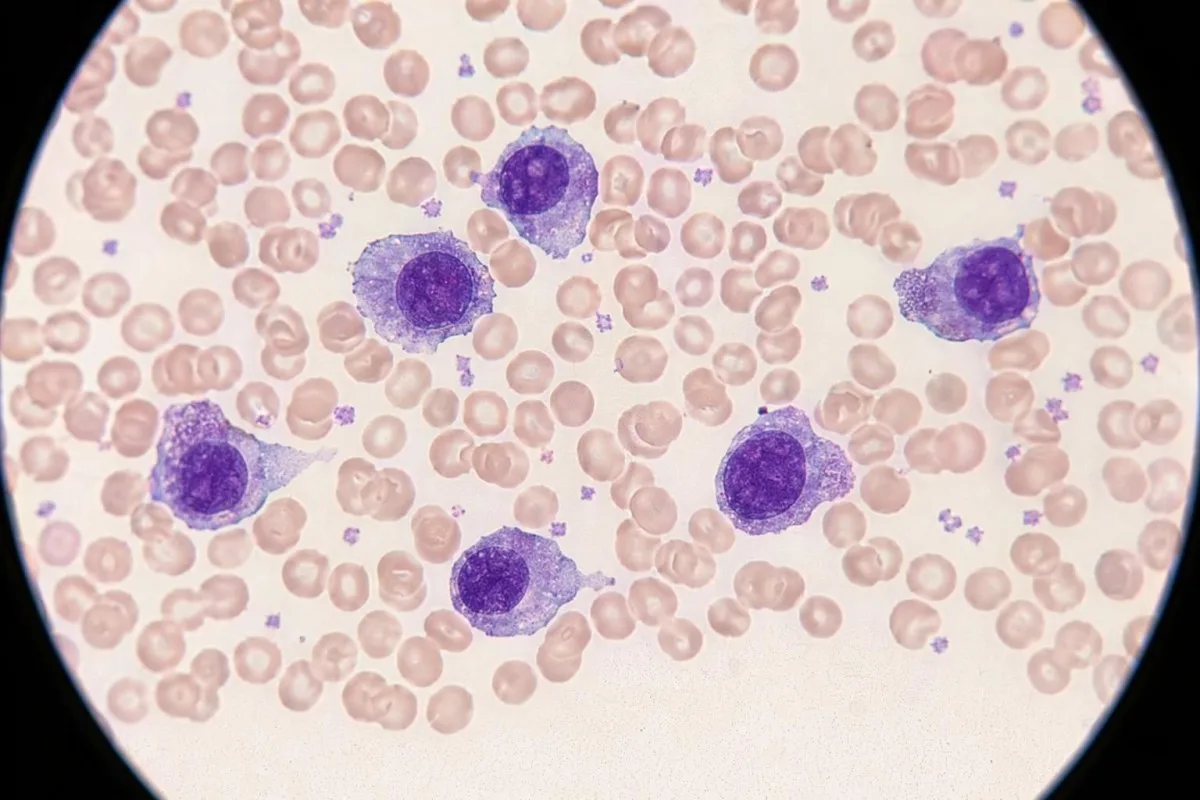
A blood film helps separate reactive lymphocytes from clonal-looking lymphocytes and machine artifacts. Automated counters are excellent for screening, but flags such as smudge cells, atypical lymphocytes, platelet clumps, or nucleated red cells may require manual review.
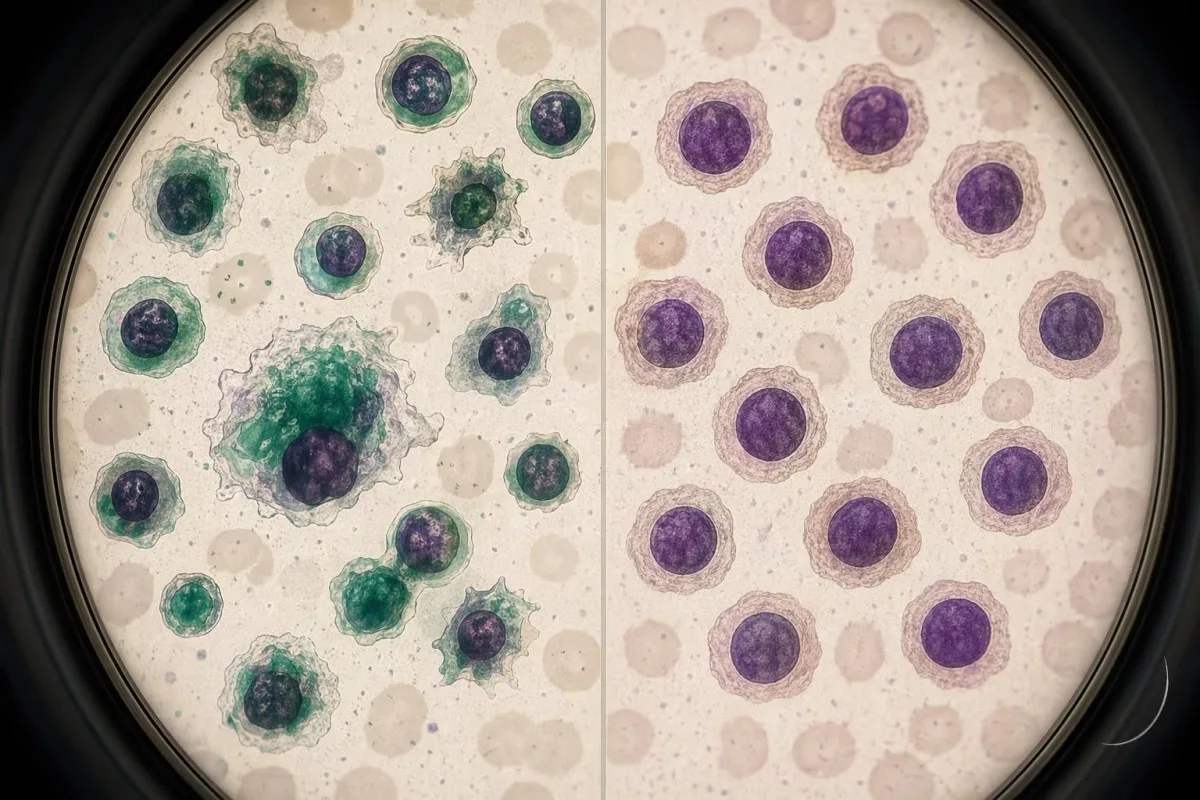
Bain’s NEJM review on peripheral smear diagnosis remains a practical reminder: cell shape, maturity, and distribution can change the differential diagnosis even when the CBC number looks simple (Bain, 2005). Atypical reactive lymphocytes after EBV look different from a monotonous lymphocyte population, but the distinction is not always obvious from the report alone.
Kantesti AI can flag when a machine-counted lymphocyte result conflicts with platelets, NRBCs, or the differential pattern, but it cannot replace a hematologist looking at a slide. For artifact patterns like clots, smudge cells, and analyzer misclassification, see our WBC error guide.
A manual differential is most useful when the automated report says atypical lymphocytes, abnormal lymphs, blasts, or review recommended. Our manual differential explainer covers why a human-reviewed slide can override the neat-looking percentages from an analyzer.
How soon to repeat high lymphocyte results
A mild lymphocyte elevation after a clear viral illness is often repeated in 2-6 weeks, not the next day. Faster repeat testing is reasonable if the ALC is above 10.0 x 10^9/L, symptoms are worsening, or hemoglobin and platelets are abnormal.
Repeating a CBC 24 hours later usually creates noise unless the patient is acutely unwell. Hydration, time of day, exercise, and analyzer variation can shift WBC by 5-15%, which is enough to make a borderline result appear falsely dramatic.
For a well adult with ALC 4.3-5.5 x 10^9/L after a cold, I commonly suggest a repeat around 4 weeks if symptoms are settling. Our repeat testing guide gives practical timing for borderline and persistent abnormalities.
Do not wait weeks if there are red flags. Same-week care is sensible for unexplained bruising, breathlessness, fainting, persistent fever, rapidly enlarging lymph nodes, or a CBC showing lymphocytosis plus hemoglobin below 100 g/L or platelets below 100 x 10^9/L.
Other biomarkers that make the pattern clearer
Lymphocytes are most useful when read with neutrophils, hemoglobin, platelets, CRP, ESR, LDH, and liver enzymes. A single ALC of 4.8 x 10^9/L means less than the pattern surrounding it.

High CRP with neutrophilia points toward acute tissue response, while lymphocytosis with atypical lymphocytes and ALT elevation can fit EBV, CMV, or hepatitis. If CRP remains elevated after symptoms improve, our post-infection CRP guide explains expected falling patterns.
LDH is nonspecific but useful when it is very high or rising. A modest LDH bump after intense exercise is common, but lymphocytosis plus LDH above 2 times the upper limit of normal, anemia, or night sweats deserves more care; our high LDH explainer covers that nuance.
Kantesti is an AI blood test interpretation platform that maps CBC results against thousands of biomarkers in clinical context. The biomarkers guide is where we keep our broader marker library, including immune, inflammation, liver, kidney, and clotting patterns.
Non-infectious count shifters people miss
Not every high lymphocyte result is infectious. Smoking, splenectomy, intense exercise, seizures, chronic inflammatory disease, and some medications can shift lymphocytes, although steroids more often cause neutrophilia with lower lymphocyte counts.
A hard interval workout can transiently increase circulating lymphocytes, then lower them for several hours as cells redistribute into tissues. That is why a CBC taken 1-3 hours after intense training can look very different from a rested morning sample.
Cigarette smoking can raise total WBC chronically, often with neutrophil predominance but sometimes a lymphocyte contribution. Our high WBC guide separates stress, steroid, and infection patterns because patients often assume every white-cell flag means a germ.
Splenectomy is a special case. Without the spleen’s filtering and immune-cell reservoir function, lymphocytes and platelets can remain higher long term, so the personal baseline matters more than a generic adult range.
How Kantesti AI reads lymphocyte context
Kantesti AI interprets lymphocyte results by comparing absolute count, percentage, WBC, age, symptoms entered by the user, and prior trends when available. It does not diagnose cancer or infection; it helps users see whether the pattern fits routine follow-up or needs clinician review.
Kantesti is an AI-powered blood test analysis tool used by 2M+ people across 127+ countries, and multilingual CBC interpretation is one of the most common workflows we see. A 22-year-old with ALC 5.2 after fever and sore throat is handled differently from a 72-year-old with ALC 5.2 on three annual tests.
Dr. Thomas Klein reviews our medical logic for cases where pattern recognition could be misleading, such as relative lymphocytosis with neutropenia or a high percentage with a normal ALC. The technology guide explains how our AI uses lab units, ranges, trend direction, and cross-marker checks.
The safest output is usually a ranked explanation, not a scary label. I would rather tell a patient, “this looks reactive but repeat in 4 weeks,” than imply certainty from one CBC.
What to bring to a medical review
A medical review is more useful when you bring the trend, symptoms, exposures, medications, and the actual CBC differential. For persistent lymphocytosis, doctors may add a blood film, EBV or CMV tests, HIV testing, hepatitis testing, immunoglobulins, or flow cytometry.

Write down when symptoms started, whether fever exceeded 38.0°C, whether nodes are painful, and whether weight changed by more than 5% over 6 months. That short timeline can save a clinic visit from becoming a vague “watch and wait” conversation.
Bring old CBCs if you have them. A stable ALC of 4.6 x 10^9/L for 5 years is a different risk profile from a rise from 2.1 to 6.8 x 10^9/L in 10 weeks; our trend analysis guide shows how slow changes often matter more than one flag.
Kantesti’s clinical content is reviewed against internal safety standards, and complex hematology logic is overseen with physician input through our medical validation process. If your report says urgent, critical, blasts, or hematology review recommended, treat that as a medical instruction rather than a wellness data point.
Kantesti research notes and publication standards
Research standards matter because lymphocyte interpretation sits inside a broader lab-safety workflow. As of June 11, 2026, Kantesti separates consumer education from clinical decision-making and keeps physician review visible through our governance and publication process.
Kantesti LTD. (2026). Iron Studies Guide: TIBC, Iron Saturation & Binding Capacity. Zenodo. DOI. ResearchGate. Academia.edu. This companion publication is not about lymphocytes directly, but it documents how we handle multi-marker interpretation when one CBC abnormality points to another lab domain.
Kantesti LTD. (2026). aPTT Normal Range: D-Dimer, Protein C Blood Clotting Guide. Zenodo. DOI. ResearchGate. Academia.edu. We include clotting research because infection, inflammation, and CBC abnormalities often arrive together in real reports.
Our doctors do not expect patients to diagnose lymphocytosis alone. The safer path is pattern recognition, repeat timing, and escalation when thresholds or symptoms justify it; our medical advisory board supports that boundary between explanation and clinical care.
Frequently Asked Questions
What does high lymphocytes mean on a blood test?
High lymphocytes means either the lymphocyte percentage is high or the absolute lymphocyte count is high. In adults, an absolute lymphocyte count above about 4.0 x 10^9/L is usually called lymphocytosis, while a percentage above 40% may be only relative if the total WBC is normal. Viral infections are the most common temporary cause, but persistence beyond 3 months needs medical review.
What is the difference between relative and absolute lymphocytosis?
Relative lymphocytosis means lymphocytes make up a high percentage of white cells, usually above about 40%, but the absolute lymphocyte count may still be normal. Absolute lymphocytosis means the actual lymphocyte number is high, typically above 4.0 x 10^9/L in adults. Doctors usually care more about the absolute count because it reflects the true number of circulating lymphocytes.
Which infections cause high lymphocytes?
Common infectious high lymphocytes causes include EBV, CMV, influenza, acute HIV, hepatitis viruses, COVID-19 recovery, and many routine respiratory viruses. Pertussis is a bacterial exception that can cause very high lymphocyte counts, sometimes above 20.0 x 10^9/L. Tuberculosis, toxoplasmosis, and other chronic intracellular infections can also produce lymphocyte-predominant patterns.
How long do lymphocytes stay high after a viral infection?
Lymphocytes can remain high for 2-8 weeks after a viral infection, especially during the recovery phase when neutrophils are returning to baseline. A falling ALC over several weeks is usually more reassuring than a rising count. If the absolute lymphocyte count stays above 5.0 x 10^9/L for 3 months in an adult, a clinician may order a blood film or flow cytometry.
When should I worry about an absolute lymphocyte count high result?
An absolute lymphocyte count high result is more concerning when it is above 10.0 x 10^9/L, persists above 5.0 x 10^9/L for 3 months, or appears with anemia, low platelets, unexplained weight loss, night sweats, or enlarged lymph nodes. A single mild result after a cold is often monitored with repeat testing. Urgent review is sensible if the report mentions blasts, critical values, or hematology review.
Can high lymphocytes be cancer?
High lymphocytes can be associated with blood cancers such as chronic lymphocytic leukemia, but most short-term lymphocyte elevations are reactive and infection-related. CLL is generally defined by at least 5.0 x 10^9/L clonal B lymphocytes persisting for 3 months, confirmed by flow cytometry. Symptoms, age, trend, blood film appearance, hemoglobin, and platelets all affect the level of concern.
Can seasonal allergies cause a high lymphocyte count?
Seasonal allergies more often raise eosinophils than produce a meaningful absolute lymphocyte increase. If your lymphocyte count is persistently high, do not assume allergies explain it; review the absolute count, symptoms, and repeat CBC with your clinician.
Do I need to fast before repeating a CBC for high lymphocytes?
No. A CBC usually does not require fasting, and skipping meals does not usually explain a meaningful lymphocyte elevation. Follow your laboratory’s preparation instructions, drink water normally, and avoid drawing conclusions from one result alone.
Get AI-Powered Blood Test Analysis Today
Join over 2 million users worldwide who trust Kantesti for instant, accurate lab test analysis. Upload your blood test results and receive comprehensive interpretation of 15,000+ biomarkers in seconds.
📚 Referenced Research Publications
Klein, T., Mitchell, S., & Weber, H. (2026). Iron Studies Guide: TIBC, Iron Saturation & Binding Capacity. Kantesti AI Medical Research.
Klein, T., Mitchell, S., & Weber, H. (2026). aPTT Normal Range: D-Dimer, Protein C Blood Clotting Guide. Kantesti AI Medical Research.
📖 External Medical References





⚕️ Medical Disclaimer
This article is for educational purposes only and does not constitute medical advice. Always consult a qualified healthcare provider for diagnosis and treatment decisions.
E-E-A-T Trust Signals
Experience
Physician-led clinical review of lab interpretation workflows.
Expertise
Laboratory medicine focus on how biomarkers behave in clinical context.
Authoritativeness
Written by Dr. Thomas Klein with review by Dr. Sarah Mitchell and Prof. Dr. Hans Weber.
Trustworthiness
Evidence-based interpretation with clear follow-up pathways to reduce alarm.