Chan eil toradh dearbhach Zika IgM a’ dearbhadh galar: faodaidh tar-fhreagairt ri dengue no antibodies a mhaireas mìosan a mhìneachadh. Tha PCR an urra ri àm a’ chruinneachaidh; feumar measadh clionaigeach stèidhichte air nochdadh rè torrachas agus, nuair a tha sin iomchaidh, dearbhadh le obair-lann fiosrachaidh.

Prìomh phuingean
- IgM Zika mar as trice thig e am bàrr anns a’ chiad seachdain den tinneas agus faodaidh e mairsinn mìosan no nas fhaide; chan urrainn do thoradh dearbhach ceann-là a’ ghalair innse gu h-earbsach.
- Tar-fhreagairt le dengue agus flavivirus eile faodaidh toraidhean ath-ghnìomhach airson antibodies Zika tighinn am bàrr gun ghalar Zika a bhith dearbhte.
- Uine PCR ga thomhas gu h-àraidh bhon àm a thòisicheas na comharraidhean, chan ann dìreach bho bhìdeadh a’ mhèisg; mar as trice thèid prìomhachas a thoirt do dheuchainn serum taobh a-staigh a’ chiad 7 latha ann an euslaintich le comharraidhean nach eil trom.
- deuchainn torrachais faodaidh e gabhail a-steach deuchainn mholacileach suas ri 12 seachdainean às dèidh do na comharraidhean tòiseachadh ann an cuid de shlighean nochdaidh, ach chan eil seo a’ gealltainn gun lorgar e rè na h-ùine sin gu lèir.
- PCR àicheil tha e a’ ciallachadh nach deach RNA a lorg anns an t-sampall sin; chan eil e a’ cur às do ghalar taobh a-muigh ùine-lorgaidh fheumail an deuchainn.
- Dearbhadh PRNT faodaidh e toraidhean antibodies a shoilleireachadh, ach faodaidh nochdadh roimhe do flavivirus adhbharachadh gum bi an dà dheuchainn neodrachaidh Zika agus dengue dearbhach.
- Coltas ceàrr-deimhinneach bidh e nas coltaiche nuair a tha an cothrom gun robh galar ann mus deach an deuchainn a dhèanamh ìosal; chan innis sònrachas na deuchainn leis fhèin dè cho coltach ’s a tha e gu bheil an toradh agad ceart.
- Leantainn air torrachas bu chòir a chur air dòigh gu sgiobalta ma tha toradh ath-ghnìomhach ann agus nochdadh iomchaidh air a bhith ann; chan urrainn do thoradh antibody na màthar leis fhèin galar fetal a dhearbhadh.
Dè dìreach a tha toraidhean dearbhach deuchainn Zika a’ dearbhadh?
Tha toradh dearbhach Zika IgM na fhianais air ath-bhualaidheachd an-aghaidh-chuirp, chan e dearbhadh fèin-obrachail air galar Zika. Tha PCR dearbhach dligheach a’ toirt seachad fianais nas dìriche oir tha e a’ lorg RNA bhìorasaich; chan eil gin den dà sheòrsa deuchainn seo, leis fhèin, a’ dearbhadh galar fàsail no a’ ro-innse a’ bhuaidh a bhios aige.
Tha am facal dearbhach a’ toirt iomradh air stairsneach co-dhùnaidh deuchainn, chan ann air breithneachadh iomlan. Do 1 neach a shiubhail o chionn ghoirid, aig a bheil comharraidhean co-chòrdail agus aig nach robh nochdadh dengue roimhe, tha ciall eadar-dhealaichte aig toradh ath-ghnìomhach an-aghaidh-chuirp na bhiodh aig an aon toradh do neach aig nach robh nochdadh so-chreidsinneach agus aig an robh grunn ghalaran flavivirus roimhe.
Tha toradh moileciuil a chaidh a lorg airidh air leantainn clionaigeach, a’ gabhail a-steach dearbhadh nuair a tha slighe obair-lann no slàinte phoblach ga iarraidh. Tha truailleadh, measgachadh shampaill agus meudachaidh faisg air a’ chrìch tearc ach comasach; cha toir toradh àicheil bho 1 sampall eile toradh dearbhach dligheach bhon chiad sampall a chur gu neo-dhligheach gu fèin-obrachail.
’S e anailisear deuchainn-fala AI a th’ ann an Kantesti a chuidicheas le bhith a’ mìneachadh an eadar-dhealachaidh eadar ath-ghnìomhachd an-aghaidh-chuirp a chaidh aithris agus lorg moileciuil, seach a bhith a’ dèiligeadh ri 1 bhratach dhearbhach mar bhreithneachadh. Tha fiosrachadh mun bhuidhinn againn a’ mìneachadh ar dleastanais; tha dearbhadh fhathast an urra ri dleastanas clionaigeach agus obair-lann.
Tòisich le bhith a’ comharrachadh 3 mion-fhiosrachadh: dearbh ainm na deuchainn, seòrsa an t-sampaill agus ceann-là a’ chruinneachaidh. Tha an stiùireadh againn air toraidhean antibody dearbhach a’ mìneachadh carson a tha sgrìonadh, fianais air nochdadh roimhe agus dearbhadh air galar làithreach nan roinnean fa leth.
Brìgh IgM Zika dearbhach: galar o chionn ghoirid no antibodies nas sine?
Tha brìgh toradh dearbhach Zika IgM an urra ri àm, nochdadh agus sònrachas na deuchainn. Mar as trice gabhaidh IgM a lorg tron chiad seachdain de thinneas, ach tha e a’ mairsinn airson mìosan no nas fhaide; mar sin, chan eil aon toradh dearbhach a’ dearbhadh gun do thachair an galar rè torrachas sònraichte no taobh a-staigh nan 2 sheachdain a chaidh seachad.
Thathar tric a’ toirt iomradh air IgM mar an t-an-aghaidh-chuirp tràth, ach chan eil coltas tràth a’ ciallachadh gun tèid e à sealladh gu luath. Tha an stiùireadh breithneachaidh aig Sharp et al. (2019) a’ cur cuideam air lorg Zika IgM fad ùine mhòr; mar sin faodaidh e a bhith doirbh toradh a fhuaradh 6 mìosan às dèidh siubhail a cheangal ri tachartas ùr de bhroth no fiabhras.
Tha Zika IgM sònraichte agus IgM iomlan san t-serum nan 2 thomhas eadar-dhealaichte. Faodar IgM iomlan aithris ann an mg/dL no g/L, ach faodaidh deuchainn Zika clàr-amais, co-mheas no mìneachadh càileachdail aithris; chan urrainn do dhùmhlachd IgM iomlan àrdaichte Zika a dhearbhadh, mar a tha an toraidhean immunoglobulin a’ stiùireadh a’ mìneachadh.
Chan e dùmhlachd bhìorasaich a th’ ann an clàr-amais an-aghaidh-chuirp. Gu beachdail, faodaidh clàr-amais de 3.0 an taca ri 1.5 air an aon deuchainn ath-ghnìomhachd anailiseach nas làidire a riochdachadh, ach chan urrainnear gin de na luachan atharrachadh gu àireamh lethbhric RNA/mL, cunnart sa cheud de bhuaidhean fàsail no àireamh nan làithean bhon nochdadh.
Tha toradh Zika IgG a’ cur sreath eile ris, chan e freagairt uile-choitcheann. Fiù nuair a tha IgM agus IgG le chèile ath-ghnìomhach air 1 ceann-là cruinneachaidh, faodaidh tar-ath-ghnìomhachd agus nochdadh flavivirus roimhe bacadh a chur air ceann-là earbsach a dhearbhadh; cleachd beachd-mhìneachaidh an obair-lann seach a bhith a’ gabhail ris gu bheil àireamh nas motha an-aghaidh-chuirp a’ ciallachadh tinneas nas miosa.
Carson as urrainn do dengue agus flavivirus eile tar-fhreagairt adhbharachadh
Faodaidh deuchainnean an-aghaidh-chuirp Zika freagairt ri an-aghaidh-chuirp a chaidh a chruthachadh an aghaidh dengue agus flavivirus eile oir tha feartan antigenach co-roinnte aig na bhìorasan sin. ’S e dengue an tar-lùbadh as iomchaidh gu clionaigeach ann an iomadh suidheachadh siubhail; faodaidh nochdadh roimhe do bharrachd air 1 flavivirus cuideachd lùghdachadh a thoirt air comas lethbhreith deuchainn dearbhaidh an-aghaidh-chuirp.
Bidh deuchainnean an-aghaidh-chuirp a’ lorg ceangal ri antigeanan bhìorasach taghte, chan e dearbh-aithne iomlan bhìorais. Ma dh’aithnicheas an-aghaidh-chuirp feart uachdair co-roinnte, faodaidh 1 fhreagairt dìonach fhìor do dengue ath-ghnìomhachd a thoirt ann an deuchainn Zika; ’s e tar-ath-ghnìomhachd bith-eòlach a tha sin, seach dearbhadh gun do làimhsich an obair-lann an sampall gu mì-cheart.
Faodaidh banachdach buidhe-fhiabhrais no encephalitis Iapanach seròlas flavivirus sònraichte a dhèanamh nas toinnte, a rèir an antigen agus na deuchainn. Inns don neach-clionaigeach ainmean agus cinn-là nam banachdachan, a’ gabhail a-steach banachdachan bho 5 no 10 bliadhnaichean roimhe, seach a bhith a’ gabhail ris nach eil ach banachdachan o chionn ghoirid cudromach; co-dhùinidh an obair-lann iomraidh dè an eachdraidh a dh’atharraicheas am mìneachadh.
Buinidh bhìoras West Nile don aon teaghlach bhìorasach nas fharsainge, ach chan eil chikungunya. Tha am mìneachadh againn air dearbhadh an-aghaidh-chuirp West Nile a’ dèiligeadh ri mì-chinnt co-cheangailte, ach chan eil cuairteachadh aig an aon àm de 2 thinneas a ghiùlaineas mosgìotothan a’ dearbhadh gum bi tar-ath-ghnìomhachd eadar na deuchainnean an-aghaidh-chuirp aca gu riatanach.
Faodaidh nochdaidhean flavivirus a-rithist freagairtean an-aghaidh-chuirp neodrachaidh a leudachadh tro chuimhne dìonach. Tha Sharp et al. (2019) a’ mìneachadh carson a dh’fhaodadh e a bhith doirbh fhathast seòrsachadh ceart a dhèanamh air neach aig an robh 2 ghalar dengue roimhe, fiù às dèidh deuchainn neodrachaidh; dh’fhaodadh am mìneachadh deireannach iomchaidh a bhith na ghalar flavivirus de sheòrsa neo-chinnteach, chan e Zika dearbhte.
Dè cho coltach ’s a tha e gum bi deuchainn Zika dearbhach meallta?
The probability that a positive Zika antibody result is false depends on both assay performance and the chance of infection before testing. There is no defensible universal percentage for every laboratory, traveler or pregnancy; even a test with 95% specificity can produce mostly false positives in a low-prevalence group.
Consider a clearly hypothetical assay with 90% sensitivity and 95% specificity used in 10,000 people, of whom 1% truly have the target condition. It would yield approximately 90 true positives and 495 false positives, so only 90 of 585 positive results, or 15.4%, would represent the target condition.
Now keep those hypothetical assay characteristics but increase the underlying prevalence to 10%. Approximately 900 true positives and 450 false positives would result, giving a positive predictive value of 66.7%; the test has not improved, but the tested population has changed.
Improving specificity also matters: at 1% prevalence, a hypothetical assay with 90% sensitivity and 99% specificity would produce 90 true positives and 99 false positives. Its positive predictive value would still be only 47.6%; none of these figures is a measured performance estimate for a particular Zika assay.
Persistent antibodies from a genuine old Zika infection are not necessarily an analytically false result, although interpreting them as a new infection would be wrong. Our discussion of reactive hepatitis A IgM illustrates a similar distinction: 1 positive antibody finding can be accurate analytically yet misleading clinically.
Tha cruinneas deuchainn PCR Zika an urra ris an ùine-lorgaidh
Zika PCR test accuracy is highest when an appropriate specimen is collected while viral RNA remains detectable. For symptomatic nonpregnant patients, serum molecular testing is commonly prioritized within the first 7 days of illness; a later negative test may reflect falling RNA rather than absence of earlier infection.
Analytical sensitivity describes how little RNA an assay can detect under validated conditions; clinical sensitivity describes how often it identifies infected people in practice. A very low detection limit cannot rescue a specimen collected 3 weeks after RNA has cleared, and there is no single clinical sensitivity percentage that applies across all collection times.
Count the molecular-testing window from symptom onset when symptoms are present, not automatically from the mosquito bite or flight home. Zika symptoms generally begin 3–14 days after exposure, so a specimen taken 7 days after a bite might fall before, during or after the most useful serum-testing period.
Some pregnancy pathways allow molecular testing up to 12 weeks after symptom onset because RNA detection can be prolonged. This is an eligibility window for selected testing strategies, not a promise of 12 weeks of reliable detection; exposure geography, symptoms, specimen choice and public-health advice determine the actual testing plan.
Urine can complement serum testing when the assay is validated for urine, but it is not a guaranteed longer-lasting specimen. The broader principle also appears in our PCR window-period guide: a negative molecular result from 1 body site cannot be interpreted without its collection timing.
Dè na cinn-latha a tha cudromach nuair nach eil PCR agus IgM ag aontachadh?
Discordant Zika results should be interpreted using at least 2 clocks: the exposure timeline and the symptom timeline. Add the specimen collection date to both; PCR-negative, IgM-positive findings can reflect late collection, persistent antibodies or cross-reactivity, while early PCR-positive, IgM-negative findings can precede antibody development.

In the prospective cohort reported by Paz-Bailey et al. in the New England Journal of Medicine (2018), estimated median times to loss of detectable RNA were 14 days in serum and 8 days in urine. These estimates came from a selected cohort with confirmed infection; they are not universal cutoffs for excluding infection in an individual patient.
For a hypothetical traveler tested on illness day 3, detected RNA with negative IgM can fit an early immune response. Testing both Zika and dengue through the appropriate pathway matters because the illnesses overlap; our discussion of PCR and antibody disagreement explains why discordance does not automatically indicate laboratory error.
Imagine instead that the first specimen was collected on illness day 21 and shows negative PCR with reactive IgM. That pattern cannot distinguish recent Zika from another flavivirus response or persistent antibodies without additional context; when indicated, a clinician may arrange a later specimen, often around 10–14 days after the first, using laboratory-specific instructions.
At Kantesti, we encourage recording collection dates separately from report-release dates because a 5-day reporting delay does not extend the biological detection window. Our stiùireadh loidhne-tìm nan deuchainnean fala againn explains this distinction; ongoing exposure may also prevent assignment of a single meaningful last-exposure date.
Mar a leughas tu toraidhean Zika a chaidh a lorg, mì-chinnteach agus neo-dhligheach
Detected, not detected, equivocal and invalid are different laboratory conclusions. A detected PCR identifies RNA in the tested specimen; not detected means the signal was absent or below the assay threshold, while an invalid result means the test did not produce a usable answer and may require a second specimen.
An equivocal antibody result falls into the assay's uncertainty zone, which varies by laboratory and test design. A hypothetical index of 1.0 cannot be called positive or negative without that assay's reference intervals; our guide to toraidhean càileachdail an aghaidh toraidhean tomhasach explains why a number and its interpretation must stay together.
PCR cycle threshold, when reported, describes amplification behavior rather than a standardized severity score. A hypothetical Ct of 35 on 1 instrument cannot be directly compared with Ct 35 on another assay, and it cannot reliably predict fetal effects, contagiousness or the precise day on which infection began.
An inhibited or invalid PCR is not a negative PCR. Problems involving extraction, specimen handling or amplification controls can require reprocessing or recollection; if the original specimen was collected on illness day 5, a replacement collected on day 12 must be interpreted at its own later biological time point.
Keep the complete report, including 4 often-overlooked fields: specimen source, assay name, collection date and interpretive comments. A cropped photograph showing only a red positive flag can hide a presumptive designation or a pending confirmatory test, making both clinical review and any automated explanation less reliable.
Cuin a bhios PRNT no ath-dheuchainn mholacileach na chuideachadh?
Confirmatory testing helps when a reactive Zika screen needs virus-specific clarification or an unexpected molecular result needs verification. Plaque reduction neutralization testing, or PRNT, measures functional neutralizing antibodies; however, responses against 2 or more flaviviruses can prevent PRNT from identifying which virus caused the original immune response.
Some reference laboratories use PRNT90, meaning the dilution that reduces plaque formation by 90%. In established CDC interpretive schemes, a Zika neutralizing titer of at least 1:10 with negative dengue neutralization can support Zika-specific classification; the complete algorithm, antibody screening result and laboratory instructions still matter.
If both Zika and dengue neutralizing titers are at least 1:10, the result may remain consistent with an unspecified flavivirus infection. A 4-fold difference between titers is not universally decisive after previous flavivirus exposures, so patients should not calculate their own confirmation rule from two numbers.
Repeating an unexpected positive NAAT may involve a new extraction from the original specimen, a second target or another specimen, depending on the assay and public-health protocol. This is not the same as simply rerunning 1 antibody screen; our antibody confirmation guide discusses why independent confirmation is more informative than repeated screening.
Kantesti is an AI lab test interpretation service that explains laboratory wording without converting 1 presumptive result into a confirmed diagnosis. Our fiosrachadh mu dhearbhadh agus stiùireadh a’ chàileachd describes evaluation boundaries; no interpretation tool can make PRNT reliably date infection when the underlying antibody biology cannot do so.
Cuin a dh’fheumas torrachas measadh bho eòlaiche
Pregnancy warrants prompt clinician assessment when possible Zika exposure accompanies compatible symptoms, reactive testing or concerning prenatal findings. Stable patients do not usually need emergency care solely because of 1 positive IgM result, but maternal-fetal medicine, infectious-disease or public-health input may be needed to choose testing and follow-up.

The key question is whether infection could have occurred during pregnancy, not simply whether an antibody is present today. The CDC pregnancy guidance by Oduyebo et al. (2017) explains how persistent IgM and falling transmission rates complicate screening; a reactive result at 10 weeks of pregnancy may still reflect exposure before conception.
Symptoms are not required for fetal risk assessment because maternal Zika infection can be asymptomatic. Conversely, 1 episode of fever or rash is not specific to Zika; a specialist weighs travel destination, mosquito exposure, sexual exposure, dates and alternative diagnoses rather than using symptoms alone to label the pregnancy.
Bring at least 4 dates to the appointment: the pregnancy dating estimate, travel or exposure dates, symptom onset and specimen collection. Our discussion of toraidhean toxoplasma ann an torrachas explains a shared counseling principle: maternal antibodies do not automatically prove a new infection during pregnancy.
Routine Zika IgM screening is not appropriate for every asymptomatic pregnancy, especially where pretest probability is low and antibody persistence would create ambiguity. Similar timing difficulties arise with pàtranan antibody CMV, but the diagnostic algorithms are different; do not transfer 1 virus's avidity or confirmation rules to another.
Dè as urrainn do dheuchainn ultrasound agus fetal a dhearbhadh?
Prenatal ultrasound assesses fetal development; it does not confirm or exclude maternal Zika infection. For pregnancies with confirmed or possible infection, specialist-led serial ultrasound may be considered every 3–4 weeks, while amniotic-fluid testing is individualized because a negative result cannot reliably exclude fetal infection.

A normal scan shortly after exposure does not end the assessment because some findings develop later. The 3–4-week surveillance interval discussed in CDC pregnancy guidance is intended to reassess growth and neuroanatomy over time; it is not a guarantee that every affected pregnancy will produce a visible finding at the next appointment.
Amniocentesis should not be ordered automatically for an isolated reactive IgM result. The decision depends on gestational age, imaging findings, other diagnostic indications and counseling about procedural uncertainty; there is no single post-exposure day on which a negative amniotic-fluid PCR reliably provides a 100% exclusion of fetal infection.
Concerning prenatal findings can justify specialist evaluation even when maternal PCR is negative. A specimen collected 8 weeks after symptoms may no longer detect maternal RNA, and abnormalities have alternative causes; counseling should separate what the scan shows from what the maternal laboratory result can establish.
Fever during pregnancy still needs assessment for other treatable illnesses, including conditions covered in our pregnancy fever testing guide. If maternal evidence or prenatal findings warrant newborn follow-up, a pediatric team plans examination and appropriate hearing, eye or laboratory assessment; 1 maternal IgM result alone does not diagnose the infant.
Carson a bu chòir deuchainn dengue a bhith mar phàirt de mhìneachadh Zika
Dengue testing often belongs in the Zika workup because dengue overlaps geographically, resembles Zika clinically and can complicate Zika serology. During the first 7 days of dengue illness, NAAT or NS1 antigen testing is commonly useful; later testing relies more heavily on antibody interpretation and the clinical picture.
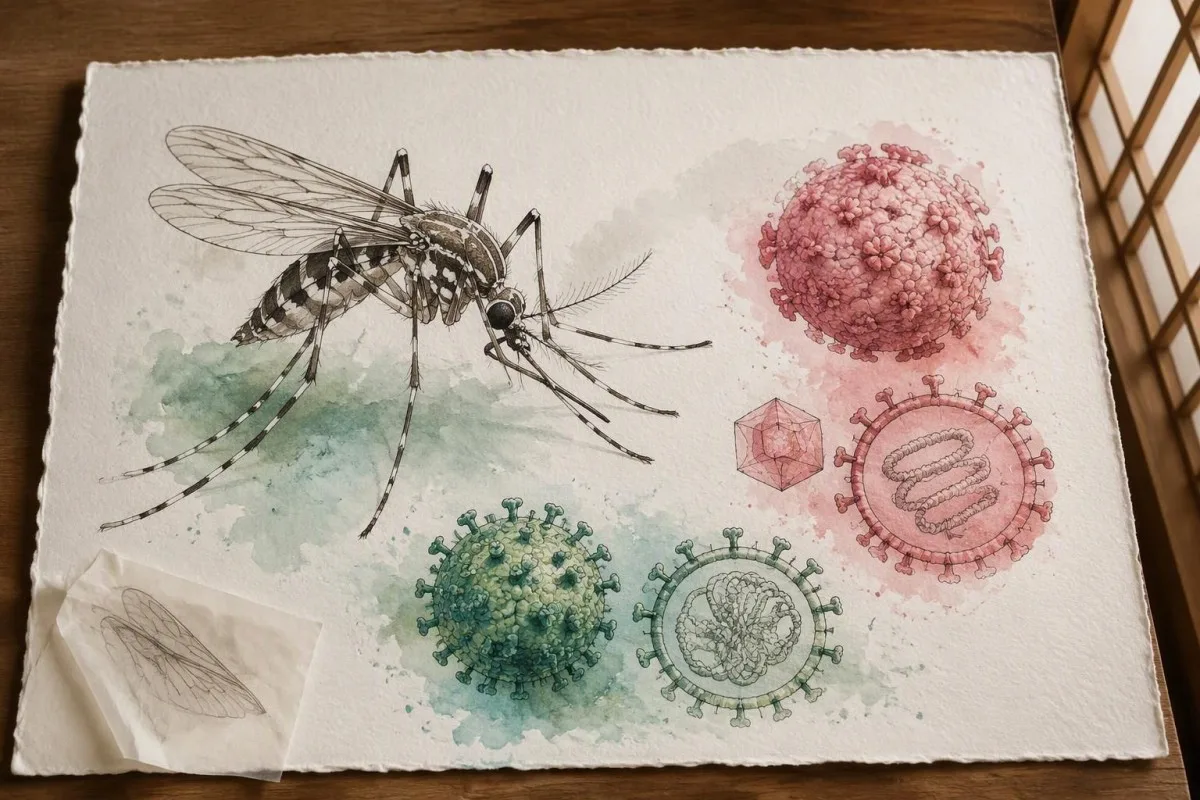
A positive dengue NAAT or NS1 result offers evidence that differs from a cross-reactive antibody screen. Our explanation of dengue NS1 timing covers the early window; a negative NS1 result after illness day 7 cannot be treated as equivalent to a negative result obtained on day 2.
Zika and dengue are not mutually exclusive diagnoses, although a dual-reactive antibody pattern commonly reflects serologic overlap rather than 2 proven infections. Sharp et al. (2019) recommend diagnostic reasoning that considers both viruses; molecular evidence, exposure timing and reference-laboratory interpretation are more informative than counting positive antibody flags.
Chikungunya can produce prominent joint symptoms after the same type of mosquito exposure, but it is an alphavirus rather than a flavivirus. Our guide to chikungunya IgM persistence explains why a reactive result also needs timing context; 3 overlapping illnesses require virus-specific tests, not interchangeable antibody assumptions.
Malaria and other travel-related illnesses remain possible when the itinerary supports them. A returned traveler with 38°C fever should not wait for a Zika confirmation result before obtaining clinical assessment; the danger of anchoring on 1 reactive test is missing a different condition with an urgent or specific treatment.
Dè na comharraidhean a dh’fheumas cùram èiginneach fhad ’s a tha na toraidhean mì-chinnteach?
New progressive weakness, breathing difficulty, confusion, fainting or severe dehydration require urgent assessment regardless of the Zika result. Severe abdominal pain, persistent vomiting or unusual bleeding can suggest dengue complications; 1 negative Zika PCR does not make these symptoms safe to monitor without medical advice.
Zika is associated with Guillain-Barré syndrome, but a positive IgM result cannot diagnose that neurological condition. Weakness that progresses over 1–2 days, difficulty walking or problems swallowing needs urgent care; our stiùireadh rabhaidh mu laigse a tha a’ fàs nas miosa explains why symptoms outweigh reassurance from an uncertain laboratory finding.
Avoid aspirin and nonsteroidal anti-inflammatory medicines such as ibuprofen until dengue has been excluded or a clinician advises otherwise. Paracetamol, also called acetaminophen, is commonly used for fever within appropriate dosing limits; 1 negative Zika test does not exclude dengue, and significant liver disease or pregnancy may require individualized medication advice.
For people planning pregnancy after possible Zika exposure, CDC prevention advice generally uses at least 3 months for males and 2 months for females, measured from return, symptom onset or diagnosis as applicable. These prevention intervals address possible sexual transmission; neither a negative serum PCR nor a reactive IgM result serves as a reliable fertility-clearance test.
During pregnancy, use condoms consistently or avoid sex for the rest of the pregnancy when a partner has relevant possible exposure, according to public-health advice. Travelers should also prevent mosquito bites for 3 weeks after returning from a risk area; prevention decisions should not depend solely on whether 1 laboratory specimen detected RNA.
Mar a chleachdas tu mìneachadh AI gun a bhith ga mheas mar dhearbhadh
AI can help explain a Zika laboratory report, but it cannot verify infection, arrange confirmatory testing or determine fetal risk. The useful workflow preserves at least 3 essentials: the original laboratory wording, the collection date and the exposure history, followed by clinician review when the result could change care.

Kantesti is an AI-powered blood test analysis tool that turns laboratory reports into patient-readable explanations, not a replacement for reference-laboratory testing. Our stiùireadh teicneòlais AI explains the interpretation workflow; a report saying presumptive positive should remain presumptive in every explanation, even when the flag appears strongly abnormal.
If you choose to upload a report, our free test explanation workflow can help you understand its wording; remove unnecessary identifiers while retaining the assay name, specimen and collection date. An explanation produced in about 60 seconds is not the turnaround time of PCR, PRNT or specialist assessment, which depends on the actual laboratory and care pathway.
Kantesti AI should not be used to infer 1 missing clinical fact from another: negative PCR does not prove absence of earlier infection, high IgM does not prove recent infection and maternal reactivity does not prove fetal effects. Any explanation that converts those findings into certainty needs correction against the complete report and clinical context.
Before acting, check 4 questions: Was the test indicated, was the specimen timely, is confirmation pending and does pregnancy change follow-up? AI is most useful for preparing those questions and organizing results; avoid using its output alone to cancel specialist follow-up, change pregnancy plans or declare sexual-transmission risk resolved.
Foillseachaidhean rannsachaidh agus crìochan na fianais
Clinical Zika interpretation should rely on directly relevant diagnostic guidance and infection studies, not unrelated biomarker publications. The 3 external references below address Zika testing, RNA persistence and pregnancy management; the 2 accompanying Zenodo publications are educational resources about other laboratory measurements, not evidence validating Zika diagnosis.
Sharp et al. (2019) provide the central framework for distinguishing molecular evidence from ambiguous flavivirus serology, while Paz-Bailey et al. (2018) quantify RNA persistence in a confirmed-infection cohort. Neither source supplies 1 universal accuracy figure for every modern assay, and their population and testing methods must remain attached to any numerical claim.
Kantesti's educational publications include an RDW and cell-index guide, archived on Zenodo under DOI 10.5281/zenodo.18202598. RDW can help explain a concurrent complete blood count, but it does not diagnose Zika, establish the date of infection or predict whether a fetus is affected.
Tha am foillseachadh foghlaim obair-lann kidney-function ratio guide is archived under DOI 10.5281/zenodo.18207872. Kidney measurements may matter in someone with dehydration or another travel-related illness, but there is no validated BUN/creatinine ratio threshold that confirms Zika; these 2 publications should not be presented as Zika diagnostic research.
Pregnancy recommendations and test availability vary with transmission patterns, jurisdiction and laboratory access, so a 2017 or 2019 algorithm should not be applied mechanically to every exposure. Our inbhean susbaint mheidigeach support separating established facts from uncertainty; use the relevant public-health or reference-laboratory pathway for the actual decision.
Ceistean cumanta
A bheil toradh dearbhach air deuchainn IgM Zika a’ ciallachadh gu bheil Zika orm gu cinnteach?
Chan eil deuchainn IgM Zika dheimhinneach a’ dearbhadh gu cinnteach gu bheil galar Zika ann. Mar as trice bidh IgM a’ leasachadh anns a’ chiad seachdain den tinneas, ach faodaidh na h-antìbodies mairsinn airson mìosan no nas fhaide agus faodaidh iad tar-fhreagairt a thoirt ri dengue no flavivirus eile. Chan urrainn do thoradh dearbhach singilte ceann-là a’ ghalair a dhearbhadh gu earbsach no dearbhadh gun do thachair e rè torrachas. Bidh eachdraidh nochdaidh, àm togail an t-sampaill agus slighe iomchaidh airson deuchainn mholacileach no dearbhaidh a’ dearbhadh dè an ath cheum.
An urrainn dengue toradh meallta dearbhach adhbharachadh ann an deuchainn Zika?
Faodaidh antibodies dengue toradh antibody Zika freagairteach adhbharachadh oir tha feartan antigenach co-roinnte aig na bhìorasan. Tha an duilgheadas seo a’ toirt buaidh gu h-àraidh air serology, seach a bhith a’ ciallachadh gu bheil PCR Zika a chaidh a dhearbhadh gu ceart a’ lorg RNA dengue gu cunbhalach. Faodaidh nochdadh roimhe do bharrachd air 1 flavivirus deuchainn neodachaidh a dhèanamh dà-sheaghach cuideachd. Dh’fhaodadh gum bi feum aig an neach-clionaigeach air deuchainn dengue agus mìneachadh bho obair-lann iomraidh, an àite dèiligeadh ri toraidhean antibody dà-fhreagairteach mar dhearbhadh air dà ghalar.
Dè cho ceart ’s a tha deuchainn PCR airson Zika às dèidh nochdadh dha?
Tha cruinneas PCR Zika an urra ris an anailis, ris an t-sampall agus ris an ùine bhon a thòisich na comharraidhean, agus mar sin chan eil aon cheudad ann a tha freagarrach do gach nochdadh. Mar as trice, thèid prìomhachas a thoirt do dheuchainn mholacileach air seirum taobh a-staigh a’ chiad 7 latha den tinneas ann an euslaintich shamhlaichte nach eil trom. Tha cuid de na slighean cùraim airson torrachas a’ ceadachadh deuchainnean suas ri 12 sheachdain às dèidh do na comharraidhean tòiseachadh, ach chan eil dearbhadh ann gun lorgar am bhìoras fad na h-ùine sin. Tha toradh àicheil a’ ciallachadh nach deach RNA a lorg san t-sampall sin agus chan eil e gu fèin-obrachail a’ dùnadh a-mach gun robh galar ann na bu tràithe.
Dè tha e a’ ciallachadh ma tha Zika IgM dearbhach ach PCR àicheil?
Faodaidh Zika IgM dearbhach le PCR àicheil nochdadh gu bheil galar o chionn ghoirid ann a chaidh a shamplachadh às dèidh do RNA crìonadh, gu bheil seann antasubstamaidean fhathast ann, no gu bheil tar-fhreagairt ann ri flabhabhìoras eile. Mar eisimpleir, tha brìgh eadar-dhealaichte aig a’ phàtran seo air latha 21 den tinneas seach aig an aon phàtran air latha 3. Chan eil aon seach aon de na toraidhean leis fhèin a’ dearbhadh cuin a thachair an galar. A rèir an nochdaidh agus inbhe an torrachais, faodaidh neach-clionaigeach iarraidh gun tèid sampall eile a ghabhail, gun tèid deuchainn airson dengue a dhèanamh, no gun tèid dearbhadh fhaighinn bho obair-lann iomraidh.
Am bu chòir dhomh speisealaiche fhaicinn ma tha deuchainn dearbhach agam airson Zika fhad ’s a tha mi trom?
0. Tha toradh Zika ath-ghnìomhach rè torrachas ag iarraidh gun tèid fios a chur gun dàil chun an neach-clionaigeach a tha a’ stiùireadh na torrachais, gu h-àraidh ma tha siubhal buntainneach, nochdadh gnèitheasach no tinneas a tha iomchaidh an lùib sin. Dh’fhaodadh gum bi feum air comhairle bho eòlaiche no bho shlàinte a’ phobaill gus àm an nochdaidh a mheasadh agus deuchainnean dearbhaidh a thaghadh. Dh’fhaodadh gum faigh cuid de dh’fheadhainn a tha trom le leanabh aig a bheil galar dearbhte no comasach sreath de dhealbhan-ultrafhuaim gach 3–4 seachdainean, ach chan eil aon toradh IgM màthaireil a’ dearbhadh galar san fhàsas. Ma nochdas laigse ùr a tha a’ fàs nas miosa, duilgheadas analach no tinneas trom, tha feum air measadh èiginneach seach feitheamh ri co-chomhairle a tha clàraichte.
0 An urrainn do PRNT dearbhadh cuin a fhuair mi Zika?
0 PRNT cuideachadh le measadh a dhèanamh air antabhaidhean neodrachaidh a tha sònraichte don bhìoras, ach chan urrainn dha dearbhadh gu earbsach cuin a thachair galar Zika. Bidh cuid de sgeamaichean obair-lann iomraidh a’ cleachdadh titer neodrachaidh de 1:10 co-dhiù mar phàirt den mhìneachadh, agus am pàtran iomlan airson Zika agus dengue a’ dearbhadh an seòrsachaidh. Ma bheir an dà bhìoras toraidhean neodrachaidh dearbhach, faodaidh nochdaidhean flavivirus roimhe bacadh a chur air eadar-dhealachadh soilleir. Is dòcha nach dearbhaich eadhon dearbhadh antabhaidhean a tha sònraichte do Zika gun do thachair an galar rè an torrachais làithrich.
An innis deuchainn Zika àicheil dhomh gu bheil e sàbhailte feuchainn ri fàs trom?
0 Chan eil PCR serum Zika àicheil na dheuchainn dearbhte airson cunnart tar-chuir feise no planadh torrachais a chur às. Mar as trice, tha comhairle CDC mu chasg a’ moladh feitheamh co-dhiù 3 mìosan às dèidh nochdadh a dh’fhaodadh a bhith ann dha fireannaich agus 2 mhìos do bhoireannaich, a’ tomhas bhon cheann-là iomchaidh airson tilleadh, tòiseachadh chomharran no breithneachadh. Chan eil deuchainn serum a’ dearbhadh gu earbsach a bheil stuth bhìorasach fhathast ann an roinn eile den bhodhaig. Bu chòir do dhaoine a tha fhathast fosgailte don chunnart, aig a bheil com-pàirtiche trom no aig a bheil mì-chinnt mu na cinn-là, comhairle fa leth iarraidh bho ùghdarrasan slàinte phoblach no bho neach-clionaigeach.
Faigh mìneachadh air na toraidhean deuchainn fala agad
Luchdaich suas aithisg an obair-lann agad agus mìnichidh AI Kantesti gach bith-chomharradh ann an cànan soilleir taobh a-staigh diogan. Air a chleachdadh le còrr is 2 mhillean neach air feadh an t-saoghail.
Tùsan
- Klein, T., Mitchell, S., & Weber, H. (2026). Deuchainn fala RDW: stiùireadh iomlan air RDW-CV, MCV agus MCHC. Rannsachadh Meidigeach AI Kantesti. DOI
- Klein, T., Mitchell, S., & Weber, H. (2026). BUN/Ratio Creatinine air a mhìneachadh: Stiùiridh Deuchainn Feum Glaodh. Rannsachadh Meidigeach AI Kantesti. DOI
- Sharp TM et al. (2019). Dengue and Zika Virus Diagnostic Testing for Patients with a Clinically Compatible Illness and Risk for Infection with Both Viruses. MMWR Recommendations and Reports. DOI
- Paz-Bailey G et al. (2018). Persistence of Zika Virus in Body Fluids — Final Report. New England Journal of Medicine. DOI
- Oduyebo T et al. (2017). Update: Interim Guidance for Health Care Providers Caring for Pregnant Women with Possible Zika Virus Exposure — United States (Including U.S. Territories), July 2017. MMWR Morbidity and Mortality Weekly Report. DOI
- 2M+Deuchainnean air an sgrùdadh
- 127+Dùthchannan
- 100+Cànanan
Mu dheidhinn an sgioba mheidigeach


Comharran earbsa E-E-A-T
Eòlas
Lèirmheas clionaigeach air a stiùireadh le lighiche air sruthan-obrach mìneachaidh obair-lann.
Eòlas
Fòcas air leigheas obair-lann air mar a bhios bith-chomharraidhean (biomarkers) a’ giùlan ann an co-theacsa clionaigeach.
Ùghdarrasachd
Ath-sgrùdadh meidigeach leis an Dr Thomas Klein, le tabhartasan bhon Dr Sarah Mitchell agus an t-Oll. Dr Hans Weber.
Earbsachd
Mìneachadh stèidhichte air fianais le slighean leanmhainn soilleir gus dragh a lughdachadh.



Àicheadh meidigeach
Tha an artaigil seo dìreach airson adhbharan foghlaim agus chan eil e a’ dèanamh comhairle mheidigeach. Cuir fios an-còmhnaidh gu solaraiche cùram slàinte teisteanasach airson co-dhùnaidhean breithneachaidh is leigheis.
Foillsichte · Cuir fios chun sgioba dheasachaidh
Foillsichte le Kantesti Ltd, clàraichte ann an Sasainn agus sa Chuimrigh, àireamh companaidh. 17090423, Lunnainn, an Rìoghachd Aonaichte.
