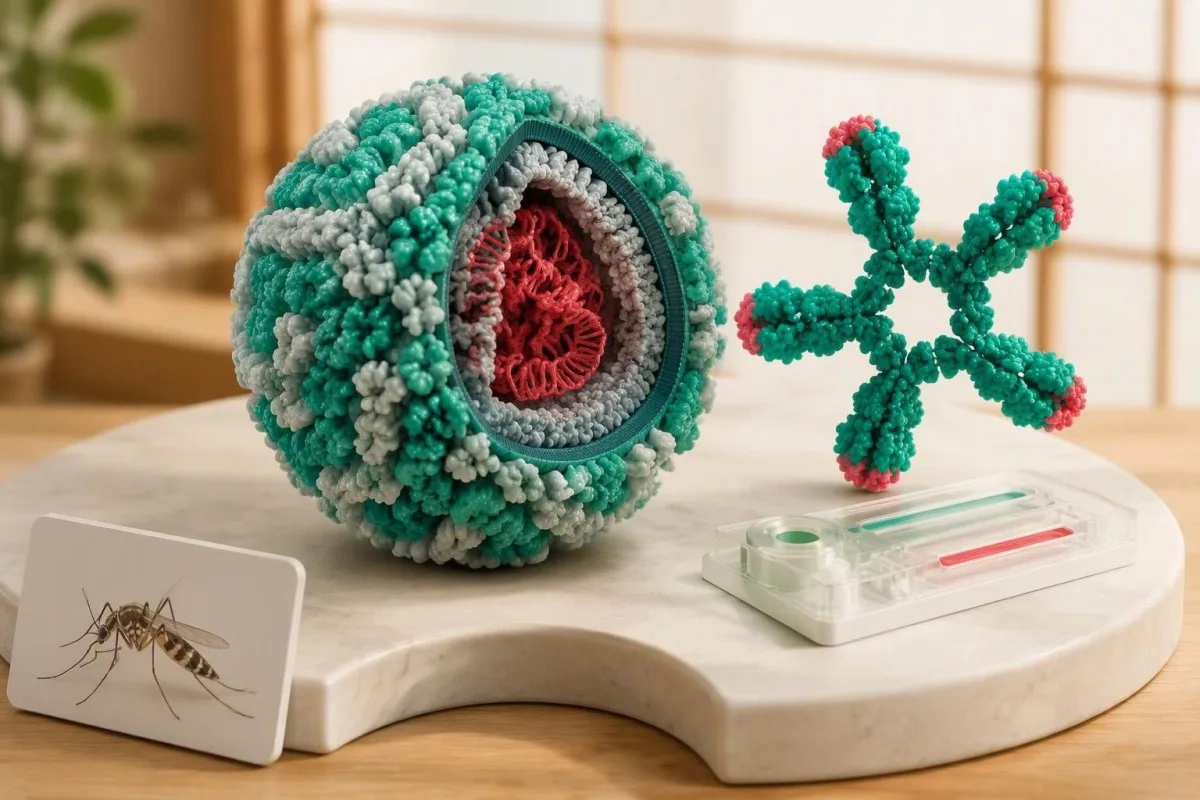
A positive Zika IgM result does not confirm infection: dengue-related cross-reactivity or persistent antibodies can explain it. PCR depends on collection timing; pregnancy calls for exposure-based clinical assessment and, when indicated, reference-laboratory confirmation.

اهم ڳالهيون
- Zika IgM usually develops during the first week of illness and can persist for months or longer; a positive result cannot reliably date infection.
- ڪراس ريئڪٽيوٽي with dengue and other flaviviruses can produce reactive Zika antibody results without confirmed Zika infection.
- PCR لاءِ مناسب وقت is measured primarily from symptom onset, not just the mosquito bite; serum testing is commonly prioritized within the first 7 days in symptomatic nonpregnant patients.
- حمل جي جاچ may include molecular testing up to 12 weeks after symptom onset in selected exposure pathways, but this does not guarantee detection throughout that period.
- منفي PCR means RNA was not detected in that specimen; it does not exclude infection outside the assay's useful detection window.
- PRNT جي تصديق may clarify antibody results, but previous flavivirus exposures can leave both Zika and dengue neutralization tests positive.
- غلط مثبت امڪان increases when the chance of infection before testing is low; assay specificity alone does not tell you the probability that your result is correct.
- Pregnancy follow-up should be arranged promptly for a reactive result with relevant exposure; a maternal antibody result alone cannot establish fetal infection.
What do positive Zika test results actually confirm?
A positive Zika IgM result is evidence of antibody reactivity, not automatic confirmation of Zika infection. A validated positive PCR provides more direct evidence because it detects viral RNA; neither of these 2 test types, by itself, establishes fetal infection or predicts its consequences.
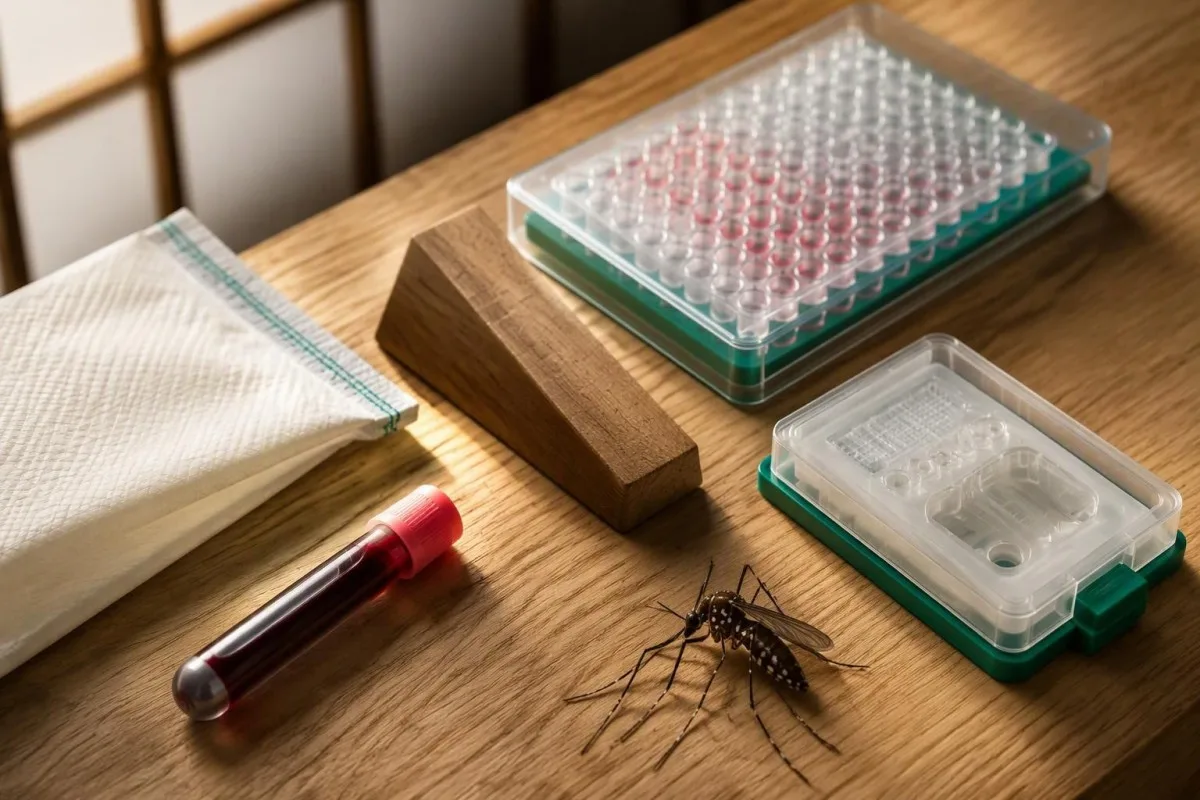
The word positive describes an assay's decision threshold, not a complete diagnosis. For 1 person with recent travel, compatible symptoms and no previous dengue exposure, a reactive antibody result carries a different meaning than the same result in someone with no plausible exposure and several previous flavivirus infections.
A detected molecular result deserves clinical follow-up, including verification when the laboratory or public-health pathway requires it. Contamination, specimen mix-ups and borderline amplification are uncommon but possible; a negative result from 1 other specimen does not automatically overturn a valid positive result from the first specimen.
Kantesti is an AI blood test analyzer that helps explain the difference between reported antibody reactivity and molecular detection, rather than treating 1 positive flag as a diagnosis. Information اسان جي اداري بابت describes our role; confirmation remains a clinical and laboratory responsibility.
Start by identifying 3 details: the exact assay name, the specimen type and the collection date. Our guide to مثبت اينٽي باڊي نتيجن بابت explains why a screen, evidence of past exposure and proof of a current infection are separate categories.
Zika IgM positive meaning: recent infection or older antibodies?
Zika IgM positive meaning depends on timing, exposure and assay specificity. IgM commonly becomes detectable during the first week of illness, but persistence for months or longer prevents a single positive result from proving that infection occurred during a particular pregnancy or within the past 2 weeks.
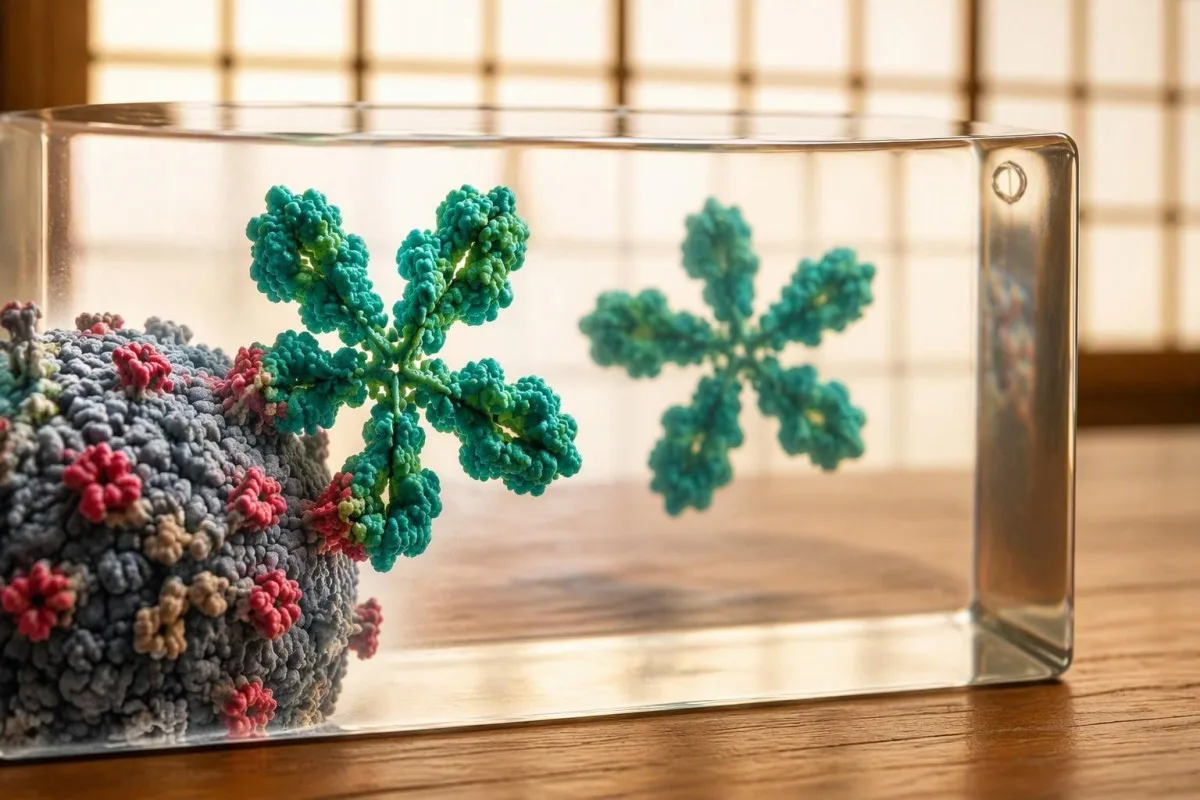
IgM is often described as the early antibody, but early appearance does not mean rapid disappearance. The diagnostic guidance from Sharp et al. (2019) emphasizes prolonged Zika IgM detection; a result obtained 6 months after travel can therefore be difficult to connect to a new episode of rash or fever.
Zika-specific IgM and total serum IgM are 2 different measurements. Total IgM may be reported in mg/dL or g/L, while a Zika assay may report an index, ratio or qualitative interpretation; an elevated total IgM concentration cannot diagnose Zika, as our immunoglobulins جا نتيجا هدايت ڪن ٿا بيان ڪري ٿو.
An antibody index is not a viral concentration. Hypothetically, an index of 3.0 versus 1.5 on the same assay may represent stronger analytical reactivity, but neither value can be converted into RNA copies/mL, a percentage risk of fetal effects or the number of days since exposure.
A Zika IgG result adds another layer, not a universal answer. Even when IgM and IgG are both reactive on 1 collection date, cross-reactivity and previous flavivirus exposure can prevent reliable dating; use the laboratory's interpretive comment instead of assuming that a larger antibody number means a more severe illness.
Why dengue and other flaviviruses can cause cross-reactivity
Zika antibody tests can react with antibodies generated against dengue and other flaviviruses because these viruses share antigenic features. Dengue is the most clinically relevant overlap in many travel settings; previous exposure to more than 1 flavivirus can also make confirmatory antibody testing less discriminating.

Antibody assays detect binding to selected viral antigens, not a virus's entire identity. If an antibody recognizes a shared surface feature, 1 genuine immune response to dengue may produce reactivity in a Zika assay; that is biological cross-reactivity, rather than proof that the laboratory mishandled the specimen.
Previous yellow fever or Japanese encephalitis vaccination can complicate some flavivirus serology, depending on the antigen and assay. Give the clinician the vaccine names and dates, including vaccinations from 5 or 10 years earlier, rather than assuming only recent vaccines matter; the reference laboratory decides which history changes interpretation.
West Nile virus belongs to the same broader viral family, while chikungunya does not. Our explanation of West Nile antibody confirmation covers related ambiguity, but co-circulation of 2 mosquito-borne illnesses does not establish that their antibody assays necessarily cross-react.
Repeated flavivirus exposures can broaden neutralizing antibody responses through immune memory. Sharp et al. (2019) describe why a person with 2 previous dengue infections may remain difficult to classify even after a neutralization test; the appropriate final interpretation may be flavivirus infection of uncertain type, not confirmed Zika.
How likely is a false positive Zika test?
The probability that a positive Zika antibody result is false depends on both assay performance and the chance of infection before testing. There is no defensible universal percentage for every laboratory, traveler or pregnancy; even a test with 95% specificity can produce mostly false positives in a low-prevalence group.

Consider a clearly hypothetical assay with 90% sensitivity and 95% specificity used in 10,000 people, of whom 1% truly have the target condition. It would yield approximately 90 true positives and 495 false positives, so only 90 of 585 positive results, or 15.4%, would represent the target condition.
Now keep those hypothetical assay characteristics but increase the underlying prevalence to 10%. Approximately 900 true positives and 450 false positives would result, giving a positive predictive value of 66.7%; the test has not improved, but the tested population has changed.
Improving specificity also matters: at 1% prevalence, a hypothetical assay with 90% sensitivity and 99% specificity would produce 90 true positives and 99 false positives. Its positive predictive value would still be only 47.6%; none of these figures is a measured performance estimate for a particular Zika assay.
Persistent antibodies from a genuine old Zika infection are not necessarily an analytically false result, although interpreting them as a new infection would be wrong. Our discussion of reactive hepatitis A IgM illustrates a similar distinction: 1 positive antibody finding can be accurate analytically yet misleading clinically.
Zika PCR test accuracy depends on the detection window
Zika PCR test accuracy is highest when an appropriate specimen is collected while viral RNA remains detectable. For symptomatic nonpregnant patients, serum molecular testing is commonly prioritized within the first 7 days of illness; a later negative test may reflect falling RNA rather than absence of earlier infection.
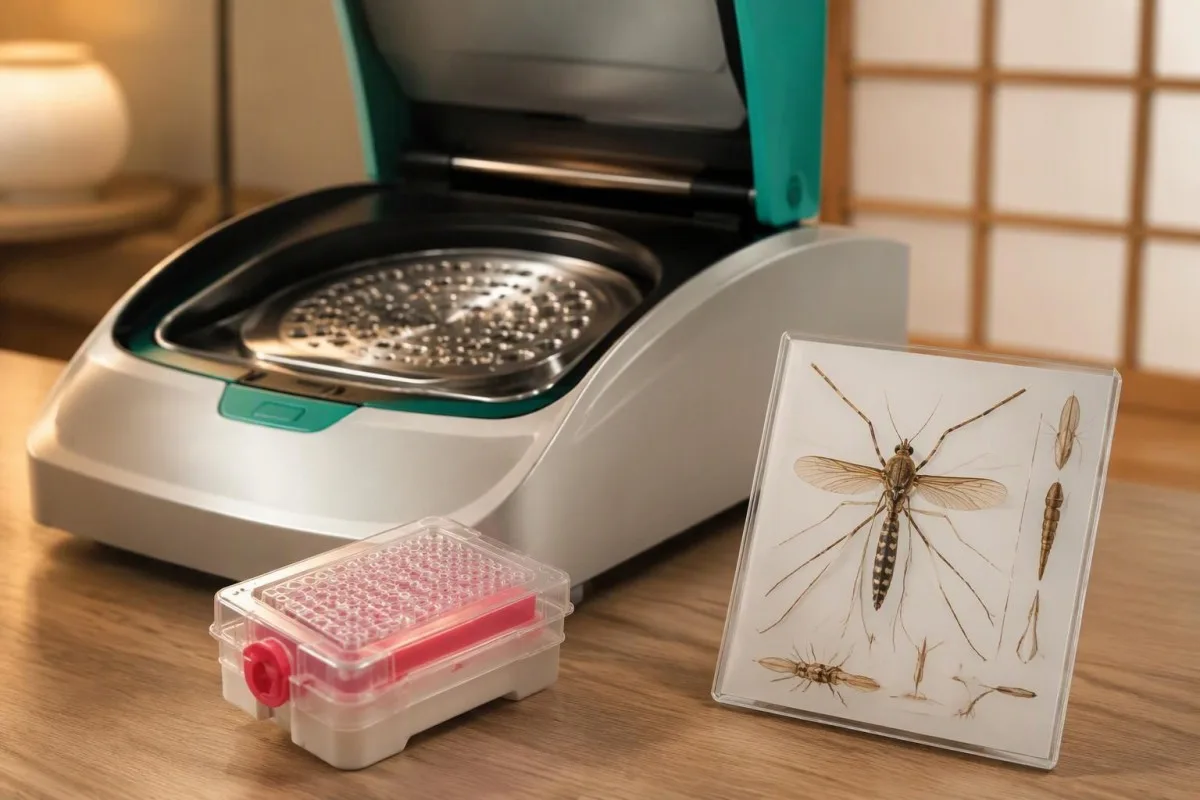
Analytical sensitivity describes how little RNA an assay can detect under validated conditions; clinical sensitivity describes how often it identifies infected people in practice. A very low detection limit cannot rescue a specimen collected 3 weeks after RNA has cleared, and there is no single clinical sensitivity percentage that applies across all collection times.
Count the molecular-testing window from symptom onset when symptoms are present, not automatically from the mosquito bite or flight home. Zika symptoms generally begin 3–14 days after exposure, so a specimen taken 7 days after a bite might fall before, during or after the most useful serum-testing period.
Some pregnancy pathways allow molecular testing up to 12 weeks after symptom onset because RNA detection can be prolonged. This is an eligibility window for selected testing strategies, not a promise of 12 weeks of reliable detection; exposure geography, symptoms, specimen choice and public-health advice determine the actual testing plan.
Urine can complement serum testing when the assay is validated for urine, but it is not a guaranteed longer-lasting specimen. The broader principle also appears in our PCR window-period guide: a negative molecular result from 1 body site cannot be interpreted without its collection timing.
Which dates matter when PCR and IgM disagree?
Discordant Zika results should be interpreted using at least 2 clocks: the exposure timeline and the symptom timeline. Add the specimen collection date to both; PCR-negative, IgM-positive findings can reflect late collection, persistent antibodies or cross-reactivity, while early PCR-positive, IgM-negative findings can precede antibody development.

In the prospective cohort reported by Paz-Bailey et al. in the New England Journal of Medicine (2018), estimated median times to loss of detectable RNA were 14 days in serum and 8 days in urine. These estimates came from a selected cohort with confirmed infection; they are not universal cutoffs for excluding infection in an individual patient.
For a hypothetical traveler tested on illness day 3, detected RNA with negative IgM can fit an early immune response. Testing both Zika and dengue through the appropriate pathway matters because the illnesses overlap; our discussion of PCR and antibody disagreement explains why discordance does not automatically indicate laboratory error.
Imagine instead that the first specimen was collected on illness day 21 and shows negative PCR with reactive IgM. That pattern cannot distinguish recent Zika from another flavivirus response or persistent antibodies without additional context; when indicated, a clinician may arrange a later specimen, often around 10–14 days after the first, using laboratory-specific instructions.
At Kantesti, we encourage recording collection dates separately from report-release dates because a 5-day reporting delay does not extend the biological detection window. Our رت جي جاچ جو ٽائيم لائن گائيڊ explains this distinction; ongoing exposure may also prevent assignment of a single meaningful last-exposure date.
How to read detected, equivocal and invalid Zika findings
Detected, not detected, equivocal and invalid are different laboratory conclusions. A detected PCR identifies RNA in the tested specimen; not detected means the signal was absent or below the assay threshold, while an invalid result means the test did not produce a usable answer and may require a second specimen.
An equivocal antibody result falls into the assay's uncertainty zone, which varies by laboratory and test design. A hypothetical index of 1.0 cannot be called positive or negative without that assay's reference intervals; our guide to معياري بمقابله مقدار جا نتيجا explains why a number and its interpretation must stay together.
PCR cycle threshold, when reported, describes amplification behavior rather than a standardized severity score. A hypothetical Ct of 35 on 1 instrument cannot be directly compared with Ct 35 on another assay, and it cannot reliably predict fetal effects, contagiousness or the precise day on which infection began.
An inhibited or invalid PCR is not a negative PCR. Problems involving extraction, specimen handling or amplification controls can require reprocessing or recollection; if the original specimen was collected on illness day 5, a replacement collected on day 12 must be interpreted at its own later biological time point.
Keep the complete report, including 4 often-overlooked fields: specimen source, assay name, collection date and interpretive comments. A cropped photograph showing only a red positive flag can hide a presumptive designation or a pending confirmatory test, making both clinical review and any automated explanation less reliable.
When does PRNT or repeat molecular testing help?
Confirmatory testing helps when a reactive Zika screen needs virus-specific clarification or an unexpected molecular result needs verification. Plaque reduction neutralization testing, or PRNT, measures functional neutralizing antibodies; however, responses against 2 or more flaviviruses can prevent PRNT from identifying which virus caused the original immune response.

Some reference laboratories use PRNT90, meaning the dilution that reduces plaque formation by 90%. In established CDC interpretive schemes, a Zika neutralizing titer of at least 1:10 with negative dengue neutralization can support Zika-specific classification; the complete algorithm, antibody screening result and laboratory instructions still matter.
If both Zika and dengue neutralizing titers are at least 1:10, the result may remain consistent with an unspecified flavivirus infection. A 4-fold difference between titers is not universally decisive after previous flavivirus exposures, so patients should not calculate their own confirmation rule from two numbers.
Repeating an unexpected positive NAAT may involve a new extraction from the original specimen, a second target or another specimen, depending on the assay and public-health protocol. This is not the same as simply rerunning 1 antibody screen; our antibody confirmation guide discusses why independent confirmation is more informative than repeated screening.
Kantesti is an AI lab test interpretation service that explains laboratory wording without converting 1 presumptive result into a confirmed diagnosis. Our تصديق ۽ نگراني بابت ڄاڻ describes evaluation boundaries; no interpretation tool can make PRNT reliably date infection when the underlying antibody biology cannot do so.
When pregnancy warrants specialist assessment
Pregnancy warrants prompt clinician assessment when possible Zika exposure accompanies compatible symptoms, reactive testing or concerning prenatal findings. Stable patients do not usually need emergency care solely because of 1 positive IgM result, but maternal-fetal medicine, infectious-disease or public-health input may be needed to choose testing and follow-up.

The key question is whether infection could have occurred during pregnancy, not simply whether an antibody is present today. The CDC pregnancy guidance by Oduyebo et al. (2017) explains how persistent IgM and falling transmission rates complicate screening; a reactive result at 10 weeks of pregnancy may still reflect exposure before conception.
Symptoms are not required for fetal risk assessment because maternal Zika infection can be asymptomatic. Conversely, 1 episode of fever or rash is not specific to Zika; a specialist weighs travel destination, mosquito exposure, sexual exposure, dates and alternative diagnoses rather than using symptoms alone to label the pregnancy.
Bring at least 4 dates to the appointment: the pregnancy dating estimate, travel or exposure dates, symptom onset and specimen collection. Our discussion of حمل دوران ٽوڪسوپلازما جا نتيجا explains a shared counseling principle: maternal antibodies do not automatically prove a new infection during pregnancy.
Routine Zika IgM screening is not appropriate for every asymptomatic pregnancy, especially where pretest probability is low and antibody persistence would create ambiguity. Similar timing difficulties arise with CMV اينٽي باڊي نمونن, but the diagnostic algorithms are different; do not transfer 1 virus's avidity or confirmation rules to another.
What can ultrasound and fetal testing establish?
Prenatal ultrasound assesses fetal development; it does not confirm or exclude maternal Zika infection. For pregnancies with confirmed or possible infection, specialist-led serial ultrasound may be considered every 3–4 weeks, while amniotic-fluid testing is individualized because a negative result cannot reliably exclude fetal infection.

A normal scan shortly after exposure does not end the assessment because some findings develop later. The 3–4-week surveillance interval discussed in CDC pregnancy guidance is intended to reassess growth and neuroanatomy over time; it is not a guarantee that every affected pregnancy will produce a visible finding at the next appointment.
Amniocentesis should not be ordered automatically for an isolated reactive IgM result. The decision depends on gestational age, imaging findings, other diagnostic indications and counseling about procedural uncertainty; there is no single post-exposure day on which a negative amniotic-fluid PCR reliably provides a 100% exclusion of fetal infection.
Concerning prenatal findings can justify specialist evaluation even when maternal PCR is negative. A specimen collected 8 weeks after symptoms may no longer detect maternal RNA, and abnormalities have alternative causes; counseling should separate what the scan shows from what the maternal laboratory result can establish.
Fever during pregnancy still needs assessment for other treatable illnesses, including conditions covered in our pregnancy fever testing guide. If maternal evidence or prenatal findings warrant newborn follow-up, a pediatric team plans examination and appropriate hearing, eye or laboratory assessment; 1 maternal IgM result alone does not diagnose the infant.
Why dengue testing belongs beside Zika interpretation
Dengue testing often belongs in the Zika workup because dengue overlaps geographically, resembles Zika clinically and can complicate Zika serology. During the first 7 days of dengue illness, NAAT or NS1 antigen testing is commonly useful; later testing relies more heavily on antibody interpretation and the clinical picture.

A positive dengue NAAT or NS1 result offers evidence that differs from a cross-reactive antibody screen. Our explanation of dengue NS1 timing covers the early window; a negative NS1 result after illness day 7 cannot be treated as equivalent to a negative result obtained on day 2.
Zika and dengue are not mutually exclusive diagnoses, although a dual-reactive antibody pattern commonly reflects serologic overlap rather than 2 proven infections. Sharp et al. (2019) recommend diagnostic reasoning that considers both viruses; molecular evidence, exposure timing and reference-laboratory interpretation are more informative than counting positive antibody flags.
Chikungunya can produce prominent joint symptoms after the same type of mosquito exposure, but it is an alphavirus rather than a flavivirus. Our guide to chikungunya IgM persistence explains why a reactive result also needs timing context; 3 overlapping illnesses require virus-specific tests, not interchangeable antibody assumptions.
Malaria and other travel-related illnesses remain possible when the itinerary supports them. A returned traveler with 38°C fever should not wait for a Zika confirmation result before obtaining clinical assessment; the danger of anchoring on 1 reactive test is missing a different condition with an urgent or specific treatment.
Which symptoms need urgent care while results are uncertain?
New progressive weakness, breathing difficulty, confusion, fainting or severe dehydration require urgent assessment regardless of the Zika result. Severe abdominal pain, persistent vomiting or unusual bleeding can suggest dengue complications; 1 negative Zika PCR does not make these symptoms safe to monitor without medical advice.
Zika is associated with Guillain-Barré syndrome, but a positive IgM result cannot diagnose that neurological condition. Weakness that progresses over 1–2 days, difficulty walking or problems swallowing needs urgent care; our وڌندڙ ڪمزوري بابت خبرداري واري رهنمائي ۾ بحث ڪيل حالتون شامل آهن explains why symptoms outweigh reassurance from an uncertain laboratory finding.
Avoid aspirin and nonsteroidal anti-inflammatory medicines such as ibuprofen until dengue has been excluded or a clinician advises otherwise. Paracetamol, also called acetaminophen, is commonly used for fever within appropriate dosing limits; 1 negative Zika test does not exclude dengue, and significant liver disease or pregnancy may require individualized medication advice.
For people planning pregnancy after possible Zika exposure, CDC prevention advice generally uses at least 3 months for males and 2 months for females, measured from return, symptom onset or diagnosis as applicable. These prevention intervals address possible sexual transmission; neither a negative serum PCR nor a reactive IgM result serves as a reliable fertility-clearance test.
During pregnancy, use condoms consistently or avoid sex for the rest of the pregnancy when a partner has relevant possible exposure, according to public-health advice. Travelers should also prevent mosquito bites for 3 weeks after returning from a risk area; prevention decisions should not depend solely on whether 1 laboratory specimen detected RNA.
How to use AI interpretation without mistaking it for confirmation
AI can help explain a Zika laboratory report, but it cannot verify infection, arrange confirmatory testing or determine fetal risk. The useful workflow preserves at least 3 essentials: the original laboratory wording, the collection date and the exposure history, followed by clinician review when the result could change care.

Kantesti is an AI-powered blood test analysis tool that turns laboratory reports into patient-readable explanations, not a replacement for reference-laboratory testing. Our AI ٽيڪنالاجي گائيڊ explains the interpretation workflow; a report saying presumptive positive should remain presumptive in every explanation, even when the flag appears strongly abnormal.
If you choose to upload a report, our free test explanation workflow can help you understand its wording; remove unnecessary identifiers while retaining the assay name, specimen and collection date. An explanation produced in about 60 seconds is not the turnaround time of PCR, PRNT or specialist assessment, which depends on the actual laboratory and care pathway.
Kantesti AI should not be used to infer 1 missing clinical fact from another: negative PCR does not prove absence of earlier infection, high IgM does not prove recent infection and maternal reactivity does not prove fetal effects. Any explanation that converts those findings into certainty needs correction against the complete report and clinical context.
Before acting, check 4 questions: Was the test indicated, was the specimen timely, is confirmation pending and does pregnancy change follow-up? AI is most useful for preparing those questions and organizing results; avoid using its output alone to cancel specialist follow-up, change pregnancy plans or declare sexual-transmission risk resolved.
تحقيق شايعات ۽ ثبوت جي حدون
Clinical Zika interpretation should rely on directly relevant diagnostic guidance and infection studies, not unrelated biomarker publications. The 3 external references below address Zika testing, RNA persistence and pregnancy management; the 2 accompanying Zenodo publications are educational resources about other laboratory measurements, not evidence validating Zika diagnosis.

Sharp et al. (2019) provide the central framework for distinguishing molecular evidence from ambiguous flavivirus serology, while Paz-Bailey et al. (2018) quantify RNA persistence in a confirmed-infection cohort. Neither source supplies 1 universal accuracy figure for every modern assay, and their population and testing methods must remain attached to any numerical claim.
Kantesti's educational publications include an RDW and cell-index guide, archived on Zenodo under DOI 10.5281/zenodo.18202598. RDW can help explain a concurrent complete blood count, but it does not diagnose Zika, establish the date of infection or predict whether a fetus is affected.
گڏ ڏنل kidney-function ratio guide is archived under DOI 10.5281/zenodo.18207872. Kidney measurements may matter in someone with dehydration or another travel-related illness, but there is no validated BUN/creatinine ratio threshold that confirms Zika; these 2 publications should not be presented as Zika diagnostic research.
Pregnancy recommendations and test availability vary with transmission patterns, jurisdiction and laboratory access, so a 2017 or 2019 algorithm should not be applied mechanically to every exposure. Our طبي مواد جا معيار support separating established facts from uncertainty; use the relevant public-health or reference-laboratory pathway for the actual decision.
اڪثر پڇيا ويندڙ سوال
ڇا زيڪا IgM ٽيسٽ جو مثبت نتيجو اچڻ جو مطلب آهي ته مون کي ضرور زيڪا آهي؟
زڪا IgM ٽيسٽ جو مثبت نتيجو زڪا جي انفيڪشن جي پڪ سان تصديق نٿو ڪري. IgM عام طور بيماريءَ جي پهرئين هفتي دوران ٺهندو آهي، پر اينٽي باڊيز مهينن يا ان کان وڌيڪ عرصي تائين برقرار رهي سگهن ٿيون ۽ ڊينگي يا ٻين فليوائرس سان ڪراس ري ايڪٽ ڪري سگهن ٿيون. هڪ اڪيلو مثبت نتيجو انفيڪشن جو وقت ڀروسي سان طئي نٿو ڪري سگهي، نه ئي اهو ثابت ڪري سگهي ٿو ته انفيڪشن حمل دوران ٿيو هو. ايندڙ قدم جو تعين ڪرڻ لاءِ متاثر ٿيڻ جي تاريخ، نموني وٺڻ جو وقت ۽ مناسب ماليڪيولر يا تصديقي ٽيسٽنگ جو طريقو اهم آهن.
ڇا ڊينگي سبب زيڪا ٽيسٽ جو نتيجو غلط طور تي مثبت اچي سگهي ٿو؟
ڊينگي اينٽي باڊيز، زڪا اينٽي باڊي جي ردعمل واري نتيجي جو سبب بڻجي سگهن ٿيون، ڇاڪاڻتہ ٻنهي وائرسن ۾ اينٽيجن جون خاصيتون گڏيل آهن. هي مسئلو بنيادي طور سيرولوجي تي اثرانداز ٿئي ٿو، نه ڪي ان ڳالهه جي نشاندهي ڪري ٿو ته صحيح نموني تصديق ٿيل زڪا PCR معمول طور ڊينگي RNA ڳولي ٿو. هڪ کان وڌيڪ فليوائرس جي اڳوڻي نمائش سبب نيوٽرلائيزيشن ٽيسٽ جا نتيجا به مبهم ٿي سگهن ٿا. ڊاڪٽر کي شايد ڊينگي جي جاچ ۽ ريفرنس ليبارٽريءَ جي تشريح جي ضرورت پوي، بجاءِ ان جي ته ٻنهي لاءِ ردعمل ڏيندڙ اينٽي باڊي نتيجن کي ٻن انفيڪشنن جو ثبوت سمجهي.
زڪا وائرس جي سامهون اچڻ کان پوءِ پي سي آر ٽيسٽ ڪيترو درست آهي؟
زيڪا PCR جي درستگي ٽيسٽ، نموني ۽ علامتن جي شروعات کان گذريل وقت تي دارومدار رکي ٿي، تنهنڪري هر قسم جي سامهون اچڻ لاءِ هڪ ئي لاڳو ٿيندڙ سيڪڙو موجود ناهي. علامتن وارن غيرحامله مريضن ۾ بيماريءَ جي پهرين 7 ڏينهن اندر سيرم جي ماليڪيولي جاچ کي عام طور تي ترجيح ڏني ويندي آهي. حمل جي ڪجهه مخصوص جاچ جي طريقن ۾ علامتن جي شروعات کان 12 هفتن تائين جاچ جي اجازت هوندي آهي، پر ان سڄي عرصي دوران وائرس جي سڃاڻپ جي ضمانت ناهي. منفي نتيجي جو مطلب آهي ته ان نموني ۾ RNA نه مليو ۽ اهو پاڻمرادو اڳوڻي انفيڪشن کي رد نٿو ڪري.
زيڪا IgM مثبت پر PCR منفي هجڻ جو ڇا مطلب آهي؟
PCR منفي سان Zika IgM مثبت هجڻ، RNA جي گهٽجڻ کان پوءِ نمونو وٺڻ سبب تازو انفيڪشن، پراڻين برقرار رهندڙ اينٽي باڊيز، يا ڪنهن ٻئي فليوي وائرس سان ڪراس ري ايڪٽوٽي ظاهر ڪري سگهي ٿو. مثال طور، بيماريءَ جي 21هين ڏينهن تي هي نمونو، ٽئين ڏينهن تي ساڳئي نموني کان مختلف معنيٰ رکي ٿو. انهن مان ڪو به نتيجو اڪيلو اهو ثابت نٿو ڪري ته انفيڪشن ڪڏهن ٿيو. واسطي جي امڪان ۽ حمل جي حالت موجب، ڊاڪٽر ٻيهر نمونو وٺڻ، ڊينگي جي جاچ يا ريفرنس ليبارٽريءَ کان تصديق ڪرائڻ جي درخواست ڪري سگهي ٿو.
ڇا حمل دوران زيڪا ٽيسٽ مثبت اچڻ تي مون کي ڪنهن ماهر ڊاڪٽر کي ڏيکارڻ گهرجي؟
0 حمل دوران زيڪا جو ري ايڪٽو نتيجو هجي ته حمل جي نگراني ڪندڙ طبيب سان فوري رابطو ڪرڻ گهرجي، خاص طور تي جڏهن لاڳاپيل سفر، جنسي واسطو يا ان سان ٺهڪندڙ بيماري هجي. وقت جو جائزو وٺڻ ۽ تصديقي جاچ چونڊڻ لاءِ ماهر يا عوامي صحت جي ماهرن جي راءِ گهربل ٿي سگهي ٿي. تصديق ٿيل يا ممڪن انفيڪشن واريون چونڊيل حملون هر 3–4 هفتن ۾ الٽراسائونڊ جي سلسليوار جاچ ڪرائي سگهن ٿيون، پر ماءُ جي IgM جو هڪ نتيجو جنين جي انفيڪشن ثابت نٿو ڪري. نئين وڌندڙ ڪمزوري، ساهه کڻڻ ۾ ڏکيائي يا سخت بيماريءَ جي صورت ۾ مقرر صلاح مشوري جو انتظار ڪرڻ بدران تڪڙي طبي جائزو وٺڻ ضروري آهي.
ڇا PRNT تصديق ڪري سگهي ٿو ته مون کي زيڪا ڪڏهن ٿيو؟
PRNT وائرس لاءِ مخصوص غيرجانبدار ڪندڙ اينٽي باڊيز جو جائزو وٺڻ ۾ مدد ڪري سگهي ٿو، پر اهو زڪا جي انفيڪشن جي تاريخ معتبر طور تي طئي نٿو ڪري سگهي. ڪجهه حوالاتي ليبارٽري اسڪيمون تشريح جي حصي طور گهٽ ۾ گهٽ 1:10 جو غيرجانبدار ڪندڙ ٽائيٽر استعمال ڪن ٿيون، جڏهن ته مڪمل زڪا ۽ ڊينگي نمونو درجابندي جو تعين ڪري ٿو. جيڪڏهن ٻئي وائرس غيرجانبداري جا مثبت نتيجا ڏين، ته فليوائرس سان اڳوڻيون واسطيداريون واضح فرق ڪرڻ کان روڪي سگهن ٿيون. زڪا لاءِ مخصوص اينٽي باڊي جي تصديق به اهو ثابت نه ڪري سگهي ٿي ته انفيڪشن موجوده حمل دوران ٿيو هو.
Can a negative Zika test tell me it is safe to try for pregnancy?
A negative Zika serum PCR is not a validated clearance test for sexual-transmission risk or pregnancy planning. CDC prevention advice generally uses at least 3 months after possible exposure for males and 2 months for females, measured from the relevant return, symptom-onset or diagnosis date. Serum testing does not reliably determine whether viral material persists in another body compartment. People with ongoing exposure, a pregnant partner or uncertainty about dates should obtain individualized public-health or clinician advice.
پنهنجي رت جي جاچ جو نتيجو ڪيئن پڙهجي
پنهنجي ليبارٽري رپورٽ اپلوڊ ڪريو ۽ Kantesti جو AI سيڪنڊن اندر هر بائيو مارڪر کي سادي ٻوليءَ ۾ سمجهائيندو. سڄي دنيا ۾ 2 ملين کان وڌيڪ ماڻهن طرفان استعمال ٿيل.
حوالا
- Klein, T., Mitchell, S., & Weber, H. (2026). RDW رت جي جاچ: RDW-CV، MCV ۽ MCHC بابت مڪمل رهنمائي. Kantesti AI طبي تحقيق. ڊي او آءِ
- Klein, T., Mitchell, S., & Weber, H. (2026). BUN/Creatinine Ratio Explained: گردن جي ڪم جاچ Guide. Kantesti AI طبي تحقيق. ڊي او آءِ
- Sharp TM et al. (2019). Dengue and Zika Virus Diagnostic Testing for Patients with a Clinically Compatible Illness and Risk for Infection with Both Viruses. MMWR Recommendations and Reports. ڊي او آءِ
- Paz-Bailey G et al. (2018). Persistence of Zika Virus in Body Fluids — Final Report. New England Journal of Medicine. ڊي او آءِ
- Oduyebo T et al. (2017). Update: Interim Guidance for Health Care Providers Caring for Pregnant Women with Possible Zika Virus Exposure — United States (Including U.S. Territories), July 2017. MMWR Morbidity and Mortality Weekly Report. ڊي او آءِ
- 20 لک+تجزيو ڪيل ٽيسٽون
- 127+ملڪ
- 100+ٻوليون
طبي ٽيم بابت


E-E-A-T اعتماد جا سگنل
تجربو
ڊاڪٽر جي نگرانيءَ هيٺ ليبارٽري نتيجن جي تشريح واري عمل جو جائزو.
ماهر
ليبارٽري دوائن جو ڌيان ان ڳالهه تي ته بايو مارڪرز ڪلينڪل حوالي سان ڪيئن رويو ڏيکارين ٿا.
اختيار
ڊاڪٽر ٿامس ڪلائن طبي جائزو ورتو، جنهن ۾ ڊاڪٽر سارا مچل ۽ پروفيسر ڊاڪٽر هانس ويبر جون ڀاڱيداريون شامل آهن.
اعتبار
ثبوتن تي ٻڌل تشريح، جنهن سان خبرداري گهٽائڻ لاءِ واضح پيرويءَ جا رستا موجود هجن.




طبي ترديد
هي آرٽيڪل صرف تعليمي مقصدن لاءِ آهي ۽ طبي مشورو نٿو بڻجي. تشخيص ۽ علاج جي فيصلن لاءِ هميشه ڪنهن قابل صحت فراهم ڪندڙ سان صلاح ڪريو.
شايع ٿيل · ايڊيٽوريل ٽيم سان رابطو ڪريو
Kantesti Ltd پاران شايع ٿيل، انگلينڊ ۽ ويلز ۾ رجسٽرڊ، ڪمپني نمبر. 17090423, ، لنڊن، برطانيه.
