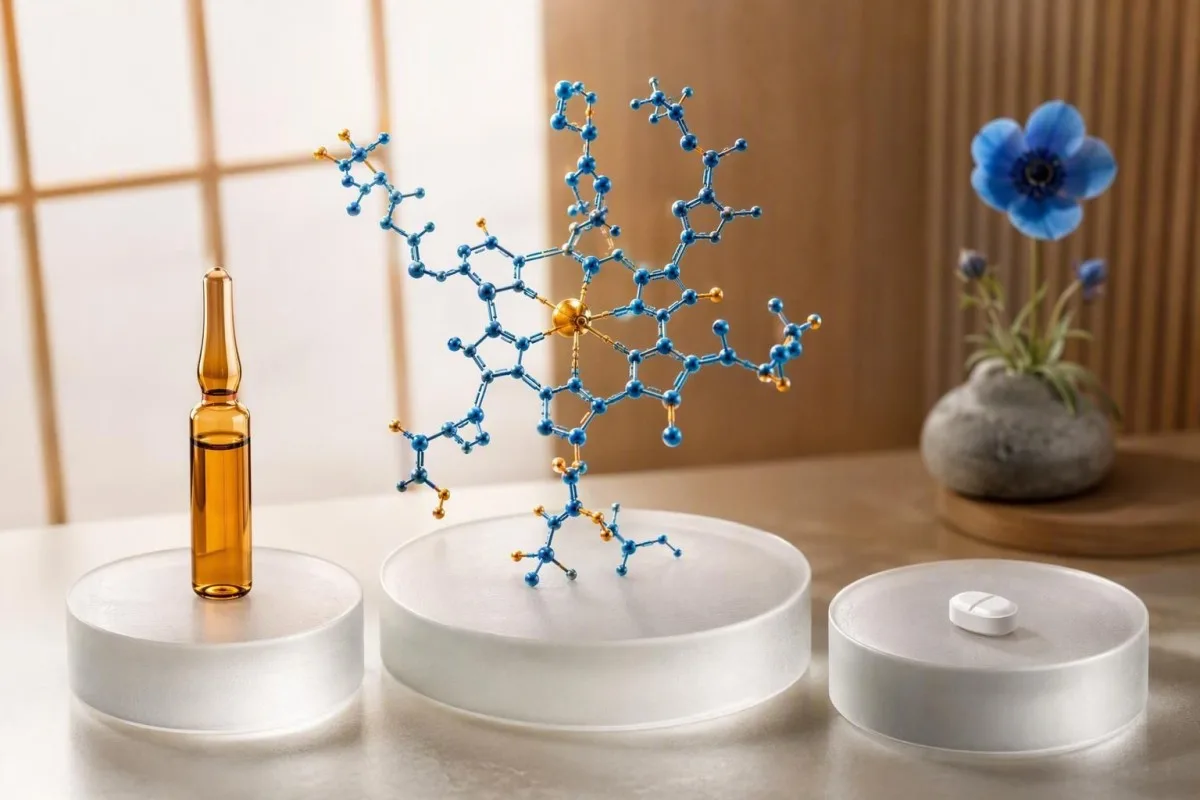
Las inyecciones producen un pico sérico inmediato, pero la B12 oral en dosis altas a menudo corrige la deficiencia de manera igualmente efectiva a lo largo de semanas. El factor decisivo suele ser la causa y la gravedad de la deficiencia, no solo la preferencia.


- Aumento sérico más rápido: Una inyección intramuscular de B12 de 1.000 microgramos aumenta la B12 circulante en cuestión de horas, mientras que las tabletas aumentan de forma más gradual a lo largo de días.
- Reemplazo comparable: La cianocobalamina oral de 1.000-2.000 microgramos al día puede lograr resultados similares a corto plazo en sangre y síntomas que la terapia intramuscular para muchos adultos.
- Indicación de inyección: Los síntomas neurológicos severos, la anemia profunda, la incapacidad para tomar tabletas o la absorción poco confiable generalmente justifican inyecciones dirigidas por el médico.
- Resultado límite: El B12 sérico por debajo de 180 pg/mL (133 pmol/L) se considera comúnmente deficiente; 180-350 pg/mL a menudo necesita confirmación con MMA u homocisteína.
- Absorción pasiva: Aproximadamente el 1% de una dosis oral grande de B12 se absorbe por difusión pasiva, razón por la cual una tableta de 1.000 microgramos puede funcionar a pesar del factor intrínseco alterado.
- Momento para repetir la prueba: Un hemograma completo (CBC) y la respuesta clínica suelen ser más útiles a las 4-8 semanas que un nivel de B12 medido inmediatamente después del tratamiento.
- Punto de seguridad: No trate el entumecimiento inexplicable solo con ácido fólico; el folato puede mejorar la anemia mientras la lesión nerviosa relacionada con la B12 progresa.
- La causa importa: La metformina, los inhibidores de la bomba de protones, las dietas veganas, la enfermedad celíaca, la cirugía gástrica y la anemia perniciosa requieren planes de seguimiento diferentes.
¿Qué opción aumenta los niveles de vitamina B12 más rápido?
Las inyecciones de B12 elevan el nivel sérico medido más rápido que las tabletas, a menudo en cuestión de horas, porque eluden el intestino. Sin embargo, para la mayoría de los adultos estables con deficiencia confirmada, una dosis oral de 1000-2000 microgramos al día puede reponer las reservas corporales y mejorar los recuentos sanguíneos en semanas a un ritmo clínicamente similar.
Una inyección crea un pico temprano agudo porque la hidroxocobalamina o la cianocobalamina se administran directamente en el músculo y luego en la circulación. Ese pico de laboratorio no es lo mismo que las reservas tisulares restauradas o la función nerviosa reparada; en mi práctica, la recuperación de los síntomas se mide en semanas o meses, no a la mañana siguiente.
La comparación práctica es a menudo horas versus días para la concentración sérica, pero aproximadamente 4-8 semanas para una respuesta hematológica significativa con cualquiera de las rutas adecuadas. Los reticulocitos suelen aumentar al día 3-5, la hemoglobina comienza a mejorar después de aproximadamente 1-2 semanas y la macrocitosis puede tardar hasta 8 semanas en normalizarse.
Kantesti es un Analizador de sangre con inteligencia artificial que coloca la B12 junto al MCV, hemoglobina, folato, creatinina y resultados previos en lugar de tratar un pico de B12 post-tratamiento como prueba de que el problema subyacente está resuelto. Los lectores también pueden comparar su resultado con nuestro guía de rangos de referencia de B12.
Qué significa realmente “más rápido”
Un resultado alto después de una inyección confirma la exposición reciente, no necesariamente una entrega celular adecuada. El ácido metilmalónico, los hallazgos neurológicos y la tendencia del CBC son más informativos cuando el diagnóstico original era incierto.
Cómo funciona la absorción de B12 oral cuando el factor intrínseco es bajo
La B12 oral en dosis altas puede funcionar incluso cuando la absorción del factor intrínseco está alterada porque una pequeña fracción entra por difusión pasiva. Aproximadamente el 1% de una dosis de 1000 microgramos puede ser absorbido pasivamente, produciendo alrededor de 10 microgramos, muy por encima del requerimiento diario promedio de 2,4 microgramos para adultos.
La B12 unida a los alimentos debe ser liberada por el ácido estomacal, unirse al factor intrínseco y ser captada en el íleon terminal. Este sistema de múltiples pasos explica por qué la supresión ácida a largo plazo, la gastritis autoinmune, la enfermedad ileal y los procedimientos bariátricos pueden causar deficiencia; también explica por qué un multivitamínico estándar a menudo es una dosis demasiado pequeña para el tratamiento.
La absorción oral de B12 depende de la dosis pero no es lineal. La vía del factor intrínseco se satura aproximadamente a 1,5-2 microgramos por comida, mientras que la difusión pasiva solo se vuelve clínicamente útil con tabletas en el rango de miligramos. Un suplemento de 50 microgramos es una prevención razonable para algunas personas, pero no es equivalente a 1000 microgramos para una deficiencia establecida.
Para pacientes que usan omeprazol, pantoprazol u otro IBP, reviso el patrón más amplio (dieta, edad, anemia y duración del uso) en lugar de asumir que el medicamento es toda la historia. Nuestra revisión de monitorización de laboratorio a largo plazo con IBP explica por qué el magnesio y el hierro también pueden ser importantes.
Lo que los ensayos clínicos muestran sobre las tabletas frente a las inyecciones
La evidencia aleatorizada sugiere que la B12 oral a 1000-2000 microgramos diarios puede ser tan efectiva como la B12 intramuscular para muchas personas con deficiencia. La base de evidencia no es enorme y contiene menos pacientes con enfermedad neurológica grave de los que a los médicos les gustaría.
La revisión Cochrane de Wang y colegas encontró que la B12 oral a dosis altas produjo respuestas similares en los niveles de B12 en sangre al tratamiento intramuscular en los pequeños ensayos aleatorizados disponibles (Wang et al., 2018). Un estudio utilizó 2000 microgramos por vía oral cada día; otro utilizó 1000 microgramos por vía oral después de un esquema inicial, por lo que “terapia oral” no significa un producto de supermercado a dosis bajas.
El ensayo anterior de Kuzminski et al. reportó mayores concentraciones séricas de B12 con 2000 microgramos de cianocobalamina oral que con un régimen de inyección de 1000 microgramos, sin embargo, los resultados clínicos fueron la pregunta que importaba (Kuzminski et al., 1998). La evidencia es honestamente mixta sobre el protocolo ideal porque los ensayos utilizaron diferentes intervalos de inyección y períodos de seguimiento.
Una tableta solo funciona si se toma. Las dosis diarias omitidas pueden hacer que una inyección administrada cada 2-3 meses sea más confiable en la vida real, especialmente para adultos frágiles o personas con regímenes de medicación complejos. Nuestro guía de línea de tiempo de análisis de sangre puede ayudar a distinguir un cambio de tratamiento real de una reevaluación mal programada.
Cuándo las inyecciones de B12 son médicamente necesarias
Las inyecciones de B12 suelen ser médicamente necesarias cuando la deficiencia es grave, hay síntomas neurológicos presentes, la ingesta oral es imposible o la absorción y la adherencia no se pueden garantizar. No son automáticamente obligatorias simplemente porque se sospeche anemia perniciosa, siempre que el tratamiento oral a dosis altas y el seguimiento sean factibles.
La evaluación urgente por parte del médico es apropiada para un nuevo desequilibrio de la marcha, entumecimiento progresivo, debilidad, confusión, cambio visual, anemia marcada o embarazo con deficiencia significativa. El daño neurológico por B12 puede volverse parcialmente irreversible; en ese entorno, no retrasaría la terapia parenteral mientras debate la conveniencia.
La guía NICE NG239 aconseja tratamiento intramuscular cuando se sospecha o confirma malabsorción y recomienda reposición intramuscular de por vida para la gastritis autoinmune en muchos casos (NICE, 2024). La práctica varía internacionalmente: algunos médicos utilizan 1-2 mg diarios por vía oral en pacientes confiables con anemia perniciosa, mientras que otros prefieren inyecciones porque las consecuencias de un error son mayores.
Una hemoglobina por debajo de 80 g/L, disnea sintomática, taquicardia o posible afectación de la médula espinal justifican una revisión médica rápida en lugar de autotratamiento. Para comprender cómo aparecen los patrones de anemia en las pruebas de rutina, consulte qué incluye un hemograma completo.
Dosis de tratamiento de deficiencia de B12 que los médicos realmente usan
Las dosis comunes de tratamiento oral son de 1000-2000 microgramos diarios, mientras que los regímenes intramusculares comunes utilizan 1000 microgramos por dosis con una fase de carga inicial. El producto, la guía nacional y la causa de la deficiencia determinan el horario exacto.
En la práctica del Reino Unido, a menudo se administra hidroxocobalamina 1000 microgramos por vía intramuscular tres veces por semana durante 2 semanas cuando no hay afectación neurológica, luego cada 2-3 meses para el mantenimiento; los protocolos difieren según el servicio local. Con características neurológicas, las dosis iniciales a menudo se administran cada dos días hasta que no haya más mejoría, luego el mantenimiento sigue el consejo del especialista.
Un plan oral típico es cianocobalamina 1000 microgramos diarios durante 8-12 semanas, seguido de 1000 microgramos diarios o un régimen de mantenimiento más bajo si la dieta fue la única causa. Los productos sublinguales no han demostrado superar a las tabletas tragadas; una vez disueltos, la mayor parte se traga de todos modos.
No improvise un régimen de carga con consejos de redes sociales. El comparación de B12 metilada frente a cianocobalamina explica por qué la dosis y la consistencia generalmente importan más que las afirmaciones de marketing sobre la forma de B12.
Cómo interpretar un resultado de B12 bajo o límite
Un nivel de B12 sérica por debajo de 180 pg/mL (133 pmol/L) generalmente apoya la deficiencia, mientras que los valores de aproximadamente 180-350 pg/mL son una zona indeterminada en la que la MMA o la homocisteína pueden aclarar la deficiencia celular. Los intervalos de laboratorio individuales difieren, y un valor sérico normal no excluye completamente la deficiencia después de una suplementación reciente.
El ácido metilmalónico aumenta cuando el metabolismo dependiente de la B12 se ve alterado, pero la función renal reducida puede elevar la MMA de forma independiente. La homocisteína puede aumentar con la deficiencia de B12, deficiencia de folato, deficiencia de vitamina B6, hipotiroidismo y deterioro renal, por lo que ninguna prueba confirmatoria debe leerse de forma aislada.
La macrocitosis es un apoyo pero no es necesaria. Un volumen corpuscular medio superior a 100 fL aumenta la sospecha de deficiencia de B12 o folato, exposición al alcohol, enfermedad hepática, hipotiroidismo, trastornos de la médula ósea o efectos de medicamentos; aproximadamente una cuarta parte de los pacientes sintomáticos con deficiencia de B12 pueden tener un MCV normal.
Kantesti AI interpreta los resultados de B12 comprobando el patrón de MCV, RDW, hemoglobina, folato y valores históricos, incluyendo indicios de que un suplemento de folato puede estar enmascarando la macrocitosis. Nuestro artículo sobre seguimiento de MCV alto cubre las alternativas comunes.
La anemia perniciosa cambia el plan a largo plazo, no siempre la vía
La anemia perniciosa es la pérdida autoinmune de la función del factor intrínseco, y requiere reemplazo de B12 de por vida después del diagnóstico. Las inyecciones ofrecen una administración confiable, pero la terapia oral en dosis altas aún puede mantener un estado adecuado en adultos seleccionados y estrechamente monitorizados.
Las pruebas más utilizadas son los anticuerpos contra el factor intrínseco y los anticuerpos parietales, junto con B12, CBC y, a veces, gastrina. Un anticuerpo contra el factor intrínseco positivo es muy específico pero no muy sensible, por lo que un resultado negativo no descarta la afección; esta es una de esas áreas donde el contexto importa más que un solo anticuerpo.
La anemia perniciosa es más que un problema de absorción. La gastritis autoinmune puede coexistir con deficiencia de hierro antes de que la deficiencia de B12 sea obvia, y la enfermedad de larga data conlleva consideraciones de vigilancia gástrica que deben discutirse con el médico tratante. Nuestra guía de pruebas de anemia perniciosa detalla la secuencia diagnóstica.
Kantesti es un plataforma de interpretación análisis de sangre de AI se utiliza en 127+ países, pero una interpretación de IA no puede diagnosticar la gastritis autoinmune ni seleccionar un intervalo de inyección de por vida. Un médico necesita conectar los síntomas, los anticuerpos, el historial endoscópico y el patrón de laboratorio.
Por qué los síntomas neurológicos necesitan una acción clínica más rápida
Hormigueo, pérdida de la sensación de vibración, marcha inestable, cambios cognitivos o debilidad con B12 baja deben desencadenar una evaluación presencial inmediata y, por lo general, un tratamiento inyectable. La recuperación nerviosa es menos predecible que la recuperación de la anemia y puede permanecer incompleta después de meses de deficiencia.
Las columnas dorsales y los nervios periféricos son vulnerables a la deficiencia de B12, produciendo un patrón que los médicos llaman degeneración combinada subaguda en casos avanzados. Una hemoglobina normal no protege contra esto; he visto pacientes cuyos pies entumecidos y sensación de vibración anormal precedieron a cualquier anemia obvia.
La mejora a menudo comienza dentro de 1 semana de terapia efectiva, pero los síntomas sensoriales pueden tardar de 3 a 12 meses y pueden no resolverse por completo. El enfoque más seguro es registrar la función basal (distancia de caminata, caídas, destreza manual, sensación de vibración), porque un aumento de la B12 sérica por sí solo no es una puntuación de recuperación.
La neuropatía también tiene muchos imitadores, incluyendo diabetes, lesión nerviosa relacionada con el alcohol, enfermedad tiroidea, exceso de vitamina B6 y algunos medicamentos. Los pacientes con hormigueo pueden usar nuestra guía de síntomas nerviosos por vitamina B6 para preparar mejores preguntas, pero la debilidad progresiva requiere atención médica ahora.
Cuándo las tabletas son suficientes para la deficiencia de B12 por dieta
Las tabletas suelen ser suficientes cuando la B12 baja se debe a una ingesta inadecuada y el intestino puede absorber los suplementos. Los veganos, las personas que consumen muy pocos alimentos de origen animal y los adultos con restricciones dietéticas temporales suelen responder bien a la cianocobalamina oral de 1000 microgramos al día.
La vitamina B12 se concentra de forma natural en alimentos de origen animal y alimentos fortificados, por lo que una dieta vegana estricta necesita una estrategia confiable de alimentos fortificados o suplementos. Los alimentos vegetales comercializados como fuentes naturales de B12 son inconsistentes; las algas marinas y los alimentos fermentados pueden contener análogos inactivos que no son un tratamiento confiable.
La deficiencia dietética aún debe incitar una breve historia. Una vegana de 23 años con B12 de 142 pg/mL, MMA normal después del tratamiento y sin síntomas intestinales es diferente de una persona de 68 años con el mismo resultado, pérdida de peso y deficiencia de hierro. La edad, los medicamentos y los síntomas gastrointestinales cambian el estudio.
Para la planificación de alimentos, nuestra guía de vitaminas hidrosolubles separa las dosis de prevención del tratamiento de deficiencia. No asuma que la nutrición por sí sola corregirá los síntomas neurológicos lo suficientemente rápido.
Medicamentos y afecciones intestinales que alteran la elección del tratamiento de B12
La metformina, los medicamentos supresores de ácido, la enfermedad celíaca, la enfermedad de Crohn que afecta el íleon, la insuficiencia pancreática y la cirugía gástrica pueden reducir la disponibilidad de B12. Una prueba con tabletas puede ser razonable en algunos casos, pero las inyecciones se eligen a menudo cuando la absorción es incierta o los síntomas son significativos.
La deficiencia de B12 asociada a la metformina es lo suficientemente común como para que los reguladores aconsejen verificar los niveles en pacientes con neuropatía, anemia u otros factores de riesgo, particularmente con dosis más altas o de larga duración. El mecanismo probablemente implica la captación dependiente de calcio del complejo B12-factor intrínseco en el íleon, no simplemente una dieta pobre.
Después de una gastrectomía en manga o un bypass gástrico, las decisiones de tratamiento deben seguir el protocolo del equipo bariátrico porque el hierro, el folato, la tiamina, la vitamina D y el cobre pueden verse afectados conjuntamente. La diarrea, la hipoalbuminemia, la pérdida de peso inexplicable o las heces grasosas deben incitar a la investigación en lugar de a cambios interminables de suplementos.
El bajo nivel de cobre también puede causar anemia y síntomas neurológicos que se asemejan a la deficiencia de B12, especialmente después de una cirugía bariátrica o un exceso de zinc. Nuestras pistas clínicas de bajo nivel de cobre explican por qué verificar solo la B12 puede pasar por alto la explicación real.
Cuándo volver a evaluar después del tratamiento de B12
Un CBC y una revisión de síntomas a las 4-8 semanas son generalmente más útiles que repetir la B12 sérica inmediatamente después de una inyección o un ciclo de tabletas. Un resultado de B12 muy alto poco después del tratamiento refleja principalmente la dosis que se tomó.
Una respuesta de reticulocitos alrededor del día 3-5 ofrece una pista temprana de que la producción medular se está recuperando, mientras que la hemoglobina debería aumentar en las semanas siguientes si la deficiencia de B12 fue un factor clave. La falta de mejoría debe reabrir el diagnóstico diferencial: deficiencia de hierro, pérdida de sangre continua, deficiencia de folato, inflamación, enfermedad renal o un diagnóstico incorrecto.
Para un déficit dietético sin complicaciones, a menudo vuelvo a revisar el CBC y la B12 a las 8-12 semanas, luego confirmo un plan de mantenimiento sostenible. Para enfermedades neurológicas, gastritis autoinmune, embarazo, insuficiencia renal o deficiencias múltiples, el seguimiento debe ser individualizado y comúnmente comienza antes.
Kantesti’s Herramienta de análisis de pruebas de sangre con IA puede comparar B12 secuencial, MCV, RDW y resultados de hemoglobina en lugar de mostrar cada extracción como un evento desconectado. El guía de comparación de laboratorios lado a lado muestra qué registrar entre pruebas.
Por qué un resultado alto de B12 después del tratamiento no siempre es tranquilizador
Un nivel alto de B12 después de una inyección o una tableta de dosis alta comúnmente refleja la suplementación y no prueba que los síntomas tengan otra causa. Por el contrario, la elevación persistente e inexplicable de B12 sin suplementos merece una revisión clínica, especialmente cuando coexisten anomalías hepáticas, renales o de recuento sanguíneo.
La B12 sérica puede superar el límite superior de un laboratorio de aproximadamente 900-1,000 pg/mL después del tratamiento, dependiendo del ensayo y el momento. Esto es esperado y generalmente no es tóxico; la B12 no tiene un nivel de ingesta tolerable superior establecido en adultos sanos porque el exceso se excreta en gran medida, aunque las erupciones acneiformes ocurren en una minoría pequeña.
La pregunta que hago es simple: ¿se tomó la muestra después de un suplemento, inyección, multivitamínico, bebida energética o producto fortificado? Si no, la elevación de B12 puede acompañar enfermedades hepáticas, aclaramiento renal reducido, inflamación o ciertas afecciones hematológicas, y necesita contexto en lugar de alarma.
Nuestro guía de niveles altos de vitamina B12 explica la distinción entre la elevación esperada relacionada con suplementos y una pista de laboratorio inexplicable.
Errores comunes en el tratamiento de B12 que retrasan la recuperación
El error más importante es tomar ácido fólico solo cuando no se ha descartado la deficiencia de B12. El ácido fólico puede normalizar la anemia mientras permite que la lesión nerviosa relacionada con la B12 progrese, particularmente cuando las dosis exceden el rango dietético habitual.
No utilice los síntomas solos para decidir entre inyecciones y comprimidos. La fatiga, la niebla mental y el bajo estado de ánimo son reales pero inespecíficos; la falta de sueño, las enfermedades de la tiroides, la deficiencia de hierro, la depresión, la diabetes y los efectos de los medicamentos pueden producir quejas similares. Un resultado de B12 cercano a 250 pg/mL justifica una confirmación con más frecuencia que una inyección automática.
Otro error es retrasar una prueba hasta después de comenzar los suplementos cuando sea posible. Incluso 50-500 microgramos diarios pueden modificar la B12 sérica lo suficiente como para complicar el diagnóstico, aunque los síntomas neurológicos urgentes siempre deben tratarse primero. El problema de folato alto y B12 oculta es particularmente relevante para las personas que toman suplementos prenatales o de energía.
A partir del 27 de agosto de 2026, mi consejo como Dr. Thomas Klein es elegir la vía menos onerosa que sea médicamente confiable, luego verificar la recuperación con síntomas y tendencias. El tratamiento con inyecciones es una medicina excelente cuando está indicado; no es inherentemente una medicina más fuerte para cada resultado bajo.
Un marco de decisión práctico para inyecciones o tabletas de B12
Elija inyecciones cuando el riesgo sea alto o la confiabilidad oral sea baja; elija comprimidos de dosis alta cuando la deficiencia sea leve a moderada, la ingesta sea el problema principal y el seguimiento sea confiable. La mejor vía es la que corrige la deficiencia sin posponer la investigación de su causa.
Los comprimidos son más adecuados cuando la B12 es baja por la dieta, no hay signos neurológicos, la deglución es segura y la persona puede tomar 1,000-2,000 microgramos diarios de manera consistente. Las inyecciones son más adecuadas con hallazgos neurológicos, anemia sintomática grave, vómitos, malabsorción importante, anatomía postoperatoria o adherencia incierta.
Lleve cuatro cosas a la cita: el resultado original de B12 con unidades, un CBC, cada suplemento y dosis de medicamento, y una línea de tiempo de síntomas. La regla clínica del Dr. Thomas Klein es que la causa debe ser nombrada antes de que el mantenimiento se haga indefinido siempre que esto se pueda hacer de forma segura.
Kantesti AI es un servicio de interpretación de pruebas de laboratorio de IA diseñado para organizar el contexto de laboratorio para pacientes y médicos, mientras que el diagnóstico final y la prescripción siguen siendo decisiones clínicas. Nuestra Consejo Asesor Médico y enfoque de validación clínica describe la supervisión médica detrás de esa frontera.
Preguntas frecuentes
¿Funcionan más rápido las inyecciones de B12 que las pastillas?
Las inyecciones de B12 aumentan la B12 sérica más rápido que las tabletas porque una dosis intramuscular de 1,000 microgramos evita la absorción intestinal y puede aumentar los niveles circulantes en cuestión de horas. La B12 oral en dosis altas, generalmente de 1,000 a 2,000 microgramos diarios, aún puede corregir la deficiencia de manera efectiva en varias semanas en muchos adultos. Los puntos finales significativos son la mejora de los síntomas, los reticulocitos al día 3-5 y la recuperación del CBC aproximadamente a las 4-8 semanas, no solo el pico sérico inmediato. Se prefieren las inyecciones cuando hay síntomas neurológicos, anemia severa o absorción poco confiable.
¿Funciona la B12 oral si tengo anemia perniciosa?
La vitamina B12 oral en dosis altas puede funcionar en algunas personas con anemia perniciosa porque aproximadamente 1% de una dosis grande se absorbe por difusión pasiva sin factor intrínseco. Por lo tanto, una dosis oral diaria de 1.000-2.000 microgramos puede proporcionar 10-20 microgramos de B12 absorbida, superando el requisito diario adulto de 2.4 microgramos. La guía NICE comúnmente apoya el reemplazo intramuscular de por vida para la gastritis autoinmune, particularmente cuando la confiabilidad es incierta. La vía debe acordarse con el médico que maneja el diagnóstico y monitorizarse con los síntomas y un CBC.
¿Cuántas pastillas de B12 equivalen a una inyección?
No existe una conversión exacta de tableta a inyección porque las inyecciones producen una biodisponibilidad sistémica casi completa, mientras que la absorción oral depende de la dosis y es parcialmente saturable. Una inyección de 1.000 microgramos y una dosis oral diaria de 1.000-2.000 microgramos son dosis de tratamiento comunes, pero no son farmacológicamente intercambiables en una base de dosis por dosis. Aproximadamente el 1% de una dosis oral de 1.000 microgramos puede entrar por difusión pasiva, mientras que se produce absorción adicional a través del factor intrínseco cuando esa vía funciona. La respuesta al tratamiento y la causa de la deficiencia deben guiar cualquier cambio.
¿Cuánto tiempo tardan las inyecciones de B12 en mejorar la fatiga?
Las inyecciones de B12 pueden mejorar la energía en cuestión de días a pocas semanas cuando la deficiencia es la verdadera causa de fatiga, pero el plazo varía ampliamente. La producción de reticulocitos a menudo aumenta entre el día 3 y 5, la hemoglobina comúnmente comienza a aumentar después de 1-2 semanas, y la corrección completa de la macrocitosis puede llevar hasta 8 semanas. El entumecimiento, los problemas de equilibrio y los síntomas cognitivos a menudo tardan de 3 a 12 meses y pueden ser incompletos si la deficiencia fue prolongada. La fatiga persistente después de un CBC normalizado debe motivar la revisión de deficiencia de hierro, enfermedad tiroidea, problemas de sueño y otras causas.
¿Debo tomar pastillas de B12 antes de un análisis de sangre?
Si se planea realizar pruebas para diagnosticar la deficiencia de B12 inexplicable y usted está clínicamente estable, evite comenzar los suplementos hasta que se recoja la muestra, ya que incluso 50-500 microgramos diarios pueden alterar la B12 sérica. No existe un intervalo de lavado universal, ya que los laboratorios y las dosis varían, por lo que debe solicitar al médico o laboratorio sus consejos de preparación. No retrase el tratamiento para obtener una línea de base perfecta si tiene síntomas neurológicos, anemia grave, preocupación relacionada con el embarazo o deterioro clínico significativo. Documente la dosis y la fecha de inicio para que el resultado pueda interpretarse correctamente.
¿Es un nivel de B12 de 200 pg/mL lo suficientemente bajo como para requerir inyecciones?
Un nivel de B12 de 200 pg/mL es borderline bajo y no determina por sí solo si se requieren inyecciones. Muchos laboratorios consideran que los valores por debajo de 180 pg/mL son claramente deficientes, mientras que los valores de aproximadamente 180-350 pg/mL pueden requerir ácido metilmalónico, homocisteína, hallazgos de CBC y revisión de síntomas. Las inyecciones son razonables a 200 pg/mL cuando hay síntomas neurológicos, anemia, malabsorción, embarazo o incapacidad para tomar terapia oral. Una persona estable con riesgo dietético y sin hallazgos neurológicos puede responder bien a 1000-2000 microgramos de B12 oral al día con seguimiento planificado.
Obtén hoy un análisis de sangre con IA
Únete a más de 2 millones de usuarios en todo el mundo que confían en Kantesti para el análisis instantáneo y preciso de pruebas de laboratorio. Sube tus resultados de análisis de sangre y recibe una interpretación completa de los biomarcadores de 15,000+ en segundos.
📚 Publicaciones de investigación citadas
Klein, T., Mitchell, S., & Weber, H. (2026). Kantesti LTD. (2026). Un punto de referencia técnico automatizado basado en rúbricas, pre-registrado, del motor de interpretación de análisis de sangre de Kantesti en 100,000 casos de prueba sintéticos. Figshare.. Investigación médica con IA de Kantesti.
Klein, T., Mitchell, S., & Weber, H. (2026). Kantesti LTD. (2026). Marco de Validación Clínica v2.0 (Página de Validación Médica). Zenodo.. Investigación médica con IA de Kantesti.
📖 Referencias médicas externas
NICE (2024). Deficiencia de vitamina B12 en mayores de 16 años: diagnóstico y manejo. Guía NICE NG239.
⚕️ Descargo de responsabilidad médica
Este artículo es solo con fines educativos y no constituye asesoramiento médico. Consulta siempre a un profesional sanitario cualificado para decisiones de diagnóstico y tratamiento.
Señales de confianza E-E-A-T
Experiencia
Revisión clínica dirigida por un médico de los flujos de interpretación de análisis.
Pericia
Enfoque en medicina de laboratorio sobre cómo se comportan los biomarcadores en el contexto clínico.
Autoridad
Escrito por el Dr. Thomas Klein, con revisión de la Dra. Sarah Mitchell y el Prof. Dr. Hans Weber.
Integridad
Interpretación basada en la evidencia con vías de seguimiento claras para reducir la alarma.