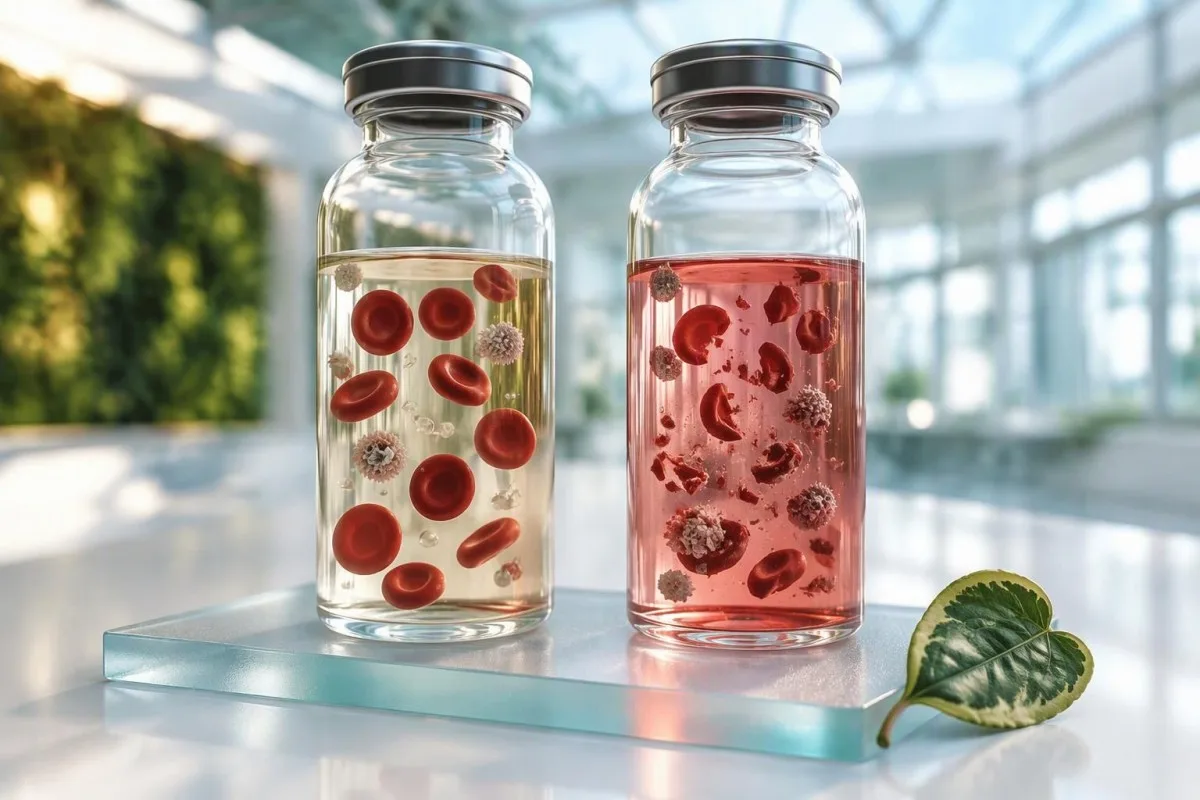
A high hemolysis index usually describes damage to cells after collection, not a diagnosis in you. The useful question is which reported results remain trustworthy and which need repeating.


- High hemolysis index means the analyzer detected free hemoglobin in serum or plasma, usually from cell breakage during collection or transport.
- Potassium is particularly vulnerable because red cellular elements contain roughly 100–120 mmol/L of potassium versus a plasma range of 3.5–5.0 mmol/L.
- LDH ug AST can rise markedly in a hemolyzed specimen; an isolated unexpected elevation should not be labelled liver or muscle disease before repeat testing.
- Analyzer thresholds are method-specific: a hemolysis index of 100 on one analyzer is not a universal measure of severity or a diagnosis of hemolytic anemia.
- Redraw decisions depend on the individual assay, the degree of interference, and clinical urgency—not on the sample’s appearance alone.
- Urgent potassium decisions require rapid confirmation by a non-hemolyzed plasma sample, whole-blood blood-gas measurement, or ECG when the result is high.
- In-vivo hemolysis causes a clinical pattern such as anemia, reticulocytosis, low haptoglobin and raised indirect bilirubin; a high index alone cannot establish it.
- As of September 27, 2026, patients should ask whether the lab suppressed, qualified, or analytically corrected each affected result before acting on it.
What a High Hemolysis Index Actually Measures
A high hemolysis index means an analyzer detected excess free hemoglobin in the liquid portion of a laboratory sample. In most outpatient draws, this reflects cellular breakage after collection rather than red-cell destruction occurring inside the body.
The index is commonly generated by spectrophotometry: the analyzer measures absorbance at wavelengths where hemoglobin absorbs light, then applies assay-specific interference rules. A pink to red serum sample may have an index flagged as 50, 100, or 300, but those numbers are not standardized across manufacturers. The pamaagi sa balidasyon sa medisina we use treats the laboratory’s own comment and assay flags as the primary evidence.
A difficult collection, a tube shaken too vigorously, delayed separation from cells, extreme temperature, or transport through a pneumatic tube can all create a hemolyzed blood sample. In my clinical work, the commonest culprit is not the patient’s veins; it is a technically challenging draw combined with a very small collection device or forceful transfer. Even a sample that looks normal to the eye can have enough free hemoglobin to affect a sensitive assay.
Si Kantesti usa ka AI blood test analyzer that reads a hemolysis comment as a specimen-quality signal, not as proof of a disease. Dr. Thomas Klein’s practical rule is simple: interpret the affected analyte only after checking whether the laboratory marked it as unreliable, suppressed it, or released it with a warning.
Why the color matters but does not decide the case
Visible pink serum often corresponds to substantial free hemoglobin, yet visual inspection misses mild hemolysis and is subjective. Modern indices are more consistent than visual grading, but their clinical meaning still varies by analyzer, reagent, and test method.
Sample Hemolysis Versus Hemolysis Happening in the Body
A high index alone usually indicates in-vitro hemolysis, meaning cellular damage occurred in the tube or during handling. In-vivo hemolysis is a medical process that requires corroborating symptoms, CBC findings, and targeted blood tests.
In-vivo hemolysis often produces a coherent pattern: falling hemoglobin, reticulocytosis, indirect bilirubin elevation, increased LDH, and low haptoglobin. Dark urine, jaundice, fatigue, or back pain may occur, although chronic mild hemolysis can be quiet. A single high hemolysis index with an otherwise stable CBC is far more often pre-analytical than clinical.
This distinction matters because a hemolyzed sample can falsely imitate the very pattern used to diagnose hemolysis—especially raised potassium, LDH, AST, and phosphate. Lippi et al. described hemolysis as the leading cause of unsuitable specimens in clinical laboratories, precisely because intracellular contents spill into the sample and spectral interference affects photometric methods (Lippi et al., 2008).
If anemia or jaundice is genuinely present, clinicians may repeat the sample and add reticulocytes, bilirubin fractions, haptoglobin, and a reticulocyte interpretation rather than relying on the index. Kantesti’s AI lab test interpretation service compares these linked results and flags when the pattern deserves clinician review rather than a routine redraw.
A useful clue from timing
True hemolysis persists across carefully collected samples; collection-related hemolysis usually disappears on repeat testing. That contrast is often more informative than one isolated laboratory flag.
Which Blood Test Results Change Most With Hemolysis
Hemolysis most often creates falsely high potassium, LDH, AST, phosphate, magnesium, iron, and sometimes total protein results. The magnitude is assay-dependent, so a laboratory’s interference comment outweighs any universal correction formula.
Potassium is the safety-critical example. Red cellular elements contain approximately 100–120 mmol/L potassium, while normal plasma potassium is 3.5–5.0 mmol/L; even modest cellular leakage can push a normal result above 5.5 mmol/L. A reported potassium of 6.2 mmol/L with a high hemolysis index may be pseudohyperkalemia, but it still needs rapid clinical triage if symptoms, kidney disease, ECG changes, or potassium-raising medicines are present.
LDH is highly concentrated within cellular elements, and AST is also more abundant inside them than in serum. In a 52-year-old runner with AST 89 IU/L, a hemolysis warning plus normal ALT and CK changes my first step from diagnosing liver disease to repeating the panel. See our practical guide to high AST results for the non-hemolysis causes that remain relevant.
Phosphate, magnesium, and iron may rise because they are released from disrupted cells; bilirubin and some enzyme assays can be biased in either direction by optical interference. This is why a numerical result may be released but not clinically usable. A pagpatin-aw sa liver panel helps separate a real enzyme pattern from one compromised result.
Tests that can be falsely lower
Hemoglobin absorbance can produce negative interference in some colorimetric or enzymatic assays, including selected lipase, alkaline phosphatase, and bilirubin methods. There is no safe assumption that hemolysis only makes values high.
High Potassium With Hemolysis: When Is It Urgent?
A potassium result of 6.0 mmol/L or higher with a hemolysis flag should be confirmed promptly, but it must not be dismissed automatically. Immediate assessment is appropriate when potassium is 6.5 mmol/L or higher, an ECG is abnormal, or weakness, palpitations, chest symptoms, or significant kidney impairment are present.
Pseudohyperkalemia is common when cellular elements rupture during collection, but genuine hyperkalemia can coexist with a difficult draw. A fresh lithium-heparin plasma specimen, carefully collected whole-blood analysis, and ECG are common confirmation routes. Do not try to lower potassium through diet or supplements before speaking with the clinician who ordered the test; that could delay necessary care.
The risk rises when a patient has eGFR below 30 mL/min/1.73 m², takes an ACE inhibitor, ARB, spironolactone, trimethoprim, or potassium supplement, or has metabolic acidosis. In those settings, a result of 5.8 mmol/L deserves more attention than the same result in a well person with normal renal function and an obviously compromised tube. Our detailed giya sa sayop nga pagkuha sa potassium explains this decision point.
A clenched fist during collection can raise potassium slightly even without visible sample hemolysis, while prolonged tourniquet use adds another source of pre-analytical variation. The thing is, neither detail can prove the result is false. Repeat testing is the safe answer when the number could alter urgent treatment.
Symptoms that override the laboratory caveat
Severe muscle weakness, fainting, new palpitations, chest discomfort, or shortness of breath need urgent assessment regardless of a hemolysis comment. Laboratory uncertainty should never be used to explain away concerning symptoms.
LDH, AST and CK: Reading Enzymes in a Hemolyzed Sample
LDH and AST are among the least reliable results in a markedly hemolyzed specimen because both are released from disrupted cellular elements. CK is often less directly affected by red-cell leakage but can still be analytically affected depending on the laboratory method.
An isolated LDH elevation should not trigger a cancer, liver, or hemolytic-anemia work-up until specimen quality is addressed. LDH has five isoenzymes and is found in many tissues, so even a pristine high value is nonspecific. Our explanation of LDH test meaning shows why trends and companion tests matter more than a single result.
AST can rise after strenuous exercise, alcohol exposure, muscle injury, or liver injury, while ALT is more liver-focused. When AST is 90 IU/L but ALT is 22 IU/L and the sample is hemolyzed, repeating AST, ALT, CK, and bilirubin after 48–72 hours without unusual exercise often clarifies the picture. This timing is clinical convention, not a hard evidence-based rule for every patient.
Kantesti AI uses pattern logic: AST plus LDH plus a hemolysis flag is labelled potentially compromised, whereas AST plus ALT plus bilirubin elevation in a clean sample carries different weight. That distinction prevents false alarms while preserving follow-up for genuine liver or muscle disease.
Why an AST:ALT ratio may be unusable
A hemolyzed AST value can artificially inflate the AST:ALT ratio, making it unsuitable for alcohol-related liver pattern interpretation or fibrosis scores. Repeat the panel before calculating ratios that may influence a referral.
Which Results May Still Be Usable After Hemolysis?
Many results can remain usable despite a hemolyzed sample if the hemolysis level is below that assay’s validated interference limit. Sodium, chloride, urea, creatinine, glucose, and many immunoassays are often less affected, but “often” is not a guarantee.
Laboratories validate each test by measuring bias at increasing free-hemoglobin concentrations, then set suppression or comment thresholds. A sodium result may be reliable in a moderately hemolyzed specimen while potassium from the same tube is not. This analyte-by-analyte decision is why a blanket request to repeat an entire panel can be unnecessary.
Cardiac troponin, thyroid hormones, vitamin B12, and ferritin have assay-specific susceptibility to hemoglobin interference; no result should be assumed valid or invalid solely from the test name. If chest pain is present, troponin testing follows urgent clinical pathways regardless of a specimen flag. Read our guide to troponin result differences for why assay identity matters.
A laboratory may release a result with an HIL comment, suppress it entirely, or report that interference is not significant at the measured index. Kantesti’s neural network preserves that distinction when extracting PDF reports rather than treating every number as equally precise. The Kantesti AI benchmark describes technical evaluation of this report-reading workflow.
The serum-versus-plasma detail
Serum waits for clotting before separation, whereas plasma is separated from anticoagulated whole blood. Delay before separation can increase contact between cells and liquid, but both specimen types can hemolyze during collection or transport.
Why Hemolysis Index Cutoffs Differ Between Laboratories
There is no universal normal range for a hemolysis index because instruments, wavelengths, sample types, and assay reagents differ. A value of 150 may be a minor flag in one laboratory and a rejection threshold in another.
The HIL system—hemolysis, icterus, and lipemia indices—usually estimates optical interference before selected chemistry assays run. It is not the same as plasma free hemoglobin measured for suspected intravascular hemolysis, which may be reported in mg/dL. Confusing these two measures is a surprisingly common source of unnecessary worry.
Laboratories choose action limits based on acceptable analytical bias, frequently aligned with a change no greater than 10% or a fraction of biological variation. Yet a 10% error is trivial for one test and consequential for potassium near 6.0 mmol/L. Clinicians disagree on the most practical cutoff because the correct threshold depends on what decision the result will drive.
Si Kantesti usa ka AI pagsabot sa resulta sa blood test platform that displays the exact printed laboratory flag and reference context instead of translating an index into a made-up universal severity grade. Readers comparing reports from different countries can use our 15,000-marker guide to check units and assay names before comparing trends.
Why you should not compare index values over time
A hemolysis index of 80 in one laboratory and 80 in another may not represent the same free-hemoglobin concentration. Compare clinical analytes across laboratories cautiously unless the assay method and specimen handling are consistent.
When a Redraw Is Needed—and When It Is Not
A redraw is usually needed when hemolysis could change a result that guides an urgent or major clinical decision. It may not be needed when the laboratory confirms negligible interference for the released tests and the result fits the clinical picture.
Redraw promptly for a high potassium, unexpectedly high LDH or AST, discrepant phosphate or magnesium, or any result the laboratory has withheld. Repeat testing also makes sense when a result conflicts sharply with a prior baseline—such as creatinine 0.8 to 2.1 mg/dL without illness, dehydration, or medication change. A delta-check explanation can help frame that conversation.
A repeat may be unnecessary for a stable HbA1c, TSH, or creatinine when the lab has explicitly released it without an interference warning. Still, repeat if the number would trigger a medication change, imaging, or referral. In my experience, patients are reassured by asking one specific question: “Which individual results did the lab consider affected?”
Do not assume fasting fixes hemolysis. Better prevention is a relaxed collection, appropriate tube filling, gentle inversions rather than shaking, rapid transport, and timely centrifugation. Our repeat-test guide after hemolysis gives patients a practical checklist.
Hospital and emergency settings
In emergency care, clinicians may use a rapid whole-blood result while simultaneously sending a carefully collected confirmatory specimen. Treatment decisions are based on symptoms, ECG findings, kidney function, and repeat values—not the hemolysis index alone.
Why Blood Samples Hemolyze During Collection and Transport
Most hemolyzed blood samples arise from mechanical stress, delayed processing, or temperature extremes rather than any fault in the patient. Prevention begins before the tube reaches the analyzer.
Drawing through an undersized device, pulling too forcefully with a vacuum device, forcing a sample through a connector, or vigorous shaking can damage cellular elements. Underfilling additive tubes creates a wrong blood-to-additive ratio, which can introduce separate errors even if hemolysis is absent. The details sound fussy, but they change real results.
Transportation matters after collection. Extended heat exposure, freezing, rough transit, and a long delay before separating serum or plasma can increase hemolysis. Samples from lines can also be misleading if collection follows infusion or if technique is difficult; a clean peripheral collection may be preferable when the result is pivotal.
Patients can help by arriving hydrated unless fluid restriction applies, keeping their arm warm, and avoiding repeated fist pumping. None of these steps guarantees a clean sample, particularly in fragile veins. A baseline draw preparation guide covers preparation without turning routine testing into an ordeal.
Exercise is a separate issue
A hard workout can genuinely raise CK, AST, and creatinine for 24–72 hours even when the specimen is pristine. Exercise may coexist with collection hemolysis, so a repeat result should ideally follow an ordinary rest day when medically appropriate.
What the CBC and Blood Smear Can Tell You
A complete blood count can help distinguish a poor specimen from possible true hemolysis, but it cannot do so by itself. Falling hemoglobin, rising reticulocytes, and smear changes carry more diagnostic weight than the chemistry hemolysis index.
A true hemolytic process commonly causes reticulocytosis as marrow responds to shortened red-cell survival, although this response may be absent with iron deficiency, marrow disease, or very early onset. A reticulocyte count above the laboratory’s upper limit—often roughly 2.0%—must be converted to an absolute count and interpreted alongside hemoglobin. Percentage alone can mislead in anemia.
A peripheral cell sample slide may show schistocytes, spherocytes, bite cells, or polychromasia depending on cause. Schistocytes at 1% or more on a standardized review can support thrombotic microangiopathy in the right setting, but this is a specialist interpretation and urgent symptoms matter. Our guide to makadiskubre nga urgent nga schistocyte findings explains why this is not a home diagnosis.
Dr. Thomas Klein advises looking for internal consistency: high LDH plus low haptoglobin plus anemia on a clean repeat sample is meaningful; high LDH alone in a hemolyzed tube is not. The hematocrit and hemoglobin comparison is useful when CBC values seem contradictory.
A falsely high MCHC can be a clue
Markedly high MCHC can occur with sample hemolysis, lipemia, cold agglutinins, or spherocytosis. It should prompt laboratory review rather than an immediate conclusion about red-cell disease.
Special Situations: Children, Pregnancy and Difficult Access
Hemolysis is more common when collection is technically difficult, including neonatal, pediatric, emergency, and critical-care testing. The consequences may also be greater because small electrolyte shifts can affect urgent decisions.
In newborns and young children, capillary collection and low sample volumes can increase cellular disruption, while potassium reference intervals differ by age. A potassium value that is high for an adult may be less abnormal in a newborn, yet any suspected hyperkalemia still requires prompt clinician-led confirmation. Never apply adult cutoffs to a child’s report without the laboratory’s pediatric range.
Pregnancy adds another layer: anemia is common from dilution or iron deficiency, while HELLP syndrome and other obstetric emergencies can involve real hemolysis. New headache, visual symptoms, right-upper abdominal pain, high blood pressure, or reduced fetal movement need urgent maternity assessment—not an assumption that the tube was damaged. Our HELLP laboratory pattern guide details the red flags.
For people with dialysis access, implanted lines, burns, or very difficult peripheral access, a higher rate of unsuitable samples may be unavoidable. The care team can often arrange an approach that minimizes redraws, but the test’s clinical urgency determines whether another sample is required.
Home collection kits
Finger-prick samples are not interchangeable with venous samples for every analyte, and inadequate handling can create interference. Follow kit-specific instructions and ask the provider whether a venous redraw is needed after a high hemolysis flag.
How to Read a Hemolysis Comment on Your Lab Report
A lab report may say “hemolyzed,” “hemolysis index elevated,” “interference possible,” or “result not reported.” These phrases have different implications: a suppressed result is unusable, while a released result may remain valid if interference is below the assay’s limit.
Look for a comment attached to the individual analyte, not merely a general specimen note. For example, potassium may say “not reported due to hemolysis,” while creatinine is reported without qualification. This reflects the laboratory’s validation work and is more useful than judging the tube’s color from a photograph.
If a number is marked with an H for high and also a hemolysis caveat, it can be both analytically elevated and clinically uncertain. Ask the ordering clinician whether the result fits your medications, symptoms, earlier values, and other tests. Our guide to out-of-range flags explains why a flag is a prompt for context, not a diagnosis.
Kantesti AI can organize a photographed or PDF report in about 60 seconds, but it cannot inspect the physical specimen or replace a laboratory’s interference decision. Our giya sa teknolohiya explains how we preserve qualifiers, units, and reference intervals for clinician discussion.
A question worth writing down
Ask: “Was this specific test suppressed, corrected, or released as valid despite the hemolysis index?” That single question usually gets a clearer answer than asking whether the whole panel was “bad.”
What Not to Do After a Hemolyzed Result
Do not self-treat a possibly false result, ignore a potentially dangerous one, or assume every result in the panel is invalid. The right response is targeted confirmation based on the analyte and your clinical context.
Do not stop prescribed ACE inhibitors, diuretics, thyroid medicine, or supplements solely because one hemolyzed sample was abnormal. Potassium, thyroid, and kidney results must be interpreted against the medication list and a repeat value where needed. Sudden medication changes can be riskier than waiting a few hours for confirmation.
Avoid searching for a diagnosis from a high LDH or AST result before checking sample quality. Serious disease can cause these elevations, of course, but an unreliable first sample does not justify a frightening conclusion. For muscle-specific concerns, our high CK safety guide sets out symptoms that do need prompt care.
Likewise, do not repeatedly redraw yourself through commercial testing without sharing the original report with a clinician. Recurrent hemolysis may be a collection issue, but recurrent abnormal results in properly handled samples deserve a structured evaluation.
When to seek same-day help
Seek urgent advice for high potassium with weakness or palpitations, jaundice with dark urine, severe fatigue with breathlessness, chest pain, fainting, or rapidly worsening symptoms. A specimen-quality note cannot lower the urgency of these clinical signs.
How to Compare Results Safely After a Repeat Draw
A clean repeat sample is most useful when collected under comparable conditions and interpreted as a trend, not as a verdict on the first result. A large change after a hemolyzed draw often identifies interference, but biological variation still exists.
Record the draw date, fasting status, exercise in the previous 48 hours, illness, supplements, and medications. Creatinine can shift with hydration and exercise; AST and CK can shift after training; potassium may shift with kidney function and medicines. These ordinary variables matter even when the second sample has no hemolysis flag.
For potassium, a change from 6.1 mmol/L in a hemolyzed sample to 4.3 mmol/L in a clean sample strongly supports pseudohyperkalemia. For AST, a decline from 88 to 29 IU/L may reflect removal of interference, recovery after exercise, or both; timing and ALT help adjudicate. Our giya sa pagbag-o sa blood test explains reference change value more fully.
Si Kantesti usa ka AI-powered blood test analysis tool that can place repeat values beside prior results while retaining specimen-quality comments. Trend displays are useful, but they must never obscure a redrawn critical result that needs immediate clinician action.
Hupti ang orihinal nga report
Save the first report, including the hemolysis comment, rather than deleting it after the repeat. It documents why a value changed and prevents future clinicians from mistaking a collection artifact for sudden disease resolution.
Questions to Ask Your Clinician or Laboratory
The best question after a high hemolysis index is not “Do I have hemolysis?” but “Which analytes were affected, how urgently should they be repeated, and what symptoms would change the plan?” A short, specific discussion avoids both false reassurance and unnecessary alarm.
Ask whether the abnormal value was suppressed, whether the lab has a validated interference threshold for that method, and whether a fresh plasma or whole-blood sample is preferable. For potassium, ask whether an ECG or same-day repeat is needed. For enzyme results, ask whether exercise, alcohol, infection, or medicines may also be contributing.
Ask whether you need a full panel or only selected tests repeated. A targeted redraw often includes potassium, AST, LDH, phosphate, magnesium, or bilirubin, whereas a CBC or HbA1c may not need repeating. This can reduce cost, discomfort, and confusing duplicate results without compromising care.
Ang among mga doktor sa Lupon sa Medikal nga Magtatambag review clinical-safety principles used in Kantesti content, but personal treatment decisions belong with the clinician who knows your history and can assess you. Most patients find that a precise repeat plan is far calmer than trying to interpret a colored sample image online.
Sa katapusan
A high hemolysis index is usually a laboratory-quality warning, not a diagnosis. Respect the warning, identify the affected tests, and repeat only what could change clinical decisions.
How Kantesti Handles Hemolysis Flags in Blood Reports
Kantesti identifies hemolysis flags and links them to the results most likely to be affected, but it does not replace laboratory validation or urgent clinical assessment. A flagged potassium, troponin, or critical electrolyte result always needs the laboratory and treating team’s protocol.
Kantesti AI reads the test name, value, unit, reference interval, collection context, and printed laboratory comments together. That matters because “high potassium” without the accompanying hemolysis statement is an incomplete clinical fact. Our system is designed to surface uncertainty plainly rather than conceal it behind a confident-looking score.
Si Kantesti usa ka plataporma sa paghubad sa AI biomarker used across 127+ countries, so it also avoids assuming that identical labels or index values mean identical methods. Different laboratories may use serum, plasma, direct or indirect assays, and different interference thresholds. International reports need the source laboratory’s own interpretive note preserved.
As of September 27, 2026, our safety approach is to encourage a clinician discussion for results that are critical, internally inconsistent, newly abnormal, or clearly compromised by blood test hemolysis. If you want to understand how health data are handled, our Panid Bahin Kanato describes the organization and its privacy-focused approach.
The limit of any report interpretation
No report-reading system can know whether you have palpitations, jaundice, dehydration, or a new medication unless you provide that context to a clinician. The specimen flag is one piece of evidence, not a substitute for examination or urgent care.
Kanunay nga Gipangutana nga mga Pangutana
Unsay gipasabut sa taas nga hemolysis index sa blood test?
Ang taas nga hemolysis index nagpasabot nga ang laboratory analyzer nakamatikod ug libreng hemoglobin gikan sa pagkabungkag nga red cellular elements sa serum o plasma. Kadaghanan sa mga kaso motumaw panahon sa pagkolekta, transportasyon, o pagproseso kaysa gikan sa medikal nga kondisyon sa pasyente. Ang index makahimo sa potassium, LDH, AST, phosphate, magnesium, ug iron results nga dili kasaligan, apan ang epekto nagdepende sa assay. Ang hemolysis index dili usa ka diagnostic test alang sa hemolytic anemia.
Makahatag ba ang taas nga hemolysis index og taas nga potassium?
Oo, ang taas nga hemolysis index mahimong hinungdan sa pseudohyperkalemia kay ang mga elemento sa pula nga selula adunay mga 100–120 mmol/L nga potassium samtang ang normal nga plasma potassium kay 3.5–5.0 mmol/L. Bisan ang gamay nga pagkabungkag sa selula mahimong sayop nga makapataas sa nasukod nga potassium labaw sa 5.5 mmol/L. Ang resulta sa potassium nga 6.0 mmol/L o mas taas kinahanglan nga kumpirmahon dayon, ilabi na sa sakit sa kidney, mga tambal nga makapataas sa potassium, kaluya, o palpitations. Mahimong gikinahanglan ang usa ka ECG ug usa ka maampingon nga gikolekta nga balik-balik nga sample.
Kinahanglan ba nako balikon ang tanan nga blood tests human sa usa ka hemolyzed sample?
Dili, ang usa ka sample nga hemolyzed dili awtomatikong mawala ang tanan nga pagsulay sa dugo. Ang mga laboratoryo nagtimbang-timbang sa interference sa lainlaing paagi alang sa matag assay, ug ang sodium, chloride, creatinine, glucose, ug pipila ka immunoassays mahimong magamit gihapon sa usa ka lebel sa hemolysis. Balika ang mga pagsulay nga gipugngan, gitakda, o nga magbag-o sa usa ka dinalian nga desisyon, sama sa potassium o wala damha nga taas nga LDH ug AST. Pangutan-a kung unsang mga piho nga analytes ang naapektuhan sa wala pa pag-andam ang usa ka bug-os nga panel redraw.
Can a hemolyzed sample mean I have hemolytic anemia?
A hemolyzed sample does not by itself mean you have hemolytic anemia. Hemolytic anemia is supported by a pattern that may include falling hemoglobin, high reticulocytes, elevated indirect bilirubin and LDH, plus low haptoglobin on a carefully collected sample. Symptoms such as jaundice, dark urine, breathlessness, or marked fatigue increase concern, but some patients have mild symptoms. A repeat clean sample is usually the first way to separate collection-related hemolysis from true red-cell destruction.
How long should I wait before repeating blood work after hemolysis?
A repeat can often be performed the same day when potassium, a critical electrolyte, troponin, or another urgent result is involved. For non-urgent AST, CK, or LDH abnormalities after strenuous activity, clinicians sometimes repeat after 48–72 hours of avoiding unusual exercise because exercise itself can raise these enzymes. There is no universal waiting period for a high hemolysis index; the relevant test and the reason for testing determine timing. The laboratory or ordering clinician should give the specific plan.
Can dehydration cause a high hemolysis index?
Dehydration does not directly cause a high hemolysis index, but it can make collection more difficult and may increase the chance of a technically challenging draw. Heat exposure or poor storage after collection can also damage cellular elements and raise the index. Hydration may help vein access for people who are not fluid-restricted, but it cannot correct a hemolyzed specimen after it has been collected. A fresh properly handled sample is the appropriate confirmation.
Karon na ang AI-Powered Blood Test Analysis
Apil sa kapin sa 2 milyon nga mga user sa tibuok kalibutan nga nagsalig sa Kantesti para sa dayon ug tukma nga pag-analisa sa lab test. I-upload ang imong resulta sa blood test ug makadawat og komprehensibong pagsabot sa 15,000+ nga mga biomarker sulod sa mga segundo.
📚 Mga Napangalan nga Research Publications
Klein, T., Mitchell, S., & Weber, H. (2026). Klein, T. (2026). A Pre-Registered, Rubric-Based Automated Technical Benchmark of the Kantesti Blood-Test Interpretation Engine on 100,000 Synthetic Test Cases. Figshare. https://doi.org/10.6084/m9.figshare.32095435. Kantesti AI Medical Research.
Klein, T., Mitchell, S., & Weber, H. (2026). Kantesti LTD. (2026). Balangkas sa Balidasyon sa Klinikal v2.0 (Pahina sa Balidasyon sa Medikal). Zenodo. https://doi.org/10.5281/zenodo.17993721. Kantesti AI Medical Research.
📖 Mga Panlabas nga Sanggunian sa Medisina
⚕️ Pagpasabot sa Medikal
Kini nga artikulo para sa katuyoan sa edukasyon ra ug dili kini mosangpot sa medikal nga tambag. Kanunay mokonsulta sa usa ka kwalipikado nga healthcare provider alang sa mga desisyon sa diagnosis ug pagtambal.
Mga E-E-A-T Trust Signals
Kasinatian
Pagsusi sa klinika nga gipangulohan sa doktor sa mga workflow sa interpretasyon sa lab.
Kahanas
Pokus sa medisina sa laboratoryo kung giunsa paglihok ang mga biomarker sa konteksto sa klinika.
Pagka-awtorisado
Gisulat ni Dr. Thomas Klein ug gisusi ni Dr. Sarah Mitchell ug Prof. Dr. Hans Weber.
Kasaligan
Interpretasyon nga base sa ebidensya, nga adunay klaro nga mga agianan sa sunod nga buhat aron makunhuran ang kabalaka.