Patients often ask for a full blood panel when they really mean chemistry testing. Here is what a blood chemistry panel can clarify quickly, and the very real things it can still miss.


- BMP usually contains 8 core chemistry tests; CMP usually contains 14 by adding liver and protein markers.
- Sodium normal range is commonly 135-145 mmol/L. Levels below 125 mmol/L often need same-day clinical review.
- Potassium normal range is usually 3.5-5.0 mmol/L. Levels above 6.0 mmol/L can be urgent, especially with weakness or palpitations.
- Fasting glucose of 70-99 mg/dL is generally normal, 100-125 mg/dL suggests prediabetes, and 126 mg/dL or higher on repeat testing supports diabetes.
- Creatinine can look normal while eGFR is reduced in older adults or people with low muscle mass.
- ALT and AST are not interchangeable; an AST 89 U/L with ALT 31 U/L after hard exercise often points to muscle stress, not liver failure.
- Blood chemistry panel helps with dehydration, electrolyte shifts, glucose problems, kidney stress, and liver-bile patterns.
- What it misses includes anemia, infection cell patterns, thyroid disease, iron deficiency, B12 deficiency, many cancers, and most cardiac injury.
- Normal chemistry results do not rule out clotting disorders, pancreatitis, autoimmune disease, or early fatty liver.
- Trend analysis over 6-12 months is often more clinically useful than one normal-looking panel.
What a blood chemistry panel usually includes—and what the name actually means
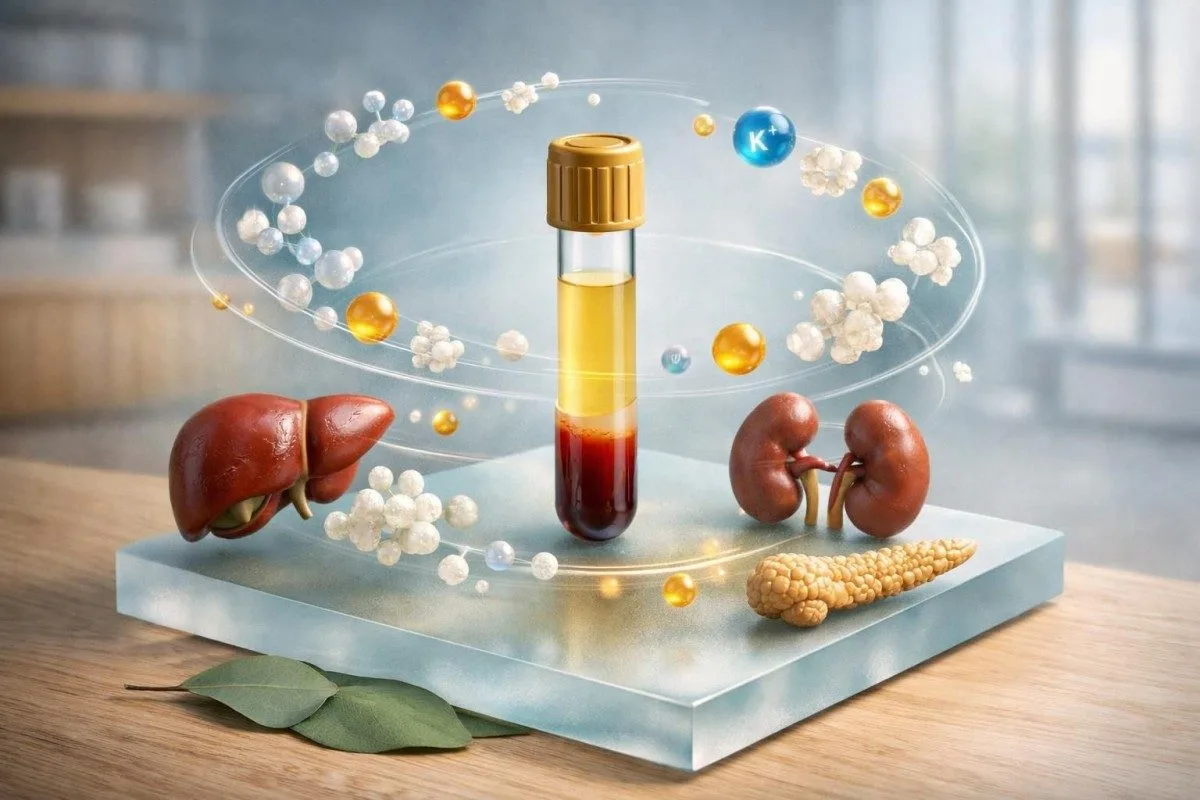
A blood chemistry panel is a group of serum tests that usually checks glucose, electrolytes, kidney markers such as BUN and creatinine, and often liver-related markers such as ALT, AST, bilirubin, and albumin. It is not a CBC, which counts cells; a BMP is the smaller 8-test chemistry version, while a CMP is the common 14-test expansion. The panel can help evaluate dehydration, diabetes clues, kidney stress, liver injury, and electrolyte problems, and we interpret these patterns daily on Kantesti AI after patients first read our standard blood test overview.
Here is the part most websites skip: the phrase itself is not standardized. One lab's chemistry panel is essentially a BMP or CMP order, while another adds magnesium, phosphorus, or uric acid; as of April 19, 2026, I still see international portals translate several different serum bundles into the same English phrase, which is why patients think they had the same test when they did not.
A chemistry panel measures dissolved substances in serum; a CBC differential measures cells. I have seen many people with profound fatigue and a normal chemistry panel whose actual problem was iron deficiency, B12 deficiency, or a low hemoglobin pattern that never appears on chemistry at all.
The label full blood panel sounds complete, but it usually is not. Thomas Klein, MD, my rule of thumb is simple: if the question is about cells, hormones, iron, clotting, or heart damage, a chemistry panel alone is the wrong starting point.
Why labs use the same name for different bundles
Hospitals often name panel orders based on instrument workflow rather than patient-facing clarity. That means a comprehensive blood panel on one portal may equal a CMP only, while on another it quietly includes lipids or HbA1c—context that changes interpretation before you even look at the numbers.
Which markers are usually on a blood chemistry panel
Most chemistry panels include sodium, potassium, chloride, CO2/bicarbonate, glucose, calcium, BUN, and creatinine; a CMP usually adds albumin, total protein, bilirubin, ALT, AST, and alkaline phosphatase. Adult reference intervals vary by lab, but the common anchors are reliable enough to recognize danger.
Sodium is usually 135-145 mmol/L, potassium 3.5-5.0 mmol/L, chloride 98-106 mmol/L, and CO2 22-29 mmol/L. A potassium level above 5.5 mmol/L deserves attention, while above 6.0 mmol/L can be urgent—our electrolyte panel guide goes deeper into why the ECG matters more than the isolated number.
BUN is commonly 7-20 mg/dL, albumin 3.5-5.0 g/dL, total bilirubin 0.2-1.2 mg/dL, AST about 10-40 U/L, and ALP roughly 44-147 U/L. Some European labs use lower healthy ALT upper limits than many US reports, so Kantesti AI checks the printed range against our medical validation standards; if the enzyme-heavy side of the panel is your main concern, start with our liver function test guide.
Fasting glucose of 70-99 mg/dL is generally normal, 100-125 mg/dL fits prediabetes, and 126 mg/dL or higher on repeat testing supports diabetes. A random glucose of 200 mg/dL or higher with classic symptoms is also diagnostic, but I still like pairing it with A1c context because steroids, acute illness, and sleep loss can distort the picture.
A lab nuance most people miss
Hemolysis can falsely raise potassium and AST because intracellular contents leak into the sample after collection. Lipemia can distort some photometric assays, and dehydration can make albumin and total protein look better than they really are.
Symptoms a blood chemistry panel can actually help evaluate
A blood chemistry panel is most helpful when symptoms suggest a problem with fluids, salts, sugar metabolism, kidneys, or bile flow. It can clarify dizziness, vomiting, excessive thirst, muscle cramps, confusion, edema, itching, or dark urine, but it usually narrows the differential rather than naming the disease.
After 24 hours of vomiting or diarrhea, I care about sodium, potassium, chloride, and CO2 more than almost anything else. When those numbers are off, the chemistry panel can explain lightheadedness, cramps, weakness, or confusion quickly, and a bicarbonate level below 22 mmol/L often tells me the fluid loss has become metabolically important rather than just inconvenient.
Swelling is another classic example. Low albumin can accompany liver disease, kidney protein loss, gut protein loss, or severe inflammation—so a result of 2.8 g/dL is a clue, not a verdict, and most patients are surprised to learn that low albumin does not automatically mean cirrhosis.
With thirst, frequent urination, blurry vision, or unexplained weight loss, glucose on the chemistry panel may be the first abnormality. In our review of more than 2 million uploaded reports, Kantesti AI repeatedly sees mildly high glucose dismissed as stress when the better move was follow-up diabetes testing; liver-dominant symptoms such as itching, dark urine, or pale stools often need the pattern workup in our elevated liver enzymes guide.
What a blood chemistry panel often misses—even when results are normal
A normal blood chemistry panel does not rule out anemia, infection cell patterns, thyroid disease, iron deficiency, B12 deficiency, clotting problems, most cancers, or many autoimmune disorders. This is the blind spot that frustrates patients who were told their standard blood test was normal even though the right tests were never ordered.
Chest pain is the cleanest example. A patient can have an ordinary chemistry panel and still have a positive troponin test or an abnormal ECG, because heart muscle injury is not measured by sodium or albumin; the same logic applies to many infections, where cell counts and cultures tell the story earlier than chemistry.
Fatigue, hair loss, mouth soreness, numb feet, and restless legs frequently come from iron or vitamin deficiencies with chemistry values still sitting in range. I see this pattern weekly, and I usually add a vitamin B12 workup before I accept a normal chemistry panel as reassuring; ferritin and thyroid testing are often the next step if symptoms persist.
And some diagnoses live almost entirely outside chemistry. If the history suggests rash, joint swelling, chronic diarrhea, or recurrent fevers, I pivot to an autoimmune panel because the chemistry panel can be bland while the real disease is active.
Blood chemistry panel vs CBC, BMP, and CMP: the clean comparison
The clean comparison is simple: a CBC counts cells, a BMP measures 8 core chemistries, and a CMP adds 6 more liver-protein markers for a typical total of 14. The phrase blood chemistry panel is an umbrella term, not a tightly regulated order name, which is why full blood panel and comprehensive blood panel often mean different things at different labs.
A BMP usually includes sodium, potassium, chloride, CO2, glucose, calcium, BUN, and creatinine. A CMP usually means the BMP plus albumin, total protein, bilirubin, ALP, ALT, and AST, which is enough to screen broadly for fluid balance, kidney stress, and several liver-bile patterns in one draw.
What patients call a full blood panel often includes extra modules such as lipids, A1c, thyroid, or iron studies, but there is no universal definition. That matters because cholesterol risk is a separate question—the 2018 AHA/ACC guideline still treats LDL-C and apoB as dedicated targets, not chemistry substitutes (Grundy et al., 2019), so a normal chemistry panel tells you little about plaque risk and you still need a lipid panel interpretation.
As of April 19, 2026, I still see lab portals label a CMP as chemistry and patients assume everything was checked. In practice, the safest habit is to look for the actual analyte names rather than trusting the bundle title.
One memory trick
Think cells, salts, and extras. CBC equals cells; BMP equals salts, sugar, and kidney basics; CMP equals BMP plus liver and protein extras. If cholesterol, thyroid, iron, or inflammation matters, assume it was not included unless you can see the result line.
Fasting, hydration, exercise, and medications that skew chemistry results
Fasting, hydration, recent exercise, and medications can change a blood chemistry panel by enough to flip a result from normal to abnormal. The common distortions are a higher BUN from dehydration, a falsely high potassium from sample handling, and transient AST or creatinine bumps after hard exercise.
For glucose, an 8-12 hour fast is often preferred unless your clinician wants a random value. Water is usually fine and often helpful, because dehydration can concentrate albumin, calcium, and BUN; if you are unsure about instructions, use our fasting rules guide.
I see this pattern in athletes all the time: a 52-year-old marathon runner shows AST 89 U/L, ALT 31 U/L, and creatinine 1.38 mg/dL the morning after a race. That pattern is much more compatible with muscle breakdown and relative dehydration than hepatitis, which is why our athlete blood test guide tells people not to test the morning after maximal effort.
Medicines matter too. ACE inhibitors, ARBs, spironolactone, and trimethoprim can raise potassium; thiazides can lower sodium; statins, antiepileptics, and even heavy acetaminophen use can nudge liver enzymes, and fist clenching during sample collection can make potassium look high when the patient is actually fine.
Why clinicians read chemistry patterns, not isolated numbers
Clinicians read chemistry patterns because combinations outperform isolated numbers. High BUN with stable creatinine suggests a different problem than both rising together, and high ALP plus bilirubin raises a different concern than a lone ALT bump.
A BUN/creatinine ratio above about 20:1 often points toward dehydration, reduced kidney perfusion, corticosteroid effect, or upper GI bleeding, while a low ratio can show up with low protein intake or advanced liver disease. I rarely interpret that pair without context, and our BUN/creatinine ratio guide explains why the ratio is useful but never diagnostic by itself.
Liver patterns are even more contextual. ALT and AST are hepatocellular markers, whereas ALP, GGT, and bilirubin lean more cholestatic; the ACG guideline by Kwo et al. emphasizes pattern-based evaluation rather than enzyme panic over a single mildly high number (Kwo et al., 2017), and that is exactly how I approach a panel showing ALT 54 U/L, ALP 198 U/L, and bilirubin 2.1 mg/dL.
Low CO2 with a high anion gap is the sort of pairing that makes me stop and think about ketoacidosis, lactic acidosis, kidney failure, or toxic alcohols. Thomas Klein's quick rule is this: if the chemistry panel looks odd in three directions at once, trust the pattern, not the prettiest single result, then use our anion gap explainer before you decide it is benign.
When a normal chemistry panel should not reassure you
A normal blood chemistry panel is not reassuring when symptoms are serious, progressive, or anatomically specific. Persistent chest pain, focal weakness, black stools, unexplained weight loss, severe fatigue, or fevers for weeks deserve more than chemistry alone.
Cancer worries come up a lot, and I am blunt about this: a chemistry panel can be completely normal in early colon, breast, lung, thyroid, or blood cancers. Even when cancer is present, lab changes are often late or nonspecific, so normal chemistry never closes that conversation if the history is worrisome.
Kidney disease is another trap. A creatinine that looks normal can still mask reduced filtration in older adults, smaller-bodied patients, or anyone with low muscle mass; modern interpretation leans hard on eGFR, and the race-free equations described by Inker et al. changed that conversation in 2021 (Inker et al., 2021).
We also see normal or near-normal ALT in fatty liver, intermittent gallstone obstruction, and early chronic liver disease. In our analysis at Kantesti AI, a single reassuring panel is much less useful than two or three panels over 6-12 months, which is why trend review in blood test history often exposes drift that a one-off result hides.
Which blood chemistry panel results are urgent or same-day
The chemistry results that worry me most urgently are potassium above 6.0 mmol/L, sodium below 125 mmol/L, glucose above 300 mg/dL with symptoms, bicarbonate below 15 mmol/L, and any rapid creatinine rise from a patient's usual baseline. Those numbers do not always mean the emergency department, but they do mean same-day clinical review.
Potassium is the classic call-from-the-lab result. 5.1-5.5 mmol/L is usually mild, 5.6-6.0 mmol/L deserves fast confirmation and medication review, and above 6.0 mmol/L can trigger arrhythmias—especially with weakness, palpitations, kidney disease, or ECG changes—so our high potassium emergency guide is one of the first links I send.
Severe sodium problems can be just as dangerous. Sodium below 125 mmol/L may cause confusion, falls, or seizures, sodium above 155 mmol/L often reflects major water deficit, and calcium above 12.0 mg/dL can bring constipation, dehydration, and mental fog; the most practical cutoffs are in our sodium range guide.
Rising bilirubin with jaundice, dark urine, pale stools, or fever makes me think about bile duct obstruction or hepatitis until proven otherwise. If abdominal pain is prominent, lipase or imaging may matter more than the chemistry panel, and I do not like sitting on that story overnight if the patient is getting sicker.
How to interpret a blood chemistry panel without missing the bigger picture
The safest way to use a blood chemistry panel is to match it to the question you are actually asking. If the concern is anemia, thyroid disease, inflammation, iron deficiency, fertility, clotting, or cardiac injury, add those tests instead of hoping a chemistry panel will somehow cover them.
That is exactly where Kantesti helps: our system reads lab PDFs or photos, maps each marker to the correct lab-specific interval, and surfaces pattern-level clues in about 60 seconds after upload. If you want to try it with your own report, start with our blood test PDF upload guide. Then use the free interpretation demo.
Kantesti now supports users in 127+ countries and 75+ languages, and our 2.78T-parameter health AI sits behind the interpretation layer—but we still keep physicians visible in the process. If you want to see who reviews the medical logic, our Medical Advisory Board is public. If you want the company context, our About Us page is the right starting point.
My closing advice, as Thomas Klein, MD, is practical: compare the panel with your symptoms, your medicines, your last result, and the tests that were never ordered. If you want a second pass that is faster than waiting for a callback, upload the report to our platform and keep a copy of the interpretation for your next appointment; most patients find that one clear page of pattern-based notes changes the conversation.
Frequently Asked Questions
Is a blood chemistry panel the same as a CBC?
No. A blood chemistry panel measures dissolved substances such as glucose, sodium, potassium, creatinine, and often liver markers, whereas a CBC measures cells such as red cells, white cells, and platelets. A BMP usually contains 8 chemistry tests, and a CMP usually contains 14, but neither replaces a CBC when the question is anemia, infection, or bleeding. If fatigue, paleness, fever, or bruising is the main symptom, many patients need both tests rather than choosing one.
Is a blood chemistry panel the same as a BMP, CMP, or full blood panel?
Not exactly. A BMP is usually the smaller 8-test chemistry panel, and a CMP is the common 14-test version that adds albumin, bilirubin, ALT, AST, ALP, and total protein. The phrases full blood panel and comprehensive blood panel are not standardized, so one clinic may mean CBC plus CMP while another adds lipids, HbA1c, or thyroid tests. The safest move is to look for the actual analyte list, not the bundle name.
Do you need to fast before a blood chemistry panel?
Often yes, but not always. If glucose is being interpreted as a fasting value, many clinicians prefer an 8-12 hour fast, while water is usually allowed and can reduce dehydration-related false highs in BUN, albumin, and calcium. Coffee, juice, gum, and a hard morning workout can change results enough to matter in borderline cases. If your lab sheet does not specify, ask before the draw rather than guessing.
Can a blood chemistry panel show kidney or liver problems?
Yes, it can suggest them, but it does not diagnose them by itself. Kidney clues include BUN, creatinine, and often eGFR, while liver-bile clues include ALT, AST, ALP, bilirubin, albumin, and total protein. A creatinine rise of even 0.3 mg/dL can matter if it is new, and a bilirubin above 2.0 mg/dL with jaundice deserves prompt attention. Normal values do not fully rule out early kidney disease, fatty liver, or intermittent bile duct problems.
Can a blood chemistry panel detect cancer?
No, not reliably. A blood chemistry panel may show indirect clues such as a high calcium above 12.0 mg/dL, low albumin, or abnormal liver tests, but many early cancers have completely normal chemistry results. That means a normal panel cannot rule out colon, lung, breast, thyroid, or blood cancers if symptoms or imaging are concerning. Cancer evaluation depends on the story, not on chemistry alone.
What if my blood chemistry panel is normal but I still feel unwell?
A normal chemistry panel means your electrolytes, glucose, kidney markers, and basic liver markers were not obviously abnormal at that moment; it does not mean nothing is wrong. Persistent fatigue may still need CBC, ferritin, B12, TSH, or sleep assessment, and chest pain may still need ECG and troponin. In my experience, symptoms that last more than 2-6 weeks deserve a more targeted workup rather than repeating the same chemistry panel over and over. Red-flag symptoms such as black stools, one-sided weakness, worsening shortness of breath, or jaundice should not wait for routine follow-up.
How often should adults repeat a blood chemistry panel?
For generally healthy adults, repeating a chemistry panel every 1-3 years is common, though age, medications, and risk factors change that timing. People with diabetes, high blood pressure, kidney disease, liver disease, or diuretic use often need testing far more often, sometimes every 3-12 months. After starting an ACE inhibitor, ARB, or spironolactone, potassium and creatinine are commonly rechecked within about 1-4 weeks. The best schedule is the one tied to your baseline and the treatment decision being made.
Can alcohol change my blood chemistry panel results?
Alcohol, especially heavy drinking, can temporarily affect glucose, hydration, and liver-related results, so tell the testing team about recent intake. Avoid binge drinking for 24 to 48 hours before a planned test when feasible, but do not delay urgent testing or conceal alcohol use.
What does the anion gap mean on my chemistry panel?
The anion gap is a calculated number from sodium, chloride, and bicarbonate that helps clinicians look for certain acid-base problems. A mild abnormality is usually interpreted with symptoms, medications, kidney function, glucose, and repeat electrolytes.
Can a blood chemistry panel be abnormal because of a difficult blood draw?
Yes. If red blood cells break during collection or transport, the lab may flag hemolysis, which can falsely raise potassium and sometimes AST. Your clinician may repeat the blood draw, often the same day if potassium is high or symptoms are present.
Get AI-Powered Blood Test Analysis Today
Join over 2 million users worldwide who trust Kantesti for instant, accurate lab test analysis. Upload your blood test results and receive comprehensive interpretation of 15,000+ biomarkers in seconds.
📚 Referenced Research Publications
Klein, T., Mitchell, S., & Weber, H. (2026). BUN/Creatinine Ratio Explained: Kidney Function Test Guide. Kantesti AI Medical Research.
Klein, T., Mitchell, S., & Weber, H. (2026). Urobilinogen in Urine Test: Complete Urinalysis Guide 2026. Kantesti AI Medical Research.
📖 External Medical References
⚕️ Medical Disclaimer
This article is for educational purposes only and does not constitute medical advice. Always consult a qualified healthcare provider for diagnosis and treatment decisions.
E-E-A-T Trust Signals
Experience
Physician-led clinical review of lab interpretation workflows.
Expertise
Laboratory medicine focus on how biomarkers behave in clinical context.
Authoritativeness
Written by Dr. Thomas Klein with review by Dr. Sarah Mitchell and Prof. Dr. Hans Weber.
Trustworthiness
Evidence-based interpretation with clear follow-up pathways to reduce alarm.