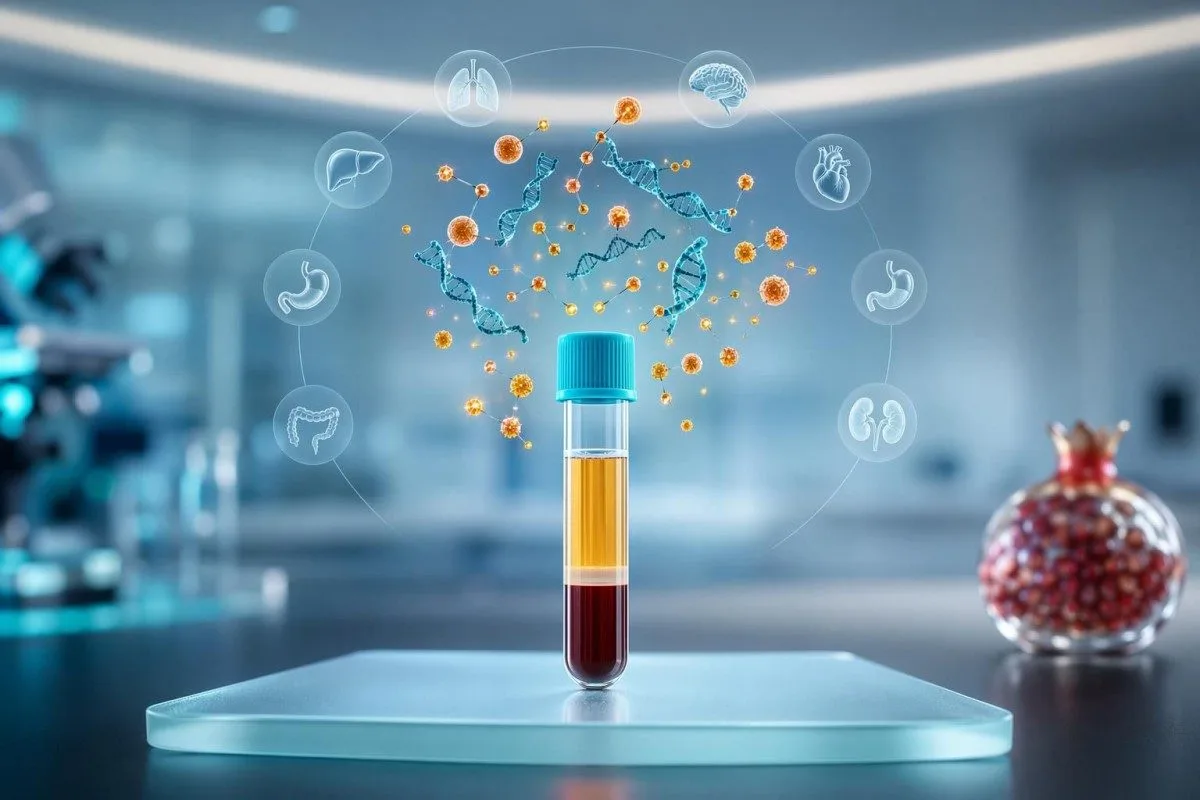
ctDNA cancer screening is promising, but it is not a whole-body cancer answer. The safest interpretation is pattern-based: signal, cancer risk, imaging target, and whether tissue confirmation is still needed.


- Liquid biopsy can detect circulating tumor DNA in some cancers, but a negative result does not rule out cancer, especially stage I disease.
- Circulating tumor DNA is usually a small fraction of total cell-free DNA; early cancers may release less than 0.01% variant allele fraction into plasma.
- Multi-cancer early detection tests often report a cancer signal and predicted tissue of origin, not a confirmed diagnosis.
- Specificity near 99% still creates false positives when testing very large low-risk populations.
- Stage matters because ctDNA sensitivity is much higher in stage III–IV cancers than in stage I cancers.
- Traditional tumor markers such as PSA, CEA, CA-125, and AFP measure proteins, not tumor DNA, and many benign conditions can raise them.
- Follow-up imaging after a positive ctDNA result may include CT, MRI, ultrasound, endoscopy, or PET-CT depending on the predicted tissue source.
- Tissue examination is still required before most cancer treatment because ctDNA cannot reliably show tumor architecture, grade, receptor status, or invasion.
What a liquid biopsy can and cannot detect
A liquid biopsy looks for cancer-related material in a laboratory sample, most often circulating tumor DNA, but it cannot prove that every hidden cancer is absent. As of May 2, 2026, a positive multi-cancer result usually needs imaging and often tissue examination; a negative result should not replace age-appropriate screening. We explain this carefully in liquid biopsy interpretation because false reassurance can be as harmful as panic.
In my clinic, the most useful sentence is also the least glamorous: a cancer blood test can raise or lower suspicion, but it rarely finishes the diagnostic job. Thomas Klein, MD, reviews these reports by asking 3 questions first: what signal was found, how strong was it, and what would change if the result is wrong?
The large Annals of Oncology validation study by Klein et al. reported 99.5% specificity and 51.5% overall sensitivity for one targeted methylation-based multi-cancer test, with stage I sensitivity around 16.8% and stage IV sensitivity around 90.1% (Klein et al., 2021). That gap is the whole story: liquid biopsy performs much better after cancer has more DNA to shed.
A positive ctDNA result is not the same as a biopsy-proven cancer diagnosis. If a patient also has weight loss, anemia, abnormal liver enzymes, or a suspicious mass, I treat the result very differently than I would in a well 38-year-old with no symptoms and a normal exam; our deeper guide to early cancer blood tests explains why ordinary labs still matter.
How circulating tumor DNA reaches the bloodstream
Circulating tumor DNA is DNA released by cancer cells into plasma, usually mixed with a much larger background of normal cell-free DNA. Most adults have about 5–30 ng/mL of total cell-free DNA in plasma, and the cancer-derived fraction can be tiny in early disease.
Cancer DNA enters circulation through ordinary cellular turnover, tissue response, and growth-related cell stress. The half-life of cell-free DNA is short — often measured in minutes to a few hours — which is why a ctDNA result is more like a snapshot than a 12-month archive.
The reason stage I cancer is difficult is not just test technology; it is biology. A 7 mm affected area may shed so little DNA that a 10 mL tube contains no detectable mutant fragment, while a larger metastatic burden may release thousands of fragments per millilitre.
Cristiano et al. showed in Nature that genome-wide cell-free DNA fragmentation patterns can carry cancer information beyond single mutations (Cristiano et al., 2019). Kantesti’s biomarker guide uses the same clinical principle for routine labs: a pattern often says more than one isolated result.
Here is the practical twist patients rarely hear: a hard-to-detect cancer may still produce indirect clues such as new iron deficiency, rising platelets above 450 × 10⁹/L, low albumin below 3.5 g/dL, or unexplained alkaline phosphatase elevation. Those are not cancer diagnoses, but they change how urgently I chase the story.
How ctDNA differs from traditional tumor markers
ctDNA tests measure cancer-associated DNA features, while traditional tumor markers measure proteins, enzymes, or antigens made by tumor tissue or normal tissue under stress. That difference matters because protein markers often rise for benign reasons, while ctDNA assays look for molecular features closer to the cancer itself.
CEA, CA-125, AFP, PSA, and CA 19-9 are not interchangeable with ctDNA. CEA can rise with smoking or bowel inflammation, CA-125 can rise with endometriosis or fluid in the abdomen, and PSA can rise after urinary retention or prostate manipulation.
A liquid biopsy may detect mutations, methylation signatures, copy-number changes, or fragment patterns. Traditional markers usually report a concentration such as ng/mL or U/mL, which is why trends over 2–3 measurements can matter more than one value.
I still order protein markers in selected situations because they are useful for monitoring known disease. For example, a falling CEA after colon cancer treatment can be reassuring, but our tumor markers guide explains why using CEA as a random screening test causes far more confusion than clarity.
The clinical mistake I see is assuming a modern DNA test makes older markers obsolete. It does not; it changes the question from “is this protein high?” to “is there a cancer-like molecular signal, and where should we look next?”
What multi-cancer early detection tests report
Multi-cancer early detection tests usually report whether a cancer signal was detected and may predict the tissue of origin. They do not usually report a visible tumor size, stage, grade, or treatment plan.
Most MCED tests are trained to recognise molecular patterns across many cancer types, not to replace colonoscopy, mammography, cervical screening, or low-dose CT in eligible smokers. In Klein et al., tissue-of-origin prediction was correct in 88.7% of true positive cases where a cancer signal was detected (Klein et al., 2021).
That 88.7% number is useful, but it still means roughly 1 in 9 predicted tissue sources could point clinicians in the wrong direction. In real life, that can mean a liver-predicted signal followed by clean liver imaging, then a separate search based on symptoms and baseline labs.
The thing is, multi-cancer screening performs differently across cancer types. Cancers that shed DNA into the bloodstream early are easier to detect than small kidney, brain, or low-volume prostate cancers; our article on what a full body blood test misses makes the same point for standard panels.
A report that says “signal detected” should be read like a high-priority clue, not a verdict. I tell patients to avoid the internet spiral for 48 hours and focus on the next scheduled step: confirm the report, review symptoms, compare old labs, and choose targeted imaging.
What a positive liquid biopsy result means next
A positive liquid biopsy result means a cancer-associated signal was found, and the next step is usually targeted clinical evaluation rather than immediate treatment. The safest pathway is confirmation of the report, symptom review, physical examination, baseline labs, and imaging aimed at the predicted tissue source.
In the DETECT-A study published in Science, Lennon et al. screened 10,006 women with a blood test plus PET-CT follow-up and reported that 26 cancers were first detected through the blood-test pathway (Lennon et al., 2020). That study is memorable because it shows both the promise and the workload created by positive screening signals.
The first clinical task is to separate a plausible signal from a mismatch. A predicted colorectal signal in a 62-year-old with ferritin 9 ng/mL and new bowel habit change is a very different scenario from a predicted colorectal signal in a 31-year-old with normal ferritin, normal CBC, and a colonoscopy 8 months ago.
False positives still happen even when specificity is 99% or higher. If 10,000 low-risk people are screened and true cancer prevalence is 1%, a small false-positive percentage can produce dozens of anxious workups; our guide to critical blood test results shows how clinicians triage urgency without overreacting.
I usually want a copy of the original lab report, not a screenshot. Pre-analytical details — sample timing, tube type, processing delay, and whether white-cell DNA was filtered computationally — can change how much confidence I place in the result.
Why a negative result does not rule out cancer
A negative liquid biopsy result does not rule out cancer because some cancers shed little or no detectable ctDNA at the time of testing. Early-stage, slow-growing, anatomically contained, or poorly shedding cancers can be missed even by technically excellent assays.
The phrase “no cancer signal detected” is not the same as “no cancer exists.” In stage I disease, some validation studies show sensitivity below 20% for broad multi-cancer tests, which means many early cancers will not be found by plasma DNA alone.
Symptoms still outrank screening when the story is concerning. Rectal bleeding, a breast lump, progressive trouble swallowing, coughing blood, unexplained hemoglobin below 10 g/dL, or unintentional weight loss over 5% in 6 months should be investigated even after a negative ctDNA result.
Routine labs can also point away from reassurance. A negative liquid biopsy does not explain a platelet count of 620 × 10⁹/L, albumin of 2.9 g/dL, or alkaline phosphatase 3 times the upper reference limit; our standard blood test guide covers the blind spots of basic panels.
Most patients find this frustrating because they paid for a sophisticated test and want a yes-or-no answer. Medicine is messier: a negative result lowers probability in some contexts, but it rarely closes the file when the clinical picture is loud.
False positives, clonal hematopoiesis, and biological noise
False positives in ctDNA testing can come from technical error, benign tissue changes, or clonal hematopoiesis, where aging blood-forming cells acquire mutations that are not cancer from a solid organ. Clonal hematopoiesis becomes more common with age, affecting roughly 10–20% of people over 70 depending on the mutation panel used.
The classic clonal hematopoiesis genes include DNMT3A, TET2, and ASXL1. When a ctDNA assay detects one of these mutations without comparing white-cell DNA, the signal can be wrongly attributed to a hidden solid cancer.
Good laboratories reduce this risk by sequencing matched cellular DNA or applying bioinformatic filters. Even then, I have seen reports where a low-level mutation at 0.08% variant allele fraction created weeks of anxiety before repeat testing and imaging showed no cancer.
This is also where CBC patterns matter. New leukocytosis above 11 × 10⁹/L, unexplained macrocytosis with MCV above 100 fL, or persistent abnormal differential counts should be interpreted separately from the liquid biopsy result; our blood differential guide explains why manual review sometimes changes the story.
There is a quieter false-positive category too: signals from benign growths, recent procedures, tissue repair, or inflammatory states. These are not “lab mistakes” in the simple sense; they are biology making an imperfect translation into a report.
When follow-up imaging is needed after ctDNA
Follow-up imaging is usually needed when a ctDNA or MCED test reports a cancer signal, especially if the test predicts a tissue of origin. The imaging choice depends on the predicted source, symptoms, baseline labs, kidney function, contrast safety, and pre-test cancer risk.
For a lung-predicted signal, clinicians may choose low-dose or diagnostic chest CT depending on risk and symptoms. For a pancreas or biliary-predicted signal, contrast CT or MRI/MRCP may be more informative than ultrasound because small deep abdominal growths can be missed on basic imaging.
Kidney function can determine whether contrast is safe. An eGFR below 30 mL/min/1.73 m² often changes contrast decisions, while allergy history, metformin use, pregnancy status, and hydration all affect the plan.
PET-CT is sometimes used when standard imaging is unrevealing, but it is not a magic cancer locator. Small lesions under 5–8 mm, low-metabolic tumors, and some mucinous cancers may be PET-negative; if a procedure is being considered, our pre-procedure blood test guide explains the labs doctors usually check first.
A normal first scan does not always end the workup. If the molecular signal is strong and the patient has red flags, repeat imaging in 8–12 weeks or organ-specific evaluation may be safer than declaring victory on day 1.
Why tissue examination is still needed
Tissue examination is still needed because ctDNA can suggest cancer biology but cannot reliably show architecture, invasion, grade, receptor status, or the exact cell type. Most cancer treatment decisions still require tissue confirmation before surgery, radiotherapy, immunotherapy, or chemotherapy.
A liquid biopsy may detect an EGFR mutation, methylation signature, or copy-number pattern, but it cannot show whether cells are arranged as adenocarcinoma, squamous carcinoma, lymphoma, or a benign mimic. That distinction can completely change treatment.
For ovarian-type presentations, CA-125, ultrasound, CT, and tissue diagnosis each answer different questions. A CA-125 above 35 U/mL is not diagnostic of cancer, and our CA-125 guide covers benign causes that commonly confuse patients.
In metastatic disease, ctDNA can sometimes identify treatment mutations faster than tissue testing. Still, oncologists often need tissue to check hormone receptors, HER2 status, mismatch repair, PD-L1 expression, or grade; these details can decide whether a patient receives targeted therapy or an entirely different plan.
The hard conversation is that tissue confirmation has risks — bleeding, infection, sampling error, and delay — but treating an unconfirmed molecular signal can be worse. I would rather spend 10 days getting the diagnosis right than start the wrong treatment quickly.
Who may benefit from liquid biopsy testing
Liquid biopsy testing may be most useful for selected higher-risk adults, people with hard-to-biopsy known cancers, or patients whose oncologist needs molecular monitoring. It is less clear for low-risk, asymptomatic adults who are already up to date with recommended screening.
Age matters because cancer incidence rises sharply after 50, but age also increases clonal hematopoiesis and false-positive complexity. A 72-year-old with prior smoking, unexplained anemia, and overdue colon screening has a different risk-benefit profile than a healthy 34-year-old athlete.
Family history changes the equation, especially when 2 or more close relatives had early cancers or a known inherited syndrome is present. In those families, genetic counselling and organ-specific surveillance may outperform a broad ctDNA screen.
I am cautious when anxious, low-risk patients request MCED testing every 6 months. More testing can create more incidental findings, more radiation exposure, and more procedures; for older adults deciding which labs are actually useful, our routine senior blood tests guide gives a more grounded starting point.
In oncology follow-up, liquid biopsy can be genuinely helpful. Rising ctDNA after surgery may suggest molecular residual disease months before imaging in some cancers, but the best action threshold is still cancer-specific and not settled across all tumour types.
Why standard cancer screening still matters
A cancer blood test does not replace standard screening because established tests can find precancerous or early localized disease that ctDNA may miss. Colonoscopy can remove polyps, cervical screening can detect precancerous change, and low-dose CT can detect small lung nodules before ctDNA becomes measurable.
This is where I am fairly firm with patients: do not skip colonoscopy because a liquid biopsy was negative. A negative ctDNA result cannot remove an adenomatous polyp, and it cannot inspect the bowel lining directly.
PSA is imperfect, but prostate cancer screening decisions still depend on age, baseline PSA, family history, urinary symptoms, and life expectancy. A PSA above 4.0 ng/mL is not automatically cancer, and age-specific interpretation is covered in our PSA range guide.
Breast, cervical, colorectal, and lung screening have decades of outcome data behind them. MCED tests are promising, but as of May 2, 2026, they have not replaced guideline-based screening programs in routine average-risk care.
The most sensible model is additive, not substitutive. If someone chooses MCED testing, I still want their mammogram, colon screening, cervical screening, skin checks, and smoking-related lung screening handled on schedule.
How Kantesti AI helps interpret surrounding labs
Kantesti AI does not turn a routine CBC or chemistry panel into a ctDNA test, and we would never claim that. Our role is to interpret the surrounding blood-test pattern — anemia, platelets, liver enzymes, kidney function, inflammation, and tumor markers — so patients know what deserves clinician follow-up.
In our analysis of 2M+ blood tests across 127+ countries, the cancer-adjacent patterns that most often need escalation are not glamorous: hemoglobin below 10 g/dL, ferritin below 15 ng/mL in an adult without an obvious cause, platelets above 450 × 10⁹/L for more than 3 months, or albumin below 3.5 g/dL with weight loss.
Kantesti AI interprets these results by comparing units, reference ranges, age, sex, trends, and combinations rather than flagging one abnormal value in isolation. Our AI-powered blood test interpretation platform can read uploaded reports in about 60 seconds, but it still tells users when a clinician, imaging test, or urgent review is needed.
Our clinical standards are described in medical validation, and our published benchmark work is available through the Kantesti AI Engine validation. That matters because a cancer-related lab pattern is a triage problem, not a marketing slogan.
For patients comparing an MCED result with routine labs, our AI interpretation guide is the safer mindset: fast pattern recognition, clear blind spots, and no pretending that software can diagnose cancer from a PDF.
How to read ctDNA report terms safely
ctDNA reports often use terms such as variant allele fraction, methylation signal, copy-number change, fragmentomics, and tissue-of-origin prediction. A patient should not interpret these terms like ordinary high-low lab flags because the clinical meaning depends on assay design and cancer probability.
Variant allele fraction, or VAF, is the proportion of DNA fragments carrying a variant at a specific site. A VAF of 0.1% means about 1 in 1,000 DNA fragments at that locus carries the variant, but that number can reflect tumor DNA, clonal hematopoiesis, or technical noise depending on context.
Methylation assays look at chemical tags that influence gene regulation, not just DNA spelling. That is why a test can sometimes predict tissue origin even when it does not list a familiar mutation like KRAS, EGFR, or BRAF.
Units and wording vary a lot by lab. If a report says “signal not detected,” “below limit of detection,” or “no reportable alteration,” those phrases are not identical; our blood test abbreviations guide helps patients slow down and parse lab language rather than react to one phrase.
Trend interpretation is tricky because ctDNA can change faster than protein markers. A rise from undetectable to 0.03% VAF after cancer surgery may be clinically meaningful in one assay, while the same number in a screening test may be below action threshold; our guide to blood test variability explains why repeatability matters.
Cost, privacy, and anxiety before testing
Before ordering a liquid biopsy, patients should understand the likely cost, data privacy terms, possible follow-up imaging, and emotional consequences of an unclear result. The downstream cost of a positive result can be much higher than the price of the initial test.
I ask patients to budget not only money but also time and uncertainty. A positive MCED result can lead to 1–3 imaging studies, specialist visits, repeat labs, and sometimes tissue examination even when no cancer is ultimately found.
Privacy is not a footnote because genomic data can be sensitive. Patients should know whether raw sequencing data are stored, whether de-identified data may be used for research, and how long reports remain accessible; keeping copies in a secure place is easier with a digital lab record.
Kantesti LTD is a UK company with GDPR, HIPAA, ISO 27001, and CE-marked systems, and our organizational background is available on About Us. That does not remove every privacy question, but it gives patients a concrete place to check governance instead of guessing.
Anxiety is a real adverse effect. In my experience, the patients who cope best have a written plan before testing: who will receive the result, which doctor will order follow-up, what imaging is acceptable, and what they will do if the result is indeterminate.
Research publications and practical bottom line
The practical bottom line is simple: use liquid biopsy as a risk signal, not as a stand-alone cancer verdict. A positive result needs structured follow-up, and a negative result should not stop standard screening or symptom-based evaluation.
Thomas Klein, MD, my own clinical rule is to ask whether the result changes the next medically sensible action. If the answer is “no,” testing may create noise; if the answer is “yes, this guides imaging or oncology follow-up,” liquid biopsy can be useful.
Kantesti’s Medical Advisory Board reviews our patient-facing interpretation standards so that we do not overstate what blood tests can diagnose. You can also upload routine labs to Kantesti AI when you want fast, structured interpretation of CBC, CMP, tumor markers, inflammation markers, and trend patterns.
Kantesti LTD. (2026). C3 C4 Complement Blood Test & ANA Titer Guide. Zenodo. DOI: 10.5281/zenodo.18353989. ResearchGate: publication record. Academia.edu: publication record.
Kantesti LTD. (2026). Nipah Virus Blood Test: Early Detection & Diagnosis Guide 2026. Zenodo. DOI: 10.5281/zenodo.18487418. ResearchGate: publication record. Academia.edu: publication record.
If you already have CBC, CMP, inflammatory markers, tumor markers, or follow-up lab PDFs, try the free blood test analysis. It will not diagnose cancer, but it can help you walk into your clinician’s appointment with clearer questions and fewer loose ends.
Frequently Asked Questions
Can a liquid biopsy detect all cancers?
No, a liquid biopsy cannot detect all cancers. Broad multi-cancer ctDNA tests have reported very high specificity near 99% in some validation studies, but stage I sensitivity can be below 20% depending on the assay and cancer type. Small, slow-growing, anatomically contained, or low-shedding cancers may produce no detectable circulating tumor DNA. A negative result should not replace colonoscopy, mammography, cervical screening, lung screening when eligible, or symptom-based investigation.
What is the difference between circulating tumor DNA and tumor markers?
Circulating tumor DNA is cancer-derived DNA found among normal cell-free DNA fragments in plasma, while tumor markers such as PSA, CEA, CA-125, and AFP are usually proteins or antigens measured in units such as ng/mL or U/mL. ctDNA tests may analyse mutations, methylation, copy-number changes, or fragmentation patterns. Protein tumor markers can rise in benign conditions such as inflammation, liver disease, endometriosis, smoking, or urinary retention. Neither type of test should be interpreted without clinical context.
What happens after a positive multi-cancer early detection test?
After a positive multi-cancer early detection test, clinicians usually confirm the original report, review symptoms, check baseline labs, and order targeted imaging based on the predicted tissue of origin. Imaging may include CT, MRI, ultrasound, endoscopy, or PET-CT depending on the signal and patient risk. A positive ctDNA result does not usually justify cancer treatment by itself. Most patients still need tissue examination before surgery, chemotherapy, radiotherapy, or targeted therapy.
Can ctDNA testing replace a biopsy?
ctDNA testing usually cannot replace tissue examination because it does not reliably show tumor architecture, invasion, grade, receptor status, or exact histology. In some known advanced cancers, ctDNA can help identify actionable mutations faster than tissue testing, especially when tissue is hard to obtain. For a new suspected cancer, however, treatment decisions usually require tissue confirmation. The exception is narrow and specialist-led, not a general screening rule.
How accurate are liquid biopsy cancer screening tests?
Accuracy depends on the cancer type, stage, assay design, and population being tested. In one major Annals of Oncology validation study, a targeted methylation-based multi-cancer test reported 99.5% specificity, 51.5% overall sensitivity, about 16.8% sensitivity for stage I cancer, and about 90.1% sensitivity for stage IV cancer. Those numbers mean false positives are uncommon but not impossible, and early cancers are still often missed. Patients should ask for stage-specific sensitivity, not just one headline accuracy figure.
Should healthy people get a liquid biopsy every year?
There is no universal recommendation for every healthy adult to get annual liquid biopsy screening as of May 2, 2026. The potential benefit is more plausible in selected higher-risk adults, but the harms include false positives, incidental findings, radiation from follow-up imaging, cost, and anxiety. People should stay current with proven screening first, including colorectal, cervical, breast, and lung screening when eligible. Anyone considering annual MCED testing should decide with a clinician who can manage follow-up.
Get AI-Powered Blood Test Analysis Today
Join over 2 million users worldwide who trust Kantesti for instant, accurate lab test analysis. Upload your blood test results and receive comprehensive interpretation of 15,000+ biomarkers in seconds.
📚 Referenced Research Publications
Klein, T., Mitchell, S., & Weber, H. (2026). C3 C4 Complement Blood Test & ANA Titer Guide. Kantesti AI Medical Research.
Klein, T., Mitchell, S., & Weber, H. (2026). Nipah Virus Blood Test: Early Detection & Diagnosis Guide 2026. Kantesti AI Medical Research.
📖 External Medical References
⚕️ Medical Disclaimer
This article is for educational purposes only and does not constitute medical advice. Always consult a qualified healthcare provider for diagnosis and treatment decisions.
E-E-A-T Trust Signals
Experience
Physician-led clinical review of lab interpretation workflows.
Expertise
Laboratory medicine focus on how biomarkers behave in clinical context.
Authoritativeness
Written by Dr. Thomas Klein with review by Dr. Sarah Mitchell and Prof. Dr. Hans Weber.
Trustworthiness
Evidence-based interpretation with clear follow-up pathways to reduce alarm.