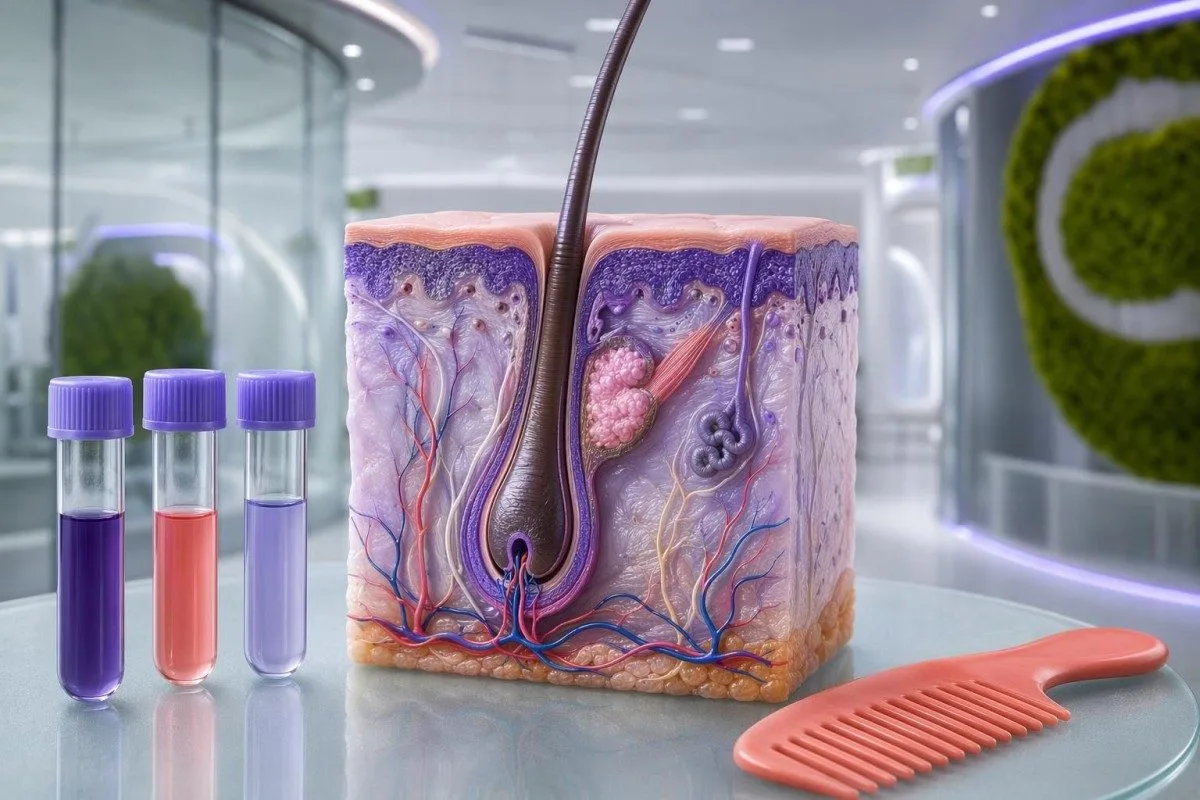
Shedding hair is frightening because the cause is often invisible. The right labs can find low iron stores, thyroid shifts, androgen excess, nutritional gaps, and metabolic patterns that are treatable.


- Ferritin below 30 ng/mL often supports iron depletion even when hemoglobin is normal; many hair clinicians aim for at least 40-70 ng/mL during recovery.
- TSH above 4.0 mIU/L with low free T4 suggests hypothyroidism, a treatable trigger for diffuse shedding and brittle hair.
- TSH below 0.4 mIU/L may suggest hyperthyroidism or over-replacement, especially when free T4 or free T3 is high.
- CBC changes such as low MCV below 80 fL or high RDW above 14.5% can appear before obvious iron-deficiency anemia.
- 25-OH vitamin D below 20 ng/mL is deficiency; it is not a stand-alone hair loss diagnosis but is common enough to correct when low.
- Total testosterone, free testosterone, SHBG, DHEA-S, LH, FSH and prolactin are the main blood tests for hormonal imbalance when hair thinning comes with acne, irregular periods or new facial hair.
- DHEA-S above 700 µg/dL is unusual and usually needs prompt endocrine review because adrenal overproduction must be excluded.
- Normal blood tests do not rule out hair loss because androgenetic alopecia, traction alopecia, telogen effluvium after a trigger, and scarring scalp disease can all occur with normal labs.
- Biotin supplements can distort thyroid and hormone immunoassays; many clinicians ask patients to stop high-dose biotin for 48-72 hours before testing.
- Trend matters more than one result: ferritin, TSH, vitamin D and androgen results are most useful when compared with symptoms, medications, menstrual history and prior values.
Which blood tests actually help when hair is shedding?
The most useful blood tests for hair loss are ferritin with iron studies, CBC, TSH with free T4, 25-OH vitamin D, B12, folate, zinc, and selected hormones such as total testosterone, free testosterone, SHBG, DHEA-S, prolactin, LH and FSH. These tests can reveal treatable causes of shedding, but they cannot diagnose every type of hair loss. At Kantesti AI, our platform interprets these results against age, sex, symptoms and trends rather than treating one low-normal number as the whole story.
In clinic, I usually separate hair loss into three buckets within the first 5 minutes: diffuse shedding, patterned thinning, and patchy or inflamed scalp disease. Diffuse shedding is where blood tests earn their keep; patterned thinning often needs scalp examination; patchy loss may need urgent dermatology even when ferritin and TSH are perfect.
A practical first panel is CBC, ferritin, serum iron, TIBC or transferrin, transferrin saturation, TSH, free T4, 25-OH vitamin D, B12 and folate. If there are irregular periods, acne, new facial hair, infertility, sudden thinning at the crown, or weight gain, I add blood tests for hormonal imbalance rather than guessing from symptoms alone.
One caution from Thomas Klein, MD: a normal lab range is not a hair-growth range. A ferritin of 18 ng/mL may be printed as normal by one lab, yet that same result can be clinically meaningful in a 31-year-old with heavy periods and 300 hairs in the shower drain. If you are new to lab reports, our guide on reading blood test results explains why flags, reference intervals and personal baselines are different things.
Ferritin: the iron storage marker that is often borderline
Ferritin estimates stored iron, and ferritin below 30 ng/mL commonly supports iron depletion in people with diffuse shedding. Adult female lab reference ranges often start near 12-15 ng/mL, but many dermatologists become more interested when ferritin sits below 40-50 ng/mL because hair follicles are metabolically demanding.
Ferritin is measured in ng/mL, which is numerically equivalent to µg/L. A ferritin of 8 ng/mL is very different from 48 ng/mL, even if both patients have a hemoglobin of 12.8 g/dL and no obvious anemia on a routine CBC.
The evidence linking ferritin thresholds to hair regrowth is honestly mixed. Almohanna et al. reviewed vitamins and minerals in hair loss in Dermatology and Therapy in 2019 and found that iron deficiency is worth correcting when present, while also warning that indiscriminate supplementation is not evidence-based.
Here is the trap I see weekly: ferritin rises during inflammation, liver disease and infection. A ferritin of 90 ng/mL with CRP of 28 mg/L may not mean iron stores are generous; it may mean ferritin is acting as an acute-phase reactant. For a deeper explanation, see our article on low ferritin with normal hemoglobin.
CBC and iron studies can change before anemia appears
A CBC can look normal while iron stores are already too low for comfortable hair cycling. Hemoglobin often falls late; ferritin, transferrin saturation, MCV, MCH and RDW can give earlier clues that iron supply is tightening.
Typical adult hemoglobin ranges are about 12.0-15.5 g/dL for many women and 13.5-17.5 g/dL for many men, though ranges vary by lab and pregnancy status. MCV below 80 fL suggests microcytosis, and a rising RDW above roughly 14.5% can be an early sign that cell size is becoming uneven.
Iron studies add context that ferritin alone cannot provide. Transferrin saturation below 16-20% often suggests iron-restricted supply, while TIBC tends to rise when the body is trying to capture more iron from circulation.
A 42-year-old runner I reviewed had ferritin of 22 ng/mL, hemoglobin of 13.1 g/dL, MCV of 84 fL and transferrin saturation of 12%. Her report looked mostly normal, yet the pattern was classic early iron depletion from training load plus heavy periods. Our guide to iron deficiency anemia labs explains which markers usually move first.
Thyroid testing: TSH is useful, but it is not the whole panel
TSH and free T4 are the core thyroid blood tests for hair loss because both hypothyroidism and hyperthyroidism can cause diffuse shedding. TSH above about 4.0 mIU/L with low free T4 supports hypothyroidism, while TSH below 0.4 mIU/L with high free T4 or free T3 supports hyperthyroidism.
The American Thyroid Association guideline by Jonklaas et al. in Thyroid in 2014 supports TSH-guided levothyroxine treatment for primary hypothyroidism, but the patient context still matters. A TSH of 5.2 mIU/L in a tired postpartum patient with positive TPO antibodies is not the same clinical problem as a TSH of 5.2 mIU/L during a brief viral illness.
Free T4 is usually reported around 0.8-1.8 ng/dL or 10-23 pmol/L, depending on the unit system. TPO antibodies above the lab cutoff, often around 35 IU/mL, suggest autoimmune thyroiditis and can predict future hypothyroidism even before free T4 drops.
Hair changes from thyroid disease are rarely instant. In my experience, shedding often lags 6-12 weeks behind a thyroid shift and can continue for another 2-3 months after treatment begins. For a deeper thyroid breakdown, read our thyroid panel guide.
Vitamin D, B12, folate and zinc: useful, but easy to overinterpret
25-OH vitamin D, B12, folate and zinc can reveal correctable deficiencies that may worsen shedding, fatigue or scalp recovery. These tests are supportive rather than diagnostic; a low vitamin D result does not prove it caused hair loss.
25-OH vitamin D below 20 ng/mL is generally deficiency, 20-29 ng/mL is often called insufficiency, and 30-50 ng/mL is a common target zone. Some endocrine groups have argued about exact cutoffs for years, which is why I avoid promising hair regrowth from vitamin D alone.
Vitamin B12 below 200 pg/mL is commonly deficient, while 200-350 pg/mL can be borderline when symptoms, vegan diet, metformin use or acid-suppressing medication are present. Folate is usually less ambiguous, but recent supplementation can make serum folate look deceptively reassuring.
Zinc is a fussy test. Serum zinc is influenced by fasting status, inflammation, albumin and time of day, and many labs report roughly 70-120 µg/dL as a typical adult range. If diet history points toward a nutritional issue, our vitamin deficiency marker guide is a useful companion.
Hormone blood tests when thinning looks androgen-driven
Total testosterone, free testosterone, SHBG and DHEA-S are the main hormone blood tests when hair thinning is accompanied by acne, irregular cycles, new facial hair or rapid crown thinning. These are the blood tests for hormonal imbalance I order before considering an androgen-related cause.
In many adult women, total testosterone is roughly 15-70 ng/dL, but the free testosterone result often tells the more relevant story. Low SHBG can make free testosterone higher even when total testosterone appears comfortably normal.
The Endocrine Society hirsutism guideline by Martin et al. in the Journal of Clinical Endocrinology and Metabolism in 2018 recommends testing for androgen excess when clinical features are moderate, severe or rapidly progressive. DHEA-S is especially helpful because values above 700 µg/dL are unusual and can point toward adrenal overproduction rather than ovarian-pattern androgen excess.
Here is the nuance: hair follicles can be sensitive to normal androgen levels. A patient may have total testosterone of 38 ng/dL, normal DHEA-S and still have androgenetic alopecia because receptor sensitivity and family history matter. For interpreting total versus free hormone patterns, see our free testosterone guide.
PCOS-pattern hair loss needs metabolic testing, not just hormones
PCOS-related thinning is best assessed with androgen tests plus glucose and insulin markers. HbA1c, fasting glucose, fasting insulin, lipid panel and sometimes HOMA-IR can reveal the insulin-resistance pattern that lowers SHBG and raises free androgen activity.
HbA1c of 5.7-6.4% is the usual prediabetes range, and fasting glucose of 100-125 mg/dL is impaired fasting glucose. Those numbers matter for hair because insulin resistance can suppress SHBG, which may increase biologically active testosterone without a dramatic rise in total testosterone.
LH and FSH are sometimes ordered, but the LH:FSH ratio is not a reliable diagnostic shortcut. I have seen patients with classic PCOS symptoms and a normal ratio, and patients with a high ratio who did not meet diagnostic criteria.
If periods are irregular or cycles exceed 35 days, I also think about pregnancy testing, prolactin, TSH and sometimes 17-hydroxyprogesterone. A morning 17-hydroxyprogesterone above 200 ng/dL can trigger evaluation for nonclassic congenital adrenal hyperplasia. Our guide to PCOS blood test patterns goes deeper into this mixed hormone-metabolic picture.
Prolactin, cortisol and stress labs: when they are worth checking
Prolactin is worth checking when hair loss occurs with missed periods, nipple discharge, infertility, low libido or headaches. Cortisol testing is not routine for ordinary shedding, but it becomes relevant when Cushing-pattern features or adrenal symptoms are present.
Typical prolactin upper limits are often below 25 ng/mL in nonpregnant women and below 20 ng/mL in men, although labs differ. Mild elevations around 25-50 ng/mL can come from stress, recent exercise, sex, sleep, chest-wall stimulation, antipsychotic medication, metoclopramide or macroprolactin.
Cortisol is a timing test, not a casual add-on. A morning serum cortisol around 5-25 µg/dL may be reported as typical, but screening for Cushing syndrome usually uses late-night salivary cortisol, 24-hour urinary free cortisol or dexamethasone suppression under medical supervision.
Kantesti's neural network weighs collection time when it is visible on the report, because a 4 PM cortisol cannot be interpreted like an 8 AM cortisol. You can review hormone-adjacent results through our AI blood test platform, but persistent menstrual changes or high prolactin should be managed with a clinician. For prolactin specifics, see our prolactin test guide.
Inflammation and autoimmune labs: helpful only with the right clues
CRP, ESR, ANA and autoimmune markers are not routine screening tests for every hair loss case. They become useful when shedding comes with joint swelling, mouth ulcers, photosensitive rash, unexplained fever, scalp pain, patchy loss or scarring changes.
CRP below 3 mg/L is often considered low cardiovascular inflammatory risk, but infection and autoimmune flares can push it much higher. ESR rises with age, anemia, pregnancy and inflammation, so an ESR of 32 mm/hr in a 72-year-old is not interpreted like 32 mm/hr in a 22-year-old.
ANA is a particularly noisy test. A low-titer positive ANA can appear in healthy people, and ordering it without symptoms can create anxiety rather than clarity. I reserve it for patterns that point toward lupus, connective tissue disease or autoimmune scalp disease.
Patchy hair loss with smooth round areas may be alopecia areata; scalp tenderness, scale, pustules or loss of follicle openings needs dermatology assessment. Blood tests can support the story, but they cannot replace looking at the scalp. For symptom-driven inflammation testing, see our guide to inflammation blood tests.
When blood tests are normal but hair loss continues
Normal blood tests do not rule out hair loss because many common hair disorders are not caused by measurable blood abnormalities. Androgenetic alopecia, traction alopecia, telogen effluvium after a past trigger, alopecia areata and scarring alopecias can all occur with normal ferritin, TSH and vitamin results.
Telogen effluvium often begins 2-3 months after fever, surgery, childbirth, crash dieting, major stress, COVID-like illness, medication change or rapid weight loss. By the time labs are checked, the trigger may already be gone and results may look clean.
Patterned thinning is different. A widening part, miniaturized hairs, family history and crown thinning can point to androgenetic alopecia even when total testosterone is 32 ng/dL and ferritin is 75 ng/mL.
The red flags are not subtle: scalp pain, burning, scaling, pus-like discharge, broken hairs, rapid patchy loss, eyebrow loss, or shiny areas where follicle openings disappear. If any of those are present, blood tests are a side note. Our earlier hair-loss lab guide covers the basic lab panel, but persistent or scarring-pattern loss needs eyes on the scalp.
Borderline results: when to repeat and when to act
Borderline lab results should be repeated or trended when they are close to a clinical cutoff, inconsistent with symptoms, or affected by timing, supplements or acute illness. A single ferritin of 34 ng/mL or TSH of 4.3 mIU/L is not the same as a persistent pattern over 3-6 months.
Ferritin usually changes slowly. If oral iron is used, I often recheck ferritin and CBC after 8-12 weeks, not after 8 days. Hair shedding may lag behind biochemical improvement by another 2-3 months because follicles cycle slowly.
TSH should usually be rechecked 6-8 weeks after starting or changing levothyroxine because that is roughly how long the pituitary-thyroid axis needs to settle. Vitamin D is commonly rechecked after about 3 months of consistent replacement.
Kantesti AI interprets borderline ferritin, TSH and vitamin results by comparing them with adjacent markers and prior uploads when available. That trend-based view is why a value just inside the reference range can still be clinically interesting. Our article on borderline blood test results gives examples that are not hair-specific but apply beautifully here.
Essential blood tests for women with shedding hair
Essential blood tests for women with new shedding include CBC, ferritin, iron studies, TSH, free T4, 25-OH vitamin D, B12, folate and pregnancy testing when relevant. Hormone testing becomes more valuable when cycles are irregular, bleeding is heavy, acne is new or thinning is crown-predominant.
Heavy menstrual bleeding is one of the most overlooked causes of low ferritin in otherwise healthy women. Soaking protection every 1-2 hours, passing large clots, or bleeding longer than 7 days can drain iron stores even when diet looks reasonable.
Postpartum shedding usually peaks around 3-5 months after delivery and often improves by 6-12 months. I still check ferritin, CBC and TSH when shedding is severe, prolonged, or paired with fatigue, palpitations, low mood or heavy bleeding.
Perimenopause adds another layer because estradiol fluctuation, lower SHBG, thyroid disease and iron loss can overlap. Thomas Klein, MD, often frames this as a pattern-recognition problem rather than a single hormone mystery. For age-specific prevention labs, see our women's blood test checklist.
Blood tests for men: when labs help and when they do not
Blood tests for men with hair loss are most useful when shedding is diffuse, sudden, accompanied by fatigue, weight change, anemia symptoms or sexual symptoms. Classic male-pattern hair loss with gradual temple and crown thinning often has normal ferritin, thyroid and testosterone results.
A morning total testosterone test is best collected before 10 AM because testosterone follows a daily rhythm. Many labs report adult male total testosterone roughly around 300-1000 ng/dL, but age, SHBG and symptoms decide whether a result is meaningful.
Low ferritin is less common in men than in menstruating women, so I take it seriously. Ferritin below 30 ng/mL in an adult man should prompt questions about diet, blood donation, endurance training, gastrointestinal symptoms and occult blood loss evaluation when clinically appropriate.
Diffuse shedding in men still deserves the basics: CBC, ferritin, TSH, free T4, vitamin D and B12. If libido, erectile function, infertility or low morning energy are part of the story, hormone testing is reasonable. Our testosterone range guide explains why timing and SHBG can change the interpretation.
How to prepare so your hair-loss labs are not misleading
Hair-loss blood tests are most reliable when timing, supplements and fasting instructions are handled correctly. Morning collection is preferred for testosterone and cortisol, thyroid tests should avoid high-dose biotin interference, and iron studies are often cleaner when collected fasting or early in the day.
Biotin is the classic spoiler. Doses of 5,000-10,000 µg are common in hair supplements and can distort immunoassays, sometimes making TSH look falsely low or thyroid hormones look falsely high depending on the assay design.
Many clinicians ask patients to stop high-dose biotin for 48-72 hours before thyroid or hormone testing, and longer for very high doses. Do not stop prescribed medication without your clinician's advice, but do tell the lab and doctor exactly what you take.
If you are doing fasting glucose, insulin or a lipid panel at the same time, an 8-12 hour fast is often used, while water is fine. Iron tablets can affect serum iron transiently, so I usually avoid taking iron on the morning of an iron study unless the ordering clinician says otherwise. For practical prep, see our fasting rules and our guide to biotin thyroid testing.
How Kantesti interprets hair-loss blood tests and when to get help
Kantesti AI interprets hair-loss blood tests by reading ferritin, CBC indices, thyroid markers, vitamins, hormones and metabolic labs together rather than as isolated flags. Our AI can analyze a PDF or photo report in about 60 seconds, but urgent scalp symptoms or severe hormone abnormalities still need clinician care.
Kantesti AI analyzes more than 15,000 biomarkers across reports from 127+ countries and 75+ languages, which matters because ferritin, TSH and hormone units vary internationally. A ferritin result in µg/L, testosterone in nmol/L and vitamin D in nmol/L should not be mentally converted on the back of a receipt.
Our medical team and Medical Advisory Board review clinical standards used in the platform, and our medical validation page explains the quality framework behind our interpretation model. The pre-registered benchmark, Clinical Validation of the Kantesti AI Engine (2.78T), is available through the DOI record.
As of April 27, 2026, the safest use of AI in hair-loss labs is triage and interpretation, not diagnosis by screenshot. Upload your results to free blood test analysis if you want a structured read of ferritin, TSH, vitamins and hormones before discussing next steps with your clinician.
Kantesti's biomarker guide is useful if your report includes unfamiliar markers such as transferrin saturation, SHBG or DHEA-S. You can also learn more about Kantesti as an organization and why we keep physician oversight in the loop for YMYL medical content.
Frequently Asked Questions
What blood tests should I ask for if my hair is falling out?
The most useful first blood tests for hair loss are CBC, ferritin, serum iron, TIBC or transferrin, transferrin saturation, TSH, free T4, 25-OH vitamin D, B12 and folate. Add total testosterone, free testosterone, SHBG, DHEA-S, prolactin, LH, FSH, HbA1c and fasting insulin when hair thinning comes with acne, irregular periods, new facial hair, infertility or weight gain. Patchy loss, scalp pain, scale or scarring needs dermatology review even if all blood tests are normal.
What ferritin level is best for hair growth?
Ferritin below 30 ng/mL often supports iron depletion, and many hair clinicians prefer ferritin above 40-70 ng/mL during recovery from shedding. A lab may print 12-150 ng/mL as a normal adult female range, but the lower end can still be clinically relevant in heavy menstrual bleeding or diffuse shedding. Ferritin also rises with inflammation, so CRP and transferrin saturation help decide whether ferritin reflects true iron stores.
Can thyroid problems cause hair loss if TSH is only borderline?
Borderline TSH can contribute to hair shedding when it is persistent, paired with symptoms, associated with positive TPO antibodies, or accompanied by abnormal free T4. TSH above about 4.0 mIU/L is commonly flagged as high, while TSH above 10 mIU/L or high TSH with low free T4 is more suggestive of overt hypothyroidism. Hair shedding can lag 6-12 weeks behind thyroid changes, so timing matters.
Which hormone tests are used for female hair thinning?
The main hormone tests for female-pattern or androgen-related thinning are total testosterone, free testosterone, SHBG, DHEA-S, prolactin, LH and FSH. HbA1c, fasting glucose and fasting insulin are often added when PCOS or insulin resistance is possible because low SHBG can raise free androgen activity. DHEA-S above 700 µg/dL or rapidly progressive androgen symptoms should prompt medical review.
Can all blood tests be normal and hair still fall out?
Yes, blood tests can be normal while hair loss continues. Androgenetic alopecia, traction alopecia, alopecia areata, scarring alopecias and telogen effluvium after a past trigger can all occur with normal ferritin, thyroid and vitamin results. If shedding lasts longer than 6 months, is patchy, or comes with scalp pain or scaling, a scalp-focused dermatology assessment is often more useful than repeating broad blood panels.
Should I stop biotin before blood tests for hair loss?
High-dose biotin can interfere with thyroid and hormone immunoassays, so many clinicians advise stopping 5,000-10,000 µg biotin supplements for 48-72 hours before testing. Very high doses may need a longer washout depending on the assay and clinician advice. Do not stop prescribed medication without guidance, but always disclose hair, nail and skin supplements before thyroid, prolactin or hormone testing.
How long after correcting low ferritin does hair shedding improve?
Ferritin often takes 8-12 weeks or longer to rise with consistent iron replacement, and hair shedding may lag another 2-3 months because follicles cycle slowly. A ferritin increase from 12 ng/mL to 38 ng/mL is biochemical progress, but visible density recovery can take 6-12 months if iron depletion was the main trigger. Ongoing heavy bleeding, poor absorption or inflammation can blunt the response.
Get AI-Powered Blood Test Analysis Today
Join over 2 million users worldwide who trust Kantesti for instant, accurate lab test analysis. Upload your blood test results and receive comprehensive interpretation of 15,000+ biomarkers in seconds.
📚 Referenced Research Publications
Klein, T., Mitchell, S., & Weber, H. (2026). Kantesti LTD. (2026). Clinical Validation of the Kantesti AI Engine (2.78T) on 15 Anonymised Blood Test Cases: A Pre-Registered Rubric-Based Benchmark Including Hyperdiagnosis Trap Cases Across Seven Medical Specialties. Figshare.. Kantesti AI Medical Research.
Klein, T., Mitchell, S., & Weber, H. (2026). Kantesti LTD. (2026). Women's Health Guide: Ovulation, Menopause & Hormonal Symptoms. Figshare.. Kantesti AI Medical Research.
📖 External Medical References
⚕️ Medical Disclaimer
This article is for educational purposes only and does not constitute medical advice. Always consult a qualified healthcare provider for diagnosis and treatment decisions.
E-E-A-T Trust Signals
Experience
Physician-led clinical review of lab interpretation workflows.
Expertise
Laboratory medicine focus on how biomarkers behave in clinical context.
Authoritativeness
Written by Dr. Thomas Klein with review by Dr. Sarah Mitchell and Prof. Dr. Hans Weber.
Trustworthiness
Evidence-based interpretation with clear follow-up pathways to reduce alarm.