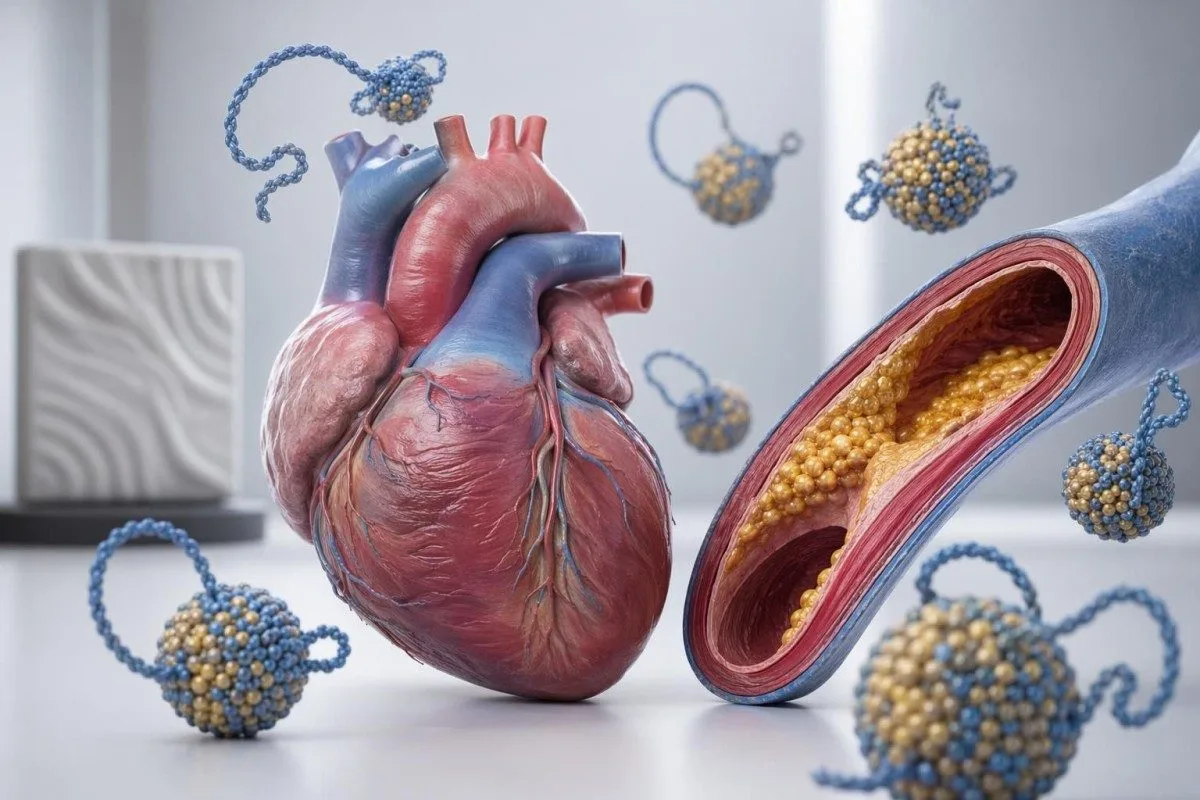
Lp(a) is the cholesterol result many patients never see on a standard lipid panel. When it is high, the story is often genetic rather than dietary.


- High Lp(a) usually means an inherited LDL-like particle is elevated; it can raise heart attack, stroke, and aortic valve risk even when LDL-C looks normal.
- Risk threshold is commonly ≥50 mg/dL or ≥125 nmol/L, which the AHA/ACC treats as a risk-enhancing factor for cardiovascular prevention.
- Very high Lp(a) around ≥180 mg/dL or ≥430 nmol/L may carry lifetime risk similar to heterozygous familial hypercholesterolaemia.
- Testing frequency is usually once in adulthood because Lp(a) is 80-90% genetically determined and often stable after childhood.
- Units matter because mg/dL and nmol/L cannot be reliably converted; apo(a) particle size varies too much between people.
- Normal LDL does not cancel risk because Lp(a) carries apoB, cholesterol, and oxidized phospholipids in a separate inherited particle.
- Treatment today focuses on lowering all modifiable risk, often aiming for lower LDL-C; PCSK9 inhibitors typically reduce Lp(a) by about 20-30%.
- Family testing is sensible when Lp(a) is high, especially if a parent, sibling, or child has premature heart disease or aortic valve disease.
High Lp(a) in plain English: inherited risk, not a diet score
High Lp(a) means your blood contains an elevated amount of lipoprotein(a), an LDL-like particle largely set by your genes. It can signal inherited heart risk even when LDL cholesterol is 90 mg/dL, HDL is fine, and you exercise daily. If your Lp(a) blood test is high, the next step is not panic; it is risk mapping with your doctor and family-aware prevention. You can upload results to Kantesti AI for a unit-aware explanation alongside your other markers.
About 1 in 5 adults has an Lp(a) level above commonly used risk thresholds, although prevalence varies by ancestry and assay. In our review of more than 2M uploaded blood test records, the pattern I see most often is a patient with a tidy lipid panel who only discovers high Lp(a) after a parent has a heart attack at 52.
A typical example: a 46-year-old cyclist with LDL-C 92 mg/dL, HDL-C 61 mg/dL, triglycerides 74 mg/dL, and Lp(a) 168 nmol/L. His standard cholesterol looked reassuring, but the inherited Lp(a) signal changed the conversation from general wellness to targeted prevention, much like an ApoB blood test can reveal particle risk when LDL-C appears acceptable.
Lp(a) is not a short-term report card on last week’s meals. Most patients find that repeating it after 3 months of oats, exercise, and fish oil produces little movement, often less than 10%, which is frustrating but clinically useful: it tells us to stop blaming willpower and start managing lifetime risk.
What Lp(a) is: an LDL particle with an extra apo(a) tail
Lipoprotein(a) is an LDL-like particle containing apoB-100 plus an added apolipoprotein(a) chain. That apo(a) chain makes the particle genetically distinctive, sticky in artery biology, and difficult to judge from total cholesterol alone.
Each Lp(a) particle contains one apoB protein, so it belongs to the same broad atherogenic family as LDL, VLDL remnants, and IDL. Kantesti AI treats Lp(a) as a particle-risk marker, not just another cholesterol number, and our biomarker guide maps it against ApoB, LDL-C, non-HDL-C, triglycerides, glucose, kidney markers, and inflammation markers.
The apo(a) part is made of repeated kringle structures, and people with smaller apo(a) isoforms often produce more Lp(a). This is why two patients can both report 60 mg/dL, yet have different particle counts and different assay behavior; the lab method matters more here than it does for a basic sodium or ALT result.
Lp(a) is produced mainly by the liver and is usually stable after about age 5. Acute illness, pregnancy, kidney disease, nephrotic syndrome, and untreated hypothyroidism can shift results, but a high adult value is still usually treated as a durable inherited trait rather than a temporary fluctuation.
Who should ask for an Lp(a) blood test?
Most adults should have Lp(a) measured at least once, and testing is especially useful with premature heart disease, stroke, aortic valve disease, familial hypercholesterolaemia, or unexplained events despite normal LDL. The 2022 European Atherosclerosis Society consensus recommends at least one adult measurement to identify inherited high-risk levels (Kronenberg et al., 2022).
I am more insistent about testing when a man has a heart attack before 55, a woman before 65, or a parent needed a coronary stent while supposedly having normal cholesterol. Those age cutoffs are not magic, but they help identify families where inherited risk is stronger than lifestyle risk alone.
Testing is also reasonable in people with calcific aortic valve stenosis, very high LDL-C above 190 mg/dL, recurrent cardiovascular events on statin therapy, or a strong family history of sudden cardiac death. If you are already planning a lipid review, our guide on when to get cholesterol testing explains which standard markers are usually ordered at the same visit.
Children do not need blanket Lp(a) testing in every family, but I do consider it when a parent has very high Lp(a), familial hypercholesterolaemia, or premature cardiovascular disease. A child’s Lp(a) can be interpretable after early childhood, yet decisions about medication still depend on LDL-C, family history, blood pressure, diabetes risk, and the child’s age.
How to read Lp(a) results in mg/dL and nmol/L
Lp(a) results are reported in either mg/dL or nmol/L, and the two units should not be converted with a simple calculator. A result of ≥50 mg/dL or ≥125 nmol/L is commonly treated as high enough to enhance cardiovascular risk assessment.
The 2018 AHA/ACC cholesterol guideline lists Lp(a) ≥50 mg/dL or ≥125 nmol/L as a risk-enhancing factor when clinicians are deciding how aggressively to prevent atherosclerotic disease (Grundy et al., 2019). Some European laboratories flag results above 30 mg/dL, so a patient may see a red mark in one country and no flag in another.
The conversion problem is real. Mg/dL measures particle mass, while nmol/L estimates particle number; because apo(a) size varies widely, a fixed conversion factor can misclassify a patient by 20-40% in my experience, especially at higher values.
If your report has unfamiliar units or symbols, compare it with the lab’s own reference interval and read it beside the rest of the lipid panel. Our plain-English guide to blood test abbreviations is useful when the report says LPA, Lp(a), lipoprotein little a, or uses a local unit convention.
Why LDL cholesterol can look normal while Lp(a) is high
Normal LDL-C does not rule out high Lp(a) risk because LDL-C measures cholesterol mass, not inherited particle behavior. Lp(a) carries cholesterol inside an apoB-containing particle, but it also carries apo(a) and oxidized phospholipids that are not captured by LDL-C alone.
LDL-C of 95 mg/dL tells you how much cholesterol is being transported in LDL-related particles; it does not tell you whether a subset of those particles is Lp(a). This is why I dislike the phrase normal cholesterol when a patient has never had ApoB, non-HDL-C, or Lp(a) measured.
Some of the cholesterol counted inside LDL-C can actually sit within Lp(a). In a patient with very high Lp(a), the reported LDL-C may partly reflect Lp(a)-cholesterol, yet lowering LDL-C still helps because the rest of the apoB particle burden remains modifiable.
For patients comparing results, the practical question is not whether LDL-C is normal for the lab; it is whether LDL-C is low enough for that person’s total risk. Our LDL range guide explains why 115 mg/dL may be fine for one 32-year-old and too high for a 58-year-old with diabetes, high Lp(a), and a coronary calcium score above 100.
What high Lp(a) means for heart, stroke, and valve risk
High Lp(a) increases risk for atherosclerotic cardiovascular disease and calcific aortic valve stenosis. The risk rises continuously, but levels above 50 mg/dL or 125 nmol/L are where many clinicians begin treating the result as a meaningful modifier.
The 2022 EAS consensus describes Lp(a) as causal for atherosclerotic cardiovascular disease and aortic stenosis, based on genetic, epidemiologic, and mechanistic evidence (Kronenberg et al., 2022). The mechanism is not just cholesterol deposition; Lp(a) also carries oxidized phospholipids that may stimulate artery wall tissue response.
Aortic valve risk is the part many patients have never heard. I have seen patients with Lp(a) above 200 nmol/L and a family pattern of valve replacement in their 60s, not heart attacks; that story should prompt the doctor to listen for a murmur and consider echocardiography when symptoms or examination fit.
Lp(a) does not predict tomorrow morning’s heart attack the way a rising troponin can diagnose acute injury. It is a lifetime risk marker, best interpreted with blood pressure, smoking history, diabetes, kidney function, family history, and the broader set of heart-related blood tests.
What one high Lp(a) result means for your family
A high Lp(a) result often has implications for parents, siblings, and children because Lp(a) is strongly inherited. Each first-degree relative may have a substantially higher chance of also having high Lp(a), especially when the family pattern includes premature heart disease.
The inheritance is not as tidy as a single on-off gene in every family, but the LPA gene is the dominant driver. Roughly 80-90% of a person’s Lp(a) level is genetically determined, which is unusually high for a cardiovascular biomarker.
When I, Thomas Klein, MD, review a high Lp(a) result, I ask for a three-generation history: heart attack, stroke, coronary stent, bypass surgery, valve replacement, sudden death, and age at the event. Kantesti’s Family Health Risk feature is built around this exact clinical habit, and many families use our medical records app to keep results and event ages in one place.
Cascade testing is not about frightening relatives. It is about finding the 39-year-old sibling whose LDL-C is 118 mg/dL, blood pressure is 142/88 mmHg, and Lp(a) is 240 nmol/L before the first event happens.
Which blood tests to check after an Lp(a) blood test is high
After a high Lp(a) result, the next useful labs are ApoB or non-HDL-C, a full lipid panel, HbA1c, kidney function, urine albumin-creatinine ratio, and sometimes hs-CRP. These markers show which modifiable risks are adding fuel to the inherited Lp(a) signal.
A full lipid panel still matters because LDL-C, HDL-C, triglycerides, and non-HDL-C shape treatment choices. Our guide to lipid panel results explains why triglycerides of 220 mg/dL change the interpretation of non-HDL-C and ApoB more than many patients expect.
HbA1c is not optional in a serious risk review. A patient with Lp(a) 155 nmol/L and HbA1c 6.1% has a different prevention plan than a patient with the same Lp(a) and HbA1c 5.2%, because insulin resistance accelerates the same artery biology Lp(a) is pushing.
I use hs-CRP selectively, not as a universal alarm bell. If hs-CRP is persistently above 2.0 mg/L after infection, injury, and autoimmune flares are excluded, it can support a more aggressive prevention discussion; our hs-CRP comparison explains why ordinary CRP and hs-CRP are not interchangeable.
What lifestyle can and cannot change about Lp(a)
Lifestyle usually does not lower Lp(a) very much, but it can sharply lower total cardiovascular risk. That distinction matters: you may not move Lp(a) from 180 nmol/L to 70 nmol/L, yet you can improve blood pressure, LDL-C, insulin resistance, fitness, and smoking-related risk.
Most diet and exercise changes move Lp(a) by less than 10%, which is why I do not ask patients to chase the number with extreme plans. A Mediterranean-style diet can lower LDL-C by about 5-15% in responsive patients, mainly through soluble fibre, unsaturated fats, and reduced saturated fat.
Blood pressure control is one of the highest-yield moves. For many high-risk adults, a target near 130/80 mmHg is discussed, though age, kidney disease, falls risk, and medication tolerance matter; our blood pressure range guide gives the practical cutoffs patients actually see in clinic.
Smoking is a multiplier, not a side issue. A person with high Lp(a) who smokes 10 cigarettes daily is stacking endothelial injury on top of inherited particle risk, while stopping smoking often reduces cardiovascular risk within 1-2 years even if Lp(a) remains unchanged.
Current treatments and the Lp(a)-lowering drugs still in trials
As of May 1, 2026, there is no widely approved Lp(a)-specific drug for routine prevention in the UK, EU, or US. Treatment usually means lowering LDL-C and ApoB aggressively, treating blood pressure and diabetes, and considering specialist options when cardiovascular disease is already present.
Statins may raise Lp(a) slightly in some patients, often by 5-20%, but they still reduce cardiovascular events by lowering LDL-C and ApoB. I tell patients not to stop a statin because Lp(a) nudged upward; the question is whether the overall risk profile improved.
Ezetimibe typically lowers LDL-C by about 15-20%, while PCSK9 inhibitors often lower LDL-C by 50-60% and Lp(a) by roughly 20-30%. Lipoprotein apheresis can acutely lower Lp(a) by 60-75% per session, but it is reserved for selected patients with progressive disease and access varies by country.
The evidence here is moving fast. In the OCEAN(a)-DOSE trial, olpasiran produced large dose-dependent Lp(a) reductions, often above 90% at higher doses, but outcome trials must prove fewer heart attacks, strokes, or valve events before routine use (O’Donoghue et al., 2022); medication changes should be tracked carefully, as outlined in our blood test monitoring guide.
When to repeat Lp(a), and when a result may mislead
Most people need Lp(a) measured once, but repeating is sensible if the result is unexpected, the units are unclear, or the test was done during pregnancy, major illness, nephrotic syndrome, or unstable thyroid disease. Use the same lab when possible.
A nonfasting Lp(a) sample is usually acceptable. Unlike triglycerides, Lp(a) does not swing dramatically after breakfast, so a value of 190 nmol/L is not explained by coffee, toast, or a late dinner.
Assay differences are the common trap. Older or poorly standardized immunoassays can be affected by apo(a) isoform size, meaning two laboratories may report somewhat different values on the same person.
If your Lp(a) is high, repeat monitoring usually shifts toward LDL-C, ApoB, non-HDL-C, HbA1c, creatinine, urine albumin, and blood pressure. For judging whether a change is real or lab noise, our guide to blood test variability is more useful than repeating Lp(a) every few months.
Questions to ask your doctor after a high Lp(a) result
The best appointment after high Lp(a) is a risk-planning visit, not a single-number debate. Ask what your LDL-C or ApoB target should be, whether family members should test, whether imaging is appropriate, and how bleeding risk affects aspirin decisions.
I suggest bringing four numbers: Lp(a) with units, LDL-C, ApoB if available, and blood pressure average from home readings. If you have diabetes, chronic kidney disease, autoimmune disease, or a coronary calcium score, add those too because they change the prevention threshold.
A practical script is: Based on my Lp(a), what LDL-C level are we aiming for, and should we use ApoB instead of LDL-C to track treatment? For very high-risk patients, some specialists aim for LDL-C below 70 mg/dL, and European very-high-risk targets may be below 55 mg/dL.
Aspirin is where clinicians disagree. Some genetic subgroup data suggest people with high Lp(a) may benefit more, but bleeding risk can erase that benefit, so this is exactly the kind of decision to discuss with a physician; Kantesti content is reviewed through our Medical Advisory Board process for that reason.
When high Lp(a) deserves faster cardiology review
High Lp(a) alone is not an emergency, but high Lp(a) plus symptoms, premature family events, known plaque, or aortic valve disease deserves faster review. Chest pressure, fainting with exertion, new neurological symptoms, or breathlessness with a murmur should not wait for a routine wellness appointment.
If chest pain lasts more than 5-10 minutes, spreads to the jaw or arm, occurs with sweating or breathlessness, or feels different from usual indigestion, seek urgent medical care. Lp(a) helps explain lifetime risk; it does not replace emergency markers such as ECG changes and troponin trends.
A cardiology referral is also reasonable when Lp(a) is very high, LDL-C remains above target despite treatment, or a coronary calcium scan shows plaque at a young age. A 42-year-old with calcium score 180 and Lp(a) 260 nmol/L is not the same patient as a 72-year-old with score 20 and the same Lp(a).
Valve symptoms deserve respect. Exertional chest tightness, breathlessness, dizziness, or a new murmur may point toward aortic stenosis, and our troponin test guide explains why acute heart injury testing answers a different question than inherited Lp(a) risk.
How Kantesti AI interprets high Lp(a) in context
Kantesti AI interprets Lp(a) by reading the unit, reference range, cardiovascular history clues, and related biomarkers rather than treating one red flag as a diagnosis. Our platform can analyze uploaded blood test PDFs or photos in about 60 seconds across thousands of markers.
When our AI blood test platform sees Lp(a) 142 nmol/L, LDL-C 108 mg/dL, HbA1c 5.9%, and eGFR 68 mL/min/1.73 m², it does not produce the same explanation as for Lp(a) 142 nmol/L with LDL-C 58 mg/dL and HbA1c 5.1%. Context changes the next question.
Kantesti’s neural network checks for common traps: mg/dL versus nmol/L, duplicated lipid entries, nonfasting triglycerides, missing ApoB, and family history phrases that raise concern. Our medical validation standards describe how physician review and benchmarking are used to reduce unsafe over-calling and under-calling.
I am Thomas Klein, MD, and I still want patients to take high-risk Lp(a) results back to their clinician. AI can organize the evidence quickly, and our pre-registered Kantesti AI benchmark supports the way we evaluate lab interpretation quality, but prescribing decisions, imaging, and aspirin use need human clinical judgment.
Bottom line, research notes, and your next step
Bottom line: high Lp(a) means inherited cardiovascular risk may be present even if LDL cholesterol looks normal. The safest next step is to confirm the unit, review the full risk profile, discuss LDL-C or ApoB targets, and consider family testing.
Most patients do not need a dramatic life overhaul after one high result. They need a focused plan: lower ApoB-containing particles where possible, control blood pressure, screen diabetes risk, stop smoking, document family events, and decide whether cardiology input or imaging is justified.
Kantesti LTD. (2026). B Negative Blood Type, LDH Blood Test & Reticulocyte Count Guide. Figshare. DOI: 10.6084/m9.figshare.31333819. ResearchGate: ResearchGate. Academia.edu: Academia.edu. Kantesti LTD. (2026). Diarrhea After Fasting, Black Specks in Stool & GI Guide 2026. Figshare. DOI: 10.6084/m9.figshare.31438111. ResearchGate: ResearchGate. Academia.edu: Academia.edu. These publications document our broader laboratory education archive, not Lp(a)-specific clinical guidelines.
If you already have your result, you can try free AI blood test analysis and bring the interpretation to your clinician. Our story as Kantesti is simple enough: help people understand the blood test in front of them before the risky part, which is guessing.
Frequently Asked Questions
What does high Lp(a) mean on a blood test?
High Lp(a) means lipoprotein(a), an inherited LDL-like particle, is above the level usually expected for lower cardiovascular risk. Many clinicians treat ≥50 mg/dL or ≥125 nmol/L as a risk-enhancing result for heart attack, stroke, and aortic valve disease. It can be high even when LDL cholesterol is below 100 mg/dL. The next step is to review your total risk profile, not to assume diet caused the result.
Can Lp(a) be high if LDL cholesterol is normal?
Yes, Lp(a) can be high when LDL cholesterol looks normal because LDL-C measures cholesterol mass rather than inherited particle type. Lp(a) contains apoB like LDL, but it also carries apolipoprotein(a) and oxidized phospholipids that add separate artery and valve risk. A person with LDL-C 90 mg/dL and Lp(a) 180 nmol/L may still need a more aggressive prevention discussion. ApoB, non-HDL-C, blood pressure, HbA1c, kidney function, and family history help clarify the risk.
What Lp(a) level is considered dangerous?
Lp(a) risk rises gradually, but ≥50 mg/dL or ≥125 nmol/L is commonly considered high enough to affect cardiovascular prevention decisions. A very high level around ≥180 mg/dL or ≥430 nmol/L may carry lifetime risk similar to heterozygous familial hypercholesterolaemia. The number is more concerning when combined with early family heart disease, LDL-C above target, smoking, diabetes, high blood pressure, or known plaque. Units matter because mg/dL and nmol/L cannot be converted reliably.
Can diet or exercise lower high Lp(a)?
Diet and exercise usually lower Lp(a) by less than 10%, because Lp(a) is mostly genetically determined. That does not mean lifestyle is useless; it lowers the surrounding risks that make high Lp(a) more dangerous. A Mediterranean-style diet may lower LDL-C by about 5-15% in responsive patients, and blood pressure control near 130/80 mmHg is often discussed for higher-risk adults. Smoking cessation is especially important because it adds artery injury on top of inherited particle risk.
Should my family be tested if my Lp(a) is high?
Yes, first-degree relatives should consider Lp(a) testing when your result is high, especially if the family has heart attack, stroke, stents, bypass surgery, sudden death, or aortic valve disease at young ages. Lp(a) is about 80-90% genetically determined, so one high result can identify risk in parents, siblings, or children. Testing is usually a once-in-a-lifetime blood test unless units, illness, pregnancy, kidney disease, or thyroid disease make the result uncertain. Family testing is prevention, not alarm.
Are there medicines that lower Lp(a)?
As of May 1, 2026, there is no widely approved Lp(a)-specific medicine for routine prevention in the UK, EU, or US. PCSK9 inhibitors usually lower Lp(a) by about 20-30% and LDL-C by about 50-60%, while lipoprotein apheresis can acutely reduce Lp(a) by 60-75% in selected severe cases. Niacin can lower Lp(a), but it is generally not used for this purpose because outcome benefit and side effects are problematic. Several targeted RNA-based drugs are in outcome trials.
How often should Lp(a) be repeated?
Most adults need Lp(a) tested once because levels are usually stable and strongly inherited. Repeat testing is reasonable if the first result was unexpected, reported in unclear units, performed during pregnancy, major illness, nephrotic syndrome, unstable kidney disease, or untreated thyroid disease. If treatment starts, doctors usually track LDL-C, ApoB, non-HDL-C, HbA1c, kidney markers, and blood pressure rather than repeating Lp(a) every few months. Use the same lab if a repeat is needed.
Can kidney disease affect my Lp(a) result?
Yes. Lp(a) can increase with chronic kidney disease or substantial protein loss in the urine, so your clinician may interpret it alongside eGFR and urine albumin; however, a clearly elevated level often still reflects inherited risk.
Does a high Lp(a) result mean I need a coronary artery calcium scan?
Not everyone needs one. A coronary calcium scan can be helpful when your treatment decision is uncertain, especially around middle age or with a family history, but it uses a small amount of radiation and should be discussed with your clinician.
Should I take aspirin if my Lp(a) is high?
Do not start aspirin on your own just because Lp(a) is high. Your doctor may consider it only if your heart risk is high and your bleeding risk is low, especially if you have known cardiovascular disease.
Get AI-Powered Blood Test Analysis Today
Join over 2 million users worldwide who trust Kantesti for instant, accurate lab test analysis. Upload your blood test results and receive comprehensive interpretation of 15,000+ biomarkers in seconds.
📚 Referenced Research Publications
Klein, T., Mitchell, S., & Weber, H. (2026). B Negative Blood Type, LDH Blood Test & Reticulocyte Count Guide. Kantesti AI Medical Research.
Klein, T., Mitchell, S., & Weber, H. (2026). Diarrhea After Fasting, Black Specks in Stool & GI Guide 2026. Kantesti AI Medical Research.
📖 External Medical References
⚕️ Medical Disclaimer
This article is for educational purposes only and does not constitute medical advice. Always consult a qualified healthcare provider for diagnosis and treatment decisions.
E-E-A-T Trust Signals
Experience
Physician-led clinical review of lab interpretation workflows.
Expertise
Laboratory medicine focus on how biomarkers behave in clinical context.
Authoritativeness
Written by Dr. Thomas Klein with review by Dr. Sarah Mitchell and Prof. Dr. Hans Weber.
Trustworthiness
Evidence-based interpretation with clear follow-up pathways to reduce alarm.