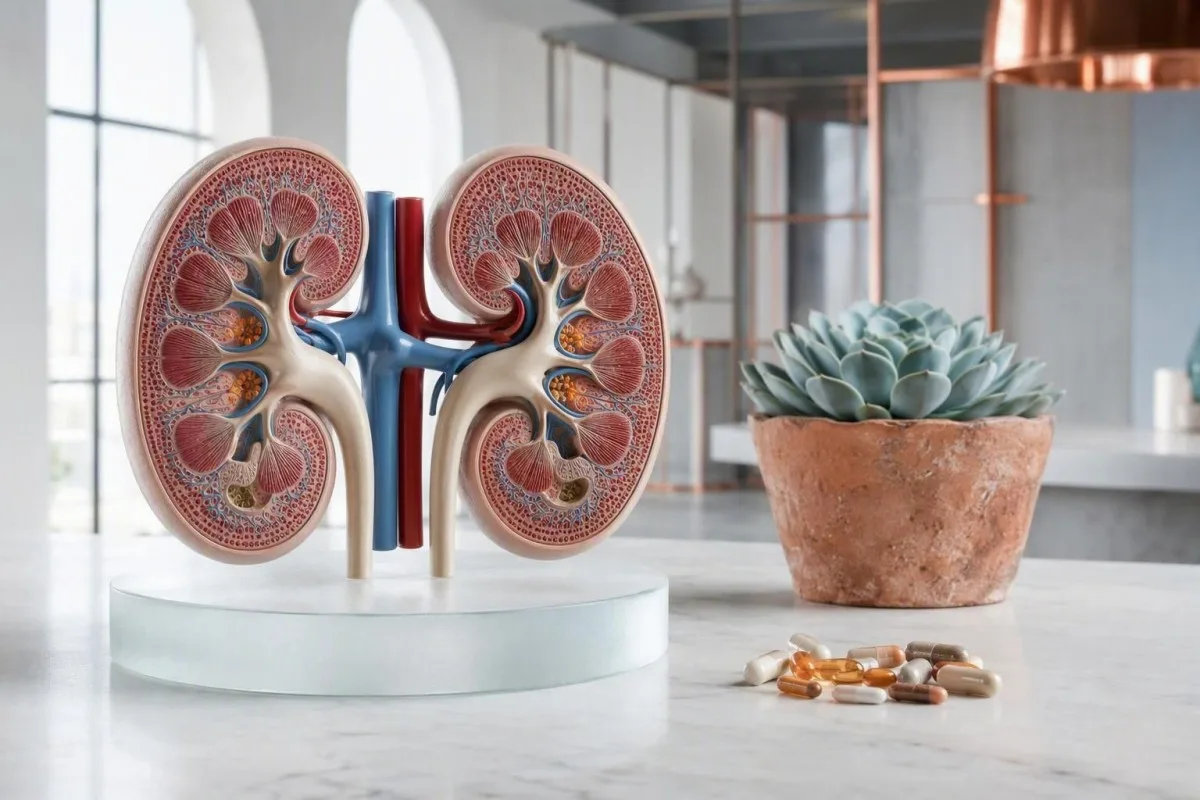
Most people with chronic kidney disease should not start a “kidney supplement” without checking eGFR, urine albumin, potassium, phosphate, calcium, bicarbonate, and medicines first. Deficiency-directed vitamin D, iron, vitamin B12, folate, and sometimes omega-3 can be reasonable; potassium, phosphorus, magnesium, high-dose vitamin C, creatine, and poorly regulated herbal blends can create real harm when filtration is reduced. The safest choice depends on kidney stage, dialysis status, blood results, and why the supplement is being considered.


- Kidney-first rule: Check eGFR and urine ACR before adding supplements; eGFR below 60 mL/min/1.73 m² changes risk calculations.
- Potassium: A serum potassium result above 5.5 mmol/L needs prompt clinical advice, especially with weakness, palpitations, ACE inhibitors, ARBs, or spironolactone.
- Vitamin D: In CKD, treat documented 25-hydroxyvitamin D deficiency rather than taking large routine doses; calcium and phosphate can rise with excessive treatment.
- Iron: Oral or intravenous iron is prescribed from ferritin and transferrin saturation patterns, not from fatigue alone.
- Phosphorus additives: Supplements containing phosphate salts can worsen hyperphosphataemia even when the front label does not say “phosphorus.”
- Vitamin C: Doses above 200 mg/day are commonly avoided in advanced CKD because oxalate can accumulate.
- Herbs: Avoid products containing aristolochic acid, unidentified proprietary blends, or “detox” mixtures; ingredient certainty matters as much as dose.
- Creatine: Creatine can raise serum creatinine without structural injury, but it can obscure kidney-function monitoring and should be clinician-led in CKD.
Start With Kidney Function, Not a Supplement Label
Supplements for kidney health are safe only when they fit the person’s kidney function, laboratory pattern, and medication list. An eGFR below 60 mL/min/1.73 m² for at least 3 months or a urine ACR of 30 mg/g or higher meets the usual definition of CKD, and both findings change how the body handles minerals and drugs.
As of August 12, 2026, I advise patients to treat the marketing claim “renal support” as a warning flag, not reassurance. Kantesti is an AI blood test analyzer that places creatinine, eGFR, potassium, bicarbonate, calcium, phosphate, and albumin in the same clinical view, which is far more useful than judging one result in isolation. For a practical staging refresher, see our CKD stages guide.
In my practice, the commonest mistake is assuming CKD is one condition. A 44-year-old with eGFR 58 and normal potassium has a very different supplement risk profile from an 81-year-old with eGFR 22, diabetes, loop diuretics, and recurrent dehydration. Dr. Thomas Klein’s rule is simple: bring every bottle, powder, gummy, tea, and sports product to the medication review.
The Seven Labs to Check Before Any CKD Supplement
Creatinine or eGFR, potassium, bicarbonate, calcium, phosphate, 25-hydroxyvitamin D, and urine ACR are the core pre-supplement checks in CKD. No single “renal panel” answers every question, but these results identify the risks that labels hide.
Potassium is usually reported around 3.5-5.0 mmol/L, although local laboratory limits vary. A result of 5.5 mmol/L or higher is not automatically an emergency, but it deserves same-day clinical advice when CKD, ECG symptoms, diabetes, or potassium-raising medicines are present; a falsely high result from sample haemolysis is also common. Our explanation of potassium draw errors can prevent unnecessary panic.
KDIGO’s 2024 CKD guideline recommends assessing GFR and albuminuria together because their combination predicts progression and complications more accurately than either alone (KDIGO, 2024). If eGFR falls by more than 20% after starting a new drug or supplement, clinicians usually review volume status, medicines, and the possibility of an acute kidney injury rather than assuming ordinary CKD drift. Read about the expected SGLT2 eGFR dip before attributing every change to a capsule.
Supplements That Can Be Appropriate When a Deficiency Is Proven
Vitamin D, iron, vitamin B12, folate, and selected omega-3 products can be appropriate CKD supplements when a specific indication exists. They do not repair nephrons or reverse CKD, and their dose should be guided by a measurable target.
Vitamin B12 and folate are generally low-risk at replacement doses, but they should answer a real question: macrocytosis, low B12, dietary restriction, malabsorption, or treatment-related deficiency. A B12 level below roughly 200 pg/mL (148 pmol/L) is commonly treated as deficient, while 200-300 pg/mL may need methylmalonic acid or clinical context. Our B12 and folate guide explains why folate alone can mask the blood-count effects of B12 deficiency.
Omega-3 fish oil may lower triglycerides, but it has not convincingly been shown to preserve eGFR in most adults with CKD. For triglycerides above 500 mg/dL (5.6 mmol/L), the objective is usually pancreatitis-risk reduction and prescription treatment decisions, not “kidney cleansing.” Review the evidence and practical dosing in our omega-3 guide.
Vitamin D in CKD: Useful, but Not Automatically Harmless
Vitamin D should be corrected for documented deficiency in CKD, while calcitriol and active vitamin-D analogues require more caution because they can raise calcium and phosphate. The relevant result is usually 25-hydroxyvitamin D, not a generic wellness score.
KDIGO’s CKD-mineral and bone disorder guideline advises measuring 25-hydroxyvitamin D and correcting deficiency using strategies used in the general population, while avoiding routine calcitriol in non-dialysis CKD G3a-G5 unless hyperparathyroidism is severe and progressive (KDIGO, 2017). Many laboratories call 25-hydroxyvitamin D below 20 ng/mL (50 nmol/L) deficient, but targets differ by country and clinical purpose.
The catch is calcium-phosphate balance. A patient with a 25-hydroxyvitamin D of 14 ng/mL may reasonably receive cholecalciferol, whereas someone with calcium 10.5 mg/dL, phosphate 5.8 mg/dL, and elevated PTH needs a renal plan, not an over-the-counter dose escalation. Kantesti is an AI blood test interpretation platform that reads vitamin D beside calcium, phosphate, alkaline phosphatase, and kidney function, rather than presenting a green or red flag alone. Browse our biomarker reference guide for the related tests.
Phosphorus, Calcium, and Magnesium: Risks Rise as eGFR Falls
Phosphate, calcium, and magnesium supplements need individualized review in CKD because reduced renal clearance can turn an ordinary dose into an excessive body burden. The risk is greatest with eGFR below 30 mL/min/1.73 m² and in dialysis.
Adult phosphate is often around 2.5-4.5 mg/dL (0.81-1.45 mmol/L), but treatment in CKD is based on serial values, diet, PTH, and medicines rather than one draw. Phosphate additives in effervescent tablets, protein powders, bowel preparations, and some multivitamins are absorbed more readily than naturally occurring food phosphate. Our high phosphate guide details the usual follow-up pattern.
Magnesium is another under-recognised issue. Magnesium citrate and oxide are common in sleep and constipation products, and magnesium can accumulate in advanced CKD, causing lethargy, low blood pressure, and slowed reflexes at substantial elevations. A typical serum magnesium reference interval is 1.7-2.4 mg/dL (0.70-1.00 mmol/L); our review of high magnesium causes explains why laxatives matter.
Iron for CKD Anaemia: Treat the Pattern, Not Tiredness Alone
Iron can help CKD anaemia when iron availability is low, but ferritin and transferrin saturation must be interpreted together because inflammation can raise ferritin. Fatigue by itself is not evidence that iron is needed.
Transferrin saturation, or TSAT, below 20% often suggests inadequate available iron; ferritin below 100 ng/mL in non-dialysis CKD is also strongly suggestive, although thresholds vary with dialysis and inflammation. The KDOQI nutrition guideline stresses individual nutritional assessment in CKD rather than generic supplement protocols (Ikizler et al., 2020). See our detailed iron studies guide before self-treating a ferritin result.
Oral iron commonly causes constipation, nausea, and dark stools, which can be more troublesome in CKD patients already taking phosphate binders. A useful practical point: a ferritin of 300 ng/mL does not exclude functional iron deficiency if TSAT is 14% and CRP is elevated, but it absolutely does not justify a high-dose iron product without the prescriber who manages anaemia.
Protein Powders and Creatine: Why Lab Interpretation Gets Tricky
High-protein powders and creatine are not proven treatments for CKD, and creatine can increase serum creatinine enough to complicate eGFR interpretation. Neither should be started simply because a product claims to support muscle or kidney resilience.
Creatinine is generated from muscle metabolism and dietary creatine, so a rise after creatine may represent altered creatinine production rather than falling filtration. Still, in established CKD, we often cannot safely assume that explanation without a baseline, cystatin C, urinalysis, blood pressure, and repeat testing. Our creatinine after exercise guide covers a similar interpretive trap.
Protein targets vary. Many stable non-dialysis adults with CKD are advised around 0.6-0.8 g/kg/day, while dialysis patients commonly need about 1.0-1.2 g/kg/day because dialysis removes amino acids; pregnancy, frailty, wounds, and cancer alter this further. A 30 g scoop added twice daily can matter a lot for a 55 kg person, so involve a renal dietitian rather than guessing.
Herbal Supplements and Kidneys: Ingredients That Deserve a Hard No
Herbal supplements and kidneys are a risky combination when ingredients are unknown, doses are concentrated, or products contain aristolochic acid, stimulant laxatives, heavy metals, or hidden anti-inflammatory drugs. “Natural” is not a renal safety category.
Aristolochic acid has been linked to progressive tubulointerstitial kidney injury and urothelial cancer, and products may use plant names unfamiliar to consumers. I advise patients with CKD to avoid all products listing Aristolochia, Asarum, or vague traditional botanical mixtures unless a renal pharmacist can verify the ingredients. Kantesti is an AI-powered blood test analysis tool that can help patients notice changing creatinine, liver enzymes, and electrolytes over time, but it cannot certify an unregulated herb as safe.
Turmeric or curcumin is not automatically forbidden, yet high-dose products can be problematic in people prone to calcium oxalate stones because turmeric powder is oxalate-rich. “Kidney detox” teas may also contain senna, licorice, or diuretic herbs that shift potassium and volume status. For a related safety checklist, read curcumin and CRP safety.
Vitamin C and Fat-Soluble Vitamins: Dose Changes the Risk
Vitamin C, vitamin A, vitamin E, and vitamin K are not interchangeable wellness supplements in CKD. High-dose vitamin C can increase oxalate exposure, while vitamin A can accumulate when filtration is impaired.
For advanced CKD and dialysis, many renal clinicians limit vitamin C to approximately 60-100 mg/day and generally avoid doses above 200 mg/day unless there is a specific supervised indication. The concern is oxalate accumulation and calcium oxalate deposition, especially with poor filtration, high-dose powders, or intravenous vitamin C. Vitamin C also changes some urine glucose and stool blood tests.
Vitamin A is not routinely supplemented in CKD because retinol may accumulate and contribute to bone, skin, and liver toxicity. Vitamin E may increase bleeding tendency at high doses, especially with antiplatelet or anticoagulant medicines; vitamin K interacts with warfarin rather than directly harming kidneys. Our overview of fat-soluble vitamin labs helps separate deficiency testing from marketing claims.
Uric Acid Products and “Kidney Cleanses” Do Not Replace Gout Care
Uric acid supplements and alkaline “kidney cleanse” products should not replace prescribed gout or stone treatment in CKD. Potassium citrate, sodium bicarbonate, cherry concentrates, and vitamin C each carry different risks depending on potassium, sodium, urine pH, and stone type.
Serum urate above 6.8 mg/dL (0.40 mmol/L) is the approximate saturation point for monosodium urate at physiological pH, but the result alone does not diagnose gout. Allopurinol and febuxostat dosing often need adjustment or monitoring in CKD; unregulated “uric acid support” products do not have comparable evidence. Start with our uric acid testing plan.
Sodium bicarbonate may be prescribed for persistent metabolic acidosis, often when serum bicarbonate is below 22 mmol/L, but it can worsen oedema or hypertension through sodium load. Potassium citrate may be appropriate for selected stone patterns, yet it is often unsuitable with hyperkalaemia risk. This is one of those areas where the urine chemistry matters more than the supplement category.
How Supplements Can Distort Kidney and Related Blood Tests
Biotin, creatine, vitamin C, intense exercise products, and dehydration can distort laboratory interpretation even when they do not directly injure the kidneys. A reliable trend requires knowing what was taken and when.
Biotin can interfere with some immunoassays, particularly thyroid, hormone, and cardiac marker tests; the risk rises with doses of 5-10 mg/day often found in hair products. Creatine can increase creatinine, while large protein meals and heavy resistance training can transiently change urea and creatinine. Our fasting and supplements guide gives a practical pre-test checklist.
Dr. Thomas Klein recommends recording dose, last use, exercise, illness, alcohol, and hydration beside each blood draw. Kantesti AI interprets kidney-related trends by comparing prior results and context, rather than treating a one-off flagged creatinine as a diagnosis. A change that is biologically plausible and repeated is much more meaningful than a single outlier.
A Safer Monitoring Plan After Starting a CKD Supplement
A new supplement in CKD should have a stated indication, a baseline result, a stop rule, and a planned recheck date. Without those four items, it is difficult to separate benefit, harm, and ordinary laboratory variation.
For potassium-, magnesium-, calcium-, phosphate-, or bicarbonate-containing products, many clinicians recheck a renal panel within 1-2 weeks in high-risk CKD, and sooner after symptoms or medication changes. For iron or vitamin D, the interval is often 6-12 weeks, depending on the dose and whether anaemia or mineral-bone disease is present. See how to identify meaningful changes in our lab trend analysis guide.
Stop the product and seek medical advice urgently for new palpitations, fainting, profound weakness, confusion, severe vomiting, markedly reduced urine output, or rapidly worsening swelling. Those symptoms are not proof of supplement toxicity, but with CKD they deserve quicker assessment than an online review. Keep photographs of labels; formulations change more often than patients realise.
Questions to Ask Your Kidney Team Before Taking a Supplement
The best question is not “Is this supplement good for kidneys?” but “What problem are we treating, what result will show benefit, and what result means I should stop?” This framing protects patients from unnecessary expense and avoidable electrolyte harm.
Ask whether your current medicines raise potassium, alter phosphate absorption, cause magnesium loss, or change vitamin D metabolism. Ask whether the supplement has independent quality testing and whether the stated dose is appropriate for your eGFR and dialysis status. Our medical advisory board reviews clinical content with the same principle: technology can organise information, but prescribing decisions remain personal and clinician-led.
There is no validated over-the-counter product that regenerates kidneys or reliably reverses CKD. Blood-pressure control, diabetes management, avoiding NSAID overuse, smoking cessation, vaccination, medication review, and albuminuria-directed treatment have much stronger evidence than a branded renal blend. A useful next read is our renal panel fasting guide.
Research, Clinical Oversight, and the Limits of AI Lab Interpretation
AI can organise CKD laboratory patterns and prompt questions, but it cannot determine whether a supplement is safe without the person’s medicines, diagnosis, examination, and prescribing clinician. The clinical decision is particularly sensitive when eGFR is below 30 mL/min/1.73 m² or potassium is abnormal.
Kantesti is an AI lab test interpretation service designed to interpret laboratory reports in context and support better follow-up conversations. Its output should be treated as educational decision support, not as a substitute for renal care, emergency assessment, or a pharmacist’s interaction review. Readers who want to understand methodology can review our medical validation standards.
Our research publications describe engineering validation and multilingual clinical-decision-support development; they do not establish that an AI tool can prescribe supplements or replace nephrology care. Kantesti’s clinical work is supported by physician review, transparent limitations, and continued monitoring of how results are communicated. The publications are listed below with their DOI records for direct source review.
Frequently Asked Questions
What supplements are safe for kidneys with CKD?
Supplements that may be safe with CKD include vitamin D, iron, vitamin B12, folate, and omega-3 products when there is a documented indication and an appropriate dose. Safety depends on eGFR, urine albumin, potassium, phosphate, calcium, bicarbonate, dialysis status, and medicines. For example, vitamin D may be used for a 25-hydroxyvitamin D level below 20 ng/mL, while iron treatment depends on ferritin and transferrin saturation rather than fatigue alone. No over-the-counter supplement has been proven to regenerate kidneys or reverse CKD.
Should people with CKD avoid potassium supplements?
Most people with CKD should avoid potassium supplements and potassium-based salt substitutes unless their renal clinician specifically recommends them. Potassium above 5.5 mmol/L requires prompt clinical advice, and values of 6.0 mmol/L or higher can require urgent assessment depending on symptoms, ECG findings, and the rate of rise. ACE inhibitors, ARBs, spironolactone, finerenone, trimethoprim, and dehydration can increase the risk. Potassium citrate for stones is also a medication-level decision in CKD, not a routine wellness product.
Can I take vitamin D if I have chronic kidney disease?
Vitamin D can be used in CKD when testing shows deficiency, but the form and follow-up testing matter. A 25-hydroxyvitamin D concentration below 20 ng/mL, or 50 nmol/L, is commonly considered deficient, although target ranges vary among guidelines. Active vitamin D medicines such as calcitriol can raise calcium and phosphate and are not routinely used in non-dialysis CKD without a specific mineral-bone indication. Calcium, phosphate, PTH, eGFR, and repeat vitamin D levels guide safe treatment.
Why is high-dose vitamin C risky in CKD?
High-dose vitamin C can increase oxalate production, and oxalate may accumulate when kidney filtration is reduced. Many renal clinicians limit vitamin C to about 60-100 mg/day in advanced CKD and avoid routine doses above 200 mg/day unless a clinician has a specific reason. The concern is greater with powders, intravenous therapy, recurrent calcium oxalate stones, and eGFR below 30 mL/min/1.73 m². Vitamin C can also interfere with selected urine and stool laboratory tests.
Are herbal kidney detox supplements safe?
Herbal kidney detox supplements are not considered reliably safe for people with CKD because products may contain poorly disclosed ingredients, concentrated extracts, stimulant laxatives, potassium, or contaminants. Aristolochic acid-containing products have been associated with severe chronic kidney injury and urinary tract cancer. Even widely used ingredients such as turmeric, licorice, cranberry, or green tea extract can be unsuitable for particular stone patterns, blood pressure problems, liver conditions, or medicines. Use a pharmacist or nephrology review before taking any multi-herb product.
Does creatine damage kidneys if I have CKD?
Creatine can raise serum creatinine because creatinine is a breakdown product of creatine, which can make eGFR appear lower without proving kidney injury. In people with established CKD, that laboratory effect can obscure detection of a genuine decline, so creatine should not be started without clinician oversight. Cystatin C, urinalysis, blood pressure, medication review, and repeated results may help distinguish an assay interpretation problem from true kidney stress. Evidence supporting unsupervised creatine use in moderate-to-advanced CKD remains limited.
Get AI-Powered Blood Test Analysis Today
Join over 2 million users worldwide who trust Kantesti for instant, accurate lab test analysis. Upload your blood test results and receive comprehensive interpretation of 15,000+ biomarkers in seconds.
📚 Referenced Research Publications
Klein, T., Mitchell, S., & Weber, H. (2026). Multilingual AI Assisted Clinical Decision Support for Early Hantavirus Triage: Design, Engineering Validation, and Real-World Deployment Across 50,000 Interpreted Blood Test Reports. Kantesti AI Medical Research.
Klein, T., Mitchell, S., & Weber, H. (2026). A Pre-Registered, Rubric-Based Automated Technical Benchmark of the Kantesti Blood-Test Interpretation Engine on 100,000 Synthetic Test Cases. Kantesti AI Medical Research.
📖 External Medical References
⚕️ Medical Disclaimer
This article is for educational purposes only and does not constitute medical advice. Always consult a qualified healthcare provider for diagnosis and treatment decisions.
E-E-A-T Trust Signals
Experience
Physician-led clinical review of lab interpretation workflows.
Expertise
Laboratory medicine focus on how biomarkers behave in clinical context.
Authoritativeness
Written by Dr. Thomas Klein with review by Dr. Sarah Mitchell and Prof. Dr. Hans Weber.
Trustworthiness
Evidence-based interpretation with clear follow-up pathways to reduce alarm.