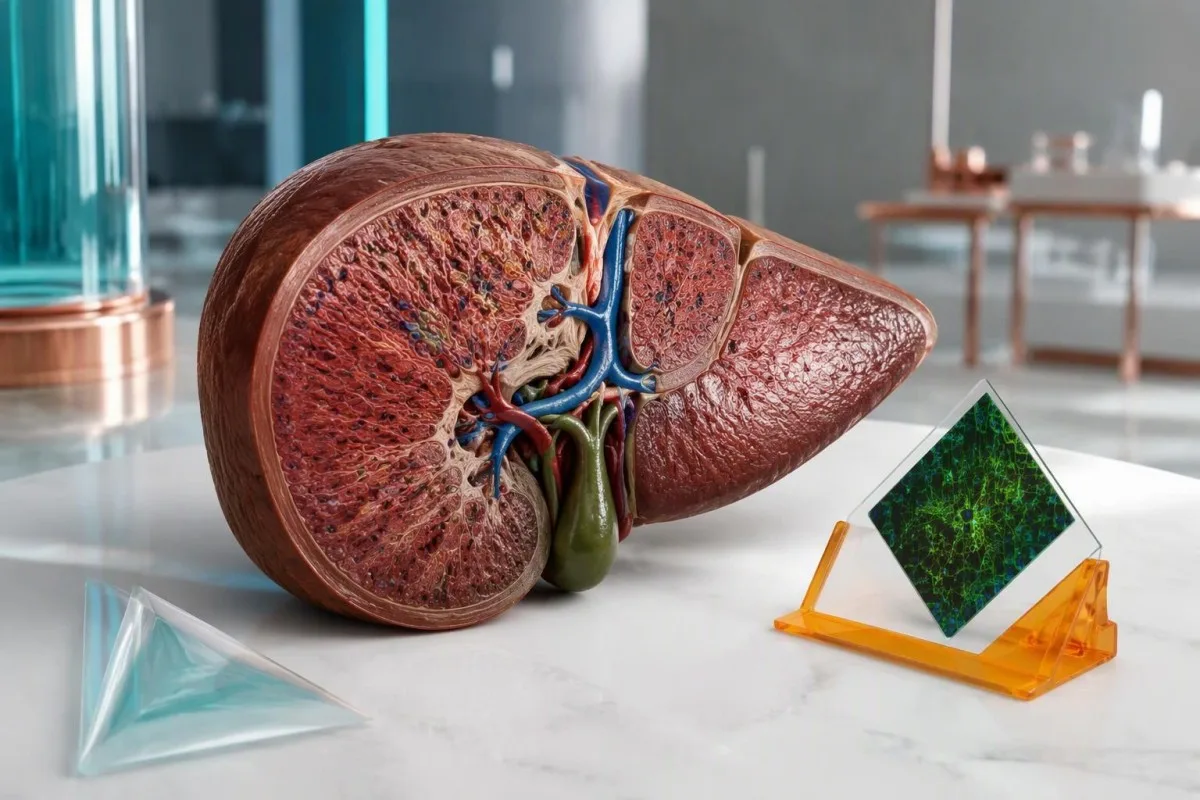
Um resultado positivo de anticorpos é uma pista, não um diagnóstico. A questão útil é saber se ele é compatível com suas enzimas hepáticas, seu nível de IgG, seu histórico de medicamentos e os achados histológicos.


- Anticorpos antimúsculo liso positivos por si só não diagnosticam hepatite autoimune; um título de ASMA de 1:40 em adultos contribui com apenas 1 ponto para o escore diagnóstico simplificado.
- Títulos mais altos de ASMA aumentam o suporte diagnóstico, mas os títulos de 1:80 e 1:320 recebem a mesma pontuação máxima de 2 pontos para anticorpos nos critérios simplificados.
- Anticorpos anti-F-actina identificam um alvo de anticorpos mais específico, mas um resultado positivo ainda precisa ser considerado no contexto dos exames hepáticos e do quadro clínico; as unidades do ensaio não podem ser convertidas em títulos de ASMA.
- IgG total acima do limite superior de referência do laboratório dá suporte ao diagnóstico de hepatite autoimune; um nível acima de 1,1 vez esse limite recebe 2 pontos no escore simplificado.
- ALT normal torna a positividade incidental menos preocupante, embora enzimas ou IgG normais não excluam universalmente a hepatite autoimune.
- Histórico de medicação deve incluir medicamentos prescritos e suplementos iniciados meses ou anos antes, particularmente nitrofurantoína e minociclina.
- Biópsia hepática geralmente ajuda a estabelecer a hepatite autoimune e avaliar a fibrose; decisões urgentes sobre o tratamento não devem aguardar exames eletivos em um paciente gravemente enfermo.
- Avaliação urgente é necessário em caso de icterícia com confusão, sonolência significativa ou INR crescente; INR de pelo menos 1,5 com encefalopatia pode indicar insuficiência hepática aguda.
Anticorpos antimúsculo liso positivos indicam hepatite autoimune?
Anticorpos antimúsculo liso positivos não diagnosticam hepatite autoimune por si só. Um resultado de baixo título, como 1:40, pode ser inespecífico; os médicos procuram um padrão correspondente de ALT ou AST elevada, IgG aumentada, exclusão de outras doenças hepáticas e, em geral, achados compatíveis no tecido hepático.
ASMA, também chamado de SMA, detecta anticorpos que reagem com componentes do músculo liso e estruturas celulares relacionadas; isso não significa que seus músculos estejam sendo destruídos. O ASMA está mais fortemente associado à hepatite autoimune tipo 1, mas também pode aparecer durante outras respostas imunes ou doenças hepáticas, por isso a palavra positivo no exame laboratorial não é um diagnóstico.
Considere 2 resultados ilustrativos: ASMA 1:40 com ALT 24 IU/L e IgG normal, em comparação com ASMA 1:160 com ALT 286 IU/L e IgG acima do limite do laboratório. O segundo padrão merece uma investigação consideravelmente mais aprofundada, embora nenhum dos dois estabeleça a causa sem uma avaliação clínica. Nossa explicação sobre significado de resultado positivo de anticorpos diferencia a detecção de anticorpos das evidências de doença ativa.
Kantesti é um Analisador de teste de sangue de IA que pode ajudar a organizar os resultados de ASMA junto com as enzimas hepáticas e a IgG, em vez de tratar um resultado 1:40 como diagnóstico. Como Thomas Klein, Diretor Médico, minha abordagem neste artigo é explicar esse raciocínio abertamente, inclusive os aspectos que os números não conseguem esclarecer. Nossas organização e foco clínico contextualizam essa função educativa; o diagnóstico continua sendo responsabilidade do médico.
Interpretação do título de ASMA: o que significam 1:40 e 1:80?
Os títulos de ASMA descrevem até que ponto uma amostra pode ser diluída enquanto a marcação de anticorpos permanece detectável. Em adultos, os critérios simplificados para hepatite autoimune atribuem 1 ponto para ANA ou SMA de pelo menos 1:40 e 2 pontos para pelo menos 1:80; nenhum dos limites diagnostica hepatite de forma independente.
Um título de 1:160 significa que a marcação continua detectável após uma diluição maior do que em 1:40; não significa 4 vezes mais lesão hepática. Nos critérios simplificados de Hennes et al., a pontuação dos anticorpos para em 2, portanto, 1:80 e 1:640 não continuam somando pontos diagnósticos. A concentração de anticorpos, a sensibilidade do ensaio e a lesão tecidual estão relacionadas de forma imperfeita — e essa distinção evita alarmes desnecessários.
Os métodos laboratoriais afetam a comparabilidade. A imunofluorescência indireta em substratos de tecido, os ensaios específicos para antígenos, as diluições iniciais e as convenções de laudo variam entre laboratórios; uma mudança de 1:40 para 1:80 pode representar uma única etapa de diluição, e não uma mudança clinicamente significativa. A mesma cautela se aplica à interpretação do teste de ANA, especialmente quando vários anticorpos fracamente positivos aparecem juntos.
A interpretação em crianças é diferente: títulos de SMA tão baixos quanto 1:20 podem ser relevantes em um quadro pediátrico apropriado. Os limites de pontuação para adultos não devem ser aplicados ao laudo de uma criança sem o parecer de um especialista, e uma triagem negativa no padrão de adultos pode deixar passar achados pediátricos de títulos mais baixos. Pergunte ao laboratório qual substrato e qual diluição inicial foram usados; esses detalhes costumam ser mais úteis do que repetir o exame em outro local.
Um resultado positivo para anticorpos anti-F-actina esclarece o diagnóstico?
An F-actin antibody positive result can strengthen suspicion of autoimmune hepatitis, but it is not a stand-alone confirmation. F-actin testing targets filamentous actin, one antigen recognized by some smooth muscle antibodies; its usefulness depends on the assay, strength of positivity, and accompanying liver abnormalities.
F-actin assays and ASMA titers are different measurements. Some commercial ELISA methods report less than 20 units as negative, 20–30 as weakly positive, and above 30 as positive, but other kits use different categories and units. A result of 25 units must therefore be read against that report's reference interval, not a cutoff copied from another laboratory or an online discussion.
A weak F-actin result with ASMA 1:40 and normal ALT may add little certainty; a clearly positive result alongside persistent enzyme elevation and increased IgG is more persuasive. F-actin antibodies can occur outside autoimmune hepatitis, including in other liver diseases, while some patients with autoimmune hepatitis lack detectable F-actin antibodies. This is a probability adjustment, not a yes-or-no confirmation switch.
Discordant tests deserve a method check before another diagnosis is added. ASMA may recognize targets other than F-actin, and antigen preparation can influence an ELISA result, so positive ASMA with negative F-actin is not automatically a laboratory error. Our guide to resultados qualitativos e quantitativos explains why 1:80, 25 units, and a simple positive flag cannot be converted into one interchangeable number.
Por que a IgG total é mais importante do que outro resultado positivo de anticorpos?
Elevated total IgG supports autoimmune hepatitis because it reflects increased immunoglobulin production accompanying immune-mediated liver injury. The simplified criteria award 1 point above the laboratory upper limit and 2 points above 1.1 times that limit; normal IgG does not completely exclude the disease.
Adult IgG reference intervals commonly approximate 7–16 g/L, equivalent to 700–1,600 mg/dL, although laboratory and age-specific ranges take priority. If the upper limit is 16 g/L, an IgG of 17 g/L exceeds normal, while 18 g/L exceeds 1.1 times the limit of 17.6 g/L. Use the measured total IgG—not total protein—to make that comparison.
Globulin and the gamma gap cannot substitute for quantitative IgG. For example, total protein 84 g/L minus albumin 38 g/L produces a 46 g/L gap, but that gap contains proteins other than IgG and does not prove autoimmune hepatitis. Our gamma gap interpretation guide explains why an apparently useful shortcut can send the investigation down the wrong path.
Normal IgG should lower confidence in a classic presentation, not close the case when ALT is 500 IU/L or the patient is jaundiced. Acute presentations can lack the usual immunoglobulin pattern, and IgG can also rise with cirrhosis or other inflammatory conditions. Read IgG, IgA e IgM juntas when the protein abnormality is broader than isolated IgG elevation.
Qual padrão de exames hepáticos torna a positividade para ASMA mais preocupante?
Persistent ALT and AST elevation makes positive ASMA more concerning, especially when IgG is also elevated. Autoimmune hepatitis usually produces a hepatocellular pattern—aminotransferases rising more prominently than alkaline phosphatase—but the enzyme magnitude alone cannot identify the cause or accurately measure liver function.
ALT reflects injury more than function. An ALT of 240 IU/L with an upper limit of 40 is 6 times the upper limit, but that ratio does not distinguish autoimmune hepatitis from viral hepatitis, drug injury, or several other causes. Bilirubin, INR, albumin, symptoms, and the direction of change tell a different part of the story; our explicação do resultado de ALT separates these roles.
O rácio R compares ALT divided by its upper limit with ALP divided by its upper limit; a ratio at least 5 supports a hepatocellular injury pattern, particularly in drug-injury assessment. ALT 240/40 and ALP 120/120 give an R ratio of 6. This calculation classifies the pattern, not the diagnosis, and should use values obtained at the same time.
Disproportionate ALP elevation changes the differential diagnosis. If ALP is 3 times its upper limit while ALT is only mildly raised, clinicians consider biliary obstruction, primary biliary cholangitis, primary sclerosing cholangitis, or an overlap presentation rather than assuming isolated autoimmune hepatitis. Our guide to cholestatic liver-test patterns shows why GGT and imaging may become more useful than another ASMA measurement.
Quão tranquilizadoras são enzimas hepáticas normais com ASMA positivo?
Positive ASMA with repeatedly normal liver enzymes is generally less concerning than ASMA with unexplained enzyme elevation. In a retrospective cohort reported by Healey et al. in 2016, only 1 of 202 people with SMA positivity and ALT below 55 IU/L subsequently received an autoimmune hepatitis diagnosis.
The observed proportion was approximately 0.5%, not zero. That study's ALT threshold of 55 IU/L was part of its design and should not become everyone's definition of normal, particularly when your laboratory uses a lower limit. The retrospective population also cannot provide an individualized probability for someone with jaundice, high IgG, prior abnormal tests, or established liver disease.
For an illustrative patient with ASMA 1:40, ALT 26 IU/L, normal bilirubin, and normal IgG, the next step is usually clinical review rather than immediate immunosuppression. A clinician may choose a repeat liver panel in roughly 6–12 weeks when a recent illness, medication exposure, or uncertain baseline needs clarification, but there is no universal ASMA-specific retesting interval. Review mild ALT elevation follow-up if the supposedly normal result is actually borderline.
Previous results can overturn a reassuring snapshot. An ALT of 30 IU/L today means something different after an unexplained value of 300 IU/L last month, especially if corticosteroids were started between samples. Bring at least 2 dated panels when possible; the important question is whether injury never occurred, resolved after a trigger disappeared, or was suppressed by treatment rather than truly excluded.
Medicamentos podem causar ASMA positivo e hepatite semelhante à autoimune?
Some medicines can cause liver injury with ASMA positivity, increased IgG, and tissue findings resembling autoimmune hepatitis. Nitrofurantoin and minocycline are classic examples; exposure may precede recognition by months or years, so a medication taken uneventfully for 2 years still belongs in the history.
The start date matters as much as the medicine name. Hydralazine, methyldopa, and some biologic medicines can also produce autoimmune-like liver injury, while herbal products may cause other injury patterns that coexist with incidental antibodies. Write down dose changes, intermittent courses, and supplements used during the preceding 12 months; include longer-standing drugs rather than limiting the list to something newly prescribed last week.
Drug-induced autoimmune-like hepatitis and idiopathic autoimmune hepatitis can look remarkably similar initially. Improvement after supervised withdrawal and the longer-term relapse pattern help distinguish them, but ALT may take weeks to fall and some patients still require corticosteroids. A fall from 400 to 200 IU/L is encouraging, not proof of the cause; persistent or recurrent injury needs reassessment rather than a premature label.
Kantesti é um plataforma de interpretação de biomarcadores por IA that can help arrange laboratory trends beside medication dates, but it cannot determine causality from an ASMA titer of 1:80. Our guia de tecnologia de interpretação por IA describes the supporting workflow rather than a replacement for hepatology assessment. Do not stop an essential prescription on your own; suspected liver injury requires prompt prescriber advice, with emergency assessment when symptoms are severe.
O que mais deve ser excluído antes de diagnosticar hepatite autoimune?
Viral hepatitis, drug injury, metabolic liver disease, and selected inherited conditions must be considered before attributing liver injury to positive ASMA. The AASLD practice guidance emphasizes compatible findings and exclusion of competing explanations; antibody positivity does not protect a patient from having a second, more common condition.
Acute hepatitis E can resemble autoimmune hepatitis, including marked aminotransferase elevation, and testing depends on exposure, geography, immune status, and clinical presentation. Hepatitis B and C assessment is also part of a standard liver work-up, with hepatitis A or other viruses considered when appropriate. Our hepatitis E testing explanation clarifies why IgM, IgG, and PCR answer different questions rather than supplying 3 interchangeable confirmations.
MASLD can coexist with positive autoantibodies. An illustrative person with metabolic risk factors, liver fat on imaging, ALT 65 IU/L, ASMA 1:40, and normal IgG may have steatotic liver disease rather than autoimmune hepatitis, although coexisting disease remains possible. Our guide to metabolic liver disease testing explains how fibrosis assessment differs from identifying an immune cause.
In younger patients, unexplained hepatitis may require consideration of Wilson disease; iron overload and alpha-1 antitrypsin deficiency enter the differential according to age and presentation. An ALP elevation of 3 times normal also raises questions about biliary disease or overlap syndromes rather than simply increasing the apparent strength of ASMA. Kantesti AI should support a discussion of missing context, not automatically order every available test because 1 antibody is positive.
Quando é necessária uma biópsia hepática para investigar ASMA positivo?
Liver biopsy is usually needed to establish autoimmune hepatitis when the clinical and laboratory findings suggest it. Tissue assessment can identify hepatitis, evaluate fibrosis, and reveal competing explanations; the AASLD guidance advises against diagnosing autoimmune hepatitis without biopsy, while urgent or unsafe situations require specialist judgment.
Interface hepatitis describes immune-cell activity at the boundary between portal areas and liver-cell plates; it supports autoimmune hepatitis but is not unique to it. Plasma-cell-rich inflammation can be helpful, yet its absence does not exclude the diagnosis, and drug injury can produce similar appearances. A tissue report must be interpreted alongside ASMA 1:80, IgG, viral testing, and the medication timeline—not treated as another isolated positive test.
Fibrosis tests cannot replace diagnostic histology. Liver stiffness may rise during active hepatitis, so a FibroScan value obtained while ALT is 500 IU/L can overstate fibrosis relative to a measurement after the injury settles. Our FibroScan result guide explains the distinction between stiffness and cause; a scan cannot show the cellular pattern needed to evaluate autoimmune hepatitis.
Biopsy timing and route depend on safety. A patient with impaired clotting, fluid accumulation, or severe acute illness may need a transjugular approach or a different immediate plan rather than routine percutaneous sampling. Likewise, a FIB-4 risk calculation can be distorted by acute AST elevation or platelets falling for another reason; none of these tools should delay urgent care when INR is rising toward or above 1.5.
Como os médicos combinam os critérios do escore de hepatite autoimune?
The simplified autoimmune hepatitis score combines autoantibodies, IgG, liver histology, and exclusion of viral hepatitis. Hennes et al. developed an 8-point system in which at least 6 points supports probable and at least 7 supports definite autoimmune hepatitis; the score assists clinical judgment rather than replacing it.
Autoantibody points are capped at 2. ANA 1:160 plus ASMA 1:160 does not produce 4 points, and adding F-actin positivity is not a separate extra-point category. Anti-LKM1 at the qualifying threshold or positive anti-SLA can contribute within the same antibody category, but assay details matter. This prevents several related tests from being mistaken for several independent proofs of one diagnosis.
An illustrative adult with ASMA 1:80, IgG 1.2 times normal, typical histology, and excluded viral hepatitis reaches 8 points: 2 in each category. Another patient could mathematically reach 6 without histology, but that arithmetic does not justify bypassing the AASLD biopsy recommendation or ignoring medication-related injury. The original Hennes et al. criteria are a clinical framework, not a self-diagnosis calculator.
A low simplified score does not reliably dismiss every atypical presentation. Acute severe disease, normal IgG, or absent conventional antibodies can require a specialist assessment using additional evidence or a more detailed scoring system. Our padrões de metodologia clínica explain why interpretation tools need explicit limitations; neither a 5-point estimate nor an 8-point estimate should independently decide whether someone starts immunosuppression.
Quais achados precisam de avaliação urgente em vez de acompanhamento de rotina?
Urgency depends on symptoms and liver dysfunction, not the ASMA titer. New jaundice with confusion, unusual drowsiness, significant bleeding, or rapidly worsening illness needs emergency assessment; INR at least 1.5 with hepatic encephalopathy can indicate acute liver failure in someone without pre-existing cirrhosis.
A rising INR can be more concerning than a rising antibody titer. Interpretation must account for warfarin, vitamin K deficiency, and other causes, but an unexplained INR of 1.6 during acute hepatitis deserves prompt clinical attention rather than waiting for repeat ASMA. Our explicação do resultado do INR distinguishes a clotting-time measurement from a diagnosis and explains why medication context changes its meaning.
ALT at least 5 times the upper limit warrants timely investigation, particularly with symptoms or increasing bilirubin, although there is no universal ASMA-specific ALT threshold that automatically means admission. A patient with ALT 220 IU/L, rising bilirubin, and poor intake may need faster assessment than someone with ALT 400 IU/L who has stable function and an established treatment plan. Numbers need a trajectory and a bedside assessment.
Conjugated bilirubin elevation points toward hepatobiliary dysfunction, but it does not distinguish autoimmune hepatitis from obstruction or another hepatitis. New yellow eyes or dark urine should prompt assessment, even if ASMA is only 1:40; our guia de padrões de bilirrubina direta explains the competing mechanisms. Do not wait for an AI interpretation, a second antibody result, or an elective appointment if confusion or significant drowsiness develops.
ASMA positivo deve ser tratado com esteroides ou azatioprina?
Positive ASMA alone should not be treated with corticosteroids or azathioprine. Treatment targets confirmed or strongly supported active autoimmune hepatitis, not an antibody concentration; even a titer of 1:320 does not justify immunosuppression when the clinical evidence for liver disease is absent.
Confirmed autoimmune hepatitis is treatable, commonly with corticosteroid-based induction and a steroid-sparing medicine selected for the individual patient. Disease severity, cirrhosis, pregnancy considerations, infection risk, and medication tolerance affect the regimen, so a laboratory report cannot safely generate a dose. The initial aim is improvement and eventual normalization of ALT, AST, and IgG—not necessarily making an ASMA titer of 1:160 disappear.
Azathioprine requires safety assessment and monitoring. TPMT and, where appropriate, NUDT15 testing help identify susceptibility to severe thiopurine toxicity, but reassuring results do not remove the need for blood-count and liver-test monitoring. Our TPMT testing explanation describes these limits; early checks are often arranged within weeks, sometimes every 1–2 weeks during initiation or adjustment, according to the treating service's protocol.
Diet cannot erase positive smooth muscle antibodies or replace immunosuppression. Adequate protein and individualized calcium and vitamin D assessment may support patients receiving prolonged corticosteroids, whereas unregulated liver-detox supplements can complicate the investigation. Kantesti can help organize 2 or more dated panels for a treatment discussion, but treatment response, steroid tapering, and possible withdrawal must be managed by the clinician because relapse can occur despite previous normal results.
O que você deve fazer após receber um laudo positivo para ASMA?
After a positive ASMA result, obtain the exact titer or assay value and review it with liver enzymes, total IgG, symptoms, and medication history. A useful first appointment needs the original report and previous results; 2 dated panels often reveal more than repeating the antibody immediately.
Bring the report rather than only a screenshot of the positive flag. Confirm whether the result was ASMA by immunofluorescence, F-actin by ELISA, or both, and include the laboratory reference interval and units. Kantesti is an Ferramenta de análise de exames de sangue com IA that can help organize this information, but an extracted value such as 25 units should always be checked against the original document before it influences care.
I would prioritize 3 questions: Is there persistent hepatocellular injury, is IgG genuinely elevated, and has a plausible competing cause been addressed? That is the reasoning Thomas Klein uses here—not a claim that one threshold can diagnose an individual reader. Our conselho consultivo médico describes the clinical expertise behind our educational approach; a hepatologist must still decide whether additional serology, imaging, or tissue assessment is appropriate.
Share only the information needed for the task, and check consent before uploading a relative's results. Our práticas de privacidade e tratamento de dados describe the handling framework; laboratory identifiers and unrelated personal details deserve attention even when a result feels urgent. As of 20 de outubro de 2026, the practical message remains unchanged: use ASMA as 1 component of a liver assessment, not as a diagnosis or a reason to start treatment yourself.
Publicações de pesquisa e as evidências por trás desta interpretação
The clinical interpretation rests on autoimmune hepatitis guidance, diagnostic-criteria research, and outcome data—not on educational DOI registration alone. The 2008 Hennes criteria, 2019 AASLD guidance published in 2020, and Healey's 2016 cohort address different questions: diagnostic support, clinical management, and the significance of incidental SMA positivity.
The AASLD guidance supports a combined diagnostic assessment, including liver histology and exclusion of competing causes (Mack et al., 2020). Hennes et al. (2008) provide the 8-point simplified framework, while Healey et al. (2016) offer observational evidence about patients whose ALT was below 55 IU/L. These sources are not interchangeable: a retrospective follow-up study cannot replace a biopsy recommendation or determine an individual treatment plan.
Serum-protein education helps prevent misreading IgG-related clues. Nosso guia de interpretação de proteínas séricas explains albumin and globulin distinctions, including why albumin 38 g/L and a raised protein gap do not establish immune-mediated hepatitis. The related Zenodo publication is listed below as supporting educational material, not as primary evidence validating ASMA specificity, the 1:80 threshold, or autoimmune hepatitis treatment.
Coagulation education explains a different part of liver assessment: the significance of impaired protein synthesis and interpretation of clotting results. Our coagulation biomarker guide provides background, but an INR of 1.5 during acute hepatitis must be assessed using the patient's clinical situation rather than an aPTT reference range. The 2 Kantesti educational publications below use n.d. where publication dates were not supplied; discovery links are searches, not claims of verified hosting on ResearchGate or Academia.edu.
Perguntas frequentes
O que significa um resultado positivo no teste de anticorpos antimúsculo liso?
Um resultado positivo para anticorpos antimúsculo liso significa que foram detectados anticorpos que reagem com alvos celulares associados à musculatura lisa; por si só, não diagnostica hepatite autoimune. Em adultos, ASMA em 1:40 soma 1 ponto ao escore diagnóstico simplificado, enquanto um título de pelo menos 1:80 soma 2 pontos. Os médicos interpretam o achado em conjunto com ALT, AST, IgG total, medicamentos, exames para exclusão de outras causas e, geralmente, biópsia hepática. Enzimas hepáticas repetidamente normais geralmente tornam menos preocupante um resultado positivo incidental.
0 Um título de ASMA de 1:40 é preocupante?
Um título de ASMA de 1:40 é baixo em adultos e pode ocorrer na ausência de hepatite autoimune. Ele contribui com 1 ponto para os critérios simplificados, mas não é um diagnóstico nem uma medida de lesão hepática. Um resultado de 1:40 com ALT de 25 IU/L e IgG normal é interpretado de forma diferente do mesmo título com elevação persistente de ALT e icterícia. Crianças podem apresentar títulos mais baixos clinicamente relevantes, incluindo 1:20, portanto, os resultados pediátricos precisam de avaliação adequada à idade.
Um anticorpo anti-actina F positivo confirma hepatite autoimune?
Um resultado positivo para anticorpos anti-F-actina não confirma, por si só, hepatite autoimune. Alguns ensaios classificam valores inferiores a 20 unidades como negativos e valores de 20–30 unidades como fracamente positivos, mas esses pontos de corte são específicos do kit, e o intervalo de referência do laboratório responsável pelo laudo tem prioridade. Os resultados de anti-F-actina não podem ser convertidos em títulos de diluição de ASMA, como 1:80. Enzimas hepáticas elevadas, aumento de IgG, exclusão de outras causas e, geralmente, a histologia hepática determinam se o resultado tem relevância clínica.
Os anticorpos antimúsculo liso podem ser positivos com enzimas hepáticas normais?
Os anticorpos antimúsculo liso podem ser positivos apesar de enzimas hepáticas normais. Em uma coorte retrospectiva publicada por Healey et al. em 2016, 1 de 202 pessoas com positividade para SMA e ALT abaixo de 55 IU/L recebeu posteriormente o diagnóstico de hepatite autoimune, aproximadamente 0,5%. Esse limiar do estudo não é um limite universal de ALT normal, e exames anteriores alterados, sintomas ou IgG elevada podem mudar a avaliação. O acompanhamento deve ser individualizado, em vez de presumir que o anticorpo exige tratamento ou testes frequentes por toda a vida.
0 Você precisa fazer uma biópsia do fígado se o seu exame de ASMA der positivo?
Um teste positivo isolado para ASMA não exige automaticamente uma biópsia hepática. A biópsia geralmente é necessária quando há suspeita clínica de hepatite autoimune devido a lesão hepática persistente, IgG elevada ou outros achados que a apoiem; as diretrizes da AASLD recomendam não diagnosticar hepatite autoimune sem biópsia. Um título de 1:160 com testes hepáticos normais não é, por si só, indicação para uma biópsia urgente. Uma doença aguda grave ou um INR de pelo menos 1,5 requer avaliação especializada da urgência, da segurança e da via de investigação apropriada.
Os anticorpos antimúsculo liso positivos podem desaparecer?
Os resultados do anticorpo antimúsculo liso podem se tornar mais fracos ou negativos ao longo do tempo, especialmente quando uma resposta imune transitória ou um fator desencadeante relacionado a medicamentos desaparece. Uma mudança de 1:80 para 1:40 corresponde a apenas uma etapa de diluição e também pode refletir variação do ensaio, em vez de uma melhora clínica significativa. Na hepatite autoimune estabelecida, ALT, AST e IgG são geralmente marcadores de resposta ao tratamento mais úteis do que títulos repetidos de ASMA. A positividade persistente do anticorpo, por si só, não é motivo para iniciar ou aumentar a imunossupressão.
Faça hoje a análise de exame de sangue com IA
Junte-se a mais de 2 milhões de usuários no mundo todo que confiam na Kantesti para análise instantânea e precisa de exames laboratoriais. Envie seus resultados de exame de sangue e receba uma interpretação abrangente de biomarcadores 15,000+ em segundos.
📚 Publicações de pesquisa referenciadas
Klein, T., Mitchell, S., & Weber, H. (2026). Valores normais de aPTT: Guia de coagulação sanguínea para dímero-D e proteína C.. Pesquisa Médica por IA da Kantesti.
Klein, T., Mitchell, S., & Weber, H. (2026). Guia de Proteínas Séricas: Exame de Sangue de Globulinas, Albumina e Relação A/G. Pesquisa Médica por IA da Kantesti.
📖 Referências Médicas Externas
Mack CL et al. (2020). Diagnosis and Management of Autoimmune Hepatitis in Adults and Children: 2019 Practice Guidance and Guidelines From the American Association for the Study of Liver Diseases. Hepatology.
Hennes EM et al. (2008). Simplified criteria for the diagnosis of autoimmune hepatitis. Hepatology.
Healey R et al. (2016). Do anti-smooth muscle antibodies predict development of autoimmune hepatitis in patients with normal liver function? A retrospective cohort review.Guia do Paciente Interpretação de Exames Laboratoriais Atualização 2026 Números levemente anormais revisados por clínico são comuns, mas o momento de a...
⚕️ Aviso Médico
Este artigo é apenas para fins educacionais e não constitui aconselhamento médico. Consulte sempre um profissional de saúde qualificado para decisões de diagnóstico e tratamento.
Sinais de confiança E-E-A-T
Experiência
Revisão clínica orientada por médicos dos fluxos de interpretação de exames laboratoriais.
Especialização
Foco em medicina laboratorial sobre como os biomarcadores se comportam no contexto clínico.
Autoridade
Escrito pelo Dr. Thomas Klein, com revisão da Dra. Sarah Mitchell e do Prof. Dr. Hans Weber.
Confiabilidade
Interpretação baseada em evidências, com caminhos de acompanhamento claros para reduzir alarmes.